
 Download PDF
Market Overview
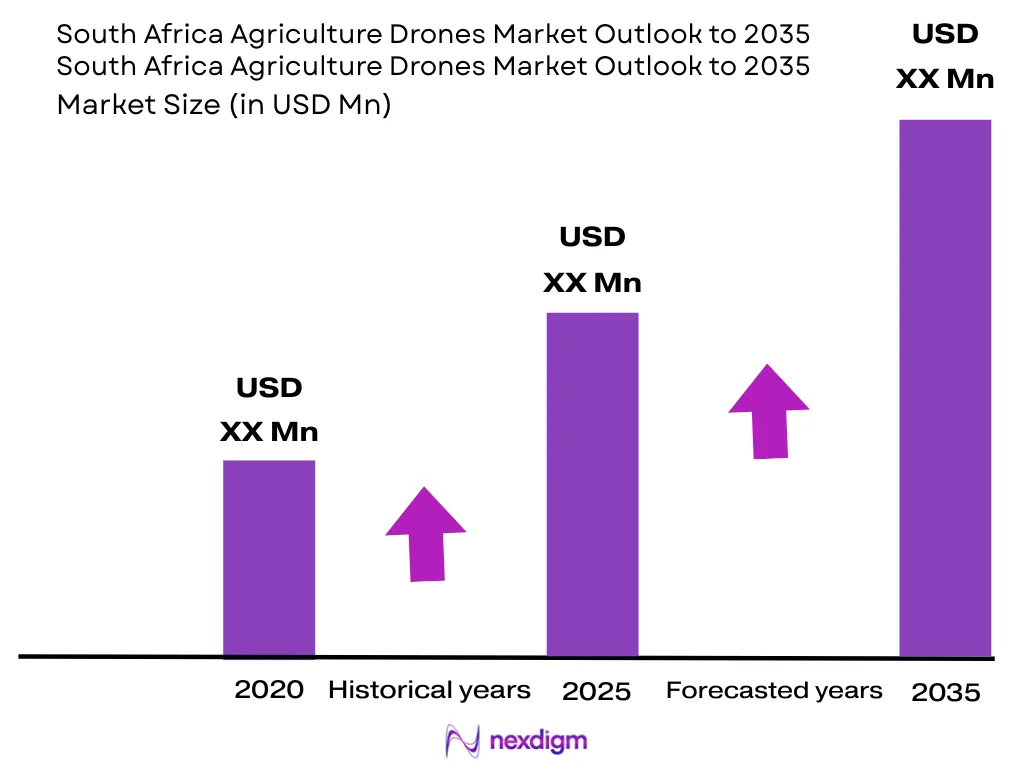
The South Africa Agricultural Drones Market was valued at approximately USD ~ million in 2024 and expanded from USD ~ million in 2023, supported by increasing adoption of precision agriculture technologies across commercial farming operations. The market is driven by rising demand for crop monitoring, precision spraying, field mapping, and resource optimization solutions. South Africa recorded agricultural exports worth USD 13.7 billion in 2024 compared to USD 13.2 billion in 2023, reflecting the growing importance of productivity enhancement technologies in agriculture. The expansion of high-value crops, including citrus, grapes, and deciduous fruits, has accelerated the deployment of agricultural drones for efficient farm management and yield improvement.
Market Segmentation
By Drone Type
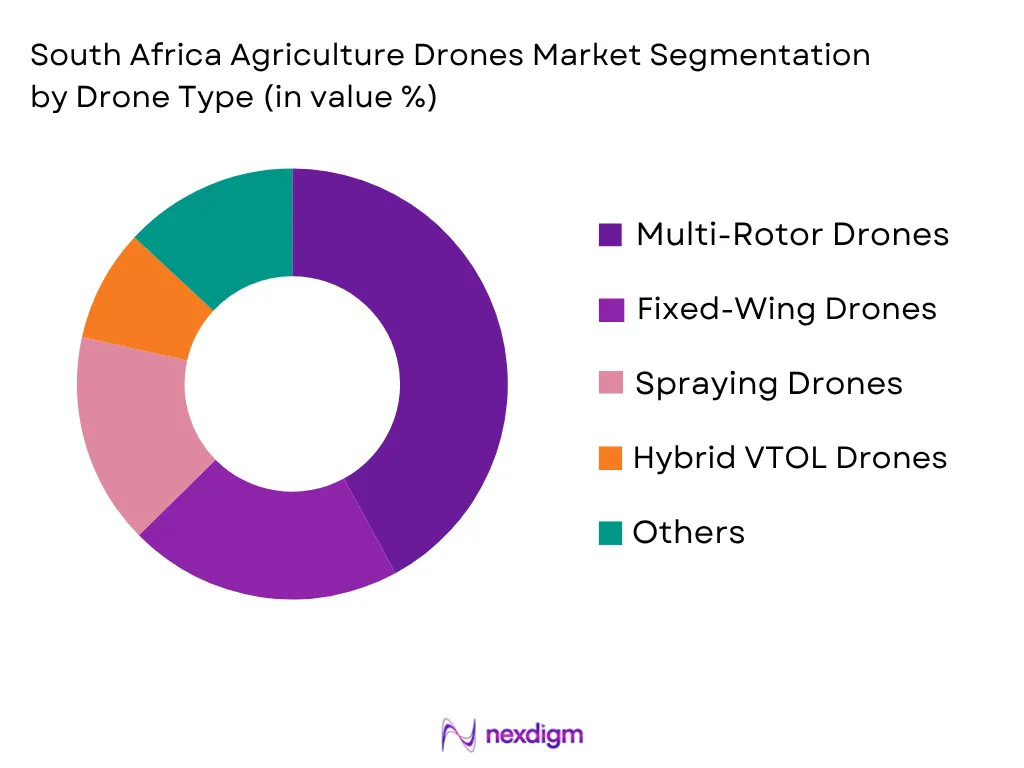
South Africa Agricultural Drones Market is segmented by drone type into multi-rotor drones, fixed-wing drones, hybrid VTOL drones, spraying drones, and mapping & surveillance drones. Recently, multi-rotor drones have a dominant market share under the drone type segmentation due to their operational flexibility, ease of deployment, precision spraying capabilities, and suitability for South Africa’s diverse crop landscape. These drones are extensively used across vineyards, citrus plantations, sugarcane fields, and grain farms for monitoring crop health, identifying pest infestations, and conducting precision spraying activities. Their ability to operate within smaller fields and deliver accurate low-altitude imaging makes them highly preferred among commercial farmers. Furthermore, the increasing availability of advanced payload systems, multispectral sensors, automated flight planning software, and real-time analytics platforms has strengthened the adoption of multi-rotor drones. Their lower operational complexity compared to fixed-wing platforms also contributes to wider acceptance among farmers seeking practical precision agriculture solutions.
By Application
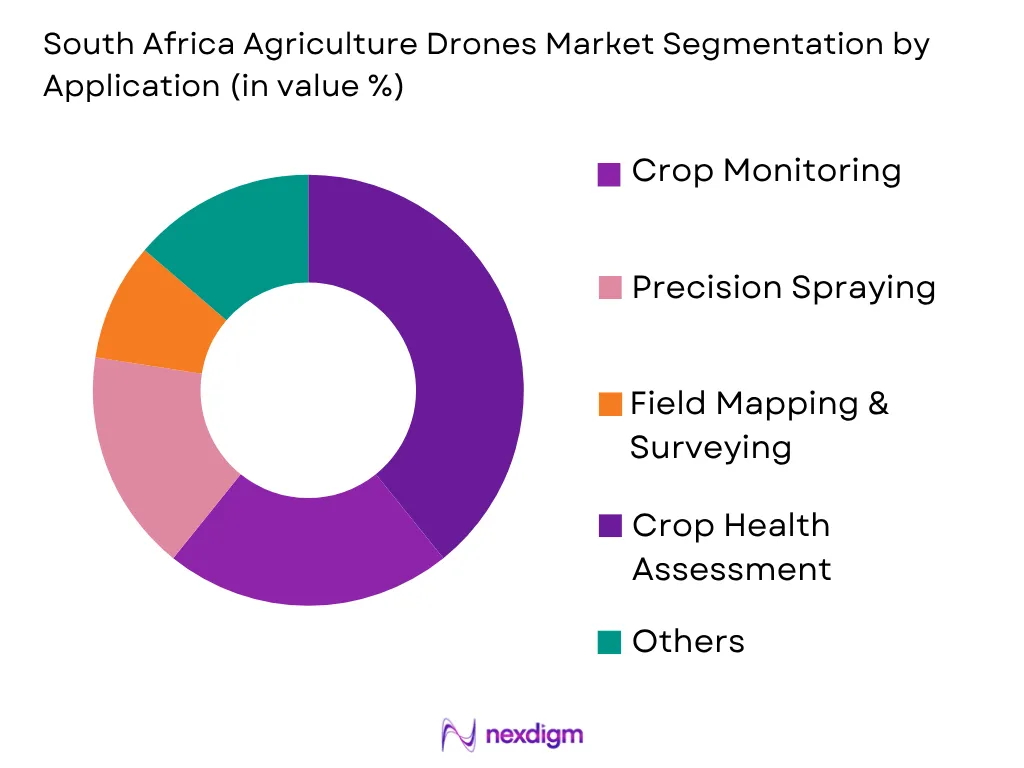
South Africa Agricultural Drones Market is segmented by application into crop monitoring, precision spraying, field mapping & surveying, crop health assessment, irrigation management, planting & seeding, and livestock monitoring. Recently, crop monitoring has a dominant market share under the application segmentation owing to the growing need for real-time field intelligence and data-driven farming decisions. Farmers increasingly utilize drone-based aerial imaging, multispectral analysis, and vegetation index mapping to evaluate crop performance, identify disease outbreaks, monitor nutrient deficiencies, and optimize farm operations. South Africa’s large commercial farms require efficient monitoring solutions across extensive cultivation areas, making crop monitoring the most frequently adopted drone application. The segment’s leadership is also supported by rising awareness regarding precision agriculture and increasing investments in digital farming technologies. By enabling timely interventions and reducing manual scouting requirements, crop monitoring applications help farmers improve productivity, conserve resources, and enhance overall farm management efficiency, thereby maintaining their leading position within the agricultural drone ecosystem.
Competitive Landscape
The South Africa Agricultural Drones Market is characterized by the presence of global drone manufacturers, precision agriculture technology providers, and specialized drone service companies. The competitive environment is increasingly driven by technological innovation, payload capacity enhancement, software integration capabilities, and precision agriculture solutions. Global players such as DJI Agriculture, XAG, and AgEagle Aerial Systems maintain strong market positions through advanced drone platforms, while regional service providers strengthen adoption through localized support, training, and drone-as-a-service offerings. The market continues to witness strategic collaborations aimed at expanding precision farming capabilities and improving operational efficiency across South Africa’s commercial agricultural sector.
| Company | Establishment Year | Headquarters | Agriculture Drone Portfolio | Max Payload Capacity | Precision Spraying Capability | AI Analytics Integration | South Africa Distribution Network | Precision Agriculture Solutions |
| DJI Agriculture | 2006 | ~ | ~ | ~ | ~ | ~ | ~ | ~ |
| XAG | 2007 | ~ | ~ | ~ | ~ | ~ | ~ | ~ |
| AgEagle Aerial Systems | 2010 | ~ | ~ | ~ | ~ | ~ | ~ | ~ |
| Aerobotics | 2014 | ~ | ~ | ~ | ~ | ~ | ~ | ~ |
| PrecisionHawk | 2010 | ~ | ~ | ~ | ~ | ~ | ~ | ~ |
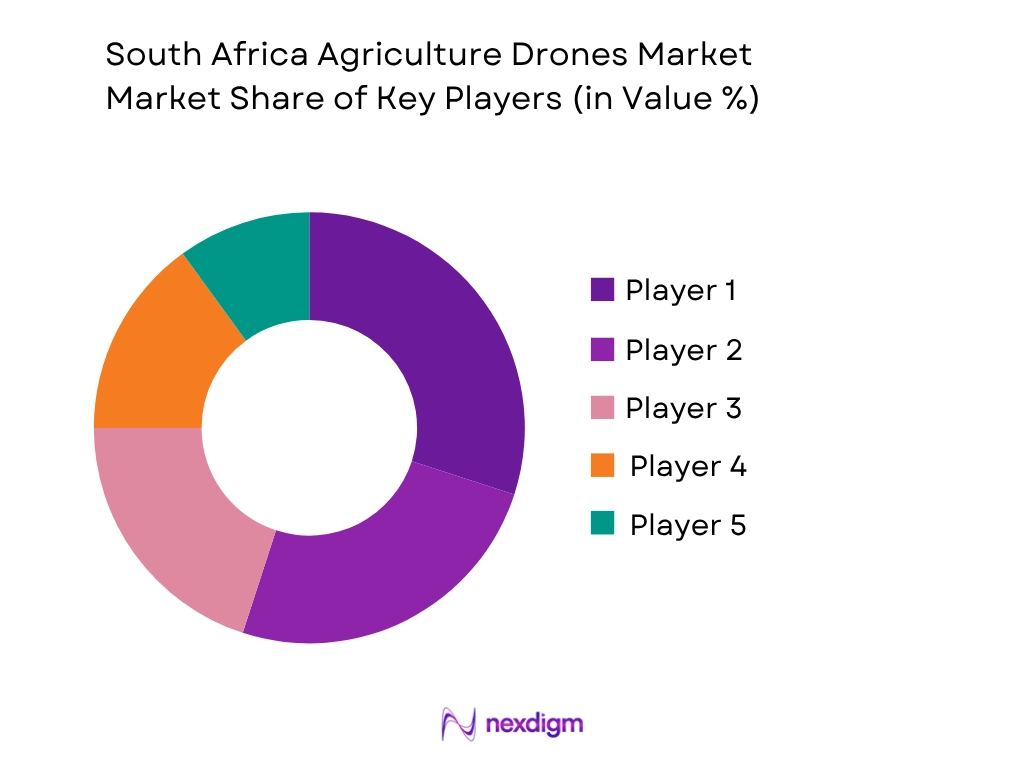
South Africa Agriculture Drones Market Analysis
Growth Drivers
Expansion of Commercial Agriculture and Precision Farming Adoption
South Africa’s agricultural sector continues to create strong demand for agricultural drones through the expansion of commercial farming and increasing adoption of precision agriculture technologies. According to Statistics South Africa, agriculture contributed approximately ZAR 156 billion to GDP during 2024, while total agricultural exports exceeded USD 13.7 billion. The country maintains more than 80 million hectares of agricultural land, including approximately 12 million hectares of arable land, creating significant requirements for efficient crop monitoring and resource management technologies. Major agricultural regions such as Western Cape, Free State, Mpumalanga, and KwaZulu-Natal cultivate extensive areas of maize, wheat, citrus, grapes, sugarcane, and deciduous fruits that increasingly require high-frequency aerial surveillance. South Africa produced more than 15 million tonnes of maize and over 2 million tonnes of wheat during recent production cycles, increasing the need for drone-based field intelligence and precision application systems. The World Bank estimates South Africa’s population exceeded 63 million in 2024, while urban population surpassed 43 million, creating sustained food demand and productivity pressures. Agricultural drones enable farmers to monitor large cultivation areas, optimize fertilizer application, identify disease outbreaks earlier, and improve yield management. These factors collectively strengthen demand for drone technologies throughout commercial agricultural operations.
Rising Labor Constraints and Agricultural Technology Modernization
Agricultural labor shortages and increasing operational efficiency requirements are accelerating drone adoption across South Africa’s farming sector. Statistics South Africa reported total employment in agriculture, forestry, and fisheries exceeding 900,000 workers during 2024; however, producers continue to face seasonal labor availability challenges and rising productivity requirements. South Africa’s economy exceeded USD 400 billion according to IMF estimates, while agricultural producers increasingly invest in technologies capable of reducing operational inefficiencies and enhancing farm management. Large commercial farms covering thousands of hectares require continuous crop surveillance, pest detection, irrigation assessment, and spraying operations that are difficult to perform manually. Drone technology provides rapid field coverage while generating real-time imagery and geospatial insights. The Department of Agriculture, Land Reform and Rural Development continues to encourage modernization initiatives across the agricultural value chain, supporting technology-driven productivity improvements. South Africa also remains a leading exporter of citrus fruits, grapes, wine products, and deciduous fruits, industries where crop quality management is critical. Drone-enabled monitoring systems allow growers to identify stress conditions, optimize input usage, and improve harvest planning. Growing investments in precision agriculture software, multispectral imaging technologies, and autonomous flight systems are further strengthening agricultural drone deployment across the country.
Market Challenges
High Capital Requirements and Limited Adoption Among Smallholder Farmers
Despite increasing technological awareness, the adoption of agricultural drones remains constrained by capital intensity and affordability barriers, particularly among smallholder farmers. South Africa has approximately 2 million smallholder farming households according to government agricultural estimates, many of which operate under limited financial resources. Although agriculture contributes substantially to employment and food security, farm profitability varies significantly across regions and crop categories. The South African Reserve Bank reported elevated financing costs across several sectors during 2024, making investment decisions more challenging for smaller agricultural enterprises. Agricultural drones often require complementary investments in software platforms, sensors, data analytics tools, operator training, and maintenance infrastructure. Commercial producers can justify such investments through economies of scale, whereas smaller farms frequently struggle to achieve similar returns. South Africa’s agricultural landscape is highly diverse, ranging from large export-oriented commercial operations to resource-constrained subsistence farms. This disparity creates uneven technology penetration across the market. Furthermore, limited access to agricultural financing and technology-specific lending programs restricts adoption among emerging farmers. Consequently, high acquisition and implementation requirements continue to represent a major challenge for broader agricultural drone utilization throughout South Africa’s farming ecosystem.
Regulatory Complexity and Shortage of Skilled Drone Operators
The agricultural drone industry in South Africa operates within a regulated aviation environment overseen by the South African Civil Aviation Authority. Drone operators involved in commercial agricultural activities must comply with licensing, certification, operational safety, and airspace management requirements. While these regulations support safe drone operations, compliance processes can increase operational complexity for agricultural users. South Africa’s agricultural production areas often extend across remote regions where access to certified drone operators and technical specialists remains limited. The country’s unemployment challenges coexist with shortages of highly specialized technical skills required for drone operation, maintenance, data analytics, and precision agriculture integration. The successful deployment of agricultural drones increasingly depends on expertise in GIS mapping, multispectral imaging, software interpretation, autonomous flight planning, and agronomic analytics. Many agricultural enterprises continue to face difficulties recruiting personnel with these capabilities. In addition, varying levels of digital infrastructure across rural areas can impact data transmission and cloud-based analytics applications. Large-scale commercial farms may possess the resources necessary to develop in-house expertise, while smaller operators often rely on third-party service providers. These workforce and regulatory constraints continue to moderate the pace of agricultural drone adoption across the South African market.
Market Opportunities
Expansion of Drone-as-a-Service Models Across Commercial Farming Operations
Drone-as-a-Service (DaaS) represents a significant opportunity for expanding agricultural drone utilization across South Africa. The country’s agricultural sector encompasses a wide range of farm sizes, creating demand for flexible technology deployment models. South Africa’s agricultural exports exceeded USD 13.7 billion in 2024, while commercial farming operations continue to prioritize productivity enhancement and resource optimization. Many producers require access to aerial imaging, precision spraying, crop health assessments, and field mapping capabilities without committing to substantial capital investments. DaaS providers address this requirement by offering specialized services on a subscription or project basis. The model enables farmers to access advanced drone technologies, data analytics platforms, and trained operators while minimizing ownership burdens. South Africa’s extensive cultivation of maize, citrus, grapes, sugarcane, and horticultural crops provides numerous use cases for service-based drone operations. As awareness of precision agriculture increases, DaaS platforms can improve accessibility for medium-sized and emerging farmers who may otherwise face financial barriers. The combination of increasing technology acceptance and growing demand for operational efficiency creates a strong foundation for service-oriented agricultural drone business models throughout South Africa.
Increasing Demand for AI-Driven Precision Agriculture and Sustainable Farming
The growing emphasis on sustainable agriculture and data-driven farm management creates substantial opportunities for advanced agricultural drone solutions. South Africa’s water resources remain under pressure, with agriculture accounting for a significant share of national water consumption. Precision agriculture technologies help farmers optimize irrigation, fertilizer application, and crop protection activities through improved decision-making. The country’s commercial farming sector manages millions of hectares of cultivated land, generating substantial demand for actionable agronomic intelligence. Drone systems integrated with artificial intelligence, machine learning, multispectral imaging, and predictive analytics can provide detailed insights regarding crop stress, nutrient deficiencies, pest infestations, and irrigation performance. South Africa’s strong export orientation in high-value agricultural products further reinforces the need for quality assurance and yield optimization technologies. The continued digital transformation of agriculture, combined with increasing investments in smart farming infrastructure, supports broader adoption of advanced drone platforms. As producers seek to improve productivity while reducing resource consumption, agricultural drones equipped with AI-enabled analytics are positioned to become increasingly important tools for sustainable and precision-oriented farming operations across South Africa.
Future Outlook
The South Africa Agricultural Drones Market is expected to witness substantial growth over the forecast period, supported by increasing adoption of precision agriculture practices, rising labor shortages in farming operations, and growing emphasis on sustainable resource utilization. The integration of artificial intelligence, machine learning, multispectral imaging, and cloud-based analytics platforms is expected to enhance the capabilities of agricultural drones. Furthermore, increasing awareness regarding data-driven farming, expansion of drone-as-a-service business models, and supportive advancements in agricultural technology infrastructure are anticipated to strengthen market penetration across both commercial and emerging farming sectors. The market is also expected to benefit from growing demand for crop monitoring, precision spraying, irrigation optimization, and yield enhancement solutions.
Major Players
- DJI Agriculture
- XAG
- AgEagle Aerial Systems
- PrecisionHawk
- senseFly
- Parrot Drones
- Quantum Systems
- Delair
- Yamaha Motor Unmanned Systems
- AeroVironment
- Hylio
- Aerobotics
- DroneX South Africa
- UAS Africa
- Falcon Agricultural Solutions
Key Target Audience
- Commercial Farming Enterprises
- Agricultural Cooperatives
- Agribusiness Companies
- Drone-as-a-Service Providers
- Precision Agriculture Technology Providers
- Investments and Venture Capitalist Firms
- Government and Regulatory Bodies (South African Civil Aviation Authority, Department of Agriculture, Land Reform and Rural Development)
- Agricultural Input Manufacturers and Distributors
Research Methodology
Step 1: Identification of Key Variables
The initial phase involves constructing an ecosystem map encompassing all major stakeholders within the South Africa Agricultural Drones Market. This step is supported by extensive desk research utilizing industry publications, government databases, trade associations, regulatory documents, and company disclosures. The objective is to identify key variables influencing market performance, including drone adoption rates, crop-specific demand patterns, technology penetration, and precision agriculture investments.
Step 2: Market Analysis and Construction
In this phase, historical market data is compiled and analyzed to establish market size, deployment trends, and technology adoption patterns. The study evaluates drone utilization across different farm sizes, crop categories, and agricultural applications. Demand-side and supply-side assessments are conducted to estimate revenue generation, product penetration, and service adoption across the agricultural ecosystem.
Step 3: Hypothesis Validation and Expert Consultation
Market hypotheses are developed and validated through structured discussions with industry participants, including drone manufacturers, agricultural technology providers, farm operators, distributors, and precision agriculture specialists. These consultations provide operational insights, technology trends, adoption challenges, and commercial perspectives that assist in refining market assumptions and validating analytical findings.
Step 4: Research Synthesis and Final Output
The final stage involves triangulation of information collected from secondary research, primary interviews, and internal analytical frameworks. Detailed assessments of market segments, competitive positioning, technology developments, and future growth opportunities are consolidated into a comprehensive report. This process ensures the accuracy, reliability, and consistency of all market estimates and strategic conclusions.

- Executive Summary
- Research Methodology (Market Definitions and Assumptions, Abbreviations, Market Sizing Approach, Consolidated Research Approach, Top-Down Analysis, Bottom-Up Analysis, Demand-Side Assessment, Supply-Side Assessment, Primary Industry Interviews, Data Triangulation, Forecasting Framework, Limitations and Future Conclusions)

- Definition and Scope
- Market Evolution and Industry Genesis
- Timeline of Major Industry Developments
- Agricultural Drone Ecosystem Overview
- Agricultural Value Chain Analysis

- Growth Drivers (Expansion of Precision Agriculture, Rising Farm Mechanization, Increasing Labor Shortages, Growing Demand for Input Optimization, Expansion of High-Value Crop Farming)
- Market Challenges (High Initial Investment Requirements, Regulatory Compliance Complexity, Limited Skilled Drone Operators, Connectivity Constraints in Rural Areas, Weather Dependency)
- Market Opportunities (Drone-as-a-Service Expansion, AI-Powered Farm Analytics, Smart Irrigation Applications, Sustainable Agriculture Initiatives, Precision Viticulture Applications)
- Market Trends (Autonomous Flight Systems, RTK Precision Navigation, Multispectral Imaging Adoption, Cloud-Based Farm Analytics, Swarm Drone Operations)
- Government Regulations (SACAA RPAS Regulations, Drone Pilot Licensing Requirements, Agricultural Chemical Application Compliance, Airspace Usage Regulations, Data Protection Requirements)
- SWOT Analysis
- Porter’s Five Forces Analysis
- PESTLE Analysis
- Competition Ecosystem

- By Market Value (2020-2025)
- By Volume (2020-2025)
- By Average Selling Price (2020-2025)

- By Drone Type (In Value %)
Multi-Rotor Drones
Fixed-Wing Drones
Hybrid VTOL Drones
Single-Rotor Drones
Mapping & Surveillance Drones - By Application (In Value %)
Crop Monitoring
Precision Spraying
Field Mapping & Surveying
Crop Health Assessment
Irrigation Management
Planting & Seeding
Livestock Monitoring - By Crop Type (In Value %)
Maize
Wheat
Sugarcane
Citrus Fruits
Grapes & Vineyards
Oilseeds & Pulses
Deciduous Fruits - By Region (In Value %)
Western Cape
Gauteng
KwaZulu-Natal
Free State
Mpumalanga
Limpopo
Eastern Cape
Northern Cape - By End User (In Value %)
Commercial Farms
Agricultural Cooperatives
Agribusiness Companies
Drone-as-a-Service Providers
Government & Research Institutions

- Market Share of Major Players (By Value, Volume, Drone Type, Application)
- Cross Comparison Parameters (Payload Capacity, Flight Endurance, Spraying Efficiency, Multispectral Imaging Capability, Precision Navigation Technology, Software & Analytics Integration, Distribution & Service Network Reach, Product Portfolio Breadth)
- SWOT Analysis of Major Players
- Pricing Analysis by Drone Category and Payload Capacity
- Detailed Profiles of Major Companies
DJI Agriculture
XAG
AgEagle Aerial Systems
PrecisionHawk
senseFly
Parrot Drones
Quantum Systems
Delair
Yamaha Motor
Unmanned Systems
AeroVironment
Hylio Aerobotics
DroneX South Africa
UAS Africa
Falcon Agricultural Solutions

- Drone Adoption and Utilization Assessment
- Farm Digitalization Analysis
- Purchasing Power and Budget Allocation
- Precision Agriculture Adoption Trends
- Pain Point Assessment
- Technology Preference Analysis
- ROI and Productivity Assessment
- Purchase Decision-Making Process

- By Market Value (2026-2035)
- By Volume (2026-2035)
- By Average Selling Price (2026-2035)


 Request a Sample
 Ask for Customization
 Get a Quote
 Enquire Now