

 Download PDF
Market Overview
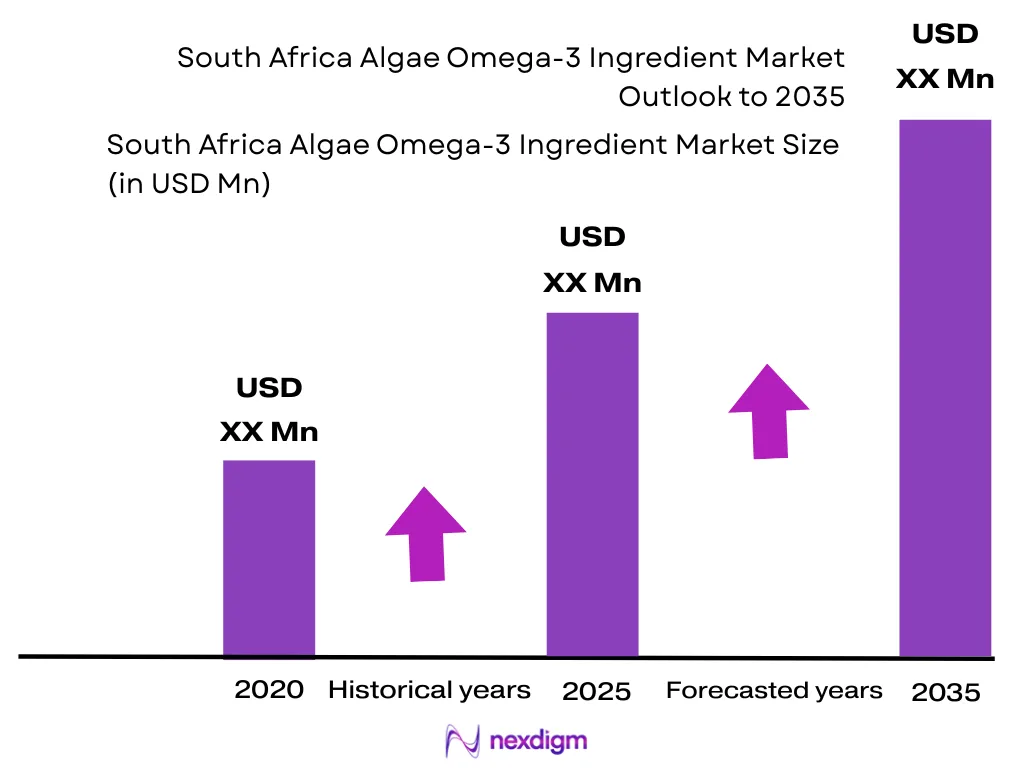
The South Africa Algae Omega-3 Ingredient Market is valued at USD ~ million, derived from South Africa’s omega-3 market revenue of USD ~ million and disclosed country CAGR of 7.3% for the closest available omega-3 benchmark. The market is forecast to grow at 7.0% CAGR for 2026-2035, aligned with the disclosed South Africa omega-3 fatty acids forecast. Demand is driven by DHA-led supplements, infant nutrition, vegan omega-3, functional foods, and aquafeed reformulation. Gauteng, Western Cape, KwaZulu-Natal, and Eastern Cape dominate the South Africa Algae Omega-3 Ingredient Market because they concentrate pharmacies, supplement brands, import logistics, wellness retail, food manufacturing, and aquaculture demand. Gauteng leads commercial consumption through Johannesburg and Pretoria, Western Cape supports premium nutrition and marine biotechnology, KwaZulu-Natal benefits from Durban port logistics, and Eastern Cape has aquaculture relevance. South Africa’s GDP reached USD 401.14 billion, GDP per capita reached USD 6,267.2, and GDP growth was 0.5%.
Market Segmentation
By Ingredient Type
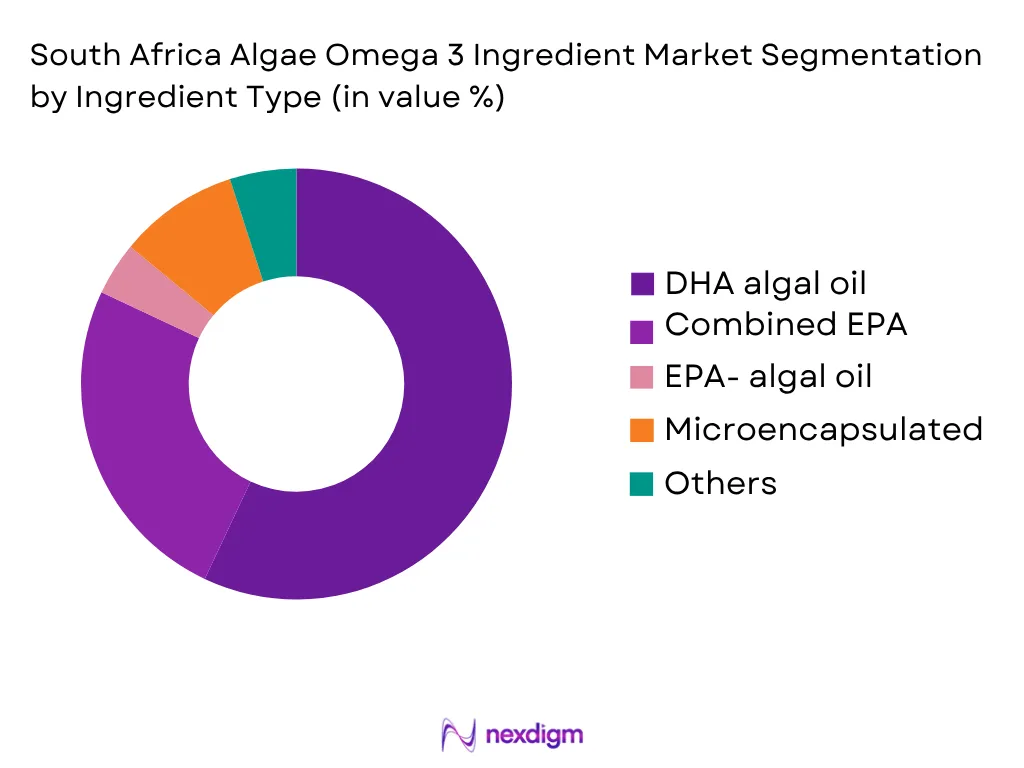
South Africa Algae Omega-3 Ingredient Market is segmented by ingredient type into DHA-dominant algal oil, combined EPA+DHA algal oil, microencapsulated algal omega-3 powder, EPA-dominant algal oil, and algal biomass and meal. DHA-dominant algal oil holds the dominant market share because DHA has stronger commercial application across pregnancy supplements, children’s DHA products, infant nutrition, eye-health capsules, and cognition-positioned supplements. South Africa’s dietary supplement market is supported by pharmacy-led distribution, and adults remain the largest end-use group in the supplement category. DHA-rich algal oil is also easier to position than EPA-rich algae inputs because it has clearer consumer association with child development and brain health. Suppliers with DHA specification sheets, oxidation data, allergen statements, vegan claims, and SAHPRA-ready documentation are better positioned for local brands.
By Application
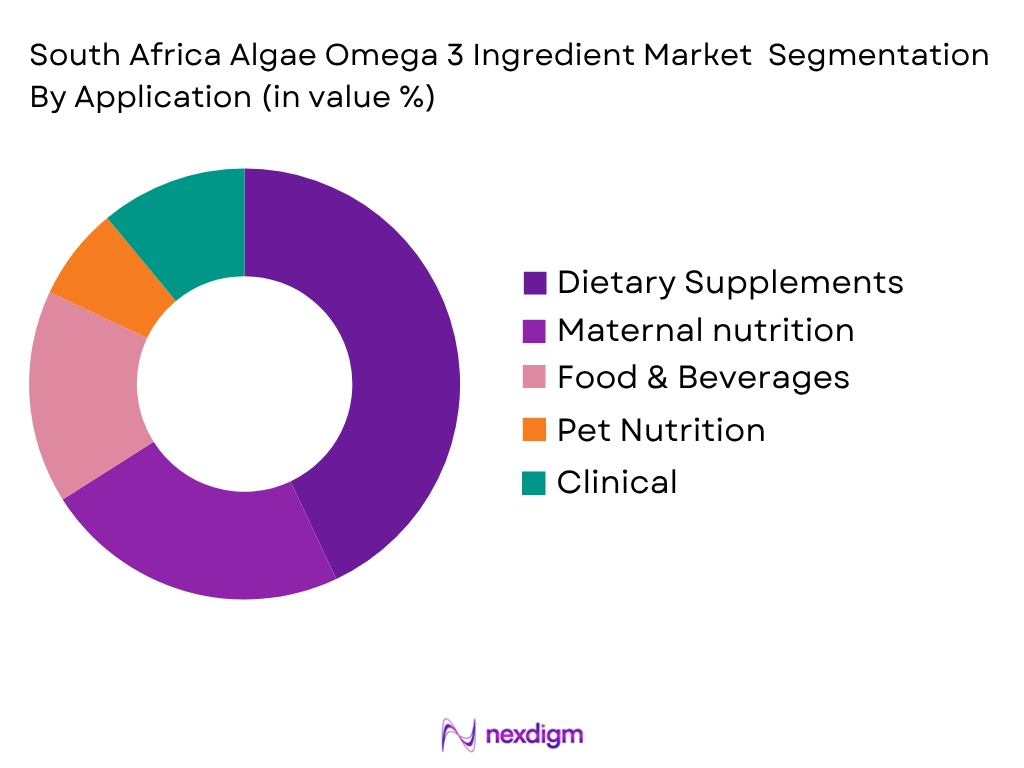
South Africa Algae Omega-3 Ingredient Market is segmented by application into dietary supplements, infant and maternal nutrition, functional food and beverages, pet nutrition, aquafeed, and clinical and medical nutrition. Dietary supplements hold the dominant market share because capsules, softgels, gummies, drops, and powder blends allow algae-derived DHA/EPA to be commercialised faster than fortified food or feed applications. South Africa’s dietary supplements market was estimated at USD 1.06 billion, and offline channels such as pharmacies dominate distribution, giving omega-3 ingredient suppliers access to established retail routes. Algal omega-3 benefits from fish-free, vegan, contaminant-controlled, and clean-label claims, which are useful in premium supplement positioning. Infant and maternal nutrition follows because DHA is strongly linked with early-life nutrition and paediatric wellness.
Competitive Landscape
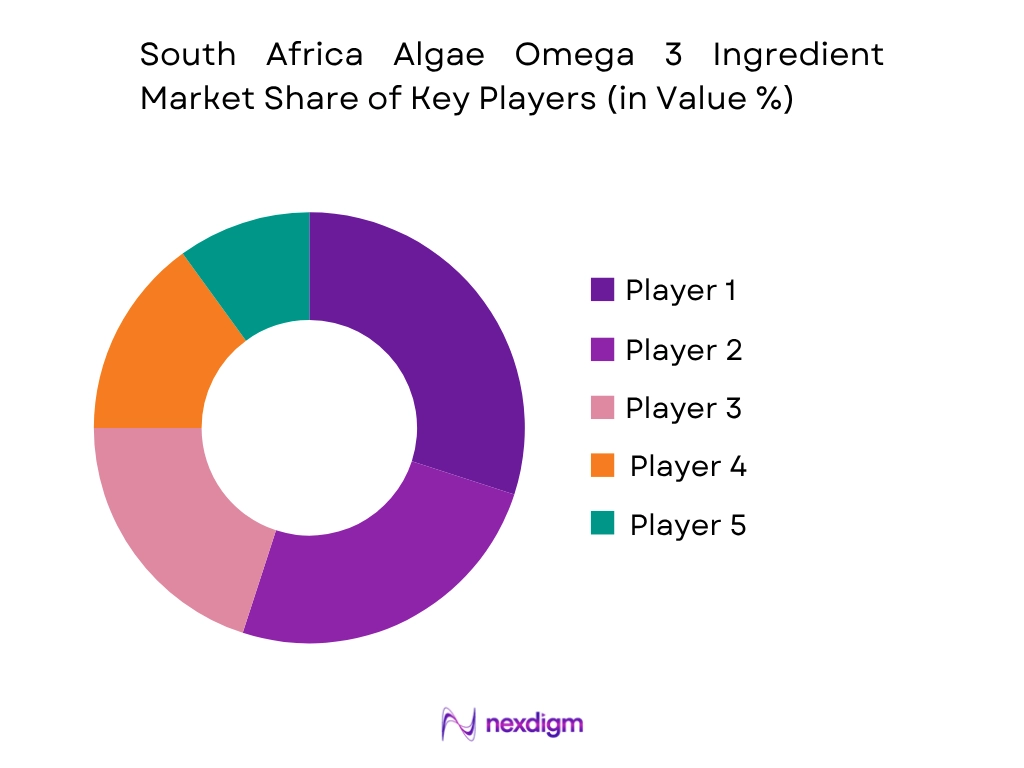
The South Africa Algae Omega-3 Ingredient Market is import-led and controlled by global upstream ingredient companies, while local competition is concentrated among distributors, private-label supplement manufacturers, and formulation partners. dsm-firmenich, Corbion, BASF, Veramaris, and Mara Renewables are important because they provide algal DHA/EPA oils, omega-3 nutrition lipid systems, feed-grade algae oils, technical dossiers, and branded ingredient support. South African buyers compete on regulatory readiness, pharmacy-channel access, vegan positioning, cold-chain handling, and ability to reformulate fish-oil products into algae-based alternatives.
| Company | Establishment Year | Headquarters | South Africa-Relevant Ingredient | Technology Base | Core Application | DHA/EPA Capability | Certification / Quality Position | Market Relevance |
| dsm-firmenich | 2023 | Kaiseraugst, Switzerland / Maastricht, Netherlands | ~ | ~ | ~ | ~ | ~ | ~ |
| Corbion | 1919 | Amsterdam, Netherlands | ~ | ~ | ~ | ~ | ~ | ~ |
| BASF | 1865 | Ludwigshafen, Germany | ~ | ~ | ~ | ~ | ~ | ~ |
| Veramaris | 2018 | Delft, Netherlands | ~ | ~ | ~ | ~ | ~ | ~ |
| Mara Renewables | 2012 | Halifax, Canada | ~ | ~ | ~ | ~ | ~ | ~ |
South Africa Algae Omega-3 Ingredient Market Analysis
Growth Drivers
Preventive Nutrition Demand Supports Algal DHA/EPA Supplement Adoption
South Africa Algae Omega-3 Ingredient Market is supported by a large consumer base for preventive nutrition, pregnancy DHA, children’s DHA, eye-health products and cardiovascular supplements. World Bank data shows South Africa had 64,007,187 people, GDP of USD 401.14 billion, GDP per capita of USD 6,267.2, and internet usage of 78 people per 100 population in 2024, supporting pharmacy and e-commerce supplement access. Algal DHA/EPA is market-specific because it gives brands fish-free, vegan, contaminant-controlled and no-fishy-aftertaste positioning for capsules, softgels, drops and gummies aimed at urban wellness buyers.
Aquaculture and Marine Nutrition Create Feed-Grade Algal Omega-3 Demand
South Africa Algae Omega-3 Ingredient Market is supported by aquaculture and marine nutrition applications, especially for trout, abalone, marine fish, hatchery feed and broodstock nutrition. FAO identifies South Africa’s aquaculture activity across species such as abalone, trout, oysters, mussels and tilapia, while the Department of Forestry, Fisheries and the Environment manages marine and coastal resources for sustainable use. The World Bank reports GDP of USD 401.14 billion and population of 64,007,187 in 2024, supporting food and feed ingredient demand. Algal DHA/EPA helps feed formulators reduce dependence on fish-oil inputs while maintaining marine lipid nutrition.
Market Challenges
SAHPRA Compliance Raises Documentation and Launch Barriers
South Africa Algae Omega-3 Ingredient Market faces regulatory complexity because supplement-grade DHA/EPA ingredients must fit South Africa’s health supplement and complementary medicine framework. SAHPRA states that health supplements allow only low-risk indications and substances within stipulated dosage ranges and indications, while its 2026 guidance addresses applications for registration of health supplements. This directly affects algal omega-3 brands requiring certificates of analysis, stability data, DHA/EPA specifications, label controls and safety files. The barrier is material because products serve 64,007,187 people in a USD 401.14 billion economy, requiring compliant national distribution rather than informal small-batch sales.
Import Reliance and Fish-Oil Competition Pressure Algal DHA/EPA Uptake
South Africa Algae Omega-3 Ingredient Market faces import and substitution pressure because conventional marine lipid supply remains present in the country. World Bank WITS reports South Africa imported 378,833 kg of fish fats and oils under HS 150420 in 2024, including 125,424 kg from France, 59,516 kg from China, 90,620 kg from Norway and 94,003 kg from Namibia. This creates an established fish-oil reference point for supplement and feed buyers. Algal omega-3 suppliers must therefore justify vegan sourcing, cleaner sensory profile, traceability and contaminant-control advantages in a market with 64,007,187 consumers and price-sensitive mass retail channels.
Market Opportunities
Vegan and Fish-Free DHA/EPA Supplements Can Scale Through Urban Retail
South Africa Algae Omega-3 Ingredient Market has an opportunity in vegan and fish-free DHA/EPA supplements because consumers can access wellness products through pharmacies, online channels and urban retail. World Bank data reports 78 internet users per 100 people in 2024 and a population of 64,007,187, supporting digital discovery for premium capsules, gummies, children’s DHA drops and prenatal products. GDP per capita of USD 6,267.2 also supports an addressable premium-health segment. Algal omega-3 is market-specific because it avoids fish origin, supports vegan claims, reduces fishy odour concerns and provides DHA/EPA labelling clarity for pharmacy-led supplement brands.
Microencapsulated Algal Omega-3 Can Expand into Functional Foods and Infant Nutrition
South Africa Algae Omega-3 Ingredient Market has an opportunity in microencapsulated DHA/EPA powders for fortified dairy, paediatric nutrition, meal replacements, protein powders and functional beverages. The format is relevant because powders improve taste masking, blending, shelf-life and oxidation control compared with direct oil addition. World Bank data shows South Africa’s GDP at USD 401.14 billion, GDP per capita at USD 6,267.2, and population at 64,007,187 in 2024, supporting a sizeable food and nutrition base. SAHPRA’s health supplement framework reinforces the need for documented ingredient specifications, which favours suppliers offering stable powder formats with certificates and dosage clarity.
Future Outlook
The South Africa Algae Omega-3 Ingredient Market is expected to expand as supplement brands, infant nutrition companies, pet nutrition manufacturers, and aquafeed formulators move from conventional fish oil toward algae-derived DHA/EPA. Growth will be supported by preventive wellness demand, vegan supplement launches, clean-label positioning, and stronger technical availability of algal oil concentrates and microencapsulated powders.
The strongest future demand is expected in dietary supplements because South Africa has an established pharmacy retail base, OTC supplement distribution, and demand for condition-specific nutrition. Infant and maternal nutrition will remain important due to DHA’s association with early-life development. Aquafeed and pet nutrition will remain smaller but strategic because algal omega-3 can reduce fish-oil dependence and support sustainability-oriented product claims.
Major Players
- dsm-firmenich
- Corbion
- BASF
- Archer Daniels Midland
- Cargill
- Veramaris
- Mara Renewables
- Fermentalg
- Polaris Nutritional Lipids
- AlgiSys BioSciences
- Cellana
- Cyanotech Corporation
- Algarithm Ingredients
- IMCD South Africa
- Brenntag South Africa
Key Target Audience
- Nutraceutical and dietary supplement manufacturers
- Infant formula and maternal nutrition companies
- Functional food and beverage manufacturers
- Aquafeed and aquaculture nutrition companies
- Pet nutrition and veterinary supplement companies
- Specialty ingredient importers and distributors
- Investments and venture capitalist firms
- Government and regulatory bodies: South African Health Products Regulatory Authority, Department of Health, Department of Forestry, Fisheries and the Environment, Department of Agriculture, South African Revenue Service Customs
Research Methodology
Step 1: Identification of Key Variables
The initial phase involves constructing an ecosystem map for the South Africa Algae Omega-3 Ingredient Market. This includes global algal oil manufacturers, local importers, supplement brands, pharmacy chains, infant nutrition players, aquafeed companies, pet nutrition brands, laboratories, and regulators. Key variables include DHA/EPA type, ingredient form, certification, application, regulatory pathway, and distribution channel.
Step 2: Market Analysis and Construction
In this phase, current and historical data is compiled from omega-3 market disclosures, dietary supplement benchmarks, macroeconomic indicators, aquaculture references, supplier product portfolios, and regulatory guidance. Demand is assessed across supplements, infant nutrition, functional foods, pet nutrition, aquafeed, and clinical nutrition to develop a bottom-up market structure.
Step 3: Hypothesis Validation and Expert Consultation
Market hypotheses are validated through discussions with ingredient distributors, supplement manufacturers, pharmacy-channel participants, food formulators, regulatory specialists, and aquafeed buyers. These consultations help verify import dependence, DHA/EPA preference, oxidation challenges, SAHPRA documentation requirements, formulation barriers, and application-level adoption.
Step 4: Research Synthesis and Final Output
The final phase integrates desk research, company benchmarking, application mapping, regulatory review, and expert validation. Outputs are triangulated through top-down and bottom-up checks so that market size, segmentation, competitor positioning, and future outlook reflect South Africa-specific market realities rather than generic omega-3 trends.

- Executive Summary
- Research Methodology (market definitions and assumptions, abbreviations, ingredient inclusion and exclusion criteria, algal oil equivalent conversion, active DHA/EPA normalisation, supplement-grade and feed-grade differentiation, top-down sizing approach, bottom-up supplier triangulation, importer interviews, nutraceutical manufacturer interviews, pharmacy-channel validation, aquafeed buyer interviews, infant nutrition formulation validation, SAHPRA regulatory mapping, food labelling review, import documentation assessment, forecast sensitivity framework)

- Definition and Scope
- Overview Genesis
- Evolution of Algae-Based DHA/EPA Ingredients
- Business Cycle
- Supply Chain and Value Chain Analysis

- Growth Drivers (preventive nutrition demand, pharmacy supplement penetration, infant DHA awareness, fish-oil substitution, vegan supplement adoption, food fortification, aquaculture feed innovation, pet humanisation)
- Market Challenges (import dependency, rand volatility, regulatory registration burden, oxidation sensitivity, price premium versus fish oil, limited local algae oil production, fragmented supplement quality)
- Opportunities (vegan DHA/EPA supplements, paediatric DHA, fortified foods, aquafeed innovation, pet supplements, local blending, Southern Africa distribution, marine biotech collaboration)
- Market Trends (plant-based omega-3 transition, DHA/EPA ratio differentiation, clean-label softgels, powder formats, pharmacy premiumisation, sustainability communication, local marine biotechnology)
- SWOT Analysis
- Porter’s Five Forces

- By Value (2020-2025)
- By Volume (2020-2025)
- By Average Ingredient Realisation (2020-2025)

- By Omega-3 Type (In Value %)
DHA-Dominant Algal Oil
EPA-Dominant Algal Oil
Combined EPA+DHA Algal Oil
High-Potency Algal Omega-3 Concentrates - By Application (In Value %)
Dietary Supplements
Infant and Maternal Nutrition
Functional Food and Beverages
Aquafeed
Pet Nutrition - By Distribution Channel (In Value %)
Direct Sales from Global Ingredient Manufacturers
South Africa Specialty Ingredient Distributors
Supplement Contract Manufacturers and Private-Label Producers
B2B Importers and Nutritional Lipid Traders - By Province (In Value %)
Gauteng
Western Cape
KwaZulu-Natal
Eastern Cape

- Market Share of Major Players by Value and Volume (bulk algal oil sales, active DHA equivalent, active EPA equivalent, powder equivalent, feed-grade equivalent)
- Cross Comparison Parameters (DHA/EPA concentration range, SAHPRA dossier support, oxidation quality metrics, ingredient form portfolio, South Africa distribution access, cold-chain and shelf-life capability, aquafeed and functional food application support, certification and traceability coverage)
- SWOT Analysis of Major Players
- Detailed Profiles of Major Companies
dsm-firmenich
Corbion
BASF
Archer Daniels Midland
Cargill
Veramaris
Mara Renewables
Fermentalg
Polaris Nutritional Lipids
AlgiSys BioSciences
Cellana
Cyanotech Corporation
Algarithm Ingredients
IMCD South Africa
Brenntag South Africa

- Purchasing Power and Budget Allocation
- Regulatory and Compliance Requirements
- Needs, Desires and Pain Point Analysis
- Decision-Making Process

- By Value (2026-2035)
- By Volume (2026-2035)
- By Average Ingredient Realisation (2026-2035)


 Request a Sample
 Ask for Customization
 Get a Quote
 Enquire Now