

 Download PDF
Market Overview
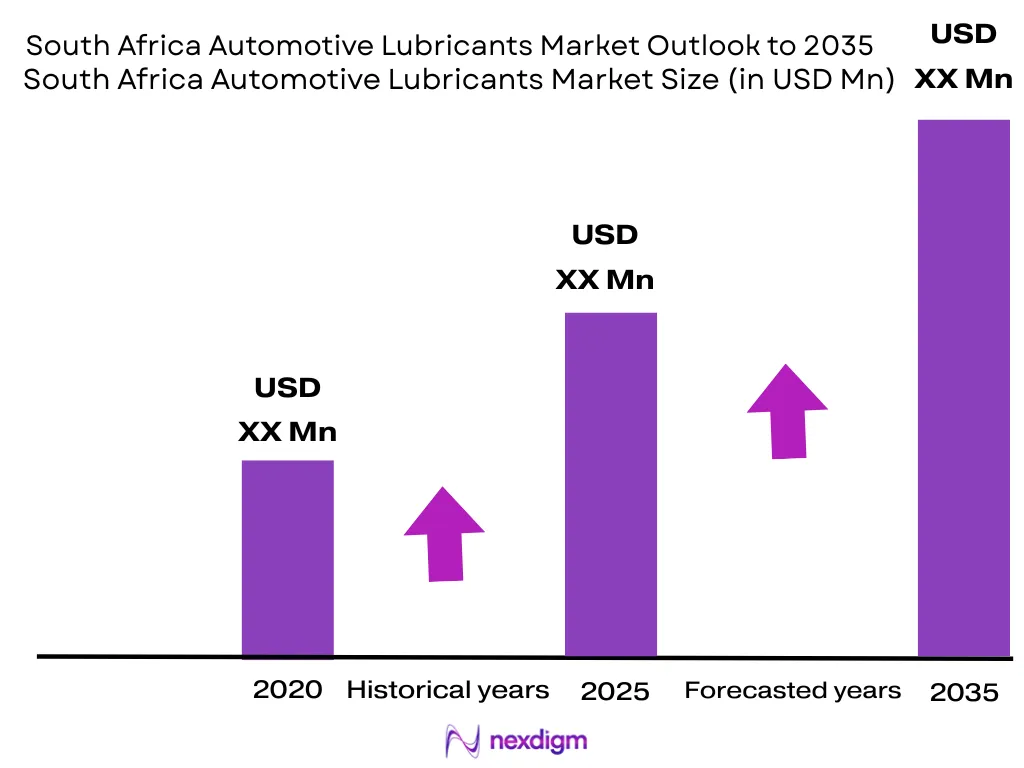
The South Africa Automotive Lubricants Market is valued at approximately ~ million, supported by a vehicle population that increased from 13,133,035 vehicles to 13,355,118 vehicles. Within this base, registered motorcars expanded from 7,794,164 to 7,949,275, while light delivery vehicles increased from 2,689,310 to 2,725,606. This extensive installed vehicle parc creates recurring requirements for engine oils, transmission fluids, gear oils, coolants and automotive greases throughout the aftermarket. Gauteng, Western Cape and KwaZulu-Natal dominate the South Africa Automotive Lubricants Market because of concentrated vehicle ownership, logistics corridors, workshops, automotive dealerships and industrial activity. The national motorised vehicle base increased from 11,884,210 units to 12,093,217 units, including trucks rising from 392,349 to 398,542 units and buses from 64,982 to 65,792 units. Gauteng alone subsequently recorded more than 5.1 million registered vehicles, reinforcing Johannesburg-Pretoria as the country’s principal automotive aftermarket and lubricant-distribution cluster.
Market Segmentation
By Vehicle Type
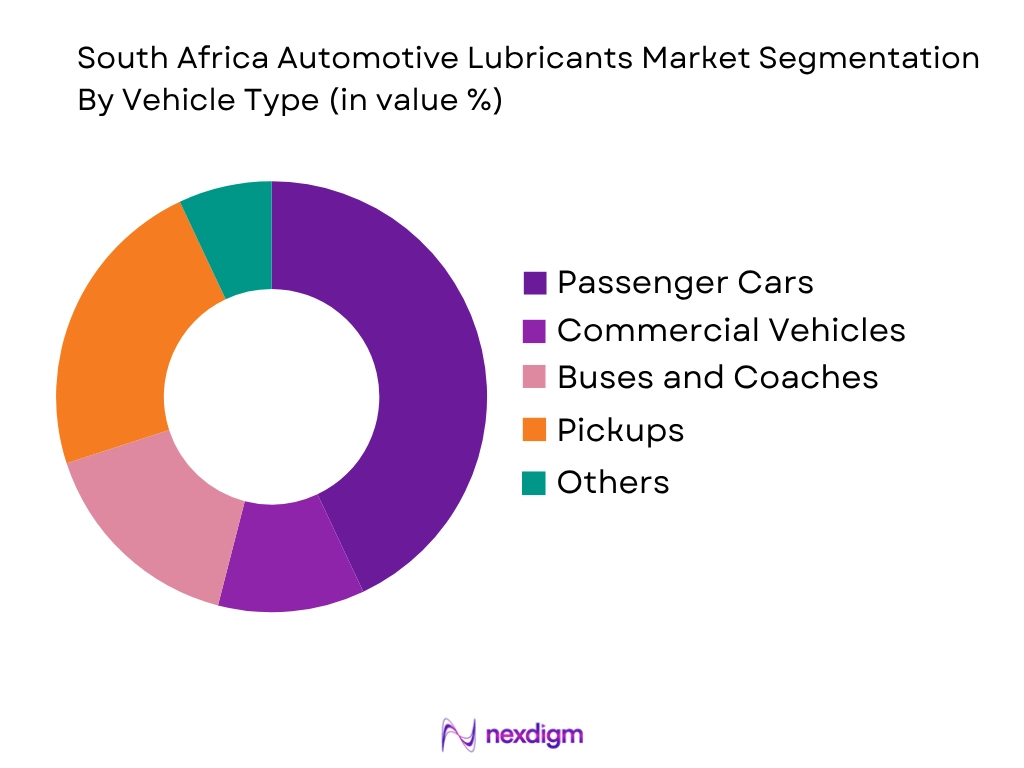
The South Africa Automotive Lubricants Market is segmented into passenger cars, SUVs and bakkies, light commercial vehicles, medium and heavy commercial vehicles, minibuses and buses, motorcycles, and off-highway vehicles. Passenger cars, SUVs and bakkies dominate the market because South Africa has nearly 7.95 million registered motorcars and approximately 2.73 million light delivery vehicles, giving these categories an exceptionally broad service-fill base. Bakkies are particularly important because they serve private households, SMEs, agriculture, construction and commercial fleets, increasing their utilisation beyond conventional passenger cars. Older vehicles also continue to require mineral, semi-synthetic and higher-viscosity engine oils, while newer turbocharged passenger vehicles increasingly use full-synthetic and low-viscosity lubricants. The combination creates broad demand across SAE viscosity grades. Commercial trucks contribute substantial volume per vehicle because of larger sump capacities and intensive annual mileage, but passenger cars and bakkies dominate total workshop interactions, replacement cycles and packaged lubricant sales.
By Lubricant Technology
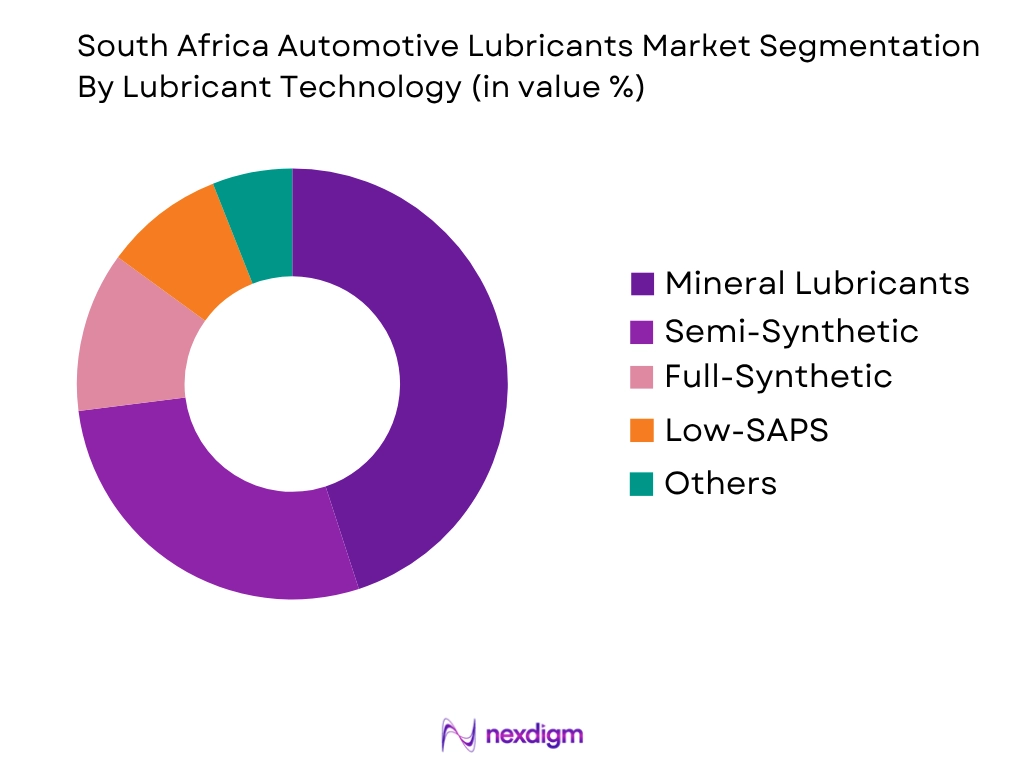
The South Africa Automotive Lubricants Market is segmented into mineral oils, semi-synthetic lubricants, full-synthetic lubricants, low-SAPS lubricants, high-mileage formulations, re-refined lubricants and hybrid/EV-specific fluids. Semi-synthetic and mineral lubricants currently represent the broadest demand base, supported by South Africa’s large installed stock of older passenger cars, bakkies, minibuses and commercial vehicles. However, full-synthetic lubricants are becoming strategically more important as newer vehicles require SAE 0W-20, 5W-30 and 5W-40 products carrying API, ACEA and manufacturer approvals. South Africa’s diverse vehicle parc creates a dual market in which older engines require robust, often higher-viscosity formulations while newer European, Japanese, Korean and Chinese vehicles require lower-viscosity synthetic products. Heavy-duty fleets additionally require API-compliant diesel engine oils, while modern emissions systems are expanding demand for low-SAPS formulations. Used-oil EPR requirements also strengthen the long-term relevance of re-refined and circular lubricant products.
Competitive Landscape
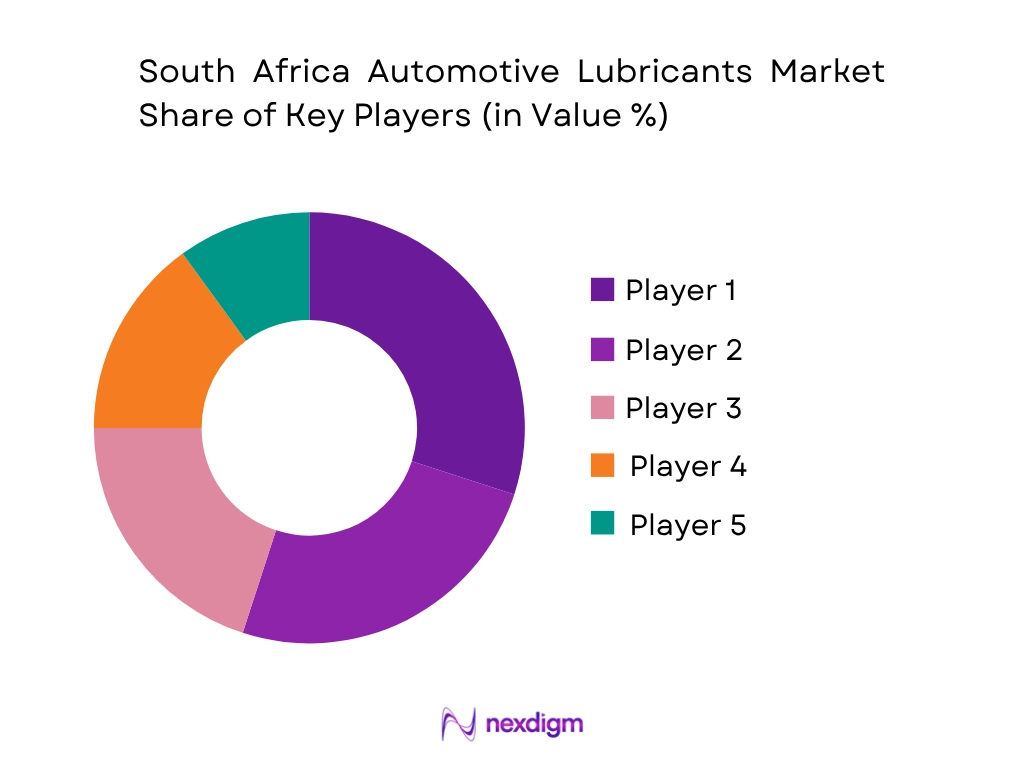
The South Africa Automotive Lubricants Market includes national fuel marketers, multinational lubricant specialists and brands with strong mining, fleet and automotive aftermarket positions. Engen maintains lubricant distribution centres across South Africa and manufactures automotive and industrial oils and greases, while FUCHS operates from Isando with branches serving major automotive, mining and industrial regions. Shell, Castrol and TotalEnergies maintain established passenger-car and heavy-duty portfolios, creating competition around OEM approvals, synthetic technology, workshop influence, fleet contracts and distribution accessibility.
| Company | Established | Headquarters | Core Automotive Portfolio | Synthetic Capability | Heavy-Duty / Mining Capability | South Africa Footprint | Distribution Strength | Technical / Future Fluid Capability |
| Engen Petroleum | 1881 heritage | Cape Town, South Africa | ~ | ~ | ~ | ~ | ~ | ~ |
| Shell | 1907 | London, UK | ~ | ~ | ~ | ~ | ~ | ~ |
| Castrol | 1899 | UK | ~ | ~ | ~ | ~ | ~ | ~ |
| TotalEnergies | 1924 | Paris, France | ~ | ~ | ~ | ~ | ~ | ~ |
| FUCHS | 1931 | Mannheim, Germany | ~ | ~ | ~ | ~ | ~ | ~ |
South Africa Automotive Lubricants Market Analysis
Growth Drivers
Large Installed Vehicle Parc and High Aftermarket Servicing Requirement
South Africa’s large and expanding vehicle parc is a fundamental demand driver for the automotive lubricants market because every internal-combustion vehicle generates recurring requirements for engine oil, transmission fluid, differential lubricant, coolant and grease throughout its operating life. The Road Traffic Management Corporation recorded 13,355,118 registered vehicles in December 2024, compared with 13,133,035 vehicles one year earlier. Registered motorcars increased from 7,794,164 to 7,949,275 units, light delivery vehicles and bakkies rose from 2,689,310 to 2,725,606 units, and trucks increased from 392,349 to 398,542 units. This provides lubricant suppliers with a broad installed aftermarket rather than dependence solely on annual new-vehicle sales. Older cars and bakkies also support mineral, semi-synthetic and high-mileage formulations, while newer vehicles require low-viscosity synthetic products carrying API, ACEA and OEM approvals. Macroeconomic scale reinforces the opportunity: the World Bank reported South Africa’s 2024 GDP at USD 401.14 billion, GDP per capita at USD 6,267.2 and population at 64,007,187 people. The IMF subsequently estimated national economic activity to strengthen in 2025, creating a more supportive environment for vehicle utilisation and aftermarket maintenance. For automotive-lubricant suppliers, the breadth of the vehicle population means demand is distributed across franchised dealerships, independent workshops, fuel stations, fitment centres and automotive retailers, sustaining consumption even during periods when new-vehicle production weakens.
Road Freight, Automotive Manufacturing and Commercial Vehicle Activity
Commercial road transport and South Africa’s automotive industrial base provide another substantial demand driver because heavy vehicles consume considerably more lubricant per service event than passenger cars. The Road Traffic Management Corporation recorded 398,542 registered trucks and 65,792 buses in December 2024, while the national light-delivery fleet reached 2,725,606 vehicles. Statistics South Africa recorded 790.611 million tonnes of road freight payload during 2024, indicating extensive utilisation of trucks across mining, agriculture, ports, manufacturing and domestic distribution. Heavy commercial vehicles generate demand for heavy-duty diesel engine oils, transmission fluids, differential and axle oils, chassis greases and extended-life coolants, while high annual kilometres shorten replacement cycles relative to many privately owned vehicles. Industrial activity also sustains factory-fill and service-fill demand. The Department of Trade, Industry and Competition reported that the automotive sector contributed R268.8 billion in vehicle and component exports in 2024, supplied 155 international markets and sustained nearly 500,000 direct jobs, with approximately 1 million jobs supported across the wider value chain. The World Bank placed South Africa’s national GDP at USD 401.14 billion in 2024, while the IMF estimated economic growth at 1.3 in 2025 and 1.4 in 2026 on its latest assessment. These indicators support continued freight movement, fleet replacement and industrial mobility. For lubricant companies, commercial fleets are particularly valuable because procurement can be consolidated into bulk contracts combining engine oil, driveline fluids, grease, coolant and oil-condition monitoring.
Market Challenges
Weak Consumer Purchasing Power and Extended Vehicle Replacement Cycles
Pressure on household purchasing power is a key challenge for the South Africa Automotive Lubricants Market because it influences vehicle replacement, maintenance frequency and the trade-off between premium synthetic formulations and lower-cost alternatives. The World Bank recorded GDP per capita of USD 6,267.2 in 2024, while South Africa’s population reached 64,007,187 people. The same institution reported 32.3 unemployment per 100 labour-force participants in 2024, indicating a constrained consumer environment in which motorists may postpone major maintenance or retain vehicles for longer periods. Statistics South Africa reported that real GDP expanded by only 0.6 per 100 units in 2024, while gross fixed capital formation contracted by 3.7 per 100 units. Automotive manufacturing also faced weaker conditions: production of motor vehicles, parts and other transport equipment fell 18.7 per 100 units year on year in September 2024, according to Statistics South Africa. For lubricant suppliers, slower vehicle replacement creates a mixed effect. It preserves demand from older internal-combustion vehicles but increases price sensitivity and widens the technical diversity of the aftermarket. Workshops must stock products for both older engines requiring conventional SAE grades and newer vehicles requiring low-viscosity OEM-approved oils. The RTMC recorded 7,949,275 motorcars and 2,725,606 light-delivery vehicles in December 2024, so even modest changes in servicing behaviour affect millions of vehicles. Suppliers therefore face pressure to balance affordability with specification compliance while protecting branded products from substitution by lower-tier alternatives.
Electrification and Increasing Lubricant Specification Complexity
The gradual shift toward new-energy vehicles creates a structural challenge because battery-electric vehicles eliminate conventional crankcase engine-oil demand while hybridisation introduces new technical specifications. The Department of Trade, Industry and Competition reported 15,611 new-energy vehicles sold in South Africa during 2024, while domestic manufacturers had attracted more than R12 billion in investment commitments for new-energy vehicle programmes. The government has also amended the Automotive Production and Development Programme to accommodate electric vehicles and components, signalling a sustained policy transition rather than a temporary niche. Although South Africa’s installed internal-combustion vehicle base remains very large—RTMC recorded 12,093,217 motorised vehicles in December 2024—lubricant companies must now support conventional petrol and diesel products alongside hybrid engine oils, electric drive-unit fluids, e-axle lubricants, thermal-management coolants and electrically compatible greases. This creates additional R&D, technician-training and SKU-management requirements. The challenge is amplified by the diversity of the existing parc: 7,949,275 motorcars, 2,725,606 light-delivery vehicles and 398,542 trucks require numerous SAE grades, API categories, ACEA specifications and OEM-specific formulations. Macroeconomic conditions further restrict how quickly workshops and distributors can absorb new inventory. The IMF estimated nominal GDP at approximately USD 401 billion in 2024 and population at around 63 million, while economic growth remained comparatively subdued. Manufacturers therefore need to fund next-generation fluid development while maintaining broad legacy portfolios for millions of existing ICE vehicles, increasing operational complexity during the transition.
Market Opportunities
Premium Synthetic, High-Mileage and Fleet Lubrication Solutions
South Africa presents substantial future opportunity for suppliers able to serve both its ageing aftermarket and high-utilisation commercial fleets with differentiated lubricants rather than commodity engine oils. The RTMC recorded 7,949,275 passenger motorcars, 2,725,606 light-delivery vehicles and 398,542 trucks in December 2024. This installed base supports distinct product propositions: older passenger vehicles create opportunities for high-mileage and semi-synthetic oils, newer turbocharged vehicles support low-viscosity full-synthetic formulations, and commercial vehicles require heavy-duty diesel oils, axle fluids, transmission lubricants and greases. The freight opportunity is especially significant because Statistics South Africa recorded 790.611 million tonnes of road freight payload in 2024. Fleet operators can be approached with extended-drain products, bulk lubricant delivery, laboratory oil analysis and predictive maintenance services designed to reduce unscheduled downtime. Automotive industrial activity provides another commercial base. The Department of Trade, Industry and Competition reported automotive exports and components valued at R268.8 billion in 2024, shipped to 155 markets, while the sector supported nearly 500,000 direct jobs. The IMF estimated economic growth of 1.3 in 2025 and 1.4 in 2026, providing a more supportive operating backdrop for logistics and industrial investment. These current indicators show a large addressable lubricant-consuming base without relying on speculative future fleet assumptions. Suppliers that combine technically differentiated oils with oil-condition monitoring, workshop training and national fleet servicing can capture recurring contractual demand and improve customer retention.
New-Energy Vehicle Fluids and Circular Used-Oil Solutions
The transition to new-energy vehicles and tighter waste-management requirements creates a future-facing opportunity for South African lubricant suppliers to diversify into specialised EV fluids and circular lubricant systems. The Department of Trade, Industry and Competition reported 15,611 new-energy vehicle sales in 2024 and more than R12 billion in domestic investment associated with new-energy vehicle programmes. These current investments provide a foundation for future demand for hybrid-specific low-viscosity oils, electric drive-unit fluids, e-axle lubricants, bearing greases and battery thermal-management coolants. At the same time, South Africa’s installed vehicle parc remains large enough to generate substantial volumes of used lubricant: the RTMC recorded 13,355,118 total registered vehicles in December 2024, including more than 12 million motorised vehicles. The Department of Forestry, Fisheries and the Environment’s Extended Producer Responsibility framework specifically covers lubricant oils, requiring producers to participate in organised end-of-life management. South Africa’s national waste strategy notes that a material portion of lubricant oil remains after use and requires controlled collection and recycling rather than disposal into soil or water. This creates opportunities for collection networks, traceability systems, re-refining partnerships and incorporation of re-refined base oils into suitable automotive products. The broader macroeconomic base remains sizeable, with the World Bank reporting GDP of USD 401.14 billion and population of 64,007,187 in 2024. Companies that develop EV-fluid portfolios while simultaneously creating closed-loop used-oil programmes can address two structural changes at once: declining long-term crankcase-oil intensity and stronger environmental accountability across the existing ICE vehicle fleet.
Future Outlook
The South Africa Automotive Lubricants Market is expected to expand at approximately ~ CAGR during 2026-2035, although growth will increasingly depend on product mix rather than simple lubricant-volume expansion. The market’s principal structural advantage is its installed vehicle base of more than 13.35 million registered vehicles, which creates a long-lasting service-fill aftermarket even as new powertrain technologies emerge. Older vehicles will continue supporting mineral, semi-synthetic and high-mileage products, while newer vehicles will stimulate demand for full-synthetic, low-viscosity and OEM-approved oils. This dual structure should preserve significant SKU diversity across workshops and automotive retailers. Commercial vehicles and road freight will remain important because Statistics South Africa recorded 790.611 million tonnes of road freight payload during 2024. Heavy truck utilisation generates disproportionately large consumption of diesel engine oils, gear oils, greases and coolants due to high mileage and larger lubricant capacities.
Major Players
- Engen Petroleum – Engen Lubricants
- Shell South Africa
- Castrol South Africa
- TotalEnergies South Africa
- Sasol
- Astron Energy – Caltex Lubricants
- FUCHS Lubricants South Africa
- Motul South Africa
- PETRONAS Lubricants International
- ExxonMobil – Mobil
- Valvoline
- Gulf Oil South Africa
- LIQUI MOLY South Africa
- Repsol Lubricants
- Lubrication Engineers South Africa
Key Target Audience
- Automotive lubricant manufacturers and lubricant blenders
- Base-oil and lubricant additive suppliers
- Passenger and commercial vehicle OEMs
- Automotive lubricant distributors, workshops and fitment-centre operators
- Road freight, minibus taxi, mining and commercial fleet operators
- Used-oil collectors, recyclers and re-refining companies
- Investments and venture capitalist firms
- Government and regulatory bodies (Department of Forestry, Fisheries and the Environment; Department of Transport; Department of Trade, Industry and Competition; South African Bureau of Standards; Road Traffic Management Corporation)
Research Methodology
Step 1: Identification of Key Variables
The initial phase develops an ecosystem map covering lubricant manufacturers, base-oil suppliers, additive companies, automotive OEMs, dealerships, independent workshops, mining fleets, commercial fleets and used-oil processors. Key variables include vehicle population, vehicle age, annual mileage, sump capacity, oil-drain frequency, lubricant viscosity, API/ACEA specification, fleet utilisation and distribution-channel penetration.
Step 2: Market Analysis and Construction
Historical demand is constructed through a bottom-up model combining passenger cars, bakkies, commercial vehicles, minibuses, buses and specialised fleet applications. RTMC vehicle registrations are matched with lubricant capacities and servicing behaviour, while Statistics South Africa freight statistics are used to assess heavy-duty utilisation. Supply-side analysis evaluates blending capacity, packaged lubricant availability, imports, distributor throughput and fleet-direct demand.
Step 3: Hypothesis Validation and Expert Consultation
Market hypotheses are validated through computer-assisted telephone interviews with lubricant manufacturers, distributors, independent workshops, automotive dealerships, trucking fleets, mining operators and automotive retailers. Interviews test assumptions concerning synthetic penetration, drain intervals, viscosity preferences, fleet contracts, workshop recommendations, high-mileage products and OEM-approved lubricant demand.
Step 4: Research Synthesis and Final Output
The final phase triangulates demand-side calculations with registered vehicle populations, road-freight activity, supplier portfolios and distribution infrastructure. South Africa’s 13,355,118 registered vehicles, including 7,949,275 motorcars, 2,725,606 light delivery vehicles and 398,542 trucks, provide the fundamental installed-base check for the market model.

- Executive Summary
- Research Methodology (Market Definitions and Assumptions, Abbreviations, Market Sizing Approach, Top-Down Analysis, Bottom-Up Analysis, Vehicle Parc Assessment, Vehicle Age Analysis, Annual Mileage Mapping, Lubricant Sump Capacity Analysis, Drain Interval Assessment, Passenger Car Demand Assessment, Commercial Fleet Demand Assessment, Mining Fleet Lubricant Assessment, Agricultural Equipment Demand Assessment, Workshop Channel Assessment, Fuel Station Channel Assessment, Lubricant Blending and Import Analysis, Primary Industry Interviews, Distributor Interviews, Fleet Operator Interviews, Data Triangulation, Forecasting Framework, Limitations and Future Conclusions)

- Definition and Scope
- Market Evolution and Industry Genesis
- Evolution of Automotive Lubricant Consumption
- Development of Passenger Car Lubrication Ecosystem
- Commercial Vehicle and Road Freight Lubrication Ecosystem

- Growth Drivers (Large Vehicle Parc, Aging Vehicles, Commercial Freight, Mining Equipment, Aftermarket Servicing)
- Market Challenges (Base Oil Dependency, Economic Pressure, Counterfeit Risk, Specification Complexity, Electrification)
- Market Opportunities (Synthetic Oils, Heavy-Duty Fleets, Mining, Re-Refining, EV Fluids)
- Market Trends (Synthetic Migration, Fleet Services, Digital Oil Selection, Circular Lubricants, EV Fluids)
- Government Regulations (EPR, Product Standards, Used Oil, Waste Transport, Environmental Compliance)
- SWOT Analysis
- Porter’s Five Forces Analysis
- PESTLE Analysis

- By Market Value (2020-2025)
- By Lubricant Consumption Volume (2020-2025)
- By Passenger Car Lubricant Value (2020-2025)

- By Product Type (In Value %)
Passenger Car Motor Oil
Heavy-Duty Diesel Engine Oil
Automatic Transmission Fluid
Continuously Variable Transmission Fluid
Dual-ClutchTransmission Fluid - By Lubricant Technology (In Value %)
Mineral Lubricants
Semi-Synthetic Lubricants
Full-Synthetic Lubricants
Low-Viscosity Synthetic Lubricants
Low-SAPS Lubricants - By Vehicle Type (In Value %)
Passenger Cars
SUVs and Crossovers
Bakkies and Pickup Trucks
Light Commercial Vehicles
Medium Commercial Vehicles - By Province (In Value %)
Gauteng
KwaZulu-Natal
Western Cape
Eastern Cape
Mpumalanga
Limpopo

- Market Share of Major Players (By Value, Volume, Vehicle Type, Product Type, Distribution Channel)
- Cross Comparison Parameters (Automotive and Heavy-Duty Lubricant Portfolio Breadth, API–ACEA–OEM Approval Portfolio, Passenger Car Synthetic and High-Mileage Product Strength, Heavy-Duty–Mining–Off-Highway Lubricant Capability, Domestic Blending and Laboratory Footprint, Fuel Station–Workshop–Distributor Network Reach, Fleet Oil Analysis and Technical Service Capability, Used-Oil EPR–Re-Refining–EV Fluid Readiness)
- SWOT Analysis of Major Players
- Detailed Profiles of Major Companies
Engen Petroleum – Engen Lubricants
Shell South Africa
Castrol South Africa
TotalEnergies South Africa
Sasol
Astron Energy – Caltex Lubricants
FUCHS Lubricants South Africa
Motul South Africa
PETRONAS Lubricants International
ExxonMobil – Mobil
Valvoline
Gulf Oil South Africa
LIQUI MOLY South Africa
Repsol Lubricants
Lubrication Engineers South Africa

- Passenger Car Owner Analysis
- Bakkie and SUV Owner Analysis
- Minibus Taxi Operator Analysis
- Ride-Hailing Vehicle Analysis
- Commercial Fleet Analysis

- By Market Value (2026-2035)
- By Lubricant Consumption Volume (2026-2035)
- By Passenger Car Lubricant Value (2026-2035)


 Request a Sample
 Ask for Customization
 Get a Quote
 Enquire Now