
 Download PDF
 Download PDF
Market Overview
The South Africa Battery Energy Storage System market reached approximately USD ~ billion based on a recent historical assessment, reflecting rapid expansion of grid-scale and distributed energy storage projects. Market growth is primarily driven by the country’s electricity reliability challenges, large-scale renewable energy integration programs, and investments in solar and wind power capacity. Energy storage systems support grid stabilization and peak demand management while improving resilience of electricity infrastructure, creating strong demand from utilities, independent power producers, and commercial energy users.
Johannesburg, Cape Town, and Durban represent dominant demand centers because these cities host large industrial clusters, major electricity consumption hubs, and significant renewable energy projects connected to the national grid. The Western Cape and Northern Cape provinces also demonstrate strong activity due to large solar and wind installations requiring storage integration. These regions benefit from renewable energy procurement initiatives, grid modernization projects, and growing corporate demand for backup energy solutions to address electricity supply instability.
Market Segmentation
By Product Type:
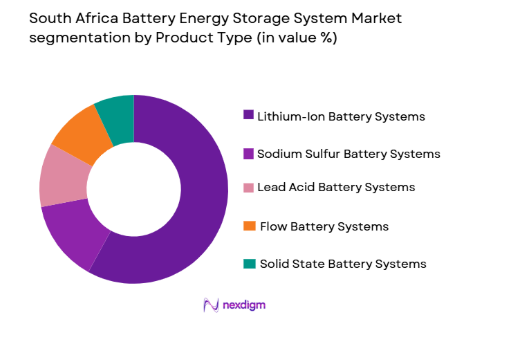
South Africa Battery Energy Storage System market is segmented by product type into Lithium-Ion Battery Systems, Sodium Sulfur Battery Systems, Lead Acid Battery Systems, Flow Battery Systems, and Solid State Battery Systems. Recently, Lithium-Ion Battery Systems has a dominant market share due to factors such as demand patterns, brand presence, infrastructure availability, and strong consumer preference for high energy density technologies. Lithium-ion batteries provide faster charging capability, longer operational life, and improved system efficiency compared with other storage technologies. Global manufacturing scale and declining battery costs have made lithium-ion systems economically viable for large renewable integration projects and commercial backup systems. Energy developers in South Africa prefer lithium-ion storage because of its compatibility with solar and wind power installations. Additionally, advanced battery management systems enable reliable performance and improved safety standards. The presence of global manufacturers and technology partnerships has also strengthened deployment of lithium-ion storage solutions across utility-scale and commercial energy applications throughout the country.
By Application:
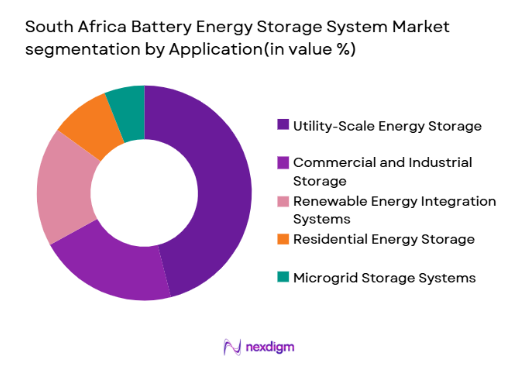
South Africa Battery Energy Storage System market is segmented by application into Utility-Scale Energy Storage, Commercial and Industrial Storage, Residential Energy Storage, Renewable Energy Integration Systems, and Microgrid Storage Systems. Recently, Utility-Scale Energy Storage has a dominant market share due to factors such as increasing grid reliability requirements and large renewable power generation projects across the country. Utility operators deploy battery storage to stabilize power supply, manage peak electricity demand, and support integration of intermittent renewable sources such as solar and wind. Large grid-connected storage projects provide frequency regulation, voltage support, and backup capacity during supply shortages. Government procurement programs and renewable energy infrastructure development have encouraged deployment of large battery installations connected to the national grid. Utility-scale storage also supports transmission infrastructure upgrades and reduces reliance on diesel backup generation during power shortages. As electricity demand continues to rise across industrial and urban sectors, utility-scale energy storage remains the primary solution for improving grid reliability and operational efficiency in the national electricity network.
Competitive Landscape
The South Africa Battery Energy Storage System market demonstrates a moderately consolidated competitive structure with strong participation from global battery manufacturers, renewable energy developers, and power technology companies. Major international players collaborate with regional utilities and engineering firms to deploy grid-scale storage projects. Technology leadership, project financing capability, and experience in renewable integration strongly influence competition. Companies specializing in lithium-ion battery technology and energy management software maintain a strategic advantage, while local energy companies support system deployment and grid integration across the country.
| Company Name | Establishment Year | Headquarters | Technology Focus | Market Reach | Key Products | Revenue | Storage Capacity Solutions |
| Tesla Energy | 2003 | United States | ~ | ~ | ~ | ~ | ~ |
| BYD Energy Storage | 1995 | China | ~ | ~ | ~ | ~ | ~ |
| Fluence Energy | 2018 | United States | ~ | ~ | ~ | ~ | ~ |
| LG Energy Solution | 2020 | South Korea | ~ | ~ | ~ | ~ | ~ |
| Wärtsilä Energy | 1834 | Finland | ~ | ~ | ~ | ~ | ~ |
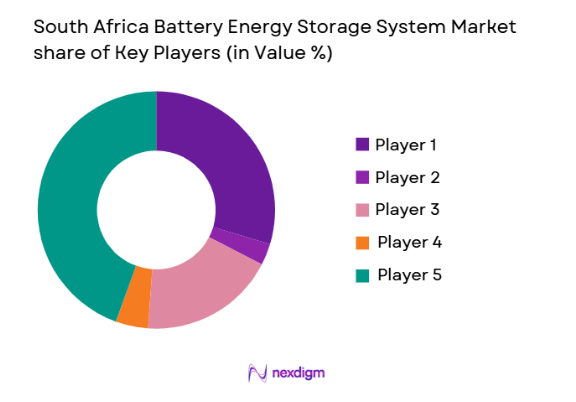
South Africa Battery Energy Storage System Market Analysis
Growth Drivers
Renewable Energy Expansion and Grid Integration Requirements:
The rapid expansion of renewable energy generation capacity in South Africa is creating significant demand for battery energy storage systems capable of stabilizing electricity supply. Solar and wind power projects are increasing across the country as part of national strategies aimed at diversifying energy sources and reducing dependence on coal-based electricity generation. However, renewable energy production is intermittent because generation depends on weather conditions and daylight availability. Battery energy storage systems provide the ability to store surplus electricity during peak generation periods and release power when demand increases or generation declines. This capability helps maintain grid stability and ensures consistent electricity supply to households and industrial facilities. Renewable project developers increasingly integrate storage solutions with solar and wind farms to improve operational efficiency and grid reliability. Additionally, energy storage systems help reduce curtailment of renewable power by storing excess electricity that would otherwise be wasted. Utilities are also investing in storage infrastructure to support frequency regulation and voltage control across transmission networks. As renewable energy installations continue expanding, battery storage will remain essential for balancing supply and demand while supporting sustainable electricity infrastructure development in the country.
Electricity Reliability Concerns and Load Shedding Challenges:
Persistent electricity supply instability across South Africa has significantly accelerated adoption of battery energy storage systems among utilities, commercial enterprises, and residential consumers. Power shortages and load shedding events have disrupted industrial production, commercial operations, and everyday activities in urban areas. Businesses require reliable electricity supply to maintain operations, prompting investment in backup power solutions that reduce dependence on unstable grid electricity. Battery storage systems integrated with solar energy installations provide a practical solution for ensuring uninterrupted electricity supply during grid outages. These systems store solar power generated during daytime hours and deliver electricity during peak demand periods or grid failures. Large industrial facilities and data centers also deploy battery storage systems to protect critical operations and prevent production losses caused by power interruptions. Telecommunications infrastructure providers rely on battery storage to maintain network connectivity during outages. In addition, municipalities are exploring energy storage technologies to improve grid resilience and reduce pressure on centralized power generation infrastructure. As electricity demand continues increasing while grid infrastructure faces operational constraints, battery energy storage systems offer a reliable solution for improving energy security and operational stability.
Market Challenges
High Capital Investment and Infrastructure Development Costs:
The deployment of battery energy storage systems requires substantial capital investment, which remains a major barrier to large-scale adoption across the South African energy sector. Battery technologies involve significant costs associated with manufacturing, transportation, installation, and system integration. Utility-scale energy storage projects require advanced engineering infrastructure, grid connection equipment, and power conversion systems to ensure efficient operation. Financing these projects can be challenging for smaller energy developers or municipalities with limited budgets. Additionally, battery storage projects often require upgrades to transmission and distribution networks in order to accommodate new energy storage capacity. These infrastructure improvements increase overall project costs and extend development timelines. Investors must also consider operational and maintenance expenses associated with battery systems over their lifecycle. Although battery prices have declined globally due to technological advancements and large-scale manufacturing, the overall project cost for storage installations remains substantial. Financing mechanisms such as public-private partnerships and energy infrastructure funds are gradually emerging to address these challenges, but capital investment requirements still represent a major barrier limiting rapid expansion of battery storage deployment.
Dependence on Imported Battery Technologies and Supply Chain Constraints:
The South Africa Battery Energy Storage System market relies heavily on imported battery technologies and energy storage components, creating supply chain vulnerabilities and cost uncertainties. Most advanced battery cells, modules, and battery management systems are manufactured in international markets including China, South Korea, and the United States. This dependence on imports exposes energy storage projects to fluctuations in global battery prices, transportation costs, and international trade conditions. Supply chain disruptions can delay project development timelines and increase procurement costs for developers and utilities. Local manufacturing capabilities for advanced battery technologies remain limited, which restricts domestic production of storage systems. Import duties, logistics challenges, and currency fluctuations also influence the overall cost structure of energy storage projects. Additionally, specialized technical expertise required for installation and maintenance of advanced battery systems is not yet widely available across the domestic workforce. Strengthening local manufacturing capacity and technical training programs could help reduce reliance on international supply chains and improve long-term sustainability of the energy storage industry in South Africa.
Opportunities
Expansion of Solar-Plus-Storage Projects Across Commercial and Industrial Facilities:
The increasing adoption of solar energy systems by commercial and industrial facilities presents significant opportunities for battery energy storage solutions in South Africa. Businesses across manufacturing, mining, and retail sectors are installing rooftop and ground-mounted solar power systems to reduce electricity costs and mitigate the impact of grid instability. However, solar generation alone cannot guarantee uninterrupted electricity supply because power production fluctuates with weather conditions and daylight hours. Integrating battery storage systems with solar installations allows businesses to store excess electricity generated during daytime hours and use it during peak demand periods or nighttime operations. This capability improves energy efficiency while reducing dependence on grid electricity and diesel backup generators. Many companies are exploring hybrid energy solutions combining solar power, battery storage, and intelligent energy management systems. These integrated energy systems provide cost savings, improve operational reliability, and support sustainability goals. As corporate energy demand continues growing, solar-plus-storage installations are expected to expand significantly across commercial and industrial facilities throughout South Africa.
Development of Grid-Scale Energy Storage Projects Supporting National Power Infrastructure:
Large-scale battery energy storage projects present major opportunities for improving the resilience and efficiency of South Africa’s national electricity grid. Utility operators are increasingly evaluating battery storage as a strategic solution for addressing peak electricity demand, stabilizing frequency fluctuations, and reducing transmission congestion. Grid-scale storage installations can store excess renewable electricity during periods of high generation and discharge energy during supply shortages. These systems help reduce reliance on expensive peaking power plants and diesel generators during periods of high electricity demand. Energy storage also enables utilities to manage electricity distribution more effectively across regional transmission networks. Government renewable procurement initiatives are encouraging integration of battery storage technology with renewable power projects to improve energy reliability. International energy companies and infrastructure investors are exploring opportunities to finance large energy storage projects connected to the national grid. As electricity demand grows and renewable generation expands, grid-scale battery energy storage will play an increasingly important role in strengthening power infrastructure and supporting sustainable energy development.
Future Outlook
The South Africa Battery Energy Storage System market is expected to experience significant expansion as renewable energy capacity continues increasing and electricity reliability challenges persist. Advancements in battery technology and declining battery manufacturing costs will improve affordability of energy storage solutions. Government policies encouraging renewable energy integration and grid modernization will further support deployment of battery storage systems. Over the coming years, increased investments from utilities, independent power producers, and industrial energy users are expected to accelerate the development of large-scale and distributed energy storage infrastructure across the country.
Major Players
- Tesla Energy
- BYD Energy Storage
- Fluence Energy
- LG Energy Solution
- Samsung SDI
- CATL
- Wärtsilä Energy
- Siemens Energy
- ABB Energy Storage
- Sungrow Power Supply
- Hitachi Energy
- Schneider Electric Energy Storage
- Enel Green Power
- EDF Renewables
- TotalEnergies
Key Target Audience
- Renewable energy developers
- Utility companies
- Energy infrastructure investors
- Power transmission operators
- Industrial energy consumers
- Investments and venture capitalist firms
- Government and regulatory bodies
- Battery technology manufacturers
Research Methodology
Step 1: Identification of Key Variables
Primary and secondary research was conducted to identify market variables including storage capacity deployment, renewable integration projects, and energy demand patterns. Key economic indicators, infrastructure developments, and energy policy frameworks were evaluated to determine major market drivers.
Step 2: Market Analysis and Construction
Comprehensive data modeling and sector analysis were performed to construct the market structure. Supply-side insights from manufacturers and project developers were combined with demand-side analysis of utilities, industrial users, and renewable developers.
Step 3: Hypothesis Validation and Expert Consultation
Energy sector experts, technology specialists, and infrastructure analysts validated the research assumptions. Industry professionals reviewed key findings to ensure realistic interpretation of technology adoption patterns and market demand.
Step 4: Research Synthesis and Final Output
All research findings were consolidated through analytical modeling and data triangulation methods. Final market insights were structured into a comprehensive framework covering segmentation, competitive landscape, market drivers, and future growth potential.

- Executive Summary
- Research Methodology (Definitions, Scope, Industry Assumptions, Market Sizing Approach, Primary & Secondary Research Framework, Data Collection & Verification Protocol, Analytic Models & Forecast Methodology, Limitations & Research Validity Checks)

- Market Definition and Scope
- Value Chain & Stakeholder Ecosystem
- Regulatory / Certification Landscape
- Sector Dynamics Affecting Demand
- Strategic Initiatives & Infrastructure Growth

- Growth Drivers
Expansion of renewable energy generation requiring grid stabilization solutions
Increasing electricity reliability concerns due to frequent power outages
Government renewable procurement programs encouraging storage deployment
Rising commercial demand for backup power and energy resilience
Technological improvements lowering lithium ion battery costs - Market Challenges
High upfront capital investment required for large scale battery storage projects
Limited domestic manufacturing capacity for advanced battery technologies
Grid integration complexity and regulatory approval delays
Dependence on imported battery components and materials
Battery lifecycle management and recycling infrastructure gaps - Market Opportunities
Integration of storage systems with solar and wind projects in renewable corridors
Deployment of community microgrids supported by battery storage
Expansion of energy storage services for peak shaving and grid balancing - Trends
Increasing deployment of lithium ion battery systems for utility scale storage
Growth of solar plus storage projects across commercial sectors
Adoption of microgrid based energy systems in remote regions
Investment from international energy companies into South African storage projects
Expansion of long duration energy storage technologies - Government Regulations & Defense Policy
National Integrated Resource Plan supporting battery energy storage adoption
Energy regulatory reforms enabling private sector electricity generation
Renewable procurement programs incorporating energy storage requirements - SWOT Analysis
- Stakeholder and Ecosystem Analysis
- Porter’s Five Forces Analysis
- Competition Intensity and Ecosystem Mapping

- By Market Value, 2020-2025
- By Installed Units, 2020-2025
- By Average System Price, 2020-2025
- By System Complexity Tier, 2020-2025

- By System Type (In Value%)
Utility Scale Battery Storage Systems
Commercial and Industrial Battery Storage Systems
Residential Energy Storage Systems
Hybrid Renewable Integrated Storage Systems
Microgrid Battery Storage Systems - By Platform Type (In Value%)
Grid Connected Storage Platforms
Off Grid Energy Storage Platforms
Renewable Energy Coupled Platforms
Distributed Energy Storage Platforms
Backup Power Storage Platforms - By Fitment Type (In Value%)
Standalone Battery Energy Storage Installations
Solar Plus Storage Integrated Systems
Wind Plus Storage Integrated Systems
Microgrid Integrated Storage Systems
Hybrid Multi Source Energy Storage Systems - By EndUser Segment (In Value%)
Electric Utilities and Grid Operators
Commercial and Industrial Facilities
Residential Households
Renewable Energy Project Developers
Telecommunication Infrastructure Providers - By Procurement Channel (In Value%)
Government Energy Tenders
Independent Power Producer Procurement
Utility Direct Procurement
Engineering Procurement Construction Contracts
Private Renewable Project Procurement - By Material / Technology (in Value %)
Lithium Ion Battery Storage Technology
Sodium Sulfur Battery Storage Technology
Vanadium Redox Flow Battery Technology
Lead Acid Advanced Battery Storage
Solid State Battery Energy Storage

- Market structure and competitive positioning
- Market share snapshot of major players
- CrossComparison Parameters (Battery Capacity Range, Energy Density, System Lifecycle, Integration Capability, Grid Compatibility, Safety Standards Compliance, Project Deployment Scale, Technology Type, Maintenance Requirements, Cost Efficiency)
- SWOT Analysis of Key Players
- Pricing & Procurement Analysis
- Key Players
Tesla Energy
BYD Energy Storage
Fluence Energy
LG Energy Solution
Samsung SDI
CATL Energy Storage
Hitachi Energy
ABB Energy Storage Solutions
Siemens Energy
Sungrow Power Supply
Eskom Rotek Industries
TotalEnergies Storage Solutions
EDF Renewables Energy Storage
Enel Green Power Storage Solutions
Wärtsilä Energy Storage

- Utilities deploying battery storage to manage grid stability and renewable intermittency
- Commercial facilities adopting storage systems to reduce electricity costs and outages
- Renewable developers integrating storage with solar and wind projects
- Telecommunications operators installing storage for network reliability

- Forecast Market Value, 2026-2035
- Forecast Installed Units, 2026-2035
- Price Forecast by System Tier, 2026-2035
- Future Demand by Platform, 2026-2035


 Request a Sample
 Ask for Customization
 Get a Quote
 Enquire Now