
 Download PDF
Market Overview
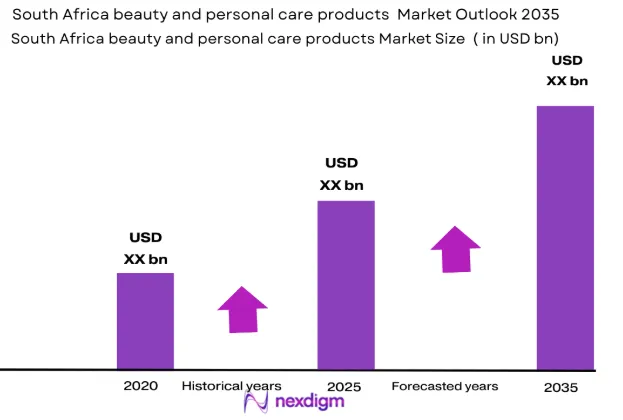
The South Africa Beauty and Personal Care Products market is valued at USD ~ billion, supported by a historical consumer base of USD 3.97 billion in the wider cosmetics and personal care category and continued demand across skincare, haircare, fragrances, and personal hygiene. Growth is driven by urban retail expansion, product premiumization, and demand for natural formulations. The market is forecast to grow at nearly 5.1% CAGR for the 2024–2030 period.
Johannesburg, Cape Town, Durban, and Pretoria dominate the South Africa Beauty & Personal Care Products market due to higher income density, stronger mall-based retail, pharmacy networks, and e-commerce penetration. Gauteng remains the most populated province with over 15.9 million people, while KwaZulu-Natal and Western Cape together form part of the 35.8 million people living in the country’s three largest provinces. This concentration supports brand visibility, modern retail access, and faster adoption of premium beauty products.
Market Segmentation
By Product Type
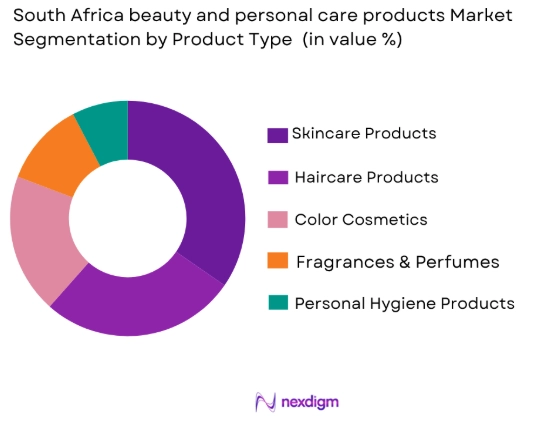
South Africa Beauty & Personal Care Products market is segmented by product type into skincare products, haircare products, fragrances & perfumes, color cosmetics, and personal hygiene products. Recently, skincare products have a dominant market share in South Africa under the segmentation product type, due to rising demand for facial creams, sun protection, anti-aging products, acne care, and dermatological skincare. South Africa’s climate conditions, high urban pollution exposure, and increasing awareness of skin health have supported the adoption of moisturizers, cleansers, serums, and SPF-based products. Global brands and pharmacy-led beauty retailers have expanded skincare shelves, while consumers are increasingly selecting products based on ingredients, skin concerns, and dermatologist recommendations. Facial skincare has also been identified as a growing category in the country, with facial creams leading the segment.
By Distribution Channel
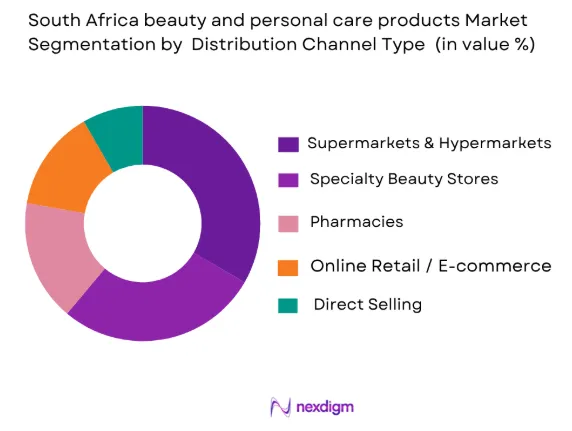
South Africa Beauty & Personal Care Products market is segmented by distribution channel into supermarkets & hypermarkets, pharmacies & drugstores, specialty beauty stores, online retail/e-commerce, and direct selling. Recently, supermarkets and hypermarkets have a dominant market share in South Africa under the segmentation distribution channel, due to their wide reach, frequent household shopping visits, and ability to offer mass-market personal care products at competitive prices. Consumers often purchase shampoos, deodorants, body care, oral care, and hygiene products during regular grocery trips, making this channel important for high-volume categories. Pharmacy chains such as Clicks and Dis-Chem also play a major role in skincare, baby care, and beauty, while online retail continues to expand through convenience, discounts, and access to imported brands.
Competitive Landscape
The South Africa Beauty & Personal Care Products market is moderately consolidated, with global multinationals controlling a large portion of branded skincare, haircare, cosmetics, and personal hygiene sales. Companies such as Unilever, L’Oréal, Procter & Gamble, and Estée Lauder compete with local and regional retail-led beauty players. Pharmacy chains such as Clicks and Dis-Chem influence consumer access through private label, promotions, and beauty-focused retail formats.
| Company | Establishment Year | Headquarters | Product Strength | Pricing Position | Distribution Strength | Digital Presence | Key Category Focus | South Africa Relevance |
| L’Oréal Group | 1909 | Clichy, France | ~ | ~ | ~ | ~ | ~ | ~ |
| Unilever | 1929 | London, UK | ~ | ~ | ~ | ~ | ~ | ~ |
| Procter & Gamble | 1837 | Cincinnati, USA | ~ | ~ | ~ | ~ | ~ | ~ |
| Estée Lauder Companies | 1946 | New York, USA | ~ | ~ | ~ | ~ | ~ | ~ |
| Clicks Group | 1968 | Cape Town, South Africa | ~ | ~ | ~ | ~ | ~ | ~ |
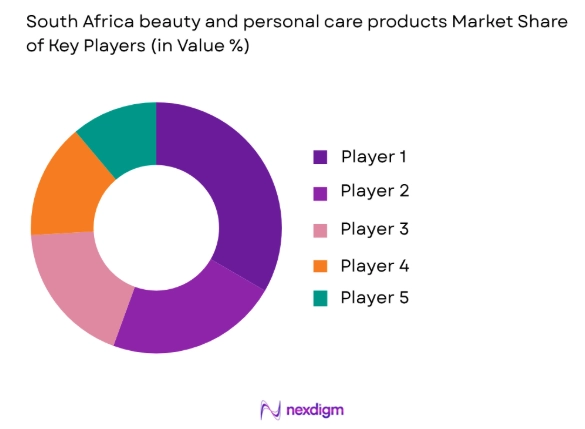
South Africa Beauty & Personal Care Products Market Analysis
Growth Drivers
Urban Consumer Base and Retail Concentration
South Africa Beauty & Personal Care Products market is supported by a large urban consumer base concentrated in provinces with stronger retail infrastructure. Statistics South Africa reported a national population of 63.02 million, including 32.13 million females, while Gauteng, KwaZulu-Natal, and Western Cape together accounted for 35.8 million people. Gauteng alone had over 15.9 million residents, making it the country’s largest consumer province. This supports beauty and personal care demand because urban provinces have stronger access to supermarkets, pharmacies, malls, and beauty retail formats. World Bank data also shows South Africa’s GDP at USD 401.14 billion and GDP per capita at USD 6,267.2, supporting formal retail purchasing capacity.
Digital Access Supporting Beauty Product Discovery
Digital access is strengthening beauty and personal care product discovery in South Africa, particularly through online retail, social media, and mobile-first shopping. ICASA reported 94 million mobile cellular active subscriptions in South Africa, compared with 90.5 million subscriptions and 90.4 million subscriptions in the preceding two reported years. This large mobile base supports beauty browsing, influencer-led brand awareness, product comparison, and e-commerce purchases. Statistics South Africa’s household survey also shows mobile internet access as the most common method of connectivity, with rural mobile internet use at 66.3, only 6.3 points below the national average. These indicators support digital retail expansion for skincare, cosmetics, haircare, fragrances, and personal hygiene products. Sources:
Market Challenges
Household Pressure and Price-Sensitive Demand
South Africa Beauty & Personal Care Products market faces pressure from weak household purchasing conditions, especially in mass personal care categories. Statistics South Africa reported 17.1 million employed persons and 8.0 million unemployed persons in Q4, while the working-age population increased by 539,000 compared with the prior year. World Bank data shows real GDP growth of only 0.5 and consumer inflation of 4.4. These macroeconomic conditions create cautious spending behavior, especially for discretionary beauty items such as premium cosmetics, fragrances, and advanced skincare. As a result, consumers are more likely to prioritize essential hygiene products, value packs, promotions, and private-label alternatives over higher-priced beauty categories.
Intense Retail Competition Across Beauty Channels
South Africa Beauty & Personal Care Products market faces intense channel competition because beauty products are sold through pharmacies, supermarkets, hypermarkets, specialty stores, and online platforms. Statistics South Africa reported retail trade sales of R341,925 million at constant prices in Q4, while retailers in pharmaceutical and medical goods, cosmetics and toiletries recorded R22,537 million at constant prices in the same quarter. At current prices, this retailer group recorded R29,495 million in Q4 and monthly values of R10,061 million, R9,068 million, and R10,366 million from October to December. This scale reflects high retail activity but also creates crowded shelf space, strong promotion intensity, and pressure on smaller brands.
Opportunities
Expansion in Pharmacy-Led Skincare and Personal Care Retail
South Africa Beauty & Personal Care Products market has an opportunity in pharmacy-led skincare, hygiene, baby care, and dermatological personal care. Statistics South Africa’s retail data shows pharmaceutical and medical goods, cosmetics and toiletries retailers reached R21,445 million at constant prices in Q2, compared with R20,878 million in the previous quarter. The same category reached R22,537 million at constant prices in Q4. This shows active consumer purchasing through channels where skincare, hygiene, medicated beauty, and personal care products are commonly sold. The opportunity is strongest for brands offering dermatologist-positioned skincare, sensitive-skin products, sun protection, acne care, baby care, and daily-use personal hygiene products suited to pharmacy and health-led retail environments. Sources:
Digital Retail and Mobile-First Beauty Engagement
South Africa Beauty & Personal Care Products market has a clear opportunity in mobile-first digital retail because consumer connectivity is already widespread. ICASA reported 94 million mobile cellular active subscriptions, compared with 90.5 million and 90.4 million in earlier reported years. This supports online product discovery, beauty tutorials, influencer-led marketing, direct-to-consumer brand launches, and marketplace sales. Statistics South Africa also reported that mobile internet access in rural areas stood at 66.3, showing that digital beauty engagement is not limited only to metro consumers. Beauty brands can use this connectivity to expand personalized recommendations, online promotions, subscription models, loyalty programs, and digital-first product launches across skincare, haircare, fragrances, cosmetics, and personal hygiene.
Future Outlook
Over the next five years, the South Africa Beauty & Personal Care Products market is expected to grow steadily, supported by demand for skincare, textured haircare, affordable personal hygiene, and premium beauty products. Growth will be shaped by urban consumers, pharmacy-led beauty retail, and e-commerce. Natural and clean-label products are expected to gain traction, while price sensitivity will continue to support mass-market offerings. Brands that combine affordability, ingredient transparency, and digital engagement are likely to perform strongly.
Major Players
- L’Oréal Group
- Unilever
- Procter & Gamble
- Estée Lauder Companies
- Beiersdorf AG
- Coty Inc.
- Shiseido Company
- Johnson & Johnson
- Amorepacific Corporation
- Chanel
- Dior Beauty
- Clicks Group
- Dis-Chem Pharmacies
- Avon Justine
- Natura &Co
Key Target Audience
- Beauty and personal care product manufacturers
- Cosmetics and skincare brand owners
- Haircare and ethnic beauty product manufacturers
- Retail chains and pharmacy chains
- E-commerce and online beauty platforms
- Investments and venture capitalist firms
- Government and regulatory bodies
- Fragrance, cosmetics, and personal care importers
Research Methodology
Step 1: Identification of Key Variables
The initial phase involves constructing an ecosystem map encompassing all major stakeholders within the South Africa Beauty & Personal Care Products Market. This step is underpinned by extensive desk research using secondary databases, company reports, retail publications, and regulatory sources. The primary objective is to identify key variables influencing product demand, pricing, retail reach, and category adoption.
Step 2: Market Analysis and Construction
In this phase, historical data related to the South Africa Beauty & Personal Care Products Market is compiled and analyzed. This includes evaluating product penetration, retail channel performance, category-level demand, and revenue generation. The process also assesses pricing patterns, consumer purchasing behavior, and product availability across mass, premium, and natural beauty categories.
Step 3: Hypothesis Validation and Expert Consultation
Market hypotheses are developed and validated through interviews with industry experts representing manufacturers, distributors, retailers, and category specialists. These consultations provide operational and commercial insights into consumer preferences, channel performance, product innovation, and competitive positioning. The findings are used to refine assumptions and validate the market structure.
Step 4: Research Synthesis and Final Output
The final phase involves synthesizing secondary research, expert inputs, and bottom-up market assessment. Product-level and channel-level findings are cross-verified to ensure consistency and reliability. This process delivers a structured and validated view of the South Africa Beauty & Personal Care Products Market, including segmentation, competitive landscape, and future outlook.

- Executive Summary
- Research Methodology (Definitions, Scope, Industry Assumptions, Market Sizing Approach, Primary & Secondary Research Framework, Data Collection & Verification Protocol, Analytic Models & Forecast Methodology, Limitations & Research Validity Checks)

- Market Definition and Scope
- Value Chain & Stakeholder Ecosystem
- Regulatory / Certification Landscape
- Sector Dynamics Affecting Demand

- Growth Drivers
Increasing Urbanization and Middle-Class Spending
Growing Awareness of Skincare and Grooming
Rising Demand for Premium and Natural Beauty Products
Influence of Social Media and Beauty Influencers - Market Challenges
Price Sensitivity Among Mass Consumers
High Competition from Global and Local Brands
Counterfeit and Grey Market Products
Regulatory and Product Compliance Requirements - Opportunities
Expansion of Natural and Organic Beauty Products
Growth of E-commerce and Digital Retail Channels
Increasing Demand for Men’s Grooming Products
Innovation in Haircare and Ethnic Beauty Solutions - Trends
Rising Popularity of Clean Beauty and Sustainability
Growth in Textured Haircare and Scalp Care Products
Increasing Demand for Anti-Aging and Dermatological Skincare
Adoption of AI and AR in Beauty Retail - Government Regulations
South African Health Products Regulatory Authority Guidelines
Department of Health Cosmetic Product Requirements
Import and Labeling Regulations
Product Safety and Compliance Standards - SWOT Analysis
- Porter’s Five Forces Analysis

- By Market Value, 2020–2025
- By Volume Consumption, 2020–2025
- By Average Product Price, 2020–2025
- By Product Premiumization Trends, 2020–2025

- By Product Type (In Value%)
Skincare Products
Haircare Products
Color Cosmetics
Fragrances & Perfumes
Personal Hygiene Products
- By Distribution Channel (In Value%)
Supermarkets & Hypermarkets
Specialty Beauty Stores
Pharmacies
Online Retail / E-commerce
Direct Selling - By Gender (In Value%)
Women
Men
Kids & Baby Care - By Category (In Value%)
Premium Products
Mass Products
Organic / Natural Products
Dermatological / Medicated Products

- Market Share Analysis
- Cross Comparison Parameters(Product Innovation, Pricing Strategy, Distribution Network, Brand Positioning, Digital Presence, Product Portfolio, Regulatory Compliance, Sustainability Practices, Customer Loyalty Programs, Packaging Innovation, Retail Expansion, Influencer Marketing, Omnichannel Strategy)
- SWOT Analysis of Key Competitors
- Pricing & Procurement Analysis
- Key Players
L’Oréal Group
Unilever
Procter & Gamble
Estée Lauder Companies
Beiersdorf AG
Coty Inc.
Shiseido Company
Johnson & Johnson
Amorepacific Corporation
Chanel
Dior Beauty
Clicks Group
Dis-Chem Pharmacies
Avon Justine
Natura &Co

- Growing Demand from Female Consumers
- Rising Adoption of Grooming Products Among Men
- Increasing Demand for Baby and Child Care Products
- Changing Consumer Preferences Toward Premium and Natural Products

- By Market Value, 2026–2035
- By Volume Consumption, 2026–2035
- By Average Product Price, 2026–2035
- By Product Premiumization Trends, 2026–2035


 Request a Sample
 Ask for Customization
 Get a Quote
 Enquire Now