
 Download PDF
Market Overview
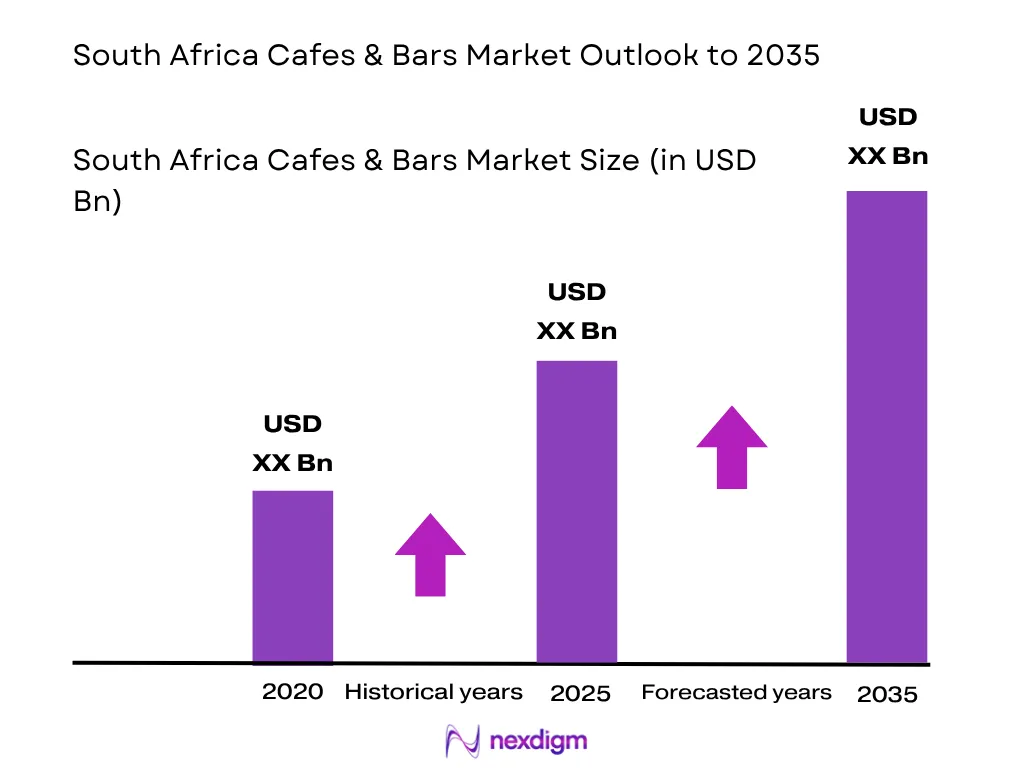
The South Africa Cafes & Bars Market is valued at approximately USD ~ billion, derived from Nexdigm Research, disclosed market value of USD ~ billion and its published growth trajectory. The wider official food-and-beverages-for-immediate-consumption industry generated USD ~ billion and then USD ~ billion in current-price income, showing the demand base supporting cafés, coffee shops, bars and dine-in beverage venues. Growth is driven by urban dining, coffee-led breakfast occasions, alcohol-led social occasions, delivery usage and tourism-linked footfall.
Dominance is concentrated in Johannesburg, Pretoria, Cape Town, Durban and Stellenbosch, because these cities combine office districts, malls, tourism nodes, nightlife streets, universities and higher-density middle-income consumers. South Africa recorded 8.92 million international arrivals, up from the prior annual base, while the formal foodservice survey covers VAT-registered restaurants, coffee shops, takeaways and catering operators. Cape Town benefits from tourism and specialty coffee, Gauteng from corporate daypart demand, and Durban from leisure, beachfront and suburban foodservice clusters.
Market Segmentation
By Outlet Type
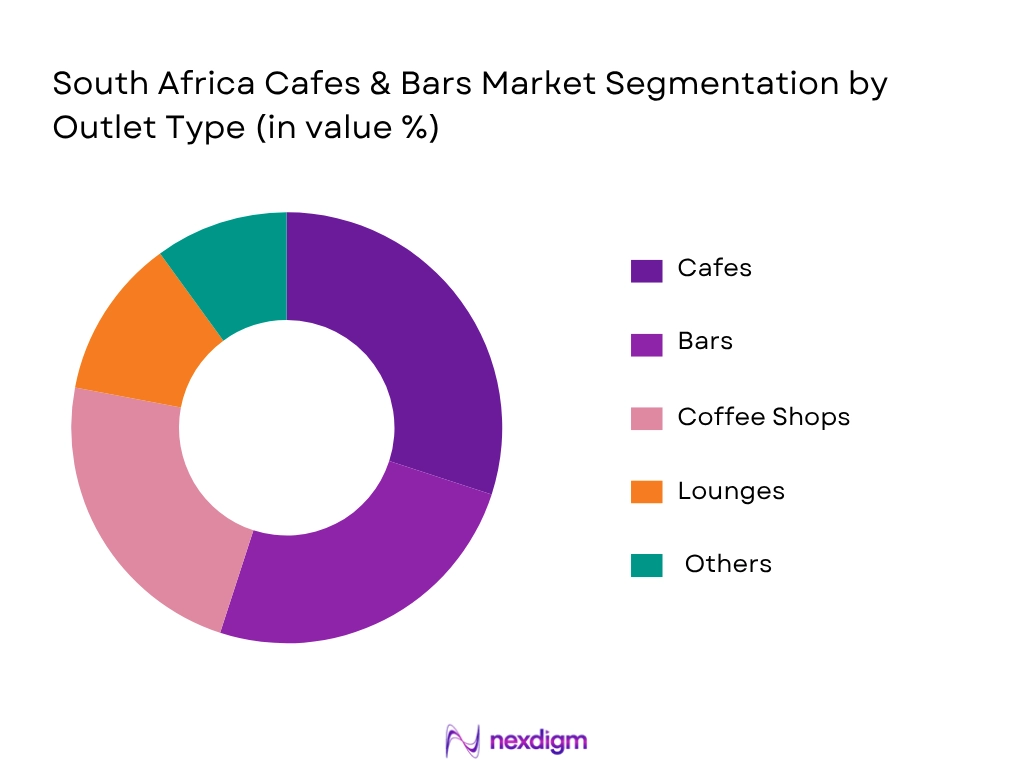
The South Africa Cafes & Bars Market is segmented by type into cafés, bars, coffee shops and lounges. Cafés dominate the market as they combine coffee, light meals, breakfast, brunch and casual dining under one operating model. This makes them less exposed to single-category demand than pure bars or pure coffee counters. Chains such as Mugg & Bean, tashas, Doppio Zero and Wimpy benefit from mall locations, family dining, office-area demand and high food attach rates. The segment also captures both weekday breakfast/lunch traffic and weekend leisure occasions. Nexdigm identifies cafés as the leading type segment, while coffee shops are highlighted as a fast-growth pocket, showing that café-led formats remain the core revenue anchor but specialist coffee formats are gaining strategic importance.
By Service Type
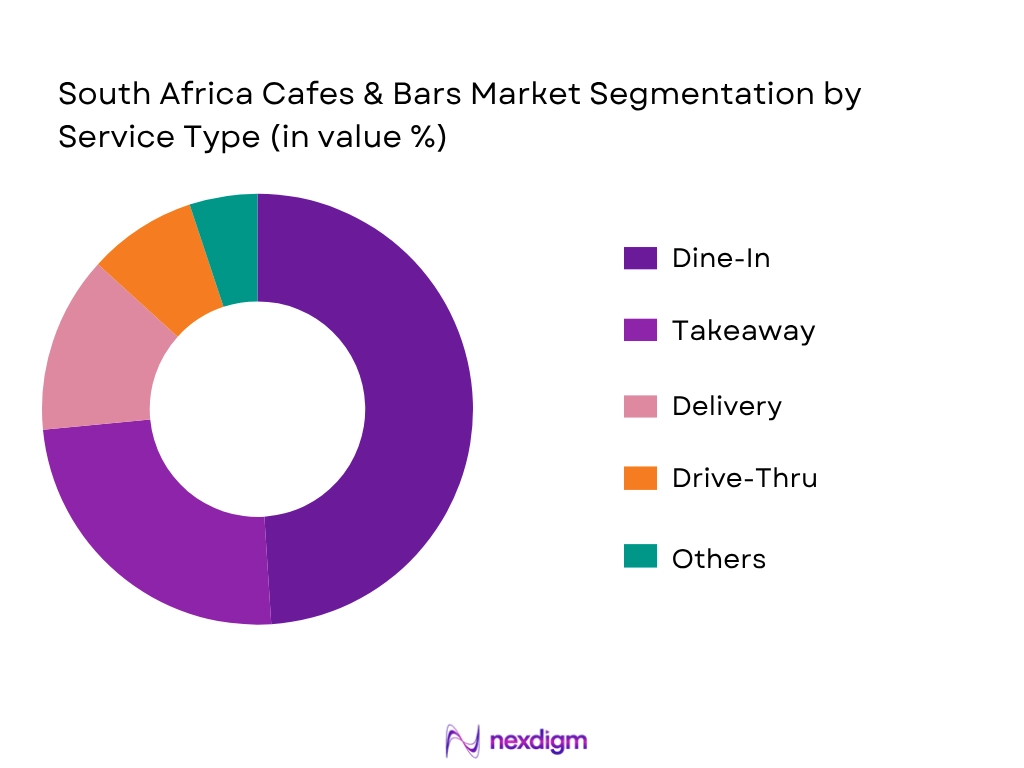
The South Africa Cafes & Bars Market is segmented by service type into dine-in, takeaway, delivery and drive-through. Dine-in holds the dominant position because cafés and bars are experience-led venues where ambience, seating, table service, alcohol consumption, Wi-Fi access and social interaction directly influence spending. Bars, lounges and brunch cafés depend heavily on dwell time, group occasions and higher-margin beverage upselling. Dine-in also supports higher basket values through desserts, cocktails, wine, draught beer and plated meals. Takeaway and delivery have expanded through Uber Eats, Mr D and brand-owned channels, but they remain better suited to coffee, bakery, breakfast and selected casual meals. Drive-through is growing through forecourt and commuter coffee formats, though it has not displaced dine-in as the core revenue driver.
Competitive Landscape
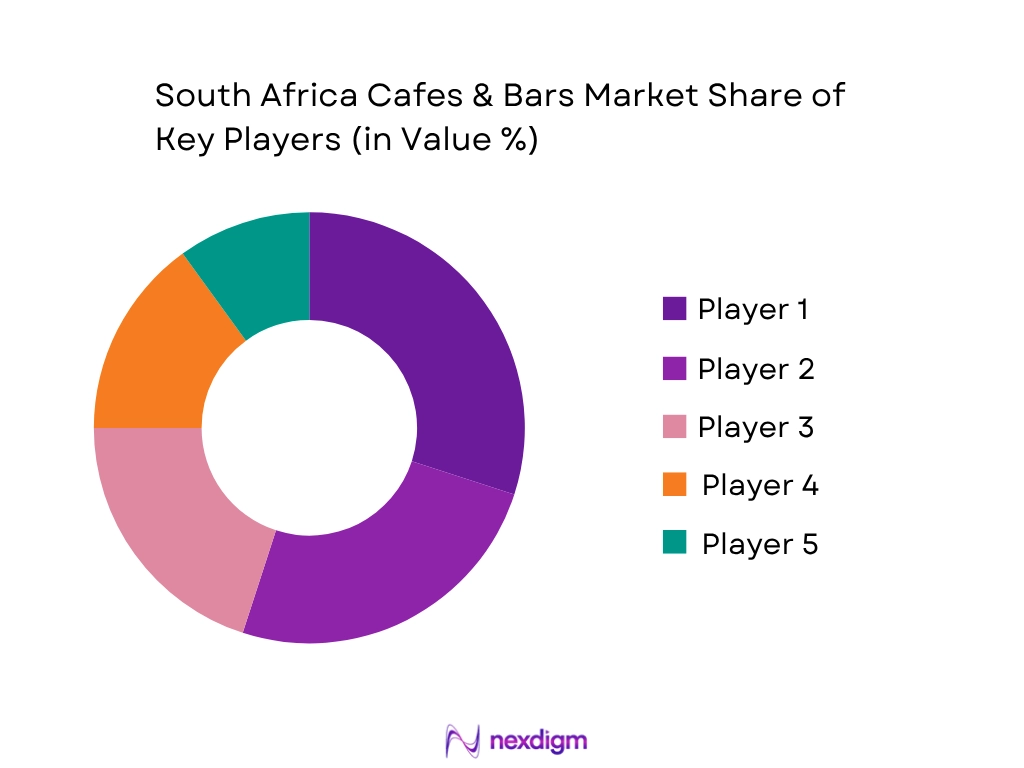
The South Africa Cafes & Bars Market is moderately fragmented, with national café chains, coffee specialists, casual-dining groups, hospitality-led bar brands and independent premium venues competing across different occasions. Franchise systems have stronger procurement, site access and brand recall, while independent cafés and cocktail bars differentiate through local sourcing, interiors, roastery partnerships, wine lists and experiential menus. Famous Brands strengthens the chain-led café ecosystem through Mugg & Bean and Wimpy, while vida e caffè, Seattle Coffee Company and Bootlegger compete strongly in coffee-led convenience and premium café formats.
| Player | Establishment Year | Headquarters | Core Format | Approx. Outlet Footprint | Beverage Positioning | Food Offering | Channel Strength | Strategic Edge |
| Mugg & Bean | 1996 | Midrand, South Africa | ~ | ~ | ~ | ~ | ~ | ~ |
| vida e caffè | 2001 | Cape Town, South Africa | ~ | ~ | ~ | ~ | ~ | ~ |
| Seattle Coffee Company | 1997 SA launch | Cape Town, South Africa | ~ | ~ | ~ | ~ | ~ | ~ |
| Bootlegger Coffee Company | 2012/2013 | Cape Town, South Africa | ~ | ~ | ~ | ~ | ~ | ~ |
| tashas | 2005 | South Africa / international group footprint | ~ | ~ | ~ | ~ | ~ | ~ |
South Africa Cafes & Bars Market Analysis
Growth Drivers
Urban Footfall
South Africa’s cafés and bars are supported by a large urban consumer base that concentrates weekday coffee demand, after-work drinking occasions, mall footfall, transport-node consumption and tourism-linked dining. World Bank data records South Africa’s total population at 64,007,187 people and urban population at 44,355,700 people in 2024, giving cafés, pubs, coffee shops and lounges a dense catchment for repeat visits in Gauteng, Western Cape and KwaZulu-Natal. The same source records GDP at USD 401.14 billion and GDP per capita at USD 6,267.2, indicating a sizeable formal consumption base despite weak economic growth. Stats SA’s tourism release recorded 8.9 million tourists in 2024, while 10.5 million tourists were recorded in 2025, strengthening café-bar demand in Cape Town, Johannesburg, Durban, Stellenbosch and airport/mall precincts. For operators, this urban-tourism combination increases breakfast coffee demand, brunch occasions, evening bar traffic and weekend leisure consumption. Urban footfall is therefore market-specific because café and bar sales depend directly on dense pedestrian flows, office clusters, tourist districts, universities, malls and nightlife zones rather than dispersed rural demand.
Café Culture
South Africa’s café culture is reinforced by formal restaurant-and-coffee-shop activity, digital discovery and tourism-led consumption. Stats SA’s food and beverages release shows restaurants and coffee shops generated R9,461.9 million in constant-price income during April–June 2025, compared with R9,153.1 million during the same period in 2024, confirming active demand for sit-down coffee, breakfast, brunch and light-meal formats. The World Bank records 78 people per 100 population using the internet in 2024, which supports mobile menu discovery, delivery-platform visibility, loyalty apps, reservations and social-media-led café discovery. The café segment also benefits from South Africa’s 64,007,187 total population and 44,355,700 urban population, because café occasions are concentrated around office nodes, malls, airports, universities, hospitals and suburban high streets. Tourism adds another layer: Stats SA recorded 8.9 million tourists in 2024 and 10.5 million tourists in 2025, supporting specialty cafés, waterfront cafés, hotel cafés and premium coffee destinations. This makes café culture a structural demand driver rather than a short-term trend, as cafés increasingly function as breakfast venues, workspaces, meeting points and lifestyle-led foodservice outlets.
Market Challenges
Load-Shedding Exposure
Load-shedding remains a market-specific operating risk for cafés and bars because espresso machines, grinders, refrigeration, ice machines, draft systems, kitchen equipment, lighting, music systems and payment terminals depend on reliable electricity. CSIR’s utility-scale power report states that South Africa’s actual load-shedding declined in 2024, with energy shed falling from 10.6 TWh in 2023 to 2.5 TWh in 2024; however, that still represents a material operational disruption for foodservice outlets. CSIR also reported 281 consecutive days without load-shedding as of 31 December 2024, while Eskom later reported only 26 hours of load-shedding between 1 April and 28 August 2025. The improvement reduces disruption, but it does not remove the exposure: cafés and bars still need backup power, generator maintenance, inverter systems, battery storage and alternative trading plans. CSIR also records total system load at 217.8 TWh in 2024, while coal generation supplied 177.9 TWh, showing that the market remains dependent on a centralized electricity system. For smaller independent cafés, township taverns and bars, this creates uneven resilience because larger chains can absorb backup-power investment more easily than single-site operators.
Food Inflation
Food inflation pressures cafés and bars through bakery items, meat, dairy, eggs, cooking oils, sauces, hot beverages and non-alcoholic beverages. Stats SA reported that food and non-alcoholic beverage inflation was 4.6 in June 2024, while hot beverages recorded 16.5, driven by drinking chocolate at 3.5 month-on-month, black tea at 2.7, instant coffee at 2.2 and rooibos tea at 1.6. This is highly relevant to cafés because coffee, tea, bakery products and breakfast menus sit at the centre of the café basket. Stats SA’s November 2024 CPI release recorded food and non-alcoholic beverages at 2.3, alcoholic beverages and tobacco at 4.5, and restaurants and hotels contributing 0.2 points to headline CPI. Cost pressure continued into 2026 in categories used by café-bar operators: Stats SA recorded food inflation at 4.4 in January 2026, meat at 13.5, beef steak at 31.2, stewing beef at 30.3, beef mince at 28.0, and non-alcoholic beverages at 4.2 in December 2025. These pressures restrict menu flexibility, increase gross-margin risk and make value engineering critical.
Market Opportunities
Premium Coffee
Premium coffee has a strong growth runway because South Africa’s café base is supported by urban concentration, tourism and digital consumption behaviour. The World Bank records 44,355,700 urban residents and 64,007,187 total residents in 2024, giving specialty cafés and branded coffee chains a large catchment in high-density nodes. Stats SA recorded restaurants and coffee shops at R9,461.9 million in constant-price income during April–June 2025, showing that coffee-led venues remain active within formal foodservice. Premium coffee is further supported by tourism: Stats SA recorded 8.9 million tourists in 2024 and 10.5 million tourists in 2025, creating demand for destination cafés, roastery-led formats, hotel cafés, airport coffee and lifestyle venues in Cape Town, Johannesburg, Durban and Stellenbosch. Digital adoption strengthens this opportunity because the World Bank records 78 internet users per 100 people in 2024, enabling app-based loyalty, online menu discovery, delivery orders and social-media visibility for specialty cafés. While food inflation affects hot beverages, premium coffee gives operators room to differentiate through single-origin beans, roastery partnerships, iced coffee, plant-based milk, branded merchandise and subscription-style loyalty programs.
Low/No-Alcohol
Low/no-alcohol beverages represent a future growth opportunity for cafés, bars and lounges because they allow operators to serve social drinking occasions without relying only on beer, spirits and wine. The opportunity is supported by South Africa’s large urban consumer base of 44,355,700 people in 2024, where bars, restaurants, malls and lifestyle precincts can test alcohol-free cocktails, premium soft drinks, kombucha, iced tea, non-alcoholic beer and functional beverages. WHO’s alcohol indicator, updated in 2025, defines adult alcohol consumption as litres of pure alcohol per person aged 15 years and above, and its global alcohol fact sheet records average male consumption at 8.2 litres and female consumption at 2.2 litres, highlighting the public-health relevance of moderation-led beverage alternatives. Stats SA’s December 2025 CPI data shows non-alcoholic beverages rose 4.2 in the 12 months to December, with cold beverages moving from 1.4 in November to 2.2 in December, confirming that non-alcoholic beverage categories are visible in household price tracking. For cafés and bars, this supports menu expansion across mocktails, premium mixers and daytime beverage occasions.
Future Outlook
The South Africa Cafes & Bars Market is expected to expand steadily as branded coffee chains, casual cafés, licensed bars and hybrid café-workspace formats increase penetration across major cities. Growth will be supported by tourism recovery, higher delivery adoption, forecourt coffee expansion, brunch-led dining and demand for premium cocktails, low/no-alcohol beverages and specialty coffee. However, operators will continue to manage electricity costs, liquor compliance, food inflation, rent pressure and consumer affordability. Nexdigm projects the market to reach USD 11,638.87 million, growing at 3.97% CAGR over the forecast horizon.
Major Players
- Mugg & Bean
- vida e caffè
- Seattle Coffee Company
- Starbucks South Africa
- Bootlegger Coffee Company
- Wimpy
- tashas
- Spur Steak Ranches
- RocoMamas
- Tiger’s Milk
- La Parada
- Doppio Zero
- News Café
- The Baron Group
- Hard Rock Café South Africa
Key Target Audience
- Café chain operators
- Bar, pub and lounge operators
- Restaurant and hospitality groups
- Coffee roasters and beverage suppliers
- Alcoholic beverage manufacturers and distributors
- Shopping mall owners and commercial real estate developers
- Investments and venture capitalist firms
- Government and regulatory bodies: Department of Tourism, Statistics South Africa, National Liquor Authority, South African Revenue Service, Provincial Liquor Boards, municipal licensing departments
Research Methodology
Step 1: Identification of Key Variables
The initial phase involves mapping the South Africa Cafes & Bars Market ecosystem, including café chains, independent coffee shops, bars, pubs, lounges, hotels, landlords, aggregators, alcohol distributors, coffee roasters and regulatory bodies. Variables include outlet count, beverage mix, food attach rate, dine-in share, bar sales, coffee sales, location type and licensing exposure.
Step 2: Market Analysis and Construction
Historical market performance is assessed using published foodservice, food-and-beverages and cafés-and-bars datasets. Revenue pools are reviewed across cafés, bars, coffee shops, dine-in formats, takeaway, delivery and drive-through. Market construction uses both top-down foodservice value reconciliation and bottom-up outlet-level assumptions based on average ticket size, daypart utilization and transaction frequency.
Step 3: Hypothesis Validation and Expert Consultation
Market hypotheses are validated through structured interviews with café operators, franchise executives, bar owners, beverage distributors, coffee roasters, commercial landlords and hospitality professionals. The validation process tests assumptions on outlet productivity, menu pricing, demand by city, delivery economics, liquor compliance and consumer occasion shifts.
Step 4: Research Synthesis and Final Output
The final stage consolidates secondary research, official statistics, company information, primary inputs and analyst models. Data is triangulated across formal foodservice income, published cafés-and-bars market values, competitor footprints and segment-level behaviour. The final output provides market sizing, segmentation, growth drivers, competitive benchmarking, outlook and strategic recommendations.

- Executive Summary
- Research Methodology (Market Definitions and Scope, Café-Bar Classification, On-Trade Liquor Assumptions, Foodservice Revenue Mapping, Outlet Universe Estimation, Formal vs Informal Channel Treatment, Primary Interview Coverage, Franchisee Validation, Menu Price Basket, Coffee Bean Consumption Model, Alcohol Pour-Size Assumptions, Bottom-Up Outlet Sampling, Top-Down Foodservice Revenue Reconciliation, Limitations and Forecast Confidence)

- Definition and Scope
- Market Genesis
- Evolution of Coffee Shops, Casual Cafés, Pubs, Taverns and Cocktail Bars
- Business Cycle
- Value Chain and Supply Chain Analysis
- Formal and Informal Ecosystem Mapping
- Role of Franchise Networks, Independent Operators and Township Liquor Venues
- Demand Concentration Across Urban, Mall, High-Street, Tourism and Township Locations

- Growth Drivers (Urban Footfall, Café Culture, Tourism Recovery, Remote Work, Nightlife Demand)
- Market Challenges (Load-Shedding Exposure, Food Inflation, Liquor Licensing, Safety, Rent Pressure)
- Market Opportunities (Premium Coffee, Low/No-Alcohol, Loyalty Apps, Township Formalization, Tourism Nodes)
- Market Trends (Third-Wave Coffee, Hybrid Café Workspaces, Mixology, Delivery, Sustainability)
- Government Regulation (Liquor Licence, Food Safety, Employment, VAT, Zoning, Municipal By-Laws)
- SWOT Analysis (Franchise Scale, Independent Differentiation, Cost Exposure, Digital Upside)
- Porter’s Five Forces Analysis (Supplier Power, Buyer Power, New Entrants, Substitutes, Rivalry)
- Value Chain Analysis (Coffee Importers, Roasters, Breweries, Distributors, Aggregators, Operators, Landlords)
- Supply Chain Analysis (Beans, Dairy, Bakery Inputs, Alcohol, Cold Chain, Packaging, Equipment Maintenance)
- Unit Economics Analysis (Rent-to-Sales, Labour Cost Ratio, Beverage Gross Margin, Food Gross Margin, Utilities Cost, Delivery Commission)
- Pricing Analysis (Flat White, Cappuccino, Breakfast Plate, Draught Beer, House Wine, Cocktail, Bar Snack Basket)
- Demand and Utilization Analysis (Seat Turnover, Dwell Time, Daypart Footfall, Weekend Peak Load, Event Occupancy)
- Consumer Behaviour Analysis (Occasion, Spend Frequency, Brand Loyalty, Menu Preference, Channel Preference)
- Competitive Ecosystem (Franchise Café Chains, Casual Dining Cafés, Coffee Specialists, Hospitality Groups, Bars, Taverns)

- By Value (2020-2025)
- By Transaction Volume (2020-2025)
- By Number of Outlets (2020-2025)
- By Average Ticket Size (2020-2025)
- By Coffee Cup Sales Volume (2020-2025)
- By Alcoholic Beverage Sales Value (2020-2025)
- By Delivery and Takeaway Gross Merchandise Value (2020-2025)

- By Outlet Format (In Value%)
Specialty Coffee Shops
Bakery Cafés
Bars and Pubs
Cocktail Bars and Lounges
Taverns and Shebeens
Hotel Cafés and Bars
Nightclubs and Late-Night Venues - By Ownership Model (In Value%)
Franchise-Owned Outlets
Independent Operators
Hotel-Affiliated Venues
Township and Informal Operators
Multi-Brand Hospitality Groups - By Beverage Type (In Value%)
Espresso-Based Coffee
Filter and Brew Bar Coffee
Tea and Hot Beverages
Beer and Draught
Wine and Sparkling Wine
Spirits and Cocktails
Non-Alcoholic Beverages
Ready-to-Drink and Low/No-Alcohol Beverages - By Food Offering (In Value%)
Breakfast and Brunch
Bakery and Pastry
Light Meals and Café Dining
Bar Snacks and Sharing Plates
Premium Casual Dining
Township Grill/Braai and Local Plates
Desserts and Confectionery - By Service Model (In Value%)
Dine-In
Takeaway
Delivery Aggregator
Click-and-Collect
Counter Service
Table Service
Hybrid Daypart Service - By Price Positioning (In Value%)
Economy
Mass-Market
Mid-Market
Premium
Luxury/Lifestyle - By Location Type (In Value%)
Shopping Malls
High Streets
CBD and Office Nodes
Transport Hubs
Tourism Precincts
Residential Suburbs
Township Nodes
University and Student Areas - By Region (In Value%)
Gauteng
Western Cape
KwaZulu-Natal
Eastern Cape
Free State
Mpumalanga
Limpopo
North West
Northern Cape - By Customer Cohort (In Value%)
Office Workers
Students
Tourists
Affluent Urban Consumers
Price-Sensitive Mass Consumers
Township Consumers
Remote Workers and Freelancers
Nightlife Consumers - By Order Channel (In Value%)
Walk-In
Reservation Platforms
Delivery Apps
Brand-Owned Apps
WhatsApp and Social Ordering
Corporate Catering and Events

- Market Share of Major Players (Foodservice Value, Outlet Count, Transaction Share)
Market Share by Café and Bar Format (Coffee Chains, Café Restaurants, Specialty Cafés, Bars and Pubs, Taverns) - Cross Comparison Parameters (Outlet Footprint and Regional Penetration, Average Ticket Size and Menu Price Basket, Beverage Revenue Mix: Coffee, Alcohol and Non-Alcoholic Beverages, Franchise vs Company-Owned Outlet Mix, Daypart Coverage: Breakfast, Lunch, After-Work, Late Night, Delivery, Takeaway and Loyalty App Capability, Liquor Licence Coverage, On-Trade Beverage Portfolio)
- SWOT Analysis of Major Players (Brand Equity, Outlet Productivity, Menu Differentiation, Cost Resilience)
- Pricing Benchmark of Major Players (Coffee Basket, Breakfast Basket, Draught Beer, Cocktail, Wine-by-Glass, Bar Snack Basket)
- Digital and Delivery Benchmarking (Aggregator Presence, Own App, Loyalty Program, Ratings, Online Menu Coverage)
- Franchise Model Benchmarking (Initial Investment, Royalty, Franchisee Support, Site Selection, Supply Tie-Ins)
- Detailed Profiles of Major Companies
Mugg & Bean
vida e caffè
Seattle Coffee Company
Starbucks South Africa
Bootlegger Coffee Company
Wimpy
tashas
Spur Steak Ranches
RocoMamas
Tiger’s Milk
La Parada
Doppio Zero
News Café
The Baron Group
Hard Rock Café South Africa

- Office Worker Demand (CBD Footfall, Breakfast Coffee, Lunch Attach Rate, After-Work Drinks)
- Student Demand (Price Sensitivity, Wi-Fi Usage, Group Seating, Late-Night Consumption)
- Tourist Demand (Destination Cafés, Hotel Bars, Waterfront Locations, Local Wine and Cocktail Experiences)
- Township Consumer Demand (Tavern Footfall, Beer Preference, Social Drinking, Local Food Pairing)
- Affluent Urban Consumer Demand (Premium Coffee, Brunch, Cocktails, Wine Bars, Lifestyle Venues)
- Remote Worker Demand (Dwell Time, Plug Points, Wi-Fi, Coffee Refill Behaviour)
Nightlife Consumer Demand (Weekend Peaks, Music Events, Cocktails, Bottle Service, Safety Expectations) - Needs, Desires and Pain Point Analysis (Value Meals, Speed of Service, Safety, Ambience, Consistency, Digital Convenience)
- Decision-Making Process (Location, Menu Price, Social Proof, Brand Trust, Alcohol Availability, Reservation Ease)

- By Value (2026-2035)
- By Transaction Volume (2026-2035)
- By Number of Outlets (2026-2035)
- By Average Ticket Size (2026-2035)
- By Coffee Cup Sales Volume (2026-2035)
- By Alcoholic Beverage Sales Value (2026-2035)
- By Delivery and Takeaway Gross Merchandise Value (2026-2035)


 Request a Sample
 Ask for Customization
 Get a Quote
 Enquire Now