

 Download PDF
Market Overview
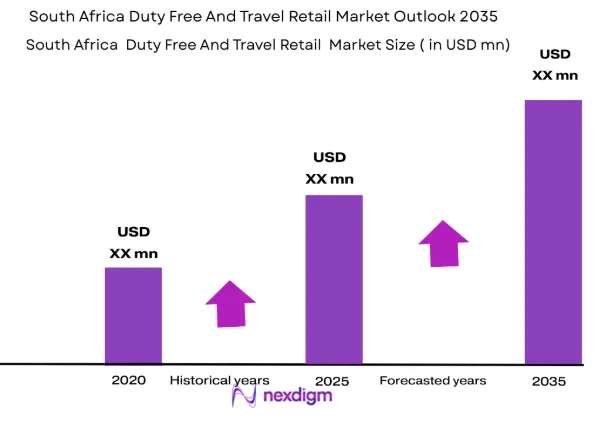
The South Africa Duty Free and Travel Retail Market is valued at approximately USD ~ million, supported by the recovery of international travel, increasing airport passenger throughput, rising spending on premium products, and expansion of airport retail infrastructure. International tourism activity has strengthened significantly, with South Africa recording approximately 2.4 million international tourist arrivals during the first quarter alone, reflecting strong inbound travel momentum. Growth is further supported by increasing purchases of perfumes, cosmetics, wines & spirits, luxury accessories, and tobacco products at major travel hubs.
Johannesburg, Cape Town, and Durban dominate the South African duty free and travel retail ecosystem due to their concentration of international passenger traffic, premium airport infrastructure, and established duty free operations. O.R. Tambo International Airport serves as the country’s primary international gateway, while Cape Town International Airport has surpassed 10 million annual passengers, creating substantial retail opportunities. These cities also benefit from strong tourism inflows, airline connectivity, business travel demand, and the presence of leading travel retail operators offering extensive luxury and destination-focused product portfolios.
Market Segmentation
By Product Category
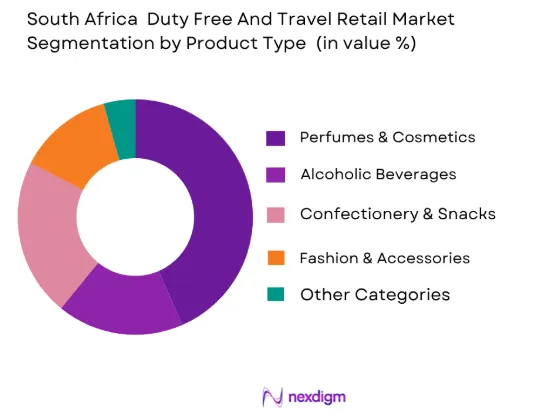
SBy Product Category Beauty & Personal Care dominates the South Africa Duty Free and Travel Retail Market. The segment benefits from strong traveler preference for tax-free luxury fragrances, skincare products, cosmetics, and travel-exclusive beauty collections. International brands frequently launch airport-exclusive offerings that attract both leisure and business travelers. Premiumization trends among African, European, Middle Eastern, and Asian travelers have increased spending on high-margin beauty products. Duty free shoppers also perceive beauty products as value purchases due to tax savings compared with domestic retail channels. The segment further benefits from impulse purchasing behavior, strategic placement within departure terminals, extensive promotional campaigns, and growing demand for prestige skincare and fragrance products among international travelers transiting through major airports such as Johannesburg and Cape Town.
By Distribution Channel
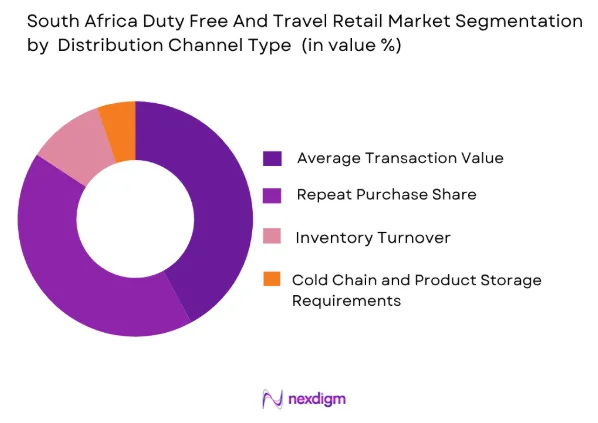
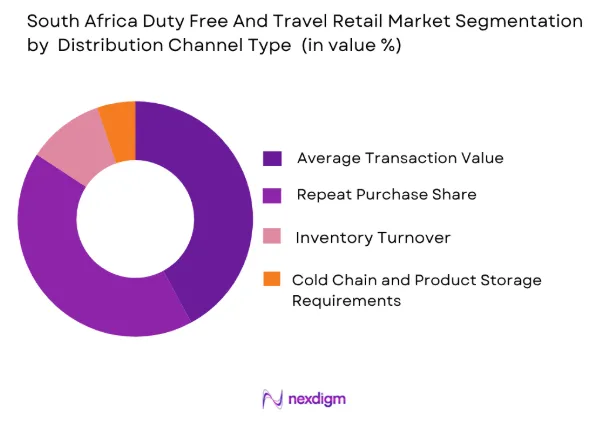
Airport Duty Free Stores account for the largest share due to South Africa’s highly concentrated international travel infrastructure. Major airports such as O.R. Tambo International Airport, Cape Town International Airport, and King Shaka International Airport serve as primary points for duty free transactions. These locations offer extensive retail space, premium brand assortments, and high passenger footfall. Airport operators and retailers continuously invest in experiential retail concepts, digital shopping solutions, and luxury brand partnerships to increase passenger spending. Travelers often allocate time before departure for shopping, making airports the most effective retail environment. Additionally, click-and-collect services integrated with airport stores further strengthen the dominance of this channel by improving convenience and purchase conversion rates.
Competitive Landscape
The South Africa Duty Free and Travel Retail Market is moderately consolidated, with a mix of international travel retail groups, airport-focused operators, luxury retailers, and regional duty free specialists. Major operators leverage airport concessions, exclusive brand partnerships, digital pre-order platforms, and premium traveler experiences to maintain competitive advantage. Airport retail remains the most important competitive battleground, with operators focusing on passenger conversion rates, spend per traveler, and premium product portfolios.
| Company | Establishment Year | Headquarters | Retail Footprint | Product Portfolio Coverage | Premium Brand Partnerships | Digital Integration | Exclusive Travel SKUs | Shopper Engagement |
| Dubai Duty Free | 1983 | UAE | ~ | ~ | ~ | ~ | ~ | ~ |
| Avolta AG | 1865 | Switzerland | ~ | ~ | ~ | ~ | ~ | ~ |
| Lagardère Travel Retail | 1994 | France | ~ | ~ | ~ | ~ | ~ | ~ |
| Heinemann Group | 1879 | Germany | ~ | ~ | ~ | ~ | ~ | ~ |
| DFS Group | 1960s | Hong Kong | ~ | ~ | ~ | ~ | ~ | ~ |
South Africa Duty Free and Travel Retail Market Analysis
Growth Drivers
Increasing International Passenger Traffic
South Africa’s duty free and travel retail market is significantly supported by rising international passenger traffic through key airports, including Johannesburg O.R. Tambo, Cape Town International, and King Shaka International. Growing tourism from Europe, Asia, the Middle East, and intra‑African corridors has increased footfall at airport and border retail outlets. Higher volumes of transit passengers with extended layovers amplify opportunities for retail engagement, particularly in premium categories such as perfumes, cosmetics, wines, and spirits. Frequent international travel has also cultivated repeat shoppers who actively seek duty free exclusives. This sustained growth in passenger numbers directly correlates with higher per‑traveler expenditure, stimulating revenue growth and encouraging further investment in airport and travel retail infrastructure to capitalize on the expanding market.
Expansion of Airport and Border Retail Infrastructure
Significant investments in airport renovations and border retail facilities have expanded the footprint and visibility of duty free offerings across South Africa. Upgrades at major international terminals include larger, more modern retail spaces, curated luxury displays, and enhanced customer flow designs to optimize shopper experience. Border retail outlets along routes to Zimbabwe, Mozambique, and Botswana are being modernized to capture regional travel demand. These infrastructure improvements facilitate greater product assortment, allow premium brand visibility, and encourage impulse purchases by high‑spending travelers. Additionally, improved operational logistics and point-of-sale systems increase efficiency, reducing queue times and enhancing convenience. Such strategic expansion strengthens the overall market, attracting both domestic and international passengers to duty free shopping zones.
Market Challenges
Regulatory Complexity and Licensing Requirements
South Africa’s duty free and travel retail market operates within a complex regulatory framework, which includes multiple licensing, customs, and operational compliance requirements. Retail operators must navigate permits for airport concessions, border stores, and onboard airline retail, with category-specific regulations for alcohol, tobacco, and luxury goods. Compliance audits, inspections, and varying provincial or federal requirements create administrative burdens, often increasing operational costs and delaying market entry. Additionally, periodic policy updates and import restrictions introduce uncertainty, requiring retailers to remain agile and well-informed. Navigating this regulatory complexity limits new entrants, affects product assortment flexibility, and requires dedicated legal and compliance resources, representing a key barrier to scaling operations in South Africa’s duty free and travel retail landscape.
Currency Volatility and Import Costs
Fluctuations in the South African rand against major currencies, particularly USD and EUR, directly impact duty free import costs, particularly for premium and luxury goods. Internationally sourced perfumes, cosmetics, spirits, and fashion items are priced in foreign currencies, and volatility increases procurement expenses, squeezing retailer margins. To maintain competitiveness, duty free operators may pass these costs to consumers, which can affect perceived value relative to domestic retail channels. Currency swings also complicate pricing strategies and forecasting, increasing financial risk. Supply contracts, hedging strategies, and dynamic pricing are required to mitigate these risks, but sustained volatility can reduce profitability, constrain product availability, and disrupt overall market stability in South Africa’s travel retail sector.
Market Opportunities
Expansion of Lifestyle and Experiential Retail Concepts
South Africa’s duty free and travel retail market has strong potential to grow through lifestyle-oriented and experiential retail formats. Retailers can enhance engagement by creating interactive shopping environments, curated brand spaces, sampling stations, and immersive experiences that encourage exploration and extended dwell time. Airports and border outlets can integrate cultural themes, luxury service offerings, and personalized shopping assistance to elevate the traveler experience. Experiential retail also supports higher conversion rates for premium products, as consumers are more likely to purchase after tactile interaction or guided demonstrations. By prioritizing experience-driven design, duty free operators can differentiate from domestic retail competition, foster brand loyalty, and increase per-customer spending across luxury and lifestyle product categories.
Growth in Luxury, Premium, and Sustainable Product Offerings
Increasing demand for luxury, premium, and sustainably sourced products offers substantial opportunities for South Africa’s travel retail operators. Travelers, particularly high-income international visitors, are increasingly interested in ethically produced, eco-friendly, or regionally sourced items, including South African wines, craft spirits, designer accessories, and beauty products. Retailers that expand curated assortments with certified sustainable brands or travel-exclusive luxury editions can differentiate their offerings, appealing to conscious and affluent consumers. Highlighting provenance, ethical sourcing, and limited editions enhances perceived value and encourages higher spend per transaction. This trend allows duty free and travel retail outlets to attract new shopper segments while strengthening South Africa’s position as a hub for premium and sustainable travel retail experiences.
Future Outlook
The South Africa Duty Free and Travel Retail Market is expected to witness sustained expansion driven by increasing international passenger volumes, tourism recovery, airport modernization initiatives, and premiumization trends. Growth in long-haul travel, digital retail integration, and rising disposable income among travelers will further enhance spending within duty free channels. Additional growth opportunities are expected from click-and-collect services, personalized traveler promotions, luxury brand expansion, experiential retail concepts, and improved airport infrastructure. The continued development of tourism corridors and enhanced airline connectivity across Africa are likely to strengthen the market’s long-term growth trajectory. Rising demand for premium beauty products, spirits, and luxury accessories will remain key revenue drivers throughout the forecast period.
Major Players
- Big Five Duty Free
- Tourvest Retail Services
- Gebr. Heinemann
- Avolta (Dufry)
- DFS Group
- Lagardère Travel Retail
- Qatar Duty Free
- Dubai Duty Free
- Flemingo International
- WHSmith Travel Retail
- ARI (Aer Rianta International)
- Lotte Duty Free
- Shilla Duty Free
- King Power International
- Duty Free Americas
Key Target Audience
- Airport Operators and Airport Authorities
- Government and Regulatory Bodies
- Duty Free and Travel Retail Operators
- Luxury Brand Owners and Global Consumer Goods Manufacturers
- Wines, Spirits and Tobacco Producers
- Airline Companies and Inflight Retail Operators
- Investments and Venture Capitalist Firms
- Travel Technology and Digital Commerce Solution Providers
Research Methodology
Step 1: Identification of Key Variables
The study begins with the development of a comprehensive ecosystem map covering airport operators, duty free retailers, airlines, tourism agencies, luxury goods suppliers, and regulatory authorities. Extensive secondary research is conducted through industry databases, company disclosures, tourism statistics, aviation reports, and trade publications to identify critical market variables influencing revenue generation and passenger spending.
Step 2: Market Analysis and Construction
Historical market data is compiled and analyzed to assess passenger traffic trends, traveler spending patterns, retail productivity, duty free penetration rates, airport concession performance, and product category demand. Both top-down and bottom-up methodologies are utilized to construct accurate market estimates and validate revenue streams.
Step 3: Hypothesis Validation and Expert Consultation
Market assumptions are validated through structured interviews with airport retail operators, brand owners, airline representatives, airport authorities, and travel retail specialists. These consultations provide operational insights regarding traveler preferences, category performance, retail margins, and future expansion strategies.
Step 4: Research Synthesis and Final Output
The final stage integrates primary and secondary findings into a consolidated market framework. Cross-verification is conducted using financial reports, passenger traffic statistics, retail sales indicators, and expert interviews to ensure accuracy, consistency, and reliability of market forecasts and strategic recommendations.

- Executive Summary
- Research Methodology (Market Definitions and Assumptions, Abbreviations, Research Framework, Bottom-Up Market Estimation, Top-Down Validation, Airport and Border Retail Mapping, Duty-Free Trade Flow Analysis, Primary Interviews with Retailers, Operators, and Distributors, Forecasting Model, Limitations and Assumptions)

- Definition and Scope
- Evolution of Duty-Free and Travel Retail in South Africa
- Industry Ecosystem and Stakeholder Mapping
- Supply Chain and Value Chain Analysis
- Retail Infrastructure and Airport Concessions Landscape
- Import, Licensing, and Regulatory Flow

- Growth Drivers
Increasing International Passenger Traffic
Expansion of Airport and Border Retail Infrastructure
Rising Demand for Premium and Luxury Goods
Growth of Travel Retail E-Commerce and Digital Platforms - Market Challenges
Regulatory Complexity and Licensing Requirements
Currency Volatility and Import Costs
Competition from Domestic Retail Channels
Supply Chain Disruptions - Market Opportunities
Expansion of Lifestyle and Experiential Retail Concepts
Growth in Luxury, Premium, and Sustainable Product Offerings
Integration of Digital Payments and Loyalty Programs
Regional Trade and Freeport Opportunities - Market Trends
Premiumization of Duty-Free Offerings
Smart Retail and IoT-enabled Store Monitoring
Sustainable and Local Product Adoption
Cashless and Omnichannel Travel Retail Experiences - Government Regulations
Duty-Free Licensing and Compliance
Import and Customs Regulations
Environmental and Packaging Regulations
Trade Agreements Impacting Duty-Free - Porter’s Five Forces Analysis
- PESTLE Analysis
- Pricing Analysis
- Competition Ecosystem

- By Value, 2020-2025
- By Volume, 2020-2025
- By Product Category Revenue, 2020-2025
- By Average Transaction Value, 2020-2025

- By Product Category (in Value %)
Perfumes & Cosmetics
Alcoholic Beverages (Wine, Spirits, Beer)
Tobacco Products
Confectionery & Snacks
Fashion & Accessories
Other Categories - By Retail Channel (in Value %)
Airport Concessions
Border Posts & Land Ports
Cruise Terminals
Online Duty-Free / Travel Retail Platforms - By Consumer Type (in Value %)
International Travelers
Domestic Travelers
Business vs Leisure Segments - By Distribution Channel
Average Transaction Value
Repeat Purchase Share
Inventory Turnover
Cold Chain and Product Storage Requirements - By Geography (in Value %)
Gauteng (OR Tambo International, Lanseria)
Western Cape (Cape Town International)
KwaZulu-Natal (King Shaka International)
Other Provinces

- Market Share Analysis of Major Players (Revenue & Footfall)
- Cross Comparison Parameters (Company Overview, Retail Footprint, Product Portfolio, Licensing, Digital Capabilities, Value-Added Services, Sustainability Initiatives, Loyalty Programs, EBITDA Margins, Strategic Partnerships)
- Competitive Benchmarking Matrix
- SWOT Analysis of Major Players
- Pricing Analysis by Product Category and Channel
- Detailed Profiles of Major Companies
Dufry South Africa
Nuance Group South Africa
Bidvest Travel Retail
Shoprite Travel Retail Division
Lekker Retail Duty Free
Distell Duty‑Free Distribution
Clicks Duty Free
Edgars Travel Retail Division
Truworths Travel Retail / Duty Free Segment
Exclusive Books Duty Free Concessions
Imperial Logistics Duty Free Services
Puma Energy Duty Free & Retail
Bidfood Travel Retail Supplies
Travel Retail Africa (Independent Operator)
Airport Company South Africa (ACSA) Concession Partners

- Traveler Demographics and Behavior
- Purchasing Patterns and Frequency
- Price Sensitivity Analysis
- Luxury vs Value Preferences
- Sustainability and Ethical Sourcing Awareness

- By Value, 2026-2035
- By Volume, 2026-2035
- By Product Category Revenue, 2026-2035
- By Average Transaction Value, 2026-2035


 Request a Sample
 Ask for Customization
 Get a Quote
 Enquire Now