

 Download PDF
Market Overview
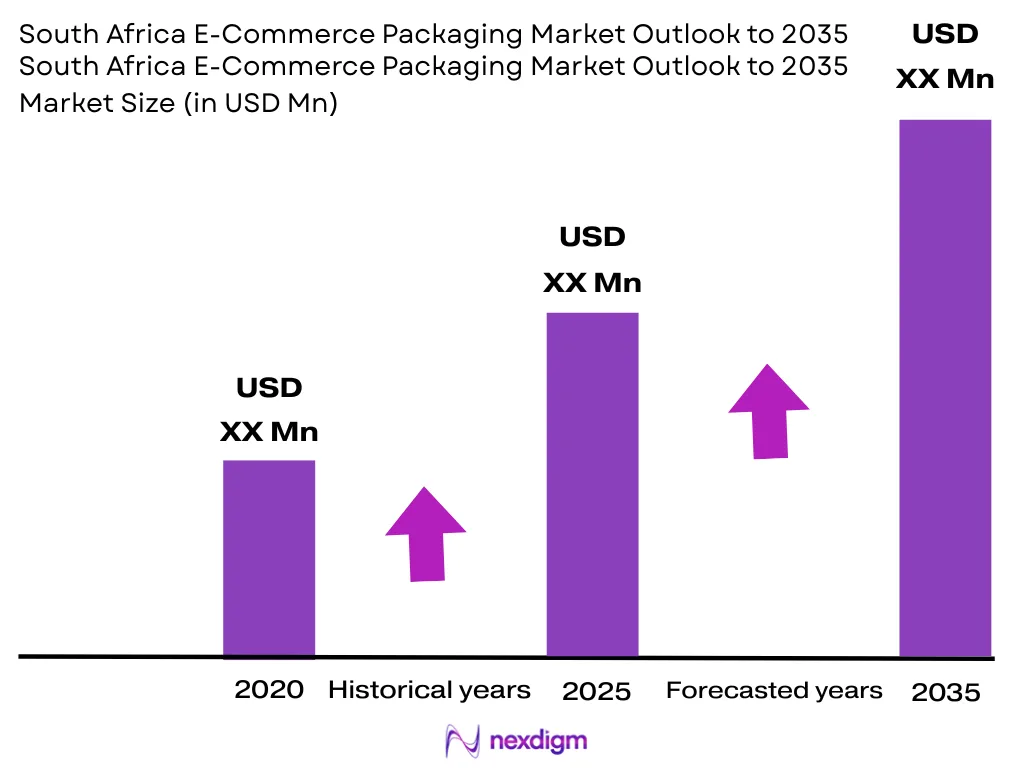
The South Africa E-Commerce Packaging Market was valued at USD ~ Million in 2024 and is anticipated to expand at a CAGR of ~ % during 2026–2035. The market is primarily driven by rapid growth of online grocery and dark-store delivery, entry of global fast-fashion marketplaces, and rising Buy-Now-Pay-Later adoption among younger shoppers. According to Verified Market Research, the South Africa packaging market surpassed USD 10.82 billion in 2024 and is projected to reach USD 16.11 billion by 2032, with the country’s e-commerce boom playing a significant role in driving market expansion. Domestic players account for 76 percent of South Africa’s packaging market, according to Verified Market Research, reflecting a robust local manufacturing ecosystem sustaining consistent demand for durable, damage-resistant packaging across fashion, groceries, electronics, and beauty e-commerce categories.
Market Segmentation
By Material
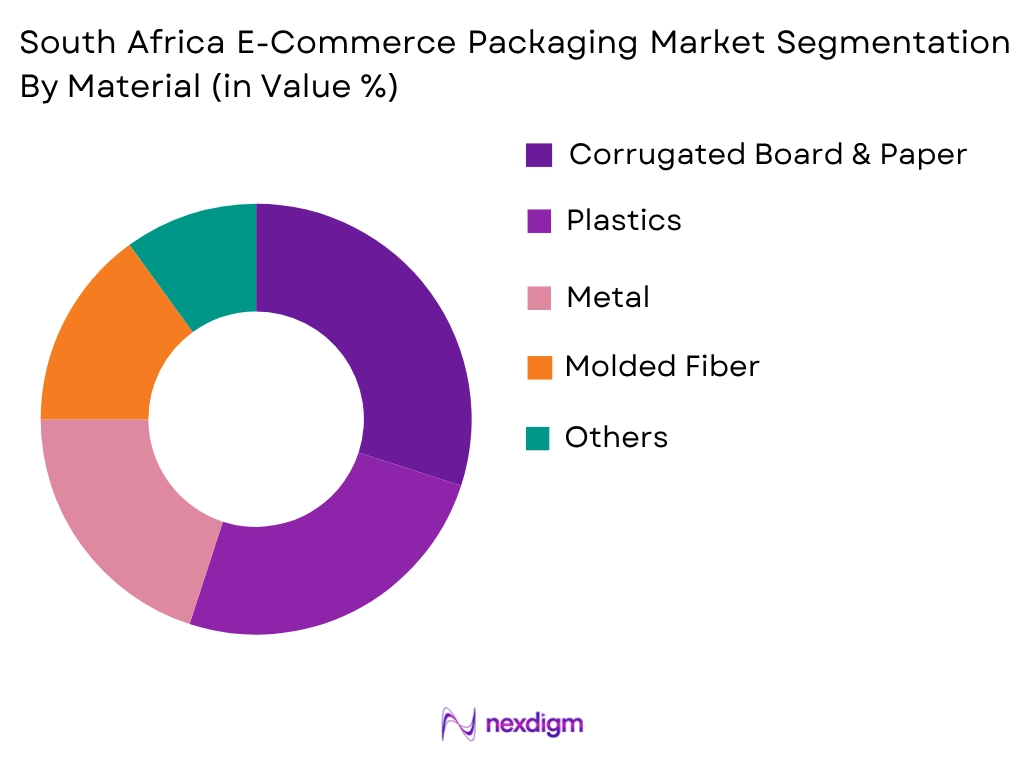
Among these, Corrugated Board & Paper holds a significant share of the South Africa E-Commerce Packaging Market, with domestic containerboard capacity under active expansion to meet rising demand. Corrugated-box orders climbed after citrus exports hit 163 million cartons in the 2024-2025 season, forcing linerboard imports and prompting Sappi to add 220,000 metric tons of containerboard capacity by late 2026 through its Somerset Mill conversion to containerboard, according to Mordor Intelligence. At the same time, Plastics remain significant, with the South Africa plastic packaging market valued at USD 8.6 billion in 2024, according to Market Research Future, with e-commerce identified as the fastest-growing application segment for plastic packaging. Retailer mandates for recyclable substrates have accelerated mono-material film uptake, though converter profitability remains under pressure as raw-material surcharges cannot always be passed on immediately, prompting many players to consider vertical integration into pulp or resin recycling to defend margins.
By End-Use Category
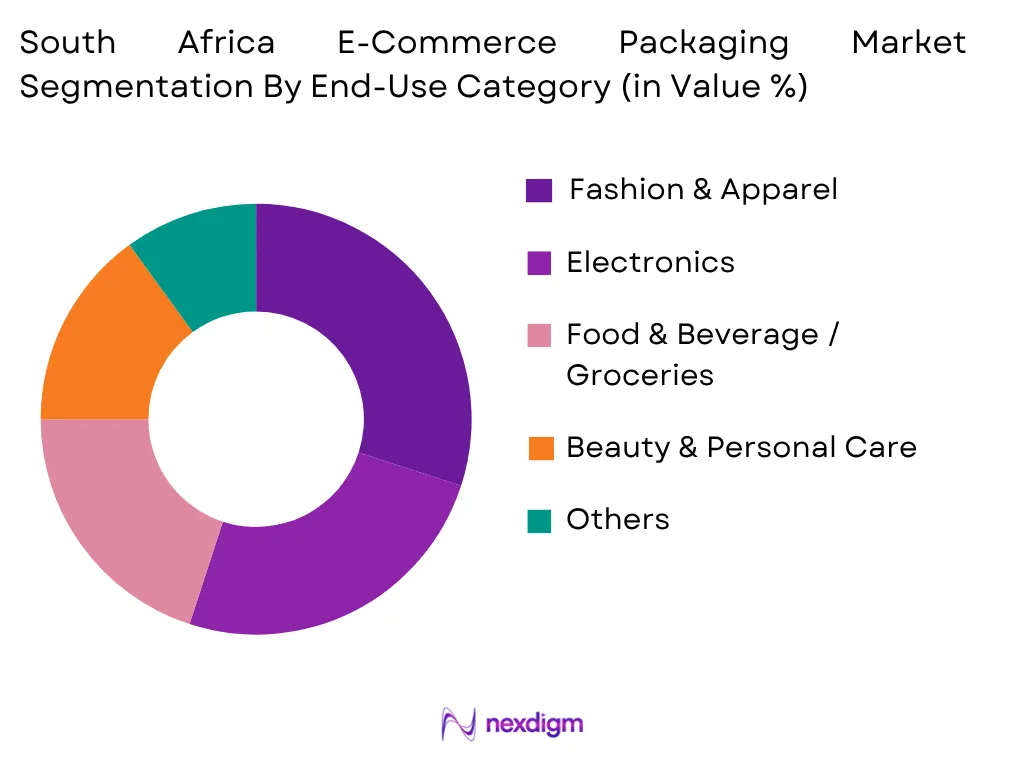
The Fashion & Apparel segment holds the largest share, accounting for 24.67 percent of e-commerce revenue in 2025, buoyed by Shein and Temu’s combined 37.1 percent hold on online clothing sales in 2024, according to Mordor Intelligence, despite a 45 percent import levy on fashion imports. Meanwhile, Food & Beverages and grocery e-commerce is forecast to grow at an 11.68 percent CAGR, the fastest of any category, as dark-store networks slash fulfillment times to under 60 minutes in major metros. The South Africa e-commerce market attached to groceries expanded sharply after Checkers Sixty60 recorded ZAR 18.9 billion (USD 1.15 billion) in sales in 2024 and extended web ordering in 2025, directly increasing demand for cold-chain-compatible and insulated grocery delivery packaging. Electronics, beauty, and furniture categories followed in the 12 to 16 percent revenue share range, each requiring specialized protective packaging formats.
Competitive Landscape
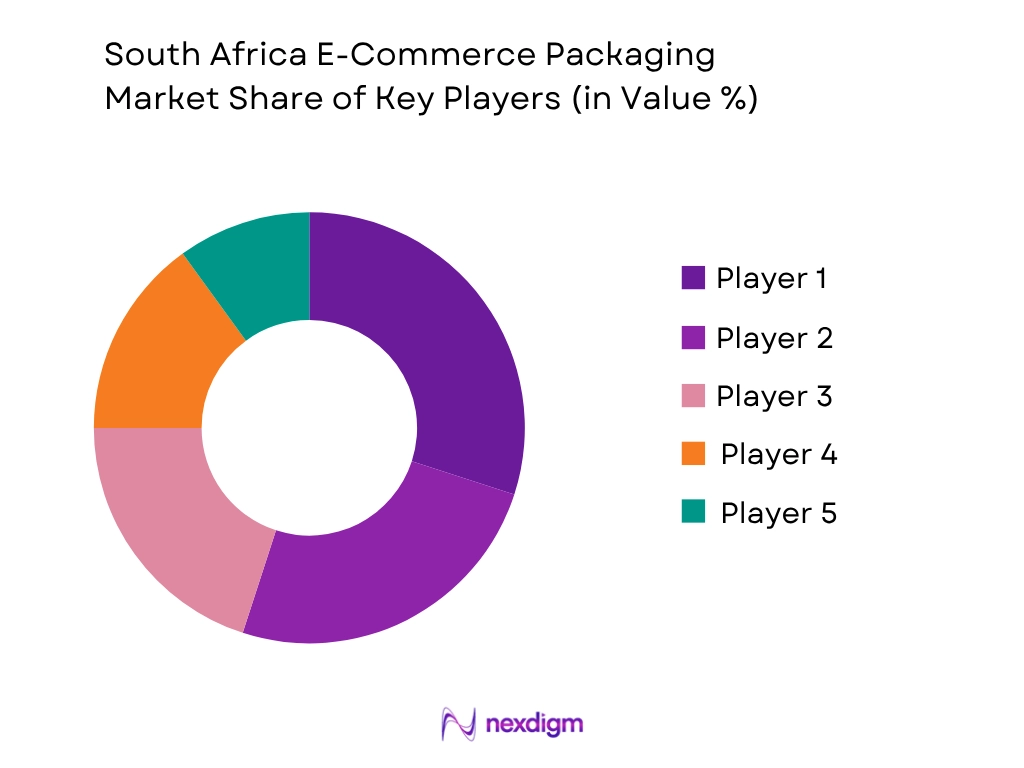
The South Africa E-Commerce Packaging Market is moderately consolidated, combining large domestic pulp and paper majors with multinational packaging companies. Sappi Limited, a South African-headquartered global pulp and paper producer, is actively expanding containerboard capacity to meet rising e-commerce and agricultural export demand. Mondi plc, Nampak Limited, Constantia Flexibles GmbH, Huhtamäki Oyj, and Smurfit Westrock plc are identified among the leading companies in South Africa’s broader packaging industry, according to Mordor Intelligence. Premium glass bottles have gained favor as craft-beer launches seek shelf differentiation, while retailer mandates for recyclable substrates continue to accelerate mono-material film adoption across the industry. Converter profit remains under pressure as raw-material surcharges cannot always be passed on immediately, prompting many players to pursue vertical integration into pulp or resin recycling to defend margins and secure long-term supply resilience.
| Company | Established | Headquarters | Primary Product Portfolio | Natural Color Portfolio | Manufacturing Presence | Major End-Use Industries | Key Strategic Focus | Certifications & Compliance |
| Sappi Limited | 1936 | ~ | ~ | ~ | ~ | ~ | ~ | ~ |
| Mondi plc | 1967 | ~ | ~ | ~ | ~ | ~ | ~ | ~ |
| Nampak Limited | 1968 | ~ | ~ | ~ | ~ | ~ | ~ | ~ |
| Mpact Ltd | 2011 | ~ | ~ | ~ | ~ | ~ | ~ | ~ |
| Smurfit Westrock plc | 2024 | ~ | ~ | ~ | ~ | ~ | ~ | ~ |
South Africa E-Commerce Packaging Market Analysis
Growth Drivers
Rapid Growth of Online Grocery and Dark-Store Delivery
South Africa’s e-commerce packaging market is experiencing sustained growth due to the rapid expansion of online grocery and dark-store delivery formats. The South Africa e-commerce market attached to groceries expanded sharply after Checkers Sixty60 recorded ZAR 18.9 billion (USD 1.15 billion) in sales in 2024 and extended web ordering in 2025, according to Mordor Intelligence. Food and beverages e-commerce is forecast to grow at an 11.68 percent CAGR, the fastest of any category, as dark-store networks slash fulfillment times to under 60 minutes in major metros. This rapid growth in time-sensitive grocery delivery directly increases demand for insulated, cold-chain-compatible, and rapidly assembled packaging formats capable of supporting South Africa’s expanding quick-commerce grocery ecosystem.
Entry of Global Fast-Fashion Marketplaces and BNPL Adoption
The entry of global fast-fashion marketplaces and rising adoption of Buy-Now-Pay-Later payment options remain major drivers for e-commerce packaging consumption in South Africa. Shein and Temu seized 37.1 percent of online apparel revenue in 2024 by leveraging direct-from-factory supply and price points that outweighed a 45 percent import levy, according to Mordor Intelligence. BNPL penetration grew fastest among shoppers aged 18 to 27, lifting average order value to ZAR 1,850 (USD 112.89), 67 percent higher than cash-on-delivery transactions, with Payflex surpassing 1.2 million active users in 2024. Fashion marketplaces embedding four-installment payment plans have successfully converted browsers who previously abandoned carts at the payment stage, sustaining strong parcel volume growth that continues to drive demand for lightweight, cost-efficient e-commerce packaging formats across South Africa’s fashion and apparel category.
Market Challenges
Volatility in Containerboard Prices and Absence of Pooled Return Networks
Despite steady demand growth, the South Africa e-commerce packaging market faces significant challenges from volatility in containerboard and resin prices. Corrugated-box orders climbed sharply after citrus exports hit 163 million cartons in the 2024-2025 season, forcing linerboard imports and straining domestic containerboard supply ahead of Sappi’s planned capacity expansion, according to Mordor Intelligence. Converter profit stayed under pressure because raw-material surcharges could not be passed on immediately, squeezing margins across the packaging supply chain. In addition, the absence of pooled return networks forces retailers to absorb premium courier tariffs, hindering margin improvement for e-commerce businesses managing high return volumes, particularly within the fashion and apparel category where sizing-related returns remain common.
Electricity Supply Constraints and Regulatory Compliance Complexity
South Africa’s e-commerce packaging market faces structural challenges from recurring electricity supply constraints affecting manufacturing operations, consistent with challenges observed across the country’s broader packaging industry. Since e-commerce packaging manufacturing requires consistent power supply for extrusion, converting, and containerboard production processes, recurring supply disruptions increase production planning complexity and manufacturing costs for converters. In addition, packaging manufacturers must comply with South Africa’s Extended Producer Responsibility (EPR) Regulations under the National Environmental Management: Waste Act, while cross-border e-commerce platforms and their packaging suppliers must navigate import levy and customs compliance requirements, adding further complexity for companies serving South Africa’s rapidly growing cross-border e-commerce segment.
Market Opportunities
Rising Investment in Domestic Containerboard Capacity
South Africa’s growing e-commerce and agricultural export volumes create significant opportunities for investment in domestic containerboard and linerboard manufacturing capacity. Sappi’s planned addition of 220,000 metric tons of containerboard capacity by late 2026, through the conversion of its Somerset Mill, directly addresses the linerboard import dependency created by citrus export cartons reaching 163 million units in the 2024-2025 season, according to Mordor Intelligence. As converter profit remains under pressure from raw-material surcharges, companies pursuing vertical integration into pulp or resin recycling are positioned to defend margins while capturing growing demand from both e-commerce and agricultural export packaging applications, creating a favorable investment case for expanded domestic manufacturing capacity.
Expansion of Recyclable Mono-Material and Premium Packaging Formats
South Africa’s retailer-driven sustainability mandates and premiumization trends create substantial long-term opportunities for e-commerce packaging manufacturers. Retailer mandates for recyclable substrates have accelerated mono-material film uptake across the industry, according to Mordor Intelligence, while premium glass bottles have gained favor as craft-beer and premium beverage launches seek shelf differentiation. As BNPL-driven fashion e-commerce and dark-store grocery delivery continue expanding, packaging manufacturers offering recyclable mono-material mailers, cold-chain-compatible grocery packaging, and premium unboxing-focused formats are well positioned to capture growing demand from South Africa’s diversifying e-commerce categories, ranging from fast fashion to quick-commerce grocery delivery.
Future Outlook
The South Africa E-Commerce Packaging Market is expected to witness sustained expansion over the forecast period, supported by continued growth in online grocery and dark-store delivery, expanding fast-fashion marketplace penetration, and increasing regulatory and retailer pressure to adopt recyclable and sustainable packaging materials. Continued investment in domestic containerboard capacity, mono-material recyclable formats, and cold-chain packaging technologies will further accelerate innovation across the industry. The market is also likely to benefit from South Africa’s role as a regional trade and e-commerce fulfillment hub for the Southern African Development Community, enabling greater investment in advanced, sustainable, and damage-reducing packaging technologies.
Major Players
- Sappi Limited
- Mondi plc
- Nampak Limited
- Mpact Ltd
- Smurfit Westrock plc
- Constantia Flexibles GmbH
- Huhtamaki Oyj
- Tetra Pak International SA
- ALPLA Group
- Amcor plc
- CONSOL Glass
- Polyoak Packaging
- Astrapak
- International Paper Company
- DS Smith plc
Key Target Audience
- E-Commerce Packaging Manufacturers
- Online Retailers and Marketplace Operators
- Fast-Fashion and Cross-Border E-Commerce Platforms
- Grocery Delivery and Dark-Store Operators
- Third-Party Logistics and Courier Providers
- Investment and Venture Capitalist Firms
- Government and Regulatory Bodies (Department of Forestry, Fisheries and Environment (DFFE), National Regulator for Compulsory Specifications (NRCS), South African Revenue Service (SARS))
- Packaging Material Suppliers and Industrial Raw Material Distributors
Research Methodology
Step 1: Identification of Key Variables
The research process begins with identifying the complete ecosystem of the South Africa E-Commerce Packaging Market, including raw material and containerboard suppliers, packaging converters and manufacturers, online retailers and marketplaces, third-party logistics and courier providers, and regulatory authorities. Extensive secondary research is conducted using company annual reports, government publications, trade associations, customs statistics, industry journals, and proprietary databases to determine the variables influencing market demand, pricing, production, consumption, and technological developments.
Step 2: Market Analysis and Construction
Historical market information is collected and analyzed to estimate market size, production volumes, import-export activity, application-wise demand, and pricing trends. A combination of top-down and bottom-up approaches is used to estimate market revenues and validate segment-level performance. Consumption patterns across fashion, groceries, electronics, and beauty e-commerce categories are evaluated to establish an accurate representation of the industry.
Step 3: Hypothesis Validation and Expert Consultation
The preliminary findings are validated through Computer-Assisted Telephone Interviews (CATIs) and structured discussions with e-commerce packaging manufacturers, procurement managers, fulfillment operations executives, logistics experts, and senior executives operating within the South African e-commerce packaging industry. These interviews help verify market assumptions, competitive developments, technology adoption trends, pricing dynamics, and future investment opportunities while refining the overall market estimates.
Step 4: Research Synthesis and Final Output
The final stage integrates insights obtained from primary interviews with quantitative information collected through secondary sources. Data triangulation techniques are applied to reconcile differences between supply-side and demand-side estimates, ensuring robust market forecasting. The report is then reviewed through multiple quality assurance checkpoints to deliver a comprehensive analysis covering market size, segmentation, competitive landscape, future outlook, and strategic recommendations for industry stakeholders.

- Executive Summary
- Research Methodology (Market Definitions and Assumptions, Abbreviations, Market Sizing Approach, Top-Down Analysis, Bottom-Up Analysis, Demand-Side Assessment, Supply-Side Assessment, Primary Industry Interviews, Secondary Research Validation, Data Triangulation, Forecasting Framework, Limitations and Future Conclusions)

- Definition and Scope
- Market Evolution and Industry Genesis
- Timeline of Major Industry Developments
- E-Commerce Packaging Industry Value Chain Analysis
- Supply Chain Analysis

- Growth Drivers (Rapid Growth of Online Grocery and Dark-Store Delivery, Entry of Global Fast-Fashion Marketplaces, Rising Buy-Now-Pay-Later Adoption Among Younger Shoppers, Expansion of Domestic Containerboard Manufacturing Capacity, Growing Agricultural Export-Driven Carton Demand, Increasing Urbanization and Smartphone Penetration)
- Market Challenges (Volatility in Containerboard and Resin Prices, Absence of Pooled Return and Reverse Logistics Networks, Import Levy and Cross-Border Compliance Complexity, Electricity Supply Constraints Affecting Manufacturing, Regulatory Compliance Complexity Under EPR Regulations, Premium Courier Tariffs Compressing Retailer Margins)
- Market Opportunities (Investment in Domestic Containerboard and Linerboard Capacity, Growth in Recyclable Mono-Material Packaging Formats, Expansion of Cold-Chain and Grocery Delivery Packaging, Vertical Integration into Pulp and Resin Recycling, Smart and Track-and-Trace Packaging Technologies, Export-Oriented Packaging Manufacturing for the SADC Region)
- Market Trends (Rising Adoption of Recyclable Mono-Material Films, Growth in Premium and Craft Packaging Differentiation, Vertical Integration into Pulp and Resin Recycling, Containerboard Capacity Expansion to Meet Citrus Export Demand, Dark-Store and Quick-Commerce Packaging Formats, Industry Consolidation and Portfolio Restructuring)
- Government Regulations (Extended Producer Responsibility (EPR) Regulations under NEMWA, National Regulator for Compulsory Specifications (NRCS) Requirements, South African Bureau of Standards (SABS) Compliance, Import Levy and Customs Compliance for Cross-Border E-Commerce, Consumer Protection Act Requirements, Department of Forestry, Fisheries and Environment (DFFE) Oversight)
- Import and Export Analysis (Trade Volume, Major Import Sources, Export Destinations, HS Code Analysis, Trade Balance)
- Raw Material Availability Analysis (Containerboard and Linerboard, Recycled Paper Fiber, Plastic Resins, Aluminium)
- Technology Landscape (Containerboard and Linerboard Manufacturing, Mono-Material Film Production, Automated Sortation Systems, Cold-Chain Packaging Systems, Smart and Track-and-Trace Packaging)
- Sustainability Assessment (Recyclability and Post-Consumer Recycled Content, Pulp and Resin Recycling Vertical Integration, Carbon Footprint Reduction, Plastic Waste Reduction, Circular Economy Integration)
- PESTLE Analysis
- SWOT Analysis
- Porter’s Five Forces Analysis
- Stakeholder Ecosystem
- Competition Ecosystem

- By Market Value (2020-2025)
- By Volume Consumption (2020-2025)
- By Average Selling Price (2020-2025)

- By Material (In Value %)
Corrugated Board & Paper
Plastics
Metal
Molded Fiber - By Product Type (In Value %)
Corrugated Boxes
Poly Mailers & Bags
Protective & Void-Fill Packaging
Tapes & Labels - By Packaging Function (In Value %)
Primary & Retail-Ready Packaging
Protective Packaging
Shipping & Transit Packaging - By End-Use Category (In Value %)
Fashion & Apparel
Food & Beverages / Groceries
Electronics
Beauty & Personal Care
Furniture & Household Goods - By Region (In Value %)
Gauteng
Western Cape
KwaZulu-Natal
Eastern Cape
Rest of South Africa

- Market Share of Major Players (By Value, Volume, Material Type, Application Industry, Product Category)
- Cross Comparison Parameters (Material Portfolio Breadth, Sustainable Packaging Portfolio, Containerboard and Linerboard Capacity, Application Technical Support Capability, Manufacturing Capacity, Regulatory Compliance & Certifications, E-Commerce Customer Base, Innovation & New Product Launch Frequency)
- SWOT Analysis of Major Players
- Pricing Analysis by Product Category and SKU
- Production Capacity Analysis
- Manufacturing Footprint Analysis
- Distribution Network Analysis
- Innovation Benchmarking
- Detailed Profiles of Major Companies
Sappi Limited
Mondi plc
Nampak Limited
Mpact Ltd
Smurfit Westrock plc
Constantia Flexibles GmbH
Huhtamaki Oyj
Tetra Pak International SA
ALPLA Group
Amcor plc
CONSOL Glass
Polyoak Packaging
Astrapak
International Paper Company
DS Smith plc

- Consumption Pattern Analysis (Industrial Usage, Batch Size, Product Category Penetration, Seasonal Demand, Reformulation Activity)
- Purchasing Criteria (Damage Protection Performance, Cost Efficiency, Recyclability, Cube Utilization, Regulatory Compliance, Brand and Unboxing Experience)
- Procurement and Supplier Selection Analysis
- Sustainable Packaging Adoption Assessment
- Premium vs Standard Packaging Demand
- Product Attribute Preference Analysis (Cushioning Performance, Cube Efficiency, Recyclability, Tamper-Evidence, Print Quality, Unboxing Appeal)
- Consumer Sustainability and Delivery Experience Influence on Packaging Design
- Pain Point Analysis
- Decision-Making Process

- By Market Value (2026-2035)
- By Volume Consumption (2026-2035)
- By Average Selling Price (2026-2035)


 Request a Sample
 Ask for Customization
 Get a Quote
 Enquire Now