
 Download PDF
 Download PDF
Market Overview
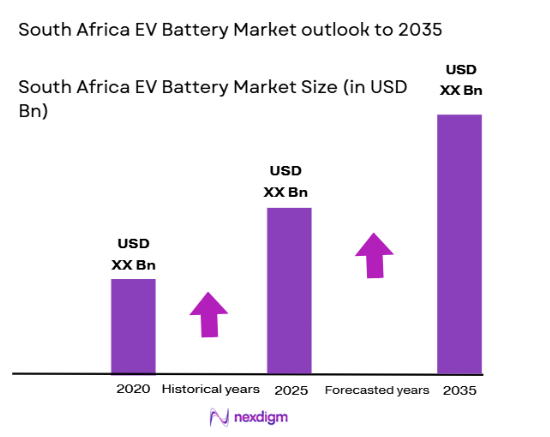
The South Africa EV Battery Market reached approximately USD ~ billion based on a recent historical assessment, driven by rising electric vehicle deployment and increased demand for energy storage technologies. The expansion of electric passenger vehicles, electric buses, and commercial fleets has created significant demand for lithium-ion battery packs. Government initiatives encouraging clean mobility, combined with global automotive manufacturers entering the South African electric vehicle ecosystem, have strengthened battery imports, distribution networks, and supply chain development across the automotive energy storage industry.
The market is strongly concentrated around major metropolitan and industrial regions such as Johannesburg, Cape Town, Durban, and Pretoria due to stronger electric mobility infrastructure and logistics hubs supporting automotive imports and assembly. These cities benefit from established automotive manufacturing ecosystems, renewable energy integration projects, and higher purchasing capacity among consumers adopting electric vehicles. Industrial clusters within Gauteng and Western Cape also host battery distributors, EV component suppliers, and energy technology firms that strengthen the regional dominance of these urban markets.
Market Segmentation
By Product Type:
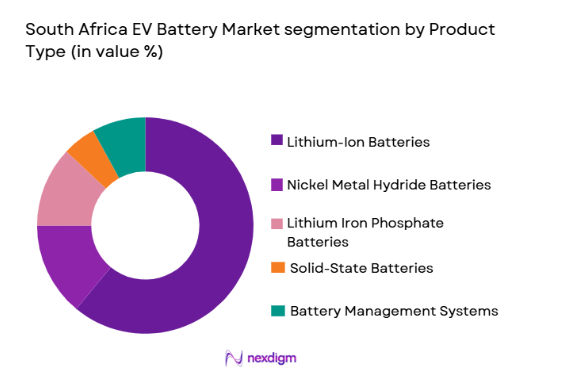
South Africa EV Battery market is segmented by product type into lithium-ion batteries, nickel metal hydride batteries, lithium iron phosphate batteries, solid-state batteries, and battery management systems. Recently, lithium-ion batteries have a dominant market share due to factors such as superior energy density, longer cycle life, strong compatibility with electric vehicles, and global automotive industry preference. Automotive manufacturers widely deploy lithium-ion batteries because they offer higher driving ranges and faster charging capabilities compared to alternative battery chemistries. The technology also benefits from established global supply chains, large-scale manufacturing capabilities, and continued cost optimization through battery innovation. Battery manufacturers and EV assemblers operating in South Africa rely heavily on imported lithium-ion battery cells integrated into battery packs for passenger vehicles and commercial fleets. Growing demand from electric buses, fleet electrification programs, and ride-hailing operators has further increased lithium-ion battery adoption across the electric mobility ecosystem. Additionally, energy efficiency improvements and battery management systems supporting lithium-ion technologies reinforce the segment’s dominance in the market.
By Vehicle Application:
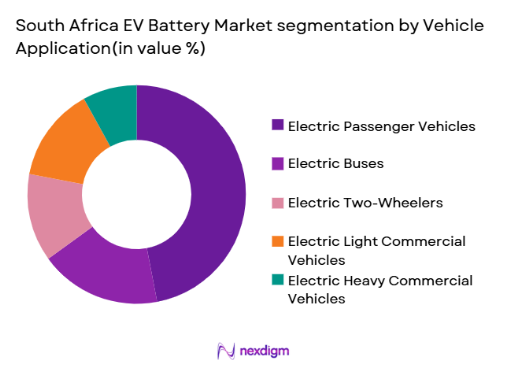
South Africa EV Battery market is segmented by vehicle application into electric passenger vehicles, electric buses, electric two-wheelers, electric light commercial vehicles, and electric heavy commercial vehicles. Recently, electric passenger vehicles have a dominant market share due to factors such as rising consumer awareness, expansion of EV charging infrastructure, and increasing availability of electric vehicle models introduced by international automotive manufacturers. Passenger EV adoption benefits from growing environmental awareness among urban consumers and increasing interest in energy-efficient mobility solutions. Automakers entering the South African market are prioritizing electric passenger vehicles because they represent the largest consumer mobility segment and attract premium urban buyers. In addition, government initiatives promoting sustainable transport and clean mobility have stimulated demand for electric passenger vehicles in major cities. Financial incentives, improved driving range, and decreasing battery costs have encouraged consumers to consider electric vehicles for daily commuting. As charging networks continue expanding across major metropolitan corridors, passenger vehicles remain the primary source of EV battery demand within the market.
Competitive Landscape
The South Africa EV Battery Market demonstrates a moderately consolidated competitive structure dominated by global battery manufacturers and automotive energy storage technology companies. International suppliers maintain a strong presence through partnerships with automotive OEMs and EV distributors operating in the country. The competitive landscape is shaped by technology innovation, battery performance improvements, and supply chain integration across the electric mobility ecosystem. Companies focus on lithium-ion battery development, battery management systems, and cost optimization strategies to strengthen their presence in the emerging EV battery market.
| Company Name | Establishment Year | Headquarters | Technology Focus | Market Reach | Key Products | Revenue | Battery Chemistry Focus |
| Contemporary Amperex Technology | 2011 | Ningde, China | ~ | ~ | ~ | ~ | ~ |
| LG Energy Solution | 2020 | Seoul, South Korea | ~ | ~ | ~ | ~ | ~ |
| Panasonic Energy | 1918 | Osaka, Japan | ~ | ~ | ~ | ~ | ~ |
| Samsung SDI | 1970 | Seoul, South Korea | ~ | ~ | ~ | ~ | ~ |
| BYD Company | 1995 | Shenzhen, China | ~ | ~ | ~ | ~ | ~ |
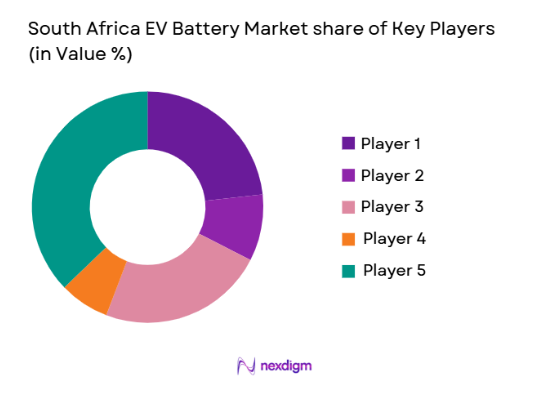
South Africa EV Battery Market Analysis
Growth Drivers
Electric Vehicle Adoption Driven by Environmental Regulations and Sustainable Mobility Policies:
Governments and policymakers in South Africa are increasingly promoting sustainable transportation solutions to address environmental concerns and reduce greenhouse gas emissions associated with conventional vehicles. The rising focus on carbon reduction initiatives and climate commitments has accelerated interest in electric vehicles across the country. As electric vehicles become more prevalent in urban transportation systems, the demand for reliable and high-capacity EV batteries has expanded significantly. Automotive manufacturers and mobility service providers are investing in electric vehicle fleets to align with sustainability objectives and environmental regulations. This transformation is creating a steady increase in battery demand across passenger vehicles, buses, and commercial transport systems. Global automotive companies introducing electric vehicle models into the South African market further stimulate demand for EV battery technologies. Growing consumer awareness about energy-efficient transportation has also contributed to increased adoption of electric vehicles. Additionally, improved charging infrastructure and supportive policy frameworks are enabling greater EV penetration across metropolitan areas. As these policies continue to shape the transportation sector, the EV battery market is experiencing accelerated expansion.
Expansion of Charging Infrastructure Supporting Electric Mobility Ecosystem:
The development of charging infrastructure across major urban regions in South Africa has significantly strengthened the electric vehicle ecosystem and created favorable conditions for EV battery adoption. Charging networks installed in commercial complexes, highways, and residential communities are reducing range anxiety and encouraging consumers to transition to electric mobility solutions. Infrastructure investments by energy companies, private charging providers, and automotive manufacturers are enabling a reliable network of charging points throughout metropolitan regions. These developments improve convenience for EV users and support longer-distance travel using electric vehicles. As charging infrastructure expands, the adoption of electric vehicles increases, subsequently boosting demand for advanced EV battery technologies capable of supporting fast charging and higher energy storage capacity. Automotive manufacturers are also designing vehicles compatible with high-performance battery systems optimized for rapid charging environments. The combination of infrastructure availability, energy management technologies, and increased consumer confidence in EV usability continues to drive battery demand within the South African electric mobility market.
Market Challenges
Limited Domestic Battery Manufacturing Capacity and Supply Chain Dependence:
One of the major structural challenges affecting the South Africa EV Battery Market is the limited domestic capacity for battery cell manufacturing and large-scale energy storage production. Most electric vehicle batteries used in the market are imported from global manufacturers located in Asia and other international regions. This dependency increases the overall cost structure of electric vehicles and exposes the market to supply chain disruptions, shipping constraints, and currency fluctuations. The absence of large-scale battery manufacturing facilities also limits the ability of domestic companies to participate fully in the EV battery value chain. Local industries primarily focus on distribution, assembly, and integration rather than core battery cell production. As electric vehicle adoption grows, reliance on imported battery technologies may create pricing pressures for automakers and consumers. Additionally, the lack of domestic battery manufacturing infrastructure reduces opportunities for technological innovation and industrial employment within the EV battery ecosystem. Addressing these challenges requires strategic investments in local battery supply chains and advanced manufacturing capabilities.
High Upfront Costs of Electric Vehicles and Battery Systems:
Another critical challenge influencing the South Africa EV Battery Market is the high upfront cost associated with electric vehicles and advanced battery technologies. Battery packs represent one of the most expensive components of electric vehicles due to complex manufacturing processes and high-value raw materials such as lithium, cobalt, and nickel. These costs significantly increase the retail price of electric vehicles compared to conventional internal combustion engine vehicles. For many consumers and businesses, the initial purchase cost remains a major barrier to adopting electric mobility solutions. Although battery costs have gradually declined due to technological improvements and global production scaling, electric vehicles still require higher initial investment. The limited availability of financing programs and government incentives for EV adoption further restricts widespread consumer access to electric mobility. As a result, many potential buyers delay EV purchases due to financial considerations. Reducing battery costs through technological innovation and supply chain optimization will be essential to overcoming this market challenge.
Opportunities
Development of Local Battery Assembly and EV Supply Chain Infrastructure:
The expansion of electric mobility across South Africa presents a significant opportunity for developing domestic battery assembly and supply chain infrastructure within the EV battery industry. As electric vehicle adoption accelerates, automotive manufacturers and energy technology companies are exploring opportunities to establish battery pack assembly facilities closer to vehicle production and distribution hubs. Local battery assembly operations could reduce dependency on imported battery systems while improving logistics efficiency and supply chain resilience. Establishing domestic manufacturing capabilities would also create employment opportunities and stimulate industrial growth within the clean energy and automotive sectors. Additionally, collaboration between international battery manufacturers and South African automotive companies could facilitate technology transfer and knowledge sharing. Such partnerships would support the development of specialized expertise in battery integration, energy storage management, and electric mobility technologies. Over time, a localized battery ecosystem could significantly strengthen the country’s electric vehicle supply chain.
Integration of EV Batteries with Renewable Energy Storage Systems:
Another major opportunity emerging in the South Africa EV Battery Market involves the integration of electric vehicle battery technologies with renewable energy storage systems. South Africa is investing heavily in renewable energy sources such as solar and wind power to improve energy security and reduce reliance on conventional energy generation. EV batteries can serve as distributed energy storage units capable of supporting grid stability and renewable energy integration. Technologies such as vehicle-to-grid systems allow electric vehicles to store excess electricity generated from renewable sources and supply energy back to the grid when needed. This capability creates a new market for EV batteries beyond transportation applications. Energy utilities, infrastructure providers, and mobility companies are exploring innovative models combining electric vehicles with renewable energy systems. These developments could transform EV batteries into multifunctional energy assets supporting both mobility and electricity storage needs.
Future Outlook
The South Africa EV Battery Market is expected to expand significantly over the next five years as electric mobility adoption continues to increase across the country. Advancements in battery technology, expansion of EV charging infrastructure, and stronger environmental policies supporting clean transportation are likely to drive market growth. Automotive manufacturers are expected to introduce a wider range of electric vehicles suited for the South African market. In addition, the integration of EV batteries with renewable energy systems and improvements in battery cost efficiency will further strengthen long-term market demand.
Major Players
- Contemporary Amperex Technology
- LG Energy Solution
- Panasonic Energy
- Samsung SDI
- BYD Company
- SK On
- Tesla Energy
- Gotion High-Tech
- EVE Energy
- Envision AESC
- CALB Group
- Farasis Energy
- Prime Planet Energy
- SVOLT Energy Technology
- Northvolt
Key Target Audience
- Automotive manufacturers
- Electric vehicle fleet operators
- Energy storage system providers
- Battery manufacturing companies
- Electric vehicle charging infrastructure providers
- Renewable energy companies
- Investments and venture capitalist firms
- Government and regulatory bodies
Research Methodology
Step 1: Identification of Key Variables
Key industry variables such as EV adoption rates, battery technology trends, supply chain dynamics, and regulatory frameworks were identified to structure the South Africa EV Battery Market research framework.
Step 2: Market Analysis and Construction
Primary and secondary research sources were used to construct market size estimates, evaluate industry trends, and analyze the competitive ecosystem within the EV battery market.
Step 3: Hypothesis Validation and Expert Consultation
Industry experts, automotive professionals, and energy storage specialists were consulted to validate key market assumptions and ensure data accuracy.
Step 4: Research Synthesis and Final Output
All collected data and expert insights were synthesized to produce a structured market report with validated conclusions regarding market growth and competitive dynamics.

- Executive Summary
- Research Methodology (Definitions, Scope, Industry Assumptions, Market Sizing Approach, Primary & Secondary Research Framework, Data Collection & Verification Protocol, Analytic Models & Forecast Methodology, Limitations & Research Validity Checks)

- Market Definition and Scope
- Value Chain & Stakeholder Ecosystem
- Regulatory / Certification Landscape
- Sector Dynamics Affecting Demand
- Strategic Initiatives & Infrastructure Growth

- Growth Drivers
Rising Electric Vehicle Adoption Driven by Emission Reduction Policies
Expansion of EV Charging Infrastructure Across Major Urban Centers
Growing Investment in Local Battery Assembly and Supply Chains
Government Incentives Supporting Electric Mobility Transition
Increased Fleet Electrification by Logistics and Public Transport Operators - Market Challenges
High Import Dependency for Advanced Battery Cells and Components
Limited Local Battery Manufacturing Infrastructure
High Upfront Cost of EV Batteries Compared to Conventional Systems
Battery Recycling and Disposal Infrastructure Gaps
Electric Grid Stability Concerns Affecting Large Scale EV Charging - Market Opportunities
Development of Local Lithium Processing and Battery Component Supply Chains
Expansion of Battery Leasing and Swapping Business Models
Integration of EV Batteries with Renewable Energy Storage Systems - Trends
Shift Toward Lithium Iron Phosphate Batteries for Cost Efficiency and Safety
Growing Deployment of Battery Swapping for Commercial Electric Fleets
Increased Collaboration Between Automotive OEMs and Energy Companies
Adoption of Advanced Battery Management Systems for Performance Optimization
Integration of EV Batteries with Smart Grid and Energy Storage Solutions - Government Regulations & Defense Policy
National Electric Mobility Roadmap Supporting EV Adoption
Battery Recycling and Environmental Compliance Regulations
Government Incentives for Local Battery Assembly and Component Manufacturing - SWOT Analysis
- Stakeholder and Ecosystem Analysis
- Porter’s Five Forces Analysis
- Competition Intensity and Ecosystem Mapping

- By Market Value, 2020-2025
- By Installed Units, 2020-2025
- By Average System Price, 2020-2025
- By System Complexity Tier, 2020-2025

- By System Type (In Value%)
Lithium Ion Battery Packs
Nickel Metal Hydride Batteries
Solid State Batteries
Lithium Iron Phosphate Batteries
Battery Management Systems - By Platform Type (In Value%)
Electric Passenger Vehicles
Electric Two Wheelers
Electric Buses
Electric Light Commercial Vehicles
Electric Heavy Commercial Vehicles - By Fitment Type (In Value%)
OEM Integrated Battery Systems
Aftermarket Replacement Batteries
Swappable Battery Modules
Modular Battery Packs
Integrated Thermal Managed Battery Packs - By EndUser Segment (In Value%)
Passenger Mobility Operators
Public Transport Authorities
Commercial Fleet Operators
Logistics and Delivery Companies
Private EV Owners - By Procurement Channel (In Value%)
Direct OEM Procurement
Government Fleet Procurement Programs
Battery Leasing Providers
Automotive Component Distributors
Energy Storage and Infrastructure Integrators - By Material / Technology (in Value %)
Lithium Nickel Manganese Cobalt Batteries
Lithium Iron Phosphate Batteries
Nickel Cobalt Aluminum Batteries
Graphite Based Anode Batteries
Silicon Enhanced Lithium Batteries

- Market structure and competitive positioning
- Market share snapshot of major players
- CrossComparison Parameters (Battery Capacity Range, Energy Density, Charging Speed Compatibility, Battery Chemistry Type, Thermal Management Technology, Lifecycle Durability, Integration with Vehicle Platforms, Cost Efficiency per kWh, Safety Certification Standards, Supply Chain Localization)
- SWOT Analysis of Key Players
- Pricing & Procurement Analysis
- Key Players
BYD Company
Contemporary Amperex Technology Co Limited
LG Energy Solution
Panasonic Energy
Samsung SDI
SK On
Tesla Energy
CALB Group
EVE Energy
Gotion High Tech
Envision AESC
Farasis Energy
Prime Planet Energy and Solutions
SVOLT Energy Technology
CATL South Africa Energy Solutions

- Commercial logistics fleets increasingly adopting electric vehicles requiring high capacity battery systems
- Public transportation agencies investing in electric bus fleets with long cycle life battery technologies
- Private EV owners demanding longer range and faster charging battery solutions
- Corporate sustainability initiatives accelerating fleet electrification and battery procurement

- Forecast Market Value, 2026-2035
- Forecast Installed Units, 2026-2035
- Price Forecast by System Tier, 2026-2035
- Future Demand by Platform, 2026-2035


 Request a Sample
 Ask for Customization
 Get a Quote
 Enquire Now