
 Download PDF
 Download PDF
Market Overview
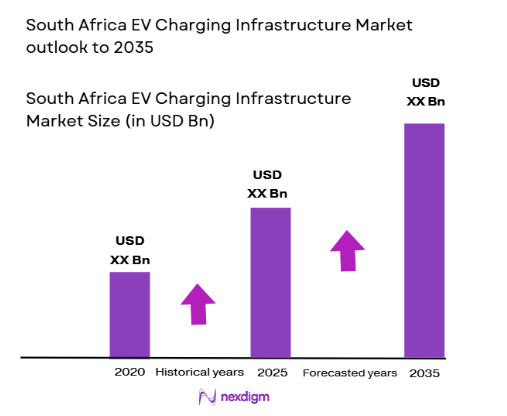
The South Africa EV Charging Infrastructure Market is valued at approximately USD ~ billion based on a recent historical assessment, supported by increasing electric vehicle adoption and infrastructure investment. Expansion of charging networks by energy utilities and private operators is accelerating deployment across metropolitan regions. Government programs encouraging low-emission mobility and renewable energy integration are also stimulating infrastructure development. Public charging corridors and commercial charging installations are becoming key drivers supporting the electrification of passenger and commercial vehicle fleets nationwide.
Major urban centers such as Johannesburg, Cape Town, and Durban dominate charging infrastructure deployment due to higher electric vehicle adoption and better grid connectivity. Johannesburg benefits from strong commercial investment and early charging network expansion by private operators and energy companies. Cape Town demonstrates rapid growth due to renewable energy initiatives and municipal sustainability programs. Durban’s logistics and port activities also encourage fleet electrification, creating demand for commercial charging infrastructure across logistics hubs and transportation corridors.
Market Segmentation
By Product Type:
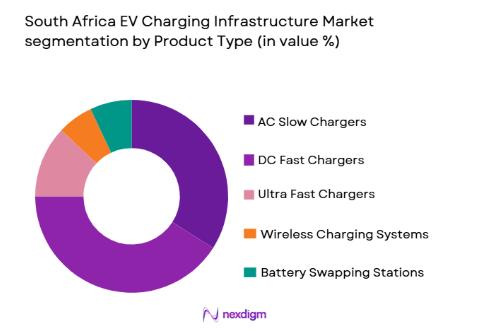
South Africa EV Charging Infrastructure Market is segmented by product type into AC Slow Chargers, DC Fast Chargers, Ultra Fast Chargers, Wireless Charging Systems, and Battery Swapping Stations. Recently, DC Fast Chargers has a dominant market share due to increasing demand for rapid charging solutions across highways, urban commercial hubs, and fleet depots. Fast charging technology significantly reduces charging time, enabling electric vehicles to operate efficiently in commercial transportation and ride-hailing services. Government programs promoting public charging corridors have also encouraged installation of fast charging systems along major highways linking metropolitan cities. Automotive manufacturers and energy providers are investing heavily in high-power charging infrastructure to support next-generation electric vehicles with larger battery capacities. Additionally, fleet electrification initiatives in logistics and delivery services require high-power charging capabilities to maintain operational efficiency. The rapid expansion of public charging stations in shopping centers, hotels, and workplaces further contributes to the dominance of fast charging technology.
By End User:
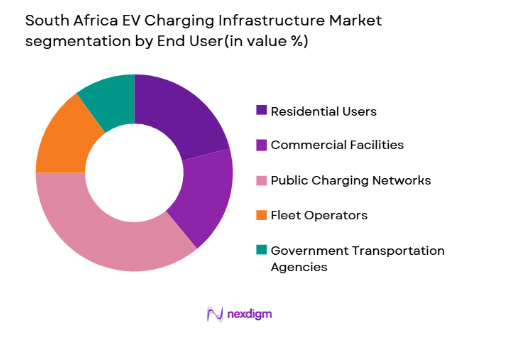
South Africa EV Charging Infrastructure Market is segmented by end user into Residential Users, Commercial Facilities, Public Charging Networks, Fleet Operators, and Government Transportation Agencies. Recently, Public Charging Networks has a dominant market share due to growing investment in accessible charging infrastructure across urban areas and intercity highways. Public charging networks provide convenient access for electric vehicle drivers who lack private home charging options, particularly in high-density urban environments. Retail centers, hospitality businesses, and parking facilities increasingly install charging stations to attract electric vehicle owners and promote sustainable mobility. Energy companies and private charging operators are also expanding network coverage to ensure reliable charging availability. The presence of publicly accessible charging stations significantly enhances consumer confidence in electric vehicle adoption. Furthermore, partnerships between automotive manufacturers and charging network providers support the rapid deployment of interoperable charging infrastructure across major transportation routes and commercial zones.
Competitive Landscape
The South Africa EV Charging Infrastructure Market is moderately consolidated with several global technology companies and regional energy providers competing to expand charging networks. Major firms invest in high-power charging systems, smart charging software, and grid integration technologies to strengthen their market presence. Strategic partnerships between automotive manufacturers, utilities, and infrastructure providers are accelerating deployment of nationwide charging corridors and urban charging hubs.
| Company Name | Establishment Year | Headquarters | Technology Focus | Market Reach | Key Products | Revenue | Charging Network Integration |
| ABB | 1988 | Zurich, Switzerland | ~ | ~ | ~ | ~ | ~ |
| Siemens | 1847 | Munich, Germany | ~ | ~ | ~ | ~ | ~ |
| Schneider Electric | 1836 | Rueil-Malmaison, France | ~ | ~ | ~ | ~ | ~ |
| ChargePoint | 2007 | California, USA | ~ | ~ | ~ | ~ | ~ |
| Tritium | 2001 | Brisbane, Australia | ~ | ~ | ~ | ~ | ~ |
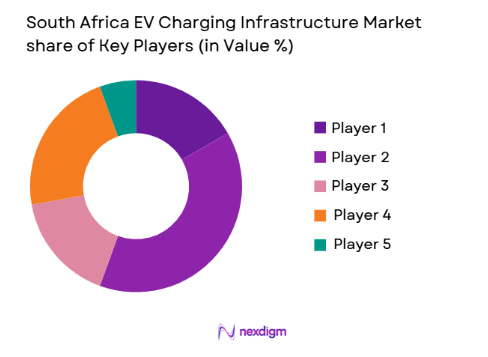
South Africa EV Charging Infrastructure Market Analysis
Growth Drivers
Electric Vehicle Adoption and Fleet Electrification Initiatives:
rapid adoption of electric vehicles across South Africa has significantly increased demand for reliable and accessible charging infrastructure nationwide. Government initiatives promoting sustainable mobility and emissions reduction have encouraged businesses and consumers to transition toward electric vehicles. Fleet operators in logistics, ride-hailing, and delivery services are also adopting electric vehicles to reduce operational costs and comply with environmental regulations. The growing availability of electric vehicle models from international manufacturers has further stimulated consumer demand. Charging infrastructure providers are responding by expanding fast charging networks across urban centers and transportation corridors. Large retail and hospitality establishments are installing charging stations to attract electric vehicle drivers and support sustainable mobility initiatives. Corporate sustainability commitments are also driving businesses to deploy charging infrastructure within office complexes and commercial buildings. The expansion of charging infrastructure strengthens consumer confidence in electric vehicle adoption and supports long-distance travel capabilities. As a result, the demand for high-capacity charging stations continues to grow across both private and public sectors.
Government Policies and Renewable Energy Integration:
Government policies supporting clean transportation and renewable energy adoption play a major role in driving investment in charging infrastructure across South Africa. National energy transition strategies emphasize reducing dependence on fossil fuels and promoting sustainable transportation technologies. Renewable energy projects including solar and wind installations are increasingly integrated with electric vehicle charging infrastructure to support green mobility initiatives. Incentives encouraging private sector investment in clean energy infrastructure further stimulate charging network expansion. Energy utilities are collaborating with charging network operators to develop smart charging systems capable of balancing electricity demand across the grid. Local municipalities are implementing urban sustainability programs that include the installation of public charging stations in transportation hubs and commercial districts. These initiatives enhance accessibility and visibility of charging infrastructure across metropolitan areas. Integration of renewable energy generation with charging stations also reduces operational costs and environmental impact. Consequently, policy support and renewable energy deployment continue to accelerate growth of the electric vehicle charging infrastructure sector.
Market Challenges
Limited Grid Capacity and Power Infrastructure Constraints:
The expansion of electric vehicle charging infrastructure requires significant electricity supply and grid stability, which presents a challenge in regions with limited power infrastructure. South Africa’s electricity network faces capacity constraints and periodic power shortages that can affect the reliability of high-power charging stations. Fast charging infrastructure requires substantial electrical capacity, particularly in commercial and highway charging hubs serving multiple vehicles simultaneously. Utility companies must invest in grid upgrades and energy storage solutions to support increasing electricity demand from electric mobility. Delays in grid expansion projects can slow the deployment of new charging stations across underserved regions. Businesses installing charging infrastructure may face high connection costs and regulatory approval processes related to electricity distribution networks. These technical and financial barriers can discourage smaller operators from entering the charging infrastructure market. Without sufficient grid modernization and power capacity expansion, charging infrastructure deployment may remain concentrated in urban areas. Addressing grid limitations is therefore critical for enabling widespread adoption of electric vehicle charging infrastructure across the country.
High Capital Investment and Infrastructure Deployment Costs:
Establishing a nationwide electric vehicle charging network requires substantial capital investment in equipment, installation, and supporting energy infrastructure. High-power charging stations involve expensive hardware components including power electronics, cooling systems, and grid connection equipment. Land acquisition and site preparation costs further increase the financial burden for infrastructure developers. Operators must also invest in digital platforms and software systems for monitoring, payment processing, and network management. In regions with lower electric vehicle adoption rates, charging stations may experience lower utilization levels, affecting profitability and return on investment. Private investors often require long-term policy stability and market demand assurance before committing capital to large infrastructure projects. Financing challenges may therefore delay the expansion of charging networks beyond major metropolitan areas. Infrastructure operators must also manage ongoing maintenance costs and technological upgrades as charging standards evolve. These financial challenges can slow the pace of infrastructure deployment despite growing demand for electric mobility solutions.
Opportunities
Expansion of Highway Charging Corridors and Intercity Infrastructure:
The development of high-power charging corridors along major highways represents a significant opportunity for expanding electric vehicle charging infrastructure across South Africa. Intercity travel requires reliable fast charging stations capable of supporting long-distance electric vehicle journeys between metropolitan areas. Infrastructure providers are investing in strategic charging locations along major transport routes to improve accessibility and travel convenience. Highway charging networks enable electric vehicle adoption beyond urban environments by reducing range anxiety among drivers. Logistics companies transitioning to electric delivery vehicles also require reliable charging infrastructure along transportation corridors. Public-private partnerships are emerging to accelerate development of charging hubs near service stations, logistics parks, and rest areas. High-power charging technology allows rapid vehicle charging during short travel breaks, making electric vehicles more practical for commercial transportation. Expansion of highway charging networks will strengthen the national electric mobility ecosystem and encourage broader adoption of electric vehicles. This infrastructure development opportunity supports both passenger mobility and commercial logistics electrification.
Integration of Smart Charging and Energy Management Systems:
The integration of smart charging technologies and energy management platforms presents a major opportunity for optimizing electric vehicle charging infrastructure operations. Smart charging systems enable dynamic energy distribution across multiple charging stations while balancing electricity demand on the grid. These technologies allow operators to monitor charging activity in real time and adjust charging speeds based on electricity availability and demand patterns. Integration with renewable energy generation systems further enhances sustainability and cost efficiency. Energy storage solutions such as battery systems can store excess renewable electricity and supply charging stations during peak demand periods. Smart charging platforms also support advanced billing systems, user authentication, and remote diagnostics for improved operational efficiency. Fleet operators can use intelligent charging systems to schedule vehicle charging during off-peak electricity hours to reduce operational costs. Data analytics generated by smart charging networks provide valuable insights for infrastructure planning and investment strategies. Adoption of smart charging technologies therefore represents a major opportunity for improving efficiency, reliability, and scalability of electric vehicle charging infrastructure.
Future Outlook
The South Africa EV Charging Infrastructure Market is expected to expand significantly over the next five years as electric vehicle adoption accelerates across the country. Government sustainability programs and renewable energy integration will continue to support infrastructure investment. Technological advancements in high-power charging and smart grid connectivity will enhance charging efficiency and accessibility. Increased collaboration between energy providers, automotive manufacturers, and infrastructure developers will further strengthen nationwide charging networks.
Major Players
- ABB
- Siemens
- Schneider Electric
- ChargePoint
- Tritium
- EVBox
- Delta Electronics
- Shell Recharge Solutions
- Tesla
- Blink Charging
- Enel X
- ENGIE
- GridCars
- Rubicon Group
- Eskom
Key Target Audience
- Electric vehicle manufacturers
- Automotive component suppliers
- Charging infrastructure developers
- Energy utilities and power companies
- Renewable energy developers
- Investments and venture capitalist firms
- Government and regulatory bodies
- Logistics and fleet management companies
Research Methodology
Step 1: Identification of Key Variables
Key variables including electric vehicle adoption rates, charging infrastructure capacity, government policy frameworks, and investment trends were identified to evaluate market dynamics and infrastructure deployment patterns.
Step 2: Market Analysis and Construction
Market structure was analyzed using industry reports, government energy statistics, and company financial disclosures to construct the overall market size and infrastructure deployment landscape.
Step 3: Hypothesis Validation and Expert Consultation
Industry experts including energy infrastructure specialists, electric mobility analysts, and charging network operators were consulted to validate assumptions and refine the analytical framework.
Step 4: Research Synthesis and Final Output
All data sources and analytical findings were synthesized to produce a comprehensive market report describing infrastructure trends, technological developments, and future investment opportunities.

- Executive Summary
- Research Methodology (Definitions, Scope, Industry Assumptions, Market Sizing Approach, Primary & Secondary Research Framework, Data Collection & Verification Protocol, Analytic Models & Forecast Methodology, Limitations & Research Validity Checks)

- Market Definition and Scope
- Value Chain & Stakeholder Ecosystem
- Regulatory / Certification Landscape
- Sector Dynamics Affecting Demand
- Strategic Initiatives & Infrastructure Growth

- Growth Drivers
Government policies promoting electric mobility and charging infrastructure expansion
Rising adoption of electric passenger vehicles and fleet electrification initiatives
Expansion of renewable energy integrated charging networks - Market Challenges
Limited national charging infrastructure coverage across rural regions
High capital investment requirements for fast charging network deployment
Grid stability constraints affecting large scale charging station expansion - Market Opportunities
Development of highway fast charging corridors connecting major cities
Integration of solar powered charging stations to reduce grid dependency
Partnerships between utilities and automotive manufacturers for network expansion - Trends
Deployment of ultra fast charging hubs along major transport corridors
Growth of smart charging systems integrated with grid management platforms
Increasing installation of workplace and retail destination charging
Expansion of solar powered EV charging stations in commercial locations
Adoption of vehicle to grid charging capabilities in pilot projects - Government Regulations & Defense Policy
National electric mobility policy frameworks supporting charging infrastructure
Energy regulatory guidelines for grid connected charging stations
Incentive programs encouraging private sector EV charging deployment - SWOT Analysis
- Stakeholder and Ecosystem Analysis
- Porter’s Five Forces Analysis
- Competition Intensity and Ecosystem Mapping

- By Market Value, 2020-2025
- By Installed Units, 2020-2025
- By Average System Price, 2020-2025
- By System Complexity Tier, 2020-2025

- By System Type (In Value%)
AC Slow Charging Systems
DC Fast Charging Systems
Ultra Fast Charging Systems
Wireless Inductive Charging Systems
Battery Swapping Charging Systems - By Platform Type (In Value%)
Public Charging Networks
Residential Charging Infrastructure
Commercial Workplace Charging
Fleet Charging Depots
Highway Corridor Charging Stations - By Fitment Type (In Value%)
New Installation Charging Systems
Retrofitted Charging Infrastructure
Integrated Charging with Renewable Energy Systems
Modular Expandable Charging Units
Mobile Charging Solutions - By EndUser Segment (In Value%)
Passenger Electric Vehicle Owners
Electric Commercial Fleet Operators
Public Transport Authorities
Corporate and Workplace Facilities
Retail and Hospitality Locations - By Procurement Channel (In Value%)
Government Infrastructure Tenders
Utility Company Procurement Programs
Private Charging Network Operators
Automotive OEM Partnerships
Energy Service Company Installations - By Material / Technology (in Value %)
Level 2 Charging Hardware Technology
High Power DC Charging Technology
Smart Grid Integrated Charging Systems
Solar Integrated Charging Infrastructure
Vehicle to Grid Charging Technology

- Market structure and competitive positioning
- Market share snapshot of major players
- CrossComparison Parameters (Charging Speed Capacity, Installation Cost Structure, Network Coverage, Smart Charging Capability, Renewable Integration Capability, Interoperability Standards, Software Platform Integration, Maintenance Support Services, Charging Connector Compatibility, Fleet Charging Capability)
- SWOT Analysis of Key Players
- Pricing & Procurement Analysis
- Key Players
ABB
Siemens
Schneider Electric
Shell Recharge Solutions
ChargePoint
EVBox
Tritium
Delta Electronics
Tesla
Blink Charging
ENGIE
Enel X
GridCars
Rubicon Group
Eskom

- Passenger EV owners increasingly demand accessible urban and residential charging solutions
- Commercial fleet operators require high capacity depot based fast charging infrastructure
- Retail and hospitality venues deploy charging stations to attract EV driving customers
- Public transport agencies explore electrified bus charging networks for urban mobility

- Forecast Market Value, 2026-2035
- Forecast Installed Units, 2026-2035
- Price Forecast by System Tier, 2026-2035
- Future Demand by Platform, 2026-2035


 Request a Sample
 Ask for Customization
 Get a Quote
 Enquire Now