
 Download PDF
Market Overview
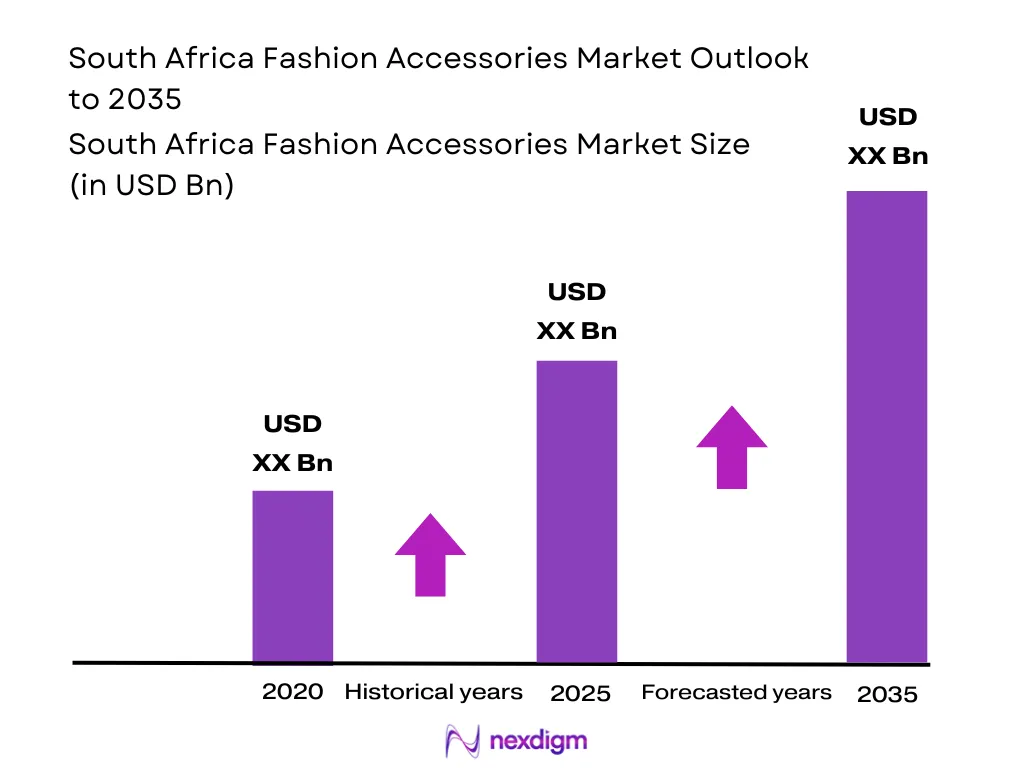
The South Africa Fashion Accessories Market is valued at USD ~ billion, based on Nexdigm Research’s country-level market sizing, with jewellery identified as the largest revenue-generating product segment and handbags and purses as the fastest-growing segment. A secondary industry estimate places the market at USD ~ billion and projects 7.83% CAGR for the forward cycle, supporting a high-single-digit growth view. Online retail reached ZAR 96 billion after growing from about ZAR 71 billion, strengthening accessories sales through fashion marketplaces and omnichannel retail.
Gauteng, Western Cape and KwaZulu-Natal dominate South Africa’s fashion accessories demand because they combine large urban populations, shopping-centre density, premium retail destinations and e-commerce fulfilment depth. South Africa’s population reached 63.02 million, while Gauteng had the largest provincial population base, followed by KwaZulu-Natal and Western Cape. Gauteng also led multiple value-added industries, while Sandton City, Cape Town’s V&A Waterfront, Gateway and major Pretoria/Johannesburg malls anchor premium jewellery, bags, eyewear, watches and fast-fashion accessory spending.
Market Segmentation
By Product Category
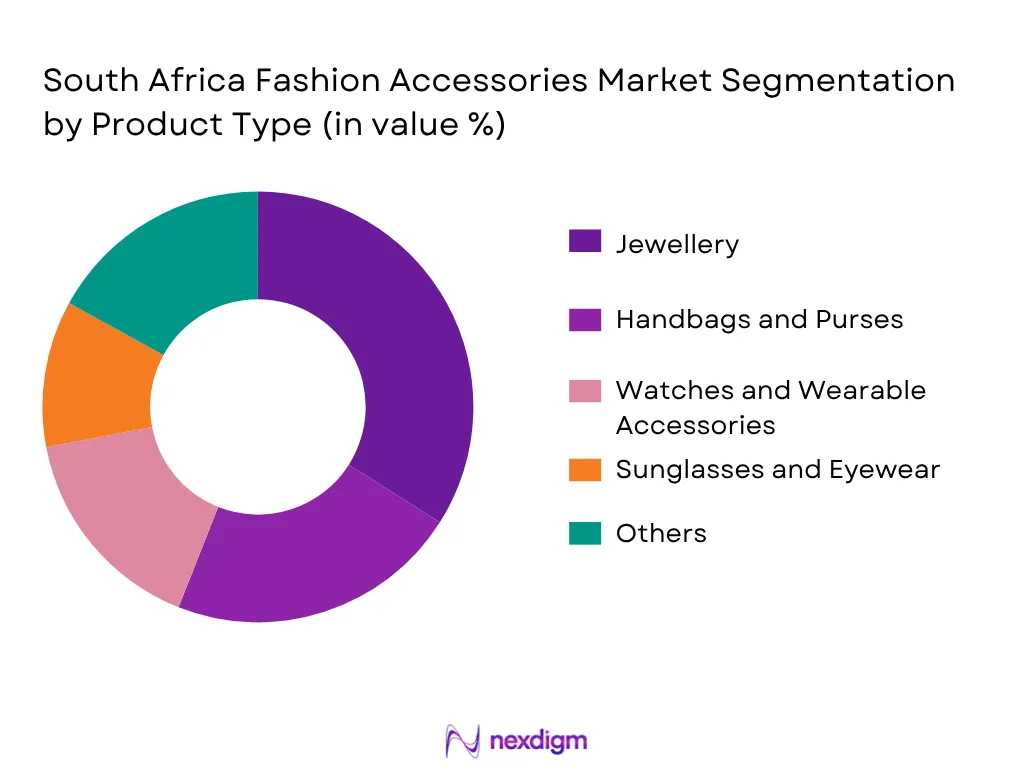
The South Africa Fashion Accessories Market is segmented by product category into jewellery, handbags and purses, watches and wearable accessories, sunglasses and eyewear accessories, belts, wallets and small leather goods, and other fashion add-ons. Jewellery holds the dominant market share because it cuts across gifting, weddings, everyday fashion, premium self-purchase and value retail. Specialist chains such as American Swiss, Sterns, NWJ and Lovisa support high retail visibility, while large apparel groups add fashion jewellery as a margin-accretive basket builder. Jewellery also benefits from a wider price ladder than handbags or watches, ranging from low-ticket earrings and plated pieces to gold, diamond and gemstone purchases. Nexdigm identifies jewellery as the largest revenue-generating product segment in the country’s fashion accessories market, while online category evidence also shows jewellery and watches as the largest bags-and-accessories e-commerce category.
By Distribution Channel
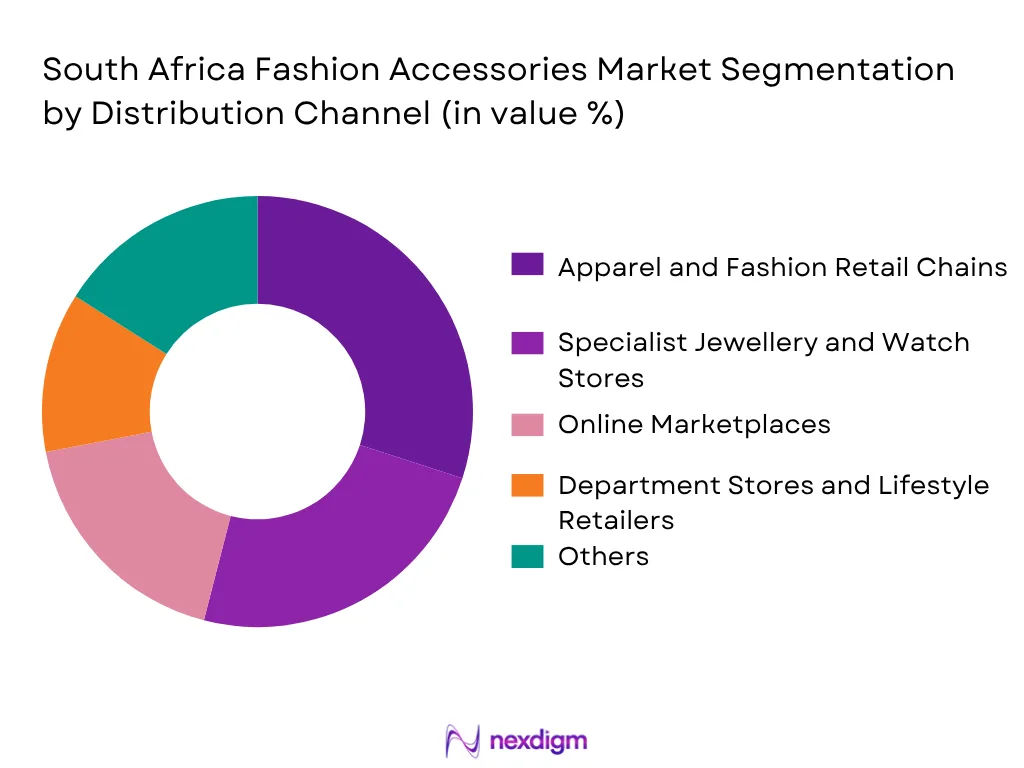
The South Africa Fashion Accessories Market is segmented by distribution channel into apparel and fashion retail chains, specialist jewellery and watch stores, online marketplaces and multi-brand e-commerce platforms, department stores and lifestyle retailers, informal retail and supermarkets/value general retail. Apparel and fashion retail chains dominate because accessories are heavily sold as add-on purchases alongside dresses, workwear, footwear, streetwear, beauty and seasonal fashion. TFG, Mr Price, Truworths, Woolworths, Pepkor and Cotton On operate large physical networks and use accessories to improve basket value and styling completeness. These chains also have stronger loyalty programs, private-label sourcing, credit or cash-based affordability models, and high mall visibility. Online marketplaces are rising quickly, but physical fashion chains retain advantage in impulse conversion, fitting-room styling, gifting traffic and coordinated collections across clothing, handbags, jewellery, belts and sunglasses.
Competitive Landscape
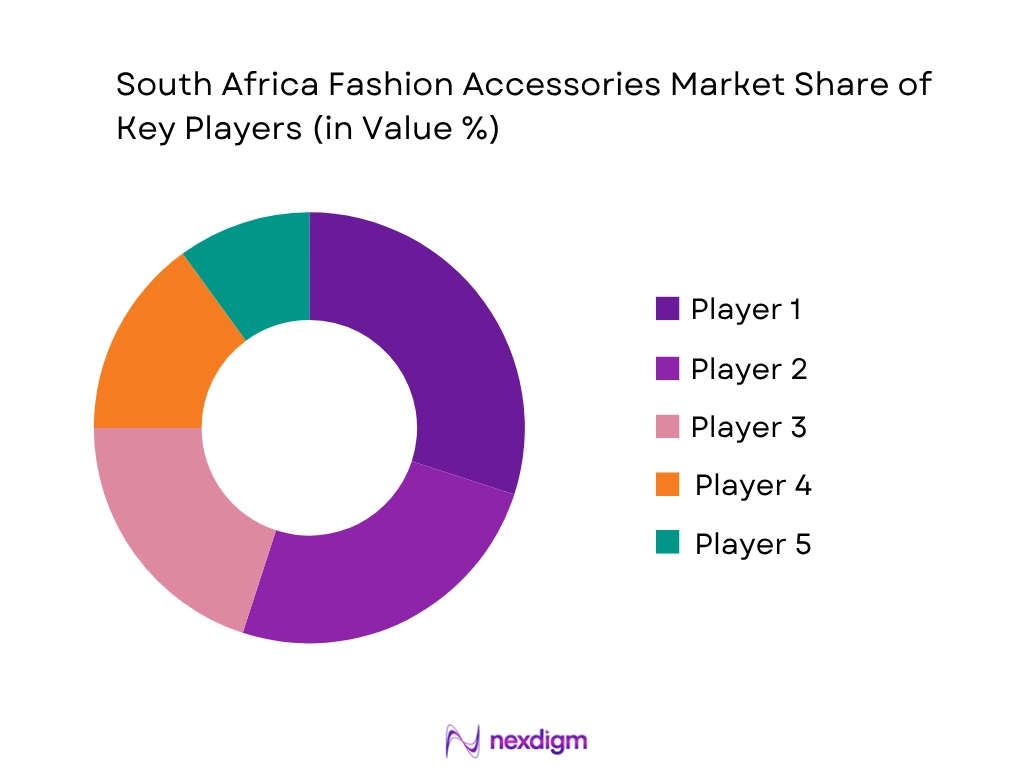
The South Africa Fashion Accessories Market is competitive but not fully fragmented. Large retail groups dominate store-based distribution, specialist jewellers control fine jewellery and watch retail, and e-commerce platforms are reshaping price discovery. TFG, Woolworths, Mr Price and Truworths use omnichannel fashion portfolios to capture accessory attach sales, while Takealot, Superbalist, Zando, Shein and Temu intensify competition through online assortment breadth, discounting and fast product cycles. Shein and Temu generated ZAR 7.3 billion in South African CTFL sales and held a strong online clothing position, underlining cross-border pressure on local accessory pricing.
| Player | Establishment Year | Headquarters | Accessory Focus | Channel Strength | Pricing Position | Omnichannel Capability | Key Consumer Base | Market-Specific Advantage |
| The Foschini Group / TFG | 1924 | Cape Town | ~ | ~ | ~ | ~ | ~ | ~ |
| Woolworths South Africa | 1931 | Cape Town | ~ | ~ | ~ | ~ | ~ | ~ |
| Mr Price Group | 1985 | Durban | ~ | ~ | ~ | ~ | ~ | ~ |
| Truworths International | 1917 | Cape Town | ~ | ~ | ~ | ~ | ~ | ~ |
| Takealot | 2011 | Cape Town | ~ | ~ | ~ | ~ | ~ | ~ |
South Africa Fashion Accessories Market Analysis
Growth Drivers
Rising fashion-conscious youth population
South Africa’s fashion accessories demand is supported by a large, urban and digitally connected youth pipeline. Stats SA estimates the country’s population at 63.02 million in 2024, with 16.8 million people younger than 15, creating a sizeable future consumer base for earrings, hair accessories, handbags, caps, wallets, sunglasses and trend-led fashion add-ons. The World Bank records South Africa’s urban population at 40.77 million in 2024, which matters because fashion accessories retail is concentrated in malls, high-street stores, e-commerce delivery zones and social-media-led shopping ecosystems. ICASA reports 94 million active mobile-cellular subscriptions in 2024, indicating deep mobile reach for TikTok, Instagram, marketplace discovery and app-based retail. This supports frequent exposure to micro-trends, influencer styling, fast accessory drops and cross-border fashion platforms. The market impact is most visible in low- to mid-ticket fashion jewellery, handbags, sunglasses, caps, belts, wallets and hair accessories, where young consumers can refresh outfits without replacing full apparel wardrobes.
Jewellery gifting culture
Jewellery gifting remains a structural demand driver for the South Africa Fashion Accessories Market because it is linked to weddings, engagements, birthdays, religious occasions, family celebrations and formal gifting. Stats SA reports 102,373 marriages and unions registered in 2024, including 97,510 civil marriages, 2,634 customary marriages and 2,229 civil unions, sustaining demand for rings, chains, earrings, bracelets, watches and occasion jewellery. The same Stats SA release records 105,123 marriages and unions in 2023, showing that even with a decline, the absolute base of formal relationship events remains large. South Africa’s tourism system also supports gifting and jewellery retail in destination malls and airports: Stats SA recorded 1,215,250 foreign traveller arrivals in December 2024, creating seasonal demand for locally purchased jewellery, sunglasses, handbags and premium accessories in Cape Town, Johannesburg, Durban and resort corridors. For retailers, jewellery is particularly attractive because it works across entry-level fashion jewellery and higher-ticket precious-metal pieces, allowing the same gifting culture to support both value chains and specialist jewellers.
Market Challenges
Currency depreciation exposure
Currency exposure is a direct challenge for South Africa’s fashion accessories retailers because handbags, fashion jewellery, watches, sunglasses, belts, wallets, hair accessories and small leather goods often rely on imported finished goods or imported inputs. The World Bank records South Africa’s merchandise imports at USD 123.469 billion in 2024, showing the economy’s large exposure to foreign-currency procurement. For accessories retailers, dollar-linked sourcing becomes more difficult when the rand weakens or moves sharply. SARB’s selected historical rates show the rand at ZAR 16.6666 per US dollar on 15 May 2026, while its quarterly bulletin noted rand effective exchange-rate movement across 2024, including a 5.2% NEER increase in the second quarter and 2.3% in the third quarter. Even when appreciation occurs, volatility complicates purchase orders, landed-cost planning, markdown decisions and replenishment timing. World Bank inflation data also records South Africa consumer inflation at 4.4% in 2024, adding pressure to discretionary categories. Since accessories are often impulse purchases, retailers must balance currency-driven sourcing pressure against consumer affordability.
Import duties
Import duties and VAT create a landed-cost challenge for South Africa’s fashion accessories market, especially for imported handbags, small leather goods, fashion jewellery, watches, eyewear and cross-border e-commerce parcels. SARS states that all commercial imports must be classified under the correct tariff heading and that the tariff classification is directly linked to the duty payable. SARS also states that South Africa’s VAT rate on imported goods is 15%, calculated on added tax value after customs value and non-rebated duties. For fashion-related e-commerce imports, SARS introduced VAT treatment on low-value parcels after concerns that goods below ZAR 500 had used a concession involving a 20% flat rate and no VAT; the revised treatment added VAT and moved parcels toward the World Customs Organization duty framework. Handbags under HS 4202 can attract duty treatment depending on material and trade origin, while sunglasses and watches still face customs classification and VAT obligations. For retailers, this affects price architecture, cross-border competitiveness, gross margin protection and inventory planning.
Opportunities
Lab-grown diamonds
Lab-grown diamonds represent a growth opportunity for South Africa’s fashion accessories and jewellery retailers because they create an alternative route for consumers seeking diamond-style jewellery at accessible ticket points while keeping the gifting, engagement and occasion-use case intact. The opportunity is supported by South Africa’s existing diamond ecosystem and regulatory infrastructure. The South African Diamond and Precious Metals Regulator reports that national diamond production stood at 5.34 million carats in 2024, while the Government Diamond Valuator assessed 6.1 million carats, showing that diamonds remain a material jewellery-linked sector even amid weaker natural diamond conditions. Kimberley Process statistics also show South Africa as an active rough-diamond participant in 2024, anchoring consumer familiarity with diamond jewellery. Lab-grown diamonds can use this established cultural association but shift the offer toward modern, sustainability-oriented and affordability-conscious buyers. Specialist jewellers can position lab-grown stones for engagement rings, tennis bracelets, pendants and earrings, while fashion retailers can extend into accessible “diamond-look” gifting ranges. The current pressure in natural diamond production and trading also makes product diversification strategically relevant for jewellers.
Sustainable bags
Sustainable bags are an opportunity in South Africa’s fashion accessories market because environmental regulation, waste-service gaps and consumer visibility of plastic pollution are making reusable, recycled, vegan-leather, canvas and durable tote formats more commercially relevant. National Treasury’s 2024 Budget documentation increased the plastic bag levy to 32 cents per bag from 1 April 2024, reinforcing a policy signal against single-use retail bags. SARS explains that the environmental levy applies to certain plastic carrier and flat bags because their disposal contributes to littering, and that the levy is payable by manufacturers in South Africa. Stats SA’s General Household Survey shows that only 61.3 out of every 100 households had refuse removed at least once per week in 2024, while 34.3 out of every 100 used communal or household refuse dumps, indicating visible waste-management constraints. This creates space for retailers to sell reusable totes, recycled-polyester shoppers, durable beach bags, work bags and sustainable handbags as functional accessories rather than only environmental products. For fashion chains, sustainable bags also support private-label storytelling, gifting bundles and checkout conversion.
Future Outlook
The South Africa Fashion Accessories Market is expected to maintain a high-single-digit growth path, with the forward CAGR estimated at 7.8% for 2026-2035, aligned with published long-range market expectations and supported by online fashion adoption, value-retail penetration and premium jewellery demand. Growth will be shaped by jewellery gifting, handbags and purses, smart wearables, sunglass replacement cycles, social commerce, and imported fast-fashion accessories. However, rand volatility, customs enforcement, counterfeit products and weak discretionary spending will continue to pressure margins.
Over the next cycle, the strongest upside is expected in omnichannel retail, online marketplaces, lab-grown and affordable fine jewellery, vegan/faux-leather bags, waterproof fashion jewellery and youth-led trend accessories. Retailers with stronger sourcing, localized assortment, returns infrastructure and loyalty ecosystems will outperform pure store-led players. Cross-border platforms will continue influencing price benchmarks, while local retailers will defend share using click-and-collect, private labels, curated South African styling and faster replenishment.
Major Players
- The Foschini Group / TFG
- Woolworths South Africa
- Mr Price Group
- Truworths International
- Pepkor / Ackermans
- Edgars
- American Swiss
- Sterns
- NWJ Fine Jewellery
- Lovisa South Africa
- Cotton On South Africa
- Superbalist
- Zando
- Takealot
- Shein South Africa
Key Target Audience
- Fashion accessories manufacturers and brand owners
- Jewellery, watch and eyewear retailers
- Apparel and lifestyle retail chains
- E-commerce marketplaces and omnichannel retail platforms
- Shopping mall developers and retail real estate operators
- Importers, wholesalers and fashion accessories distributors
- Investments and venture capitalist firms
- Government and regulatory bodies (South African Revenue Service, National Consumer Commission, Companies and Intellectual Property Commission, South African Bureau of Standards, Department of Trade, Industry and Competition)
Research Methodology
Step 1: Identification of Key Variables
The research begins by mapping the South Africa Fashion Accessories Market ecosystem across jewellery, handbags, purses, watches, sunglasses, belts, wallets, hair accessories and other fashion add-ons. Key variables include retail price bands, product materials, import flows, online GMV, retail chain footprint, marketplace penetration, regional mall concentration and accessory attach rates within apparel retail.
Step 2: Market Analysis and Construction
Historical and current market indicators are analyzed through top-down and bottom-up approaches. The top-down approach reviews published market size, apparel and accessories retail indicators, online retail growth and demographic consumption patterns. The bottom-up approach builds revenue by category, average selling price, channel contribution, SKU density and retailer-level accessory exposure.
Step 3: Hypothesis Validation and Expert Consultation
Market hypotheses are validated through interviews with retailers, fashion accessory distributors, jewellery chains, e-commerce category managers, mall leasing professionals, importers and brand owners. These consultations help test assumptions around product category dominance, channel mix, online competition, pricing pressure, promotional intensity, sourcing dependency and consumer switching behaviour.
Step 4: Research Synthesis and Final Output
The final stage synthesizes secondary research, company-level evidence, expert inputs and internal category modelling into a validated view of the South Africa Fashion Accessories Market. The output includes market size, growth outlook, segmentation, competitive benchmarking, target audience mapping and strategic implications for business professionals evaluating entry, expansion or investment.

- Executive Summary
- Research Methodology (Market definitions and exclusions, accessory category taxonomy, fashion jewellery versus fine jewellery distinction, handbag SKU classification, watch and smartwatch boundary assumptions, sunglass and eyewear accessory scope, value versus volume modelling, store-count normalization, online GMV triangulation, import-led supply validation, primary interviews with retailers/distributors/brand owners/mall operators, bottom-up SKU pricing checks, top-down retail expenditure allocation, limitations and forecast assumptions)

- Definition and Scope
- Market Genesis and Evolution
- Timeline of Major Retail Groups, Jewellery Chains, Online Platforms and Cross-Border Entrants
- Business Cycle and Demand Seasonality
- Supply Chain and Value Chain Analysis
- Import Dependency and Local Sourcing Ecosystem
- Retail Channel Architecture: Mall Retail, Standalone Stores, Department Stores, Marketplaces and Social Commerce
- Consumer Occasion Map: Everyday Wear, Workwear, Weddings, Gifting, Travel, Festivals, Beachwear and Athleisure Styling

- Growth Drivers (Rising fashion-conscious youth population, jewellery gifting culture, mall retail expansion, social media trend cycles, mobile commerce penetration, affordable accessory experimentation)
- Market Challenges (Currency depreciation exposure, import duties, counterfeit jewellery and eyewear, margin pressure from Shein/Temu, discretionary-spend volatility, load-shedding impact on retail operations)
- Opportunities (Lab-grown diamonds, sustainable bags, men’s accessories, youth streetwear accessories, omnichannel loyalty, township retail expansion, influencer-led drops)
- Market Trends (Fast-fashion SKU churn, social commerce styling, minimalistic jewellery, waterproof jewellery, smartwatches, micro-bags, oversized sunglasses, gifting bundles)
- Government Regulations and Compliance (Customs classification, import duties, VAT, precious metals regulation, diamond certification, consumer protection, product labelling, eyewear safety standards)
- SWOT Analysis (Value-retail depth, mall reach, private-label margins, import dependency, cross-border price pressure, premium jewellery upside)
- Stakeholder Ecosystem (Retail groups, jewellery chains, apparel chains, online marketplaces, importers, wholesalers, mall operators, logistics providers, payment providers, influencers, informal traders)
- Porter’s Five Forces (Supplier concentration, buyer switching, substitute fashion categories, marketplace rivalry, private-label threat, new entrant pressure)
- Competition Ecosystem (Retail conglomerates, specialist jewellers, online fashion platforms, international fast-fashion platforms, department stores, informal sellers, luxury boutiques)
- Pricing and Margin Pool Analysis (Entry-price jewellery, handbag ASP bands, sunglass markdowns, watch ticket size, luxury margin pool, promotional intensity)

- By Value (2020-2025)
- By Volume (2020-2025)
- By Average Selling Price (2020-2025)
- By Online Gross Merchandise Value (2020-2025)
- By Retail Footprint and Accessory Store Density (2020-2025)

- By Product Category (In Value%)
Fashion Jewellery
Fine Jewellery
Watches
Smartwatches and Wearable Accessories
Handbags and Purses
Wallets and Cardholders
Belts
Sunglasses
Hair Accessories
Hats, Caps and Scarves - By Price Positioning (In Value%)
Mass / Value
Economy Fashion
Mid-Market
Premium
Affordable Luxury
Luxury - By Consumer Gender and User Group
Women
Men
Kids
Teens and Gen Z
Unisex - By Material Type (In Value%)
Gold
Silver and Sterling Silver
Diamond and Gemstone
Stainless Steel and Plated Metal
Leather
Faux Leather / PU
Textile / Fabric
Plastic / Resin / Acetate
Recycled and Sustainable Materials - By Distribution Channel (In Value%)
Specialist Jewellery and Watch Stores
Apparel and Fashion Retail Chains
Department Stores
Supermarkets / Hypermarkets
Multi-Brand Fashion E-Commerce Platforms
Online Marketplaces
Brand-Owned Online Stores
Social Commerce and Influencer-Led Sales
Informal Retail, Flea Markets and Independent Boutiques - By Region (In Value%)
Gauteng
Western Cape
KwaZulu-Natal
Eastern Cape
Free State
Limpopo
Mpumalanga
North West
Northern Cape - By Purchase Occasion (In Value%)
Everyday Fashion Styling
Gifting and Celebrations
Weddings and Engagements
Workwear and Formal Styling
Travel and Leisure
Beachwear and Outdoor Use
Athleisure and Streetwear Styling
Festive and Promotional Buying - By Consumer Income Cohort (In Value%)
Lower Income
Lower-Middle Income
Middle Income
Upper-Middle Income
High Income - By Sales Model (In Value%)
Private Label
National Brands
International Brands
Designer / Luxury Brands
Marketplace Sellers
Informal and Unbranded Sellers

- Market Share of Major Players (Retail sales value, accessory GMV, store network, online share, category leadership)
- Cross Comparison Parameters (Accessory SKU breadth, price architecture, jewellery/watch specialization, handbag and purse assortment depth, omnichannel maturity, private-label penetration, store footprint by province, import sourcing exposure, promotional intensity, loyalty and credit ecosystem, delivery and return capability, social commerce engagement, premium/luxury brand access, counterfeit-risk controls, gross margin profile)
- SWOT Analysis of Major Players (Brand equity, category depth, store reach, online execution, pricing flexibility, sourcing resilience, customer loyalty, fashion-cycle responsiveness)
- Pricing Analysis Basis SKUs for Major Players
- Detailed Profiles of Major Companies
The Foschini Group / TFG
Woolworths South Africa
Mr Price Group
Truworths
Pepkor / Ackermans
Edgars
American Swiss
Sterns
NWJ Fine Jewellery
Lovisa South Africa
Cotton On South Africa
Superbalist
Zando
Takealot
Shein South Africa

- Consumer Demand and Utilization (Daily wear, office styling, gifting, weddings, travel, beachwear, youth fashion drops)
- Purchasing Power and Basket Allocation (Disposable income, credit retail usage, value packs, premium gifting, monthly fashion budget)
- Needs, Desires and Pain Point Analysis (Affordability, quality durability, tarnish resistance, authenticity, fit and comfort, return convenience, trend relevance)
- Decision-Making Process (Influencer discovery, mall browsing, marketplace price comparison, brand trust, promotions, loyalty programs, peer validation)
- Consumer Cohort Analysis (Gen Z, millennials, working women, men’s gifting buyers, wedding buyers, premium shoppers, value shoppers)
- Customer Journey Mapping (Awareness, discovery, comparison, trial, checkout, delivery, return, repeat purchase, loyalty retention)

- By Value (2026-2035)
- By Volume(2026-2035)
- By Average Selling Price (2026-2035)
- By Online Gross Merchandise Value (2026-2035)
- By Retail Footprint and Accessory Store Density (2026-2035)


 Request a Sample
 Ask for Customization
 Get a Quote
 Enquire Now