
 Download PDF
Market Overview
The South Africa fertilizer market is the largest and most developed agricultural input market in sub-Saharan Africa, supported by the country’s position as a significant producer of maize, sugarcane, wheat, soybeans, sunflower, fruits, and a wide range of horticultural crops. South Africa cultivated approximately 12.5 million hectares of commercial agricultural land and produced over 17 million metric tons of maize alone, creating substantial demand for nutrient replenishment and soil fertility management. Fertilizer consumption is driven by expanding commercial agricultural acreage, rising crop productivity requirements, increasing adoption of precision farming technologies, and government programs aimed at strengthening food security and supporting both commercial and smallholder farming sectors across the country.
Market Segmentation
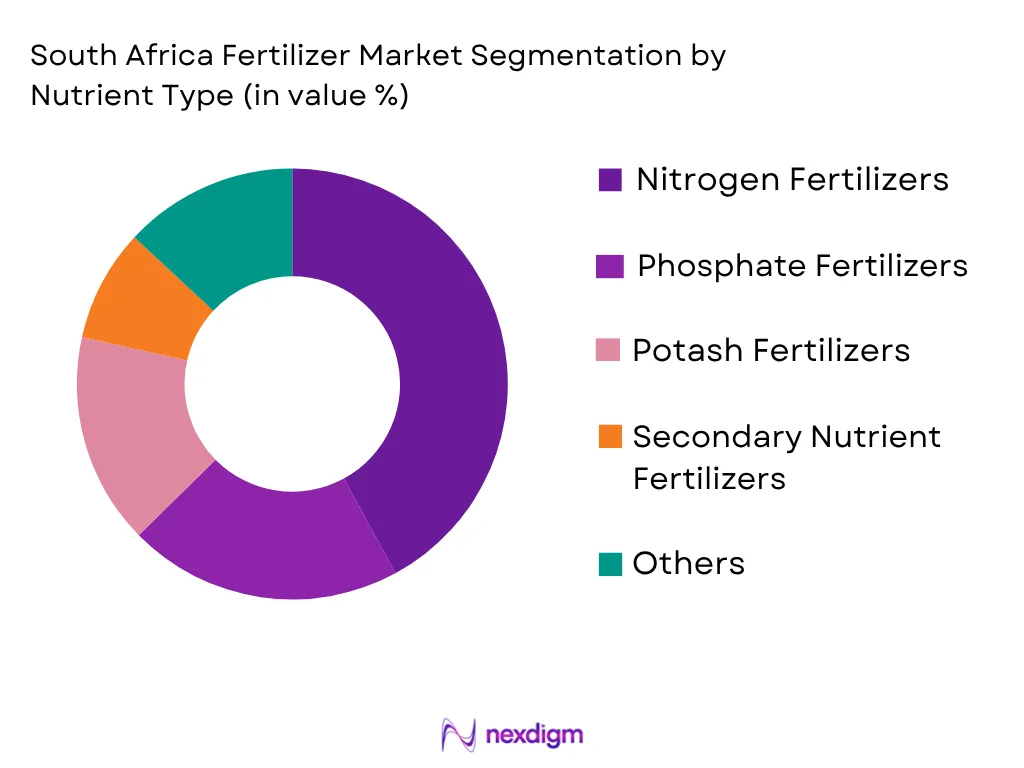
By Nutrient Type
Nitrogen fertilizers dominate the South Africa fertilizer market due to the country’s extensive cultivation of maize, wheat, and sugarcane, all of which require consistent nitrogen applications to sustain productivity across diverse soil types and climatic zones. South African soils vary significantly across provinces, but many commercial farming regions in the Free State, Mpumalanga, and North West exhibit moderate to low inherent nitrogen content, making regular fertilization essential for achieving high yields. The widespread adoption of single-crop and rotation farming systems further increases nitrogen demand. Additionally, South Africa’s agricultural export orientation encourages producers to maximize productivity, leading to consistent consumption of nitrogen-based fertilizers across large-scale commercial farming operations. Strong agronomic extension services and the need to improve nutrient-use efficiency continue to reinforce the dominance of the nitrogen fertilizer segment.
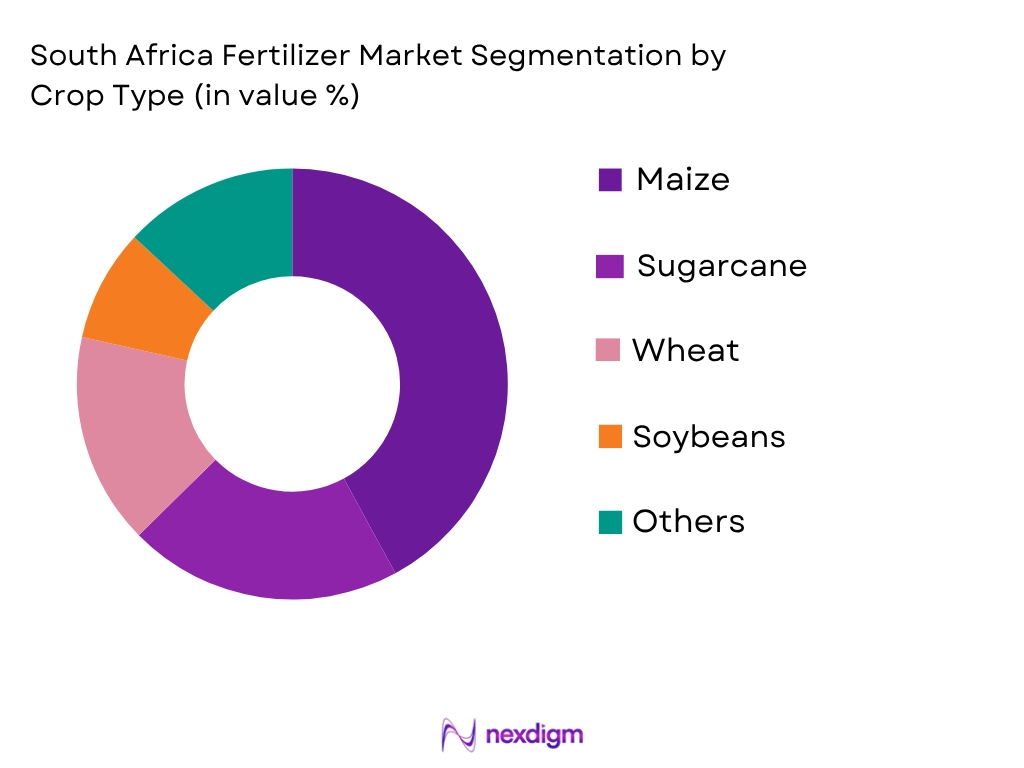
By Crop Type
Maize represents the dominant crop segment within the South Africa fertilizer market as the country is the largest producer of maize on the African continent and among the top producers globally. Maize occupies the largest share of cultivated agricultural land, with the Free State, North West, Mpumalanga, and Limpopo provinces accounting for the majority of production. The crop requires significant applications of nitrogen, phosphate, and potassium fertilizers to sustain productivity across multiple growing seasons. Large-scale commercial maize farms depend on structured fertilization programs to achieve competitive yields and maintain soil nutrient balance. Rising domestic and regional demand for maize grain and maize-based food products has encouraged producers to expand cultivation areas and improve yields through advanced nutrient management practices. Consequently, maize farming remains the largest contributor to fertilizer consumption throughout South Africa.
Competitive Landscape
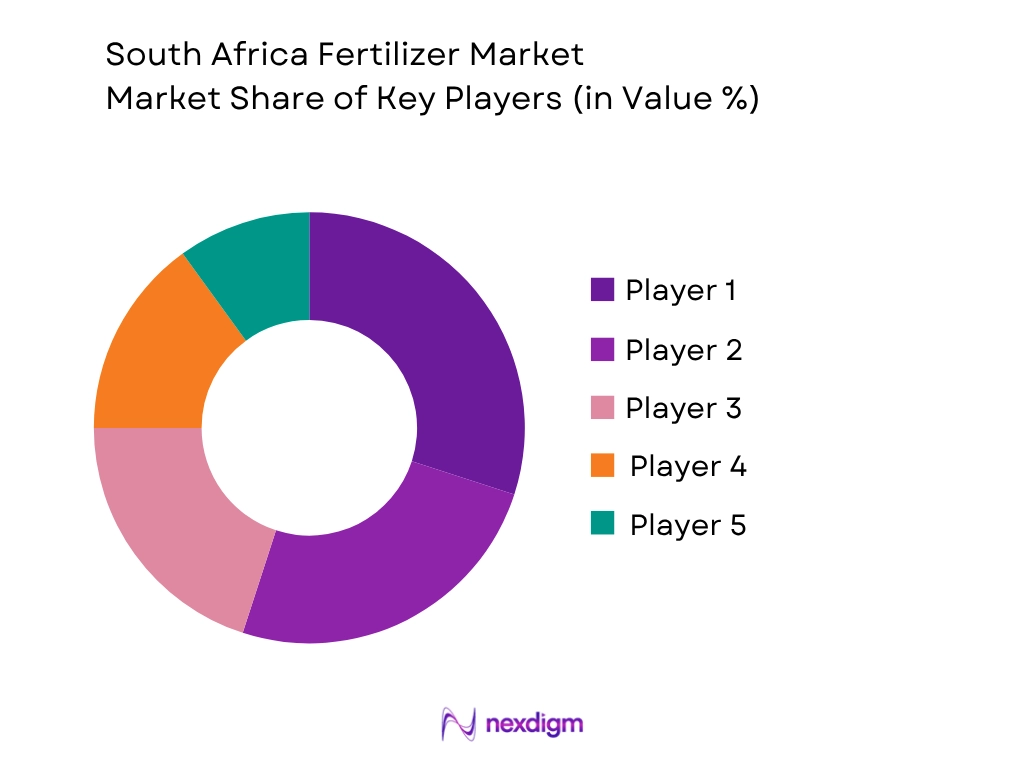
The South Africa fertilizer market is relatively concentrated, with major domestic producers, multinational fertilizer companies, and agricultural cooperative-linked distributors controlling a substantial portion of production, imports, distribution, and agricultural service activities. Companies compete through extensive distribution networks, agronomic consulting services, blending capabilities, import infrastructure, and crop-specific nutrient solutions tailored to South African soil and climate conditions. Strategic investments in domestic production, specialty fertilizers, and precision agriculture solutions continue to shape competitive dynamics across the market.
| Company | Establishment Year | Headquarters | Product Portfolio | Production & Blending Facilities
|
Import Infrastructure | Distribution Reach | Specialty Fertilizer Portfolio | Agronomic Support Network |
| Omnia Holdings) | 1953 | ~ | ~ | ~ | ~ | ~ | ~ | ~ |
| Yara South Africa | 1905 | ~ | ~ | ~ | ~ | ~ | ~ | ~ |
| Foskor | 1951 | ~ | ~ | ~ | ~ | ~ | ~ | ~ |
| Kynoch
Fertilizers |
1903 | ~ | ~ | ~ | ~ | ~ | ~ | ~ |
| Profert | 1996 | ~ | ~ | ~ | ~ | ~ | ~ | ~ |
South Africa Fertilizer Market Analysis
Growth Drivers
Expansion of Maize and Soybean Cultivation
South Africa’s fertilizer market continues to be driven by the expansion of large-scale commercial agriculture, particularly maize and soybean cultivation. According to the South African Department of Agriculture, Land Reform and Rural Development (DALRRD), South Africa’s total maize production reached approximately 16.3 million metric tons in the 2023/24 season, while planted maize area exceeded 2.7 million hectares. Soybean production surpassed 2.9 million metric tons, reflecting rapidly growing domestic crush capacity and rising demand for animal feed and oilseed processing. These crops require intensive applications of nitrogen, phosphate, and potassium fertilizers to sustain productivity and soil nutrient balance. The Fertilizer Association of Southern Africa (FERTASA) reported total fertilizer consumption of approximately 2.5 million metric tons in 2024, reflecting the substantial nutrient demand generated by South Africa’s agricultural sector. The Free State, Mpumalanga, North West, and Limpopo remain among the largest fertilizer-consuming provinces due to their extensive grain cultivation areas. South Africa’s GDP exceeded USD 380 billion in 2024 according to the World Bank, with agribusiness contributing meaningfully to economic activity and export revenues. The combination of expanding cultivated land, increasing crop output, and the need to maintain competitiveness in both domestic food supply and agricultural exports continues to create strong demand for fertilizer products across the country.
Rising Agricultural Export Demand and Regional Food Supply Requirements
South Africa’s position as the continent’s largest agricultural exporter is significantly supporting fertilizer demand. According to DALRRD and the Agricultural Business Chamber of South Africa (Agbiz), agricultural exports exceeded USD 12 billion in 2024, with maize, citrus, wine, deciduous fruit, sugar, and wool products accounting for a substantial portion of export revenues. South Africa exports significant volumes of maize to neighboring countries including Zimbabwe, Mozambique, Lesotho, and other SADC member states, requiring consistent nutrient replenishment to sustain high productivity. The country’s population exceeded 62 million people in 2024, while regional food demand across sub-Saharan Africa continues to increase, encouraging producers to maximize yields from existing farmland. The International Monetary Fund recorded moderate economic activity in South Africa despite structural challenges, with agricultural exports providing a key source of foreign exchange. Fertilizer consumption remains closely linked to export-oriented and food security farming because nutrient-intensive crops dominate South African commercial agriculture. Furthermore, the country’s grain storage infrastructure, road network, and port facilities continue to support broader agricultural production. These developments reinforce the need for nitrogen, phosphate, and potassium fertilizers, making agricultural export growth and regional food supply a key structural driver for the South Africa fertilizer market.
Market Challenges
Dependence on Imported Fertilizer Raw Materials
A major challenge facing the South Africa fertilizer market is the country’s significant reliance on imported fertilizer products and raw materials. According to FERTASA, South Africa imports a substantial proportion of its fertilizer requirements, particularly for potash and portions of its phosphate and nitrogen needs, with domestic production capacity insufficient to meet total agricultural demand. This dependence exposes the market to global supply chain disruptions, geopolitical tensions, currency fluctuations, and international commodity price volatility. The South African rand’s susceptibility to depreciation amplifies import cost pressures, as fertilizer prices are denominated in US dollars on global markets. Potassium chloride imports remain especially critical because South Africa has no commercial potash mining operations, making the country entirely dependent on imports from Belarus, Russia, Canada, and other producers. Since agriculture is a critical sector for South Africa’s food security and economic activity, any disruption in fertilizer imports directly impacts planting decisions, nutrient application rates, and crop productivity. The country’s fertilizer logistics also rely on port infrastructure at Durban, Richards Bay, and Cape Town, as well as inland transportation systems. Ensuring stable access to imported fertilizer products remains a persistent challenge for manufacturers, distributors, and farmers operating throughout South Africa’s commercial farming regions.
Load Shedding, Infrastructure Constraints, and Economic Headwinds
South Africa’s fertilizer market faces significant operational challenges due to persistent electricity supply disruptions, logistics infrastructure constraints, and broader macroeconomic pressures. According to Eskom, South Africa’s national electricity utility, the country experienced extensive load shedding throughout 2023 and into 2024, with power interruptions affecting agricultural operations, fertilizer blending facilities, cold storage, irrigation systems, and distribution infrastructure. These disruptions increase production costs and reduce operational efficiency across the agricultural input supply chain. Road freight, which carries the majority of fertilizer volumes to farms, faces challenges related to deteriorating road quality, rising diesel costs, and port congestion at key import terminals including the Port of Durban. According to the Transnet Freight Rail annual report, rail network inefficiencies have further constrained the movement of agricultural commodities and inputs across the country. Additionally, South Africa’s unemployment rate remained above 32% in 2024 according to Statistics South Africa, limiting smallholder farmer purchasing power and constraining fertilizer adoption in emerging farming communities. The combination of energy insecurity, infrastructure bottlenecks, and economic pressures creates a challenging operating environment for fertilizer manufacturers, distributors, and commercial farmers across the country.
Market Opportunities
Expansion of Domestic Fertilizer Production Capacity
The growing emphasis on reducing import dependence and strengthening domestic supply chains presents a significant opportunity for the South Africa fertilizer market. South Africa possesses substantial phosphate reserves concentrated in the Phalaborwa region of Limpopo, and Foskor operates one of the continent’s largest integrated phosphate mining and processing complexes, providing a strategic foundation for domestic fertilizer production. According to FERTASA, domestic fertilizer production capacity covers a meaningful share of nitrogen and phosphate demand but leaves significant gaps, particularly in potash supply. Investment in additional blending facilities, enhanced nitrogen production capacity, and specialty fertilizer manufacturing presents clear opportunities to reduce import exposure and improve supply chain resilience. The South African government has identified agricultural input security as a component of its broader food security strategy, and infrastructure development under programs such as the Presidential Employment Stimulus supports agricultural value chain development. Increasing domestic production would reduce vulnerability to global commodity price shocks and currency depreciation, while also creating employment opportunities in manufacturing and logistics. These factors position local manufacturing expansion and supply chain development as one of the most important long-term opportunities within the South African fertilizer industry.
Growth of Specialty, Biological, and Sustainable Fertilizers
The transition toward sustainable agriculture, conservation farming, and improved nutrient-use efficiency is creating strong opportunities for specialty fertilizer products in South Africa. The country cultivates millions of hectares of commercial farmland across diverse agro-ecological zones, creating substantial demand for advanced nutrient solutions that enhance productivity while managing soil health and environmental impact. Biological fertilizers, micronutrients, controlled-release formulations, and organomineral products are gaining attention as commercial farmers seek higher efficiency, reduced input costs, and improved soil biology. South Africa generates significant volumes of agricultural residues, livestock manure, and agro-processing waste that can be converted into sustainable fertilizer products, presenting opportunities for circular economy solutions within the agricultural sector. Conservation agriculture practices, which are actively promoted by DALRRD and agricultural development organizations, increase demand for precision-placed fertilizers and reduced-tillage compatible nutrient solutions. Additionally, growing adoption of precision agriculture technologies across large commercial farms in the Western Cape, Limpopo, and Mpumalanga is enabling more targeted fertilizer applications and increasing demand for customized nutrient blends. Supported by strong commercial agricultural output, rising environmental awareness, and innovation in crop nutrition, specialty and sustainable fertilizer categories are positioned for meaningful growth within South Africa’s broader fertilizer market.
Future Outlook
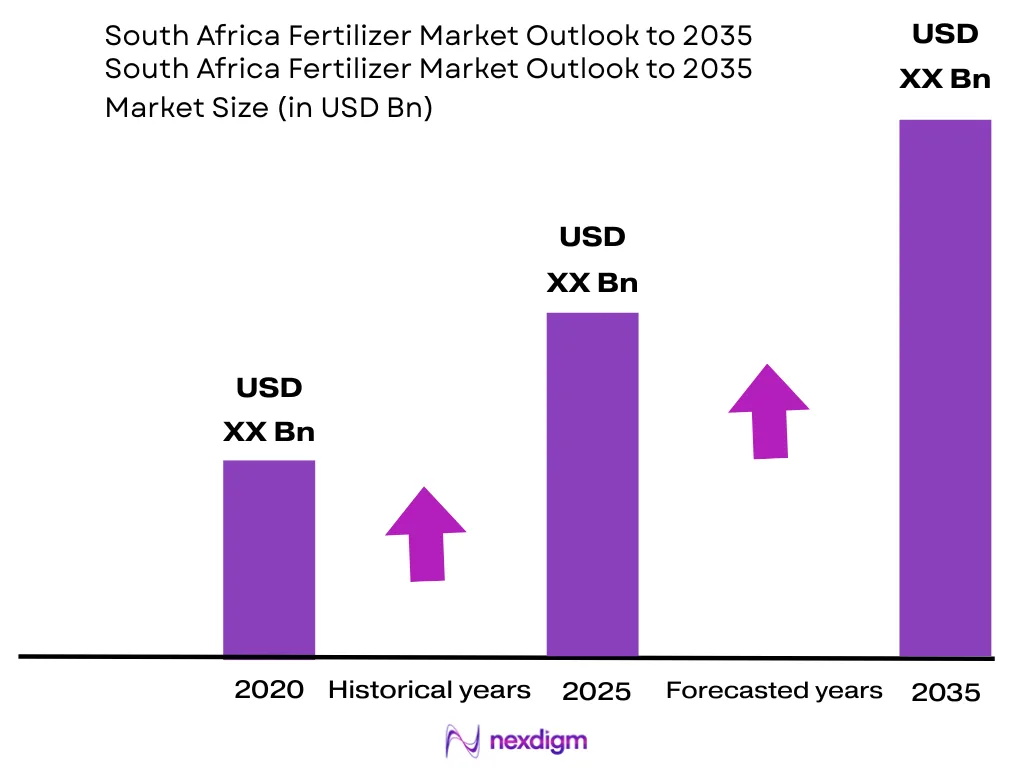
The South Africa fertilizer market is expected to witness sustained growth over the forecast period due to expanding commercial agricultural production, increasing adoption of precision farming technologies, and growing demand for higher crop yields to meet domestic food security and export requirements. Government initiatives under agricultural development programs are expected to encourage smallholder fertilizer adoption and improve access to agricultural inputs across underserved farming communities. Rising demand for specialty fertilizers, micronutrients, biological solutions, and controlled-release products will further support market expansion. Additionally, investments in domestic fertilizer production capacity, digital agriculture technologies, and sustainable farming practices are likely to strengthen long-term market prospects throughout the country.
Major Players
- Omnia Holdings
- Yara South Africa
- Sasol Chemicals (Nitrogen Fertilizers)
- Foskor
- Haifa Group South Africa
- Nutri-Tech Solutions SA
- ICL South Africa
- Profert
- Kynoch Fertilizers
- Windmill Agri
- Agri Supplies SA
- Chemfos
- Bayer Crop Science South Africa
- Syngenta South Africa
- TWK Agri
Key Target Audience
- Fertilizer Manufacturers
- Agricultural Input Distributors and Retailers
- Commercial Farming Enterprises
- Agribusiness Cooperatives
- Investments and Venture Capitalist Firms
- Government and Regulatory Bodies (Department of Agriculture Land Reform and Rural Development – DALRRD, Fertilizer Association of Southern Africa – FERTASA, National Agricultural Marketing Council)
- Fertilizer Importers and Exporters
- Precision Agriculture Technology Providers
Research Methodology
Step 1: Identification of Key Variables
The initial phase involves constructing an ecosystem map encompassing all major stakeholders within the South Africa Fertilizer Market. Extensive secondary research is conducted through industry publications, government databases, company annual reports, trade associations, and agricultural statistics. The objective is to identify critical variables influencing fertilizer demand, supply, pricing, imports, and crop production.
Step 2: Market Analysis and Construction
This phase focuses on gathering and analyzing historical information regarding fertilizer production, imports, nutrient consumption, crop acreage, and agricultural output. Market revenues are estimated through analysis of fertilizer volumes, average selling prices, and nutrient demand trends. Both supply-side and demand-side assessments are incorporated to develop comprehensive market estimates.
Step 3: Hypothesis Validation and Expert Consultation
Preliminary findings and market assumptions are validated through structured interviews with fertilizer manufacturers, distributors, agricultural cooperatives, agronomists, and industry specialists. These consultations provide valuable insights into purchasing patterns, nutrient application trends, production economics, and future market developments.
Step 4: Research Synthesis and Final Output
The final stage integrates findings obtained from primary and secondary research. Data triangulation techniques are applied to ensure consistency and reliability across all market estimates. The resulting report provides a comprehensive assessment of market structure, competitive dynamics, growth opportunities, and long-term industry outlook for the South Africa Fertilizer Market.

- Executive Summary
- Research Methodology (Market Definitions and Assumptions, Abbreviations, Market Sizing Approach, Top-Down Analysis, Bottom-Up Analysis, Fertilizer Demand Assessment by Crop Area, Nutrient Consumption Analysis, Import-Export Assessment, Primary Industry Interviews, Data Triangulation, Forecasting Framework, Limitations and Future Conclusions)

- Definition and Scope
- Market Evolution and Industry Genesis
- Timeline of Major Industry Developments
- South Africa Agricultural Production Ecosystem
- Fertilizer Industry Value Chain Analysis

- Growth Drivers (Expansion of Maize and Soybean Cultivation, Rising Crop Export Demand, Increasing Adoption of Precision Agriculture, Government Support through Agricultural Programs, Growth in Commercial Farming, Rising Demand for Food Security Solutions)
- Market Challenges (Dependence on Imported Fertilizer Raw Materials, Volatility in Global Fertilizer Prices, Currency Exchange Rate Fluctuations and Load Shedding, Logistics and Infrastructure Constraints, Environmental Compliance Costs)
- Market Opportunities (Domestic Fertilizer Production Expansion, Specialty Fertilizer Growth, Biofertilizer Adoption, Organomineral Fertilizer Development, Precision Nutrient Management Solutions)
- Market Trends (Increased Use of Enhanced Efficiency Fertilizers, Digital Agriculture Integration, Customized Nutrient Blends, Carbon-Efficient Crop Nutrition, Expansion of Biological Inputs)
- Government Regulations (Fertilizer Act and Amendments, DALRRD Registration Requirements, Environmental Licensing Standards, Nutrient Quality Regulations, Import and Trade Policies)
- Import Dependency Assessment (Nitrogen Import Ratio, Phosphate Import Ratio, Potash Import Ratio, Supplier Country Concentration)
- Raw Material Analysis (Coal-Based Nitrogen Capacity, Phosphate Rock Supply, Potash Availability, Sulfur Supply)
- Fertilizer Consumption Intensity Analysis (Kg per Hectare, Nutrient Use Efficiency, Crop-Wise Consumption, Regional Application Rates)
- Price Trend Analysis (Urea Prices, MAP Prices, DAP Prices, Potash Prices, NPK Prices)
- Supply-Demand Gap Analysis (Domestic Production Capacity, Installed Capacity Utilization, Import Requirements, Inventory Levels)
- SWOT Analysis
- Porter’s Five Forces Analysis
- PESTLE Analysis
- Stakeholder Ecosystem
- Competition Ecosystem

- By Market Value (2020-2025)
- By Production Volume (2020-2025)
- By Average Selling Price (2020-2025)

- By Nutrient Type (In Value %)
Nitrogen Fertilizers
Phosphate Fertilizers
Potash Fertilizers
Secondary Nutrient Fertilizers
Micronutrient Fertilizers
Specialty and Customized Fertilizers - By Application Method (In Value %)
Soil Application
Fertigation
Foliar Application
Seed Treatment
Precision Agriculture Application - By Crop Type (In Value %)
Maize
Sugarcane
Wheat
Soybeans
Sunflower
Potatoes
Fruits and Citrus
Vegetables
Others - By Region (In Value %)
Limpopo
Mpumalanga
Free State
KwaZulu-Natal
North West
Western Cape
Other Provinces (Gauteng, Eastern Cape, Northern Cape) - By Distribution Channel (In Value %)
Agricultural Cooperatives (Agri-Co-ops)
Agricultural Retailers
Direct Sales by Manufacturers
Distributors and Wholesalers
Digital Agricultural Platforms

- Market Share Analysis of Major Players (By Value, By Volume, Nutrient Segment, Crop Segment, By Region)
- Market Concentration Analysis
- Cross Comparison Parameters (Product Portfolio Diversity, Annual Fertilizer Production Capacity, Blending Capacity, Import Terminal Infrastructure, Distribution Network Reach, Agronomic Technical Service Coverage, Specialty Fertilizer Portfolio Strength, Crop-Specific Nutrient Solution Capability)
- SWOT Analysis of Major Players
- Pricing Analysis by Product Type and Nutrient Grade
- Detailed Profiles of Major Companies
Omnia Holdings
Yara South Africa
Sasol Chemicals (Nitric Acid and Nitrogen Fertilizers)
Foskor
Haifa Group South Africa
Nutri-Tech Solutions SA
ICL South Africa
Profert
Kynoch Fertilizers
Windmill Agri
Agri Supplies SA
Chemfos
Bayer Crop Science South Africa
Syngenta South Africa
TWK Agri

- Crop Nutrient Consumption Assessment (Crop Area, Yield Targets, Nutrient Removal Rates, Fertilizer Intensity)
- Farm Size Analysis (Small-Scale Subsistence Farms, Medium Farms, Large Commercial Farms)
- Purchasing Power Analysis (Farm Income Levels, Credit Availability, Fertilizer Budget Allocation)
- Seasonal Demand Assessment (Planting Cycles, Crop Calendar, Procurement Patterns)
- Farmer Purchasing Behavior (Brand Preference, Nutrient Preference, Price Sensitivity)
- Precision Agriculture Adoption Analysis (GPS-Based Application, Variable Rate Technology, Digital Farm Management)
- Sustainability Adoption Analysis (Carbon Reduction Practices, Soil Health Management, Conservation Agriculture)
- Pain Point Analysis (Input Costs, Nutrient Availability, Logistics Challenges, Agronomic Support)
- Purchase Decision-Making Process

- By Market Value (2026-2035)
- By Production Volume (2026-2035)
- By Average Selling Price (2026-2035)


 Request a Sample
 Ask for Customization
 Get a Quote
 Enquire Now