
 Download PDF
Market Overview
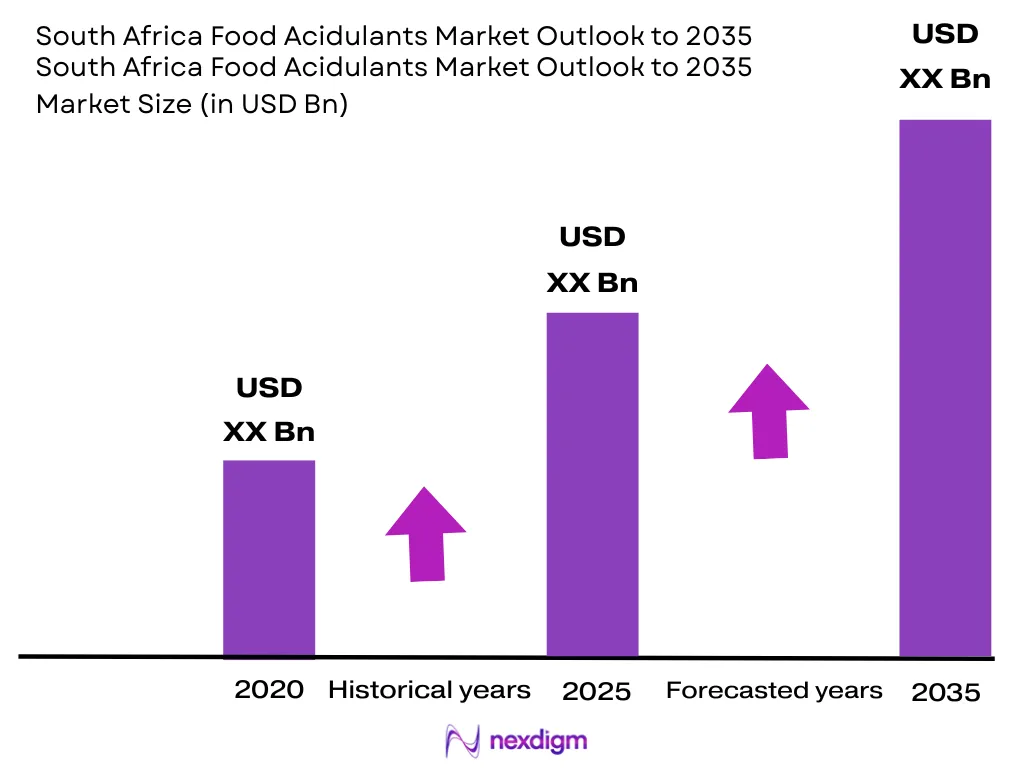
The South Africa Food Acidulants Market reached approximately USD 20 million in 2024 and is estimated to grow to approximately USD 31.17 million by 2033, expanding at a CAGR of approximately 5.04% from 2026 to 2033, according to Deep Market Insights. South Africa is the largest food acidulants market in Africa, accounting for approximately 1.21% of the global food acidulants market in 2024 and dominating the Africa food ingredients market with a 34.3% share of total regional revenue. The country’s leading position is underpinned by its advanced food processing infrastructure, well-developed retail sector, regulatory maturity, and its strategic role as the primary food ingredient sourcing and distribution hub for the broader Sub-Saharan Africa region. The global food acidulants market was valued at USD 6.42 billion in 2024 and is projected to reach USD 8.74 billion by 2030 at a CAGR of 5.3%, providing a strong global demand backdrop for acidulant ingredient supply into South Africa. Market growth is driven by increasing consumption of processed and convenience foods, the rapidly expanding beverage sector, a growing confectionery industry with high acidulant intensity, and the progressive adoption of natural and clean-label acidulants by health-conscious South African food manufacturers responding to new food additive regulations published in November 2024 under the Foodstuffs, Cosmetics and Disinfectants Act No. 54 of 1972. South Africa is additionally distinguished by the presence of Isegen South Africa (Pty) Ltd, a locally established acidulant producer that provides domestic manufacturing capability for selected organic acids, reducing the market’s import dependency relative to most other African acidulant markets.
Market Segmentation
By Acidulant Type
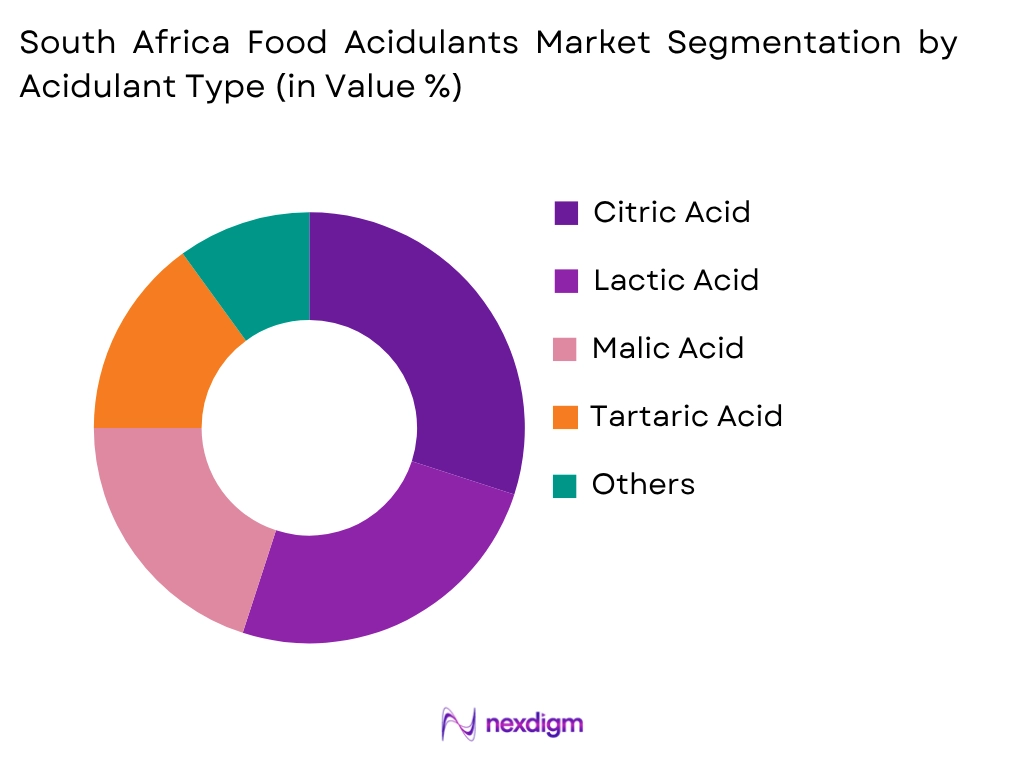
Citric acid dominates the South Africa food acidulants market, consistent with its global dominance where it accounts for approximately 62% of food acidulant revenue, driven by its multifunctional versatility as a pH buffer, flavor enhancer, natural preservative, and chelating agent across beverages, confectionery, dairy, and bakery applications. Citric acid’s widespread adoption in South Africa is reinforced by abundant global supply from fermentation-based producers, cost-competitiveness relative to alternative acidulants, and its broad regulatory acceptance across all major food additive categories as defined by the Foodstuffs, Cosmetics and Disinfectants Act and its associated regulations. The South African beverage sector, which consistently drives the highest acidulant demand volume nationally, relies extensively on citric acid for pH management, flavor balance, and preservation in carbonated soft drinks, fruit juices, flavored waters, and energy drinks. Lactic acid represents the fastest-growing acidulant segment in South Africa, driven by expanding dairy processing applications, the growth of fermented food and beverage products, and increasingly prominent use in processed meat applications where its antimicrobial properties, pathogen inhibition capacity, and meat flavour protection benefits deliver measurable product quality and safety advantages. Malic acid is gaining significant traction in the confectionery segment, where its persistent tart flavor and fruit-enhancing properties make it the preferred acidulant in sour candies, gummy confections, and premium flavored beverages. According to Mordor Intelligence, the South Africa Acidulants Market is projected to register a CAGR of 7.80% during the 2024 to 2029 forecast period, with citric acid and lactic acid identified as the dominant sub-segments driving market expansion.
By Application
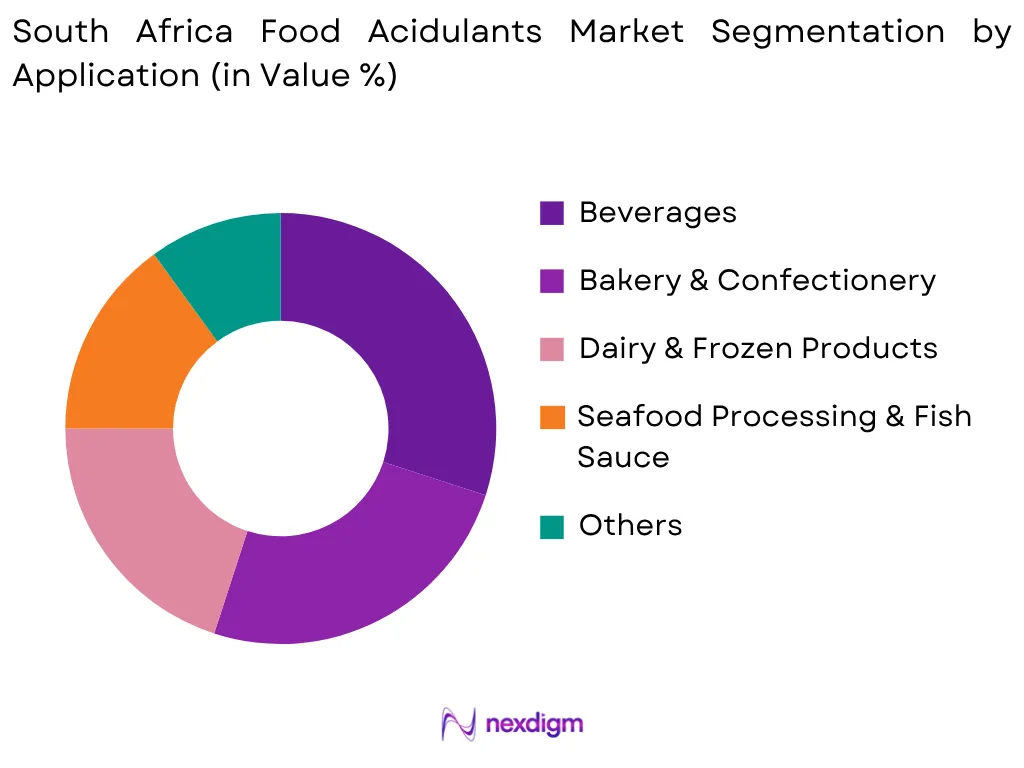
The beverages segment accounts for the largest share of food acidulant demand in South Africa, consistent with global market dynamics where beverages represent approximately 50.1% of total acidulant consumption. South Africa’s carbonated soft drink market, fruit juice industry, and rapidly expanding energy and functional beverage sector generate substantial and continuous demand for citric acid, phosphoric acid, and malic acid as primary acidulant ingredients. The Health Promotion Levy, South Africa’s sugar tax introduced in 2018 and applying a levy of ZAR 2.31 per gram of sugar above 4 grams per 100 millilitres on beverages, has incentivized manufacturers to reformulate beverage products toward reduced-sugar formulations that maintain desired tartness and flavor through precise application of citric acid and malic acid acidulant systems, further expanding functional acidulant demand in the beverage segment. The bakery and confectionery segment represents the second-largest application area, with South Africa’s well-developed confectionery industry generating strong demand for citric acid, malic acid, fumaric acid, and lactic acid in chocolate, candy, gummy, and baked goods manufacturing. According to Mordor Intelligence, the confectionery segment is expected to grow at a robust pace, driven by the growing popularity of sour confectionery products in which malic acid and citric acid deliver the distinctive tart flavor profiles that consumers increasingly prefer. The dairy and frozen products segment also contributes significantly, with lactic acid playing a particularly important role in yogurt, fermented dairy beverage, and cheese manufacturing applications across South Africa’s established dairy processing industry.
Competitive Landscape
The South Africa Food Acidulants Market is characterized by the presence of both international specialty ingredient companies and a unique domestic producer, Isegen South Africa (Pty) Ltd, which provides local manufacturing capability that distinguishes the South African acidulant market from most other African markets that are entirely import-dependent. Isegen South Africa, established in 1952, is one of the few domestic manufacturers of food-grade organic acids on the African continent and provides competitive advantages through local production, shorter supply chain lead times, rand-denominated pricing for applicable products, and direct technical support relationships with South African food manufacturers. International players including Corbion, Cargill, Tate & Lyle, and ADM supply a broader range of imported citric acid, lactic acid, malic acid, and specialty acidulant systems through established distribution networks and ingredient trading partnerships in Johannesburg, Cape Town, and Durban. Competitive differentiation centers on supply reliability, pricing relative to imported Chinese fermentation-based citric acid, natural and clean-label positioning, technical application support, and sub-Saharan Africa export distribution capability.
| Company | Establishment Year | Headquarters | Primary Acidulant Portfolio | Key Application Industries
|
Manufacturing Presence | R&D Capability | Distribution Network | Clean Label Solutions |
| Isegen South Africa (Pty) Ltd | 1952 | ~ | ~ | ~ | ~ | ~ | ~ | ~ |
| Corbion N.V. | 1919 | ~ | ~ | ~ | ~ | ~ | ~ | ~ |
| Cargill Incorporated | 1865 | ~ | ~ | ~ | ~ | ~ | ~ | ~ |
| Archer Daniels Midland (ADM) | 1902 | ~ | ~ | ~ | ~ | ~ | ~ | ~ |
| Tate & Lyle PLC | 1859 | ~ | ~ | ~ | ~ | ~ | ~ | ~ |
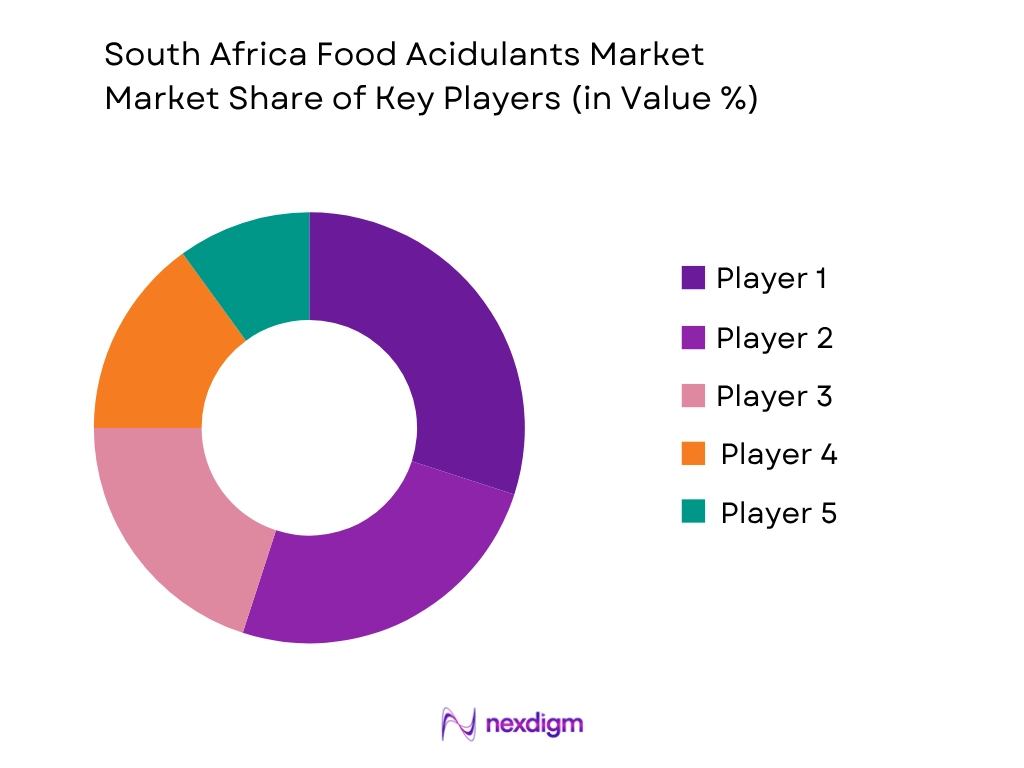
South Africa Food Acidulants Market Analysis
Growth Drivers
Rising Demand for Processed and Convenience Foods and South Africa’s Role as Sub-Saharan Africa Food Processing Gateway
South Africa’s well-developed food processing industry, which accounted for 34.3% of the total Africa food ingredients market in 2024, represents the most fundamental structural driver of acidulant demand. The country hosts an advanced food manufacturing base that spans beverages, dairy, bakery, confectionery, processed meat, sauces, and convenience foods, all of which are significant consumers of citric acid, lactic acid, malic acid, acetic acid, and other food-grade organic acids. South Africa is the largest market for food and beverage products in Southern Africa and serves as the primary gateway and distribution hub for food ingredients reaching the broader Sub-Saharan Africa region, reinforcing the commercial significance of its domestic acidulant demand as a proxy for regional ingredient procurement. The Africa food ingredients market was valued at USD 1.97 billion in 2024 and is expected to reach USD 3.03 billion by 2033, with South Africa consistently leading regional demand at 34.3% share, reflecting the country’s disproportionate food processing sophistication and economic scale relative to other African nations. Rising urbanization, the expansion of South Africa’s organized retail sector through chains such as Pick n Pay, Shoprite, Woolworths, and SPAR, and growing consumer access to processed and packaged foods across all income segments have progressively increased per capita consumption of acidulant-containing food and beverage products. Consumer food consumption shifts documented in academic research show sustained movement toward sugar-sweetened beverages, processed and packaged foods, and convenience meals since 1994, all of which are major consumers of citric acid, phosphoric acid, and other acidulant ingredients, reinforcing the long-term structural demand trajectory for food acidulants across South Africa’s diverse consumer market.
New Food Additive Regulations 2024 and Health Promotion Levy-Driven Beverage Reformulation
South Africa’s evolving regulatory framework for food additives and nutritional health policies is creating significant reformulation-driven demand for certified food acidulant ingredients across the country’s food and beverage manufacturing sector. On 1 November 2024, the South African Minister of Health published the Regulations Relating to the Use of Food Additives in Foodstuffs, 2024, developed under the Foodstuffs, Cosmetics and Disinfectants Act No. 54 of 1972, which introduced updated guidelines for the use of food additives including preservatives, antioxidants, sweeteners, colorants, and emulsifiers, aligning South African standards more closely with internationally recognized Codex Alimentarius frameworks. These regulations require food manufacturers to ensure that all acidulant ingredients used in food production meet strict purity and identity specifications, compelling ingredient procurement teams to prioritize certified and documented acidulant supply chains. Draft Regulation R3337 of 2023, expected to come into force in 2026, will introduce mandatory front-of-pack warning labels for products high in sugar, salt, and saturated fat, creating additional reformulation incentives for manufacturers to develop lower-sugar beverage and food products that maintain flavor profiles through natural acidulant systems. The Health Promotion Levy (Sugar Tax), applying a ZAR 2.31 per gram levy on sugars above 4 grams per 100 millilitres in beverages, has already driven widespread beverage reformulation toward reduced-sugar formulations, accelerating demand for citric acid and malic acid as primary tools for maintaining acceptable tartness and palatability in lower-sugar carbonated soft drink, juice, and flavored water formulations.
Market Challenges
Rand Currency Volatility, Import Dependency, and Energy Cost Pressures
South Africa’s food acidulants market faces compounding structural challenges arising from the South African rand’s persistent volatility against major global trading currencies, near-total import dependency for citric acid and other major acidulant raw materials, and the elevated energy costs associated with South Africa’s ongoing electricity supply challenges. While Isegen South Africa provides domestic manufacturing capability for selected organic acids, the majority of citric acid consumed in South Africa is imported from international producers in China and Eastern Europe, with rand-denominated import costs fluctuating significantly in response to exchange rate movements that have historically weakened the currency against the US dollar and euro in periods of global risk aversion, domestic political uncertainty, and commodity price volatility. The rand’s depreciation against import pricing currencies directly inflates the landed cost of fermentation-based citric acid, lactic acid, and other imported organic acids, compressing margins for food manufacturers that cannot easily pass input cost increases through to price-sensitive consumer segments. South Africa’s history of electricity supply constraints, including scheduled load shedding that has imposed significant operational costs and productivity losses on food manufacturing facilities, adds a further cost burden to food processing operations that rely on continuous refrigeration, temperature-controlled storage, and uninterrupted processing runs to maintain product quality and safety for acidulant-containing food products. These combined input cost pressures require food manufacturers to actively manage acidulant procurement strategies, maintain buffer inventory, and explore alternative sourcing relationships to protect operational continuity and ingredient cost competitiveness.
Economic Inequality, Price Sensitivity, and Regulatory Compliance Costs
South Africa’s pronounced economic inequality, with a Gini coefficient among the highest globally, creates a bifurcated consumer market that simultaneously demands premium, health-conscious food products from affluent segments and highly affordable, calorie-dense processed foods from price-sensitive lower-income consumers, complicating the commercial rationale for reformulation programs that increase ingredient costs. A significant portion of South African food manufacturers targeting mass-market consumer segments face intense price pressure that limits their ability to absorb higher costs associated with premium natural or clean-label acidulant systems, constraining the pace of reformulation toward naturally derived citric acid, organic lactic acid, or premium malic acid alternatives. Regulatory compliance costs associated with demonstrating alignment with the Regulations Relating to the Use of Food Additives in Foodstuffs 2024, the forthcoming Draft Regulation R3337 front-of-pack warning label requirements, and ongoing DALRRD agricultural product standards represent a recurring investment requirement for food manufacturers that must maintain comprehensive ingredient documentation for all acidulant compounds used in their product formulations. The presence of informally distributed food ingredients through informal trade channels in township and peri-urban markets introduces quality variability and potential food safety risks that legitimate acidulant suppliers must navigate through brand protection investment and consumer and manufacturer education programs reinforcing the importance of certified and properly documented ingredient sourcing.
Market Opportunities
Natural and Clean-Label Acidulant Growth and Sub-Saharan Africa Export Hub Development
The growing consumer demand for natural, clean-label, and health-oriented food products in South Africa’s expanding middle-class and health-conscious urban consumer segments is creating significant commercial opportunities for suppliers of naturally derived acidulant systems positioned as transparent and recognizable food ingredient alternatives. South Africa’s food industry is distinguished by its regulatory maturity and advanced food processing infrastructure, meaning that clean-label and natural ingredient trends that emerge among premium consumer segments in Johannesburg, Cape Town, and Durban can progressively influence reformulation practices across the broader food manufacturing sector. Natural lactic acid derived from fermentation, naturally sourced citric acid from citrus fermentation processes, and malic acid from fruit sources offer clean-label positioning opportunities for food manufacturers seeking Healthier Choice-aligned reformulations ahead of the implementation of Draft Regulation R3337 front-of-pack warning labels expected in 2026. South Africa’s strategic geographic position as the most developed food processing economy in Sub-Saharan Africa, combined with its well-established logistics infrastructure including the Port of Durban and Johannesburg’s road and rail distribution networks, creates a compelling opportunity to develop South Africa-based ingredient distribution hubs that supply processed food manufacturers and ingredient traders across Southern Africa, East Africa, and beyond. The Africa food ingredients market is growing at a CAGR of approximately 4.7 to 4.86%, providing a structurally expanding addressable market for South Africa-based acidulant distributors capable of cost-effectively serving regional demand.
Malic Acid Expansion in Sour Confectionery and Premium Beverages, and Lactic Acid Growth in Fermented Foods
South Africa’s growing confectionery market and the accelerating global sour candy trend present a high-growth opportunity specifically for malic acid, which delivers the distinctive persistent tartness and fruit-flavor enhancement that sour confectionery products require. Malic acid is gaining increasing popularity globally as a cost-effective alternative to citric acid in sour confectionery, premium flavored beverages, and dessert applications, with the global malic acid segment projected to register the fastest CAGR of 6.8% from 2024 to 2030 according to Grand View Research. In South Africa’s confectionery sector, the growing demand for sour gummy products, tart candy formulations, and novel flavored confectionery among younger consumer demographics is progressively increasing malic acid procurement volumes. The fermented food and beverage category represents a complementary growth opportunity for lactic acid, driven by South Africa’s established yogurt and fermented dairy sector, growing interest in gut health and probiotic food products among health-conscious consumers, and increasing adoption of fermented plant-based beverages and kombucha in premium retail channels. Corbion’s August 2023 launch of a new line of natural lactic acid products specifically targeting flavor enhancement and shelf-life extension in food applications, combined with Tate & Lyle’s May 2023 introduction of a citric acid formulation designed for the confectionery sector to improve flavor profiles for lower-sugar products, illustrate how global acidulant suppliers are actively developing South Africa-relevant product innovations to capture these emerging opportunity segments.
Future Outlook
The South Africa Food Acidulants Market is expected to maintain sustained growth through the 2035 forecast period, supported by the expanding processed food and beverage manufacturing sector, the implementation of the Regulations Relating to the Use of Food Additives in Foodstuffs 2024, the forthcoming Draft Regulation R3337 front-of-pack warning label requirements driving product reformulation, and the Health Promotion Levy incentivizing beverage manufacturers to develop natural, reduced-sugar formulations using citric acid and malic acid. Growing consumer demand for clean-label and naturally derived acidulant systems, the expansion of the confectionery sector creating demand for malic acid and fumaric acid, and the progressive growth of fermented food and dairy applications for lactic acid are expected to diversify the acidulant demand profile across South Africa’s food processing sector. South Africa’s ongoing role as the primary food ingredient gateway for Sub-Saharan Africa will further reinforce ingredient import and distribution investment by international acidulant suppliers seeking regional market development opportunities.
Major Players
- Isegen South Africa (Pty) Ltd
- Corbion N.V.
- Cargill Incorporated
- Tate & Lyle PLC
- Archer Daniels Midland Company (ADM)
- Brenntag South Africa
- Univar Solutions (Food Ingredients Division)
- IMCD South Africa
- Jungbunzlauer Suisse AG
- Bartek Ingredients Inc.
- Weifang Ensign Industry Co. Ltd.
- Foodchem International Corporation
- Kerry Group PLC
- Ingredion Incorporated
- Hawkins Watts Limited
Key Target Audience
- Food & Beverage Manufacturers and Ingredient Procurement Teams
- Beverage Producers, Bottlers, and Juice Manufacturers
- Bakery, Confectionery, and Snack Food Producers
- Dairy Processors and Fermented Food Manufacturers
- Specialty Food Ingredient Distributors and Trading Companies
- Meat Processors and Chilled Food Manufacturers
- Investments and Venture Capitalist Firms
- Government and Regulatory Bodies (Department of Health (DoH), Department of Agriculture, Land Reform and Rural Development (DALRRD), South African Bureau of Standards (SABS), South African Health Products Regulatory Authority (SAHPRA), National Regulator for Compulsory Specifications (NRCS))
Research Methodology
Step 1: Identification of Key Variables
The research begins by identifying the major stakeholders across the South Africa food acidulants value chain, including domestic and international acidulant manufacturers, specialty ingredient distributors, food and beverage processing companies, regulatory agencies, and end-user sectors across beverages, bakery, confectionery, dairy, and processed meat categories. Extensive secondary research is conducted using Department of Health regulatory publications, DALRRD product standards, USDA FAS South Africa food processing reports, Mordor Intelligence and Deep Market Insights industry data, company publications, and proprietary ingredient market databases to establish the key variables influencing market demand, pricing, and competitive dynamics.
Step 2: Market Analysis and Construction
Historical market information is compiled and analyzed to estimate the overall food acidulants market size by type, function, form, application, and end user. Ingredient import statistics, food processing sector revenue data, Health Promotion Levy beverage reformulation impact analysis, organized retail expansion metrics, and consumer health trend research are integrated using both bottom-up and top-down market sizing approaches to ensure comprehensive coverage of all demand-generating segments within the South African market.
Step 3: Hypothesis Validation and Expert Consultation
Preliminary market estimates are validated through Computer Assisted Telephone Interviews (CATIs) and structured discussions with ingredient procurement managers, food technologists, regulatory affairs specialists, distributor executives, and food industry associations operating within South Africa. These consultations provide critical commercial insights into acidulant adoption trends, regulatory compliance dynamics under the new 2024 food additive regulations, pricing benchmarks for imported and locally produced acidulants, and the competitive dynamics among international and domestic ingredient suppliers serving the South African food manufacturing sector.
Step 4: Research Synthesis and Final Output
The final stage integrates primary research findings with secondary data to develop a comprehensive market assessment covering market size, segmentation, regulatory landscape, competitive positioning, end-user demand analysis, and future growth opportunities. Multiple validation techniques including data triangulation and cross-verification against Department of Health regulatory data, DALRRD agricultural product standards, and Africa food ingredients market benchmarks are employed to ensure the accuracy and credibility of the final market report.

- Executive Summary
- Research Methodology (Market Definitions and Assumptions, Abbreviations, Market Taxonomy, Market Sizing Approach, Top-Down Analysis, Bottom-Up Analysis, Demand-Side Assessment, Supply-Side Assessment, Primary Industry Interviews, Secondary Research Validation, Data Triangulation, Forecasting Framework, Limitations and Future Conclusions)

- Definition and Scope
- Market Evolution and Industry Genesis
- Timeline of Major Industry Developments
- Industry Value Chain Analysis
- Supply Chain Analysis

- Growth Drivers (Rising Demand for Processed and Convenience Foods, Growing Beverage Industry and Carbonated Soft Drink Consumption, Expanding Confectionery Sector, Organised Retail Expansion Driving Packaged Food Demand, South Africa as Sub-Saharan Africa Food Processing Gateway, New Food Additive Regulations Driving Reformulation, Growing Health and Wellness Awareness, Rising Demand for Natural and Clean-Label Acidulants)
- Market Challenges (Import Dependency for Major Acidulant Raw Materials, Rand Currency Volatility and Input Cost Inflation, Economic Inequality and Price Sensitivity Across Consumer Segments, Load Shedding and Energy Cost Impact on Food Manufacturing, Stringent New Food Additive Regulations Compliance Costs, Supply Chain Disruptions, Competition from Informally Distributed Ingredients)
- Market Opportunities (Natural and Clean-Label Acidulant Demand Growth, Lactic Acid Expansion in Dairy and Meat, Malic Acid Growth in Premium Beverages and Confectionery, Sub-Saharan Africa Export Hub Development, Sugar Tax-Driven Beverage Reformulation, Front-of-Pack Warning Label Regulation-Driven Product Reformulation, Indigenous Fruit Acid Innovation, Functional Food Acidulant Integration)
- Market Trends (Natural Fermentation-Derived Acidulants, Clean-Label Sourcing, Malic Acid in Sour Confectionery and Beverages, Lactic Acid in Fermented and Plant-Based Dairy, Citric Acid in Functional and Energy Beverages, Organic Acid Innovation, Sustainable Acidulant Sourcing Programs, Digital B2B Ingredient Procurement)
- Government Regulations & Policy Framework (Regulations Relating to the Use of Food Additives in Foodstuffs 2024 (under Foodstuffs, Cosmetics and Disinfectants Act No. 54 of 1972), Draft Front-of-Pack Warning Label Regulation R3337 of 2023, Sugar Tax (Health Promotion Levy) on Beverages, Trans-Fat Regulation R249 of 2011, R2527 of 1973 Additives and Permitted Preservatives, DALRRD Agricultural Product Standards Act, SANS and SABS Food Standards, Meat Safety Act Regulations)
- South African Food Additive Regulations 2024 Analysis (Regulations Relating to the Use of Food Additives in Foodstuffs 2024, Permitted Acidulant Lists, Purity and Identity Specifications, Compliance Timeline and Implementation Requirements, International Codex Alimentarius Alignment)
- Health Promotion Levy (Sugar Tax) Impact Analysis (Beverage Reformulation Incentives, Natural Acidulant Demand Acceleration, Manufacturer Response Strategies, Low-Sugar Beverage Market Development)
- Draft Front-of-Pack Warning Label Regulation R3337 Impact Analysis (High Sugar, Salt and Saturated Fat Warning Labels, Reformulation Incentives, Clean-Label Acidulant Demand Implications)
- South Africa as Sub-Saharan Africa Food Ingredient Hub Analysis (Gateway to Southern, East and West Africa, Export Distribution Infrastructure, Ingredient Trading and Warehousing, Preferred Sourcing Hub Status)
- Food Processing Industry Assessment (Beverages, Bakery, Confectionery, Dairy, Meat Processing, Sauces and Condiments, Convenience Foods, Snack Foods)
- Ingredient Import and Local Production Analysis (Import Volumes by Acidulant Type, Key Sourcing Countries, Isegen Local Production Capabilities, Import Price Trends, Rand Volatility Impact)
- Organised Retail and Informal Trade Analysis (Modern Retail Expansion, Township Economy Growth, Informal Spaza Shop Market, Consumer Access to Processed Foods)
- SWOT Analysis
- Porter’s Five Forces Analysis
- PESTLE Analysis
- Stakeholder Ecosystem
- Competition Ecosystem

- By Market Value (2020-2025)
- By Volume Consumption (2020-2025)
- By Average Selling Price (2020-2025)

- By Acidulant Type (In Value %)
Citric Acid
Lactic Acid
Acetic Acid
Phosphoric Acid
Malic Acid
Tartaric Acid
Fumaric Acid
Other Acidulants (Adipic Acid, Glucono-delta-lactone, Succinic Acid) - By Function (In Value %)
pH Control & Buffering
Flavor Enhancement
Microbial Control & Preservation
Leavening Agent
Chelating & Sequestrant Agent
Emulsification Support - By Application (In Value %)
Beverages
Bakery & Confectionery
Dairy & Frozen Desserts
Processed Meat & Poultry
Sauces, Dressings & Condiments
Convenience Foods & Ready Meals
Snack Foods
Other Food Applications - By Distribution Channel (In Value %)
Direct Sales to Food Manufacturers
Ingredient Distributors & Specialty Traders
Wholesale & Cash and Carry
Online B2B Platforms - By Province (In Value %)
Gauteng
Western Cape
KwaZulu-Natal
Eastern Cape
Other Provinces

- Market Share Analysis (By Value, Volume, Acidulant Type, Application, Distribution Channel)
- Cross Comparison Parameters (Citric Acid Portfolio, Lactic Acid Portfolio, Malic Acid Portfolio, Acetic Acid Capability, Natural Acidulant Range, South Africa Distribution Network, Sub-Saharan Africa Reach, Local Production Capability, Technical Application Support, Clean-Label Solutions)
- SWOT Analysis of Major Players
- Pricing Analysis (By Acidulant Type, By Form, By Application, Imported vs Locally Produced Pricing)
- Detailed Profiles of Major Companies
Isegen South Africa (Pty) Ltd
Corbion N.V.
Cargill Incorporated
Tate & Lyle PLC
Archer Daniels Midland Company (ADM)
Brenntag South Africa
Univar Solutions (Food Ingredients Division)
IMCD South Africa
Jungbunzlauer Suisse AG
Bartek Ingredients Inc.
Weifang Ensign Industry Co. Ltd.
Foodchem International Corporation
Kerry Group PLC
Ingredion Incorporated
Hawkins Watts Limited

- Food Manufacturer Demand Analysis (Beverages, Dairy, Bakery, Confectionery, Meat, Sauces, Convenience Foods)
- Acidulant Type Adoption Rate by Food Category
- Natural vs Synthetic Acidulant Preference Analysis
- Price Sensitivity and Affordability Analysis by End User Segment
- Regulatory Compliance Reformulation Demand Analysis

- By Market Value (2026-2035)
- By Volume Consumption (2026-2035)
- By Average Selling Price (2026-2035)


 Request a Sample
 Ask for Customization
 Get a Quote
 Enquire Now