
 Download PDF
Market Overview
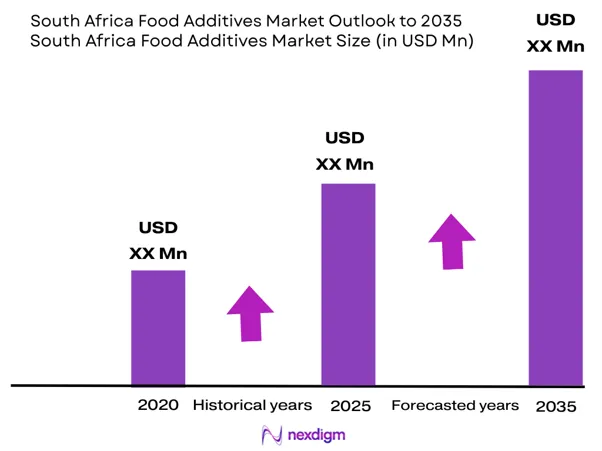
The South Africa Food Additives Market is valued at USD ~ million, based on a five-year historical analysis, and is forecast to grow at % CAGR during the forecast period. Demand is driven by bakery, milling-based foods, beverages, dairy, meat processing, snacks, sauces and retail private label. South Africa’s GDP reached USD 401.15 billion and GDP per capita reached USD 6,267.19, while the population was estimated at 63.02 million.The South Africa Food Additives Market is dominated by Johannesburg, Ekurhuleni, Pretoria, Cape Town, Paarl, Durban, Pinetown, Gqeberha and Free State milling clusters. Gauteng dominates through FMCG headquarters, food manufacturing, logistics and retail buying offices, while Western Cape dominates fruit processing, wine-adjacent food manufacturing, dairy, bakery and export-linked packaged foods. KwaZulu-Natal dominates sugar, beverage inputs, port-linked imports and ingredient distribution through Durban. Food products wholesale sales reached R123,558.0 million, while retail food, beverage and tobacco sales reached R27,891.0 million in a reported quarter.
Market Segmentation
By Additive Type
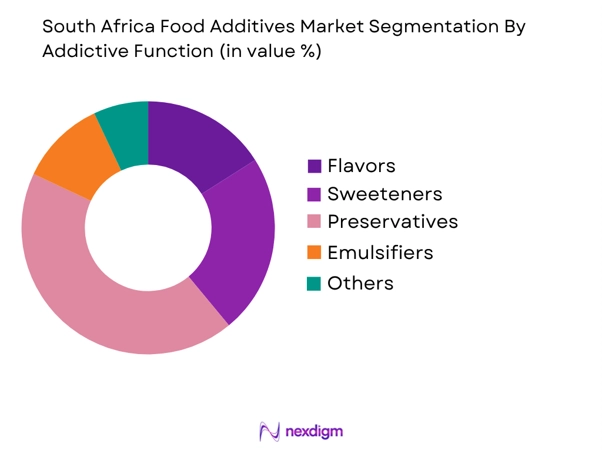
South Africa Food Additives Market is segmented by additive type into preservatives, emulsifiers, stabilizers, flavours, flavour enhancers, sweeteners, colours, acidity regulators, antioxidants, hydrocolloids, enzymes and other functional additives. Recently, preservatives have a dominant market share in South Africa under the additive type segmentation due to their extensive use across bread, cakes, sauces, processed meat, dairy products, soft drinks, snacks, ready meals and private label foods. South Africa’s long inland distribution routes, temperature variation, price-sensitive retail environment and high reliance on ambient packaged foods make shelf-life extension commercially important. Preservatives such as sorbates, benzoates, propionates and antioxidant-preservative systems help manufacturers reduce spoilage, protect taste, control mould and manage stock rotation across formal retail and wholesale channels. Their dominance is reinforced by the country’s supermarket-led packaged food structure, where suppliers must maintain consistent quality across national chains, spaza-linked wholesale distribution and regional foodservice customers.
By Application
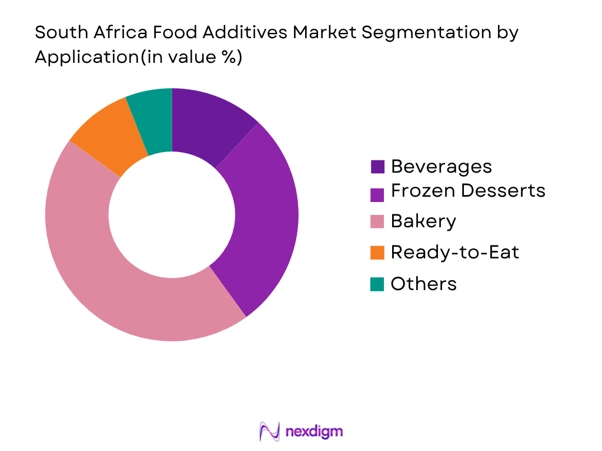
South Africa Food Additives Market is segmented by application into bakery and milling-based foods, beverages, dairy and frozen desserts, meat and poultry products, snacks, sauces, condiments, ready meals, confectionery, fortified foods and plant-based foods. Recently, bakery and milling-based foods have a dominant market share in South Africa under the application segmentation because bread, rolls, cakes, biscuits, cereals and flour-based convenience products are high-frequency staples across income groups. This application uses several additive systems together, including emulsifiers, enzymes, preservatives, acidity regulators, humectants, colours, flavours and texture improvers. Industrial bakeries require mould control, dough strength, crumb softness, volume improvement and longer shelf life for national distribution. Milling and cereal-based manufacturers also use vitamins, minerals, anti-caking agents and processing aids to maintain functional quality. Dominance is supported by strong formal retail penetration, private label bakery lines, national bread manufacturers and regional bakeries supplying both supermarkets and informal channels.
Competitive Landscape
The South Africa Food Additives Market is served by global ingredient companies, local distributors, flavour houses, meat ingredient specialists, bakery ingredient suppliers and specialty chemical distributors. The market is relatively fragmented in trading and distribution, but more concentrated in technical support, application testing, food-category documentation and multinational customer supply. Large FMCG, dairy, bakery, beverage, meat and retail private label manufacturers prefer suppliers that can provide Department of Health-aligned additive documentation, reliable import supply, stockholding, shelf-life testing and application-specific blends for South African processing conditions.
| Company | Establishment Year | Headquarters | Core Additive Focus | South Africa Market Role | Key Applications | Distribution Strength | Compliance Capability | Market-Specific Capability |
| Kerry Ingredients South Africa | 1972 | Tralee, Ireland | ~ | ~ | ~ | ~ | ~ | ~ |
| Cargill South Africa | 1865 | Wayzata, USA | ~ | ~ | ~ | ~ | ~ | ~ |
| DSM-Firmenich South Africa | 2023 | Maastricht / Geneva | ~ | ~ | ~ | ~ | ~ | ~ |
| Givaudan South Africa | 1895 | Vernier, Switzerland | ~ | ~ | ~ | ~ | ~ | ~ |
| Brenntag South Africa | 1874 | Essen, Germany | ~ | ~ | ~ | ~ | ~ | ~ |
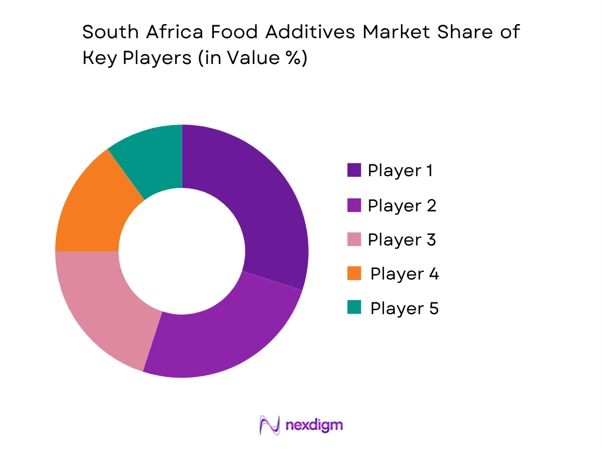
South Africa Food Additives Market Analysis
Growth Drivers
Packaged food manufacturing and formal retail demand
South Africa Food Additives Market is supported by the country’s formal food manufacturing, wholesale and retail ecosystem, where preservatives, emulsifiers, stabilizers, sweeteners, colours, flavours, antioxidants, acidulants and hydrocolloids are used in bakery, beverages, dairy, meat products, sauces, snacks and private-label foods. The World Bank recorded South Africa’s GDP at USD 401.15 billion and population at nearly 63 million in 2024, while Statistics South Africa reported formal non-agricultural employment of 10.72 million in June 2024. The Department of Agriculture’s food and beverages review reported food products wholesale sales of R123,558.0 million, retail food, beverages and tobacco sales of R27,891.0 million, and foodservice food sales income of R21,081.7 million in a reported 2024 quarter. These numbers support food-additive demand because formal retail chains, wholesalers, QSR suppliers and national food processors require consistent shelf life, mould control, oxidation stability, colour retention, texture control and taste standardisation across long distribution routes and cost-sensitive consumer channels.
Urban food consumption and beverage-processing base
South Africa Food Additives Market is driven by urban food consumption and beverage manufacturing because urban consumers purchase packaged bread, dairy drinks, carbonated soft drinks, juices, snacks, sauces, ready meals, processed meats and frozen desserts through supermarkets, wholesalers, spaza-linked channels and foodservice outlets. World Bank data recorded South Africa’s urban population at 69.3 units per 100 units of total population in 2024, while the country’s population was about 63 million. This urban concentration supports additive usage because packaged food needs to move from Gauteng, Western Cape and KwaZulu-Natal manufacturing clusters into inland and coastal retail networks without losing safety, sensory quality or shelf life. The Department of Agriculture’s food and beverages review reported beverage sales rising from R47,357.6 million to R50,553.9 million across two reported quarters, while foodservice food sales income reached R21,081.7 million. These figures justify strong demand for beverage acidulants, preservatives, sweeteners, colours, stabilizers and emulsions, as well as bakery preservatives and dairy stabilizer systems.
Market Challenges
Regulatory transition and additive-category compliance burden
South Africa Food Additives Market faces a major challenge from regulatory transition because additive permissions are not generic; they are linked to additive class, technological function, product category, permitted conditions and label declaration. The National Department of Health published the No. 5506 draft regulations relating to the use of food additives in foodstuffs on 1 November 2024, with comments invited until 1 February 2025. The draft framework is intended to replace or consolidate several older controls covering colours, preservatives, sweeteners and miscellaneous additives. This directly affects suppliers of preservatives, stabilizers, emulsifiers, sweeteners, colours, antioxidants, flavour enhancers and hydrocolloids because food processors must verify permitted use, dosage, labelling and technical documentation before commercial launch. The compliance burden is market-specific because South Africa’s formal food system serves a population of about 63 million and formal non-agricultural employment of 10.72 million supports organized packaged-food production and distribution. Any uncertainty in additive rules can delay bakery, beverage, dairy, meat, snack and private-label reformulation projects.
Import dependence, logistics risk and technical reformulation constraints
South Africa Food Additives Market is constrained by imported specialty additive reliance and technical reformulation risk, especially for hydrocolloids, enzymes, natural colours, high-intensity sweeteners, specialty emulsifiers, acidulants and stabilizer blends. The challenge is not only supply availability; it also includes documentation, batch consistency, cold-chain stress, long-distance inland distribution and application performance in cost-sensitive products. Statistics South Africa reported that formal non-agricultural employment increased from 10.67 million in March 2024 to 10.72 million in June 2024, but still recorded 144,000 jobs lost between June 2023 and June 2024, reflecting a pressured operating environment for manufacturers and consumers. Reuters also reported South Africa’s economy grew only 0.6 units per 100 units in 2024, while manufacturing remained vulnerable. For additives, weak demand and logistics pressure matter because reformulating a bread preservative, dairy stabilizer, beverage sweetener system or meat antioxidant blend requires trials, shelf-life tests, sensory validation and supplier technical support. Smaller manufacturers often delay clean-label replacement when imported ingredients or formulation support are uncertain.
Market Opportunities
Clean-label, natural and application-specific additive systems
South Africa Food Additives Market has an opportunity in clean-label, natural and application-specific additive systems because food manufacturers need to balance affordability, shelf life and consumer-facing ingredient transparency. The Department of Health’s draft food additive regulations published on 1 November 2024 create a more structured compliance environment for suppliers that can provide permitted-use guidance, technical dossiers, certificates of analysis and category-specific documentation. The opportunity is supported by South Africa’s large formal food chain: the Department of Agriculture’s food and beverages review reported food products wholesale sales of R123,558.0 million, retail food, beverages and tobacco sales of R27,891.0 million, and foodservice food sales income of R21,081.7 million in a reported 2024 quarter. These active channels require preservatives, colours, sweeteners, stabilizers and emulsifiers, but increasingly prefer systems that can support cleaner labels. Suppliers can target natural colours, plant-based hydrocolloids, rosemary extract antioxidants, fermentation-derived preservatives, enzyme-led bakery improvers and sugar-reduction blends for bakery, beverages, dairy, snacks, sauces, meat processing and retail private-label foods.
Township retail, private label and regional foodservice expansion
South Africa Food Additives Market has a forward growth opportunity in township retail, private label manufacturing and regional foodservice supply because these channels need affordable, shelf-stable and consistent packaged foods. Reuters reported that Tiger Brands expanded its township presence from 50,000 stores to more than 71,000 stores in 2024, with a stated target of 90,000 stores by the end of 2024 and at least 130,000 township stores within five years. While this example is company-specific, it indicates the scale of informal and township-linked packaged food distribution that additive suppliers can serve through bakery preservatives, snack antioxidants, beverage stabilizers, sauce thickeners, colour systems and flavour enhancers. The opportunity is reinforced by South Africa’s urban population structure, with World Bank-linked data showing urban residents at 69.3 units per 100 units of the population in 2024. Additive suppliers that offer low-MOQ premixes, locally stocked ingredients, shelf-life testing and private-label documentation can support manufacturers serving township stores, wholesalers, supermarkets, QSR suppliers and catering channels.
Future Outlook
Over the forecast period, the South Africa Food Additives Market is expected to expand steadily through packaged food manufacturing, retail private label growth, bakery demand, beverage innovation, meat processing, dairy products and convenience foods. Additives will remain necessary for shelf-life extension, taste consistency, texture control, colour stability, pH management, oxidation control and product standardization across national supply chains.
Bakery and milling-based foods will continue to anchor additive demand because bread, biscuits, cakes, cereals and flour-based foods are high-frequency consumption categories. Enzymes, emulsifiers, preservatives and dough conditioners will remain central to factory-scale production and longer distribution.
Beverages will remain a high-value application area for sweeteners, acidulants, flavours, colours, stabilizers and preservatives. Reduced-sugar beverages and flavoured dairy drinks will increase demand for taste modulation, masking systems and stabilizer blends.
Meat and poultry processing will continue to require phosphates, antioxidants, curing systems, colour stabilizers and moisture-retention solutions. Suppliers with technical meat-processing expertise and documentation-ready additive systems will be better placed in this category.
Clean-label reformulation will gain relevance, especially among premium retail brands, dairy processors, bakery manufacturers, plant-based food companies and private label ranges. Natural colours, plant-based hydrocolloids, bio-based preservatives and fermentation-derived ingredients will benefit from the shift.
Regulatory transition will remain an important market variable. The Department of Health’s food additive framework and draft food additive regulations will push suppliers toward better category mapping, additive declarations, permitted-use verification and technical documentation.
Major Players
- Kerry Ingredients South Africa
- Cargill South Africa
- DSM-Firmenich South Africa
- International Flavors & Fragrances South Africa
- Givaudan South Africa
- Symrise South Africa
- Brenntag South Africa
- IMCD South Africa
- Azelis South Africa
- Barentz South Africa
- Crown National
- Cape Food Ingredients
- Orkila South Africa
- Carst & Walker South Africa
- Savannah Fine Chemicals
Key Target Audience
- Food additive manufacturers
- Food and beverage processing companies
- Bakery, milling and confectionery manufacturers
- Dairy, beverage and frozen dessert manufacturers
- Meat, poultry and ready-meal processors
- Ingredient importers and specialty ingredient distributors
- Investments and venture capitalist firms
- Government and regulatory bodies (National Department of Health, Department of Agriculture, Land Reform and Rural Development, South African Bureau of Standards, National Regulator for Compulsory Specifications, South African Revenue Service Customs, Department of Trade, Industry and Competition)
Research Methodology
Step 1: Identification of Key Variables
The initial phase involves constructing an ecosystem map covering additive manufacturers, ingredient importers, distributors, bakery companies, dairy processors, beverage producers, meat processors, foodservice suppliers and retail private label manufacturers. This step is underpinned by desk research, regulatory review and company-level mapping. The objective is to define the key variables influencing South Africa Food Additives Market demand, including additive type, application, source, functionality, regulatory classification and distribution model.
Step 2: Market Analysis and Construction
In this phase, historical data is compiled across food manufacturing activity, food wholesale and retail movement, beverage sales, foodservice income, import dependency and end-user procurement patterns. The top-down approach evaluates macro food and manufacturing indicators, while the bottom-up approach assesses additive usage across bakery, beverages, dairy, meat, snacks, sauces and private label foods. This supports value, volume and segment-level modelling.
Step 3: Hypothesis Validation and Expert Consultation
Market hypotheses are validated through computer-assisted telephone interviews with additive suppliers, ingredient distributors, food technologists, bakery ingredient specialists, beverage formulators, meat-processing ingredient suppliers and procurement teams. These consultations help verify category dominance, supplier selection criteria, regulatory documentation needs and clean-label reformulation trends. Expert inputs are used to refine segmentation, competitive structure and future outlook.
Step 4: Research Synthesis and Final Output
The final phase integrates regulatory review, secondary research, company benchmarking, channel checks, trade indicators and expert consultations into a consolidated market model. Data triangulation is applied across manufacturer demand, distributor movement, application usage and food-category requirements. The final output includes market size, segmentation, competitive landscape, future outlook and strategic recommendations for South Africa Food Additives Market participants.

- Executive Summary
- Research Methodology (Market Definitions and Assumptions, Abbreviations, INS/E-Number Mapping, South Africa Food Category Mapping, Department of Health Food Additive Regulation Mapping, HS Code Mapping, Market Sizing Approach, Top-Down Analysis, Bottom-Up Analysis, Demand-Side Assessment, Supply-Side Assessment, Import-Export Assessment, Food Processor Procurement Checks, Distributor and Trader Interviews, Primary Industry Interviews, Data Triangulation, Forecasting Framework, Limitations and Future Conclusions)

- Definition and Scope
- Market Evolution and Industry Genesis
- Timeline of Major Industry Developments
- Role of Food Additives in South African Food Processing
- South Africa Food Additives Regulatory Framework

- Growth Drivers (Expansion of Packaged Food Manufacturing, Formal Retail and Private Label Growth, Bakery and Milling-Based Food Demand, Beverage Manufacturing Expansion, Meat and Poultry Processing Demand, Dairy and Frozen Dessert Consumption, Shelf-Life Requirements Across Long Distribution Routes, Demand for Affordable Fortified and Convenience Foods)
- Market Challenges (Import Dependency for Specialty Additives, Department of Health Compliance Complexity, Draft Food Additive Regulation Transition, Clean-Label Reformulation Pressure, Quality Variation in Local Trading Channels, Cold Chain and Shelf-Life Stress, Documentation Burden for Export-Grade Additives, Raw Material and Logistics Volatility)
- Market Opportunities (Natural Colours and Natural Preservatives, Clean-Label Stabilizer Systems, Sugar Reduction Sweetener Blends, Bakery Emulsifier and Enzyme Systems, Meat Processing Antioxidant and Phosphate Systems, Dairy Stabilizer Blends, Retail Private Label Additive Systems, Export-Grade Ingredient Documentation)
- Market Trends (Shift from Synthetic to Natural Additives, Clean-Label Ingredient Lists, Reduced Sugar and Salt Formulation, Growth of Retail Private Label Foods, Increased Use of Stabilizers in Dairy and Frozen Desserts, Enzyme-Based Bakery Processing, Natural Colour Replacement, Application-Specific Additive Blends)
- SWOT Analysis
- Porter’s Five Forces Analysis
- PESTLE Analysis

- By Market Value (2020-2025)
- By Consumption Volume (2020-2025)
- By Import Value (2020-2025)

- By Additive Type (In Value %)
Preservatives
Emulsifiers
Stabilizers
Thickeners
Sweeteners
Colours - By Source Type (In Value %)
Synthetic Additives
Natural Additives
Nature-Identical Additives
Fermentation-Derived Additives
Plant-Based Additives
Mineral-Based Additives - By Distribution Channel (In Value %)
Direct Sales to Food Processors
Ingredient Distributors
Specialty Chemical Distributors
Importers
Local Food Ingredient Traders - By Province (In Value %)
Gauteng
Western Cape
KwaZulu-Natal
Eastern Cape
Free State
Mpumalanga

- Market Share of Major Players (By Value, Volume, Additive Type, Application, End User, Province, Distribution Channel, Domestic vs Imported Portfolio)
- Cross Comparison Parameters (Department of Health Compliance Capability, Additive Portfolio Breadth, Natural and Clean-Label Product Range, South Africa Stockholding and Warehousing Strength, Food Category-Specific Formulation Expertise, Distribution Reach Across Provinces, Technical Support and Shelf-Life Testing Capability, Retail Private Label and Export Documentation Strength)
- SWOT Analysis of Major Players
- Detailed Profiles of Major Companies
Kerry Ingredients South Africa
Cargill South Africa
DSM-Firmenich South Africa
International Flavors & Fragrances South Africa
Givaudan South Africa
Symrise South Africa
Brenntag South Africa
IMCD South Africa
Azelis South Africa
Barentz South Africa
Crown National
Cape Food Ingredients
Orkila South Africa
Carst & Walker South Africa
Savannah Fine Chemicals

- Food and Beverage Manufacturer Analysis
- Bakery and Milling-Based Food Manufacturer Analysis
- Dairy and Frozen Dessert Processor Analysis
- Beverage Manufacturer Analysis
- Meat and Poultry Processor Analysis

- By Market Value (2026-2035)
- By Consumption Volume (2026-2035)
- By Import Value (2026-2035)


 Request a Sample
 Ask for Customization
 Get a Quote
 Enquire Now