
 Download PDF
Market Overview
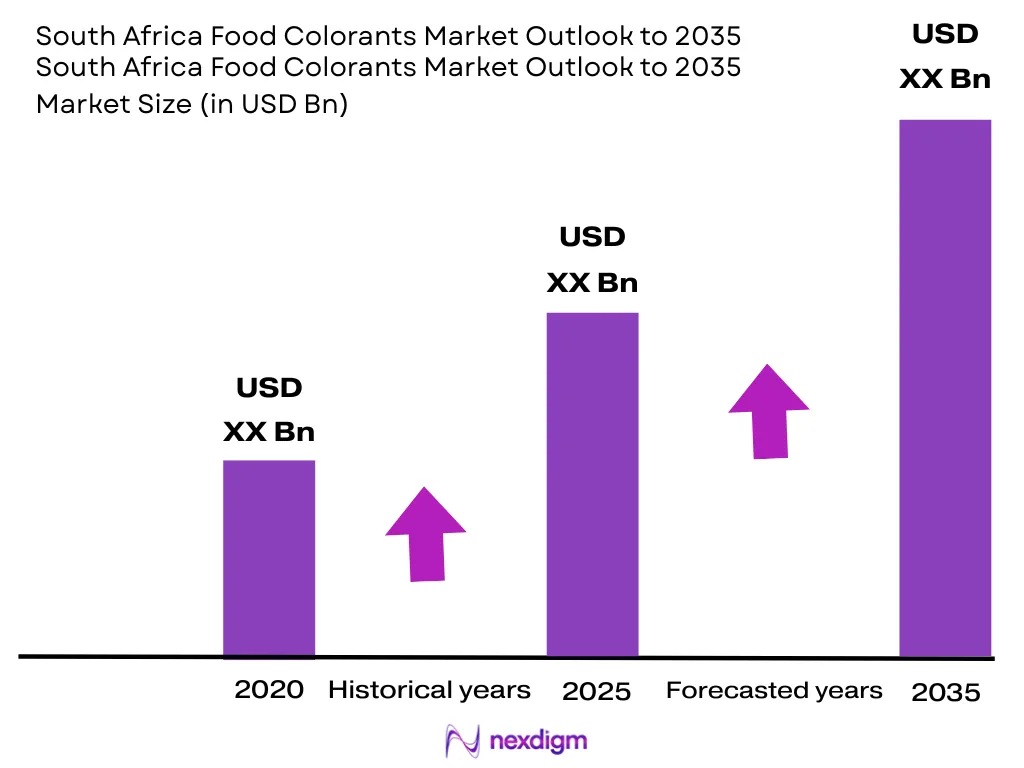
The South Africa Food Colorants Market was valued at USD ~ Billion in 2024 and is anticipated to expand at a CAGR of ~ % during 2026–2035. The market is primarily driven by the country’s expanding processed food and beverage manufacturing sector, increasing demand for clean-label ingredients, and growing preference for naturally derived food additives. According to Statistics South Africa (Stats SA), the food and beverages industry remains one of the country’s largest manufacturing divisions, with the broader manufacturing sector contributing more than R524 billion to GDP in 2023. Meanwhile, the Department of Agriculture, Land Reform and Rural Development (DALRRD) reported continued activity in food and beverage manufacturing output, creating sustained demand for functional ingredients such as food colorants across bakery, dairy, confectionery, beverages, snacks, and processed meat applications.
Market Segmentation
By Source Type
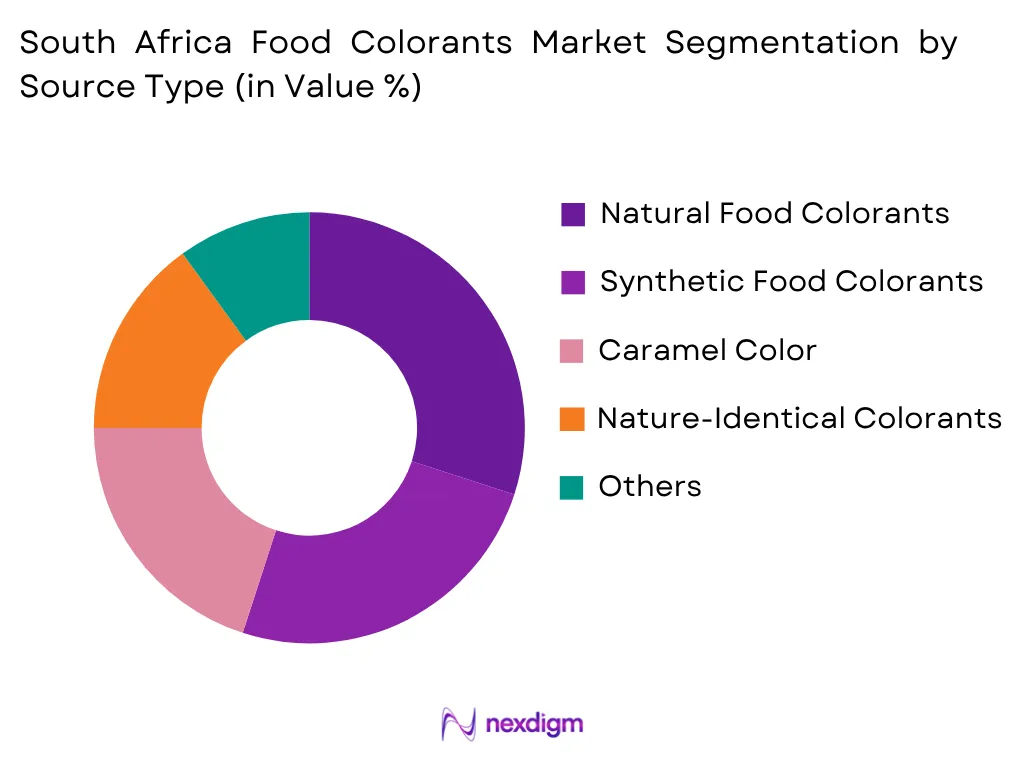
Among these, Natural Food Colorants dominate the South Africa Food Colorants Market owing to the rapid shift toward clean-label formulations, increasing regulatory scrutiny of synthetic azo dyes, and growing consumer awareness regarding naturally sourced ingredients. South African food manufacturers are actively reformulating product portfolios by replacing artificial dyes with botanical extracts such as paprika, beetroot, turmeric, rooibos, and spirulina to satisfy premium and health-conscious consumer demand. South Africa’s diverse agricultural base, particularly in Limpopo, the Western Cape, and KwaZulu-Natal, also provides a competitive advantage by ensuring domestic availability of several natural pigment sources, reducing dependence on imported ingredients. Multinational ingredient companies operating in South Africa, including through regional distribution partnerships such as Oterra’s collaboration with Barentz SK Chemtrade, have accelerated investments in natural color innovation to comply with global clean-label strategies, further strengthening the dominance of this segment across dairy, confectionery, beverages, bakery, and plant-based food applications.
By Application
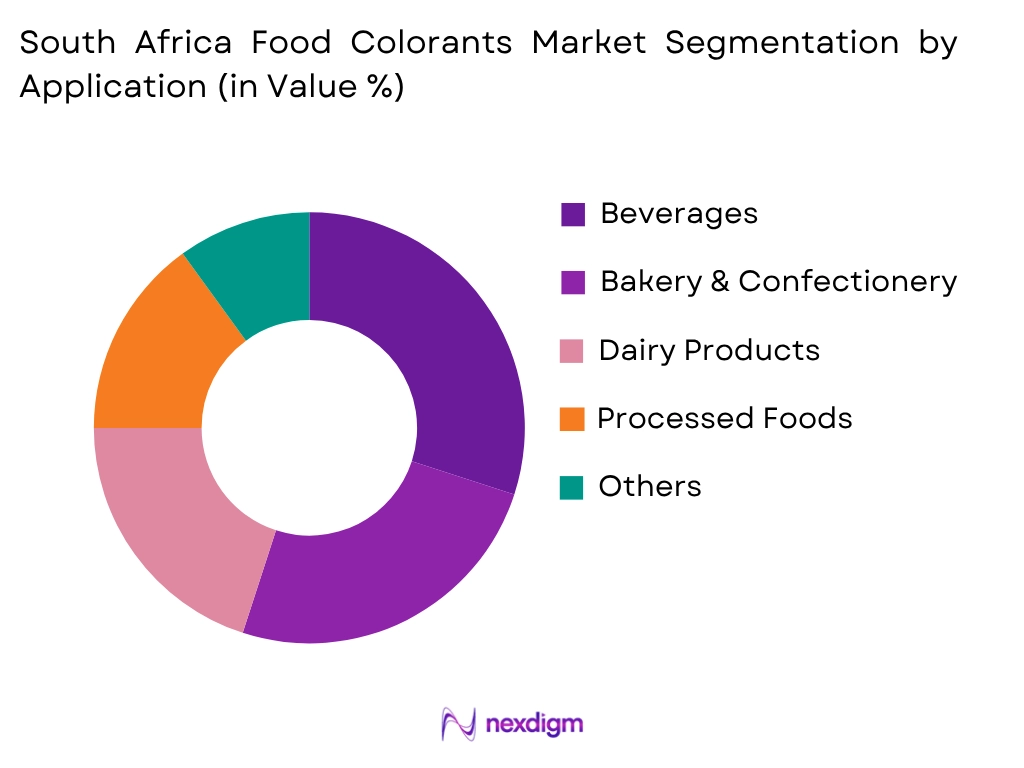
The Beverages segment holds the largest share owing to South Africa’s position as one of Africa’s largest beverage manufacturing hubs, home to major bottling and brewing operations serving both the domestic market and the wider Southern African Development Community (SADC) region. Manufacturers increasingly utilize stable natural pigments to enhance carbonated soft drinks, flavored waters, juices, dairy-based beverages, and alcoholic beverages while maintaining compliance with evolving food safety regulations. The growth of premium and functional beverages, ready-to-drink products, and export-oriented beverage manufacturing has further increased demand for customized color solutions offering heat stability, pH stability, and extended shelf life. In addition, expanding retail chains and modern supermarkets across urban centers continue introducing visually attractive beverage products, making colorants an essential functional ingredient that directly influences consumer purchasing decisions and brand recognition.
Competitive Landscape
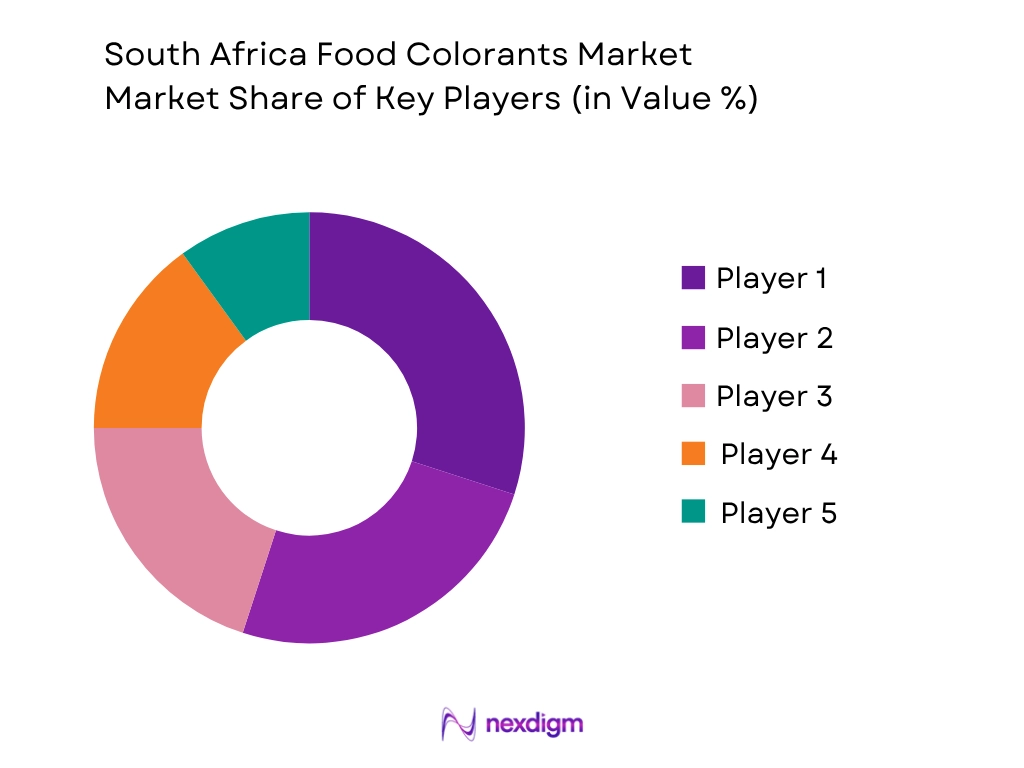
The South Africa Food Colorants Market is moderately consolidated, with the presence of several multinational ingredient manufacturers operating through local subsidiaries, technical centers, and regional distribution partnerships alongside specialty suppliers of natural pigments. Competition is primarily based on product innovation, regulatory compliance, application-specific formulations, pricing, technical support, and the ability to provide clean-label solutions. Companies are increasingly investing in research and development to improve the stability, heat resistance, pH tolerance, and shelf life of natural colorants. Strategic collaborations with food and beverage manufacturers, expansion of local technical and distribution capabilities in Johannesburg and Cape Town, and sustainable sourcing of botanical raw materials have become key competitive differentiators. The growing preference for natural food colorants has also prompted manufacturers to expand their portfolios through partnerships, acquisitions, and fermentation-based pigment technologies.
| Company | Establishment Year | Headquarters | Primary Product Portfolio | Natural Color Portfolio
|
Manufacturing Presence | Major End-Use Industries | Key Strategic Focus | Certifications & Compliance |
| Oterra (Chr. Hansen Natural Colors) | 1874 | ~ | ~ | ~ | ~ | ~ | ~ | ~ |
| Kerry Group | 1972 | ~ | ~ | ~ | ~ | ~ | ~ | ~ |
| DSM-Firmenich | 2023 | ~ | ~ | ~ | ~ | ~ | ~ | ~ |
| Sensient Technologies | 1882 | ~ | ~ | ~ | ~ | ~ | ~ | ~ |
| Barentz SK Chemtrade | 2021 | ~ | ~ | ~ | ~ | ~ | ~ | ~ |
South Africa Confectionary Market Analysis
Growth Drivers
Growing Demand for Natural and Clean-Label Food Ingredients
South Africa’s food colorants market is experiencing sustained growth due to the increasing preference for natural and clean-label ingredients across the country’s food and beverage industry. According to Statistics South Africa (Stats SA), the food and beverages industry remains one of the largest contributors within the manufacturing sector, with overall manufacturing value-add exceeding R524 billion in 2023. The expansion of processed food production directly increases the consumption of food additives, including natural colorants such as paprika, turmeric, beetroot, rooibos, and spirulina extracts. South Africa also remains a significant agricultural producer, with primary agricultural production estimated at R460 billion in 2024 according to the National Department of Agriculture, Land Reform and Rural Development (DALRRD), ensuring reasonable availability of plant-derived raw materials for pigment extraction. The World Bank estimates South Africa’s population at approximately 63 million, while the country’s urban population exceeds 42 million, creating substantial demand for packaged foods, ready-to-eat meals, dairy products, confectionery, and beverages where food colorants are essential for product differentiation. Furthermore, South Africa continues to rank among Africa’s largest agricultural exporters, with agricultural exports reaching a record USD 13.7 billion in 2024, according to trade data compiled by the National Agricultural Marketing Council (NAMC), encouraging manufacturers to formulate products that comply with international clean-label standards. This combination of steady domestic food production, diverse agricultural resources, and expanding exports continues to stimulate demand for both natural and specialty food colorants.
Expansion of Food Processing and Beverage Manufacturing
The steady expansion of South Africa’s food processing and beverage manufacturing industries remains a major driver for food colorant consumption. According to Stats SA, the food and beverages industry continues to represent one of South Africa’s largest manufacturing divisions, with food and beverages consistently contributing among the highest shares within manufacturing output and employment. South Africa is home to Coca-Cola Beverages Africa, the continent’s largest Coca-Cola bottling operation, alongside major brewing, dairy, and confectionery manufacturers, creating extensive application opportunities for food colorants across carbonated drinks, flavored milk, yogurt, desserts, and confectionery. The World Bank estimates South Africa’s nominal GDP at approximately USD 400 billion, supported by resilient household consumption in urban centers such as Johannesburg, Cape Town, Durban, and Pretoria. Rising demand in these metropolitan areas has increased demand for premium bakery products, confectionery, snacks, and functional beverages that increasingly utilize natural pigments to enhance product appeal. In addition, South Africa’s position as a regional food processing and logistics hub for the Southern African Development Community (SADC) further supports industrial demand for caramel colors, paprika oleoresins, and beetroot-derived pigments across multiple food categories. These structural developments continue to strengthen long-term demand for advanced food coloring solutions throughout the country.
Market Challenges
Volatility in Agricultural Raw Material Availability
Despite South Africa’s diverse agricultural base, the food colorants market remains vulnerable to fluctuations in the availability and quality of botanical raw materials. Natural pigments rely heavily on crops such as paprika, beetroot, turmeric, and rooibos, whose production is increasingly influenced by climate variability, droughts, and changing rainfall patterns, particularly in the Western Cape and Limpopo growing regions. According to the National Department of Agriculture, Land Reform and Rural Development (DALRRD), the estimated volume of agricultural production during 2024 was lower than in 2023 due to a mid-summer drought that affected grain and oilseed output. South Africa has also faced recurring electricity supply constraints and logistics bottlenecks at ports and on rail networks, disrupting the movement of agricultural inputs and finished ingredients. The World Bank has highlighted climate resilience and infrastructure investment as growing priorities for South Africa’s agricultural sector due to increasing weather-related and logistical risks affecting productivity and supply chains. Since natural food colorants require consistent pigment concentration and raw material quality, fluctuations in agricultural yields increase manufacturing complexity and processing costs. Furthermore, manufacturers exporting natural colorants must maintain strict quality specifications required by international food safety regulations, making supply consistency a critical challenge. These factors collectively affect production planning, inventory management, and long-term procurement strategies for companies operating within South Africa’s food colorants industry.
Stringent Regulatory Compliance for Food Additives
South Africa’s regulatory framework for food additives presents another significant challenge for food colorant manufacturers. The National Department of Health maintains rigorous requirements governing the approval, labelling, purity specifications, and permitted usage levels of food colorants used in processed foods and beverages under the Foodstuffs, Cosmetics and Disinfectants Act, 1972, including the Regulations Relating to the Use of Food Additives in Foodstuffs published in November 2024. Manufacturers introducing new botanical extracts or fermentation-derived pigments must provide extensive toxicological, stability, and safety documentation before commercialization. South Africa’s growing exports of processed foods further require compliance with international standards established by export destinations, increasing regulatory complexity for domestic producers. The National Regulator for Compulsory Specifications (NRCS) also enforces compulsory specifications relevant to several food categories, requiring manufacturers to align with multiple regulatory frameworks simultaneously. In addition, increasing consumer demand for transparency has encouraged stricter ingredient labelling requirements under Regulation R146 and its proposed replacement, draft Regulation R3337, forcing food manufacturers to reformulate existing products by replacing synthetic dyes with natural alternatives while maintaining product appearance and shelf stability. These regulatory obligations require continuous investments in research, quality assurance, laboratory testing, and documentation, extending product development timelines and increasing operational complexity for food colorant manufacturers serving both domestic and export markets.
Market Opportunities
Rising Investment in Natural Pigment Innovation
South Africa’s agricultural diversity and unique indigenous botanical resources provide significant opportunities for innovation in natural food colorants. The country remains a notable producer of paprika, particularly in Limpopo province, alongside beetroot, turmeric, and rooibos, a plant indigenous to the Western Cape’s Cederberg region, creating favorable conditions for domestic manufacturing of high-value natural ingredients. Multinational ingredient companies have expanded their presence in South Africa through technical centers and distribution partnerships, such as Oterra’s collaboration with Barentz SK Chemtrade to distribute natural colors across South Africa and Zimbabwe, supporting research into new natural pigment applications with enhanced stability and functionality. The World Bank continues to identify agribusiness and value-added food manufacturing as strategic contributors to South Africa’s economic development, while ongoing investments in industrial modernization encourage ingredient manufacturers to expand extraction technologies and processing capabilities. Advances in encapsulation, spray drying, and fermentation technologies further improve pigment stability under heat, light, and varying pH conditions, increasing commercial applications across bakery, beverages, dairy products, confectionery, and plant-based foods. As multinational food companies continue replacing synthetic additives with naturally derived alternatives, South African ingredient producers and distributors are well positioned to capitalize on both domestic demand and export opportunities across the SADC region through value-added pigment manufacturing rather than exporting raw agricultural commodities alone.
Expansion of Premium Processed Foods and Export-Oriented Manufacturing
South Africa’s expanding processed food exports create substantial long-term opportunities for food colorant manufacturers supplying export-oriented food processors. According to the National Agricultural Marketing Council (NAMC), South Africa’s agricultural exports reached a record USD 13.7 billion in 2024, with citrus, grapes, maize, apples, pears, and wine among the leading export categories, and African countries accounting for the largest share of export destinations. Export-oriented manufacturers increasingly require internationally compliant natural food colorants to satisfy labelling regulations across the European Union, Asia, and the Middle East, encouraging greater adoption of premium botanical pigments. Simultaneously, urbanization continues to stimulate domestic demand for convenience foods, ready meals, flavored dairy products, and functional beverages, supported by a population exceeding 63 million according to the World Bank. Continuous investment in food processing facilities, cold-chain logistics, and industrial automation, supported by government initiatives such as the Agriculture and Agro-processing Master Plan (AAMP), further strengthens production capacity for value-added foods requiring advanced coloring technologies. These structural developments create favorable conditions for ingredient manufacturers to introduce innovative, sustainable, and application-specific food colorants capable of serving both South Africa’s domestic food industry and its growing regional export base across the SADC.
Future Outlook
The South Africa Food Colorants Market is expected to witness sustained expansion over the forecast period, supported by increasing consumer preference for naturally derived food ingredients, continuous product reformulation by food manufacturers, and advancements in color stabilization technologies. Growing investment in plant-based foods, premium beverages, functional dairy products, and export-oriented confectionery will further accelerate demand for innovative coloring solutions. The market is also likely to benefit from South Africa’s diverse agricultural ecosystem and its role as a regional manufacturing hub, enabling greater availability of natural pigment feedstocks such as paprika, beetroot, turmeric, and rooibos extracts.
Major Players
- DSM-Firmenich
- Givaudan
- Sensient Technologies
- Oterra
- Chr. Hansen
- Kerry Group
- IFF (International Flavors & Fragrances)
- Barentz SK Chemtrade
- Döhler
- Roha Group
- DDW, The Color House
- ADM
- Symrise
- Kalsec
- LycoRed
Key Target Audience
- Food Colorant Manufacturers
- Food & Beverage Processing Companies
- Bakery and Confectionery Manufacturers
- Beverage Manufacturers
- Dairy Product Manufacturers
- Nutraceutical and Functional Food Manufacturers
- Investment and Venture Capitalist Firms
- Government and Regulatory Bodies (National Department of Health, National Regulator for Compulsory Specifications (NRCS), Department of Agriculture, Land Reform and Rural Development (DALRRD))
- Food Ingredient Distributors and Industrial Raw Material Suppliers
Research Methodology
Step 1: Identification of Key Variables
The research process begins with identifying the complete ecosystem of the South Africa Food Colorants Market, including raw material suppliers, pigment manufacturers, ingredient distributors, food processors, retailers, and regulatory authorities. Extensive secondary research is conducted using company annual reports, government publications, trade associations, customs statistics, industry journals, and proprietary databases to determine the variables influencing market demand, pricing, production, consumption, and technological developments.
Step 2: Market Analysis and Construction
Historical market information is collected and analyzed to estimate market size, production volumes, import-export activity, application-wise demand, and pricing trends. A combination of top-down and bottom-up approaches is used to estimate market revenues and validate segment-level performance. Consumption patterns across bakery, dairy, beverages, confectionery, processed foods, and nutraceuticals are evaluated to establish an accurate representation of the industry.
Step 3: Hypothesis Validation and Expert Consultation
The preliminary findings are validated through Computer-Assisted Telephone Interviews (CATIs) and structured discussions with food ingredient manufacturers, procurement managers, distributors, food technologists, regulatory experts, and senior executives operating within the South African food industry. These interviews help verify market assumptions, competitive developments, technology adoption trends, pricing dynamics, and future investment opportunities while refining the overall market estimates.
Step 4: Research Synthesis and Final Output
The final stage integrates insights obtained from primary interviews with quantitative information collected through secondary sources. Data triangulation techniques are applied to reconcile differences between supply-side and demand-side estimates, ensuring robust market forecasting. The report is then reviewed through multiple quality assurance checkpoints to deliver a comprehensive analysis covering market size, segmentation, competitive landscape, future outlook, and strategic recommendations for industry stakeholders.

- Executive Summary
- Research Methodology (Market Definitions and Assumptions, Abbreviations, Market Sizing Approach, Top-Down Analysis, Bottom-Up Analysis, Demand-Side Assessment, Supply-Side Assessment, Primary Industry Interviews, Secondary Research Validation, Data Triangulation, Forecasting Framework, Limitations and Future Conclusions)

- Definition and Scope
- Market Evolution and Industry Genesis
- Timeline of Major Industry Developments
- Food Colorants Industry Value Chain Analysis
- Supply Chain Analysis

- Growth Drivers (Growing Clean Label Food Demand, Rising Consumption of Processed Foods, Expansion of Beverage Manufacturing, Increasing Demand for Natural Pigments, Premiumization of Food Products, Growth in Plant-Based Foods)
- Market Challenges (High Cost of Natural Colorants, Color Stability Issues, Raw Material Price Volatility, Regulatory Compliance Complexity, Limited Shelf Stability of Natural Pigments, Import Dependency for Specialty Ingredients)
- Market Opportunities (Microencapsulation Technologies, Fermentation-Based Natural Pigments, Organic Food Expansion, Functional Food Innovation, Export-Oriented Ingredient Manufacturing, Clean Label Reformulation Projects)
- Market Trends (Replacement of Synthetic Colors, Rooibos Extract Adoption, Botanical Extract Innovation, Sustainable Pigment Sourcing, Heat-Stable Natural Color Development, Multi-Functional Ingredients)
- Government Regulations (Department of Health Food Additive Regulations, Food Labelling and Advertising Requirements, Maximum Permitted Usage Levels, NRCS Compulsory Specifications, Import Compliance, Food Safety Standards)
- Import and Export Analysis (Trade Volume, Major Import Sources, Export Destinations, HS Code Analysis, Trade Balance)
- Raw Material Availability Analysis (Paprika, Turmeric, Beetroot, Rooibos Extract, Spirulina, Caramel Feedstocks)
- Technology Landscape (Extraction Technologies, Encapsulation Technologies, Spray Drying, Fermentation Technologies, Stability Enhancement Technologies)
- Sustainability Assessment (Renewable Raw Materials, Carbon Footprint Reduction, Sustainable Farming Practices, Waste Valorization, Eco-Friendly Processing)
- PESTLE Analysis
- SWOT Analysis
- Porter’s Five Forces Analysis
- Stakeholder Ecosystem
- Competition Ecosystem

- By Market Value (2020-2025)
- By Volume Consumption (2020-2025)
- By Average Selling Price (2020-2025)

- By Source Type (In Value %)
Natural Food Colorants
Synthetic Food Colorants
Nature-Identical Colorants
Caramel Color
Mineral-Based Colorants
Fermentation-Derived Colorants - By Application (In Value %)
Beverages
Bakery & Confectionery
Dairy Products
Processed Foods
Snacks & Savory Products
Meat, Poultry & Seafood Products
Frozen Foods
Plant-Based Foods
Nutraceuticals & Functional Foods
Infant Nutrition - By Distribution Channel (In Value %)
Direct Sales to Food Manufacturers
Ingredient Distributors
Industrial Ingredient Suppliers
Online B2B Ingredient Platforms
Specialty Ingredient Suppliers - By End User (In Value %)
Food Processing Companies
Beverage Manufacturers
Bakery Manufacturers
Confectionery Manufacturers
Dairy Processors
Nutraceutical Manufacturers
Foodservice Manufacturers - By Region (In Value %)
Gauteng
Western Cape
KwaZulu-Natal
Eastern Cape
Rest of South Africa

- Market Share of Major Players (By Value, Volume, Source Type, Application Industry, Product Category)
- Cross Comparison Parameters (Natural Colorant Portfolio Breadth, Synthetic Colorant Portfolio, Color Stability Performance, Application Technical Support Capability, Manufacturing Capacity, Regulatory Compliance & Certifications, Food & Beverage Customer Base, Innovation & New Product Launch Frequency)
- SWOT Analysis of Major Players
- Pricing Analysis by Product Category and SKU
- Production Capacity Analysis
- Manufacturing Footprint Analysis
- Distribution Network Analysis
- Innovation Benchmarking
- Detailed Profiles of Major Companies
DSM-Firmenich
Givaudan
Sensient Technologies
Oterra
Chr. Hansen
Kerry Group
IFF (International Flavors & Fragrances)
Barentz SK Chemtrade
Döhler
Roha Group
DDW, The Color House
ADM
Symrise
Kalsec
LycoRed

- Consumption Pattern Analysis (Industrial Usage, Batch Size, Product Category Penetration, Seasonal Demand, Reformulation Activity)
- Purchasing Criteria (Color Stability, Regulatory Compliance, Cost Efficiency, Heat Stability, Light Stability, Shelf Life)
- Procurement and Supplier Selection Analysis
- Clean Label Adoption Assessment
- Premium vs Conventional Product Demand
- Product Attribute Preference Analysis (Hue Consistency, Dispersion Performance, pH Stability, Solubility, Natural Origin, Label Friendliness)
- Consumer Health & Wellness Influence on Product Development
- Pain Point Analysis
- Decision-Making Process

- By Market Value (2026-2035)
- By Volume Consumption (2026-2035)
- By Average Selling Price (2026-2035)


 Request a Sample
 Ask for Customization
 Get a Quote
 Enquire Now