
 Download PDF
Market Overview
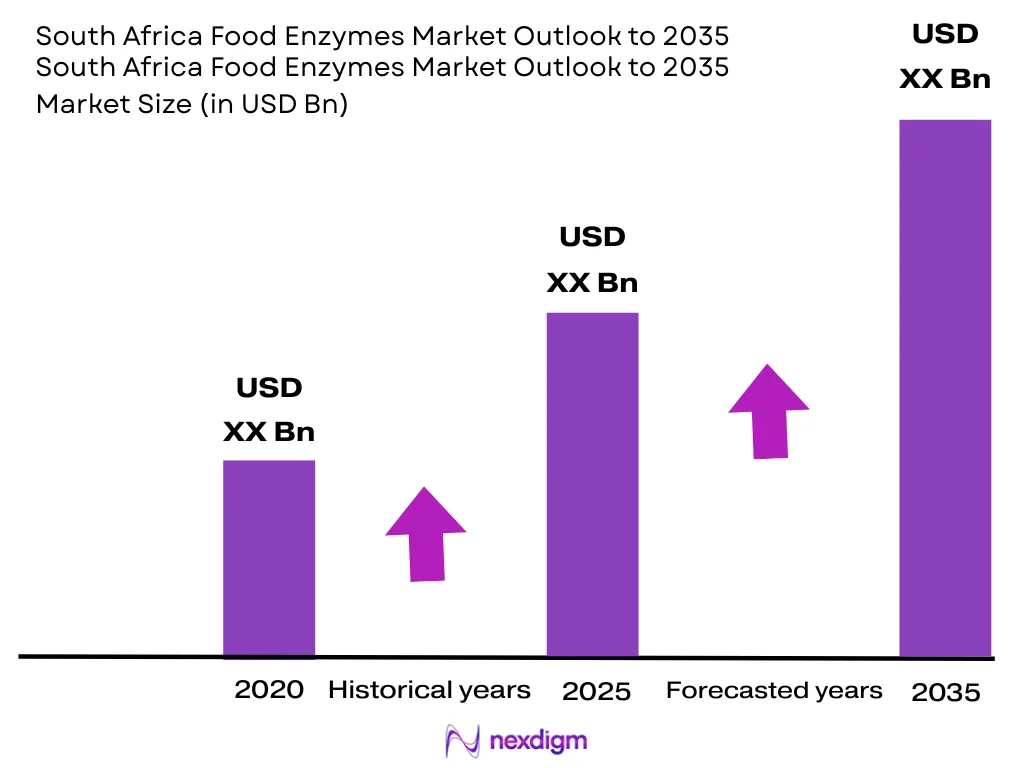
The South Africa Food Enzymes Market was valued at USD ~ Billion in 2024 and is anticipated to expand at a CAGR of ~% during 2026-2035. The market is primarily driven by the country’s expanding processed food and beverage industry, increasing demand for clean-label ingredients, and growing regulatory pressure to reformulate products away from synthetic additives. South Africa’s food additives market, of which enzymes form a growing share, was valued at approximately USD ~ Billion in 2023 and is projected to expand steadily through the end of the decade, according to industry estimates, supported by the country’s advanced food processing infrastructure relative to the rest of the continent. The Department of Health’s Directorate: Food Control continues to strengthen regulatory oversight of food additives under the Foodstuffs, Cosmetics and Disinfectants Act, 1972, including new Regulations Relating to the Use of Food Additives in Foodstuffs published in November 2024, creating sustained demand for functional ingredients such as food enzymes across bakery, dairy, brewing, meat processing, and animal feed applications.
Market Segmentation
By Source
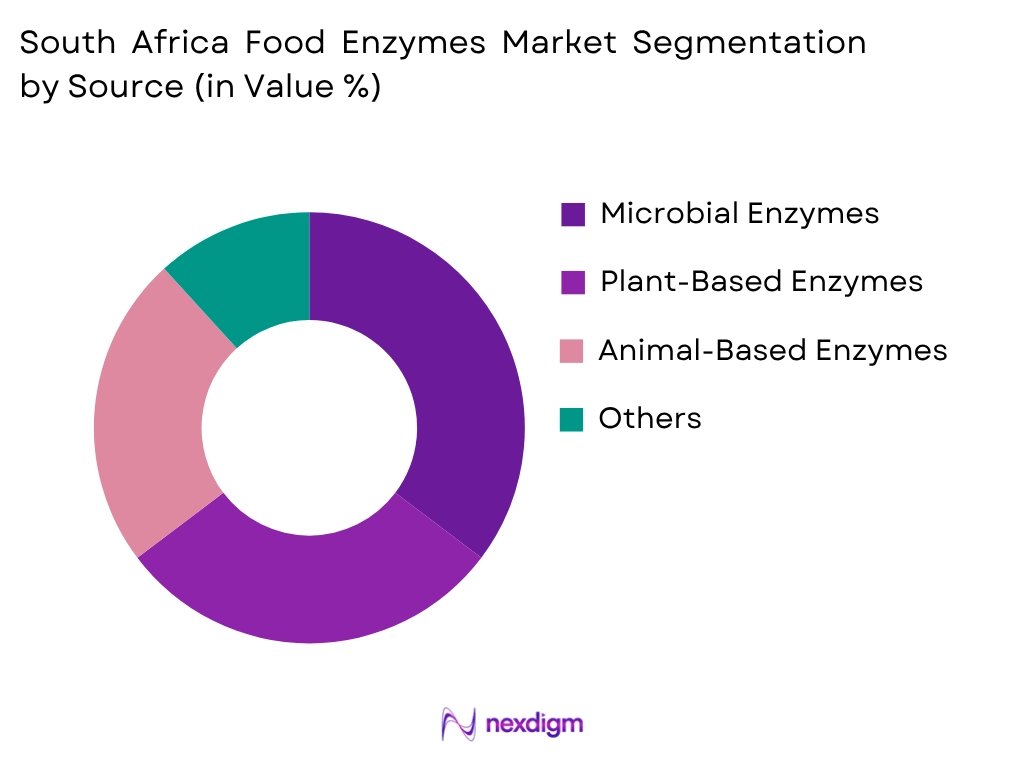
Among these, Microbial Enzymes dominate the South Africa Food Enzymes Market owing to their cost-effective production, consistent activity levels, and broad applicability across bakery, dairy, and brewing processes. South African food manufacturers are increasingly replacing synthetic preservatives and processing aids with microbial and fermentation-derived enzymes to meet clean-label consumer expectations and comply with the Department of Health’s sodium and additive reformulation targets. The country’s brewing industry, anchored by large-scale beer and traditional sorghum beer producers, continues to rely heavily on enzyme-based processing aids for wort filtration, clarification, and fermentation efficiency. Multinational enzyme manufacturers operating through regional distribution and technical service partnerships in South Africa have accelerated investments in enzyme innovation to comply with evolving clean-label strategies, further strengthening the dominance of this segment across dairy, bakery, beverages, and animal feed applications.
By Application
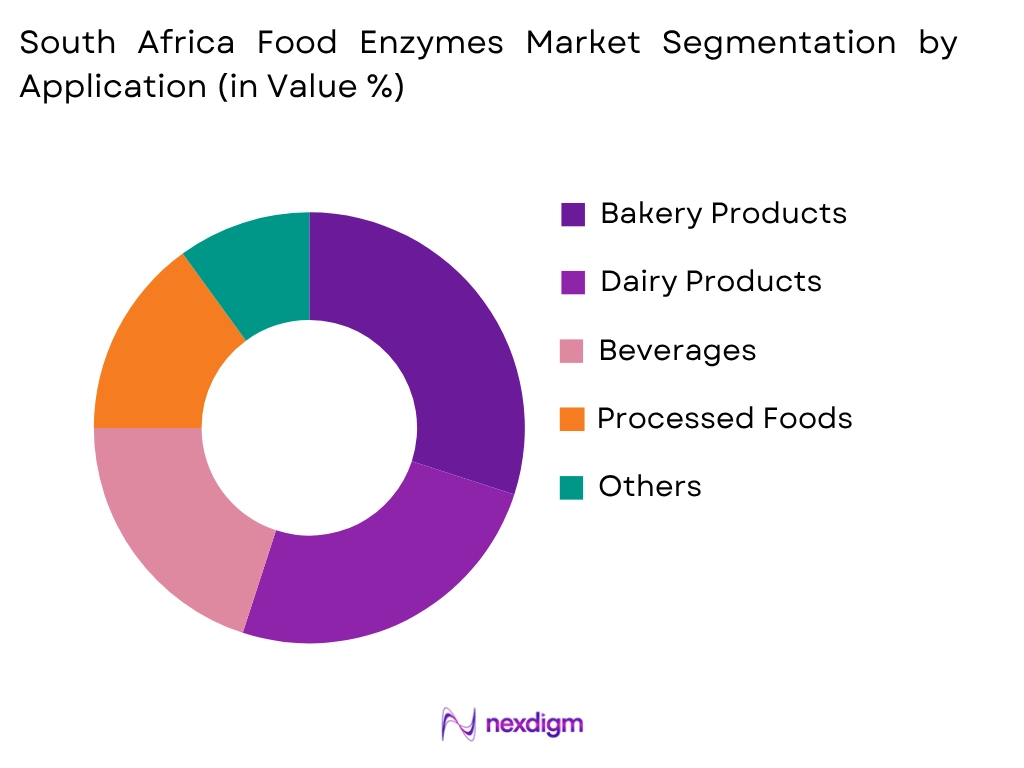
The Bakery segment holds the largest share owing to the extensive use of enzymes such as amylases, xylanases, and lipases to improve dough handling, crumb structure, shelf life, and baking consistency across South Africa’s large-scale industrial bakeries and informal retail bread supply chains. Manufacturers increasingly utilize enzyme blends to standardize product quality while reducing reliance on chemical dough conditioners, in line with evolving food safety regulations under the Department of Health. The Dairy & Cheese segment represents the second-largest application, supported by growing demand for rennet substitutes and lactase enzymes in the country’s expanding dairy processing sector. In addition, South Africa’s well-established brewing and beverage industry continues to expand its use of enzyme-based processing aids for wort clarification and fermentation optimization, while animal feed enzymes are gaining traction as feed manufacturers in Gauteng and the Western Cape seek to improve nutrient digestibility and reduce feed costs.
Competitive Landscape
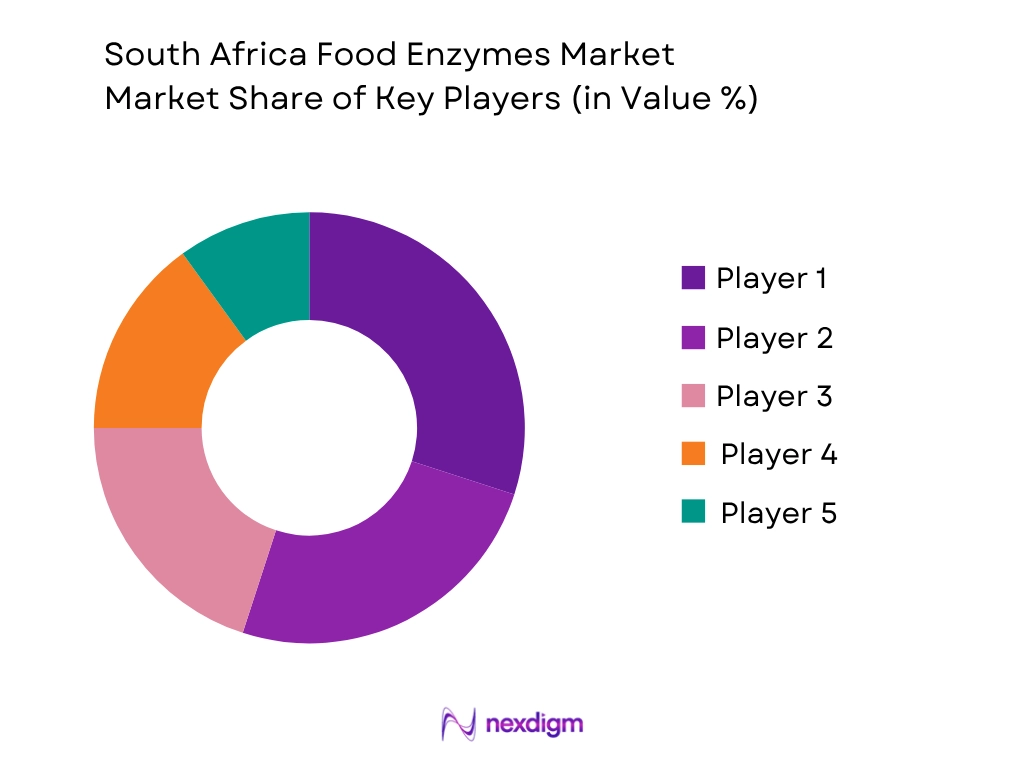
The South Africa Food Enzymes Market is moderately consolidated, with the presence of established multinational enzyme manufacturers operating through regional distribution networks, technical service centers, and, in some cases, local manufacturing facilities. Competition is primarily based on product innovation, regulatory compliance, application-specific formulations, pricing, technical support, and the ability to provide clean-label solutions suited to South Africa’s dual formal and informal food retail channels. Companies are increasingly investing in local technical service capabilities, such as Johannesburg-based formulation and applications centers, to support bakery, dairy, and brewing customers with on-the-ground troubleshooting and product development. Strategic partnerships with regional distributors, expansion of cold-chain-compatible logistics, and sustainable sourcing of fermentation feedstocks have become key competitive differentiators as manufacturers seek to serve both South Africa’s advanced food processing sector and the broader Southern African Development Community (SADC) export market.
| Company | Establishment Year | Headquarters | Primary Product Portfolio | Enzyme Portfolio
|
Manufacturing Presence | Major End-Use Industries | Key Strategic Focus | Certifications & Compliance |
| Novozymes | 2000 | ~ | ~ | ~ | ~ | ~ | ~ | ~ |
| DSM-Firmenich | 2023 | ~ | ~ | ~ | ~ | ~ | ~ | ~ |
| Kerry Group | 1972 | ~ | ~ | ~ | ~ | ~ | ~ | ~ |
| Chr. Hansen | 1874 | ~ | ~ | ~ | ~ | ~ | ~ | ~ |
| AB Enzymes | 1907 | ~ | ~ | ~ | ~ | ~ | ~ | ~ |
South Africa Food Enzymes Market Analysis
Growth Drivers
Growing Demand for Processed Foods and Clean-Label Reformulation
South Africa’s food enzymes market is experiencing sustained growth due to increasing consumption of processed and convenience foods alongside growing regulatory and consumer pressure to reformulate products with cleaner labels. According to industry estimates, South Africa’s food additives market was valued at approximately USD 330 million in 2023 and continues to expand steadily, with enzyme-based clean-label technologies increasingly displacing synthetic preservatives in bakery and dairy applications. The Department of Health’s sodium reduction targets under the Foodstuffs, Cosmetics and Disinfectants Act have compelled processed meat and poultry manufacturers to rebuild product formulations, creating sustained demand for enzyme-based processing aids alongside potassium chloride blends and yeast extracts. South Africa’s food manufacturing activity remains concentrated in the Gauteng province’s Johannesburg-Pretoria corridor, which anchors national-scale food processing operations, while rising urbanization and a growing middle-class population continue to expand demand for packaged bread, dairy products, beverages, and processed meat where enzymes play an essential functional role. This combination of regulatory reformulation pressure and expanding processed food consumption continues to stimulate demand for food enzymes across multiple applications.
Expansion of Brewing, Dairy, and Bakery Manufacturing
The continued expansion of South Africa’s brewing, dairy, and bakery manufacturing sectors remains a major driver for food enzyme consumption. South Africa’s brewing industry, one of the largest and most established in Sub-Saharan Africa, continues to rely on enzyme-based processing aids for wort filtration, clarification, and fermentation efficiency across both large-scale commercial breweries and traditional sorghum beer producers. The country’s dairy processing sector continues to expand alongside rising demand for cheese, yogurt, and flavored milk products, supporting growing use of rennet substitutes, lactase, and other specialty dairy enzymes. South Africa’s advanced food processing infrastructure, widely regarded as the most developed on the African continent, continues to attract multinational ingredient manufacturers seeking a base for regional distribution across the Southern African Development Community. Rising demand for packaged bread and baked goods, driven by both formal retail and South Africa’s extensive informal retail networks, further supports industrial demand for bakery enzymes across multiple processing formats. These structural developments continue to strengthen long-term demand for advanced enzyme solutions throughout the country.
Market Challenges
Import Dependency and Currency-Driven Cost Volatility
Despite South Africa’s advanced food processing base relative to the rest of the continent, the food enzymes market remains highly dependent on imported technical-grade enzymes, as domestic fermentation-based enzyme manufacturing capacity remains limited. Industry analysis indicates that technical-grade enzymes and specialty emulsifiers used in South Africa depend on a concentrated base of European and Asian suppliers, exposing local food manufacturers to currency fluctuations, shipping constraints, and global supply disruptions. Volatility in the South African Rand against major trading currencies directly affects the landed cost of imported enzyme products, creating pricing uncertainty for food manufacturers operating on tight margins in a price-sensitive consumer market. Since enzyme performance requires consistent activity levels and precise dosing, disruptions in the availability of specific enzyme grades increase formulation complexity and can compromise product consistency for bakery, dairy, and brewing customers. These import dependencies also expose South African manufacturers to longer lead times compared to domestically produced ingredients, complicating inventory management and just-in-time production planning.
Regulatory Compliance Complexity under Evolving Food Additive Regulations
South Africa’s regulatory framework for food additives presents a significant challenge for food enzyme suppliers and their customers. The Department of Health’s Directorate: Food Control administers food additive, hygiene, and labeling regulations under the Foodstuffs, Cosmetics and Disinfectants Act, 1972, including the Regulations Relating to the Use of Food Additives in Foodstuffs published in November 2024 and taking effect in 2025, which introduce updated purity and identity specifications for substances used in food processing. Imported enzyme formulations lacking local certification against South African National Standards (SANS) food safety requirements face compliance complexity, requiring manufacturers to invest in local regulatory documentation and, in some cases, reformulation. South Africa’s continued alignment with Codex Alimentarius standards, while intended to streamline export qualification for South African additive producers, also requires ingredient suppliers to continuously monitor evolving international benchmarks. These regulatory obligations require ongoing investment in quality assurance, laboratory testing, and documentation, extending product registration timelines and increasing operational complexity for enzyme manufacturers and distributors serving the South African market.
Market Opportunities
Expansion of Enzyme Applications Across Bakery, Dairy, and Brewing
South Africa’s well-established food and beverage manufacturing base provides significant opportunities for enzyme suppliers to expand technical service partnerships and application-specific product development. The country’s large-scale brewing industry, dairy processing sector, and industrial bakery operations continue to seek enzyme-based solutions that improve processing efficiency, product consistency, and shelf life while supporting clean-label reformulation goals. Multinational ingredient manufacturers have begun establishing local technical centers, such as Johannesburg-based formulation and applications support facilities, to work directly with South African millers, bakers, brewers, and dairy processors on enzyme performance optimization. This shift toward technical service subscriptions, rather than pure ingredient volume sales, is creating new revenue models for enzyme suppliers willing to invest in local presence. As South African food manufacturers continue to reformulate products in response to sodium reduction mandates and clean-label consumer demand, enzyme suppliers offering robust technical support and locally relevant application expertise are well positioned to capture expanding market share.
Underpenetrated Regional Corridors and Regional Trade Integration
South Africa’s position as the continent’s most developed food processing economy creates opportunities for enzyme manufacturers to serve both the domestic market and the broader Southern African region. The KwaZulu-Natal province’s Durban-Richards Bay processing corridor, in particular, offers expansion potential for technical service partnerships given its port infrastructure and growing food manufacturing base, complementing the more established Gauteng corridor. South Africa’s participation in the African Continental Free Trade Area (AfCFTA) and its role as a regional food ingredient distribution hub for the Southern African Development Community continue to support export-oriented enzyme manufacturing and formulation services. Emerging applications, including enzyme-assisted processing for plant-based meat alternatives and texture-modifying systems for reformulated products, represent additional growth avenues as South African manufacturers respond to global dietary trends. Continued investment in local technical infrastructure and regional distribution capacity positions enzyme suppliers to capitalize on both South Africa’s domestic reformulation cycle and its broader role as a gateway to Sub-Saharan African food markets.
Future Outlook
The South Africa Food Enzymes Market is expected to witness sustained expansion over the forecast period, supported by continued regulatory pressure for clean-label reformulation, growth in bakery, dairy, and brewing manufacturing, and the country’s position as the most advanced food processing economy in Sub-Saharan Africa. Growing investment in local technical service capabilities and regional distribution infrastructure will further accelerate demand for application-specific enzyme solutions. The market is also likely to benefit from South Africa’s expanding role as a regional export hub under the African Continental Free Trade Area, enabling greater integration with food manufacturers across the Southern African Development Community.
Major Players
- Novozymes
- DSM-Firmenich
- Kerry Group
- Chr. Hansen
- AB Enzymes
- IFF (International Flavors & Fragrances)
- DuPont
- BASF
- Advanced Enzyme Technologies
- Amano Enzyme
- Novus International
- Lesaffre
- Puratos
- Angel Yeast
- Enzyme Development Corporation (EDC)
Key Target Audience
- Food Enzyme Manufacturers
- Food & Beverage Processing Companies
- Bakery Manufacturers
- Dairy Product Manufacturers
- Brewing and Beverage Manufacturers
- Animal Feed Manufacturers
- Investment and Venture Capitalist Firms
- Government and Regulatory Bodies (Department of Health – Directorate: Food Control, National Regulator for Compulsory Specifications (NRCS), South African Bureau of Standards (SABS))
- Food Ingredient Distributors and Industrial Raw Material Suppliers
Research Methodology
Step 1: Identification of Key Variables
The research process begins with identifying the complete ecosystem of the South Africa Food Enzymes Market, including raw material suppliers, enzyme manufacturers, ingredient distributors, food processors, retailers, and regulatory authorities. Extensive secondary research is conducted using company annual reports, government publications, trade associations, customs statistics, industry journals, and proprietary databases to determine the variables influencing market demand, pricing, production, consumption, and technological developments.
Step 2: Market Analysis and Construction
Historical market information is collected and analyzed to estimate market size, production volumes, import-export activity, application-wise demand, and pricing trends. A combination of top-down and bottom-up approaches is used to estimate market revenues and validate segment-level performance. Consumption patterns across bakery, dairy, brewing, meat processing, and animal feed are evaluated to establish an accurate representation of the industry.
Step 3: Hypothesis Validation and Expert Consultation
The preliminary findings are validated through Computer-Assisted Telephone Interviews (CATIs) and structured discussions with food enzyme manufacturers, procurement managers, distributors, food technologists, regulatory experts, and senior executives operating within the South African food industry. These interviews help verify market assumptions, competitive developments, technology adoption trends, pricing dynamics, and future investment opportunities while refining the overall market estimates.
Step 4: Research Synthesis and Final Output
The final stage integrates insights obtained from primary interviews with quantitative information collected through secondary sources. Data triangulation techniques are applied to reconcile differences between supply-side and demand-side estimates, ensuring robust market forecasting. The report is then reviewed through multiple quality assurance checkpoints to deliver a comprehensive analysis covering market size, segmentation, competitive landscape, future outlook, and strategic recommendations for industry stakeholders.

- Executive Summary
- Research Methodology (Market Definitions and Assumptions, Abbreviations, Market Sizing Approach, Top-Down Analysis, Bottom-Up Analysis, Demand-Side Assessment, Supply-Side Assessment, Primary Industry Interviews, Secondary Research Validation, Data Triangulation, Forecasting Framework, Limitations and Future Conclusions)

- Definition and Scope
- Market Evolution and Industry Genesis
- Timeline of Major Industry Developments
- Food Enzymes Industry Value Chain Analysis
- Supply Chain Analysis

- Growth Drivers (Growing Clean Label Food Demand, Rising Consumption of Processed Foods, Expansion of Beverage & Brewing Manufacturing, Increasing Demand for Enzyme-Based Reformulation, Premiumization of Food Products, Growth in Plant-Based Foods)
- Market Challenges (Import Dependency for Technical-Grade Enzymes, Currency and Raw Material Price Volatility, Regulatory Compliance Complexity, Cold Chain and Storage Constraints, Limited Local Manufacturing Capacity, Supply Concentration Risk)
- Market Opportunities (Expansion in Bakery, Dairy & Brewing Applications, Underpenetrated Regional Corridor Growth, Export-Oriented Ingredient Manufacturing, Functional Food Innovation, Clean Label Reformulation Projects, Regional Trade Integration under AfCFTA)
- Market Trends (Replacement of Synthetic Preservatives with Enzymes, Clean Label Adoption, Botanical and Fermentation Innovation, Sustainable Sourcing, Heat-Stable Enzyme Development, Multi-Functional Ingredient Systems)
- Government Regulations (Foodstuffs, Cosmetics and Disinfectants Act Compliance, Regulations Relating to the Use of Food Additives in Foodstuffs 2024, SANS Food Safety Standards, Maximum Permitted Usage Levels, Import Compliance, Codex Alimentarius Alignment)
- Import and Export Analysis (Trade Volume, Major Import Sources, Export Destinations, HS Code Analysis, Trade Balance)
- Raw Material Availability Analysis (Maize & Grain Feedstocks, Dairy Substrates, Fermentation Media, Specialty Microbial Strains, Soy & Oilseed Feedstocks, Sugarcane-Derived Substrates)
- Technology Landscape (Fermentation Technologies, Enzyme Immobilization, Encapsulation Technologies, Recombinant Production Technologies, Stability Enhancement Technologies)
- Sustainability Assessment (Renewable Fermentation Feedstocks, Carbon Footprint Reduction, Sustainable Sourcing Practices, Waste Valorization, Eco-Friendly Processing)
- PESTLE Analysis
- SWOT Analysis
- Porter’s Five Forces Analysis
- Stakeholder Ecosystem
- Competition Ecosystem

- By Market Value (2020-2025)
- By Volume Consumption (2020-2025)
- By Average Selling Price (2020-2025)

- By Source Type (In Value %)
Microbial Enzymes
Plant-Based Enzymes
Animal-Based Enzymes
Recombinant Enzymes
Fermentation-Derived Enzymes
Chemically Modified Enzymes - By Application (In Value %)
Bakery
Dairy & Cheese
Beverages (Brewing & Winemaking)
Meat & Poultry Processing
Starch & Sweeteners
Fruit & Vegetable Processing
Animal Feed
Oils & Fats Processing
Nutraceuticals & Functional Foods
Baking Improvers - By Distribution Channel (In Value %)
Direct Sales to Food Manufacturers
Ingredient Distributors
Industrial Enzyme Suppliers
Online B2B Ingredient Platforms
Specialty Enzyme Suppliers - By End User (In Value %)
Bakery Manufacturers
Dairy Processors
Brewing & Beverage Manufacturers
Meat & Poultry Processors
Animal Feed Manufacturers
Starch & Sweetener Manufacturers
Nutraceutical Manufacturers - By Region (In Value %)
Gauteng
Western Cape
KwaZulu-Natal
Eastern Cape
Other Provinces

- Market Share of Major Players (By Value, Volume, Source Type, Application Industry, Product Category)
- Cross Comparison Parameters (Enzyme Portfolio Breadth, Activity Consistency, Technical Support Capability, Manufacturing & Distribution Capacity, Regulatory Compliance & Certifications, Food & Beverage Customer Base, Innovation & New Product Launch Frequency)
- SWOT Analysis of Major Players
- Pricing Analysis by Product Category and SKU
- Production Capacity Analysis
- Manufacturing Footprint Analysis
- Distribution Network Analysis
- Innovation Benchmarking
- Detailed Profiles of Major Companies
Novozymes
DSM-Firmenich
Kerry Group
Chr. Hansen
AB Enzymes
IFF (International Flavors & Fragrances)
DuPont
BASF
Advanced Enzyme Technologies
Amano Enzyme
Novus International
Lesaffre
Puratos
Angel Yeast
Enzyme Development Corporation (EDC)

- Consumption Pattern Analysis (Industrial Usage, Batch Size, Product Category Penetration, Seasonal Demand, Reformulation Activity)
- Purchasing Criteria (Enzyme Activity & Potency, Regulatory Compliance, Cost Efficiency, Thermal Stability, Shelf Life, Ease of Dosing)
- Procurement and Supplier Selection Analysis
- Clean Label Adoption Assessment
- Premium vs Conventional Product Demand
- Product Attribute Preference Analysis (Activity Consistency, Thermal Tolerance, pH Stability, Solubility, Natural Origin, Label Friendliness)
- Consumer Health & Wellness Influence on Product Development
- Pain Point Analysis
- Decision-Making Process

- By Market Value (2026-2035)
- By Volume Consumption (2026-2035)
- By Average Selling Price (2026-2035)


 Request a Sample
 Ask for Customization
 Get a Quote
 Enquire Now