
 Download PDF
Market Overview
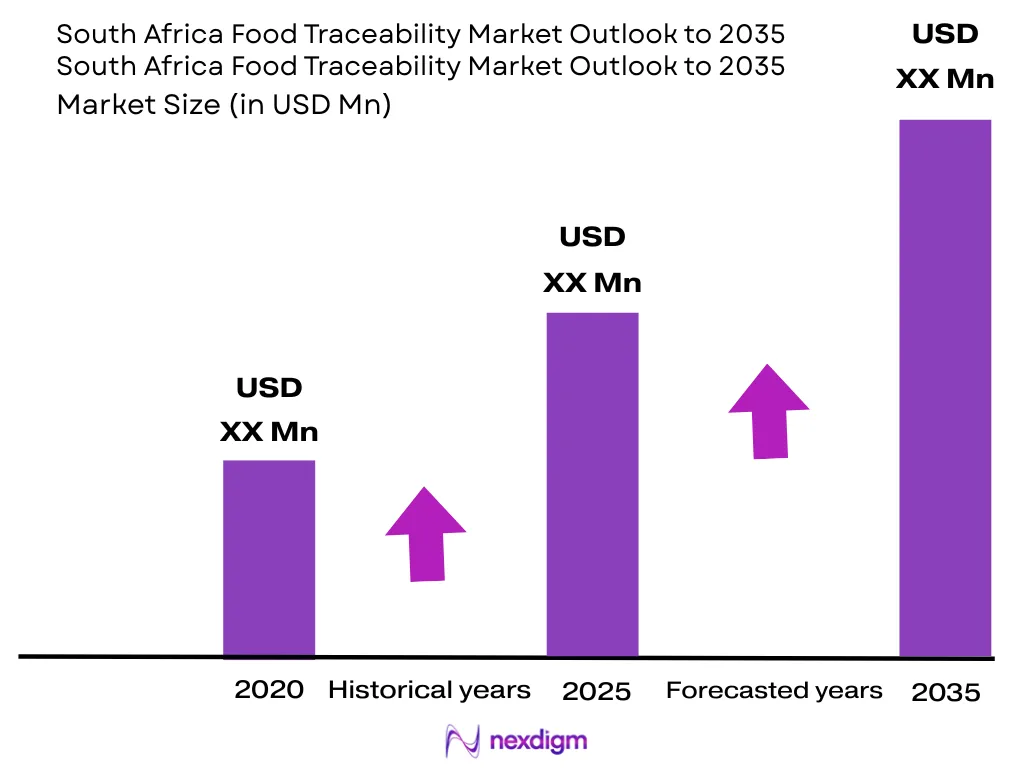
The South Africa Food Traceability Market was valued at USD ~ Million in 2024 and is anticipated to expand at a CAGR of ~% during 2026–2035. The market is primarily driven by South Africa’s export-focused agriculture and seafood sectors, the November 2025 launch of a national livestock traceability system by Red Meat Industry Services (RMIS), and rising international buyer expectations around origin verification and disease control assurance. According to Persistence Market Research, South Africa captures approximately 19% share of the Middle East and Africa food traceability solutions market, trailing only the United Arab Emirates and Saudi Arabia, driven by export-focused traceability frameworks for the country’s agriculture and seafood sectors. South Africa’s broader food supply chain market grew from approximately USD 29.7 billion in 2019 toward an estimated USD 40 billion by 2025, according to Farm to Plate, reflecting the scale of the underlying food system that traceability technology providers serve.
Market Segmentation
By Technology Type
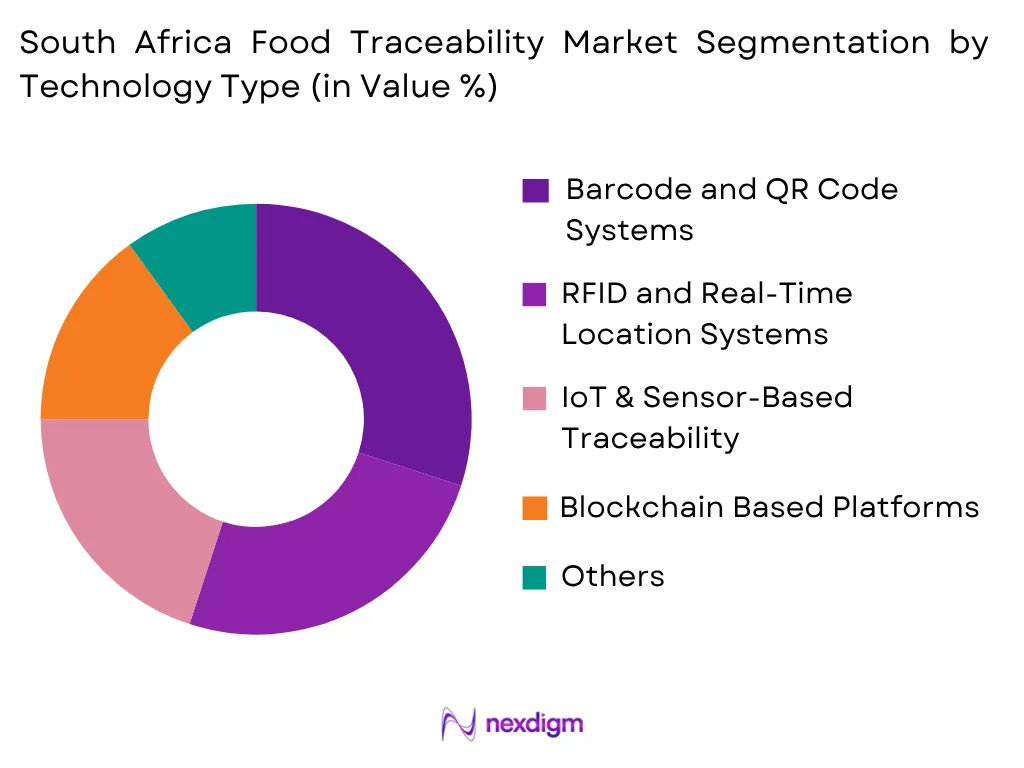
Among these, Barcodes and QR Codes represent the largest technology segment in the South Africa Food Traceability Market, holding a 35.91% revenue share in 2023, according to Grand View Research’s Horizon Databook. This reflects the foundational role of GS1 South Africa’s barcode and Global Location Number (GLN) standards, which underpin both retail-level product traceability and the country’s newly launched national livestock traceability platform. Radio Frequency Identification (RFID) also maintains a meaningful share, particularly across livestock ear-tagging applications, while Blockchain-Based Platforms represent the fastest-growing segment as organisations such as RMIS and TraceX Technologies deploy distributed ledger technology to create tamper-proof, farmer-controlled movement records. The RMIS Traceability Platform exemplifies this convergence, connecting farm-level livestock management systems to auction and feedlot systems through an API architecture layered on top of GS1-standard Global Location Numbers issued to each registered production unit.
By Application
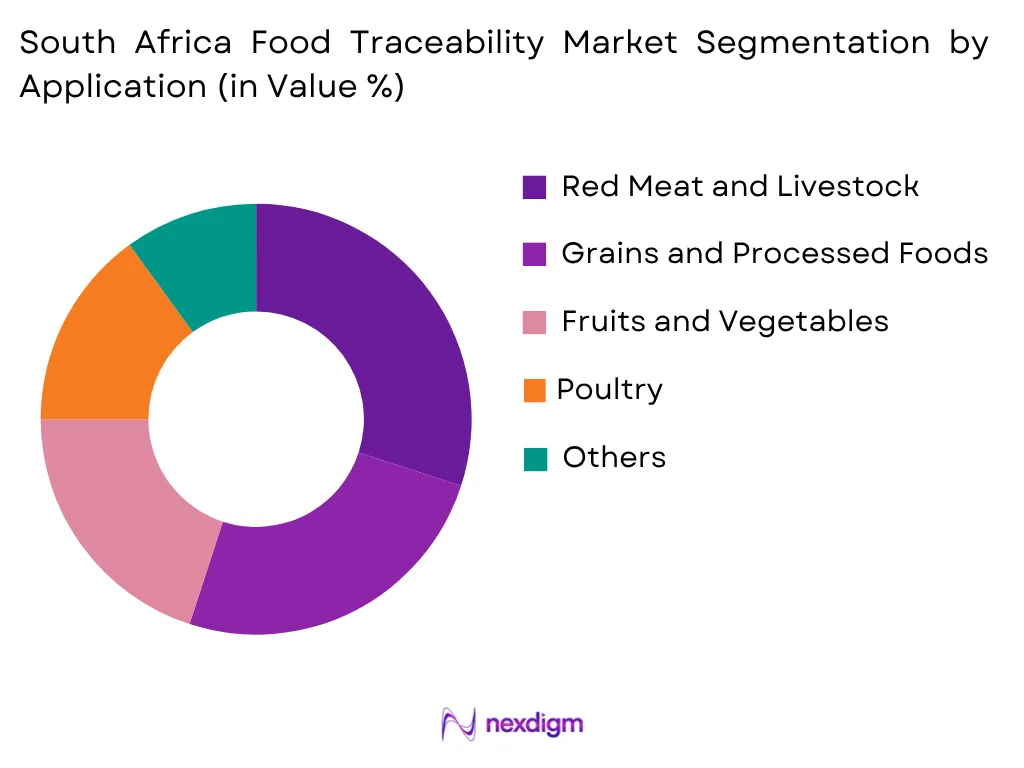
The Red Meat and Livestock segment commands a substantial and rapidly growing share of the South Africa Food Traceability Market, anchored by the November 4, 2025 launch of RMIS’s national livestock traceability system, described by industry leaders as the most important development in the sector in decades. The system covers the entire livestock value chain, from cattle and sheep farmers through feedlots, abattoirs, and auctioneers, and was designed explicitly to strengthen disease control, such as foot-and-mouth disease response, alongside market access and export competitiveness. South Africa’s confectionery and snacks segment, the largest category within the country’s food and beverage market at approximately USD 6.15 billion in 2023 revenue, alongside the fruit, citrus, and seafood export industries, further contributes meaningful demand for traceability technology as buyers in international markets increasingly require verifiable, standardised origin and handling documentation before granting market access.
Competitive Landscape
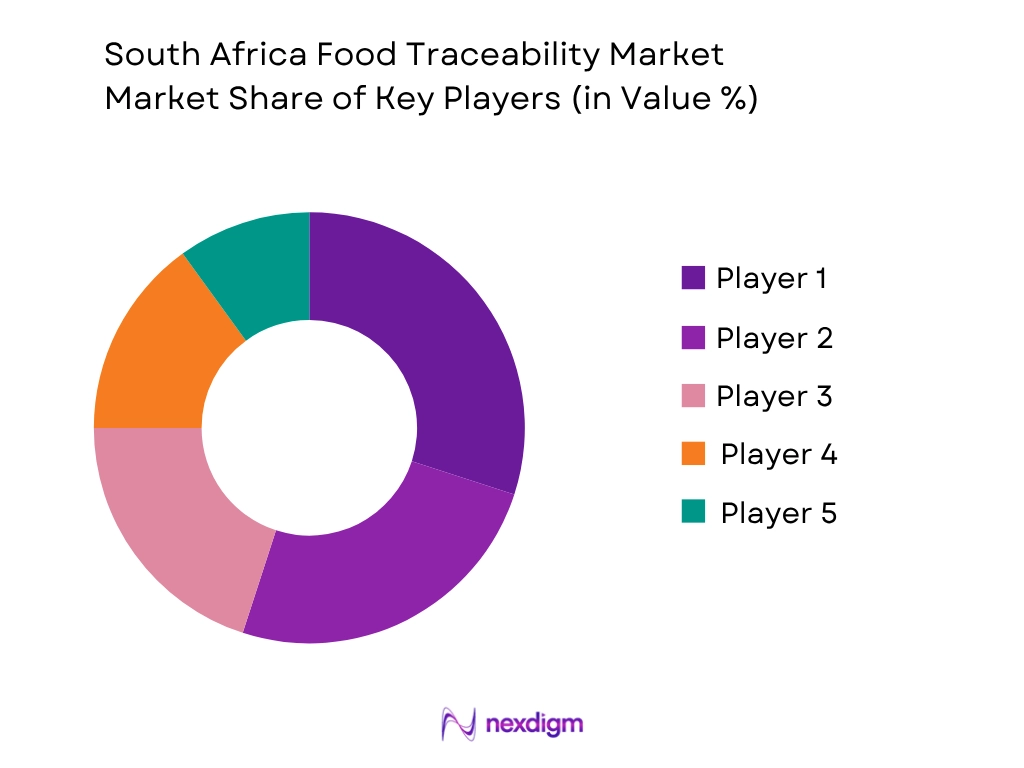
The South Africa Food Traceability Market combines a newly consolidated, industry-led national livestock platform with established global technology providers and regional Southern African agtech developers. Red Meat Industry Services (RMIS), formed through a 2019 agreement among four industry organisations to build a unified traceability future for South Africa’s red meat sector, launched its national livestock traceability platform in November 2025 following more than 18 months of stakeholder collaboration, explicitly designing the system to be farmer-owned and decentralised in contrast to earlier, less successful centralised government attempts dating back to 2010. TraceX Technologies, with documented traceability deployments across South African agriculture, and Gaborone-based Modisar, an AI-powered livestock management platform serving farmers across South Africa, Botswana, Namibia, and the wider Southern African Development Community, represent the region’s growing base of specialised agtech providers. Global technology and certification leaders including Zebra Technologies and SGS SA compete on hardware reliability and international export certification credibility, respectively, both cited as making significant inroads into the South African traceability market.
| Company | Establishment Year | Headquarters | Primary Product Portfolio | Traceability Solution Portfolio
|
Deployment Presence | Major End-Use Industries | Key Strategic Focus | Certifications & Compliance |
| TraceX Technologies | 2019 | ~ | ~ | ~ | ~ | ~ | ~ | ~ |
| Red Meat Industry Services (RMIS) | 2013 | ~ | ~ | ~ | ~ | ~ | ~ | ~ |
| Modisar | 2014 | ~ | ~ | ~ | ~ | ~ | ~ | ~ |
| Zebra Technologies Corporation | 1969 | ~ | ~ | ~ | ~ | ~ | ~ | ~ |
| SGS SA | 1878 | ~ | ~ | ~ | ~ | ~ | ~ | ~ |
South Africa Food Traceability Market Analysis
Growth Drivers
Launch of South Africa’s National Livestock Traceability System
The South Africa food traceability market is experiencing a defining moment following the November 4, 2025 launch of a national livestock traceability system led by Red Meat Industry Services (RMIS), an event industry leaders have called the most important development in decades for the country’s red meat sector. Minister of Agriculture John Steenhuisen praised the initiative as a critical partnership between government and industry, stating that international consumers demand traceability and that without it, the country cannot assure export markets of its disease control or product quality standards. The system, which covers the entire livestock value chain from cattle and sheep farmers through feedlots, abattoirs, and auctioneers, issues each registered production unit an official GS1 South Africa Certificate confirming a unique Global Location Number, forming the standardised foundation for secure livestock traceability and enabling faster response to disease outbreaks such as foot-and-mouth disease while building trust with both local and international buyers.
Export-Focused Agriculture and Seafood Sector Demand
South Africa’s position as a leading exporter of agricultural and seafood products is a significant driver of food traceability adoption, with the country capturing approximately 19% share of the Middle East and Africa food traceability solutions market, according to Persistence Market Research, driven specifically by export-focused traceability frameworks for its agriculture and seafood sectors. According to FAO data, South Africa has the second-largest economy on the African continent and operates a dual agricultural structure comprising approximately 2.5 million smallholder farming households alongside 35,000 commercial farming units, with the commercial sector’s export orientation creating sustained demand for traceability systems that meet international standards and improve market access and competitiveness. Traceability initiatives such as blockchain-based origin tracking and RFID livestock ear tagging allow South African farmers and food producers to differentiate their products in international markets, building the consumer trust and confidence needed to secure premium pricing and sustained access to demanding export destinations.
Market Challenges
Smallholder Technology Access Gaps and Producer Distrust of Legacy Structures
A significant challenge facing the South Africa Food Traceability Market is the gap between the country’s approximately 2.5 million smallholder farming households and its 35,000 commercial farming units, with smaller producers frequently lacking the technology access, training, and capital required to participate fully in digital traceability systems. Compounding this challenge, some South African farmers have expressed frustration over long-standing levy-funded livestock structures, questioning the mandate, transparency, and farmer representation behind compulsory deductions, sentiment that has given rise to independent, farmer-led initiatives advocating for greater transparency and direct producer governance over traceability data. RMIS has directly addressed this trust deficit by designing its national platform around a decentralised, farmer-owned data model, with RMIS chief operating officer Phillip Oosthuizen noting that more than a decade of prior centralised traceability attempts, dating back to 2010, had failed to gain sufficient producer buy-in.
Fragmented Legacy Systems and Rural Infrastructure Limitations
The South Africa Food Traceability Market has historically been characterised by fragmented, provincially administered legacy systems, including paper-based livestock identification processes that provinces such as North West have only recently begun upgrading to computerised Livestock Identification and Traceability System (LITS) platforms. Rural connectivity limitations further complicate nationwide rollout, as GSM-based tracking technologies can encounter difficulties updating real-time location data in areas without reliable network coverage, a challenge that has pushed some South African livestock technology developers toward satellite-based, low-earth-orbit tracking alternatives that do not depend on cellular network towers. These infrastructure gaps, combined with the need to integrate diverse existing farm management systems through standardised APIs, represent a substantial implementation challenge for both the RMIS national platform and private technology providers seeking to achieve comprehensive, interoperable coverage across South Africa’s geographically dispersed agricultural base.
Market Opportunities
Regional Interoperability Across the Southern African Development Community
South Africa’s national livestock traceability system is emerging alongside comparable national registries in neighbouring countries, including NamLITS in Namibia and BAITS in Botswana, creating a substantial opportunity for regional interoperability that would allow herds and traceability data to remain verifiable across Southern African Development Community borders. Gaborone-based Modisar, which already provides livestock management and traceability enterprise solutions across South Africa, Botswana, Namibia, and other African markets, illustrates the commercial opportunity available to technology providers capable of supporting cross-border herd verification, disease outbreak response, and coordinated export market access for the region’s livestock sector. As African nations increasingly adopt open, vendor-neutral national livestock registry standards, technology providers with the capability to interoperate across multiple sovereign systems rather than lock customers into single-country platforms are well positioned to capture growing regional demand.
Expansion into Seafood, Fruit, and Broader Agricultural Export Traceability
Beyond the red meat sector, South Africa’s substantial fruit, citrus, and seafood export industries present significant opportunities for traceability technology expansion, particularly as international buyers increasingly require verifiable, standardised origin and handling documentation. TraceX Technologies’ documented deployments across South African agriculture, using blockchain to provide an immutable record of each step in the journey from farm to fork, illustrate the type of solution that could be extended from pilot programmes into broader commercial adoption across South Africa’s diverse agricultural export base. As global retailers and regulators continue tightening food safety and origin verification requirements, and as consumer awareness of transparency and ethical sourcing continues to rise domestically, South African exporters across multiple commodity categories beyond red meat are likely to face growing pressure and opportunity to adopt comparable digital traceability infrastructure to that now being rolled out across the livestock sector.
Future Outlook
The South Africa Food Traceability Market is expected to witness substantial expansion over the forecast period, anchored by the phased nationwide rollout of RMIS’s national livestock traceability system beyond its initial launch, continued growth in export-oriented agriculture and seafood trade, and rising international buyer expectations around disease control and origin verification. Growing regional interoperability with neighbouring Southern African Development Community livestock registries, expansion of traceability infrastructure into fruit, citrus, and seafood export categories, and the continued maturation of farmer-owned, decentralised data models will further support market development. The market is also likely to benefit from GS1 South Africa’s standardised barcode and Global Location Number infrastructure, even as the industry continues to navigate smallholder technology access gaps, rural connectivity limitations, and the practical challenge of rebuilding producer trust following more than a decade of previously unsuccessful centralised traceability initiatives.
Major Players
- IBM Corporation (IBM Food Trust)
- Zebra Technologies Corporation
- SGS SA
- Bureau Veritas SA
- FoodChain ID Group
- FoodLogiQ Inc. (Trustwell)
- C.H. Robinson Worldwide, Inc.
- Optel Group
- Cognex Corporation
- TraceX Technologies
- Farmer Connect AG
- Red Meat Industry Services (RMIS)
- Modisar
- GS1 South Africa
- Find Me Security Technology
Key Target Audience
- Food Traceability Technology Providers
- Food & Beverage Processing Companies
- Red Meat and Livestock Value Chain Participants (Farmers, Feedlots, Abattoirs and Auctioneers)
- Fruit, Citrus and Seafood Exporters
- Retailers and Supermarket Chains
- Investment and Venture Capitalist Firms
- Government and Regulatory Bodies (Department of Agriculture, Land Reform and Rural Development (DALRRD), GS1 South Africa, National Regulator for Compulsory Specifications (NRCS))
- Agricultural Cooperatives and Smallholder Farmer Associations
Research Methodology
Step 1: Identification of Key Variables
The research process begins with identifying the complete ecosystem of the South Africa Food Traceability Market, including hardware and software technology providers, blockchain platform developers, certification and audit bodies, food processors and exporters, retailers, and regulatory authorities. Extensive secondary research is conducted using company annual reports, government publications, trade associations, customs statistics, industry journals, and proprietary databases to determine the variables influencing market demand, pricing, deployment, adoption, and technological developments.
Step 2: Market Analysis and Construction
Historical market information is collected and analysed to estimate market size, deployment volumes, technology adoption rates, application-wise demand, and pricing trends. A combination of top-down and bottom-up approaches is used to estimate market revenues and validate segment-level performance. Adoption patterns across red meat, poultry, seafood, fruits and vegetables, dairy, and processed foods are evaluated to establish an accurate representation of the industry.
Step 3: Hypothesis Validation and Expert Consultation
The preliminary findings are validated through Computer-Assisted Telephone Interviews (CATIs) and structured discussions with traceability technology providers, procurement managers, food processors, exporters, regulatory experts, and senior executives operating within the South African food and agribusiness industries, spanning Gauteng, the Western Cape, and KwaZulu-Natal. These interviews help verify market assumptions, competitive developments, technology adoption trends, pricing dynamics, and future investment opportunities while refining the overall market estimates.
Step 4: Research Synthesis and Final Output
The final stage integrates insights obtained from primary interviews with quantitative information collected through secondary sources. Data triangulation techniques are applied to reconcile differences between supply-side and demand-side estimates, ensuring robust market forecasting. The report is then reviewed through multiple quality assurance checkpoints to deliver a comprehensive analysis covering market size, segmentation, competitive landscape, future outlook, and strategic recommendations for industry stakeholders.

- Executive Summary
- Research Methodology (Market Definitions and Assumptions, Abbreviations, Market Sizing Approach, Top-Down Analysis, Bottom-Up Analysis, Demand-Side Assessment, Supply-Side Assessment, Primary Industry Interviews, Secondary Research Validation, Data Triangulation, Forecasting Framework, Limitations and Future Conclusions)

- Definition and Scope
- Market Evolution and Industry Genesis
- Timeline of Major Industry Developments
- Food Traceability Industry Value Chain Analysis
- Supply Chain Analysis

- Growth Drivers (National Livestock Traceability System Rollout, Export-Focused Compliance Requirements, Foot-and-Mouth Disease Control Pressure, Growing Consumer Demand for Origin Transparency, GS1 South Africa Standards Adoption, Retail Modernisation and Food Safety Regulation)
- Market Challenges (Smallholder Farmer Technology Access Gaps, Rural Connectivity Limitations, Fragmented Legacy Traceability Systems, High Implementation Costs for SMEs, Producer Distrust of Levy-Funded Structures, Data Governance and Farmer Data Ownership Concerns)
- Market Opportunities (Decentralised Farmer-Owned Traceability Models, Regional Livestock Registry Interoperability (SADC), Seafood and Fruit Export Traceability Expansion, Mobile-First Smallholder Traceability Tools, AfCFTA Cross-Border Distribution Expansion, Disease Outbreak Early-Warning Integration)
- Market Trends (Farmer-Led Decentralised Traceability Design, WhatsApp-Based Farmer Communication Channels, Blockchain-GS1 Standards Convergence, Rise of Southern African Regional Livestock Platforms, Consumer-Facing QR Code Transparency, Multi-Sector Traceability Platform Expansion)
- Government Regulations (Department of Agriculture, Land Reform and Rural Development (DALRRD) Requirements, Livestock Identification and Traceability System (LITS), GS1 South Africa Standards, National Regulator for Compulsory Specifications (NRCS), Food Safety Labelling Requirements, Export Certification Requirements)
- Import and Export Analysis (Red Meat Export Volumes, Seafood Export Volumes, Fruit and Citrus Export Compliance, HS Code Analysis, Trade Balance)
- Technology Landscape (GS1 Global Location Number (GLN) Systems, RFID Ear Tag Systems, Blockchain Platforms, Mobile Movement-Reporting Applications, API-Based Livestock Management System Integration)
- Sustainability Assessment (Disease Control and Biosecurity Verification, Sustainable Livestock Certification, Traceability-Linked Export Premiums, Smallholder Inclusion Initiatives, Ethical and Fair-Trade Sourcing Verification)
- PESTLE Analysis
- SWOT Analysis
- Porter’s Five Forces Analysis
- Stakeholder Ecosystem
- Competition Ecosystem

- By Market Value (2020-2025)
- By Volume of Deployments (2020-2025)
- By Average Selling Price (2020-2025)

- By Technology (In Value %)
Barcodes and QR Codes
Radio Frequency Identification (RFID)
Blockchain-Based Platforms
GPS and Biometrics
Infrared Systems - By Component (In Value %)
Hardware
Software
Services - By Application (In Value %)
Red Meat and Livestock
Poultry
Seafood
Fruits and Vegetables
Dairy Products
Grains and Processed Foods - By End User (In Value %)
Food Processors and Manufacturers
Exporters and Trading Companies
Retailers and Supermarket Chains
Red Meat Value Chain (Farmers, Feedlots, Abattoirs and Auctioneers)
Government and Regulatory Bodies - By Region (In Value %)
Gauteng
Western Cape
KwaZulu-Natal
Rest of South Africa

- Market Share of Major Players (By Value, Deployment Volume, Technology Type, Application Industry, Customer Segment)
- Cross Comparison Parameters (Technology Portfolio Breadth, Farmer-Level Trust and Adoption, Field Deployment Support, Application Technical Support Capability, Regional (SADC) Interoperability, Regulatory Compliance & Certifications, Customer Base Across Industries, Innovation & New Product Launch Frequency)
- SWOT Analysis of Major Players
- Pricing Analysis by Solution Category
- Deployment Capacity Analysis
- Technology Footprint Analysis
- Distribution and Partner Network Analysis
- Innovation Benchmarking
- Detailed Profiles of Major Companies
IBM Corporation (IBM Food Trust)
Zebra Technologies Corporation
SGS SA
Bureau Veritas SA
FoodChain ID Group
FoodLogiQ Inc. (Trustwell)
C.H. Robinson Worldwide, Inc.
Optel Group
Cognex Corporation
TraceX Technologies
Farmer Connect AG
Red Meat Industry Services (RMIS)
Modisar
GS1 South Africa
Find Me Security Technology

- Consumption Pattern Analysis (Enterprise Adoption Rate, Commercial vs Smallholder Adoption Rate, Product Category Penetration, Regional Adoption Variation, Reformulation Activity)
- Purchasing Criteria (Export Regulatory Compliance, Interoperability with National Systems, Cost Efficiency, Mobile Accessibility, Data Ownership Assurance, Scalability)
- Procurement and Supplier Selection Analysis
- Export Market Compliance Adoption Assessment
- Commercial Farm vs Smallholder Adoption Demand
- Product Attribute Preference Analysis (Real-Time Movement Data Capture, Offline and Low-Connectivity Functionality, Data Sovereignty, Consumer-Facing Interface, Multi-Species Support, Ease of Integration)
- Consumer Trust and Transparency Influence on Adoption
- Pain Point Analysis
- Decision-Making Process

- By Market Value (2026-2035)
- By Volume of Deployments (2026-2035)
- By Average Selling Price (2026-2035)


 Request a Sample
 Ask for Customization
 Get a Quote
 Enquire Now