

 Download PDF
 Download PDF
Market Overview
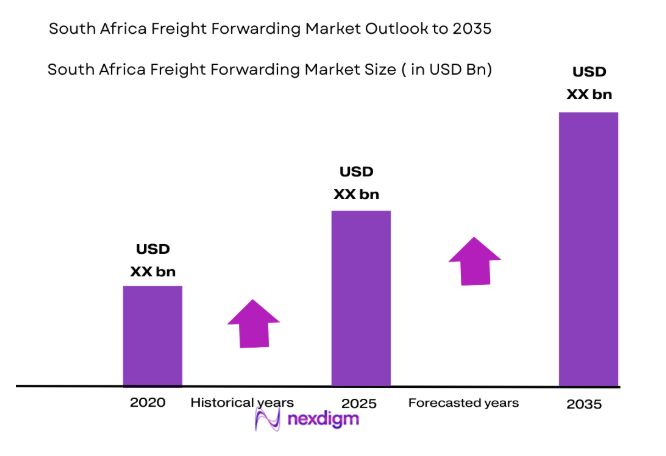
Based on a recent historical assessment, the South Africa Freight Forwarding Market was valued at USD ~ million. Demand was supported by stronger containerized cargo flows, rising movement of electrical machinery, transport equipment, and commercial products, and continued cross border shipment coordination tied to mining, retail, and industrial trade. Official freight transportation data also showed income support from containers and machinery related movements, reinforcing the need for forwarding, customs, and multimodal logistics services.
Johannesburg, Durban, and Cape Town remain the leading freight forwarding centers because they combine inland demand concentration with the country’s strongest port and airport gateways. Gauteng is the largest provincial economy, supporting Johannesburg’s role in contract logistics and air cargo, while Durban anchors maritime forwarding through the country’s premier container port. Cape Town remains important for reefer, retail, and agricultural trade, supported by established shipping links and export handling infrastructure.
Market Segmentation
By Product Type
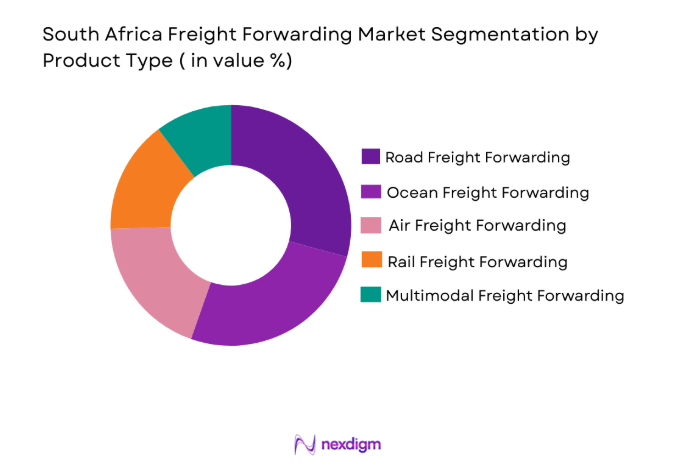
South Africa Freight Forwarding Market is segmented by product type into road freight forwarding, ocean freight forwarding, air freight forwarding, rail freight forwarding, and multimodal freight forwarding. Recently, road freight forwarding holds a dominant market share due to strong domestic distribution networks and cross border cargo movement across Southern African trade corridors. Road transportation provides high operational flexibility and connects inland manufacturing and mining hubs with ports, airports, and regional markets. Freight forwarders therefore rely heavily on road logistics to support container drayage, last mile distribution, and integrated multimodal shipment coordination across national and regional supply chains.
By Platform Type
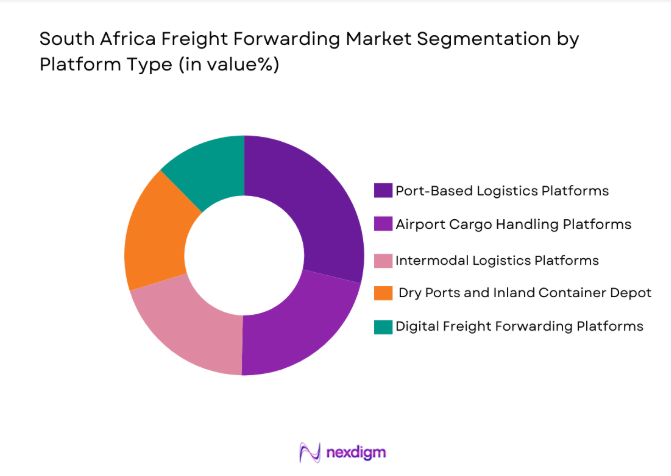
South Africa Freight Forwarding Market is segmented by platform type into port-based logistics platforms, airport cargo handling platforms, intermodal logistics platforms, dry ports and inland container depots, and digital freight forwarding platforms. Recently, port-based logistics platforms hold a dominant market share because international cargo movements rely heavily on maritime trade infrastructure. Major ports such as Durban and Cape Town serve as primary gateways for containerized imports and exports, supporting high cargo throughput and customs processing. Freight forwarding companies therefore depend on port logistics platforms for cargo consolidation, container handling, documentation coordination, and multimodal transfer operations connecting maritime shipments with inland road and rail distribution networks.
Competitive Landscape
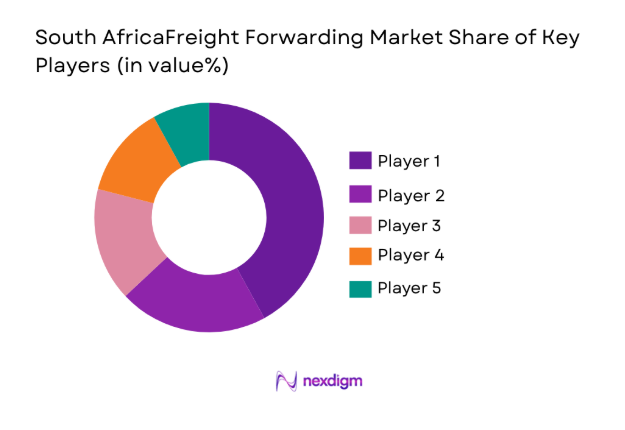
The South Africa Freight Forwarding Market remains moderately consolidated, with multinational integrators and large regional operators exerting strong influence through carrier relationships, customs brokerage depth, technology platforms, and corridor coverage. Global groups such as DHL Global Forwarding, DSV, Kuehne+Nagel, and DB Schenker benefit from international network scale, while local and regional firms such as Bidvest International Logistics retain relevance through domestic execution strength and customer proximity across industrial, retail, and cross border lanes.
| Company Name | Establishment Year | Headquarters | Technology Focus | Market Reach | Key Products | Revenue | South Africa Presence |
| DHL Global Forwarding | 1969 | Bonn, Germany | ~ | ~ | ~ | ~ | ~ |
| DSV | 1976 | Hedehusene, Denmark | ~ | ~ | ~ | ~ | ~ |
| Kuehne+Nagel | 1890 | Schindellegi, Switzerland | ~ | ~ | ~ | ~ | ~ |
| DB Schenker | 1872 | Essen, Germany | ~ | ~ | ~ | ~ | ~ |
| Bidvest International Logistics | 1988 | Johannesburg, South Africa | ~ | ~ | ~ | ~ | ~ |
South Africa Freight Forwarding Market Analysis
Growth Drivers
Port and Corridor Modernization Supporting Trade Flows
South Africa’s freight forwarding market is gaining momentum from ongoing efforts to stabilize and modernize key logistics corridors that connect inland production centers with seaports, airports, and neighboring countries. Public and private sector attention on port recovery, terminal efficiency, and corridor performance is gradually improving shipment planning reliability for freight forwarders serving mining, manufacturing, retail, and agricultural clients. Durban remains central because its container role anchors international forwarding demand, while Johannesburg benefits from its inland distribution position and concentration of high value cargo management. Investments in truck staging, terminal equipment, digital scheduling, and customs process improvements reduce costly delays and support better asset utilization across forwarding networks. Forwarders are therefore able to offer tighter transit commitments, more predictable documentation cycles, and improved handoffs between road, port, rail, and air movements. This matters especially for exporters handling minerals, automotive components, machinery, perishables, and consumer goods that depend on dependable routing windows. As logistics bottlenecks are addressed, shippers increasingly rely on specialized forwarding partners to redesign routes, manage exceptions, and coordinate border movements with more precision. The cumulative effect is stronger demand for integrated forwarding services across South Africa’s domestic and international trade ecosystem.
Expansion of Regional Trade and E Commerce Supply Chains
Demand for freight forwarding in South Africa is also being strengthened by deeper regional trade linkages and formalization of e commerce distribution networks. South Africa serves as a gateway into the Southern African region, so freight forwarders increasingly manage not only inbound ocean and air cargo but also onward road distribution into neighboring markets. Retailers, distributors, and industrial buyers require partners that can combine customs brokerage, documentation, warehousing coordination, and multimodal transport under a single operating model. The rise of time sensitive replenishment cycles has increased the importance of visibility tools, milestone tracking, and exception management, all of which sit at the center of forwarding value creation. Cross border lanes into Botswana, Namibia, Zambia, Zimbabwe, and Mozambique add complexity that many shippers prefer to outsource to experienced forwarding specialists. At the same time, e commerce sellers and importers depend on forwarding intermediaries to consolidate shipments, manage customs entries, and connect ports or airports with inland fulfillment nodes. These patterns favor scalable providers with strong carrier networks and local execution capabilities. As trade and fulfillment models become more networked, freight forwarding gains structural importance across both regional commerce and domestic distribution activity.
Market Challenges
Persistent Port Congestion and Network Unreliability
One of the clearest constraints on South Africa’s freight forwarding market is the continued unpredictability of cargo flows caused by congestion, equipment downtime, vessel bunching, and uneven corridor performance. Freight forwarders operate on coordination and timing, so weak reliability at ports or intermodal transfer points immediately raises costs for storage, demurrage, detention, trucking rescheduling, and customer service recovery. Durban’s strategic importance magnifies the issue because disruptions there quickly affect inland inventories, export bookings, and regional distribution plans linked to the broader Southern African market. Forwarders must therefore maintain larger contingency buffers, alternative routings, and more labor intensive monitoring than would be necessary in a stable operating environment. This weakens margin quality, especially for providers competing on fixed contractual rates with industrial and retail customers. It also makes smaller players vulnerable because they often have less bargaining leverage with carriers, terminals, and road transport partners during disruption periods. Service inconsistency can damage shipper confidence and shift volume toward firms with stronger balance sheets or multinational networks. Until infrastructure performance becomes more dependable, congestion related uncertainty will remain a structural challenge for market efficiency, customer retention, planning accuracy, and profitable long term scaling overall.
Regulatory Complexity and Cost Volatility Across Borders
Freight forwarding in South Africa is also challenged by compliance burdens and unpredictable cost escalation across customs, border administration, fuel, and carrier pricing. Even when shipment demand is healthy, forwarders must manage a large volume of documentation, tariff classifications, permits, inspections, and partner coordination that can slow cargo release and increase administrative overhead. Cross border forwarding into neighboring countries introduces additional variability because operating standards, border dwell times, and procedural consistency can differ materially by corridor and cargo type. Fuel price swings, port charges, storage fees, and security related costs further complicate quoting accuracy and compress margins on contracted business. Customers increasingly expect end to end visibility and stable landed costs, yet the operating environment often forces forwarders to revise plans in transit. This creates tension between service expectations and execution realities, especially for temperature sensitive, time sensitive, or high value shipments. Companies with weaker digital systems or smaller compliance teams face a disproportionate burden because manual control towers are expensive and error prone. As a result, regulatory complexity and cost volatility remain major obstacles to scale, transparency, sustainable profitability, customer trust, planning discipline, contract stability, and long term resilience in the market.
Opportunities
Digital Forwarding Platforms and Visibility Led Service Premiums
A major opportunity in South Africa’s freight forwarding market lies in expanding digital execution capabilities that convert operational complexity into a differentiated customer value proposition. Shippers increasingly want milestone tracking, exception alerts, document digitization, customs status visibility, and analytics that explain cost, delay, and route performance across every shipment leg. Forwarders that invest in transport management integration, customer portals, API connectivity, and control tower analytics can move beyond transactional booking toward higher value account management. This is particularly important in an environment where disruption is frequent, because customers reward firms that explain problems quickly and offer credible alternatives. Digital workflows also reduce manual errors, accelerate document handling, and improve billing accuracy, which directly supports margin recovery. Enterprise shippers in mining, automotive, retail, and healthcare are especially likely to pay for better planning transparency and service accountability. Providers that combine local operating knowledge with digital tools can therefore capture premium contracts and long term strategic accounts. Over the next several years, technology enabled visibility will become one of the clearest levers for differentiation, retention, profitable expansion, stronger pricing power, improved customer stickiness, and better network orchestration across major customer accounts nationally today.
Specialized Cross Border and Sector Focused Solutions
Another important opportunity comes from building specialized forwarding offerings for sectors that need compliance heavy, time sensitive, or technically complex logistics execution. South Africa handles significant trade linked to mining inputs, mineral exports, automotive supply chains, healthcare products, consumer imports, and agricultural shipments, each of which requires different routing, packaging, documentation, and risk controls. Forwarders that create sector specific teams can improve customer retention by speaking the operational language of each industry rather than selling generic transport coordination. Cross border expertise is particularly valuable because many regional shippers need a single provider that can manage border formalities, inland haulage, customs brokerage, and destination delivery across multiple countries. Healthcare and perishables create additional upside because they reward reliability, visibility, and service discipline more than basic price competition. Automotive and industrial accounts also favor partners that can support recurring schedules, supplier coordination, and exception management at scale. Companies that package these capabilities into tailored solutions can grow faster than the broader market. The strongest opportunity therefore lies not only in moving freight, but in becoming an industry specific logistics orchestrator for complex regional trade flows with stronger margins, higher customer loyalty, and deeper contractual integration.
Future Outlook
The South Africa Freight Forwarding Market is positioned for steady expansion over the next five years as trade corridor upgrades, digital forwarding adoption, and stronger cross border logistics integration improve service reliability. Demand is likely to strengthen across mining, industrial, retail, healthcare, and agricultural cargo categories. Regulatory reform and port recovery efforts should gradually support better cargo flow discipline. Providers that combine sector specialization, multimodal capability, and digital visibility are likely to capture the strongest growth.
Major Players
- DHL Global Forwarding
- Kuehne+Nagel
- DB Schenker
- DSV
- CEVA Logistics
- Expeditors International
- Nippon Express
- Bidvest International Logistics
- Grindrod Logistics
- Rhenus Logistics
- Rohlig-Grindrod
- Savino Del Bene South Africa
- Santova Logistics
- Toll Global Forwarding South Africa
- Value Logistics
Key Target Audience
- Freight forwarding companies
- Logistics and supply chain technology providers
- Importers and exporters
- Manufacturing companies
- Retail and e-commerce companies
- Investments and venture capitalist firms
- Government and regulatory bodies
Research Methodology
Step 1: Identification of Key Variables
The South Africa Freight Forwarding Market was first broken into measurable variables such as market value, transport mode, customer type, trade corridors, end use demand, and competitive positioning.
Secondary sources, company disclosures, transport statistics, and regulatory materials were screened to isolate the variables with the strongest influence on market structure and revenue formation.
This step established the analytical boundaries for the final market model.
Step 2: Market Analysis and Construction
The South Africa Freight Forwarding Market was then structured through segment mapping across product type, platform type, end use demand, and company participation.
Historical freight activity, port and airport relevance, corridor dependency, and enterprise demand patterns were synthesized to build a coherent view of present market behavior.
The resulting framework was used to organize both qualitative interpretation and segment level comparison.
Step 3: Hypothesis Validation and Expert Consultation
Initial assumptions on dominant segments, trade drivers, operating bottlenecks, and competitive intensity were tested against published industry evidence and expert informed operating logic.
Particular focus was placed on validating corridor importance, the role of B2B demand, and the impact of port and customs performance on forwarding economics.
This step reduced interpretation errors and improved the robustness of the final assessment.
Step 4: Research Synthesis and Final Output
Findings from the full research process were consolidated into a structured market narrative covering overview, segmentation, competition, growth drivers, challenges, opportunities, and outlook.
Quantitative inputs were aligned with qualitative evidence to preserve internal consistency across sections and tables.
The final output was designed to support strategic decisions by investors, operators, regulators, and enterprise buyers.

- Executive Summary
- Research Methodology (Definitions, Scope, Industry Assumptions, Market Sizing Approach, Primary & Secondary Research Framework, Data Collection & Verification Protocol, Analytic Models & Forecast Methodology, Limitations & Research Validity Checks)

- Market Definition and Scope
- Value Chain & Stakeholder Ecosystem
- Regulatory / Certification Landscape
- Sector Dynamics Affecting Demand
- Strategic Initiatives & Infrastructure Growth

- Growth Drivers
Expansion of cross border trade within Southern African Development Community corridors
Growth of mining and mineral exports requiring international cargo coordination
Increasing demand for multimodal logistics connecting ports rail and road networks - Market Challenges
Port congestion and infrastructure bottlenecks affecting shipment turnaround times
Regulatory complexities and customs clearance delays in cross border logistics
High transportation and fuel costs impacting freight forwarding operations - Market Opportunities
Development of digital freight platforms enabling real time shipment tracking
Expansion of inland logistics hubs and dry ports to support export industries
Rising e commerce trade increasing demand for international parcel forwarding - Trends
Adoption of automated cargo documentation and digital customs clearance systems
Growing investment in multimodal freight corridors linking ports and inland markets - Government Regulations
- SWOT Analysis
- Porter’s Five Forces

- By Market Value, 2020-2025
- By Installed Units, 2020-2025
- By Average System Price, 2020-2025
- By System Complexity Tier, 2020-2025

- By System Type (In Value%)
Air Freight Forwarding
Ocean Freight Forwarding
Road Freight Forwarding
Rail Freight Forwarding
Multimodal Freight Forwarding - By Platform Type (In Value%)
Port Based Logistics Platforms
Airport Cargo Handling Platforms
Intermodal Logistics Hubs
Dry Ports and Inland Container Depots
Cross Border Trade Corridors - By Fitment Type (In Value%)
Asset Based Freight Forwarding
Non Asset Based Freight Forwarding
Integrated Logistics Service Providers
Digital Freight Forwarding Platforms - By End User Segment (In Value%)
Manufacturing and Industrial Exporters
Retail and E Commerce Companies
Mining and Natural Resources Companies

- Market Share Analysis
- Cross Comparison Parameters (Service Portfolio, Global Network Coverage, Digital Logistics Capabilities, Multimodal Transport Integration, Port and Airport Partnerships, Pricing Strategy, Customs Brokerage Expertise)
- SWOT Analysis of Key Competitors
- Pricing & Procurement Analysis
- Key Players
DHL Global Forwarding
Kuehne+Nagel
DB Schenker
DSV
Bollore Logistics
CEVA Logistics
Maersk Logistics and Services
Expeditors International
Hellmann Worldwide Logistics
Nippon Express
UTi Worldwide
Imperial Logistics
Grindrod Logistics
Bidvest International Logistics
Value Logistics

- Manufacturing exporters depend on freight forwarders to coordinate multimodal cargo transportation across global trade routes
- Mining companies require specialized freight forwarding services for bulk mineral exports through major seaports
- Retail and e commerce companies rely on international freight operators to manage import logistics and distribution networks
- Agricultural exporters utilize freight forwarding providers to transport perishable goods through air and maritime channels

- Forecast Market Value, 2026-2035
- Forecast Installed Units, 2026-2035
- Price Forecast by System Tier, 2026-2035
- Future Demand by Platform, 2026-2035


 Request a Sample
 Ask for Customization
 Get a Quote
 Enquire Now