
 Download PDF
Market Overview
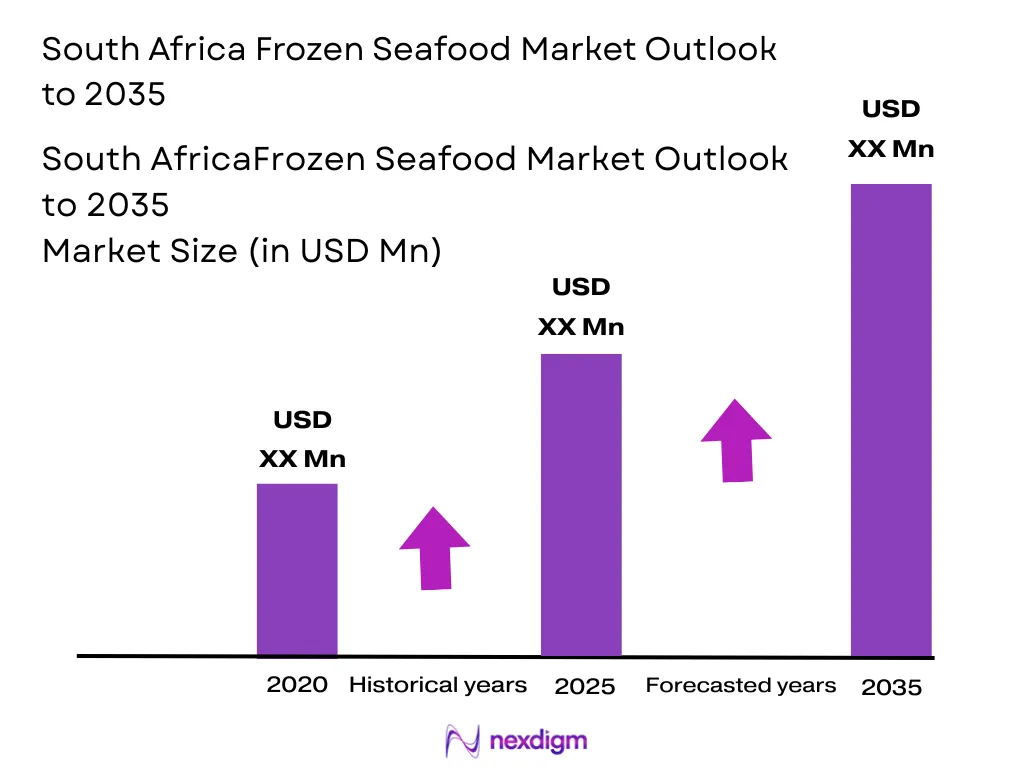
The South Africa Frozen Seafood Market is valued at USD ~ million, positioned within a broader national seafood market valued at USD ~ billion. Demand is driven by frozen hake, frozen fish fingers, prawns, calamari, mussels, salmon portions, and bulk whitefish cartons. The wider seafood category is supported by consumer preference for seafood protein, hospitality recovery, and premium seafood exports; BlueWeave records the South Africa seafood market at USD ~ billion, while DMI records frozen fish and seafood at USD ~ million in its next reported base. Cape Town, Saldanha Bay, Mossel Bay, Johannesburg, Pretoria, and Durban dominate demand and supply because they combine port access, fish landing infrastructure, processing plants, retail freezer networks, and foodservice consumption. Sea Harvest operates factory freezer and wet fish trawlers from Cape Town, Saldanha Bay and Mossel Bay, while Western Cape-linked seafood trade benefits from fish and fish-fillet flows, including R299.1 million of fish and R100.1 million of fish fillets in a recent provincial agri-food import quarter.
Market Segmentation
By Product Type
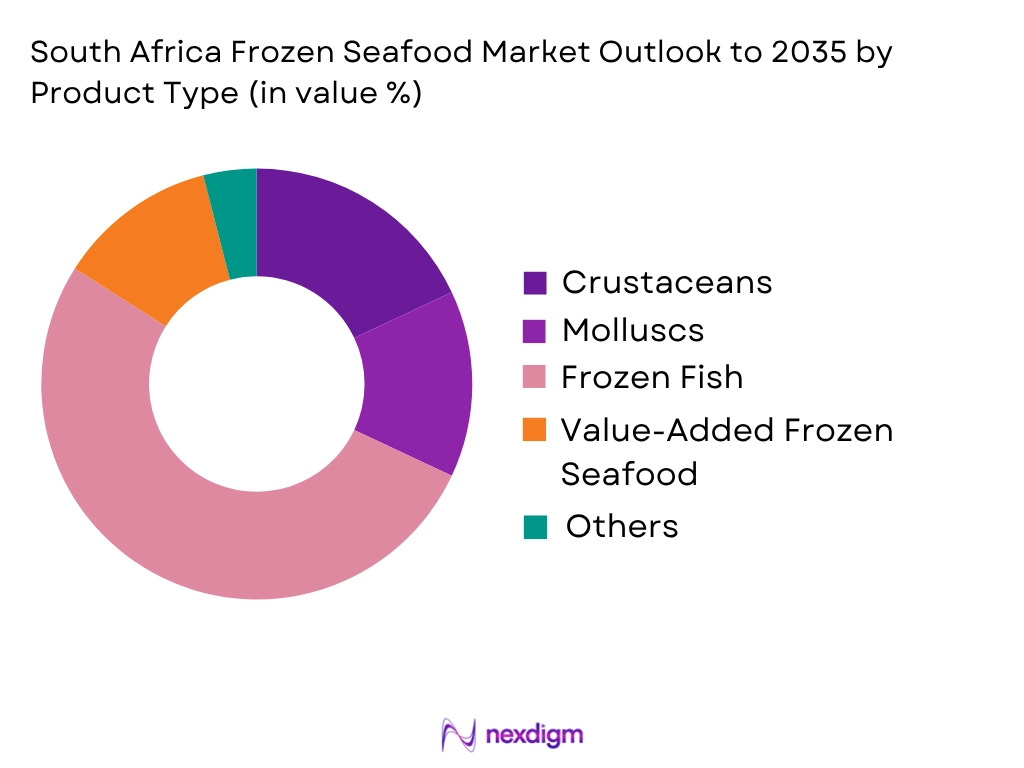
South Africa Frozen Seafood Market is segmented by product type into frozen fish, crustaceans, molluscs, frozen seafood mix, and value-added frozen seafood. Frozen fish holds the dominant share because hake, horse mackerel, pilchards, snoek, and other whitefish products are deeply embedded in South African retail and foodservice consumption. Hake has the strongest commercial identity because South Africa’s hake trawl fishery is MSC-certified and supported by established companies such as Sea Harvest and I&J. Frozen fish also fits economy and family-pack demand better than premium crustaceans or salmon. Retailers use frozen fish fingers, crumbed hake, fillets, and bulk portions as high-rotation freezer SKUs, while foodservice buyers prefer fish blocks and portion-controlled hake because they reduce wastage, simplify menu costing, and maintain consistency.
By Distribution Channel
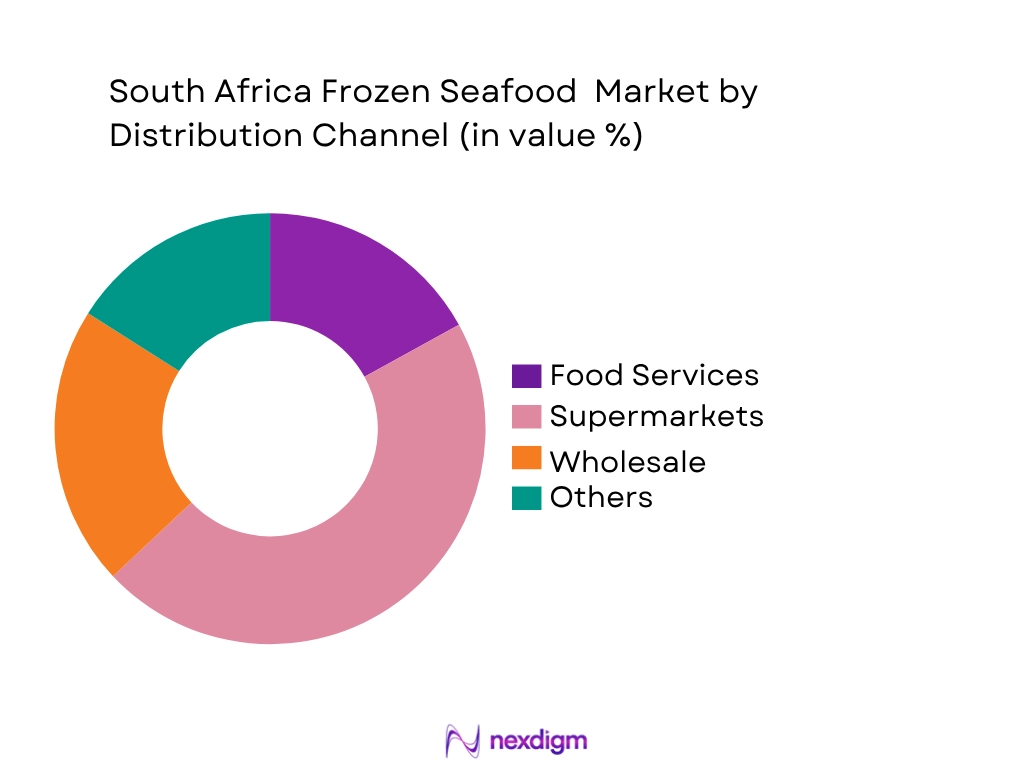
South Africa Frozen Seafood Market is segmented by distribution channel into supermarkets and hypermarkets, wholesale and cash-and-carry, foodservice distributors, specialty seafood stores, and online retail. Supermarkets dominate the market because frozen seafood is a planned household purchase requiring freezer visibility, branded trust, promotions, and private-label availability. Deep Market Insights identifies supermarkets as the largest segment, with supermarket frozen fish and seafood sales at USD ~ million in its reported base. National retailers also provide temperature-controlled merchandising, weekly promotions, family-size packs, and store-level category management. Online retail is growing, but frozen last-mile delivery remains constrained by insulated packaging, time-window delivery, and consumer concerns about thawing quality. Foodservice distributors remain critical for bulk cartons, but household retail still sets category visibility.
Competitive Landscape
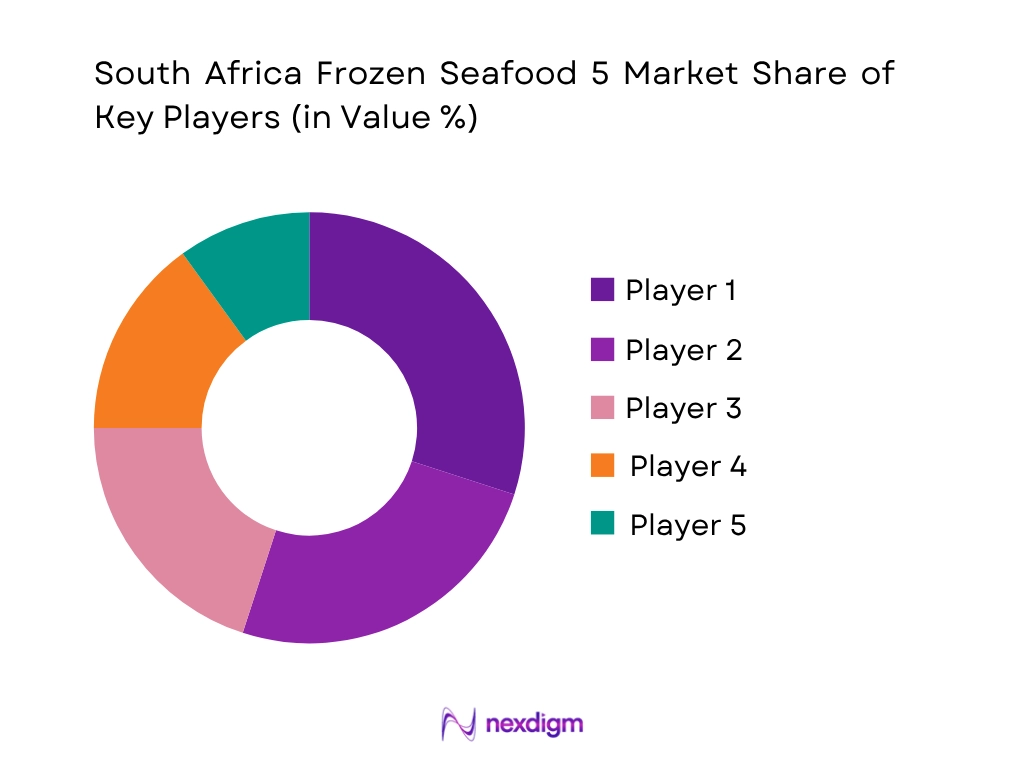
The South Africa Frozen Seafood Market is moderately consolidated around vertically integrated fishing companies, branded frozen seafood manufacturers, import-led seafood distributors, and specialist processors. Sea Harvest, I&J, Oceana, Premier Fishing, and Atlantis Seafood Products hold strong positions due to fishing rights, hake processing, freezer trawlers, retail relationships, cold-chain capacity, and access to export-quality product. Competition is shaped less by price alone and more by species access, processing capability, certification, freezer logistics, retailer listings, and foodservice consistency.
| Company | Establishment Year | Headquarters | Core Frozen Seafood Portfolio | Processing/Freezing Capability | Channel Strength | Species Strength | Certification/Compliance Position | Strategic Advantage |
| Sea Harvest Group | 1964 | Cape Town | ~ | ~ | ~ | ~ | ~ | ~ |
| I&J | 1910 | Cape Town | ~ | ~ | ~ | ~ | ~ | ~ |
| Oceana Group | 1918 | Cape Town | ~ | ~ | ~ | ~ | ~ | ~ |
| Premier Fishing & Brands | 1952 | Cape Town | ~ | ~ | ~ | ~ | ~ | ~ |
| Atlantis Seafood Products | 2003 | Cape Town | ~ | ~ | ~ | ~ | ~ | ~ |
South Africa Frozen Seafood Market
Growth Drivers
Strong Domestic Freezer Readiness and Urban Household Base
The South Africa Frozen Seafood Market is supported by household infrastructure that enables frozen product storage, especially in urban and metro markets where supermarkets, freezer aisles, and online grocery fulfilment are concentrated. Stats SA records 19.551 million households in the General Household Survey, with 15.817 million households owning a refrigerator or combined fridge-freezer and 4.459 million households owning a free-standing deep freezer, creating a direct installed base for frozen hake, fish fingers, prawns, calamari, mussels, and seafood mixes. Gauteng alone accounts for 5.981 million households, while Western Cape accounts for 2.195 million households, making these provinces commercially important for frozen seafood retail distribution. Stats SA also records 17.637 million households connected to mains electricity, which is essential for cold storage at household level and for retailer freezer operations. South Africa’s mid-year population is 63.015 million, with Gauteng at 15.931 million, KwaZulu-Natal at 12.312 million, and Western Cape at 7.562 million, giving frozen seafood brands a large urban and coastal consumer base. Sources: Stats SA General Household Survey and Mid-Year Population Estimates.
Established Marine Resource Base and Frozen Fish Export Capability
The South Africa Frozen Seafood Market benefits from a structured marine fisheries base that supports frozen fish processing, frozen-at-sea supply, and export-grade fillet production. The government yearbook records a coastline of more than 3,000 km, around 10,000 marine plant and animal species, and 22 commercial fisheries sectors, giving processors access to species such as hake, anchovy, sardine, horse mackerel, tuna, snoek, rock lobster, abalone, squid, and linefish. The same government source states that the commercial sector directly employs approximately 28,000 people, supporting vessel operations, processing plants, cold stores, and logistics activity linked to frozen seafood. World Bank WITS trade data records South Africa exporting 25,369,900 kg of frozen fish fillets under HS 030420 in 2024, showing that the country already has internationally traded frozen fillet capability rather than only domestic fresh-fish handling. This export base supports domestic frozen seafood quality because processors must maintain traceability, cold-chain controls, cutting standards, and product consistency suitable for formal buyers. Sources: GCIS/DFFE South Africa Yearbook and World Bank WITS.
Market Challenges
Cold-Chain Dependence Remains Exposed to Electricity and Household Storage Gaps
The South Africa Frozen Seafood Market faces a structural challenge because frozen seafood requires continuous cold-chain integrity from processing plants to cold stores, transport, retail freezers, and household storage. Stats SA records 17.637 million households connected to mains electricity, but the total household base is 19.551 million, leaving a gap of approximately 1.914 million households without mains electricity connection in the same household table. For cooking, 15.111 million households use mains electricity, while 1.406 million households use gas or LPG and 1.512 million households use wood, indicating that energy access and reliability remain uneven across the consumer base. Frozen seafood also depends on storage assets: 15.817 million households own a refrigerator or combined fridge-freezer, but only 4.459 million households own a free-standing deep freezer. This creates a barrier for larger frozen fish cartons, bulk hake packs, and multi-pack seafood items in lower-storage households. For processors and retailers, the issue is not only consumer demand but maintaining product integrity across every temperature-sensitive node. Sources: Stats SA General Household Survey.
Wild-Catch Constraints Limit Raw Material Expansion
The South Africa Frozen Seafood Market is constrained by biological and regulatory limits on wild-caught marine supply. The government yearbook states that fisheries output is determined by catch volumes, which depend on fish stock health, ecological changes, and risks from illegal, unreported, and unregulated fishing. It also notes that the Department of Forestry, Fisheries and the Environment manages overexploitation through total allowable catch and total allowable effort allocations that are adjusted according to the estimated state of each resource. This matters directly for frozen seafood because hake, squid, horse mackerel, sardine, rock lobster, and abalone are not unlimited raw materials for processors. South Africa has 22 commercial fisheries sectors, but the same source states that wild-catch fisheries appear unlikely to expand beyond present levels, making volume growth more dependent on processing efficiency, imports, aquaculture, and value-added conversion. The challenge is particularly relevant for frozen hake, calamari, lobster, and abalone products where processors must balance retail demand with conservation-linked supply limits.
Market Opportunities
Aquaculture-Based Frozen Seafood Diversification
Aquaculture creates a future-facing opportunity for the South Africa Frozen Seafood Market because government sources identify fish farming as a priority where wild stocks are declining and wild-catch fisheries are unlikely to expand materially. The government yearbook states that aquaculture includes breeding, trading, or rearing aquatic organisms in controlled environments and is divided into freshwater culture and mariculture. It lists farmed mariculture species including dusky kob, abalone, Pacific oysters, Mediterranean mussels, and black mussels, all of which can support frozen, chilled-to-frozen, portioned, or value-added seafood formats. South Africa’s coastline of more than 3,000 km, its 10,000 recorded marine plant and animal species, and its 22 commercial fisheries sectors give the country a broad biological and operational base for seafood development. The opportunity is commercially relevant because frozen seafood processors can use aquaculture to stabilize supply for mussels, oysters, kob, trout, and abalone-linked products, reducing dependence on volatile wild-catch cycles. Sources: GCIS/DFFE South Africa Yearbook.
Expansion of Retail, Online, and Direct-to-Consumer Frozen Seafood Channels
The South Africa Frozen Seafood Market has an opportunity to expand through retail freezer channels, e-grocery, and direct-to-consumer seafood delivery because household connectivity and cold-storage readiness are already large in absolute terms. Stats SA records 18.779 million households owning a cellular phone, including 5.803 million households in Gauteng, 3.295 million households in KwaZulu-Natal, and 2.102 million households in Western Cape. These are the same provinces that anchor supermarket, foodservice, and coastal seafood flows. World Bank data records South Africa’s GDP at USD 401.14 billion and GDP per capita at USD 6,267.2, indicating a sizeable formal consumer economy for packaged protein categories. At home-storage level, Stats SA records 15.817 million households with a refrigerator or combined fridge-freezer and 4.459 million households with a deep freezer, allowing frozen seafood brands to develop smaller packs, family packs, and online-delivered insulated seafood orders. This opportunity is strongest for frozen hake, prawns, calamari, mussels, salmon portions, and ready-to-cook seafood. Sources: Stats SA General Household Survey and World Bank.
Future Outlook
The South Africa Frozen Seafood Market is expected to expand steadily as frozen seafood becomes a more regular protein choice across households, restaurants, institutional buyers, and online grocery channels. Growth will be driven by value-added hake, frozen prawns, calamari, salmon portions, mussels, and ready-to-cook seafood products. The market is forecast to grow at 6.9% CAGR during 2026–2035, aligned with DMI’s published South Africa frozen fish and seafood growth outlook.
Retail will remain the anchor channel, but foodservice distributors and online seafood platforms will gain importance as restaurants, QSR outlets, and affluent urban households demand consistent frozen quality. The market will also see deeper segmentation between economy frozen whitefish, mid-market hake products, and premium imported seafood such as salmon, prawns, calamari, crab, and lobster tails.
Major Players
- Sea Harvest Group
- Irvin & Johnson / I&J
- Oceana Group
- Premier Fishing and Brands
- Atlantis Seafood Products
- Viking Fishing
- Gansbaai Marine
- Blue Seas Products
- Cape Fish
- Abagold
- Chapman’s Seafood Company
- Sovereign Fish Exporters
- GSA Traders
- Fish4Africa
- Caught Online
Key Target Audience
- Frozen seafood processors and packers
- Fishing companies and quota-holding operators
- Seafood importers and export houses
- Supermarket and hypermarket category teams
- Foodservice distributors and HORECA procurement teams
- Cold-chain logistics and refrigerated warehousing companies
- Investments and venture capitalist firms
- Government and regulatory bodies, including National Regulator for Compulsory Specifications, Department of Forestry, Fisheries and the Environment, Department of Agriculture, Land Reform and Rural Development, International Trade Administration Commission of South Africa, South African Bureau of Standards
Research Methodology
Step 1: Identification of Key Variables
The initial phase involves mapping the South Africa Frozen Seafood Market ecosystem across fishing rights holders, processors, importers, cold stores, retailers, wholesalers, foodservice distributors, and regulators. Key variables include species mix, frozen format, freezer retail penetration, import dependence, channel pricing, processing capacity, cold-chain reliability, and certification requirements.
Step 2: Market Analysis and Construction
The second phase compiles historical and base-year data from published market intelligence, company disclosures, retail freezer audits, trade references, and regulatory sources. Market construction includes value sizing, volume triangulation, price-per-kg benchmarking, SKU-level assortment review, and channel allocation across supermarkets, wholesale, foodservice, specialty retail, and online platforms.
Step 3: Hypothesis Validation and Expert Consultation
Market hypotheses are validated through interviews with seafood processors, frozen seafood distributors, importers, supermarket buyers, foodservice procurement managers, cold-store operators, and regulatory specialists. These interviews test assumptions on dominant species, product margins, imported seafood exposure, channel demand, pack-size movement, thaw-loss concerns, and promotional pricing.
Step 4: Research Synthesis and Final Output
The final phase consolidates bottom-up company and SKU analysis with top-down seafood consumption and trade indicators. Outputs include market size, channel shares, product segmentation, competitive benchmarking, future CAGR, and strategic recommendations for processors, retailers, investors, importers, and cold-chain operators targeting South Africa’s frozen seafood category.

- Executive Summary
- Research Methodology (Market Definitions and Assumptions, Frozen Seafood Scope, Species Inclusion and Exclusion, Primary Interviews with Processors/Distributors/Retail Buyers, Store Checks Across Modern Trade and Fish Shops, Port and Cold-Store Channel Checks, Import-Export Triangulation, Top-Down Market Sizing, Bottom-Up SKU and Channel Build-Up, Company Revenue Mapping, Price Ladder Analysis, Limitations and Forecast Assumptions)

- Definition and Scope
- Industry Genesis and Evolution
- Business Cycle
- Supply Chain and Value Chain Analysis

- Growth Drivers (Convenience Cooking, Affordable Frozen Protein, Expansion of Modern Grocery Retail, Hake Brand Familiarity, Foodservice Menu Recovery, Private-Label Development, E-Grocery Freezer Delivery, Imported Premium Seafood Demand)
- Market Restraints (Quota Pressure, Load-Shedding Exposure, Cold-Chain Cost, Import Inspection Lead Time, Currency Depreciation, High Freezer Logistics Cost, Consumer Price Sensitivity)
- Market Opportunities (Premiumization, Sustainable Sourcing, Aquaculture-Based Supply, Ready-to-Cook Seafood, Township Freezer Distribution, Foodservice Contract Supply, E-Commerce Seafood Delivery)
- Market Trends (MSC-Certified Hake, SASSI-Aligned Claims, Retailer Traceability, Imported Seafood Diversification, Smaller Packs, Bulk Economy Packs, Online Seafood Stores, Private-Label Consolidation)
- Supply Chain Analysis
- SWOT Analysis
- Porter’s Five Forces Analysis
- PESTLE Analysis
- Stakeholder Ecosystem

- By Value (2020-2025)
- By Volume (2020-2025)
- By Average Selling Price (2020-2025)

- By Species Type (In Value %)
Cape Hake
Horse Mackerel
Pilchards/Sardines
Prawns/Shrimp
Calamari/Squid - By Product Form (In Value %)
Whole Fish
Fillets
Loins
Steaks
Portions - By Freezing Technology (In Value %)
IQF
Blast Freezing
Plate Freezing
Block Frozen
Frozen-at-Sea - By End User (In Value %)
Households
HORECA
QSR/Fish-and-Chips Outlets
Institutional Catering
Retail Delis

- Market Share of Major Players (Value Share, Volume Share, Retail Share, Foodservice Share, Hake Share, Imported Seafood Share, Value-Added Seafood Share)
- Cross Comparison Parameters (Species Portfolio: Hake/Horse Mackerel/Prawns/Calamari/Salmon/Mussels; Freezing and Processing Capability: IQF/Blast/Frozen-at-Sea/Glazing; Cold-Chain and Warehousing Footprint: Port Cold Stores/Reefer Fleet/-18°C Controls; Fishing Rights and Vessel Access: MLRA Rights/Quota/Factory Vessels; Retail and Private-Label Penetration: National Chains/SKU Blocks/Promotional Depth; Foodservice and Wholesale Reach: HORECA/QSR/Cash-and-Carry/Distributor Network; Import Sourcing and Clearance Capability: NRCS/ITAC/Port Documentation; Certification and Traceability: HACCP/MSC/SASSI/Health Certificates)
- SWOT Analysis of Major Players
- Detailed Profiles of Major Companies
Sea Harvest Group
Irvin & Johnson / I&J
Oceana Group
Premier Fishing and Brands
Atlantis Seafood Products
Viking Fishing
Gansbaai Marine
Blue Seas Products
Cape Fish
Abagold
Chapman’s Seafood Company
Sovereign Fish Exporters
GSA Traders
Fish4Africa
Caught Online

- Household End-User Analysis
- HORECA End-User Analysis
- QSR and Fish-and-Chips Outlet Analysis
- Institutional Buyer Analysis
- Retailer Procurement Analysis

- By Value (2026-2035)
- By Volume (2026-2035)
- By Average Selling Price (2026-2035)


 Request a Sample
 Ask for Customization
 Get a Quote
 Enquire Now