
 Download PDF
Market Overview
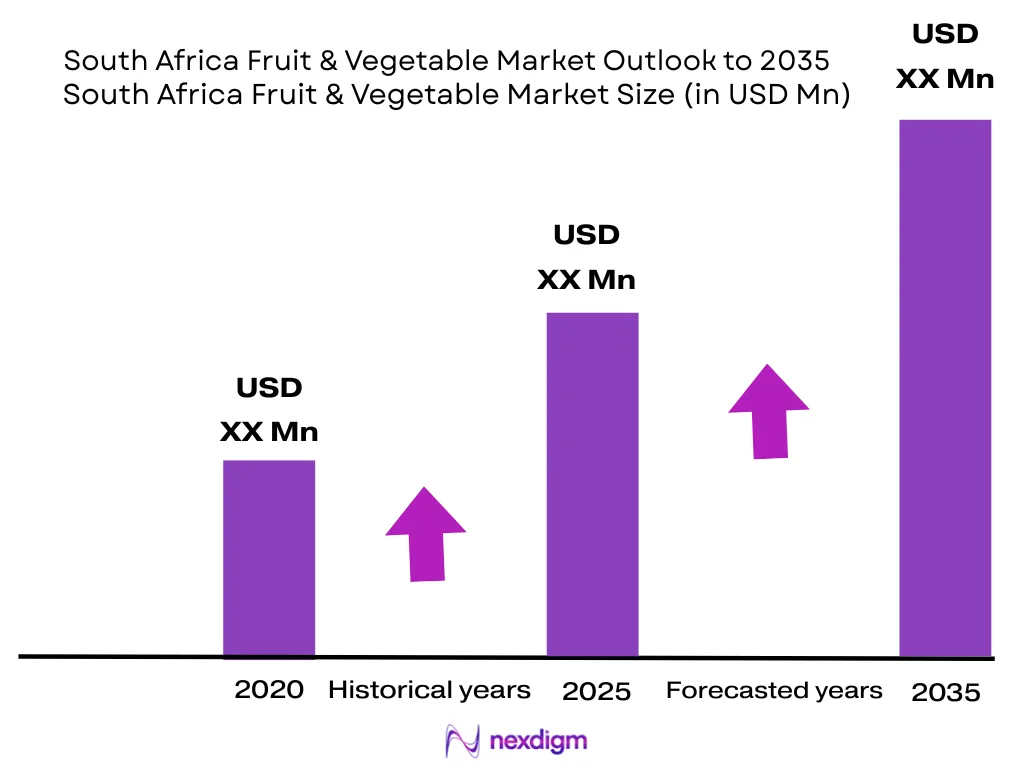
South Africa Fruits & Vegetables Market is valued at USD ~ million, based on a five-year historical analysis, and is forecast to grow at 6.5% CAGR across the 2026-2035 outlook period. Domestic demand is supported by staple vegetables, formal retail, municipal fresh produce markets and export fruit supply. Vegetables sold on major fresh produce markets increased from 1,244,208 tons to 1,275,828 tons, confirming high-volume domestic movement. Western Cape, Limpopo, Mpumalanga, Eastern Cape, KwaZulu-Natal, Northern Cape and Gauteng dominate the South Africa Fruits & Vegetables Market due to orchard concentration, vegetable belts, municipal market access, cold storage and export-port connectivity. Western Cape dominates apples, pears, grapes and stone fruits; Limpopo and Mpumalanga lead citrus, avocados and subtropical fruits; Gauteng dominates consumption and wholesale redistribution. South African fruit exports supply more than 100 destinations, with more than 60% of fruit production exported.
Market Segmentation
By Product Type
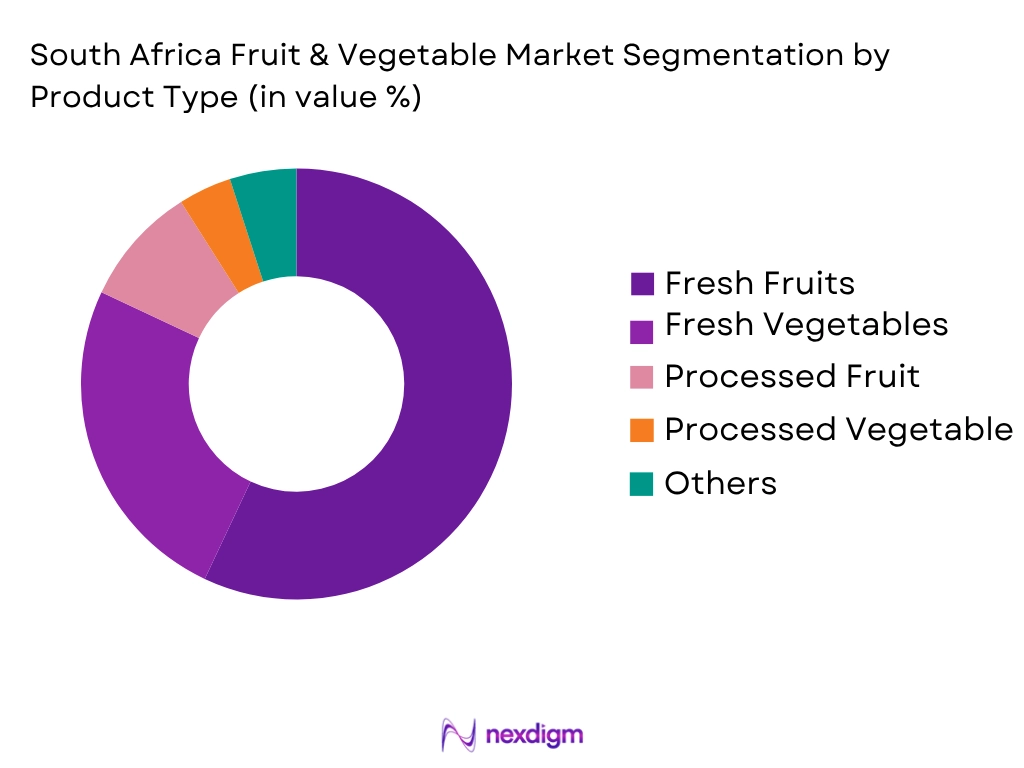
South Africa Fruits & Vegetables Market is segmented by product type into fresh vegetables, fresh fruits, processed fruits, processed vegetables, and frozen, dried and fresh-cut produce. Recently, fresh vegetables have a dominant market share in South Africa under the segmentation product type, it is due to their daily use across households, informal traders, municipal markets, supermarkets, QSRs, schools, hospitals and catering channels. Potatoes, onions, tomatoes, cabbage, carrots, pumpkins, lettuce and cucumbers form the core domestic basket and move through national fresh produce markets every day. DALRRD reported that vegetables excluding potatoes sold on major fresh produce markets increased from 1,244,208 tons to 1,275,828 tons, reinforcing the strength of vegetable movement. Fruit is strategically important due to exports, but vegetables dominate domestic consumption frequency.
By Distribution Channel
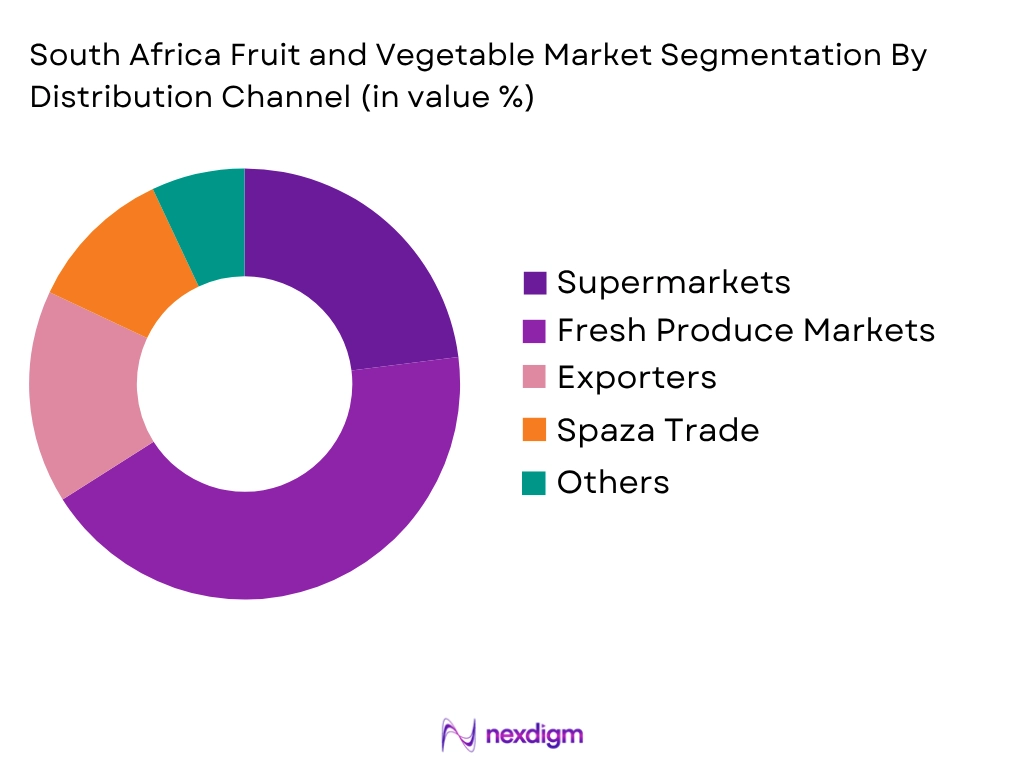
South Africa Fruits & Vegetables Market is segmented by distribution channel into national fresh produce markets, supermarkets and hypermarkets, exporters and export packhouses, informal retailers and spaza trade, and processors/foodservice/online channels. Recently, national fresh produce markets have a dominant market share in South Africa under the segmentation distribution channel, it is due to their role in bulk aggregation, daily price discovery, municipal market agency sales and redistribution to informal traders, small retailers, caterers and wholesalers. Johannesburg, Tshwane, Cape Town, Durban, Bloemfontein and other fresh produce markets remain central to domestic fruit and vegetable circulation. The Johannesburg Fresh Produce Market is described as the largest fresh produce market in South Africa and a major share of national fresh produce market sales.
Competitive Landscape
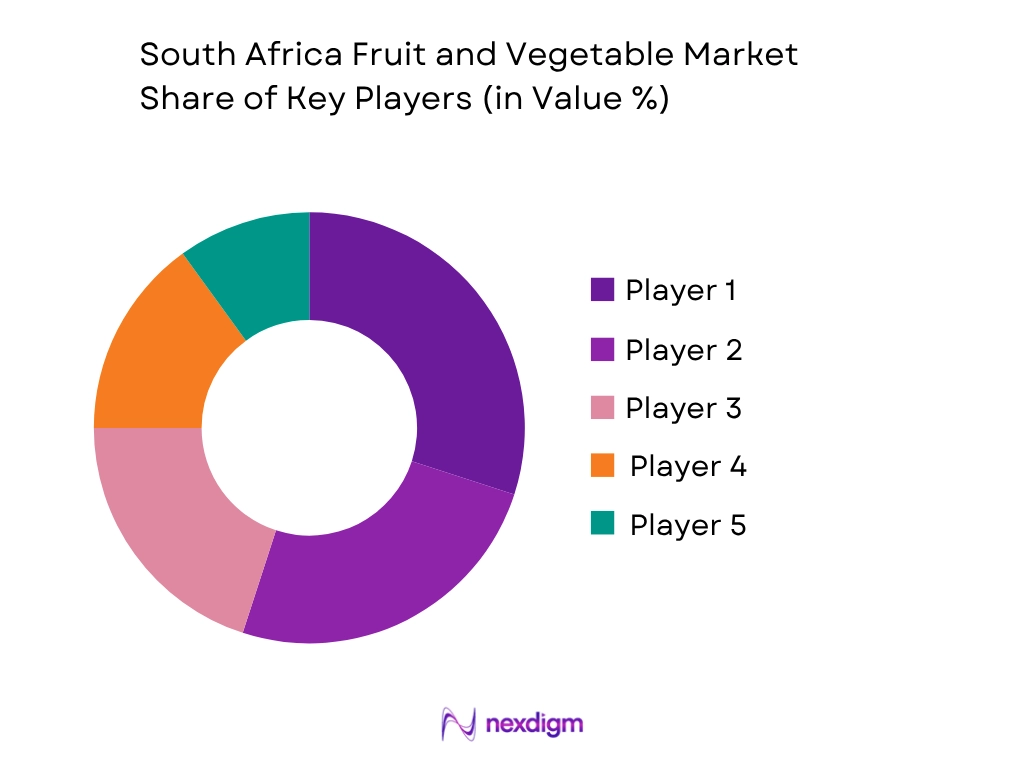
South Africa Fruits & Vegetables Market is fragmented at grower level but consolidated around large exporters, packhouses, supermarket suppliers, municipal market agencies and processing companies. Capespan, Dutoit Group, ZZ2, Westfalia Fruit South Africa and Fruitways are influential because they combine crop specialization, orchards, packhouses, cold storage, export programmes, compliance systems and retail relationships. Competition is shaped by grower networks, export-market access, PPECB compliance, cold-chain reliability, port execution, product quality and supermarket supply capability.
| Company | Establishment Year | Headquarters | Key Categories | Business Model | Key Channel | Sourcing / Production Footprint | Market-Specific Capability | Competitive Advantage |
| Capespan | 1943 | Stellenbosch, Western Cape | ~ | ~ | ~ | ~ | ~ | ~ |
| Dutoit Group | 1893 | Ceres, Western Cape | ~ | ~ | ~ | ~ | ~ | ~ |
| ZZ2 | 1903 | Mooketsi, Limpopo | ~ | ~ | ~ | ~ | ~ | ~ |
| Westfalia Fruit South Africa | 1949 | Tzaneen, Limpopo | ~ | ~ | ~ | ~ | ~ | ~ |
| Fruitways | 1997 | Grabouw, Western Cape | ~ | ~ | ~ | ~ | ~ | ~ |
South Africa Fruit Vegetable Market Analysis
Growth Drivers
Export-Oriented Citrus and Fruit Supply Supports Packhouse, Cold-Chain and Port Activity
South Africa Fruit Vegetable Market is supported by a fruit export base that creates demand for packhouses, grading lines, cold storage, reefer containers and phytosanitary inspection. World Bank data records South Africa’s GDP at USD 401.14 billion and GDP per capita at USD 6,267.2 in 2024, while total population reached 64,007,187 people, supporting both domestic consumption and export-linked investment capacity. DALRRD reported citrus exports increasing from 2,391,808 tons in 2022/23 to 2,468,382 tons in 2023/24, with 1,117,354 tons of oranges exported during the same season. SAnews reported that South Africa delivered 203.4 million 15 kg cartons of citrus to global markets in the 2025 export season, marking the highest citrus export volume recorded by the industry. This driver is market-specific because citrus, grapes, apples, pears, avocados and stone fruit require export protocols, carton marking, cold-chain discipline and PPECB oversight. The export base strengthens commercial activity in Limpopo, Mpumalanga, Eastern Cape, Western Cape, Northern Cape and port-linked corridors serving Cape Town, Durban, Ngqura and Port Elizabeth.
Domestic Vegetable Production and Municipal Fresh Produce Markets Support Daily Consumption
South Africa Fruit Vegetable Market is also driven by staple vegetable consumption across households, informal traders, supermarkets, foodservice and institutional catering. World Bank data shows South Africa’s GDP at USD 401.14 billion, GDP per capita at USD 6,267.2 and population at 64,007,187 people in 2024, indicating a large domestic food-consumption base for potatoes, onions, tomatoes, cabbage, pumpkins, carrots and green mealies. DALRRD reported vegetable production excluding potatoes rising from 2,873,041 tons in 2022/23 to 2,979,221 tons in 2023/24, with tomatoes at 533 thousand tons, onions at 697 thousand tons, green mealies and sweet corn at 424 thousand tons, cabbages at 212 thousand tons, pumpkins at 278 thousand tons and carrots at 221 thousand tons. DALRRD also reported that vegetables excluding potatoes sold on major fresh produce markets increased from 1,244,208 tons to 1,275,828 tons, confirming the continuing importance of municipal markets for bulk redistribution. This supports growers, market agents, wholesalers, informal retailers and supermarket procurement teams.
Market Challenges
Electricity Reliability and Cold-Chain Exposure Affect Perishable Produce Handling
South Africa Fruit Vegetable Market remains exposed to electricity reliability because citrus, apples, pears, grapes, avocados, berries, tomatoes and leafy vegetables require cold rooms, packhouse lines, irrigation pumps, controlled-atmosphere storage and refrigerated transport. World Bank data records South Africa’s GDP at USD 401.14 billion and GDP per capita at USD 6,267.2 in 2024, showing that horticulture operates within a large but infrastructure-constrained economy. Eskom reported 128 consecutive days of uninterrupted electricity supply from 26 March 2024 to 2 August 2024, but the earlier operating environment had required extensive backup planning by farms, packhouses and cold-chain operators. Reuters reported that Eskom implemented scheduled power cuts on 329 days in the year to end-March 2024, while electricity sales volumes declined to 183.3 terawatt hours. This challenge is market-specific because perishable produce cannot tolerate repeated temperature breaks; delays in pre-cooling, ripening, washing, grading, packing or port staging can reduce export-grade recovery and increase shrink in municipal markets, supermarkets and foodservice distribution.
Port, Road and Phytosanitary Bottlenecks Create Export Execution Risk
South Africa Fruit Vegetable Market faces export execution risk because high-volume fruit categories depend on road transport, port capacity, reefer plug availability, cold treatment and importing-country phytosanitary rules. World Bank data records South Africa’s GDP at USD 401.14 billion and population at 64,007,187 people in 2024, while fruit exports remain a key route for converting agricultural output into external trade earnings. DALRRD reported citrus exports of 2,468,382 tons in 2023/24 and identified the Netherlands, United Arab Emirates, United Kingdom, Russian Federation and United States of America among the top five importing markets for South African citrus. Reuters reported that South Africa exported a record 3.05 million metric tons of citrus in 2025 and that 95 parts of every 100 parts of citrus exports are moved by road to ports, increasing exposure to diesel availability, road congestion and port disruptions. This challenge directly affects citrus, grapes, apples, pears and avocados because missed shipping windows can disrupt quality, shelf-life, customer programmes and compliance schedules.
Market Opportunities
Citrus Export Scaling Creates Opportunity for Cold-Chain, Packhouse and Reefer Investment
South Africa Fruit Vegetable Market has a clear opportunity in cold-chain, packhouse and port-linked logistics because the current citrus export base is expanding. World Bank data records South Africa’s GDP at USD 401.14 billion, GDP per capita at USD 6,267.2 and population at 64,007,187 people in 2024, supporting investment capacity around agricultural logistics and export services. DALRRD recorded citrus exports of 2,468,382 tons in 2023/24, including 1,117,354 tons of oranges, while SAnews reported 203.4 million 15 kg cartons delivered to global markets in the 2025 export season. This current export scale supports future growth in pre-cooling, controlled-atmosphere storage, optical sorting, carton handling, reefer staging, cold-treatment monitoring and port corridor coordination. The opportunity is strongest for Limpopo, Mpumalanga, Eastern Cape, Western Cape and Northern Cape production areas, where packhouses must handle large seasonal peaks. Improved logistics can help exporters maintain arrival quality for Europe, the Middle East, the United Kingdom, Russia, the United States and Asian markets.
Domestic Vegetable Market Modernization Creates Opportunity for Aggregation and Retail Supply
South Africa Fruit Vegetable Market has an opportunity to modernize domestic vegetable aggregation, municipal market flow and retail supply because current volumes are substantial and widely distributed. World Bank data records South Africa’s GDP at USD 401.14 billion and GDP per capita at USD 6,267.2 in 2024, while the consumer base reached 64,007,187 people, creating steady demand for staple vegetables in formal and informal channels. DALRRD reported vegetable production excluding potatoes at 2,979,221 tons in 2023/24, including tomatoes at 533 thousand tons, onions at 697 thousand tons, cabbages at 212 thousand tons, pumpkins at 278 thousand tons and carrots at 221 thousand tons. Major fresh produce markets handled 1,275,828 tons of vegetables excluding potatoes, while tomato volumes sold on 17 major fresh produce markets reached 237,511 tons. These current figures support future opportunity in farmer aggregation, electronic market systems, crate pooling, quality grading, foodservice packing, supermarket direct procurement, smallholder inclusion and fresh-cut vegetable processing. The strongest use cases are potatoes, onions, tomatoes, cabbage, carrots and leafy vegetables.
Future Outlook
Over the next five years, South Africa Fruits & Vegetables Market is expected to grow through export fruit expansion, domestic vegetable demand, supermarket procurement, cold-chain investment and gradual municipal market modernization. Citrus, avocados, blueberries, apples, pears and table grapes will remain the strongest export-linked categories, while potatoes, onions and tomatoes will remain critical for domestic consumption. The market’s forecasted CAGR for 2026-2035 is assessed at 6.5%, aligned with the latest available South Africa fruits and vegetables benchmark for the 2026-2033 period. Fruit exports will continue to support packhouse, cold storage, reefer and port logistics investment, particularly through the Western Cape, Eastern Cape, Limpopo, Mpumalanga and Northern Cape production corridors.
Vegetables will retain their dominant position in domestic consumption because potatoes, onions, tomatoes, cabbage and carrots are staples in household meals, informal retail and institutional catering. Municipal markets will continue to play a structural role in price discovery and redistribution, although formal retailers will expand private-label packaged produce, direct procurement and supplier-development programmes. The biggest constraints will remain port congestion, electricity reliability, water scarcity and phytosanitary barriers. South Africa has already pursued WTO action against EU citrus requirements related to citrus black spot and false codling moth controls, highlighting the importance of compliance and market-access management for export fruit growers.
Major Players
- Capespan
- Dutoit Group
- ZZ2
- Westfalia Fruit South Africa
- Fruitways
- Core Fruit
- ALG Estates
- Goede Hoop Citrus
- SRCC
- Karsten Group
- United Exports
- RSA Group
- Subtropico
- Potatoes South Africa
- Tiger Brands
Key Target Audience
- Fruit growers and orchard owners
- Vegetable producers and producer organisations
- Exporters and export packhouse operators
- National fresh produce market agents and wholesalers
- Supermarkets, hypermarkets and formal grocery retailers
- Cold-chain logistics, controlled-atmosphere storage and port service providers
- Investments and venture capitalist firms
- Government and regulatory bodies (Department of Agriculture, Land Reform and Rural Development, PPECB, Competition Commission South Africa, National Agricultural Marketing Council, Perishable Products Export Control Board, South African Revenue Service, Transnet National Ports Authority)
Research Methodology
Step 1: Identification of Key Variables
The initial phase involves constructing an ecosystem map encompassing all major stakeholders within the South Africa Fruits & Vegetables Market. This includes growers, packhouses, exporters, PPECB, market agents, municipal fresh produce markets, supermarkets, processors and cold-chain operators. The objective is to identify production, export, domestic distribution, compliance and infrastructure variables.
Step 2: Market Analysis and Construction
In this phase, historical data is compiled and analyzed for South Africa Fruits & Vegetables Market revenue, crop output, municipal market volumes, export performance and domestic channel movement. The model combines top-down valuation with bottom-up crop analysis across citrus, apples, pears, grapes, avocados, potatoes, onions, tomatoes and cabbage.
Step 3: Hypothesis Validation and Expert Consultation
Market hypotheses are validated through computer-assisted telephonic interviews with growers, exporters, packhouse managers, market agents, cold-chain companies, retail buyers and processors. These consultations provide operational insight into export windows, price discovery, compliance cost, cold storage availability, municipal market participation and retail procurement.
Step 4: Research Synthesis and Final Output
The final phase integrates secondary research, official statistics, company profiling and expert validation into a structured market report. The output provides market size, segmentation, competitive landscape, future outlook, target audience mapping and strategic recommendations. This ensures the South Africa Fruits & Vegetables Market analysis reflects both export competitiveness and domestic market realities.

- Executive Summary
- Research Methodology (Market Definitions and Assumptions, Fresh and Processed Produce Classification, Farm-Gate and Export Valuation, National Fresh Produce Market Valuation, Retail and Foodservice Valuation, DALRRD Data Review, PPECB Export Inspection Data Review, Fruit South Africa and Industry Body Mapping, Bottom-Up Crop Output Model, Top-Down Consumption and Trade Model, Primary Interviews with Growers, Exporters, Municipal Market Agents, Retail Buyers, Packhouses, Cold-Chain Operators and Processors, Limitations and Forecast Assumptions)

- Definition and Scope
- Market Genesis and Evolution
- South Africa Horticulture Production Landscape
- Role of Fruits and Vegetables in Domestic Food Consumption
- Role of National Fresh Produce Markets

- Growth Drivers (Citrus Export Scale, Strong Deciduous Fruit Base, Municipal Market Distribution, Supermarket Procurement, Urban Food Demand, Regional Trade, Processing Demand, Cold-Chain Capability)
- Market Challenges (Port Congestion, Load-Shedding, Water Scarcity, Phytosanitary Barriers, Municipal Market Inefficiency, Input Cost Pressure, Smallholder Access Gaps, Cold-Chain Disruption)
- Market Opportunities (Cold-Chain Investment, Port Efficiency, Export Diversification, Avocado and Berry Expansion, Fresh-Cut Produce, Smallholder Integration, Processing Capacity, Regional Distribution)
- Trends (Premium Export Fruit, Retail Packaged Produce, Municipal Market Reform, Traceability, Climate-Smart Irrigation, Solar-Powered Cold Rooms, Fresh-Cut Adoption, Export Protocol Tightening)
- SWOT Analysis
- Porter’s Five Forces

- By Value (2020-2025)
- By Volume (2020-2025)
- By Average Realization (2020-2025)

- By Product Category (In Value %)
Fresh Fruits
Fresh Vegetables
Processed Fruits
Processed Vegetables
- By Fruit Type (In Value %)
Citrus Fruits
Pome Fruits
Table Grapes
Subtropical Fruits
Stone Fruits and Berries - By Distribution Channel (In Value %)
National Fresh Produce Markets
Supermarkets and Hypermarkets
Informal Retailers
Wholesale Distributors
Exporters - By Geography (In Value %)
Western Cape
Limpopo, Mpumalanga
Eastern Cape
KwaZulu-Natal
Free State

- Market Share of Major Players (Value Share, Volume Share, Export Share, Domestic Retail Share, Municipal Market Flow, Processing Share)
- Cross Comparison Parameters (Crop Portfolio Depth, Grower and Orchard Network, Export Destination Coverage, Packhouse and Sorting Capacity, Cold-Chain and Controlled Atmosphere Infrastructure, Retail/Foodservice/Municipal Market Channel Reach, PPECB/GlobalG.A.P./SIZA Compliance Infrastructure, Processing and Value-Added Produce Capability)
- SWOT Analysis of Major Players
- Pricing and SKU Benchmarking of Major Players
- Detailed Profiles of Major Companies
Capespan
Dutoit Group
ZZ2
Westfalia Fruit South Africa
Fruitways
Core Fruit
ALG Estates
Goede Hoop Citrus
SRCC
Karsten Group
United Exports
RSA Group
Subtropico
Potatoes South Africa
Tiger Brands

- Household Consumers
- Informal Traders and Spaza Retailers
- Supermarkets and Hypermarkets
- Hotels, Restaurants and QSRs
- Institutional Buyers
- Food Processors

- By Value (2026-2035)
- By Volume (2026-2035)
- By Average Realization (2026-2035)


 Request a Sample
 Ask for Customization
 Get a Quote
 Enquire Now