
 Download PDF
Market Overview
The South Africa Furniture And Home Furnishing Market is valued at USD ~ billion, while the broader South Africa home furnishing market generated USD ~ million. The market is driven by residential furniture, indoor furnishings, mattresses, lounge suites, home textiles, office furniture, patio furniture and value-led retail formats. South Africa’s GDP stood at USD ~ billion, while GDP per capita stood at USD ~ supporting formal retail and household furnishing purchases. Gauteng, Western Cape and KwaZulu-Natal dominate South Africa Furniture And Home Furnishing Market due to high population concentration, formal retail networks, furniture chain presence, credit-led purchases, office demand, hospitality procurement and stronger logistics coverage. South Africa’s population was estimated at 63.02 million, while Gauteng had around 16.1 million residents and KwaZulu-Natal had about 12.2 million residents. Johannesburg, Pretoria, Cape Town and Durban lead demand because they concentrate households, shopping centres, warehouses and commercial buyers.
Market Segmentation
By Product Type
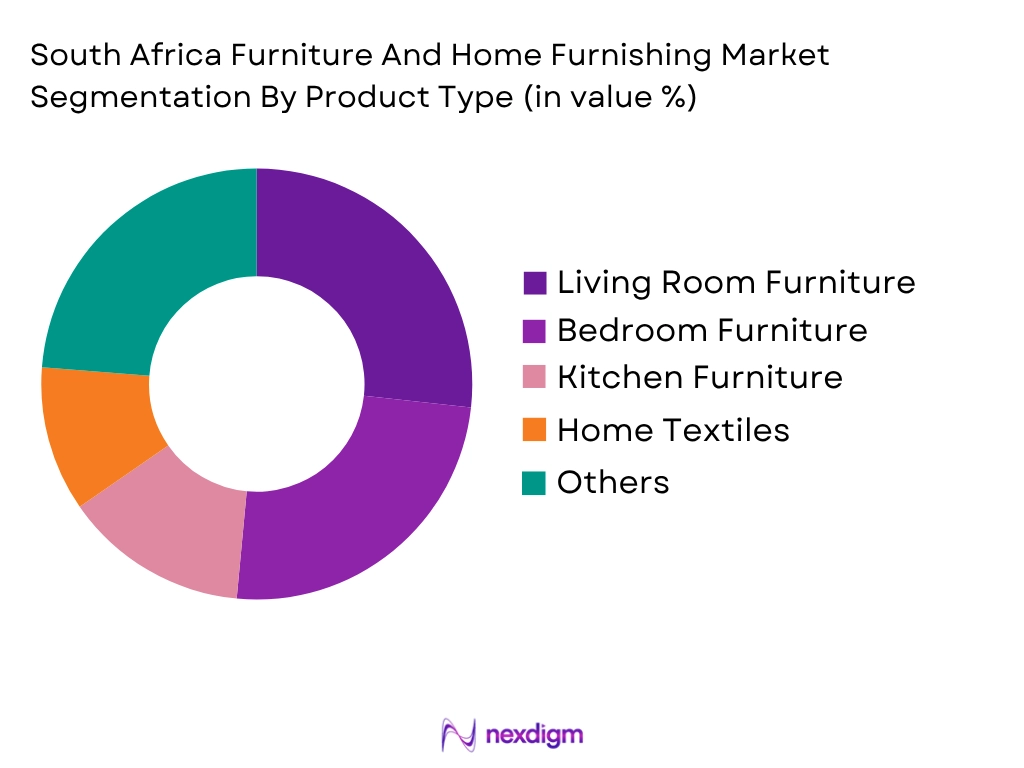
South Africa Furniture And Home Furnishing Market is segmented by product type into living room furniture, bedroom furniture and mattresses, dining and kitchen furniture, home textiles and soft furnishings, office and study furniture, outdoor and patio furniture, and home décor, lighting and accessories. Recently, living room furniture has a dominant market share in South Africa under the segmentation product type, due to strong demand for lounge suites, sofas, recliners, coffee tables, TV units and occasional chairs among residential households. The category is central to both credit-led furniture chains and independent retailers because lounge suites are high-value, visible household purchases. Retailers such as OK Furniture, Bradlows, Russells, Lewis, Rochester, Coricraft and Decofurn use lounge furniture as an anchor category for linked sales in rugs, curtains, cushions, coffee tables and décor.
By Sales Channel
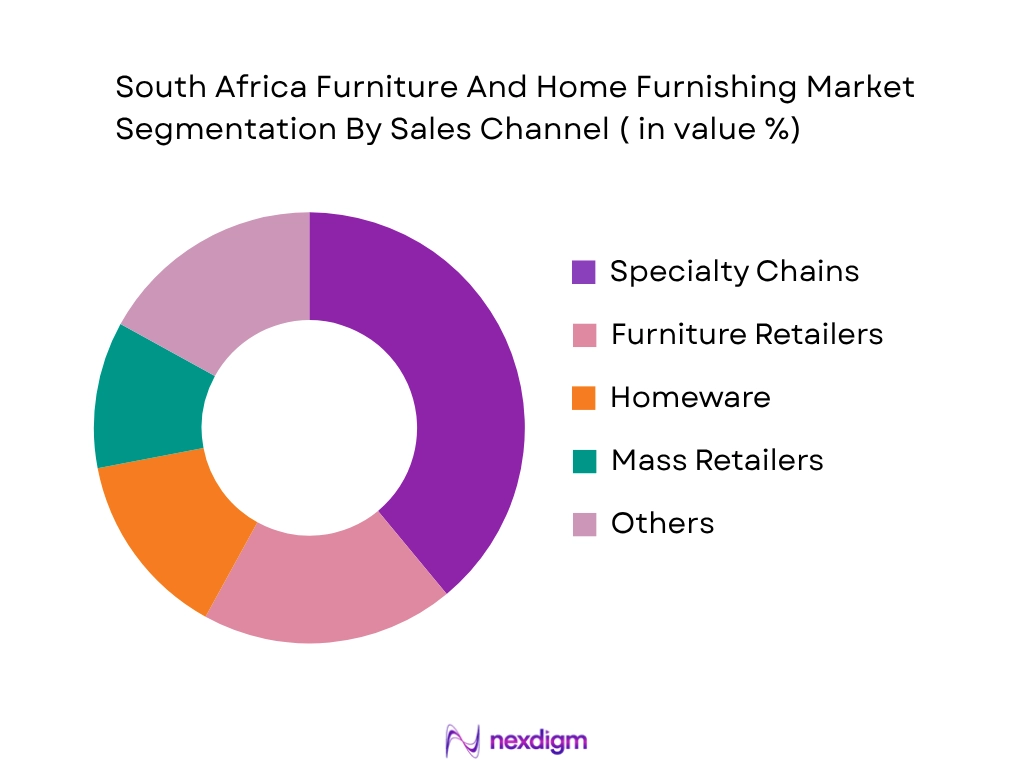
South Africa Furniture And Home Furnishing Market is segmented by sales channel into furniture specialty chains, independent furniture retailers, homeware and lifestyle retailers, department stores and mass retailers, online furniture platforms, home improvement and building material stores, and contract and interior design channels. Recently, furniture specialty chains have a dominant market share in South Africa under the segmentation sales channel, because they combine national store networks, credit accounts, lay-by options, delivery, product bundling and after-sales support. Chains such as Lewis, OK Furniture, Bradlows, Russells, Rochester and Sleepmasters serve households purchasing lounge suites, beds, wardrobes, mattresses, dining sets and home appliances. Their dominance is also supported by regional and township reach, where furniture purchases are frequently account-based and bundled with delivery, insurance, warranty and repayment plans. Independent retailers remain relevant, but national chains control formal category visibility.
Competitive Landscape
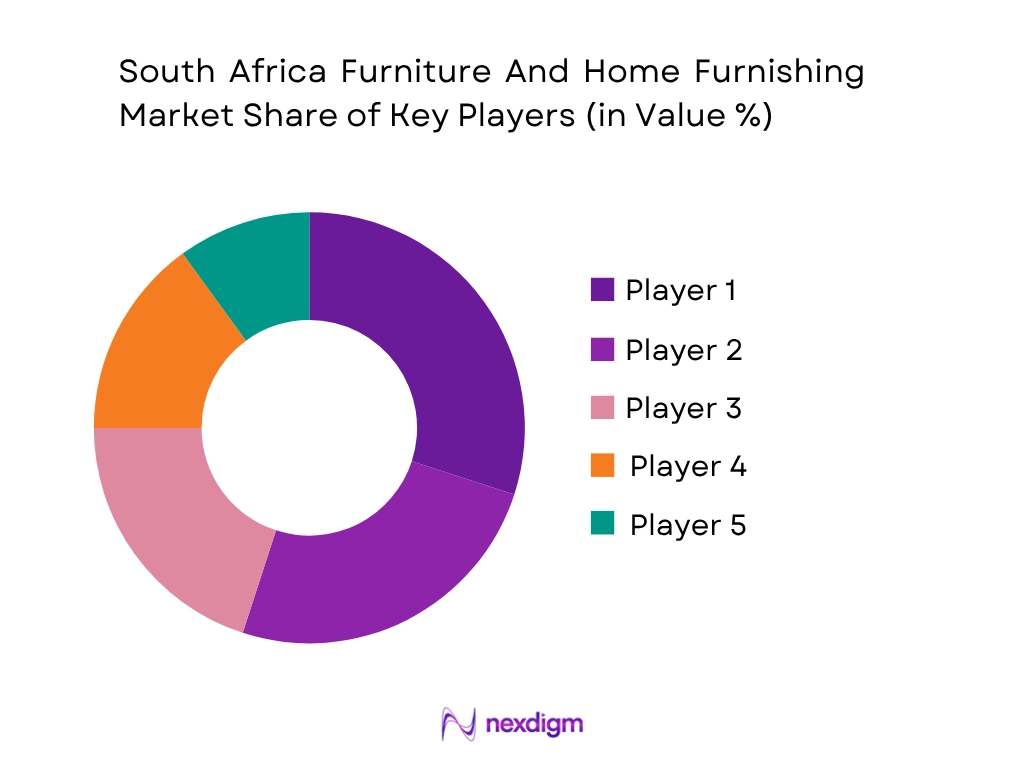
South Africa Furniture And Home Furnishing Market is led by national credit-led furniture chains, homeware retailers, mattress specialists, premium furniture brands, value warehouse retailers and local upholstery players. Pepkor Lifestyle, JD Group, Lewis Group, OK Furniture and House & Home influence the market through store footprint, account-based sales, home delivery, bedroom and lounge portfolios, mattress ranges, appliance bundles, and access to underserved regional and township demand. Reuters reported that Shoprite agreed to sell OK Furniture and House & Home to Pepkor in a deal covering more than 400 stores across Southern African markets.
| Company | Establishment Year | Headquarters | Core Positioning | Product Strength | Sales Channel | Fulfillment Model | Price Tier | Market-Specific Capability |
| Pepkor Lifestyle | 2017 | Cape Town | ~ | ~ | ~ | ~ | ~ | ~ |
| JD Group | 1983 | Johannesburg | ~ | ~ | ~ | ~ | ~ | ~ |
| Lewis Group | 1934 | Cape Town | ~ | ~ | ~ | ~ | ~ | ~ |
| OK Furniture | 1927 | Cape Town / national operations | ~ | ~ | ~ | ~ | ~ | ~ |
| House & Home | 1977 | Cape Town / national operations | ~ | ~ | ~ | ~ | ~ | ~ |
South Africa Furniture And Home Furnishing Market Analysis
Growth Drivers
Large Household Base Supporting Essential Furniture Replacement
South Africa Furniture And Home Furnishing Market is supported by a large residential base that requires beds, mattresses, lounge suites, wardrobes, curtains, dining furniture, storage units and home textiles for recurring replacement and first-home furnishing. Statistics South Africa reported the national population at 63.02 million in its latest official population profile, while World Bank data recorded South Africa’s GDP at USD 401.14 billion and GDP per capita at USD 6,267.2 in 2024. These indicators support a broad consumer base for value, mid-market and credit-led furniture retail across Gauteng, Western Cape, KwaZulu-Natal and regional towns.
Formal Housing Occupancy Supporting Beds, Lounge Suites and Homeware Demand
South Africa Furniture And Home Furnishing Market benefits from formal dwelling occupancy because furnished homes require bedroom sets, lounge furniture, mattresses, kitchen units, curtains, rugs, lighting and storage products. Statistics South Africa’s General Household Survey reported that 84.1% of households lived in formal dwellings in 2024, while 60.1% of households owned the dwelling they lived in and 25.1% rented their dwelling. Ownership supports replacement and upgrade purchases, while rental occupancy supports portable furniture, value furniture, beds and compact storage. These housing indicators directly support demand across furniture chains, independent stores, mattress retailers and homeware specialists.
Market Challenges
Credit Conditions Pressuring Big-Ticket Furniture Purchases
South Africa Furniture And Home Furnishing Market faces pressure from credit conditions because lounge suites, bedroom sets, mattresses, wardrobes and dining furniture are commonly bought through store accounts, instalments, lay-by and consumer finance. The South African Reserve Bank kept the repo rate at 8.25% in March 2024, reflecting tight borrowing conditions for households and retailers. The World Bank also recorded South Africa’s GDP growth at only 0.5% in 2024, showing weak macro momentum. These conditions affect credit approvals, repayment quality and discretionary purchasing for big-ticket furniture categories, especially among lower-to-middle income households using formal furniture chains.
Household Affordability Constraints Limiting Discretionary Home Furnishing Spend
South Africa Furniture And Home Furnishing Market is challenged by constrained household spending, as consumers prioritise essentials before replacing sofas, beds, wardrobes, rugs, lighting and décor. Statistics South Africa reported total annual household consumption expenditure at R3 trillion for the latest income and expenditure release, with average annual household consumption expenditure at R143,691 and median expenditure at R82,861. The large gap between average and median spending indicates unequal purchasing capacity across furniture buyers. This makes value furniture, credit retail, lay-by, smaller-ticket homeware and promotional bedroom or lounge bundles more important than premium discretionary furnishing in many provinces.
Market Opportunities
Digital Access Supporting Online Furniture and Homeware Retail
South Africa Furniture And Home Furnishing Market has a future growth opportunity in online catalogues, digital credit applications, click-and-collect, marketplace listings and store-assisted e-commerce. Statistics South Africa’s General Household Survey reported that 82.1% of households had access to the internet in 2024, while 75.6% of households accessed mobile internet and 17.4% had fixed internet at home. Metropolitan households showed stronger digital access, with 76.3% using mobile internet and 27.2% having fixed internet at home. These indicators support digital discovery for beds, lounge suites, mattresses, curtains, décor and homeware before customers complete purchases online or in-store.
Tourism Recovery Supporting Hospitality and Contract Furniture Demand
South Africa Furniture And Home Furnishing Market has an opportunity in contract furniture for hotels, lodges, guesthouses, restaurants, student accommodation and serviced apartments. Statistics South Africa reported 8.9 million international arrivals in 2024, showing renewed tourism demand and supporting furniture procurement for hospitality spaces. Hotel rooms, lodges and restaurants require beds, headboards, wardrobes, desks, lounge seating, outdoor furniture, dining furniture, lighting, curtains and décor. This creates demand for durable, replaceable and locally serviceable furniture in Cape Town, Johannesburg, Durban, safari destinations and coastal tourism nodes. Contract suppliers, local upholstery producers and mattress manufacturers can benefit from hospitality refurbishment and replacement cycles.
Future Outlook
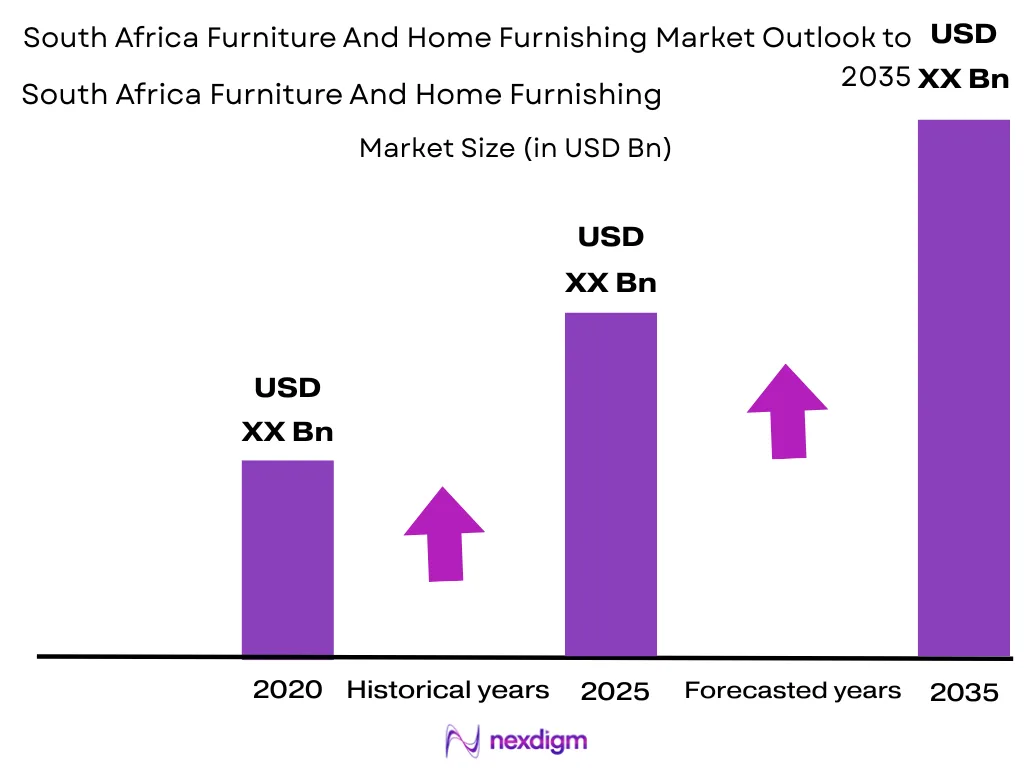
The South Africa Furniture And Home Furnishing Market is expected to expand through household formation, value retailing, mattress replacement, township and peri-urban store expansion, local upholstery production and online homeware adoption. The closest public forecast benchmark indicates the South Africa furniture market moving from USD 2.57 billion to USD 3.65 billion, implying a CAGR of approximately 5.14% over the available forecast period. Growth will remain linked to household affordability and access to credit. Furniture chains with strong credit-scoring, collection management, lay-by options and bundled household categories will retain relevance among lower-to-middle income buyers purchasing lounge suites, beds, mattresses, wardrobes, dining sets and appliances. Digital channels are expected to grow from a smaller base. Retailers will use e-commerce catalogues, mobile browsing, online credit applications, click-and-collect, delivery tracking and marketplace listings to support sales across urban and regional locations. Online channels will be more effective when paired with physical stores and flexible payment options. Local upholstery and mattress manufacturing will remain important because they shorten lead times, support replacement demand and reduce dependence on imported bulky furniture. Premium furniture, home décor and contract procurement will remain concentrated in Gauteng and Western Cape, while value furniture will continue expanding through township and regional retail formats.
Major Players
- Pepkor Lifestyle
- JD Group
- Lewis Group
- OK Furniture
- House & Home
- Rochester
- Bradlows
- Russells
- Sleepmasters
- Dial-a-Bed
- Coricraft
- @home
- Mr Price Home
- Decofurn Furniture
- Weylandts
Key Target Audience
- Furniture retailers and national furniture chain operators
- Mattress manufacturers and bedding retailers
- Homeware, décor and soft furnishing retailers
- Furniture manufacturers, upholstery producers and joinery firms
- Real estate developers, student accommodation operators and hospitality procurement teams
- Investments and venture capitalist firms
- Government and regulatory bodies
- Logistics, warehousing, furniture delivery and assembly service providers
Research Methodology
Step 1: Identification of Key Variables
The initial phase involves constructing an ecosystem map of the South Africa Furniture And Home Furnishing Market, covering furniture chains, independent stores, manufacturers, importers, mattress brands, homeware retailers, credit providers, logistics firms and end users. Key variables include product demand, credit penetration, store footprint, provincial demand, import exposure and household spending patterns.
Step 2: Market Analysis and Construction
In this phase, historical and current information is compiled across lounge furniture, bedroom furniture, mattresses, dining furniture, home textiles, décor, lighting, outdoor furniture and fitted furniture. Market construction is undertaken through top-down demand assessment and bottom-up mapping of retail chains, independent dealers, manufacturers, e-commerce platforms and contract buyers.
Step 3: Hypothesis Validation and Expert Consultation
Market hypotheses are validated through computer-assisted telephone interviews with furniture retailers, upholstery manufacturers, mattress suppliers, distributors, credit managers, logistics providers, interior designers and hospitality procurement teams. These consultations provide insight into category movement, affordability, account-based purchases, delivery issues, regional demand and competitive positioning.
Step 4: Research Synthesis and Final Output
The final phase synthesizes desk research, company benchmarking, expert validation and segmentation analysis into a structured market model. The output assesses South Africa Furniture And Home Furnishing Market size, forecast outlook, segmentation, competitive landscape, end-user behaviour, credit-led retail dynamics and strategic growth opportunities.

- Executive Summary
- Research Methodology (Market Definitions and Assumptions, Abbreviations, Market Sizing Approach, Top-Down Household Demand Mapping, Bottom-Up Retailer Revenue Assessment, Organized and Independent Retail Channel Triangulation, Import Shipment Mapping, Furniture Manufacturing Cluster Assessment, Store Network Mapping, E-Commerce Sales Estimation, Primary Interviews with Retailers/Manufacturers/Distributors/Interior Designers/Credit Providers, Limitations and Future Conclusions)

- Definition and Scope
- Overview Genesis
- Evolution of South Africa’s Furniture Retail and Manufacturing Industry
- Timeline of Major Retail Formats
- Business Cycle
- Supply Chain and Value Chain Analysis

- Growth Drivers (Household Expansion, Credit-Led Retail, Urban Rental Demand, Home Improvement, Online Retail, Hospitality Demand)
- Market Challenges (Consumer Credit Pressure, Household Income Constraint, Import Competition, Delivery Cost, Informal Retail, Currency Volatility)
- Opportunities (Township Retail, Affordable Furniture, Contract Furniture, Local Manufacturing, Online Homeware, Sustainable Materials)
- Market Trends (Omnichannel Retail, Credit Scoring, Value Furniture Bundling, Mattress Expansion, Homeware Attachments, Local Manufacturing)
- SWOT Analysis
- Porter’s Five Forces
- PESTLE Analysis

- By Value (2020-2025)
- By Volume (2020-2025)
- By Average Selling Price (2020-2025)

- By Product Category (In Value %)
Living Room Furniture
Bedroom Furniture
Mattresses and Sleep Products
Dining and Kitchen Furniture
Home Office and Study Furniture
- By Sales Channel (In Value %)
Furniture Specialty Chains
Independent Furniture Retailers
Homeware and Lifestyle Retailers
Department Stores and Mass Retailers
Online Furniture Platforms - By End User (In Value %)
Residential Households
Hospitality and Tourism Sector
Corporate Offices and Commercial Spaces
Real Estate Developers and Property Managers
- By Province (In Value %)
Gauteng
Western Cape
KwaZulu-Natal
Eastern Cape
Free State - By Room Type (In Value %)
Living Room
Bedroom
Dining Room and Kitchen
Home Office and Study Area

- Market Share of Major Players (Value Share, Volume Share, Organized Share, Channel Share, Provincial Presence)
- Cross Comparison Parameters (Store Footprint, Consumer Credit Offering, Product Category Breadth, Mattress and Bedding Portfolio, Delivery and Assembly Network, Township and Regional Reach, Online Sales Capability, Local Manufacturing and Sourcing Linkage)
- SWOT Analysis of Major Players
- Pricing Analysis by Key SKUs
- Detailed Profiles of Major Companies
Pepkor Lifestyle
JD Group
Lewis Group
OK Furniture
House & Home
Rochester
Bradlows
Russells
Sleepmasters
Dial-a-Bed
Coricraft
@home
Mr Price Home
Decofurn Furniture
Weylandts

- Residential Consumer Demand Analysis
- Credit-Based Consumer Analysis
- Hospitality Buyer Demand Analysis
- Office and Commercial Buyer Demand Analysis
- Student Housing and Institutional Buyer Demand Analysis

- By Value (2026-2035)
- By Volume (2026-2035)
- By Average Selling Price (2026-2035)


 Request a Sample
 Ask for Customization
 Get a Quote
 Enquire Now