

 Download PDF
Market Overview
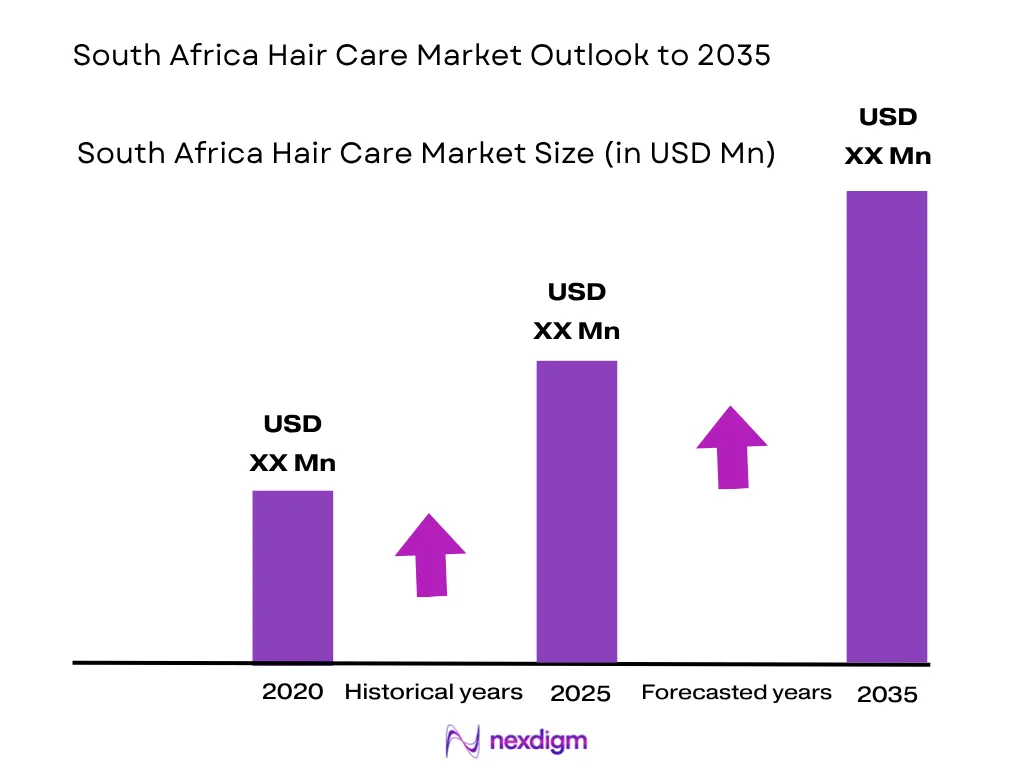
The South Africa Hair Care Market is valued at USD ~ million, based on Nexdigm’s historical analysis, after the broader category moved through a reported USD ~ million value base in the preceding industry dataset. Growth is driven by natural and personalized hair care, expanding e-commerce access, sustainability-led formulations, and demand for products addressing Afro-textured, curly, coily, relaxed, coloured, and treated hair needs. The published long-range forecast places the market at USD ~ million with a 6.63% CAGR, used as the forecast trajectory for the 2026–2035 period
Gauteng, KwaZulu-Natal, and Western Cape dominate demand because they combine dense populations, urban retail infrastructure, pharmacy chains, salon clusters, beauty specialists, and stronger online fulfilment. South Africa’s population is 63.02 million, with 32.13 million females, while Gauteng has nearly 16 million residents and KwaZulu-Natal has 12.3 million, giving these provinces strong replenishment demand for shampoos, conditioners, relaxers, braid sprays, oils, colourants, and scalp-care products. Western Cape benefits from premium beauty retail, tourism-linked salons, and higher formal retail penetration.
Market Segmentation
By Product Type
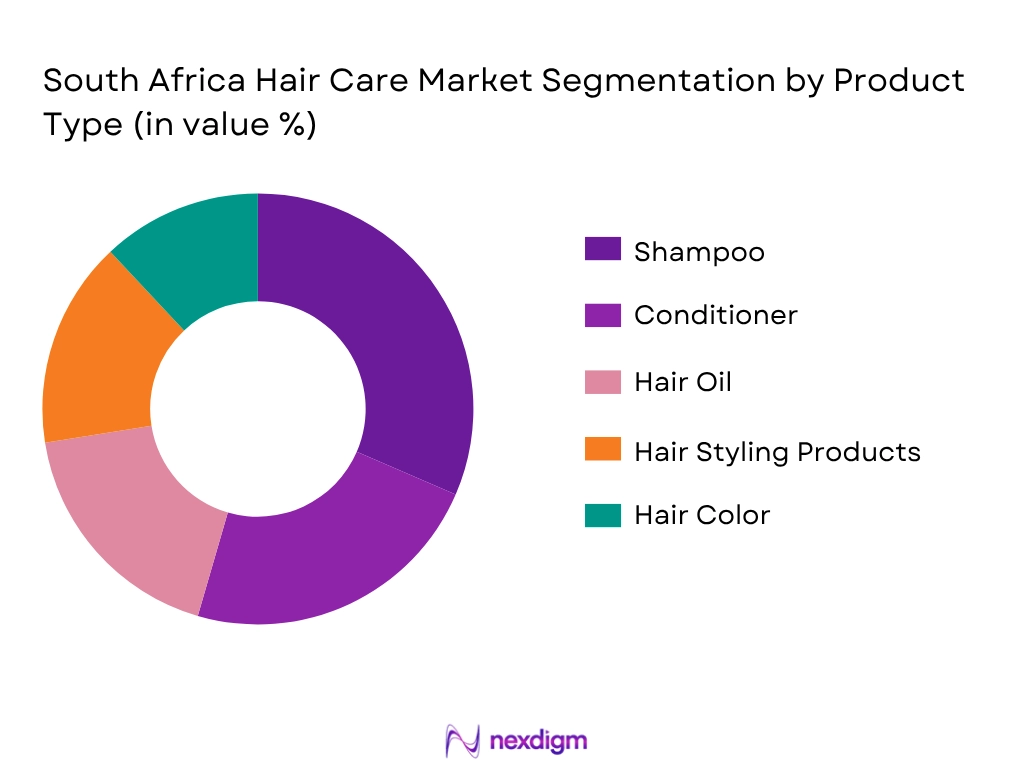
South Africa Hair Care Market is segmented by product type into shampoo, conditioner, hair oil, hair styling products, and hair colour. Shampoo holds the dominant market share under product type because it is the most frequently replenished wash-day product across mass retail, pharmacy, salon, and informal channels. The category has broad usage across straight, wavy, curly, coily, relaxed, coloured, and protective-styled hair consumers. In South Africa, shampoos also cover multiple need states such as anti-dandruff, moisturising, sulphate-free, clarifying, colour-protection, and scalp-cleansing formats. The segment benefits from strong brand portfolios from Unilever, L’Oréal, P&G, and Amka, and it remains a gateway purchase for conditioners, oils, treatments, and styling products. Nexdigm identifies shampoo as the largest type segment, while hair oil is highlighted as the fastest-growing segment due to natural ingredient preference.
By End User
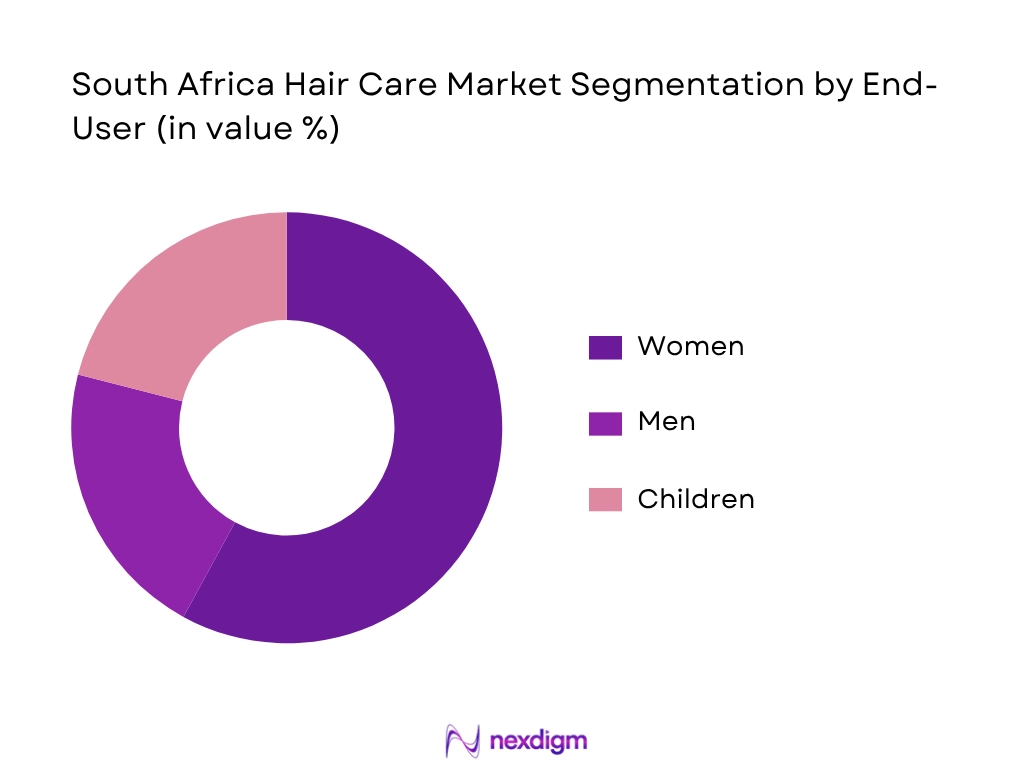
South Africa Hair Care Market is segmented by end user into women, men, and children. Women dominate the market because their routines typically include larger product baskets across cleansing, conditioning, deep treatment, oils, leave-ins, relaxers, colourants, styling gels, edge control, braid maintenance, wig care, and salon aftercare. Women consumers are also more exposed to premiumization, natural hair routines, protective styling, social media-led product discovery, and professional salon recommendations. MRFR reports women’s hair care value at USD 550.08 million, while men and children each stood at USD 200.0 million, confirming that women form the largest revenue pool. Children remain an important growth pocket because parents are buying detanglers, gentle shampoos, tear-free conditioners, and child-specific Afro-textured hair products.
Competitive Landscape
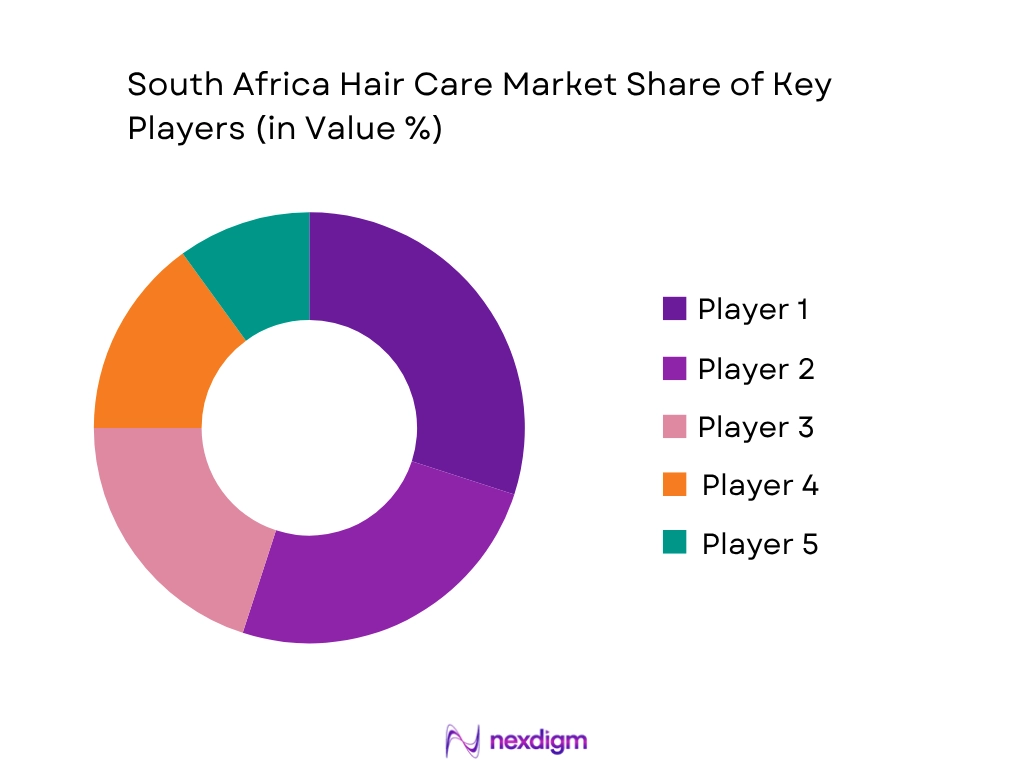
The South Africa Hair Care Market is moderately competitive, led by multinational FMCG and beauty groups with broad supermarket, pharmacy, salon, and online distribution, alongside strong local players focused on Afro-textured and ethnic hair care. Unilever, L’Oréal, P&G, Revlon, and Amka have an advantage through wide product portfolios, mass-market reach, brand recall, and specialized products for shampoo, conditioner, colour, relaxer, styling, and treatment needs. Local players retain relevance by addressing African hair textures, affordability, and protective-style maintenance.
| Company | Establishment Year | Headquarters | Key Hair Care Brands | South Africa Positioning | Core Product Strength | Channel Strength | Market-Specific Advantage | Target Hair Need |
| Unilever | 1930 | London, UK | ~ | ~ | ~ | ~ | ~ | ~ |
| L’Oréal Groupe | 1909 | Clichy, France | ~ | ~ | ~ | ~ | ~ | ~ |
| Procter & Gamble | 1837 | Cincinnati, US | ~ | ~ | ~ | ~ | ~ | ~ |
| Revlon | 1932 | New York, US | ~ | ~ | ~ | ~ | ~ | ~ |
| Amka Products | 1950s | Pretoria, South Africa | ~ | ~ | ~ | ~ | ~ | ~ |
South Africa Hair Care Market Analysis
Growth Drivers
Urbanization
South Africa’s hair care demand is structurally supported by a large, concentrated, and urban consumer base. The country’s total population reached 64,007,187 people in 2024, while the World Bank records urban population at 69.3% of the total population, creating dense demand pockets for shampoos, conditioners, hair oils, relaxers, braid sprays, scalp-care products, colourants, and salon services. Urban concentration is especially relevant for hair care because formal retail, pharmacy chains, salons, beauty supply stores, e-commerce fulfilment hubs, and informal township retail operate most efficiently in dense metros. Gauteng alone had 15.9 million residents, KwaZulu-Natal had 12.3 million, and Western Cape had 7.6 million, with 35.8 million people living across these three provinces. This concentration supports faster category replenishment, wider SKU availability, and stronger brand visibility in Johannesburg, Pretoria, Durban, Cape Town, and surrounding township markets. The same urban base also supports modern-trade purchases through supermarkets and pharmacies, while sustaining salon demand for relaxer maintenance, protective styling, colour services, treatments, and scalp consultations. South Africa’s population growth of 1.2 in 2024 further widens the replenishment base for daily-use categories, particularly shampoo, conditioner, hair food, styling gel, oils, and children’s detangling products. For the hair care market, urbanization therefore operates as a demand multiplier: it increases access, compresses distribution distances, raises exposure to beauty trends, and strengthens the commercial role of pharmacy-led and salon-led product discovery.
Hair Routine Sophistication
Hair routine sophistication is expanding because South African consumers have the digital access, product exposure, and demographic scale needed to move from basic cleansing to multi-step regimens. The World Bank reports that 78 out of every 100 people in South Africa used the internet in 2024, while ICASA recorded 94 million active mobile cellular subscriptions in 2024, giving consumers broad access to hair tutorials, product reviews, ingredient education, salon content, and online beauty retail. This matters directly for hair care because Afro-textured, relaxed, braided, loc’d, wig, weave, curly, colour-treated, and heat-styled hair routines often require multiple products: shampoo, co-wash, conditioner, deep mask, leave-in, oil, curl cream, edge control, braid spray, anti-itch scalp treatment, and heat protectant. The female population reached about 32.13 million in the Statistics South Africa mid-year estimate, creating a large consumer base for textured hair routines, protective-style maintenance, salon services, colour care, and treatment-led baskets. Trade data also indicates active movement of specialized hair preparations: South Africa exported 12,473,700 kg of “preparations for use on the hair, nes” in 2024, while imports of the same product group reached 6,572,120 kg, showing both domestic production capability and demand for imported formulations. These indicators support a market where consumers are not only buying hair care for hygiene, but also for styling identity, hair health, scalp comfort, damage repair, protective-style care, and ingredient-led personalization.
Market Challenges
Price Sensitivity
Price sensitivity remains a major constraint for the South Africa Hair Care Market because household beauty spending competes with food, transport, housing, utilities, and employment insecurity. The World Bank records South Africa’s GDP per capita at USD 6,267.2 in 2024, while real GDP growth stood at only 0.5 in the same year, indicating limited income expansion for discretionary and semi-discretionary categories such as premium shampoos, salon treatments, imported oils, colourants, and professional scalp-care products. Statistics South Africa reported average annual consumer inflation of 4.4 in 2024, down from 6.0 in 2023, but pressure remained visible in essential household categories: December CPI showed housing and utilities at 4.4, miscellaneous goods and services at 6.6, food and non-alcoholic beverages at 2.5, and services at 4.2. Labour-market conditions further reinforce trading-down behaviour. Employment declined from 17.1 million people in Q4 2024 to 16.8 million in Q1 2025, while unemployment increased to 8.2 million people. The official unemployment rate moved from 31.9 in Q4 2024 to 32.9 in Q1 2025, and the expanded unemployment rate reached 43.1. In hair care, these conditions encourage smaller pack sizes, promotional purchases, family tubs, economy shampoos, low-cost styling gels, basic hair foods, informal retail purchases, and delayed salon treatments. Premium brands must therefore justify higher basket spend through visible benefits such as anti-breakage, scalp relief, curl definition, colour protection, and longer-lasting protective-style maintenance.
Import Costs
Import costs create a structural challenge because South Africa’s hair care shelves include imported finished goods, fragrances, active ingredients, packaging inputs, professional salon products, colourants, and specialized ethnic hair formulations. World Bank data records South Africa’s imports of goods and services at USD 119,761.29 million in 2024, while imports of goods and services on a balance-of-payments basis reached USD 119,864.13 million, showing a large exposure to imported goods and foreign-currency procurement. Within hair care specifically, WITS/UN Comtrade records South Africa’s imports of “preparations for use on the hair, nes” at USD 38,833.71 thousand and 6,572,120 kg in 2024. The same dataset identifies imported supply from countries such as India at 221,705 kg, Brazil at 85,579 kg, Israel at 82,764 kg, Turkey at 133,366 kg, and the Netherlands at 14,162 kg, confirming reliance on cross-border sourcing for selected formulations. This matters for South African distributors and retailers because currency volatility, freight lead times, customs processes, and supplier payment terms can affect product availability, especially for salon-professional, imported natural, scalp-care, bond-repair, keratin, colour, and curl-specialist SKUs. The IMF also notes that South Africa’s current account remained stable despite higher US tariffs and global policy uncertainty, while public debt reached 77 of GDP at end-March 2025, indicating a macro environment where currency and external-trade risk remains relevant for imported categories. For hair care companies, this raises the importance of local manufacturing, local filling, regional sourcing, inventory planning, and disciplined SKU rationalization.
Market Opportunities
White Spaces
White spaces in the South Africa Hair Care Market are strongest in affordable textured-hair routines, scalp care, men’s hair and scalp products, children’s Afro-textured hair care, protective-style maintenance, and online-first niche brands. The opportunity is supported by a large addressable population: World Bank records 64,007,187 people in 2024, while Statistics South Africa reports approximately 32.13 million females in the same year. This is relevant because women remain the largest routine-intensive hair care audience, but unmet needs also exist among men, children, and value-seeking households. The top three provinces—Gauteng, KwaZulu-Natal, and Western Cape contained 35.8 million people, providing dense launch markets for scalp serums, anti-itch sprays, braid and loc moisturisers, wig shampoos, kids’ detanglers, edge recovery oils, sulphate-free cleansing, and low-residue protective-style care. Digital access also improves whitespace monetization: World Bank records internet use at 78 out of every 100 people, and ICASA records 94 million active mobile cellular subscriptions, enabling influencer education, direct-to-consumer discovery, WhatsApp commerce, and online replenishment. These conditions are significant because many textured-hair consumers need product education around porosity, dryness, shrinkage, breakage, protein-moisture balance, scalp buildup, and protective-style hygiene. The current trade base also indicates regional relevance for South African-made products: exports of hair preparations reached 12,473,700 kg, including shipments to Zimbabwe, Namibia, Botswana, Zambia, Lesotho, Eswatini, Angola, Kenya, and Mauritius. This supports whitespace opportunities not only in domestic retail, but also in Southern African distribution for Afro-textured hair care designed around similar climate, hair-type, and affordability needs.
Innovation Gaps
Innovation gaps are visible where South African consumers need products tailored to Afro-textured hair, protective styles, scalp concerns, affordability, and climate-specific routines, yet many advanced formulations remain imported or concentrated in premium channels. WITS/UN Comtrade data shows that South Africa imported 6,572,120 kg of “preparations for use on the hair, nes” in 2024, while exports reached 12,473,700 kg, indicating both an import requirement and a domestic manufacturing base that can be upgraded toward higher-value formulations. Imports from the European Union into South Africa for this product group reached 3,199,050 kg, while Italy supplied 680,408 kg, Belgium supplied 938,011 kg, the United States supplied 852,969 kg, and Germany supplied 479,886 kg. These flows suggest that innovation-heavy areas such as professional salon care, premium treatments, colour care, bond repair, scalp science, and specialized styling products still rely materially on external supply. At the macro level, South Africa’s internet usage of 78 out of every 100 people and 94 million active mobile cellular subscriptions create a channel for fast consumer education and product feedback loops, allowing local brands to test claims, routines, bundles, and hero ingredients quickly. The country’s 32.13 million female population and 35.8 million residents across Gauteng, KwaZulu-Natal, and Western Cape also create scale for innovation in wash-day kits, braid-care kits, relaxed-hair aftercare, children’s detangling systems, men’s scalp products, low-build-up gels, and sensitive-scalp products. For future growth, the best-positioned innovation will be evidence-led, texture-specific, affordable, and compatible with both modern retail and informal retail pack architecture.
Future Outlook
The South Africa Hair Care Market is expected to sustain steady expansion as consumers shift toward ingredient-led, personalized, scalp-health, and textured-hair solutions. Growth will be supported by higher urban beauty spending, pharmacy and supermarket distribution, salon product recovery, e-commerce assortment depth, and demand for natural and sustainable formulations. The market is forecast to move toward premium routines, while value packs and affordable ethnic hair care will remain essential for price-sensitive households. Future growth will be strongest in natural hair products, hair oils, sulphate-free shampoos, conditioners, braid and loc maintenance sprays, anti-dandruff products, hair loss solutions, and colour-care products. Beauty and health retailers such as Clicks and Dis-Chem will remain important for premium and advice-led purchases, while supermarkets and informal retail will maintain high-volume movement for everyday shampoos, hair foods, oils, relaxers, and styling products. Online retail will widen access to niche imported and local natural hair brands, especially for consumers looking for curl-specific and scalp-specific products.
Major Players
- Unilever South Africa
- L’Oréal Groupe
- Procter & Gamble
- Revlon South Africa
- Amka Products
- Godrej Consumer Products / Darling
- Strength of Nature / ORS
- Wella Company
- Henkel / Schwarzkopf
- Estée Lauder Companies / Aveda
- Coty
- Shiseido
- Kao Corporation
- Native Child
- AfroBotanics
Key Target Audience
- Hair care product manufacturers
- Beauty and personal care brand owners
- Supermarket and hypermarket chains
- Pharmacy and health & beauty retailers
- Salon chains and professional hair distributors
- E-commerce beauty platforms and online marketplaces
- Investments and venture capitalist firms
- Government and regulatory bodies (Department of Health, South African Health Products Regulatory Authority, South African Bureau of Standards, National Consumer Commission, South African Revenue Service Customs Division)
Research Methodology
Step 1: Identification of Key Variables
The initial phase involves building an ecosystem map of South Africa Hair Care Market stakeholders, including manufacturers, importers, distributors, retailers, salons, beauty specialists, and online platforms. Key variables include product type, hair type, end user, price tier, channel mix, SKU pricing, replenishment cycle, and ingredient positioning.
Step 2: Market Analysis and Construction
Historical data is compiled across published market values, retailer assortment, product pricing, channel presence, and company portfolios. The market is assessed through top-down market sizing and bottom-up SKU-level validation across shampoos, conditioners, oils, styling products, colourants, relaxers, and scalp-care products.
Step 3: Hypothesis Validation and Expert Consultation
Market hypotheses are validated through interviews with category managers, salon professionals, distributors, beauty-store operators, pharmacy buyers, and brand representatives. These discussions help refine assumptions on product movement, pricing, salon-to-retail conversion, ethnic hair care demand, and online purchase behaviour.
Step 4: Research Synthesis and Final Output
The final phase integrates secondary research, primary interviews, pricing analysis, competitive benchmarking, and channel mapping into a structured market model. The output includes market size, segmentation, competitive landscape, future outlook, target audience mapping, and opportunity assessment for the South Africa Hair Care Market.

- Executive Summary
- Research Methodology (Market Definitions and Assumptions, Abbreviations, Product Inclusion Matrix, Retail Audit Approach, Salon Interview Framework, Consumer Hair-Type Mapping, Primary Research Approach, Secondary Research Sources, Market Sizing Logic, Forecasting Assumptions, Limitations)

- Definition and Scope
- Market Genesis and Evolution
- Business Cycle and Purchase Replenishment Cycle
- Supply Chain Analysis
- Route-to-Market Structure
- Retail and Salon Ecosystem
- Consumer Hair Behaviour Landscape
- Product Lifecycle Analysis
- Import, Local Manufacturing, and Contract Manufacturing Landscape
- Role of Pharmacy Chains, Supermarkets, Beauty Specialists, Salons, Informal Retail, and E-Commerce
- Regulatory Overview for Cosmetic and Hair Care Products
- Market Maturity and Innovation Intensity

- Growth Drivers (Urbanization, Hair Routine Sophistication, Natural Hair Movement, Premium Pharmacy Retail, E-Commerce Availability)
- Market Challenges (Price Sensitivity, Import Costs, Ingredient Scrutiny, Informal Competition, Promotional Pressure)
- Market Opportunities (White Spaces, Innovation Gaps, Channel Expansion, Consumer Education)
- Market Trends (Ingredient Claims, Hair Identity, Omnichannel Retail, Professionalization)
- Government Regulation and Compliance (Cosmetic Labelling, Advertising Claims, Ingredient Declaration, Safety Standards)
- Foodstuffs, Cosmetics and Disinfectants Act Compliance (Cosmetic Classification, Labelling, Composition, Advertising)
- Cosmetic Labelling Requirements (Ingredient List, Manufacturer Details, Batch Number, Country of Origin, Expiry)
- Claims and Advertising Compliance (Hair Growth Claims, Anti-Hair Loss Claims, Therapeutic Boundary, Evidence Support)
- SANS Hair Care Standards and Industry Guidance (Product Quality, Safety, Testing, Good Manufacturing Practices)
- Import Compliance and Border Controls (Customs, Labelling, Batch Traceability, Parallel Imports)
- SWOT Analysis (Strengths, Weaknesses, Opportunities, Threats, Category-Specific Implications)
- Porter’s Five Forces Analysis (Supplier Power, Buyer Power, Competitive Rivalry, Substitution, New Entrants)
- PESTLE Analysis (Economic Pressure, Social Hair Identity, Regulatory Claims, Technology-Led E-Commerce, Environmental Packaging)
- Value Chain Margin Pool Analysis (Manufacturing, Importing, Distribution, Retail, Salon Services, D2C)
- Retail Shelf and Merchandising Analysis (Category Blocking, Ethnic Hair Bay, Natural Hair Bay, Premium Shelf, Promo Endcaps)
- Pricing and Promotion Analysis (Promo Depth, Basket Bundling, Pack-Size Laddering, Loyalty Program Influence)

- By Value (2020-2025)
- By Volume (2020-2025)
- By Average Selling Price (2020-2025)
- By Retail Sales Value (2020-2025)
- By Salon/Professional Consumption Value (2020-2025)
- By Mass vs Premium Value Contribution (2020-2025)
- By Imported vs Locally Manufactured Product Contribution (2020-2025)

- By Product Category (In Value %)
Shampoos
Conditioners
Hair Treatments and Masks
Hair Oils, Serums, and Scalp Oils
Hair Styling Products
Relaxers and Texturizers
Hair Colourants
Scalp Care Products
Braid, Loc, Wig, and Weave Care - By Hair Type and Hair Stat (In Value%)
Afro/Kinky/Coily Hair
Curly Hair
Relaxed/Chemically Treated Hair
Braided/Loc’d/Protective Styled Hair
Straight/Wavy Hair
Colour-Treated Hair
Damaged/Dry/Brittle Hair
Low-Porosity and High-Porosity Hair) - By Consumer Group (In Value%)
Women
Men
Kids
Teens and Young Adults
Professional Salon Users
Natural Hair Consumers
Value-Seeking Households - By Price Tier (In Value%)
Economy Hair Care
Mass-Market Hair Care
Masstige Hair Care
Premium Hair Care
Professional/Luxury Hair Care - By Distribution Channel (In Value%)
Supermarkets and Hypermarkets
Pharmacy and Health & Beauty Chains
Beauty Supply Stores and Cosmetic Specialists
Salons and Professional Distributors
Online Retail and Marketplaces
Informal Retail and Spaza/Small Shops
Department Stores and Premium Beauty Retail - By Formulation and Ingredient Positioning (In Value%)
Sulphate-Free and Silicone-Free
Shea Butter and Coconut Oil Based
Castor Oil and Growth-Claim Products
Protein and Keratin Products
Anti-Dandruff and Scalp Active Products
Vegan, Cruelty-Free, Natural, and Organic
Dermatologist-Tested/Sensitive Scalp Products - By Usage Occasion and Need State (In Value%)
Daily/Weekly Cleansing
Moisture and Detangling Routine
Protective Style Maintenance
Relaxer and Retouch Maintenance
Heat Styling and Blow-Out Care
Colour Maintenance
Hair Fall, Breakage, and Edge Repair
Wig, Weave, and Extension Care - By Sales Format and Pack Size (In Value%)
Sachets and Mini Packs
Standard Bottles and Tubs
Family/Salon Packs
Kits and Regimen Bundles
Refill and Eco-Pack Formats - By Region and Consumer Cluster (In Value%)
Gauteng
Western Cape
KwaZulu-Natal
Eastern Cape
Free State and Northern Cape
Limpopo, Mpumalanga
North West

- Market Share of Major Players (Value Share, Volume Share, Product Category Share, Channel Share, Hair Type Focus, Price Tier)
- Cross Comparison Parameters (Textured Hair Product Depth, Relaxer and Texturizer Portfolio Strength, Natural/Ingredient-Led Claims, Scalp Care Capability, Protective Style Care Portfolio, Salon Professional Penetration, Retail Chain Shelf Presence, Online and D2C Availability)
- Company Benchmarking Matrix (Brand Portfolio, Hero SKUs, Price Tier, Hair-Type Focus, Local Manufacturing, Import Dependency, Retailer Presence, Salon Presence)
- Competitive Positioning Map (Mass vs Premium, Natural vs Chemical, Retail vs Salon, Local vs Multinational)
- Pricing Analysis of Major Players (SKU Price, Pack Size, Rand per ml, Promo Packs, Routine Bundle Pricing)
- Product Portfolio Gap Analysis (Scalp Care, Kids’ Afro Hair, Men’s Textured Hair, Wig/Weave Care, Clean Beauty, Bond Repair)
- Distribution Reach Analysis (Modern Trade, Pharmacy Chains, Beauty Specialists, Salons, Online Marketplaces, Informal Retail)
- Marketing and Influencer Strategy Analysis (Hair Influencers, Stylist Education, Retail Loyalty Programs, Social Commerce, Tutorials)
- SWOT Analysis of Major Players (Portfolio Strength, Channel Advantage, Pricing Risk, Innovation Gap)
- Detailed Profiles of Major Companies
Unilever South Africa
Procter & Gamble
L’Oréal Groupe
Revlon South Africa
Amka Products
Godrej Consumer Products / Darling
Strength of Nature / ORS
Canviiy
Estée Lauder Companies
Henkel / Schwarzkopf
Coty / Wella Professionals
Native Child
AfroBotanics
My Natural Hair

- Consumer Demand and Utilization (Wash Frequency, Treatment Frequency, Styling Frequency, Relaxer Retouch Cycle)
- Household Hair Care Basket Analysis (Shampoo, Conditioner, Oil, Hair Food, Relaxer, Styling Gel, Braid Spray)
- Consumer Journey Mapping (Awareness, Trial, Routine Adoption, Repurchase, Brand Switching)
- Purchase Decision-Making Process (Price, Hair Type Suitability, Ingredient Claims, Peer Reviews, Stylist Recommendation)
- Hair-Type Based Needs, Desires, and Pain Points (Moisture, Detangling, Curl Definition, Breakage, Scalp Relief)
- Women Consumer Analysis (Protective Styling, Natural Hair Transition, Premium Treatment Usage, Colouring)
- Men Consumer Analysis (Dandruff, Styling Gel, Waves, Hair Thinning, Beard-Hair Adjacent Products)
- Kids’ Hair Care Consumer Analysis (Gentle Products, Detangling, Parent-Led Buying, Kids’ Relaxer Sensitivity)
- Salon Professional End-User Analysis (Back-Bar SKUs, Treatment Services, Stylist Recommendation, Retail Attachment)
- Informal Retail Consumer Analysis (Small Pack Affordability, Essential Hair Food, Relaxers, Oils, Braid Sprays)
- Online Buyer Analysis (Premium Discovery, Imported Brands, Reviews, Delivery Convenience, Subscription Potential)
- Customer Cohort Analysis (Natural Hair Consumers, Relaxed Hair Consumers, Protective Style Users, Scalp Care Seekers, Premium Salon Users)

- By Value (2026-2035)
- By Volume (2026-2035)
- By Average Selling Price (2026-2035)
- By Retail Channel Value (2026-2035)
- By Salon/Professional Channel Value (2026-2035)
- By Mass vs Premium Value (2026-2035)


 Request a Sample
 Ask for Customization
 Get a Quote
 Enquire Now