

 Download PDF
Market Overview
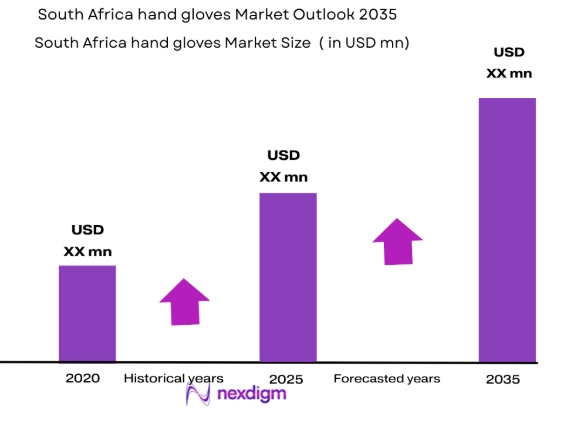
The South Africa hand gloves market is valued at approximately USD ~ million in 2025, supported by strong demand from healthcare, mining, food processing, and industrial sectors. South Africa’s healthcare system includes over 400 public hospitals and 200 private hospitals, creating consistent demand for surgical and examination gloves. The country’s GDP reached USD 377 billion, while healthcare expenditure exceeded USD 34 billion, reflecting institutional purchasing capacity. Additionally, the labor force of over 23 million people drives demand for industrial safety gloves across mining, manufacturing, and construction sectors, supporting steady market expansion.
The South Africa hand gloves market is concentrated in Gauteng, Western Cape, and KwaZulu-Natal due to dense industrial activity, healthcare infrastructure, and population centers. Gauteng dominates as the economic hub with Johannesburg and Pretoria hosting major hospitals, industrial plants, and logistics networks. Western Cape supports demand through healthcare facilities and food processing industries, while KwaZulu-Natal contributes through port-based trade and manufacturing clusters. These regions benefit from high urbanization, industrial output, and healthcare services, making them key demand centers for gloves across multiple applications.
Market Segmentation
By Product Type
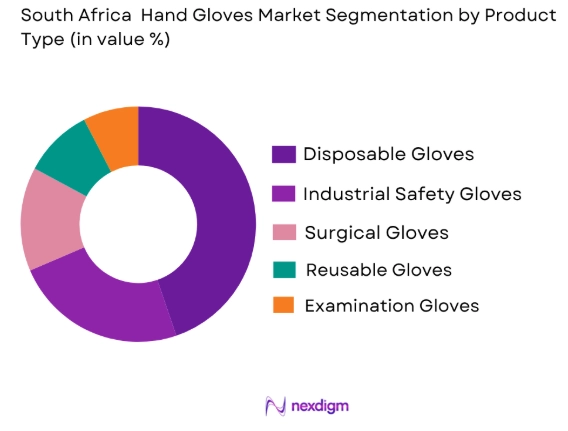
South Africa hand gloves market is segmented by product type into disposable gloves, reusable gloves, surgical gloves, examination gloves, and industrial safety gloves. Disposable gloves dominate the market due to their extensive use in healthcare, food processing, and cleaning services. Hospitals and clinics require single-use gloves for infection control, while food safety regulations drive usage in restaurants and processing units. Additionally, disposable gloves are widely used in laboratories and hygiene-sensitive environments. Their convenience, compliance with safety standards, and lower contamination risk make them the preferred choice. Industrial safety gloves also contribute significantly, especially in mining and construction, but disposable gloves lead due to recurring demand in healthcare and hygiene-driven sectors.
By Material Type
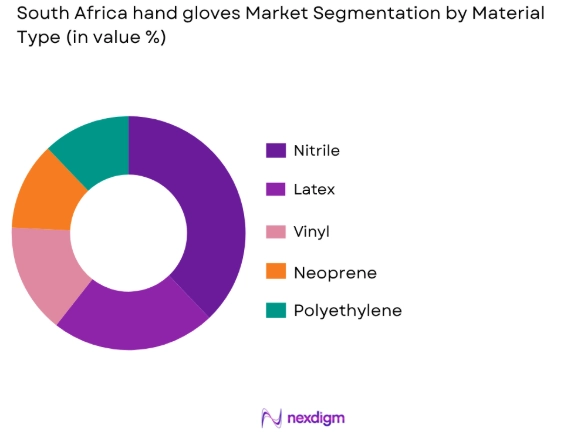
South Africa hand gloves market is segmented by material type into nitrile gloves, latex gloves, vinyl gloves, neoprene gloves, and polyethylene gloves. Nitrile gloves dominate the market due to their superior durability, chemical resistance, and hypoallergenic properties. Healthcare facilities prefer nitrile gloves to avoid latex allergies, while industrial sectors such as mining and chemicals require high-performance gloves for protection against hazardous materials. South Africa’s mining industry, producing over 300 million tonnes of minerals annually, drives demand for durable gloves. Nitrile gloves offer better puncture resistance and longevity, making them suitable for both medical and industrial applications, thereby strengthening their dominance in the market.
Competitive Landscape
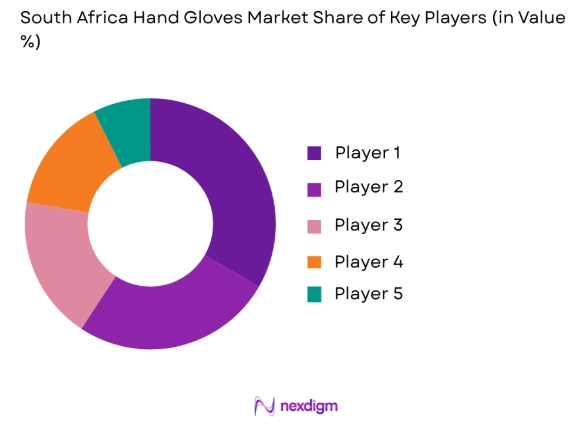
The South Africa hand gloves market is moderately fragmented, with a mix of international manufacturers and local distributors. Global players dominate due to advanced product offerings and strong supply chains, while local companies focus on distribution and cost competitiveness. The presence of large mining and industrial sectors attracts multiple suppliers, increasing competition in pricing and quality.
| Company | Establishment Year | Headquarters | Product Focus | Distribution Network | Key Industries Served | Import/Local Presence | Competitive Advantage |
| Ansell Limited | 1893 | Australia | ~ | ~ | ~ | ~ | ~ |
| Top Glove Corporation | 1991 | Malaysia | ~ | ~ | ~ | ~ | ~ |
| Hartalega Holdings | 1988 | Malaysia | ~ | ~ | ~ | ~ | ~ |
| 3M South Africa | 1902 | USA | ~ | ~ | ~ | ~ | ~ |
| BBF Safety Group | 2007 | South Africa | ~ | ~ | ~ | ~ | ~ |
South Africa Hand Gloves Market Analysis
Growth Drivers
Expansion of Healthcare Infrastructure and Medical Services
South Africa hand gloves demand is supported by recurring healthcare use across hospitals, laboratories, emergency units, clinics, and public health programmes. The National Department of Health reported new health facilities completed in 2024/25, including Siphethu Hospital in Eastern Cape, Ladysmith Clinic in KwaZulu-Natal, and Marikana Clinic in North West. The NHLS reported 64 SANAS-accredited laboratories under ISO 15189:2022, compared with 58 in the previous year, supporting laboratory glove demand. World Bank data records South Africa’s population at 64.0 million and GDP at USD 401.14 billion, indicating a large healthcare service base requiring gloves.
Rising Demand from Mining and Industrial Safety Applications
South Africa hand gloves demand is strongly linked to mining, manufacturing, construction, and industrial maintenance, where workers require cut-resistant, chemical-resistant, abrasion-resistant, and general protective gloves. Stats SA reported mining employment at 469,000 workers and manufacturing employment at 1,282,000 workers in Q4 2024. Construction employed 592,000 workers in Q2 2024, creating additional demand for safety gloves across worksites. DMRE data reported chrome production rising from 19,683 kilotons in 2023 to 22,897 kilotons in 2024, while chrome-sector employment reached 25,842 workers, supporting glove demand in extraction and processing environments.
Market Challenges
High Dependence on Imports
South Africa hand gloves market faces supply-chain exposure because a large part of rubber glove demand is import-served. World Bank WITS data shows South Africa imported 4,411,840 kg of vulcanized rubber gloves excluding surgical gloves in 2024. China supplied 2,671,700 kg, Malaysia supplied 1,137,110 kg, Thailand supplied 478,437 kg, Sri Lanka supplied 39,059 kg, and India supplied 43,423 kg. This import concentration matters for hospitals, mines, food processors, and factories because procurement can be affected by freight lead times, customs delays, foreign supplier availability, and exchange-rate movements against the rand.
Regulatory Compliance and Quality Standards
South Africa hand gloves suppliers must meet medical, occupational safety, and laboratory requirements because gloves are used in patient care, mining sites, food handling, laboratories, and industrial environments. The NHLS reported 64 SANAS-accredited laboratories under ISO 15189:2022 in 2023/24, indicating strict testing and quality expectations in medical diagnostics. The Department of Health continued transition to a web-based District Health Information System in 2023/24, strengthening monitoring and institutional reporting. In occupational environments, Stats SA recorded 469,000 mining employees and 1,282,000 manufacturing employees in Q4 2024, increasing compliance exposure for safety-related glove procurement.
Opportunities
Growth in Local Manufacturing and Distribution Networks
South Africa hand gloves suppliers have an opportunity to expand local distribution and regional supply networks because the country already exports rubber gloves to neighbouring African markets. World Bank WITS data shows Namibia imported 105,574 kg of South African vulcanized rubber gloves excluding surgical gloves in 2024, followed by Mozambique at 30,144 kg, Lesotho at 24,396 kg, Zimbabwe at 12,199 kg, and Angola at 6,199 kg. South Africa also exported surgical gloves to Namibia at 87,756 kg, Mozambique at 18,253 kg, Zimbabwe at 13,668 kg, and Lesotho at 12,310 kg, supporting regional distributor expansion.
Rising Adoption of Industrial Safety Gloves in Mining and Manufacturing
South Africa hand gloves suppliers have an opportunity in industrial safety gloves because mining, manufacturing, construction, and trade employ large workforces requiring protective equipment. Stats SA recorded manufacturing employment at 1,282,000 workers, mining employment at 469,000 workers, construction employment at 592,000 workers, and trade employment at 2,382,000 workers across 2024 quarterly releases. The Department of Mineral Resources and Energy reported chrome production of 22,897 kilotons and chrome-sector employment of 25,842 workers in 2024. These workforces operate in environments involving machinery, chemicals, minerals, packaging, logistics, and handling tasks, supporting demand for durable industrial gloves.
Future Outlook
Over the next five years, the South Africa hand gloves market is expected to grow steadily due to increasing healthcare demand, industrial expansion, and rising safety awareness. Government investments in healthcare infrastructure and improvements in public health services will boost demand for medical gloves.The mining and construction sectors will continue to drive demand for industrial safety gloves, while food processing and hospitality industries will support disposable glove consumption. Increasing adoption of nitrile gloves and advancements in protective equipment technology will further contribute to market growth.
Major Players
- Ansell Limited
- Top Glove Corporation
- Hartalega Holdings Berhad
- Kossan Rubber Industries
- Supermax Corporation
- Kimberly-Clark Corporation
- 3M South Africa
- Medicom Group
- Sempermed
- AMMEX Corporation
- BBF Safety Group
- Dromex
- Rebel Safety Gear
- North Safety Products Africa
- Uvex Safety South Africa
Key Target Audience
- Healthcare providers and hospital procurement departments
- Mining and industrial companies
- Food processing and hospitality businesses
- Construction companies
- Retail and wholesale distributors
- Investments and venture capitalist firms
- Government and regulatory bodies (Department of Health South Africa, South African Bureau of Standards)
- Occupational safety and compliance organizations
Research Methodology
Step 1: Identification of Key Variables
The initial phase involves mapping stakeholders in the South Africa hand gloves market, including manufacturers, distributors, healthcare providers, and industrial users. Secondary data sources such as government reports and trade statistics are used to identify key variables influencing market demand.
Step 2: Market Analysis and Construction
Historical data is analyzed to understand consumption patterns, industrial output, and healthcare utilization. The study evaluates glove usage across sectors to construct a reliable market model.
Step 3: Hypothesis Validation and Expert Consultation
Industry experts are consulted to validate assumptions and provide insights into market dynamics. These interactions help refine demand estimates and identify growth drivers.
Step 4: Research Synthesis and Final Output
The final phase integrates primary and secondary research findings to deliver a validated market assessment. Data triangulation ensures accuracy and consistency in the analysis.

- Executive Summary
- Research Methodology (Market Definitions and Assumptions, Abbreviations, Market Sizing Approach, Consolidated Research Approach,Understanding Market Potential Through In-Depth Industry Interviews, Primary Research Approach, Limitations and Future Conclusions)

- Definition and Scope
- Market Dynamics Overview
- Market Genesis
- Major Players and Market Timeline
- Business Cycle and Trends
- Supply Chain and Value Chain Analysis

- Growth Drivers
Expansion of Healthcare Infrastructure and Medical Services
Rising Demand from Mining and Industrial Safety Applications
Increasing Focus on Workplace Safety and Hygiene
Growth of Food Processing and Hospitality Sector - Market Challenges
High Dependence on Imports
Price Sensitivity and Competitive Market Structure
Fluctuations in Raw Material Supply
Regulatory Compliance and Quality Standards - Opportunities
Growth in Local Manufacturing and Distribution Networks
Increasing Demand for Nitrile and Powder-Free Gloves
Expansion of Healthcare Procurement and Medical Supply Chains
Rising Adoption of Industrial Safety Gloves in Mining and Manufacturing
- Key Trends
Shift Toward Nitrile and Synthetic Gloves Over Latex
Rising Demand for Disposable and Single-Use Gloves
Increasing Focus on Eco-Friendly and Biodegradable Gloves
Product Innovation Including Antimicrobial and High-Durability Gloves - Government Regulations
- SWOT Analysis
- Porter’s Five Forces

- By Value, 2020–2025
- By Volume, 2020–2025
- By Average Price, 2020–2025

- By Product Type (In Value %)
Disposable Gloves
Reusable Gloves
Surgical Gloves
Examination Gloves
Industrial Safety Gloves - By Material Type (In Value %)
Latex Gloves
Nitrile Gloves
Vinyl Gloves
Neoprene Gloves
Polyethylene Gloves - By Application (In Value %)
Healthcare
Industrial Manufacturing
Mining
Food Processing
Household and Cleaning - By Distribution Channel (In Value %)
Direct Sales
Distributors and Wholesalers
Retail Pharmacies
Online Channels - By Region (In Value %)
Gauteng
Western Cape
KwaZulu-Natal
Eastern Cape
Rest of South Africa

- Market Share of Major Players by Value/Volume
- Market Share of Major Players by Product Type
- Cross Comparison Parameters(Company Overview, Business Strategies, Recent Developments, Strength, Weakness, Organizational Structure, Revenues, Revenues by Product Type, Number of Touchpoints, Distribution Channels, Number of Dealers and Distributors, Margins, Production Plant, Capacity, Unique Value Offering and Others)
- SWOT Analysis of Major Players
- Pricing Analysis Based on Product Categories for Major Players
- Detailed Profiles of Major Companies
Ansell Limited
Top Glove Corporation
Hartalega Holdings Berhad
Kossan Rubber Industries
Supermax Corporation
Kimberly-Clark Corporation
3M South Africa
Medicom Group
Sempermed
AMMEX Corporation
BBF Safety Group
Dromex
Rebel Safety Gear
North Safety Products Africa
Uvex Safety South Africa

- Market Demand and Utilization
- Purchasing Power and Budget Allocations
- Regulatory and Compliance Requirements
- Needs, Desires, and Pain Point Analysis
- Decision-Making Process

- By Value, 2026–2035
- By Volume, 2026–2035
- By Average Price, 2026–2035


 Request a Sample
 Ask for Customization
 Get a Quote
 Enquire Now