

 Download PDF
Market Overview
The South Africa Hardware Stores Retail Market is valued at USD ~ billion, based on hardware and building materials revenue reported for the country. Demand is driven by building materials, DIY repairs, contractor purchases, electrical maintenance, plumbing supplies, tools, paints, waterproofing products and owner-builder activity. Retailers are supported by construction-linked consumption, with Cashbuild reporting ~ billion revenue and Massmart expanding Builders with 3 new stores across Hartbeespoort, Cherry Lane and Bethlehem. Gauteng, Western Cape and KwaZulu-Natal dominate the South Africa Hardware Stores Retail Market because they concentrate construction activity, income pools, urban housing stock, contractor density and organized retail networks. Gauteng remained the largest provincial economy, contributing 33.2% to national GDP, followed by KwaZulu-Natal at 16.2% and Western Cape at 14.0%. These provinces anchor demand from Johannesburg, Pretoria, Cape Town, Durban and surrounding industrial, residential and township construction clusters.
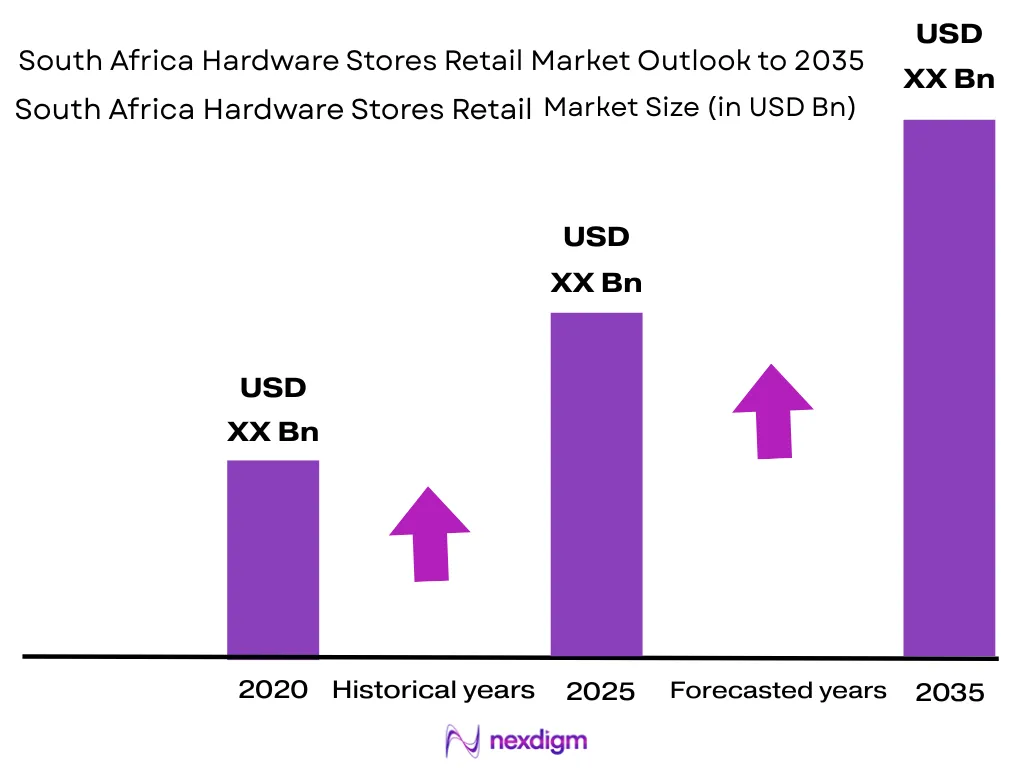
The South Africa Hardware Stores Retail Market is forecasted to grow at an estimated 4.8% CAGR during 2026-2035, supported by residential renovation, township building activity, independent hardware modernization, contractor procurement, solar-linked electrical products, online catalogue adoption and organized building-material retail expansion.
Market Segmentation
By Product Category
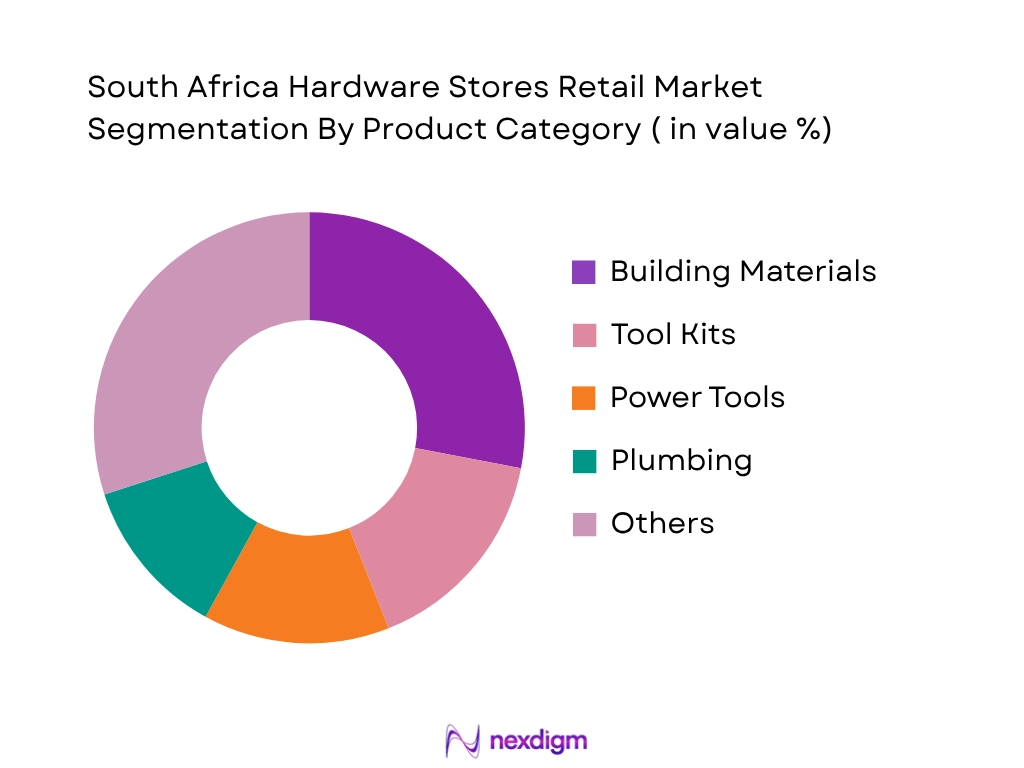
The South Africa Hardware Stores Retail Market is segmented by product category into building materials, hand tools, power tools, plumbing supplies, electrical hardware, paints, waterproofing, fasteners, safety products and garden hardware. Building materials hold the dominant market share because South Africa has a large owner-builder and contractor-led construction culture, particularly across townships, peri-urban areas and rural provinces. Cement, bricks, boards, timber, roofing sheets, sand, aggregates and plastering inputs are purchased frequently for home extensions, repairs and small building projects. Building-material chains such as Cashbuild and BUCO are positioned around owner-builders, small contractors and local trade buyers. This gives building materials a larger revenue pool than tools because bulk construction items have higher basket values and are repeatedly purchased during project phases.
By Store Format
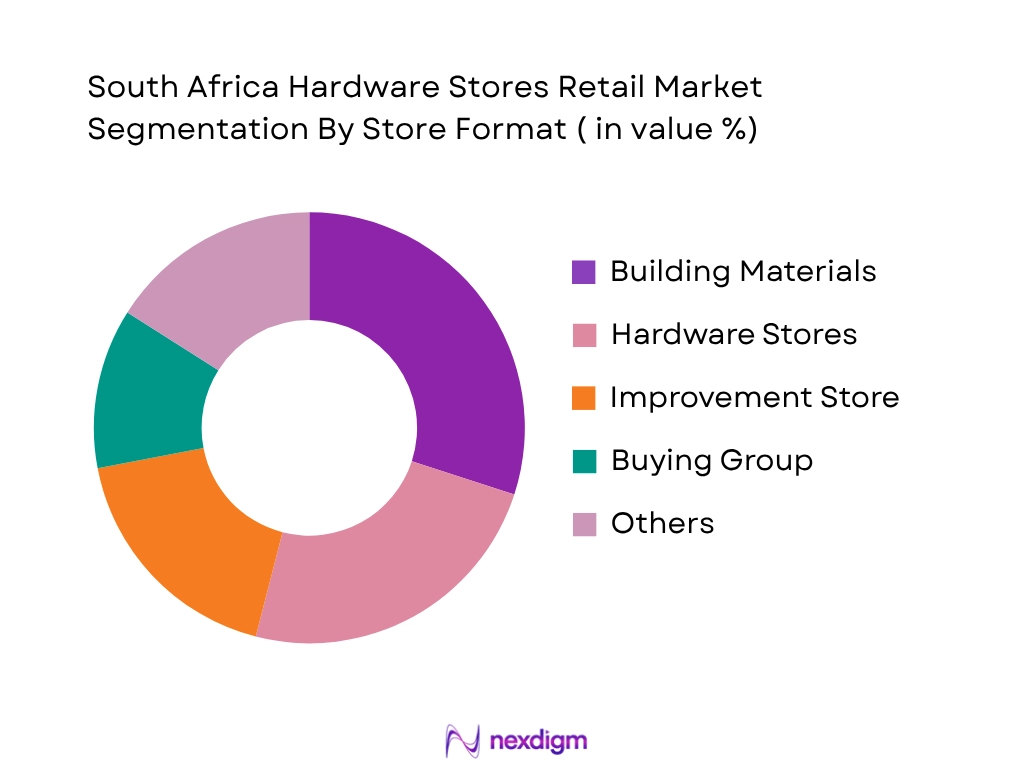
The South Africa Hardware Stores Retail Market is segmented by store format into building material retail chains, independent hardware stores, big-box home improvement stores, buying group stores, contractor trade counters, township and rural hardware stores, and online retailers. Building material retail chains dominate because they combine hardware, building supplies and contractor-focused fulfilment under one format. These stores are highly relevant to owner-builders and bakkie builders who need cement, roofing, timber, plumbing inputs, electrical basics and tools from a single outlet. Chains such as Cashbuild and BUCO also benefit from wider geographic coverage, formal supplier relationships, promotional buying power and store-level delivery capability. Independent hardware stores remain important in local catchments, but larger chains capture higher-value baskets through bulk construction materials and recurring project procurement.
Competitive Landscape
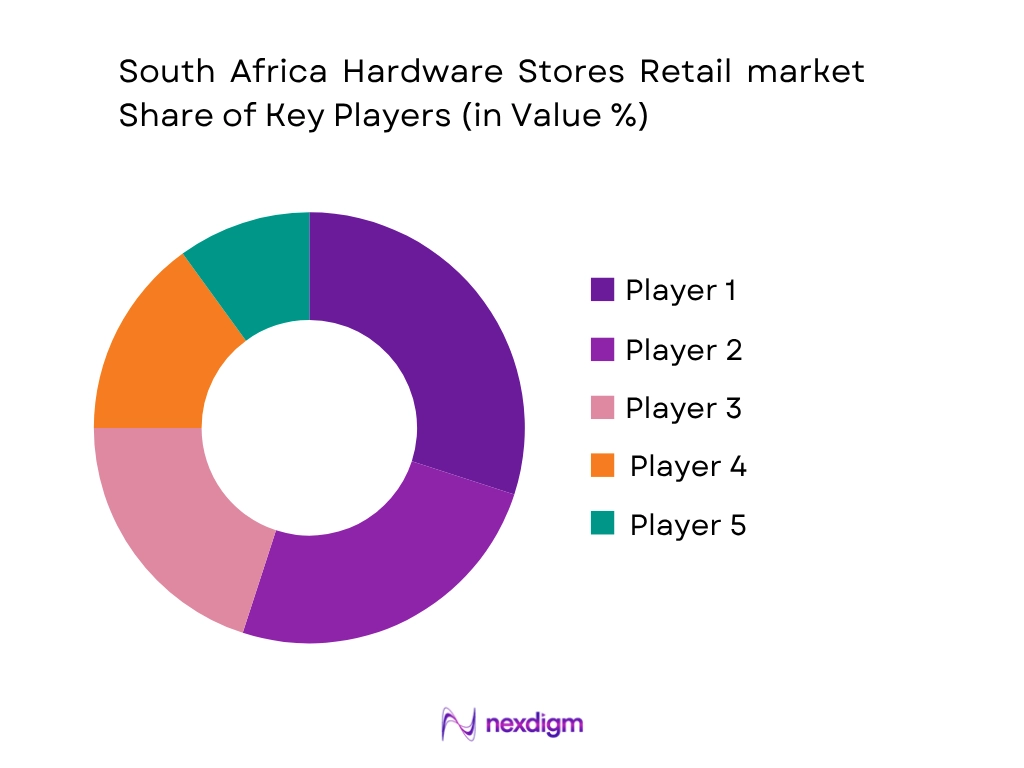
The South Africa Hardware Stores Retail Market is led by a mix of national building-material chains, big-box home improvement retailers, franchise networks, buying groups and regional specialists. Cashbuild, Builders, BUCO, Mica and Leroy Merlin serve overlapping but distinct customer bases. Cashbuild is strongly linked to owner-builders and contractors, Builders focuses on big-box DIY and home improvement, BUCO serves building materials and trade buyers, Mica supports independent franchise hardware retail, and Leroy Merlin targets large-format DIY and home improvement consumers. Massmart describes Builders as a Southern African leader in home improvement, DIY and building materials with warehouse, express and superstore formats supported by an online platform.
| Major Player | Establishment Year | Headquarters | Store / Format Positioning | Core Product Strength | Primary Customer Base | Online Presence | Delivery Capability | Market-Specific Differentiator |
| Cashbuild | 1986 | Johannesburg, South Africa | ~ | ~ | ~ | ~ | ~ | ~ |
| Builders | 2003 under Massmart category expansion | Sandton, South Africa | ~ | ~ | ~ | ~ | ~ | ~ |
| BUCO | 1993 | Cape Town, South Africa | ~ | ~ | ~ | ~ | ~ | ~ |
| Mica Hardware | 1983 | Johannesburg, South Africa | ~ | ~ | ~ | ~ | ~ | ~ |
| Leroy Merlin South Africa | 2018 | Johannesburg, South Africa | ~ | ~ | ~ | ~ | ~ | ~ |
South Africa Hardware Stores Retail Market Analysis
Growth Drivers
Residential Renovation and Building-Activity Pipeline
South Africa Hardware Stores Retail Market is supported by recurring residential repair, renovation and owner-builder activity, because hardware stores supply cement-linked inputs, roofing accessories, timber, plumbing fittings, electrical consumables, paints, sealants and hand tools used across small building projects. Statistics South Africa recorded 98,614,016 rand thousand in private-sector building plans passed at current prices, including 46,877,602 rand thousand for residential buildings, 23,653,935 rand thousand for non-residential buildings and 28,082,479 rand thousand for additions and alterations. These numbers are directly relevant to hardware retail because additions and alterations generate repeat purchases of lower-ticket but high-frequency SKUs such as fasteners, waterproofing, paint accessories, PVC fittings, door hardware and electrical replacement items. Completed-building activity also supports post-construction retail demand; larger municipalities reported 52,097,950 rand thousand in buildings completed, including 10,350,462 rand thousand for additions and alterations. This keeps demand active beyond new construction, as completed buildings require snagging, maintenance, finishing products and replacement hardware.
Trade, Construction and Urban Household Demand Base
South Africa Hardware Stores Retail Market benefits from a large employment and household-service ecosystem linked to construction, trade, real estate, repair and maintenance. Statistics South Africa recorded 17.1 million employed persons, 1.359 million people employed in construction and 3.421 million people employed in trade during Q4 2024. The same release states that trade covers wholesale and retail trade, repair of motor vehicles, motorcycles and personal and household goods, making it directly relevant to hardware-store operations and repair-led consumption. The World Bank recorded South Africa’s population at 64,007,187 and GDP per capita at USD 6,267.2, creating a wide urban and peri-urban consumer base for home repair, plumbing replacement, painting, garden maintenance and basic electrical work. Gauteng, Western Cape and KwaZulu-Natal remain core demand provinces because employment gains were recorded at 45,000, 62,000 and 52,000 respectively between Q3 and Q4 2024, supporting retail catchments around Johannesburg, Pretoria, Cape Town and Durban.
Market Challenges
Affordability Pressure and Weak Discretionary Repair Spending
South Africa Hardware Stores Retail Market faces affordability pressure because home improvement and DIY purchases compete with essential household spending. Statistics South Africa recorded 8.0 million unemployed persons in Q4 2024, even after a quarterly decrease of 20,000 people, while employed persons reached 17.1 million. This creates a narrow active-spending base for discretionary categories such as premium power tools, decorative paints, bathroom upgrades, garden hardware and renovation kits. World Bank data shows GDP per capita at USD 6,267.2 and national GDP at USD 401.14 billion, indicating that the economy has scale but household-level purchasing capacity remains uneven across provinces and income groups. Hardware retailers therefore depend heavily on essential repair categories and small-basket purchases rather than broad-based renovation upgrades. The challenge is more visible in independent stores and township outlets where consumers often buy project inputs incrementally. Retailers must maintain stock depth across economy tools, low-volume fasteners, plumbing spares and paint accessories while managing slow movement in higher-ticket branded products.
Construction Volatility and Stock Planning Risk
South Africa Hardware Stores Retail Market is exposed to construction-cycle volatility because building materials, plumbing hardware, electrical hardware, fasteners, roofing accessories and contractor tools move with project approvals and completions. Statistics South Africa recorded 98,614,016 rand thousand in building plans passed at current prices, down from 101,943,302 rand thousand in the previous comparable period. Residential building plans stood at 46,877,602 rand thousand, compared with 50,364,441 rand thousand, while additions and alterations stood at 28,082,479 rand thousand, compared with 29,689,902 rand thousand. The construction industry also decreased in Q4 2024, with decreases reported for residential and non-residential buildings, according to Stats SA’s GDP release. This creates risk for hardware retailers because demand for cement-linked consumables, roofing, timber, electrical basics and plumbing fittings can soften quickly when approvals slow. Stock planning becomes difficult across thousands of SKUs, especially where stores must hold multiple sizes, grades and brands for contractors and owner-builders while avoiding working-capital lock-up.
Market Opportunities
Additions, Alterations and Maintenance-Led Retail Expansion
South Africa Hardware Stores Retail Market has a strong opportunity in maintenance-led retail, especially in additions, alterations, repairs and finishing work. Statistics South Africa recorded 28,082,479 rand thousand in building plans passed for additions and alterations, and larger municipalities reported 10,350,462 rand thousand in completed additions and alterations. This supports future growth because additions and alterations create repeat demand for SKUs that are central to hardware-store profitability: paint, waterproofing, sealants, plumbing fittings, electrical accessories, door locks, fasteners, hand tools and small power-tool accessories. Unlike large new-build projects, maintenance-led purchases are spread across households, small contractors, bakkie builders, landlords, schools, clinics, retail properties and residential complexes. The opportunity is strongest for retailers with localized assortments, rapid replenishment, staff technical advice and delivery capability. Building completions also create after-sales demand; Stats SA recorded 29,707,430 rand thousand in completed residential buildings and 12,040,058 rand thousand in completed non-residential buildings. These completed assets require ongoing maintenance, supporting recurring store traffic.
Electrical Resilience and Solar-Linked Hardware Demand
South Africa Hardware Stores Retail Market has an opportunity in electrical resilience, backup-power accessories and solar-linked hardware. Hardware stores are positioned to supply extension leads, surge protection, cable, conduits, switches, brackets, mounting accessories, lighting components, PPE and installation consumables used by electricians, installers and households. Statistics South Africa recorded total electricity distribution of 212,952 gigawatt-hours and total electricity generation index value of 93.1 in 2024, compared with 206,201 gigawatt-hours distributed and an index value of 88.9 in 2023. The improvement in electricity availability supports retail footfall and operating continuity, while the earlier instability has already created consumer awareness around backup systems and electrical protection. World Bank data also records 64,007,187 people in South Africa, giving retailers a large addressable base for home-level electrical safety, repair and backup products. Retailers that build electrician-focused counters, stock compliant electrical accessories, bundle installation consumables and offer product guidance can capture recurring demand from households, SMEs, landlords and facility-maintenance buyers.
Future Outlook
The South Africa Hardware Stores Retail Market is expected to grow steadily through 2035, supported by home improvement, repair-led spending, township housing upgrades, contractor procurement and electrical resilience products. The forecasted CAGR for 2026-2035 is estimated at 4.8%, with organized retailers gaining from stronger procurement, store expansion, digital catalogues and value-focused private label ranges. Future market development will be shaped by three demand clusters. First, metro markets such as Johannesburg, Pretoria, Cape Town and Durban will support big-box retail, professional tool sales, online ordering and renovation demand. Second, township and peri-urban areas will continue to drive building materials, roofing, plumbing basics and informal contractor purchases. Third, rural and agricultural regions will sustain demand for fencing, pumps, irrigation hardware, workwear, roofing sheets, power tools and repair consumables. E-commerce will remain smaller than offline trade but will gain relevance in SKU discovery, click-and-collect, price comparison, tool accessories and repeat ordering. Retailers with strong physical availability, local delivery, trade credit, supplier-backed warranties and technical advice will outperform pure online models. Load-shedding-related product demand will also support electrical hardware, surge protection, backup lighting, solar accessories, batteries and installation consumables.
Major Players
- Builders
- Cashbuild
- BUCO
- Mica Hardware
- Leroy Merlin South Africa
- Build it
- Power Build
- Chamberlains
- Agrimark
- Brights Hardware
- Essential Hardware
- Timbercity
- Pennypinchers
- Gelmar
- DIY Depot
Key Target Audience
- Hardware store chains and building-material retailers
- Independent hardware store owners and franchise operators
- Power tool, hand tool and fastener manufacturers
- Paint, waterproofing and adhesive manufacturers
- Construction contractors and owner-builder suppliers
- Facility management and maintenance service providers
- Investments and venture capitalist firms
- Government and regulatory bodies, including Statistics South Africa, National Regulator for Compulsory Specifications, South African Bureau of Standards, Department of Trade, Industry and Competition, National Treasury and South African Revenue Service
Research Methodology
Step 1: Identification of Key Variables
The initial phase involves constructing an ecosystem map of the South Africa Hardware Stores Retail Market. This includes building-material retailers, DIY chains, independent hardware stores, buying groups, contractors, owner-builders, distributors, tool brands and e-commerce platforms. Key variables include product mix, store format, province-level demand, customer type, trade account usage, delivery model and SKU depth.
Step 2: Market Analysis and Construction
In this phase, historical and current data is compiled from retail trade indicators, company disclosures, construction activity, building-material demand, store expansion announcements and macroeconomic indicators. A top-down approach is used to benchmark the market against hardware and building-material retail revenue, while bottom-up modelling assesses revenue contribution by product category, store format and customer group.
Step 3: Hypothesis Validation and Expert Consultation
Market hypotheses are validated through interviews with hardware retailers, building-material distributors, contractors, plumbers, electricians, store managers and supplier representatives. These consultations help test assumptions related to basket size, category movement, contractor credit demand, private label adoption, online ordering, delivery expectations and regional differences between metro, township and rural hardware demand.
Step 4: Research Synthesis and Final Output
The final phase integrates secondary research, company disclosures, trade indicators and primary inputs into a structured market model. The output includes market sizing, segmentation, competitive benchmarking, future outlook and strategic recommendations. The final report is designed for decision-makers evaluating expansion, investment, product distribution, retail partnerships and channel strategy in South Africa’s hardware retail market.

- Executive Summary
- Research Methodology (Market Definitions and Assumptions, Abbreviations, Hardware Retail Scope, Building Materials Retail Scope, DIY and Contractor Boundary, Top-Down Market Sizing Approach, Bottom-Up Store Revenue Modelling, SKU-Level Price Benchmarking, Primary Interviews with Retailers/Contractors/Builders/Distributors, Supplier Channel Checks, Import Flow Review, Limitations and Future Conclusions)

- Definition and Scope
- Market Genesis and Evolution
- Timeline of Major Players
- Business Cycle
- Supply Chain and Value Chain Analysis

- Growth Drivers (Residential Renovation, Informal Housing Upgrades, Infrastructure Maintenance, Contractor Procurement, DIY Adoption, Solar and Electrical Repair Demand, Urbanization, Rural Building Materials Demand)
- Market Challenges (Weak Consumer Spending, High Unemployment, Import Cost Exposure, Counterfeit Tools, Stockouts, Municipal Project Delays, Crime and Shrinkage, Competition from Informal Retailers)
- Market Opportunities (Township Hardware Expansion, Rural Store Penetration, Contractor Loyalty Programs, Private Label Development, Solar-Linked Hardware, Online Catalogue Expansion, Credit-Based Trade Sales, Value Tool Ranges)
- Market Trends (Omnichannel Hardware Retail, Click-and-Collect, Store Modernization, Professional Tool Premiumization, Value Product Growth, Local Sourcing, Product Bundling, DIY Education)
- Government Regulation and Compliance (NRCS Product Standards, SABS Standards, Consumer Protection Act, Import Duties, Customs Compliance, Electrical Product Certification, Building Regulation Linkages, Occupational Safety Compliance)
- SWOT Analysis
- Porter’s Five Forces Analysis

- By Retail Revenue (2020-2025)
- By Number of Hardware Retail Outlets (2020-2025)
- By Average Revenue per Store (2020-2025)

- By Product Category (In Value %)
Building Materials
Hand Tools
Power Tools
Fasteners and Fixings
Plumbing Hardware - By Store Format (In Value %)
Big-Box Home Improvement Stores
Building Material Retail Chains
Independent Hardware Stores
Buying Group-Affiliated Stores
Contractor Trade Counters
- By Sales Channel (In Value %)
Walk-In Retail Sales
Trade Account Sales
E-Commerce and Retailer-Owned Websites
Marketplace-Led Hardware Sales
WhatsApp and Phone-Based Ordering - By Province (In Value %)
Gauteng
Western Cape
KwaZulu-Natal
Eastern Cape
Inland and Mining-Linked Provinces

- Market Share of Major Players (Retail Revenue, Store Count, Provincial Footprint, Category Sales, Contractor Account Base, Online Visibility)
- Cross Comparison Parameters (Store Footprint by Province, SKU Depth by Category, Contractor Account Penetration, Buying Group/Franchise Model, E-Commerce and Delivery Capability, Private Label Presence, Supplier and Brand Partnerships, After-Sales and Warranty Support)
- Pricing Analysis Basis Key Hardware SKUs (Cordless Drill, Angle Grinder, Screwdriver Set, Cement Bag, PVC Pipe, Electrical Cable, Silicone Sealant, Door Lock, Safety Boots, Interior Paint)
- SWOT Analysis of Major Players
- Detailed Profiles of Major Competitors
Builders
Cashbuild
BUCO
Mica Hardware
Leroy Merlin South Africa
Build it
Power Build
Chamberlains
Agrimark
Brights Hardware
Essential Hardware
Timbercity
Pennypinchers
Gelmar
DIY Depot

- DIY Customer Analysis
- Owner-Builder Analysis
- Contractor and Bakkie Builder Analysis
- Trade Professional Analysis
- Facility Maintenance Buyer Analysis

- By Retail Revenue (2026-2035)
- By Number of Hardware Retail Outlets (2026-2035)
- By Average Revenue per Store (2026-2035)


 Request a Sample
 Ask for Customization
 Get a Quote
 Enquire Now