

 Download PDF
Market Overview
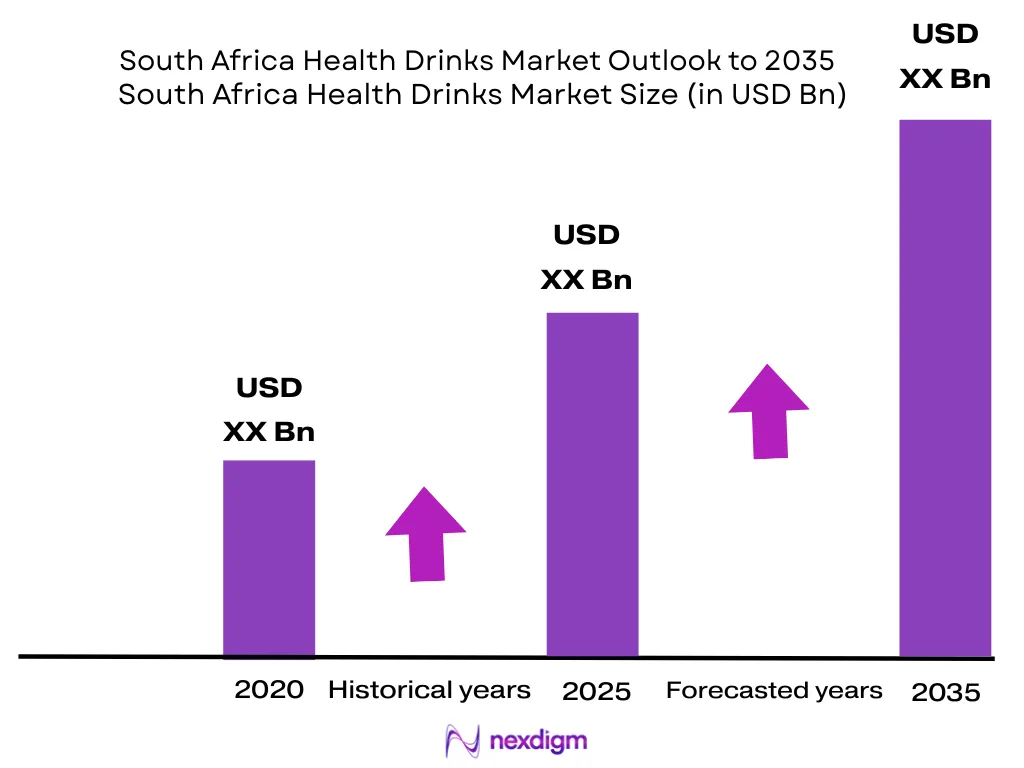
The South Africa Health Drinks Market is valued at USD ~ billion, back-cast from the disclosed South Africa functional drinks revenue of USD ~ million and the published forecast growth rate. Demand is driven by energy drinks, sports drinks, nutraceutical drinks, fortified beverages, and functional hydration. South Africa’s broader beverage market is valued at USD 19.8 billion, with health-oriented, low-sugar, and functional beverages identified as key growth categories. Gauteng, Western Cape, and KwaZulu-Natal dominate the South Africa Health Drinks Market because they concentrate formal retail, gyms, universities, offices, tourism, and high-frequency convenience consumption. Stats SA estimates South Africa’s population at 63.02 million, with Gauteng holding the largest population base, followed by KwaZulu-Natal and Western Cape. Tourism also supports Cape Town, Johannesburg, and Durban demand, with South Africa receiving 8.9 million tourist arrivals, including 6.8 million from Africa.
Market Segmentation
Product Type
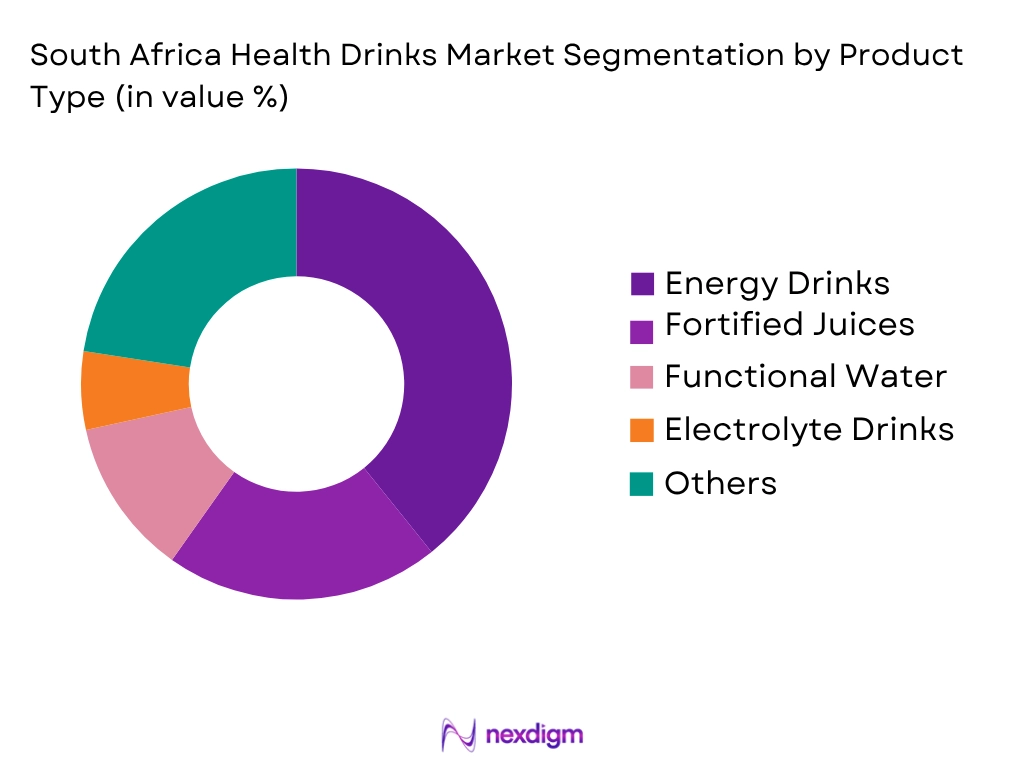
South Africa Health Drinks Market is segmented by product type into energy drinks, sports drinks, fortified juices, dairy-based health drinks, functional water, protein RTD drinks, kombucha and probiotic drinks, and plant-based functional beverages. Energy drinks hold the dominant market share in South Africa under product type segmentation because they have strong penetration across forecourts, convenience stores, supermarkets, universities, informal retail, and on-the-go commuter channels. The category is supported by major brands such as Red Bull, Monster, Switch, Dragon, Score, and Play, while global report coverage identifies energy drinks and shots as the largest functional-drinks type in South Africa. The dominance is also supported by affordability through single-serve cans, high brand recall among young adults, sugar-free product extensions, and impulse-led chilled availability. Sports drinks and electrolyte products remain important, but they are more occasion-specific and concentrated around gym, school sports, endurance events, and pharmacy-led hydration needs.
By Distribution Channel
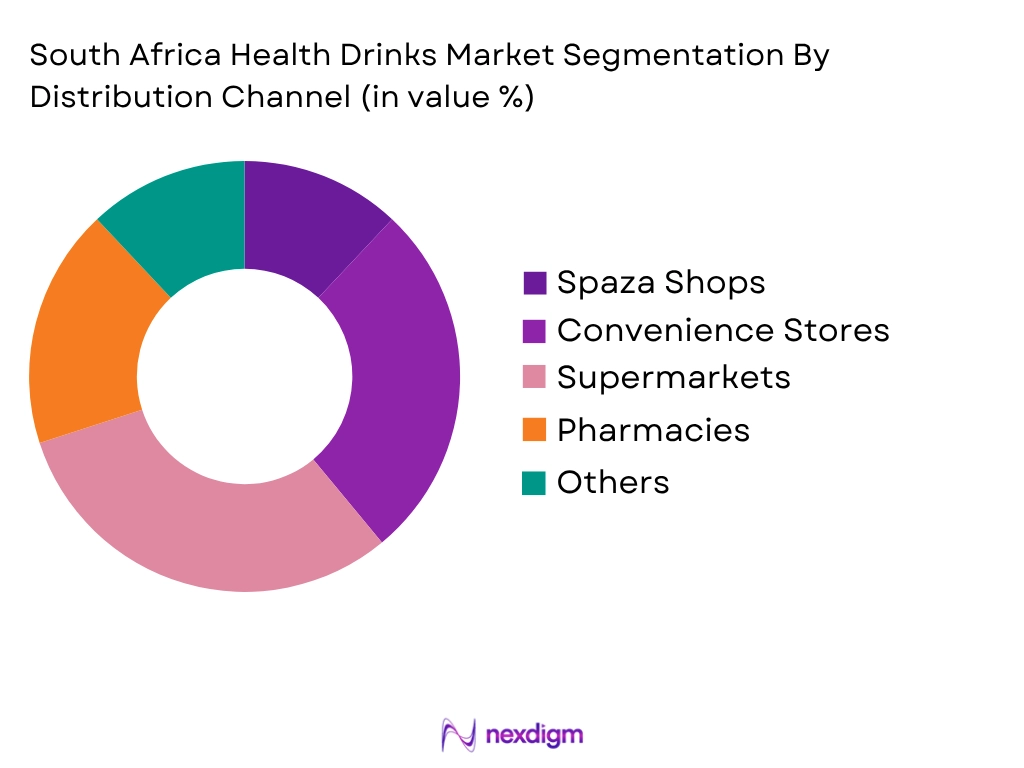
South Africa Health Drinks Market is segmented by distribution channel into supermarkets and hypermarkets, convenience stores and petrol stations, spaza shops and informal retail, pharmacies and health stores, gyms and sports clubs, online grocery, and HoReCa. Supermarkets and hypermarkets dominate the market share under distribution channel segmentation because major chains such as Shoprite, Checkers, Pick n Pay, Woolworths, Spar, and Makro offer broad chilled beverage space, multipack promotions, private-label visibility, and household replenishment. Stats SA reported that general dealers, which include supermarkets, were the largest positive contributor to annual retail trade growth, supporting their role in beverage distribution. Modern grocery also provides better category blocking for fortified juices, sports drinks, protein beverages, functional water, and dairy-based health drinks. Convenience stores and petrol stations remain strong for energy drinks, while spaza shops support low-price, high-frequency township consumption.
Competitive Landscape
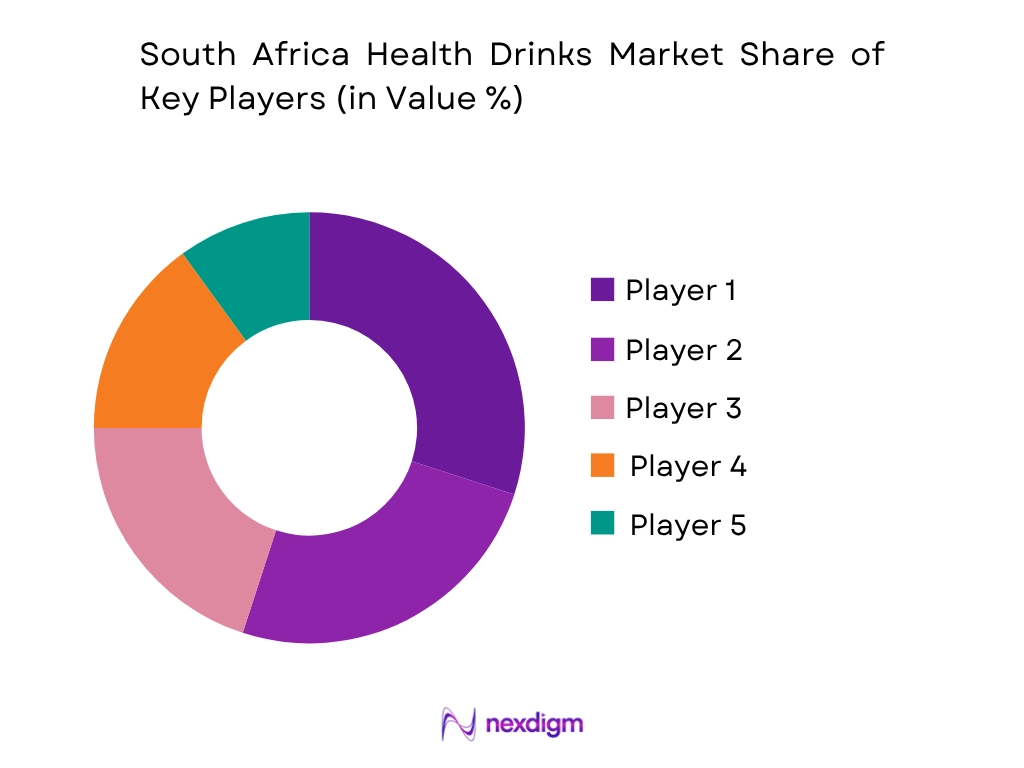
The South Africa Health Drinks Market is led by a mix of global beverage multinationals, domestic FMCG companies, dairy beverage producers, sports nutrition brands, and specialist wellness players. Coca-Cola Beverages South Africa, Red Bull, Monster, Tiger Brands, and Clover have strong influence due to their brand portfolios, chilled distribution, formal retail access, and category leadership across energy, sports hydration, fortified juice, dairy wellness, and functional beverage occasions. The market remains competitive because mass-market brands compete on affordability and visibility, while premium brands compete through sugar-free, protein, probiotic, and clean-label positioning.
| Company | Establishment Year | Headquarters | Key Health Drinks Portfolio | Functional Positioning | Core Channel Strength | Sugar-Free / Low-Sugar Strength | Packaging Strength | South Africa Competitive Advantage |
| Coca-Cola Beverages South Africa | 2016 | Clayville, Gauteng | ~ | ~ | ~ | ~ | ~ | ~ |
| Red Bull South Africa | 1987 | Austria / South Africa operations | ~ | ~ | ~ | ~ | ~ | ~ |
| Monster Beverage Corporation | 1935 / Monster brand 2002 | Corona, California | ~ | ~ | ~ | ~ | ~ | ~ |
| Tiger Brands | 1921 | Midrand, Gauteng | ~ | ~ | ~ | ~ | ~ | ~ |
| Clover South Africa | 1898 | Roodepoort, Gauteng | ~ | ~ | ~ | ~ | ~ | ~ |
South Africa Health Drinks Market Analysis
Growth Drivers
Large urban consumer base supports routine consumption of energy, fortified, hydration and wellness beverages
South Africa Health Drinks Market is supported by a large resident base and concentrated urban consumption corridors where supermarkets, forecourts, pharmacies, gyms and convenience retail operate at scale. South Africa’s mid-year population is estimated at 63.02 million people, creating a broad consumer base for daily hydration, energy, fortified juice, functional dairy and protein-based beverages. The World Bank records South Africa’s GDP at USD 401.14 billion and GDP per capita at USD 6,267.2, indicating a sizeable formal consumer economy for packaged beverages, especially in Gauteng, Western Cape and KwaZulu-Natal. Gauteng has the largest provincial population, followed by KwaZulu-Natal, Western Cape and Eastern Cape, making these regions central for beverage manufacturers and distributors targeting high-density retail, workplace, university and transport-node consumption. For health drinks, this supports single-serve energy drinks, fortified juices, sports hydration, functional water and dairy-based wellness drinks across modern grocery, forecourts and informal retail.
Formal retail and wholesale networks strengthen availability across mass and premium beverage channels
South Africa Health Drinks Market benefits from a dual distribution structure where modern grocery supports household replenishment and wholesalers support informal retail, spaza shops and independent traders. Stats SA reported that retail trade sales increased in December, with general dealers contributing positively; general dealers are critical for health drinks because supermarkets and large-format stores sell energy drinks, fortified juices, sports drinks, dairy-based wellness drinks, functional water and multipacks. Wholesale trade also remains important for township and independent-retail beverage penetration: SARS reported December merchandise trade with R144.5 billion in exports and R139.3 billion in imports, reflecting the scale of formal trade flows supporting packaged-goods supply chains. Stats SA also recorded wholesale trade sales improving in December after changes in the preceding months, which matters because cash-and-carry and wholesale networks are essential for beverage movement into spaza shops, taverns, forecourts and small grocery outlets. This channel depth supports both affordable energy drinks and premium wellness SKUs.
Market Challenges
Sugar-linked regulation increases formulation and compliance burden for beverage brands
South Africa Health Drinks Market faces a structural challenge from the Health Promotion Levy, which directly affects sweetened beverages, including many energy drinks, fortified beverages, flavored waters and juice-based health drinks. SARS states that the levy is calculated on sugar content exceeding 4 grams per 100ml, while the first 4 grams per 100ml are levy-free. SARS also states that the levy rate is fixed at 2.1 cents per gram of sugar content above the levy-free threshold. For beverage manufacturers, this creates product-level pressure to reformulate recipes, adjust sweetener systems, validate sugar content, maintain accurate labels and manage documentation for locally produced and imported drinks. National Treasury’s response document also records that there was no increase in the Health Promotion Levy for 2023/24 and 2024/25, while consultations covered lowering the 4-gram threshold and extending the levy to pure fruit juices. This creates uncertainty for brands developing fortified juices, energy drinks, functional waters and low-sugar health beverages.
Affordability pressure limits premium health drink adoption outside upper-income and urban channels
South Africa Health Drinks Market faces affordability pressure because a large share of consumers operate under constrained income and employment conditions, which affects adoption of premium kombucha, protein RTDs, functional water, plant-based beverages and imported energy drinks. Stats SA’s labour force data shows the number of unemployed people at 8.0 million in the fourth quarter, while government reporting shows employed persons decreased from 17.1 million to 16.8 million in the following quarter. Youth affordability is also relevant for energy drinks and sports hydration, as the Presidency reported 4.7 million unemployed youths and 5.8 million employed youths in the fourth quarter. The World Bank records GDP per capita at USD 6,267.2, which is materially below high-income beverage markets and reinforces the need for small packs, multipacks, entry-level energy brands and value-led functional beverages. This makes premiumization uneven across Gauteng, Western Cape, KwaZulu-Natal and township retail.
Market Opportunities
Tourism and foodservice recovery create stronger placement opportunities for premium and on-the-go health drinks
South Africa Health Drinks Market has a strong opportunity in tourism-linked consumption because airports, hotels, cafés, restaurants, events, safari destinations and coastal leisure corridors create high-frequency demand for bottled hydration, energy drinks, functional water, fortified juices, kombucha and protein beverages. South Africa recorded 8.92 million tourist arrivals, supported by government tourism reporting based on Stats SA data. South African Tourism’s performance report also records 8.9 million international arrivals and 6.8 million arrivals from Africa, indicating both regional and overseas demand for packaged beverages across travel retail and hospitality channels. Stats SA later reported tourism recovery to 10.5 million tourists, confirming that the travel-consumption base continues to support out-of-home beverage occasions. Accommodation demand also matters: Stats SA reported accommodation income rising from R14.0 billion to R37.4 billion between 2020 and 2024. This supports health-drink placement in hotel minibars, breakfast counters, gyms, cafés, forecourts and tourist retail.
Fitness, hydration and wellness positioning can scale through pharmacies, gyms, grocery and township formats
South Africa Health Drinks Market has an opportunity to expand through fitness, hydration and wellness products that bridge premium and mass-market demand. The country’s population of 63.02 million people provides scale for everyday functional beverages, while provincial concentration in Gauteng, KwaZulu-Natal and Western Cape gives brands clear rollout priorities for gyms, pharmacies, supermarkets, forecourts and spaza-linked wholesale supply. The opportunity is also supported by improving tourism and foodservice activity, with Stats SA reporting R37.4 billion in accommodation income and government reporting 8.92 million tourist arrivals, which create demand for on-the-go hydration and recovery drinks. Regulatory pressure further supports low-sugar innovation because SARS applies the sugar levy above 4 grams per 100ml, making zero-sugar energy drinks, electrolyte sachets, functional water, reduced-sugar fortified juices and protein RTDs commercially relevant. Brands that combine affordable pack architecture with credible health claims can serve both supermarket and informal-retail demand.
Future Outlook
The South Africa Health Drinks Market is forecasted to grow at a CAGR of around 8.0% during 2026-2035, supported by the published South Africa functional beverages forecast band and country-level functional drinks growth indicators. The market is expected to expand through zero-sugar energy drinks, electrolyte hydration, protein RTDs, fortified dairy beverages, probiotic drinks, and functional water. Future growth will depend on affordability, Health Promotion Levy-led reformulation, stronger township distribution, and chilled retail reliability. Online grocery and gym-linked distribution will also become more relevant for premium wellness beverages. South Africa’s future health drinks demand will be shaped by two parallel markets. The first is the mass-market channel, where consumers purchase energy drinks, fortified juices, electrolyte beverages, and dairy-based health drinks through supermarkets, wholesalers, spaza shops, and forecourts. The second is the premium wellness channel, where consumers buy kombucha, functional water, plant-based beverages, protein RTDs, and low-sugar drinks through Woolworths, Checkers, pharmacies, gyms, online grocery, cafés, and health retailers. Regulation will remain central. South Africa’s Health Promotion Levy continues to pressure high-sugar beverage portfolios, encouraging brands to reformulate, reduce sugar content, introduce non-nutritive sweeteners, and build “zero sugar” ranges. This will particularly affect energy drinks, fortified juices, sports drinks, dairy-based beverages, and fruit-based wellness drinks. Companies with strong R&D, local bottling, and flexible pack sizes will have a stronger position than import-dependent niche players. The route-to-market will also become more sophisticated. Modern grocery will continue to dominate household replenishment, but petrol stations, spaza shops, gyms, pharmacies, and e-commerce will each serve different consumption occasions. Brands that can build a complete channel strategy across single cans, PET bottles, cartons, sachets, and multipacks will be better placed to address South Africa’s income diversity and regional consumption differences.
Major Players
- Coca-Cola Beverages South Africa
- Red Bull South Africa
- Monster Beverage Corporation
- PepsiCo South Africa
- Tiger Brands
- Clover South Africa
- Danone Southern Africa
- Rhodes Food Group
- Pioneer Foods
- Nestlé South Africa
- USN South Africa
- Biogen
- Switch Energy Drink
- BOS Brands
- Faithful to Nature / Wellness Beverage Portfolio
Key Target Audience
- Health drink manufacturers and brand owners
- Beverage importers and distributors
- Supermarket, hypermarket, and wholesale retail chains
- Petrol station and forecourt retail operators
- Spaza retail aggregators and cash-and-carry operators
- Gyms, sports clubs, pharmacies, and wellness retailers
- Investments and venture capitalist firms
- Government and regulatory bodies (South African Revenue Service, National Treasury, Department of Health, Department of Trade, Industry and Competition, South African Bureau of Standards, National Consumer Commission)
Research Methodology
Step 1: Identification of Key Variables
The initial phase involves constructing an ecosystem map of the South Africa Health Drinks Market, covering brand owners, bottlers, importers, distributors, retailers, spaza wholesalers, gyms, pharmacies, cafés, and regulators. Key variables include product type, functionality claim, sugar content, pack size, Health Promotion Levy exposure, route-to-market, and chilled distribution dependency.
Step 2: Market Analysis and Construction
In this phase, historical market data is compiled using top-to-bottom analysis of functional drinks, non-alcoholic beverages, retail food sales, population indicators, tourism flows, and formal retail performance. Bottom-to-top validation is conducted through SKU benchmarking across energy drinks, sports drinks, fortified juices, functional water, dairy-based health drinks, and protein RTDs.
Step 3: Hypothesis Validation and Expert Consultation
Market hypotheses are validated through structured interviews with beverage distributors, supermarket category managers, forecourt retailers, gym operators, pharmacy buyers, importers, and local beverage manufacturers. These interviews help assess sell-through patterns, channel margins, seasonality, pack preferences, informal retail reach, and consumer response to low-sugar and functional claims.
Step 4: Research Synthesis and Final Output
The final phase combines secondary research, primary interviews, regulatory review, retail price checks, and channel-level triangulation. This synthesis generates the final market size, segmentation, competitive landscape, forecast outlook, and strategic recommendations for market entry, reformulation, distribution expansion, and product portfolio prioritization in the South Africa Health Drinks Market.

- Executive Summary
- Research Methodology (Market Definitions and Assumptions, Health Drinks Inclusion and Exclusion Criteria, Abbreviations, Top-to-Bottom Market Sizing, Bottom-to-Top SKU Build-Up, Beverage Category Mapping, Retail Shelf Audit, Distributor Interviews, Spaza and Informal Trade Checks, Gym and Pharmacy Channel Validation, Online Grocery Price Tracking, Sugar Tax Impact Review, Competitive Benchmarking, Limitations and Future Conclusions)

- Definition and Scope
- Overview Genesis
- Health Drinks Category Boundary
- Timeline of Major Players
- Business Cycle

- Growth Drivers (Urbanization, Health Awareness, Energy Drink Penetration, Gym Culture, Hot-Weather Hydration, Modern Grocery Reach, Informal Retail Availability)
- Market Challenges (Affordability Constraints, Sugar Tax Compliance, Load-Shedding Impact, Cold Chain Gaps, Import Cost Exposure, Counterfeit and Parallel Trade Risk)
- Opportunities (Zero Sugar Energy, Electrolyte Sachets, Affordable Protein RTD, Township Distribution, Functional Dairy Innovation, Local Flavor Development, Online Replenishment)
- Market Trends (Sugar-Free Migration, Functional Caffeine, Vitamin Fortification, Electrolyte Hydration, Probiotic Dairy, Multipack Grocery, Wellness Claims, Local Flavors)
- SWOT Analysis
- PESTLE Analysis
- Porter’s Five Forces Analysis

- By Value (2020-2025)
- By Volume (2020-2025)
- By Average Selling Price (2020-2025)

- By Product Type (In Value %)
Energy Drinks
Sports and Electrolyte Drinks
Functional and Enhanced Water
Fortified Juices and Nectar-Based Health Drinks
Dairy-Based Health Drinks - By Packaging Format (In Value %)
Cans
PET Bottles
Cartons and Tetra Packs
Glass Bottles
Sachets and Powder Sticks - By Distribution Channel (In Value %)
Supermarkets and Hypermarkets
Convenience Stores and Petrol Stations
Spaza Shops and Informal Trade
Wholesale and Cash-and-Carry
Pharmacies and Health Stores - By Region (In Value %)
Gauteng
Western Cape
KwaZulu-Natal
Eastern Cape
Other Provinces

- Market Share of Major Players on the Basis of Value and Volume
- Cross Comparison Parameters (Functional Product Portfolio Breadth, Sugar-Free SKU Penetration, Health Promotion Levy Exposure, Local Bottling and Co-Packing Strength, Informal Trade Reach, Chilled Distribution Capability, Gym and Sports Channel Presence, Price-Pack Architecture)
- SWOT Analysis of Major Players
- Pricing Analysis Basis SKUs for Major Players
- Detailed Profiles of Major Companies
Coca-Cola Beverages South Africa
Red Bull South Africa
Monster Beverage Corporation
PepsiCo South Africa
Tiger Brands
Clover South Africa
Danone Southern Africa
Rhodes Food Group
Pioneer Foods
Nestlé South Africa
USN South Africa
Biogen
Switch Energy Drink
BOS Brands
Faithful to Nature / Wellness Beverage Portfolio

- Students and Young Adults
- Office Professionals and Commuters
- Fitness Enthusiasts and Athletes
- Families and Household Buyers
- Township and Informal Trade Consumers

- By Value (2026-2035)
- By Volume (2026-2035)
- By Average Selling Price (2026-2035)


 Request a Sample
 Ask for Customization
 Get a Quote
 Enquire Now