
 Download PDF
Market Overview
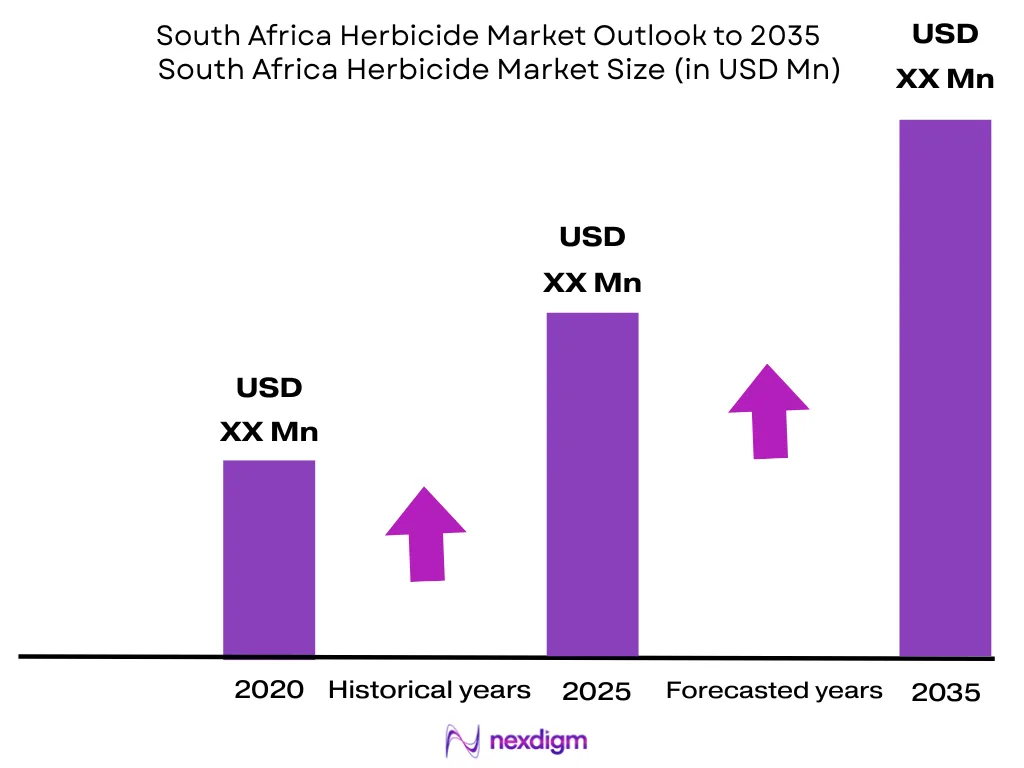
The South Africa Herbicide Market is valued at USD ~million, derived from Grand View Research’s South Africa herbicides revenue base of USD ~ million and its reported country CAGR of 5.0% for the same herbicide market. Demand is driven by maize, soybean, wheat, sugarcane, citrus and vineyard systems. South Africa’s commercial agriculture produced 13.4 million tons of maize and 9.6 million tons of sugarcane, supporting recurring weed-control demand. Free State, Mpumalanga, North West, KwaZulu-Natal, Western Cape and Limpopo dominate the South Africa Herbicide Market due to crop concentration and commercial farming intensity. Free State, Mpumalanga and North West are central to maize and soybean herbicide programs; KwaZulu-Natal supports sugarcane and forestry weed control; Western Cape drives wheat, canola and vineyard demand; Limpopo supports citrus and irrigated horticulture. The official crop estimate placed wheat at 1.9 MMT and soybean at 1.848 million tons.
Market Segmentation
By Crop Type
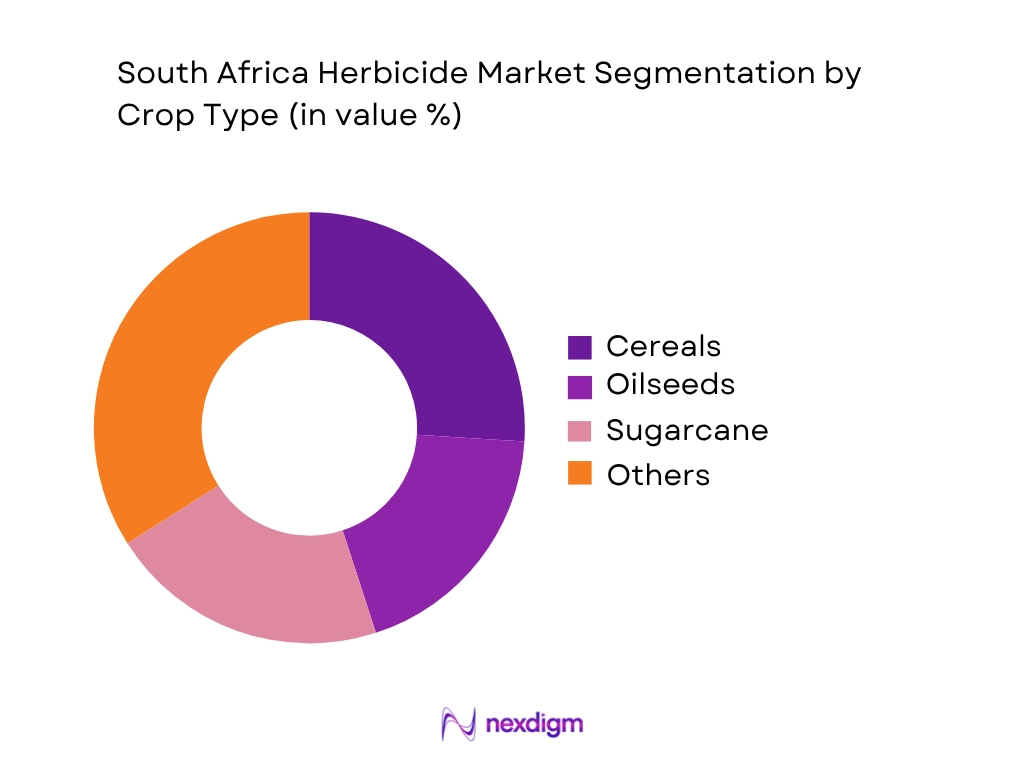
South Africa Herbicide Market is segmented by crop type into cereals & grains, oilseeds & pulses, sugarcane, fruits, citrus & vineyards, vegetables & horticulture, and forestry & non-crop areas. Recently, cereals & grains have a dominant market share in South Africa under crop type segmentation, driven by the country’s large maize and wheat base. Maize is the country’s principal field crop, while wheat remains an important winter crop in the Western Cape and other producing provinces. Herbicides are widely used in maize for pre-emergence residual programs, post-emergence grass and broadleaf control, and glyphosate-tolerant crop systems. The dominance of cereals is also linked to mechanised commercial farms, larger field sizes, no-till practices and the need to protect yield during early crop establishment.
By Herbicide Type
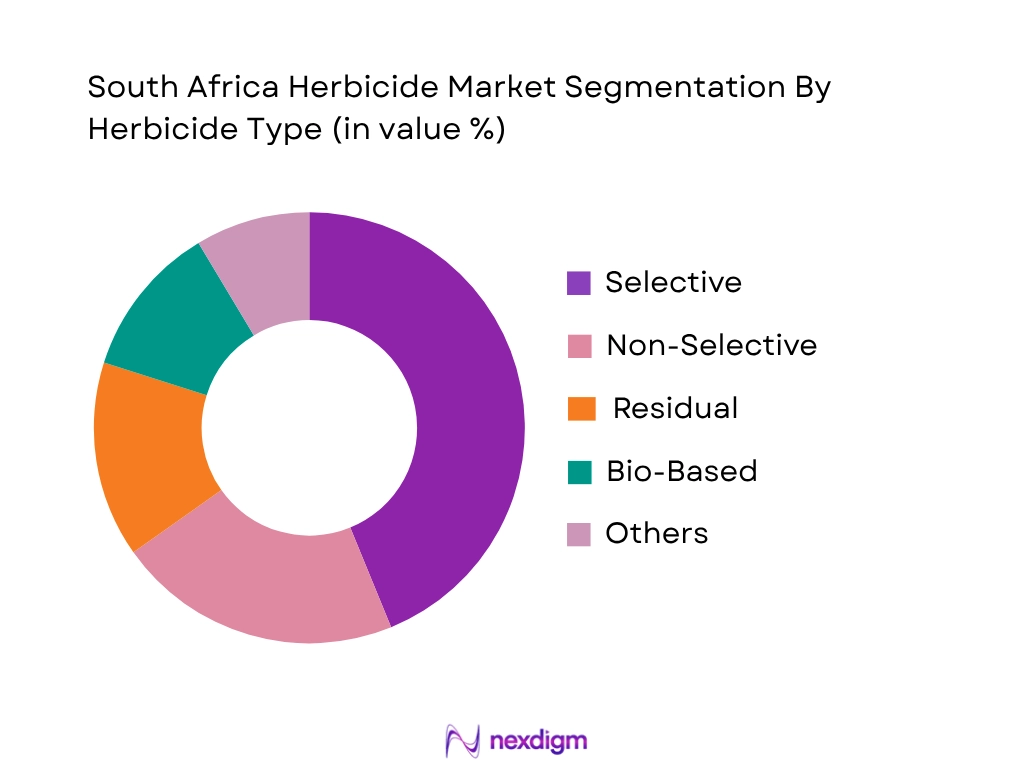
South Africa Herbicide Market is segmented by herbicide type into non-selective herbicides, selective herbicides, residual herbicides, contact herbicides, industrial vegetation management herbicides, and bio-based & other herbicides. Recently, non-selective herbicides have a dominant market share in South Africa under herbicide type segmentation due to the widespread role of glyphosate in no-till, conservation agriculture, fallow weed control, pre-plant burn-down, orchard floor management and vineyard inter-row weed control. Glyphosate-tolerant maize and soybean systems have historically supported broad non-selective use, while commercial farmers rely on large boom-sprayer programs before and during crop-establishment windows. Non-selective herbicides also serve non-crop areas such as rail corridors, fence lines, mining sites and utility infrastructure, making the segment less dependent on one crop cycle.
Competitive Landscape
The South Africa Herbicide Market is served by multinational crop-protection companies, domestic formulators, generic importers, agricultural co-operatives and professional distributors. The market is regulated under Act 36 of 1947, where agricultural remedies must be registered before import, sale or use. Most active ingredients are imported, especially from China, creating strong roles for companies with registration depth, distribution access, technical support and local formulation capability.
| Company | Establishment Year | Headquarters | Herbicide Portfolio Focus | Key Crop Focus | Distribution Strength | Registration Position | Technical Support | Strategic Positioning |
| Bayer CropScience South Africa | 1863 | Leverkusen, Germany | ~ | ~ | ~ | ~ | ~ | ~ |
| Syngenta South Africa | 2000 | Basel, Switzerland | ~ | ~ | ~ | ~ | ~ | ~ |
| BASF South Africa | 1865 | Ludwigshafen, Germany | ~ | ~ | ~ | ~ | ~ | ~ |
| ADAMA South Africa | 1945 | Airport City, Israel | ~ | ~ | ~ | ~ | ~ | ~ |
| Villa Crop Protection | 1994 | Johannesburg, South Africa | ~ | ~ | ~ | ~ | ~ | ~ |
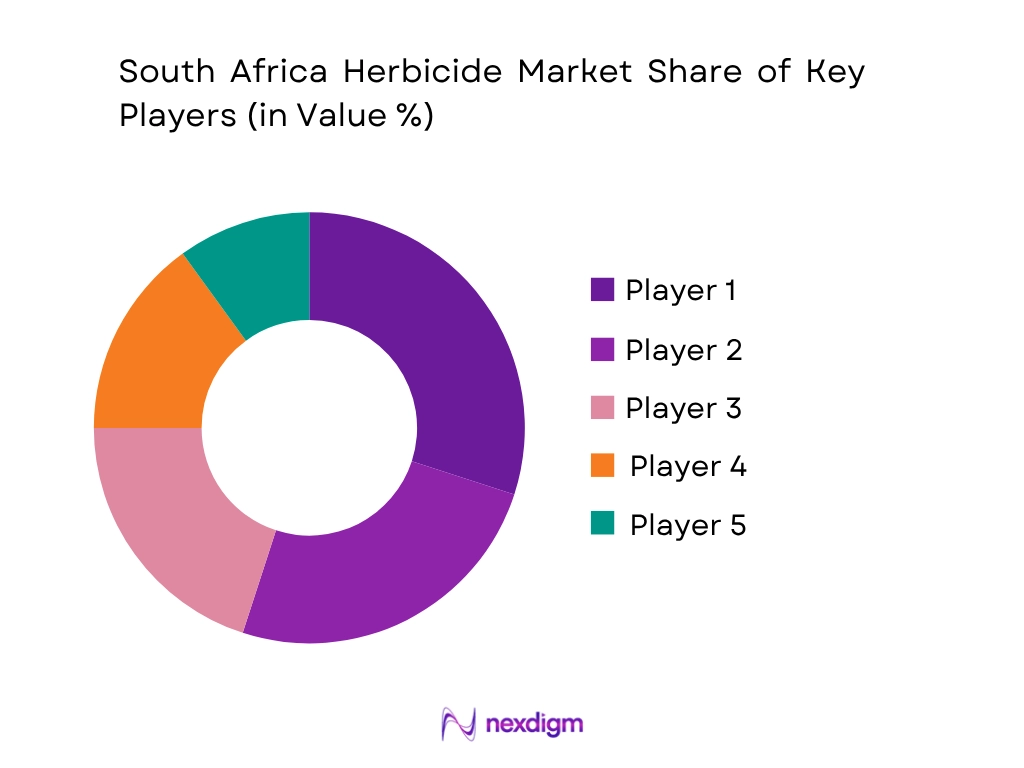
South Africa Herbicide Market Analysis
Growth Drivers
Large Maize and Soybean Base Supporting Broadacre Herbicide Use
South Africa Herbicide Market is supported by broadacre maize and soybean farming, where growers require pre-plant burn-down, pre-emergence residuals and post-emergence grass and broadleaf control. The Department of Agriculture’s Crop Estimates Committee finalised commercial maize output at 12,850,000 tons and soybean output at 1,848,000 tons for the 2024 production season; the 2025 final figures rose to 16,650,000 tons of maize and 2,800,000 tons of soybeans, expanding the field base for herbicide programmes. World Bank data places South Africa’s GDP at USD 401.14 billion and GDP per capita at USD 6,267.2, supporting commercial input procurement in mechanised farming systems. This is market-specific because maize and soybean production areas rely on glyphosate, atrazine, S-metolachlor, acetochlor, mesotrione and other residual herbicides to manage early weed competition.
Winter Cereals and Crop Rotation Creating Multi-Season Weed-Control Demand
South Africa Herbicide Market is strengthened by winter cereals and oilseed rotation systems, especially in the Western Cape, Free State and Northern Cape, where wheat, barley and canola require seasonal broadleaf and grass weed-control programmes. The Crop Estimates Liaison Committee finalised 2024 winter cereals at 505,300 hectares and 1,930,000 tons for wheat, 100,700 hectares and 372,250 tons for barley, and 165,750 hectares and 290,400 tons for canola. World Bank-linked data reports agriculture, forestry and fishing value added at USD 11,693,737,076 for South Africa, reinforcing the economic relevance of crop protection within the farming sector. These rotation systems support demand for selective herbicides, ALS inhibitors, ACCase inhibitors, phenoxy herbicides and low-drift formulations because growers must manage crop safety, resistance risk and carryover issues across maize-soybean-wheat-canola rotations.
Market Challenges
Drought and Weather Volatility Disrupt Herbicide Performance and Crop Planning
South Africa Herbicide Market faces weather-linked volatility because pre-emergence herbicides depend on soil moisture and rainfall activation, while drought can reduce planted area, crop vigour and farmer input intensity. The Department of Agriculture reported that field crop production volume decreased during 2023/24, mainly due to lower summer crops such as maize and oilseeds such as sunflower seed and soybeans. The final 2024 commercial maize crop was 12,850,000 tons, far below the previous season’s 16,430,000 tons, while soybean output fell to 1,848,000 tons from 2,770,000 tons. IMF also noted that severe droughts kept activity subdued in 2024. With South Africa’s GDP at USD 401.14 billion and population around 63 million, weather shocks affect a large food and input economy.
Act 36 Compliance and Restricted Product Controls Raise Formal Market Barriers
South Africa Herbicide Market faces a regulatory challenge because agricultural remedies must comply with Act 36 of 1947, which provides for registration and regulates importation and sale of fertilizers, farm feeds, seeds and agricultural remedies. The Department of Agriculture maintains registered agricultural remedies, restricted agricultural remedies, substances of concern and banned agricultural remedies under Act 36, making formal product access dependent on registration status and compliant labels. This matters for herbicide suppliers because glyphosate, paraquat, atrazine, 2,4-D, dicamba and other active ingredients require stewardship, correct use and registered claims. IMF lists South Africa’s nominal GDP at USD 401 billion, GDP per capita at USD 6,253, and population at 63 million, showing that the market is commercially meaningful but regulated. Companies without compliant dossiers, local registration support and distributor training face slower market access.
Market Opportunities
Recovery in Summer Crop Output Creates Scope for Residual and Sequential Herbicide Programmes
South Africa Herbicide Market has an opportunity to expand residual and sequential herbicide programmes as summer crop output recovers and broadacre growers move beyond single-pass weed control. The official 2025 final summer crop figures show 16,650,000 tons of maize from 2,596,700 hectares, 2,800,000 tons of soybeans from 1,151,000 hectares, 700,000 tons of sunflower seed from 555,700 hectares, and 150,000 tons of sorghum from 41,150 hectares. World Bank data records South Africa’s GDP at USD 401.14 billion and GDP per capita at USD 6,267.2, supporting commercial procurement capacity for input-intensive farming. This creates room for pre-emergence stacking, multiple mode-of-action blends, resistance-management products and adjuvant-supported spray programmes in maize, soybean, sunflower and sorghum systems. The opportunity is current-data-backed because these crops already represent large treated-area platforms.
Export-Oriented Horticulture and Winter Crop Systems Create Demand for Stewardship Led Herbicides
South Africa Herbicide Market has an opportunity in stewardship-led herbicide products for wheat, canola, citrus, vineyards and fruit orchards because these segments require crop safety, drift control, residue discipline and traceable input use. Official winter-crop data shows 1,930,000 tons of wheat, 372,250 tons of barley and 290,400 tons of canola in 2024, while Reuters reported South Africa exported a record 3.05 million metric tons of citrus in 2025. World Bank-linked agriculture value added stood at USD 11,693,737,076, indicating a sizeable farming economy for higher-value crop protection inputs. This supports future growth for low-drift phenoxy alternatives, directed orchard-floor herbicides, vineyard weed-control programmes, PPE-backed stewardship, QR-labelled packs and agronomist-led recommendations. Suppliers that can align Act 36 registration, export-crop residue discipline and practical farmer training can differentiate beyond generic glyphosate products.
Future Outlook
The South Africa Herbicide Market is expected to grow at a forecasted CAGR of 5.0% during 2026-2035, using Grand View Research’s South Africa herbicide growth benchmark as the baseline outlook. The market will be shaped by commercial grain farming, glyphosate stewardship, residual herbicide adoption, resistance management and export-crop compliance. Over the next decade, maize and soybean herbicide programs will remain central to market expansion because South Africa has large mechanised farms, extensive row-crop systems and strong use of no-till and conservation agriculture. Demand will gradually shift from single-mode herbicide reliance toward sequential programs combining burn-down, residual and post-emergence applications. Herbicide resistance will become a more important commercial issue. Repeated glyphosate use in conservation tillage and herbicide-tolerant crops will require mode-of-action rotation, residual herbicide stacking and stronger farmer training. Companies with agronomy-led resistance management programs will be better positioned than suppliers competing only on generic active ingredient availability. Horticulture, citrus and vineyards will create higher-value niches. These crops require directed spraying, residue compliance, drift control and crop-safety-focused products. Western Cape, Limpopo and Eastern Cape growers will need herbicide portfolios that align with export-market residue standards, farm audit requirements and traceable input use.
Major Players
- Bayer Crop Science South Africa
- Syngenta South Africa
- BASF South Africa
- Corteva Agriscience South Africa
- FMC South Africa
- ADAMA South Africa
- UPL South Africa
- Villa Crop Protection
- Nufarm South Africa
- Winfield United South Africa
- Arysta LifeScience / UPL Platform
- Philagro South Africa
- Meridian Agrochemical Company
- Protek
- Enviro Bio-Chem
Key Target Audience
- Herbicide manufacturers
- Agrochemical importers and distributors
- Agricultural co-operatives and input retailers
- Large commercial grain farmers
- Sugarcane, citrus and vineyard operators
- Investments and venture capitalist firms
- Government and regulatory bodies — Department of Agriculture, Land Reform and Rural Development, Registrar of Act 36, South African Health Products Regulatory Authority, Department of Forestry, Fisheries and the Environment
- Professional spray contractors and industrial vegetation-management companies
Research Methodology
Step 1: Identification of Key Variables
The initial phase involves constructing an ecosystem map of the South Africa Herbicide Market, including multinational suppliers, local formulators, importers, co-operatives, retailers, commercial farmers, horticulture exporters and spray contractors. Key variables include crop acreage, active ingredient mix, formulation type, application timing, province-level demand and Act 36 registration status.
Step 2: Market Analysis and Construction
In this phase, historical herbicide revenue data, crop production statistics, product registration information, company portfolios and trade-linked information are compiled. The market is constructed through top-down crop protection allocation and bottom-up validation across maize, soybean, wheat, sugarcane, citrus, vineyards, vegetables, forestry and non-crop applications.
Step 3: Hypothesis Validation and Expert Consultation
Market hypotheses are validated through structured interviews with agrochemical manufacturers, distributors, co-operatives, agronomists, commercial farmers, sugarcane growers, orchard managers, vineyard managers and professional applicators. These consultations help verify crop-wise herbicide intensity, glyphosate dependence, residual herbicide adoption, channel pricing behaviour and regional seasonality.
Step 4: Research Synthesis and Final Output
The final phase combines secondary data, regulatory screening and field-level validation into a final market model. Segment shares are refined through triangulation of crop production, treated area assumptions, application frequency, active ingredient demand, distributor feedback, farm procurement patterns and provincial crop concentration.

- Executive Summary
- Research Methodology (Market Definitions and Assumptions, Abbreviations, Active Ingredient Mapping, Crop-Wise Treated Area, Herbicide Dose Per Hectare, Commercial Farm Interviews, Agrochemical Distributor Checks, Retail Co-Op Validation, Act 36 Product Registration Review, Import-Export Triangulation, Bottom-Up SKU Modelling, Top-Down Crop Protection Allocation, Limitations and Future Conclusions)

- Definition and Scope
- Market Genesis
- Evolution of Herbicide Adoption
- Business Cycle
- Supply Chain and Value Chain Analysis

- Growth Drivers (Commercial Grain Farming, Glyphosate-Tolerant Crops, Conservation Agriculture, No-Till Farming, Weed Resistance Management, Sugarcane Residual Programs, Fruit Export Stewardship, Mechanised Spraying)
- Market Challenges (Herbicide Resistance, Glyphosate Stewardship, Climate Volatility, Drought Risk, Input Import Dependence, Rand Exchange-Rate Exposure, Act 36 Compliance, Generic Price Competition, Spray Drift Risk)
- Opportunities (Resistance Management Programs, Ready-Mix Herbicides, Residual Herbicide Stacking, Precision Spraying, Bio-Based Weed Control, Export Crop Compliance, Industrial Vegetation Management, Digital Agronomy)
- Market Trends (Glyphosate Stewardship, Pre-Emergence Premiumisation, Resistance Management Blends, Crop-Specific Tank Mixes, Digital Crop Advisory, Spray Drift Reduction, Biological Weed-Control Adjacency)
- SWOT Analysis
- Porter’s Five Forces

- By Value (2020-2025)
- By Volume (2020-2025)
- By Average Realisation (2020-2025)

- By Crop Type (In Value %)
Maize
Soybean
Wheat
Sugarcane - By Application Timing (In Value %)
Pre-Plant Application
Pre-Emergence Application
Early Post-Emergence Application
Post-Emergence Application
Directed Spray - By Sales Channel (In Value %)
Agrochemical Distributor
Agricultural Co-Operative
Input Retailer
Direct-to-Farm Sales
Estate Procurement - By Province (In Value %)
Free State
Mpumalanga
North West
KwaZulu-Natal
Western Cape, Limpopo, Eastern Cape, Northern Cape, Gauteng

- Market Share of Major Players on the Basis of Value and Volume
- Cross Comparison Parameters (Act 36 Registered Herbicide Portfolio, Maize and Soybean Product Strength, Glyphosate and Glufosinate Portfolio, Residual Herbicide Depth, Resistance Management Offering, Co-Operative and Distributor Network Reach, Local Formulation and Warehousing Capability, Agronomy and Stewardship Support)
- SWOT Analysis of Major Players
- Detailed Profiles of Major Companies
Bayer CropScience South Africa
Syngenta South Africa
BASF South Africa
Corteva Agriscience South Africa
FMC South Africa
ADAMA South Africa
UPL South Africa
Villa Crop Protection
Nufarm South Africa
Winfield United South Africa
Arysta LifeScience / UPL Platform
Philagro South Africa
Meridian Agrochemical Company
Protek
Enviro Bio-Chem

- Market Demand and Utilisation
- Purchasing Power and Budget Allocation
- Regulatory and Compliance Requirements
- Needs, Desires and Pain Point Analysis
- Decision-Making Process

- By Value (2026-2035)
- By Volume (2026-2035)
- By Average Realisation (2026-2035)


 Request a Sample
 Ask for Customization
 Get a Quote
 Enquire Now