

 Download PDF
Market Overview
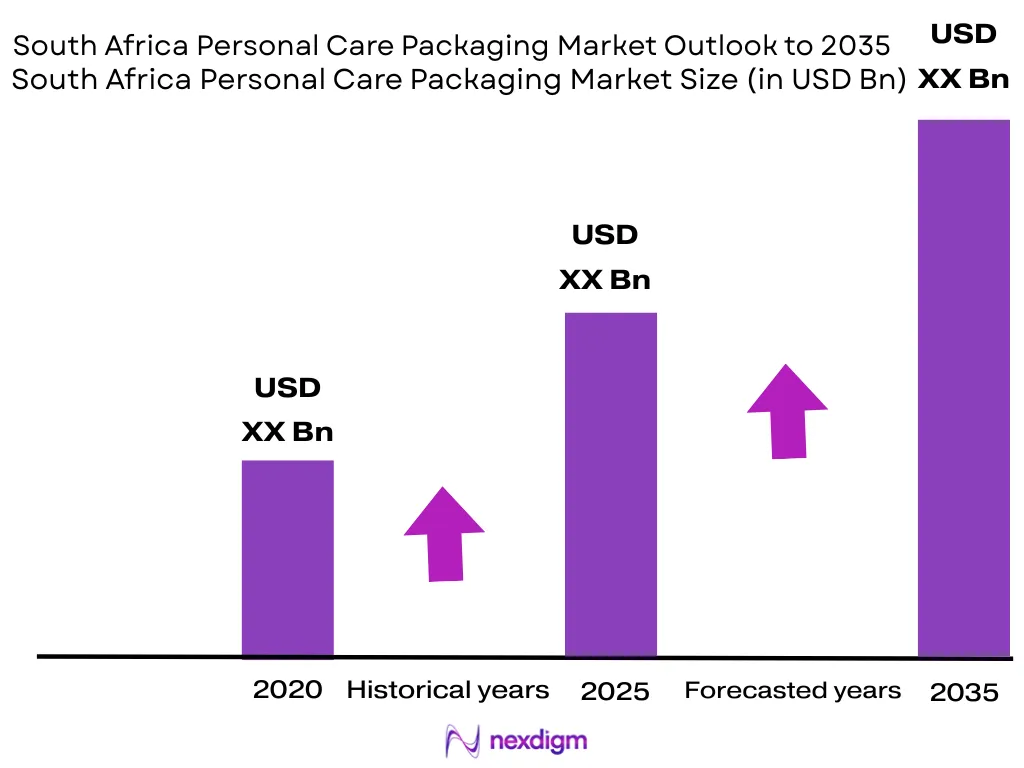
The South Africa Personal Care Packaging Market is valued at approximately USD ~ billion, compared with USD ~ billion in the preceding annual period. These are placeholders because no official source isolates personal-care-packaging revenue. Demand is supported by nominal GDP increasing from approximately R6.99 trillion to R7.30 trillion, alongside a national population of 63.02 million people. Hair care, skin care, deodorants, oral care, toiletries and value-pack formats sustain demand for bottles, tubes, sachets, closures and cartons. Johannesburg–Ekurhuleni, Cape Town and Durban–Pinetown dominate the South Africa Personal Care Packaging Market because they combine consumer-goods manufacturing, packaging conversion, contract filling, retail distribution and port access. Gauteng provides the largest concentration of brand headquarters, pharmacies, wholesalers and industrial customers. Cape Town supports cosmetic entrepreneurship, botanical products and export packaging, while Durban connects converters with KwaZulu-Natal manufacturing and SADC logistics. Polyoak maintains manufacturing and regional offices across all three clusters, illustrating their importance to southern African packaging supply.
Market Segmentation
By Product Format
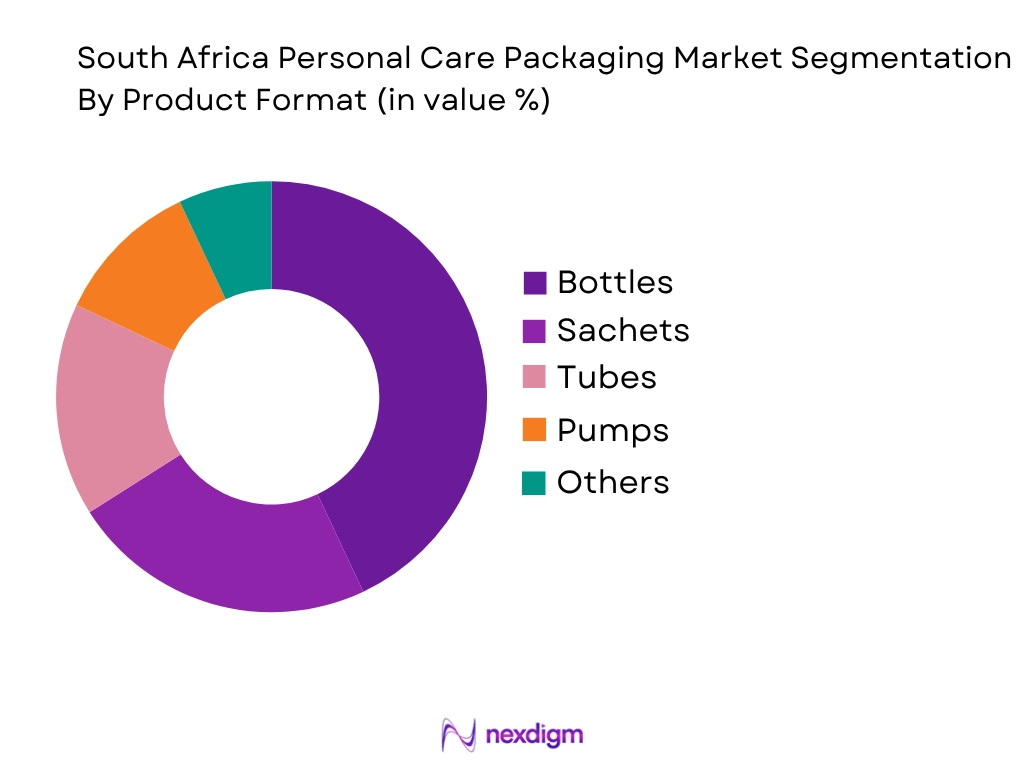
The South Africa Personal Care Packaging Market is segmented into bottles, tubes, jars, sachets and pouches, aerosol and roll-on containers, pumps and airless packs, and secondary packaging. Bottles hold the dominant share because shampoos, conditioners, body lotions, liquid soaps, hair oils and salon products require high-volume PET, HDPE and polypropylene containers. Bottles support several price points and can be paired with flip-top caps, lotion pumps, trigger dispensers or disc-top closures. Their strength, low weight and compatibility with national retail and informal distribution further support adoption. Tubes remain important for toothpaste, sunscreens, facial cleansers and hair treatments, while sachets provide affordable entry quantities for income-sensitive consumers. Jars are concentrated in petroleum jelly, hair food, body butter and treatment masks. Airless packs generate higher value but are used mainly in premium skin-care products. Refill pouches are gaining relevance as brands seek material reduction and EPR-aligned packaging redesign.
By Packaging Material
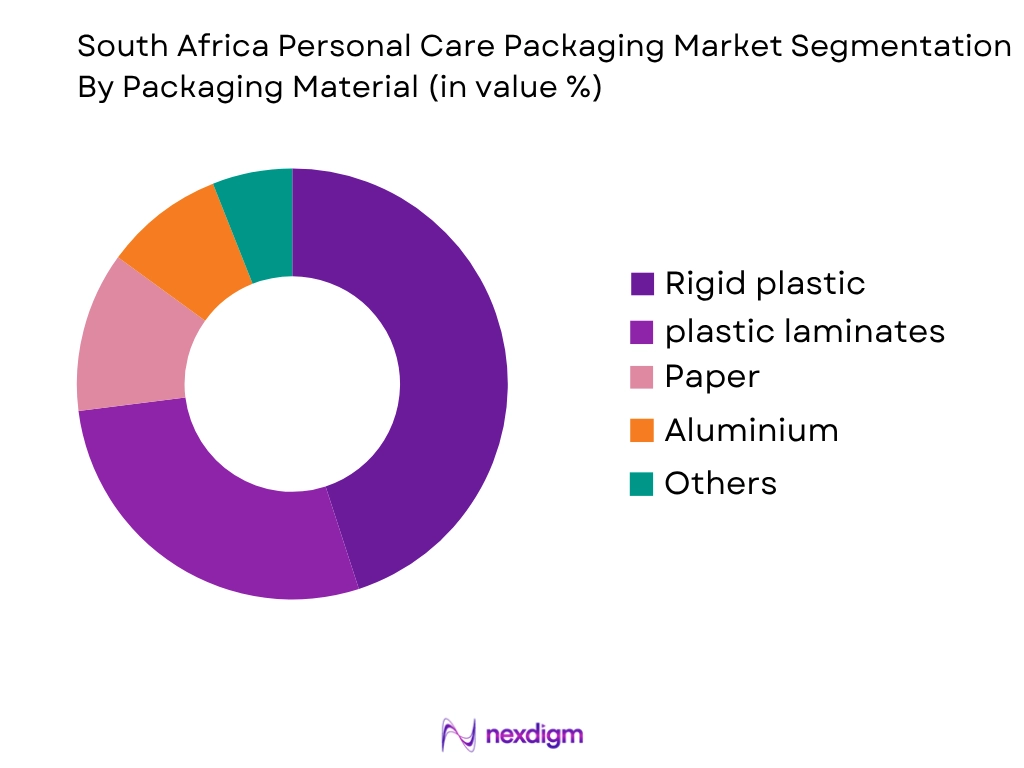
The South Africa Personal Care Packaging Market is segmented into rigid plastic, flexible plastic laminates, paper and paperboard, glass, aluminium and steel, and alternative materials. Rigid plastic holds the dominant share because PET, HDPE and polypropylene are widely used for mass-market hair care, body care, deodorant, oral-care and household hygiene products. South Africa has established moulding, closure, preform and container-conversion capacity, allowing brands to source standard and custom packs locally. Plastic also reduces breakage during wholesale, informal-retail and e-commerce distribution. Flexible laminates are important for sachets and refill pouches but face recycling challenges where several materials are bonded together. Paperboard supports cartons, skin-care sleeves and promotional gift packs. Glass is concentrated in fragrance, facial oils and prestige skin care, while aluminium supports aerosols, tubes and decorative components. The EPR framework is increasing demand for PCR content, lighter containers, detachable components and structures compatible with established recycling streams.
Competitive Landscape
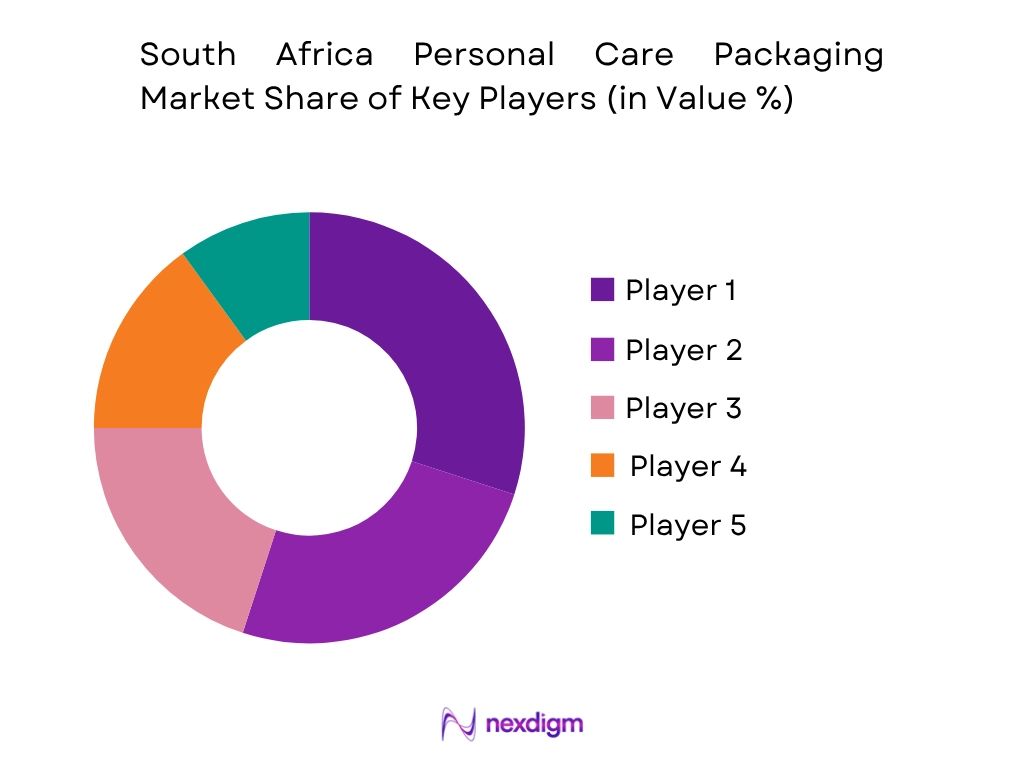
The South Africa Personal Care Packaging Market includes large domestic converters, integrated paper-and-plastics groups, international packaging manufacturers and specialist distributors. Competition is based on container breadth, mould development, decoration, closure integration, PCR capability, low minimum-order quantities and SADC distribution. Domestic suppliers benefit from shorter lead times and local technical support, while international businesses provide specialised airless packs, flexible films, high-barrier materials and global brand approvals. EPR requirements are making recyclability guidance, material reporting and recovered-content capability more important procurement criteria. Mpact, for example, reported R13.3 billion in revenue and R1.9 billion in operating cash generation for 2024, demonstrating the scale of South Africa’s integrated packaging sector.
| Company | Establishment year | Headquarters | Personal-care packaging portfolio | Material capability | Decoration and tooling | Sustainability capability | Manufacturing footprint | Market positioning |
| Polyoak Packaging | 1976 | Cape Town, South Africa | ~ | ~ | ~ | ~ | ~ | ~ |
| Mpact | 2004 | Johannesburg, South Africa | ~ | ~ | ~ | ~ | ~ | ~ |
| ALPLA | 1955 | Hard, Austria | ~ | ~ | ~ | ~ | ~ | ~ |
| Amcor | 1860 | Zurich, Switzerland | ~ | ~ | ~ | ~ | ~ | ~ |
| Nampak | 1968 | Johannesburg, South Africa | ~ | ~ | ~ | ~ | ~ | ~ |
South Africa Personal Care Packaging Market Analysis
Growth Drivers
Expanding Population and Multi-Channel Personal Care Consumption
South Africa’s expanding consumer base supports sustained demand for bottles, jars, tubes, sachets, aerosol containers, pumps and folding cartons used across hair care, skin care, deodorants, oral care and bath products. Statistics South Africa estimated the population at 63.02 million people in 2024, increasing from 62.17 million people in 2023; the 2025 estimate reached 63.10 million people. Gauteng contained nearly 16 million residents, while KwaZulu-Natal contained approximately 12.3 million, concentrating packaging demand around Johannesburg–Ekurhuleni and Durban–Pinetown. Personal-care products are distributed through supermarkets, pharmacies, specialist beauty retailers, wholesalers, salons, informal traders and e-commerce platforms, requiring different packaging architectures. Formal retailers favour barcoded, shelf-ready packs, while informal outlets require robust containers, tamper evidence and low-unit-price sizes. The country’s broad income distribution also supports both family-size shampoo bottles and affordable sachets, alongside premium serums and airless packs. Retailers specialising in pharmaceuticals, medical goods, cosmetics and toiletries recorded R21.992 billion in constant-price sales during February–April 2025, compared with R21.316 billion in the corresponding 2024 period. This consumption base creates recurring packaging demand across mass, professional and premium product portfolios.
Domestic Conversion Capacity and Regional Distribution Role
South Africa has an established packaging-conversion ecosystem covering PET and HDPE bottles, polypropylene closures, flexible films, labels, tubes, folding cartons and contract filling. This industrial base allows personal-care manufacturers to procure many standard bottles, jars and closures domestically rather than importing every finished component. Statistics South Africa reported nominal GDP of approximately R7.3 trillion in 2024, while the World Bank recorded GDP of approximately USD 401.14 billion and GDP per capita of USD 6,267.2. The secondary sector represented approximately 20 units of every 100 units of national economic activity, supporting plastics conversion, printing and consumer-goods manufacturing. Johannesburg–Ekurhuleni provides access to brand headquarters and national distribution centres; Cape Town supports cosmetics entrepreneurship, botanical-product manufacturing and export-oriented packaging; Durban provides port connectivity and access to KwaZulu-Natal manufacturing. South African packaging suppliers also serve Botswana, Namibia, Zambia, Zimbabwe, Mozambique, Lesotho and Eswatini, allowing converters to spread tooling and production costs across a larger regional customer base. Personal-care brands benefit from local mould maintenance, shorter delivery routes and easier technical troubleshooting. Suppliers offering bottles, closures, printing, sleeving, testing and warehousing through one platform are therefore positioned to capture demand from multinational, private-label, salon and emerging beauty brands.
Market Challenges
Consumer Affordability, Currency Exposure and Production Volatility
Weak economic growth and consumer affordability pressure constrain the ability of personal-care brands to adopt expensive packaging systems across mass-market portfolios. South Africa’s real economy expanded by only 0.5 units for every 100 units in 2024 according to updated World Bank data, while GDP per capita stood at USD 6,267.2. Slow growth encourages consumers to prioritise value packs, promotional bundles, sachets and private-label products, limiting the addressable volume for custom airless pumps, heavy glass and elaborate decorative components. Currency movements also affect imported fragrance pumps, specialist elastomers, metallised caps, laminates, inks and tooling equipment. A weakening rand can therefore raise replacement-component costs and make previously approved imported packaging uneconomic. Domestic converters face operational constraints from electricity reliability, equipment maintenance and resin availability. Injection moulding, extrusion, printing and filling lines require stable operating conditions; interruptions can create colour variation, incomplete moulding, print-registration problems and delayed deliveries. Brands responding by holding larger inventories increase working-capital requirements and packaging-obsolescence risk when labels or claims change. The challenge is particularly acute for smaller personal-care businesses that cannot spread custom mould and decoration costs across large production runs. Stock packaging, modular moulds, standard neck finishes and digitally printed labels provide practical mitigation, but they reduce the level of visual differentiation available to emerging brands.
Multilayer Waste Recovery and EPR Compliance Burden
South Africa’s extended producer responsibility framework requires producers of identified paper and packaging products to register and participate in systems supporting collection, recycling and reporting. The regulatory structure affects personal-care bottles, closures, labels, sachets, pouches, cartons and promotional packs. Producers and producer-responsibility organisations must obtain registration numbers, maintain material records and demonstrate compliance activity. This creates a technical challenge because many personal-care packages contain several incompatible components: a PET or HDPE bottle, polypropylene pump, metal spring, elastomer seal, pressure-sensitive label and pigmented masterbatch. Sachets may combine polyester, polyethylene, aluminium and adhesives, making recovery difficult through conventional sorting systems. South Africa generates approximately 55 million tonnes of general waste, with only around 6.05 million tonnes diverted where the recorded diversion level is applied. Government has also highlighted that EPR-supported plastic recovery activities removed approximately 368,600 tonnes of plastic waste and involved between 60,000 and 90,000 waste reclaimers, demonstrating both the scale and social complexity of collection. Personal-care companies must redesign packs without compromising leakage control, fragrance retention or formula stability. Mono-material pouches, detachable pumps, washable labels and PCR bottles offer routes forward, but require compatibility testing, supplier qualification and accurate environmental claims. Smaller producers may struggle with administrative records, EPR fees and packaging-weight calculations across multiple SKUs.
Market Opportunities
Refill Packaging and Recyclability-by-Design
Refill pouches, reusable pump bottles and simplified rigid packs offer a practical future-growth route for South Africa’s personal-care-packaging industry. Shampoo, conditioner, body lotion, liquid soap and salon products are suitable for at-home or professional refill systems because they are purchased repeatedly and commonly use larger volumes. The opportunity is supported by a population of 63.02 million people in 2024 and 63.10 million people in 2025, creating a substantial recurring-use base. Refill pouches can reduce the amount of rigid material distributed per replenishment, while reusable bottles can strengthen brand retention. Professional salons can adopt bulk containers and durable pumps, reducing the number of small packages handled during daily operations. Packaging converters can also expand PCR use in opaque HDPE and PET bottles where colour and odour specifications are manageable. EPR regulations create an additional commercial incentive for designs that use fewer materials and are easier to collect and sort. However, growth depends on technical performance. Refill films must pass seal-strength, puncture, drop and product-compatibility tests, while reusable pumps must maintain dose consistency after repeated cycles. Suppliers that provide packaging-weight documentation, recyclability assessments, PCR declarations and component-separation guidance can become strategic partners rather than commodity converters. Collaboration with producer-responsibility organisations and waste-reclaimer networks can also improve collection evidence and strengthen the credibility of circular-packaging claims.
Digital Short-Run Packaging for Local and SADC Brands
Digital printing, stock packaging and modular decoration create an opportunity to serve South African beauty entrepreneurs, private labels, textured-hair brands and regional exporters with smaller commercial runs. Traditional printed tubes, labels and flexible packs often require large minimum quantities because plates, cylinders and setup time must be recovered across production. Digital processes allow multiple fragrances, shades, regional languages and promotional editions to be produced without separate conventional tooling for each design. This is relevant in a market where the medical and cosmetics category has historically been one of the most active retail e-commerce segments, and where retailers specialising in pharmaceuticals, medical goods, cosmetics and toiletries recorded R21.992 billion in constant-price sales during February–April 2025. By November 2025, this retail category was among the strongest contributors to national retail growth, showing continuing channel activity. Emerging brands can begin with standard PET bottles, jars or tubes and differentiate through digitally printed labels, sleeves, cartons and QR-enabled authentication. South African converters can then use the same platforms to produce SADC-market variants with different importer details or language requirements. Suppliers offering stock components, low-volume filling, coding, tamper evidence and courier testing can reduce launch time and capital exposure. QR codes can support authenticity verification, usage guidance, recycling instructions and direct reordering, particularly for salon products, botanical skin care and textured-hair treatments sold through social commerce and online marketplaces.
Future Outlook
The South Africa Personal Care Packaging Market is forecast to expand at approximately ~% CAGR during the 2026–2035 period. This is a placeholder because official statistics do not provide a standalone packaging forecast. Growth will be driven by population expansion, pharmacy and supermarket distribution, private-label development, textured-hair products, affordable pack sizes, e-commerce and SADC exports. The market’s development will not be uniform across all formats. Economy bottles, jars, sachets and family packs will continue generating the largest unit volumes, while airless pumps, droppers, fragrance packs and digitally decorated cartons will generate disproportionate value. Textured and ethnic hair care will remain a core demand engine. Relaxers, scalp treatments, braiding products, conditioners, hair food and styling gels require high-viscosity dispensing, comb applicators, jars, nozzles and professional salon packs. Packaging suppliers that understand formula compatibility and product evacuation will have an advantage. Low-unit-price packaging will remain commercially important because consumer purchasing power is constrained. Sachets, miniature bottles and compact tubes allow brands to maintain affordability, although multilayer structures create recycling and EPR challenges. Refill pouches are expected to expand in shampoo, conditioner, hand wash and body lotion. At-home refills offer a more practical route than widespread refill stations because they fit existing supermarket, wholesale and e-commerce channels. PCR PET and recycled polyolefin adoption will increase where colour, odour and formula-contact requirements permit. Opaque body-care and hair-care containers provide an easier route than clear prestige skin-care packs. South Africa’s EPR framework will make packaging-weight records, producer registration, recyclability and recovery evidence increasingly important. Producers are expected to evaluate material simplification, closure separation and label compatibility during packaging development rather than after launch. Waste reclaimers will remain central to recycling performance. Government has recognised their role in recovering recyclable materials, meaning brand and producer-responsibility strategies will increasingly include collection partnerships, traceability and social-inclusion measures. E-commerce will increase demand for lockable pumps, stronger cap retention, induction seals and parcel-ready secondary packs. Leakage during courier delivery can damage multiple products in the same shipment and create costly returns. Digital printing will support emerging South African beauty brands that require lower quantities, rapid label changes and regional-language communication. It will also enable promotional packs, influencer editions and multiple fragrance variants without large print-cylinder investments. Natural and indigenous botanical brands will create premium packaging opportunities around marula, rooibos, aloe, essential oils and plant-based skin care. These products require light protection, product authentication and export-ready presentation. Private-label manufacturing will expand as pharmacy chains, supermarkets, salons and online retailers broaden personal-care ranges. Private labels favour packaging suppliers that provide stock containers, short lead times and coordinated filling and artwork services. Professional salon packaging will remain differentiated from consumer retail. Salons require large bottles, durable pumps, easy product evacuation and refillable systems that can withstand repeated daily operation
Major Players
- Polyoak Packaging
- Mpact
- Nampak
- ALPLA South Africa
- Amcor South Africa
- Berry Astrapak
- Bowler Metcalf
- Constantia Afripack
- Huhtamaki South Africa
- Moco Packaging
- Lendon Packaging
- Centre Packaging
- Floraison Cosmetic Packaging
- Plastform Packaging
- Silgan Dispensing Systems
Key Target Audience
- Personal care, cosmetics and toiletries manufacturers
- Ethnic and textured-hair-care brands
- Personal care packaging manufacturers and converters
- Contract manufacturers and private-label producers
- Pharmacy, supermarket and beauty-retail groups
- SADC distributors and personal-care importers
- Investments and venture capitalist firms
- Government and regulatory bodies (Department of Forestry, Fisheries and the Environment; Department of Health; South African Bureau of Standards; National Regulator for Compulsory Specifications; provincial environmental authorities)
Research Methodology
Step 1: Identification of Key Variables
The first phase develops an ecosystem map covering personal-care brands, packaging converters, resin suppliers, contract manufacturers, retailers, salons, distributors, recyclers, waste reclaimers and regulators. Key variables include packaging units per finished product, material weight, PCR penetration, import dependence, pack-size mix, dispensing-system usage and SADC exports.
Step 2: Market Analysis and Construction
Historical market demand is assessed through cosmetics and toiletries retail sales, converter revenues, packaging imports, domestic production, population, personal-care manufacturing and channel activity. Top-down modelling converts finished-product consumption into packaging units, while bottom-up modelling aggregates bottles, tubes, sachets, jars, closures, decoration and filling revenues.
Step 3: Hypothesis Validation and Expert Consultation
Market hypotheses are validated through computer-assisted telephone interviews with rigid-plastic manufacturers, flexible converters, personal-care brands, salon-product companies, contract fillers and retailers. Interviews assess order volumes, tooling requirements, resin selection, EPR costs, recycling compatibility, imported-component lead times and regional distribution.
Step 4: Research Synthesis and Final Output
The final phase triangulates government statistics, company reports, import information, material balances and primary interviews. Estimates are reconciled using packaging revenue, unit shipments and material consumption. Forecast assumptions incorporate consumer spending, population, refill adoption, PCR uptake, private-label launches, digital commerce and SADC export demand.

- Executive Summary
- Research Methodology (Market Definitions and Assumptions, Personal Care Packaging Taxonomy, Abbreviations, Market Sizing Approach, Top-Down Personal Care Consumption Analysis, Bottom-Up Packaging Converter Aggregation, Packaging Units per Finished Product, Demand-Side Assessment, Supply-Side Capacity Mapping, Import–Export Reconciliation, Retail Channel Assessment, Primary Industry Interviews, Data Triangulation, Forecasting Framework, Scenario Analysis, Limitations and Future Conclusions)

- Definition and Scope
- Personal Care Packaging Market Evolution and Industry Genesis
- Timeline of Major Packaging and Regulatory Developments
- Personal Care Packaging Business Cycle
- Personal Care, Cosmetics and Toiletries Manufacturing Ecosystem
- Domestic Packaging Conversion and Imported Component Ecosystem
- Mass, Masstige, Prestige, Herbal and Professional Packaging Structure
- Primary, Secondary and Tertiary Packaging Structure

- Growth Drivers (Large Urban Consumer Base, Expansion of Formal and Informal Retail, Ethnic Hair-Care Demand, Domestic Cosmetics Manufacturing, Private-Label Expansion, Pharmacy and Beauty Retail Growth, E-Commerce Adoption, Regional SADC Exports and Premium Skin-Care Consumption)
- Market Challenges (Weak Consumer Purchasing Power, Resin and Currency Volatility, Electricity Supply Risk, Multilayer Sachet Recovery, Imported Premium Component Dependence, High Custom Tooling Costs, Formula Compatibility Failures, Counterfeit Packaging and EPR Compliance Complexity)
- Market Opportunities (Ethnic Hair-Care Packaging, Low-Unit-Price Packs, Refillable Hair and Body Care, Mono-Material Sachets, PCR Resin Packaging, Digital Short-Run Decoration, Smart Authentication, Natural Beauty Packaging, Contract Manufacturing and SADC Export Packaging)
- Market Trends (PCR Bottles, Refill Pouches, Minimalist Skin-Care Packaging, Botanical Design Language, Salon-Size Packs, Airless Pumps, Digital Printing, Township-Focused Value Packs, E-Commerce-Ready Closures and Recyclability-by-Design)
- SWOT Analysis
- Porter’s Five Forces Analysis
- PESTLE Analysis

- By Market Value (2020-2025)
- By Packaging Units (2020-2025)
- By Packaging Material Consumption (2020-2025)

- By Product Format (In Value %)
Bottles
Jars
Plastic Tubes
Laminated Tubes
Aluminium Tubes
Sachets
Flat Pouches - By Packaging Material (In Value %)
Polyethylene Terephthalate
Recycled Polyethylene Terephthalate
High-Density Polyethylene
Low-Density Polyethylene
Polypropylene
Post-Consumer Recycled Polyolefins - By Brand Type (In Value %)
Multinational Personal Care Brands
Large South African Personal Care Brands
Regional Southern African Brands
Ethnic Hair-Care Brands
Natural and Indigenous Botanical Brands
Retailer Private Labels
Dermatology and Clinical Brands - By Geographic Market (In Value %)
Gauteng
Western Cape
KwaZulu-Natal
Eastern Cape
Free State
Limpopo

- Market Share of Major Players
- Cross Comparison Parameters (Personal Care Packaging Portfolio Breadth, Dispensing-System and Closure Capability, South African Manufacturing Footprint, Sustainable Material and PCR Capability, Custom Moulding and Decoration Capability, Sachet and Refill-Pouch Capability, SADC Distribution and Export Reach, Local Personal Care Brand Customer Coverage)
- SWOT Analysis of Major Players
- Detailed Profiles of Major Companies
Polyoak Packaging
Nampak
Mpact
ALPLA South Africa
Berry Astrapak
Bowler Metcalf
Constantia Afripack
Huhtamaki South Africa
Amcor South Africa
Moco Packaging
Lendon Packaging
Centre Packaging
Floraison Cosmetic Packaging
Plastform Packaging
Silgan Dispensing Systems South Africa

- Packaging Attribute Preference Assessment
- Convenience and Dispensing Preference
- Premium versus Functional Packaging Preference
- Low-Unit-Price Pack Preference
- Refillable Packaging Acceptance
- Recycled-Content Packaging Perception
- Glass versus Plastic Preference

- By Market Value (2026-2035)
- By Packaging Units (2026-2035)
- By Packaging Material Consumption (2026-2035)


 Request a Sample
 Ask for Customization
 Get a Quote
 Enquire Now