

 Download PDF
Market Overview
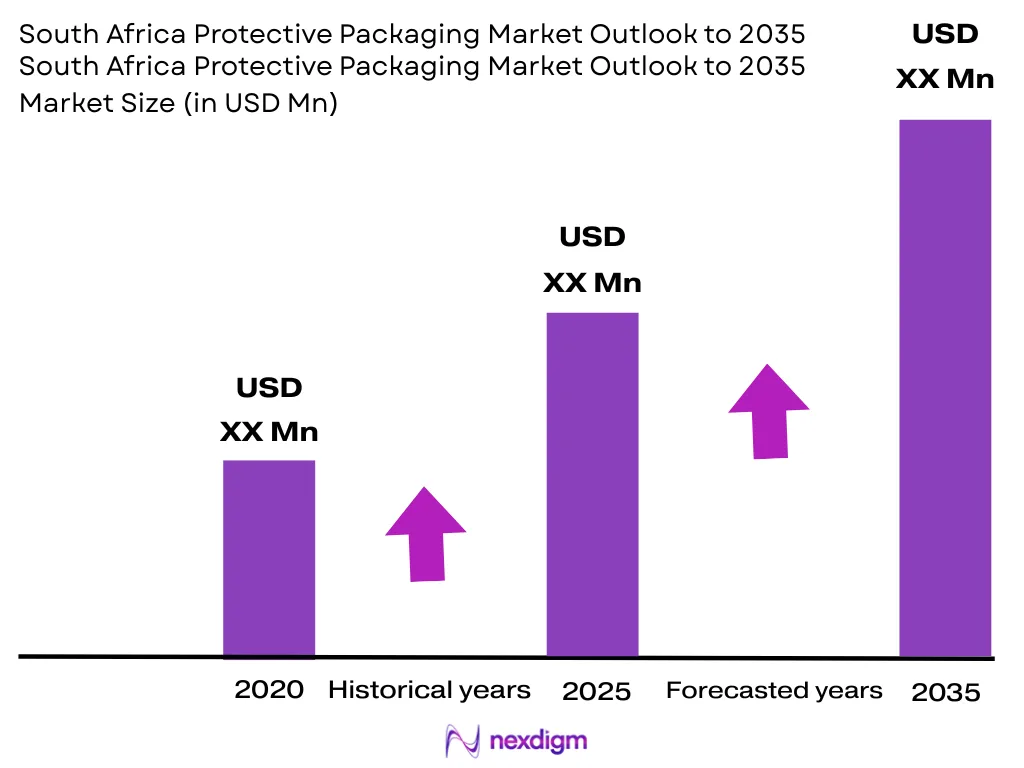
The South Africa Protective Packaging Market was valued at USD ~ Million in 2024 and is anticipated to expand at a CAGR of ~% during 2026–2035. The market is primarily driven by the country’s concentrated automotive manufacturing corridor in the Eastern Cape, growing e-commerce and regional distribution requirements, and South Africa’s role as a packaging manufacturing and export hub for the Southern African Development Community. The adjacent South Africa Flexible Packaging Market, which shares substantial material and technology overlap with protective packaging formats such as bubble wrap, air pillows, and stretch films, was valued at USD 2.96 billion in 2026 and is projected to reach USD 3.47 billion by 2031, expanding at a CAGR of 3.24%, according to Mordor Intelligence, with Amcor, Mondi, Constantia Flexibles, Huhtamaki, and Sonoco Products Company recognized as major companies operating in the market. Gauteng and Western Cape together account for more than half of national packaging output, reflecting the concentration of head-office decision makers, modern retail, and export-oriented food factories in these provinces, while household consumption rose 2.3% year-on-year in the fourth quarter of 2024, supporting retail pack volumes despite a 3.2% contraction in wider manufacturing output across bakery, dairy, beverages, automotive, and industrial protective packaging applications.
Market Segmentation
By Application
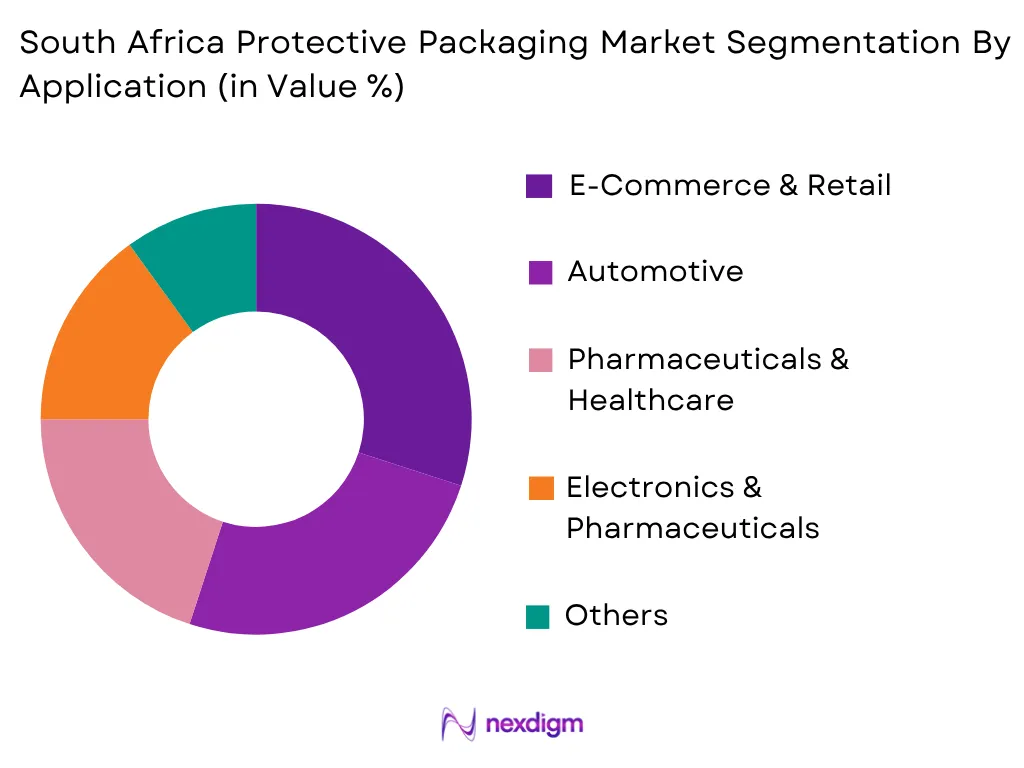
Among these, the Automotive segment holds a significant and distinctive share of the South Africa Protective Packaging Market, reflecting the Eastern Cape’s well-established automotive manufacturing corridor, which drives substantial demand for industrial liners and component wraps protecting automotive parts throughout production and export logistics. Nampak Limited, Africa’s largest diversified packaging company, and Bowler Metcalf, through its Bowler Packaging subsidiary, both maintain rigid plastics and industrial packaging capabilities directly relevant to protecting automotive components, machinery parts, and industrial equipment during South Africa’s extensive domestic and export transportation routes. The E-Commerce & Retail segment represents the fastest-growing application category, mirroring global trends in which growing online shopping penetration drives demand for protective materials such as air pillows, bubble wrap, and foam inserts to ensure products reach South African and regional SADC consumers safely.
By Type
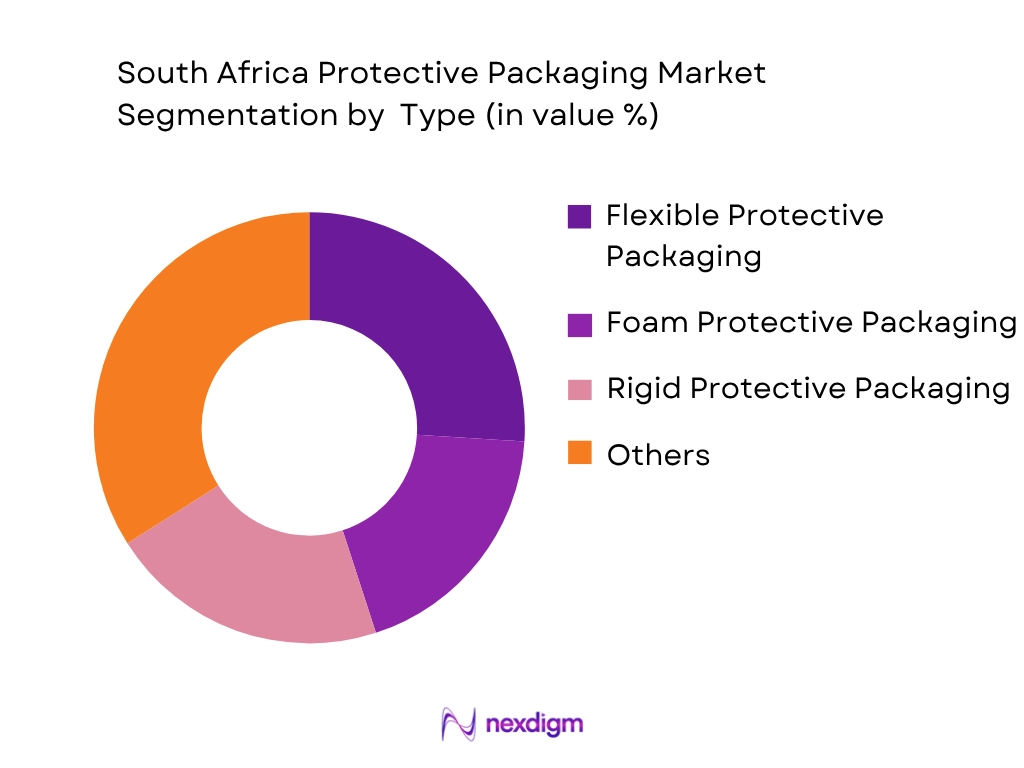
Flexible Protective Packaging, encompassing bubble wrap, air pillows, and stretch films, continues to hold a substantial share of the South Africa Protective Packaging Market, benefiting from the same manufacturing infrastructure and plastics processing capability that underpins the broader South Africa Flexible Packaging Market. KwaZulu-Natal leverages port access to import resins and export packaged goods across the Southern African Development Community, supporting the province’s role in supplying flexible protective packaging materials to both domestic converters and regional export markets. Rigid and Foam Protective Packaging formats continue to see steady demand from South Africa’s mining and industrial equipment sectors, which require durable, impact-resistant packaging solutions capable of protecting heavy machinery components and instrumentation during transport across the country’s extensive road and rail freight networks.
Competitive Landscape
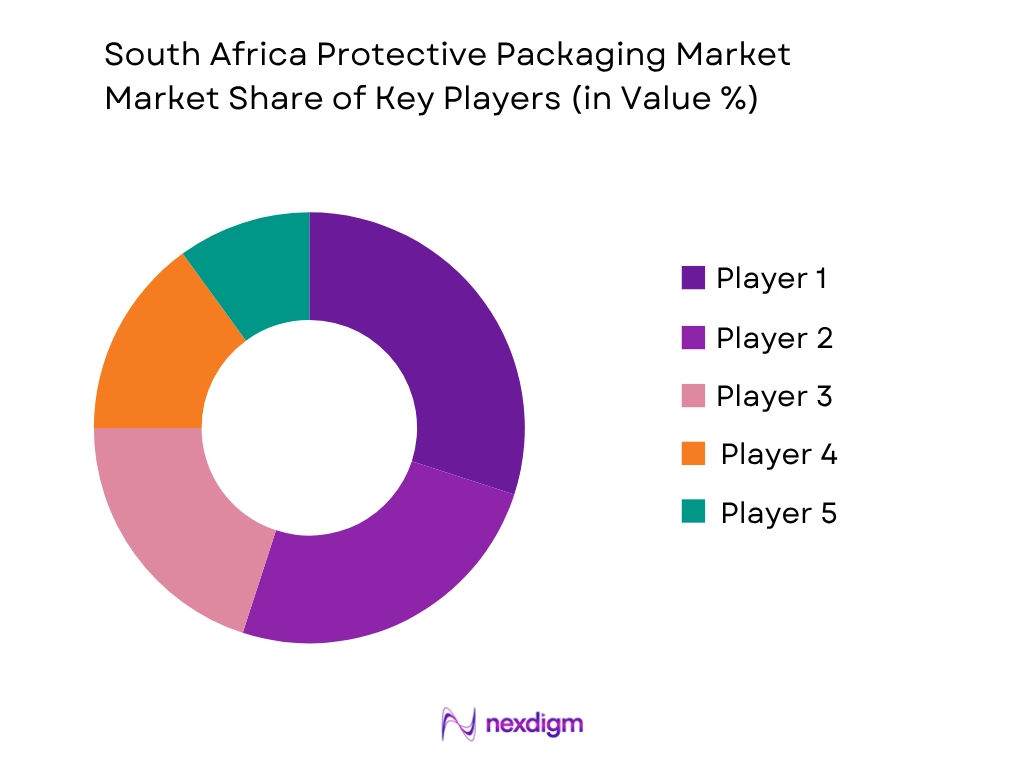
The South Africa Protective Packaging Market is moderately consolidated, with several long-established domestic packaging manufacturers competing alongside multinational protective packaging specialists that maintain distribution partnerships within the country. Competition is primarily based on manufacturing capacity, material innovation, regulatory compliance with NRCS and Plastics SA standards, and the ability to serve both South Africa’s domestic automotive and industrial sectors and its role as a regional SADC export hub. Nampak Limited, incorporated in 1968 and listed on the Johannesburg Stock Exchange since 1969, stands as Africa’s largest diversified packaging company, generating revenue of R9.96 billion in 2024 across metal, plastic, paper, and glass packaging formats relevant to protective applications. Mpact Limited, South Africa’s largest paper and plastics packaging business by revenue, reported 2024 revenue reaching R10 billion (USD 553 million), reflecting improved board-mill efficiencies and selective acquisitions that deepen the company’s vertical integration across corrugated and protective packaging formats. Bowler Metcalf, operating through Bowler Packaging since 1972, continues to serve South Africa’s personal care, industrial, and automotive sectors with rigid plastics packaging solutions, while multinational players including Sealed Air and Sonoco Products Company compete on the strength of their global protective packaging technology and automated systems.
| Company | Established | Headquarters | Primary Product Portfolio | Sustainable/Recyclable Portfolio | Manufacturing Presence | Major End-Use Industries | Key Strategic Focus | Certifications & Compliance |
| Nampak Limited | 1968 | ~ | ~ | ~ | ~ | ~ | ~ | ~ |
| Bowler Metcalf (Bowler Packaging) | 1972 | ~ | ~ | ~ | ~ | ~ | ~ | ~ |
| Sealed Air Corporation | 1960 | ~ | ~ | ~ | ~ | ~ | ~ | ~ |
| Mpact Limited | 2011 | ~ | ~ | ~ | ~ | ~ | ~ | ~ |
| Sonoco Products Company | 1899 | ~ | ~ | ~ | ~ | ~ | ~ | ~ |
South Africa Protective Packaging Market Analysis
Growth Drivers
Eastern Cape Automotive Corridor Demand for Component Protection
The South Africa Protective Packaging Market is experiencing sustained growth due to the country’s concentrated automotive manufacturing base in the Eastern Cape, which drives substantial demand for industrial liners and component wraps protecting automotive parts throughout production, domestic distribution, and export logistics. South Africa’s automotive sector, anchored by major international vehicle manufacturers operating assembly and component facilities within the province, requires durable, impact-resistant protective packaging capable of safeguarding sensitive components, spare parts, and finished vehicles during transit across the country’s extensive road and rail freight networks. This concentrated industrial demand, combined with the sector’s export orientation to European and other international markets, continues to reinforce sustained requirements for specialized protective packaging formats engineered to automotive industry specifications.
Growth of E-Commerce and Regional SADC Distribution
Rising e-commerce penetration and South Africa’s role as a regional distribution hub for the Southern African Development Community continue to drive demand for protective packaging across the country. Household consumption rose 2.3% year-on-year in the fourth quarter of 2024, supporting retail pack volumes despite a broader 3.2% contraction in national manufacturing output, reflecting resilient consumer demand for packaged goods requiring protective transit packaging. KwaZulu-Natal’s strategic port access enables the province to both import resins for protective packaging production and export packaged goods across the SADC region, reinforcing South Africa’s position as a manufacturing and distribution hub capable of serving both domestic e-commerce growth and regional cross-border trade requirements for protective packaging formats.
Market Challenges
Import Dependency for Specialty Resins and Films
The South Africa Protective Packaging Market faces ongoing challenges related to import dependency for specialty resins, films, and foam materials not produced at sufficient scale domestically. Local manufacturers remain significantly affected by currency volatility and rising production costs associated with imported polymer feedstocks, forcing packaging companies to either absorb margin compression or pass on price increases to industrial and e-commerce customers. This dependency creates persistent supply chain risk for protective packaging manufacturers, particularly given South Africa’s exposure to global resin price fluctuations and the logistical complexity of importing specialty materials required for high-performance protective packaging applications serving the automotive and industrial equipment sectors.
Manufacturing Sector Contraction
The South Africa Protective Packaging Market must navigate a challenging broader manufacturing environment, with national manufacturing output contracting 3.2% even as household consumption grew 2.3% year-on-year in the fourth quarter of 2024. This divergence between resilient consumer demand and contracting industrial manufacturing output creates a complex operating environment for protective packaging manufacturers, who must balance capacity investment decisions against uncertain industrial demand trajectories, particularly within manufacturing-intensive end markets such as automotive components and mining equipment that have historically anchored a significant share of the country’s protective packaging consumption.
Market Opportunities
Extended Producer Responsibility Driven Recyclable Packaging Investment
South Africa’s developing Section 18 Extended Producer Responsibility Plan for plastics packaging presents substantial opportunities for protective packaging manufacturers investing in recyclable material innovation. Representatives of the plastics and packaging industries, raw material suppliers, converters, brand owners, and environmental organizations have collaborated to develop a workable local plan suited to South Africa’s particular environmental and economic realities. Bowler Packaging’s active participation in driving a circular economy model for South Africa, including its involvement with PETCO and Plastics SA, exemplifies the growing industry commitment to closing the packaging loop, creating opportunities for manufacturers that can successfully integrate recycled content and mono-material designs into protective packaging formats serving e-commerce, automotive, and industrial customers.
Automotive Export-Oriented Packaging Manufacturing
South Africa’s established automotive export industry, anchored by its Eastern Cape manufacturing corridor, presents ongoing opportunities for protective packaging manufacturers to develop specialized, export-compliant packaging solutions for international automotive component and vehicle shipments. As South African automotive manufacturers continue serving European and international export markets, demand for protective packaging engineered to meet stringent international automotive industry specifications is expected to remain robust, creating opportunities for domestic manufacturers such as Nampak and Bowler Metcalf, alongside multinational specialists, to develop tailored protective packaging solutions that combine cost competitiveness with the durability and compliance standards required for long-distance international automotive component shipments.
Future Outlook
The South Africa Protective Packaging Market is expected to witness sustained expansion over the forecast period, supported by continued automotive manufacturing activity in the Eastern Cape, growing e-commerce and regional SADC distribution requirements, and increasing investment in recyclable protective packaging formats. Continued implementation of the Section 18 Extended Producer Responsibility Plan, alongside growing collaboration between domestic manufacturers and industry sustainability bodies including PETCO and Plastics SA, is expected to strengthen the market’s sustainability credentials. The market is also likely to benefit from South Africa’s continued position as a regional packaging manufacturing and export hub, supporting long-term growth across automotive, e-commerce, mining, and industrial equipment protective packaging applications.
Major Players
- Nampak Limited
- Bowler Metcalf (Bowler Packaging)
- Mpact Limited
- Sealed Air Corporation
- Sonoco Products Company
- Pregis LLC
- Storopack Hans Reichenecker GmbH
- Amcor plc
- Mondi Group
- Nefab Group
- DS Smith
- Berry Global Inc.
- International Paper Company
- Constantia Flexibles
- Ranpak Holdings Corp.
Key Target Audience
- Protective Packaging Manufacturers and Converters
- Automotive Component Manufacturers
- E-Commerce Platforms and Retailers
- Mining and Industrial Equipment Companies
- Food & Beverage Companies
- Recycling and Waste Management Companies
- Investment and Venture Capitalist Firms
- Government and Regulatory Bodies (National Regulator for Compulsory Specifications (NRCS), Department of Trade, Industry and Competition (DTIC), Department of Forestry, Fisheries and the Environment (DFFE))
- Raw Material Suppliers and Resin Distributors
Research Methodology
Step 1: Identification of Key Variables
The research process begins with identifying the complete ecosystem of the South Africa Protective Packaging Market, including raw material suppliers, packaging manufacturers, converters, automotive and industrial companies, retailers, and regulatory authorities. Extensive secondary research is conducted using company annual reports, government publications, trade associations, customs statistics, industry journals, and proprietary databases to determine the variables influencing market demand, pricing, production, consumption, and technological developments.
Step 2: Market Analysis and Construction
Historical market information is collected and analyzed to estimate market size, production volumes, import-export activity, application-wise demand, and pricing trends. A combination of top-down and bottom-up approaches is used to estimate market revenues and validate segment-level performance. Consumption patterns across automotive, e-commerce, mining, and industrial equipment applications are evaluated to establish an accurate representation of the industry.
Step 3: Hypothesis Validation and Expert Consultation
The preliminary findings are validated through Computer-Assisted Telephone Interviews (CATIs) and structured discussions with protective packaging manufacturers, procurement managers, converters, automotive logistics executives, regulatory experts, and senior executives operating within the South African packaging industry. These interviews help verify market assumptions, competitive developments, technology adoption trends, pricing dynamics, and future investment opportunities while refining the overall market estimates.
Step 4: Research Synthesis and Final Output
The final stage integrates insights obtained from primary interviews with quantitative information collected through secondary sources. Data triangulation techniques are applied to reconcile differences between supply-side and demand-side estimates, ensuring robust market forecasting. The report is then reviewed through multiple quality assurance checkpoints to deliver a comprehensive analysis covering market size, segmentation, competitive landscape, future outlook, and strategic recommendations for industry stakeholders.

- Executive Summary
- Research Methodology (Market Definitions and Assumptions, Protective Packaging Taxonomy, Abbreviations, Market Sizing Approach, Top-Down Personal Care Product Consumption Analysis, Bottom-Up Packaging Supplier Aggregation, Packaging Units per Finished Product, Demand-Side Assessment, Supply-Side Capacity Mapping, Import–Export Reconciliation, Retail Channel Analysis, Primary Industry Interviews, Data Triangulation, Forecasting Framework, Scenario Analysis, Limitations and Future Conclusions)

- Definition and Scope
- Market Evolution and Industry Genesis
- Timeline of Major Industry Developments
- Protective Packaging Industry Value Chain Analysis
- Supply Chain Analysis

- Growth Drivers (Eastern Cape Automotive Corridor Demand for Component Protection, Growth of E-Commerce and Regional SADC Distribution, Expansion of Mining and Industrial Equipment Protection, Rising Household Consumption, Port-Enabled Regional Export via KwaZulu-Natal, Growth in Modern Retail)
- Market Challenges (Import Dependency for Specialty Resins and Films, Currency Volatility and Rising Input Costs, Manufacturing Sector Contraction, High Implementation Costs, Regulatory Compliance Complexity)
- Market Opportunities (Extended Producer Responsibility Driven Recyclable Packaging Investment, Automotive Export-Oriented Packaging Manufacturing, Regional SADC Distribution Hub Positioning, Sustainable Packaging Innovation, Smart Packaging Technologies)
- Market Trends (Shift Toward Recyclable Mono-Material Films, Growth of Automotive Component Protective Packaging, Regional Manufacturing Consolidation, Digital Printing Adoption, Consolidation Through Mergers and Acquisitions)
- Government Regulations (Section 18 Extended Producer Responsibility Plan, National Regulator for Compulsory Specifications (NRCS), Plastics SA Industry Standards, National Environmental Management Waste Act, Labeling Requirements)
- Import and Export Analysis (Trade Volume, Major Import Sources, Export Destinations, HS Code Analysis, Trade Balance)
- Raw Material Availability Analysis (Polyethylene, Polypropylene, Recycled Plastics, Kraft Paper, Aluminum)
- Technology Landscape (Blow Moulding Technology, Foam Extrusion Technology, Digital Printing, Barrier Coating Technologies, Automated Packaging Systems)
- Sustainability Assessment (Recycled Content Adoption, Mono-Material Design, Carbon Footprint Reduction, PETCO Recycling Initiatives, Circular Economy Partnerships)
- PESTLE Analysis
- SWOT Analysis
- Porter’s Five Forces Analysis
- Stakeholder Ecosystem
- Competition Ecosystem

- By Market Value (2020-2025)
- By Volume Consumption (2020-2025)
- By Average Selling Price (2020-2025)

- By Type (In Value %)
Flexible Protective Packaging (Bubble Wrap, Air Pillows & Mailers)
Rigid Protective Packaging
Foam Protective Packaging - By Material (In Value %)
Plastic (Polyethylene & Polypropylene)
Paper & Paperboard
Foam Plastics (EPS & Polyurethane)
Metal & Aluminum - By Function (In Value %)
Wrapping
Cushioning
Void Fill
Blocking & Bracing
Insulation & Surface Protection - By Application (In Value %)
Automotive
E-Commerce & Retail
Food & Beverages
Mining & Industrial Equipment
Electronics & Pharmaceuticals - By Region (In Value %)
Gauteng
Western Cape
KwaZulu-Natal
Eastern Cape & Other Provinces

- Market Share of Major Players (By Value, Volume, Material, Application Industry, Product Category)
- Cross Comparison Parameters (Product Portfolio Breadth, Automotive Packaging Capability, Application Technical Support Capability, Manufacturing Capacity, Regulatory Compliance & Certifications, Industrial Customer Base, Innovation & New Product Launch Frequency)
- SWOT Analysis of Major Players
- Pricing Analysis by Product Category and SKU
- Production Capacity Analysis
- Manufacturing Footprint Analysis
- Distribution Network Analysis
- Innovation Benchmarking
- Detailed Profiles of Major Companies
Nampak Limited
Bowler Metcalf (Bowler Packaging)
Mpact Limited
Sealed Air Corporation
Sonoco Products Company
Pregis LLC
Storopack Hans Reichenecker GmbH
Amcor plc
Mondi Group
Nefab Group
DS Smith
Berry Global Inc.
International Paper Company
Constantia Flexibles
Ranpak Holdings Corp.

- Consumption Pattern Analysis (Industrial Usage, Order Size, Product Category Penetration, Seasonal Demand, Reformulation Activity)
- Purchasing Criteria (Cushioning Performance, Regulatory Compliance, Cost Efficiency, Recyclability, Crush Resistance, Supply Reliability)
- Procurement and Supplier Selection Analysis
- Sustainable Packaging Adoption Assessment
- Premium vs Conventional Packaging Demand
- Product Attribute Preference Analysis (Cushioning Performance, Print Quality, Seal Integrity, Recyclability, Moisture Resistance, Crush Resistance)
- Consumer Sustainability Preference Influence on Product Development
- Pain Point Analysis
- Decision-Making Process

- By Market Value (2026-2035)
- By Volume Consumption (2026-2035)
- By Average Selling Price (2026-2035)


 Request a Sample
 Ask for Customization
 Get a Quote
 Enquire Now