
 Download PDF
Market Overview
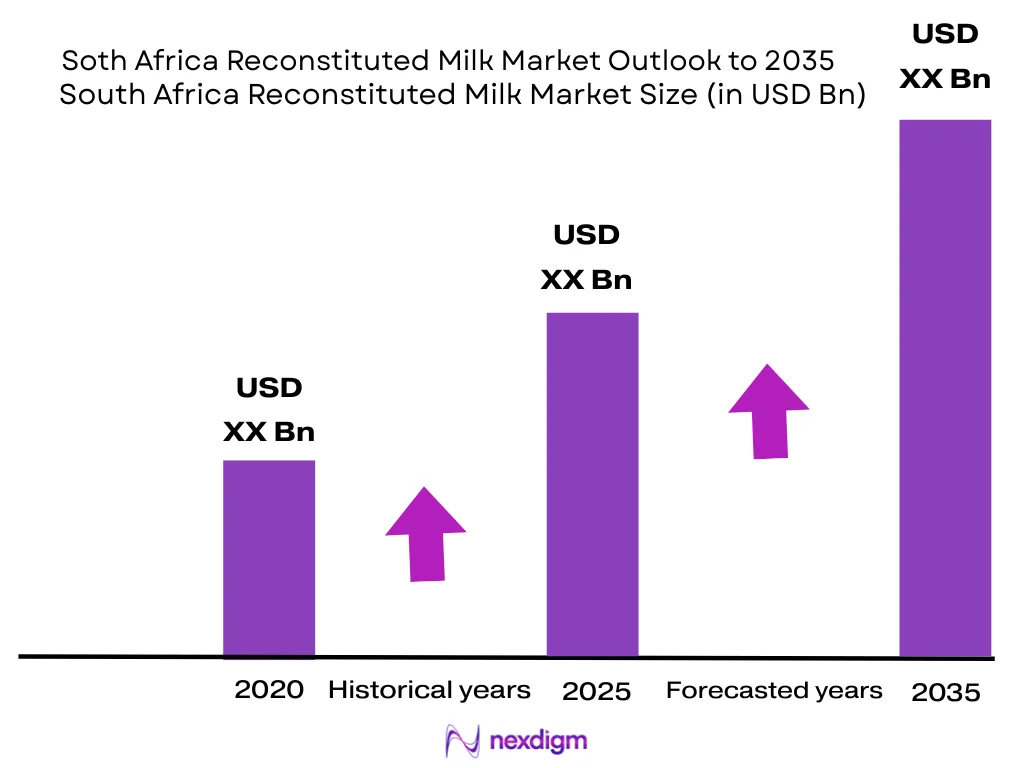
The South Africa Reconstituted Milk Market is valued at USD ~ million, based on shelf-stable UHT milk sales used as the closest reported market proxy, with liquid UHT milk contributing USD ~ million. The market is driven by long shelf life, weaker cold-chain penetration in several areas, affordability versus fresh milk, and household demand for ready-to-consume dairy. Official dairy data shows UHT milk retail sales increased by 1.6% in the latest July-to-July cycle, while UHT milk is priced at USD 1.08 per litre compared with USD 1.42 per litre for fresh milk.
The market is dominated by Gauteng, Western Cape, KwaZulu-Natal and Eastern Cape due to their combined role as consumption, production and processing centres. Western Cape has 299 milk producers, KwaZulu-Natal 182, Eastern Cape 164 and Gauteng 46, while coastal regions dominate raw milk supply due to mild temperatures, rainfall and pasture availability. UHT and reconstituted milk also benefit from Gauteng’s dense retail, wholesale and institutional demand base, while Eastern Cape, Western Cape and KwaZulu-Natal support raw milk and processing availability.
Market Segmentation
By Form
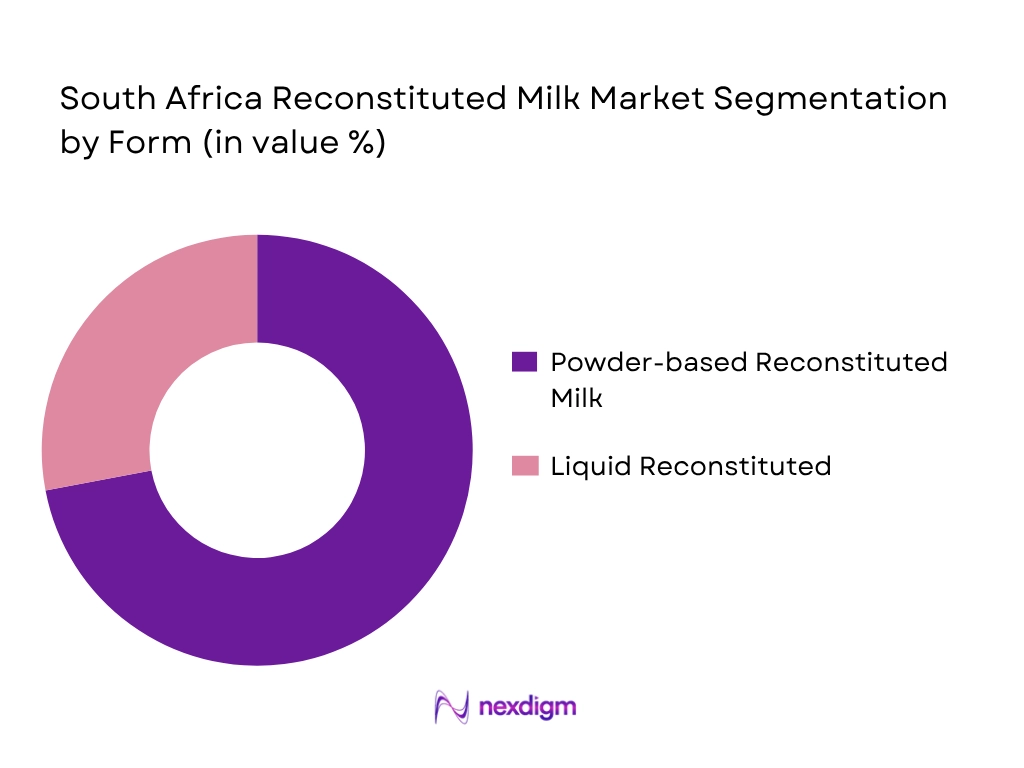
South Africa Reconstituted Milk Market is segmented by form into powder-based reconstituted milk and liquid reconstituted/UHT milk. Recently, powder-based reconstituted milk has a dominant market share under this segmentation because South Africa’s milk-powder ecosystem is central to affordable dairy formulation, infant nutrition, relief supply and industrial dairy applications. USDA FAS notes that South Africa’s milk powder products include skimmed milk powder and full cream milk powder, and that these are leading products in the utilization of unprocessed milk for processing. Between January and September, 131,647,498 kilograms of unprocessed milk was used to manufacture full cream milk powder and 51,497,106 kilograms was used for skimmed milk powder. Liquid UHT milk remains highly relevant due to ambient storage, but powder-backed reconstitution gives processors flexibility to manage seasonality, cost and institutional demand.
By Distribution Channel
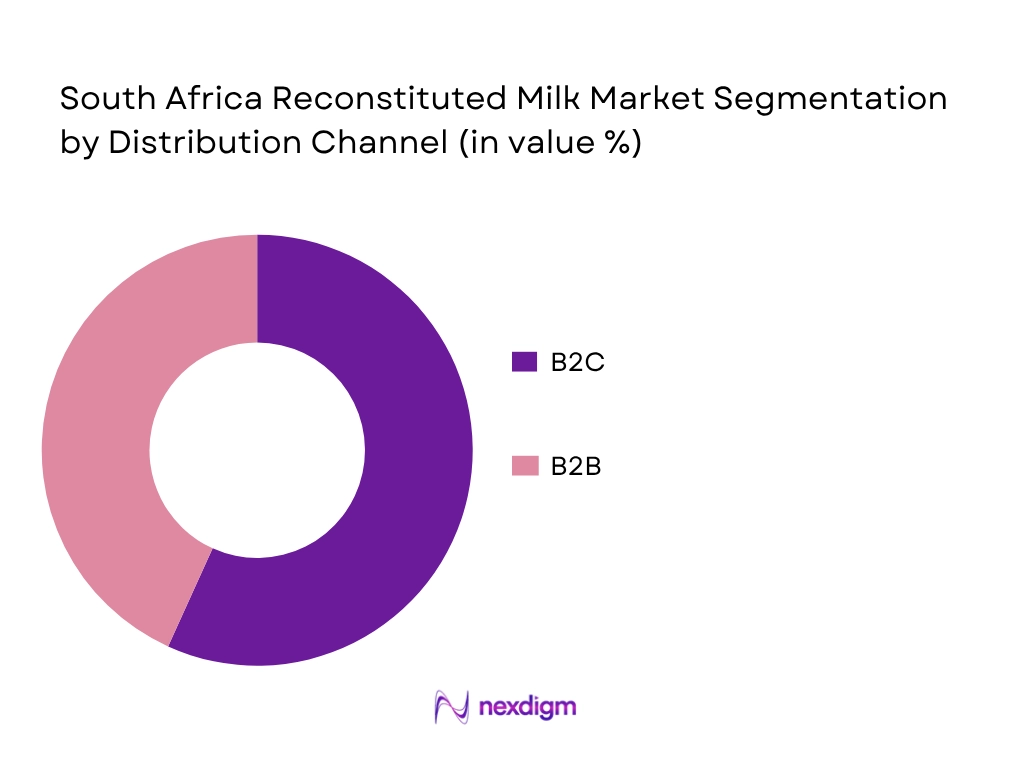
South Africa Reconstituted Milk Market is segmented by distribution channel into B2C and B2B. Recently, B2C has a dominant market share under this segmentation because reconstituted and UHT milk products are heavily consumed through supermarkets, hypermarkets, grocery stores, cash-and-carry formats, convenience stores and online grocery platforms. The segment benefits from household demand for affordable, long-life milk that can be stored without refrigeration before opening, making it attractive for monthly grocery baskets and load-shedding-sensitive households. Fact.MR reports B2C UHT milk sales at USD 159.8 million, reflecting strong retail and direct consumer pull. B2B remains important across foodservice, bakery, confectionery, dairy manufacturing, school feeding and public procurement, but the strongest commercial velocity is linked to retail shelf-stable dairy SKUs.
Competitive Landscape
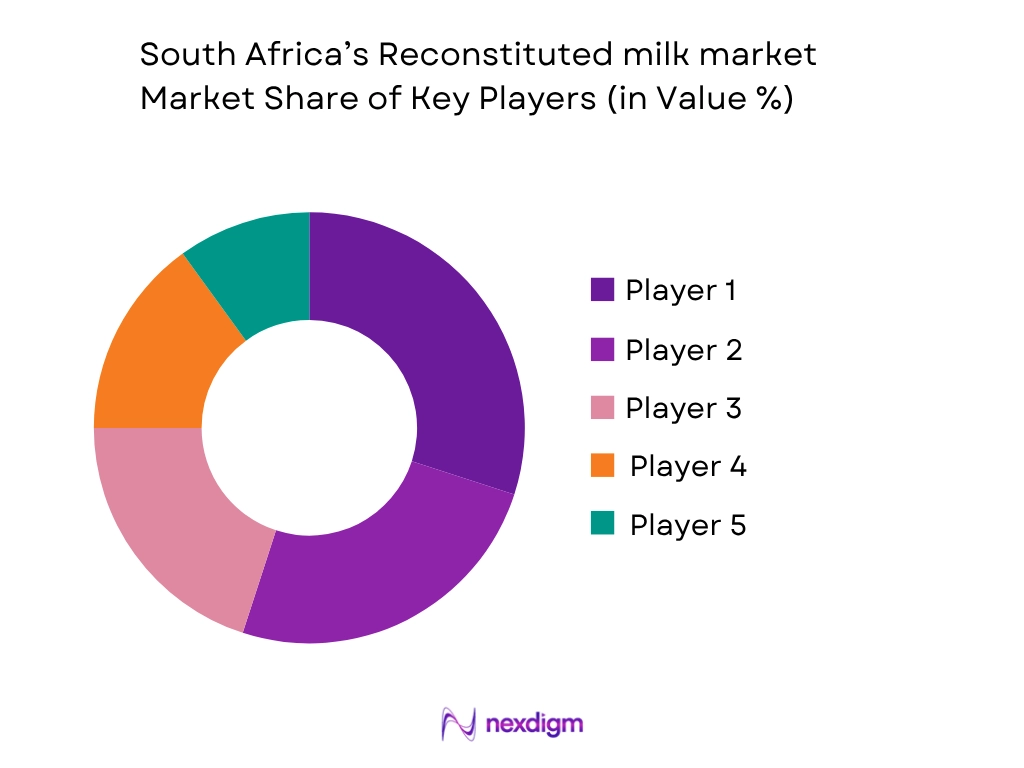
The South Africa Reconstituted Milk Market is led by integrated dairy processors, UHT specialists and large branded food companies. Competition is shaped by aseptic processing capacity, national retail access, private-label manufacturing, powder sourcing, institutional tender participation and export capability into SACU/SADC countries. Clover, Lactalis South Africa, Woodlands Dairy, Nestlé South Africa and Dairy Group/Coega Dairy represent the most relevant competitive cluster because they combine dairy brands, processing infrastructure, long-life milk capability and national or regional distribution reach. Fact.MR profiles Clover, Parmalat South Africa, Woodlands Dairy and Nestlé among leading UHT milk suppliers.
| Company | Establishment Year | Headquarters | UHT/Reconstituted Milk Presence | Key Brands/Business Lines | Processing/Manufacturing Footprint | Distribution Strength | Powder/Ingredient Linkage | Market-Specific Strategic Position |
| Lactalis South Africa / Parmalat | 2020 as Lactalis SA; roots earlier through Parmalat | Stellenbosch, Western Cape | ~ | ~ | ~ | ~ | ~ | ~ |
| Clover S.A. | 1898 | Roodepoort, Gauteng | ~ | ~ | ~ | ~ | ~ | ~ |
| Woodlands Dairy / First Choice | 1995 | Humansdorp, Eastern Cape | ~ | ~ | ~ | ~ | ~ | ~ |
| Nestlé South Africa | Registered locally in 1916 | Bryanston, Gauteng | ~ | ~ | ~ | ~ | ~ | ~ |
| Dairy Group / Coega Dairy | 2011 as Coega Dairy; Dairy Group formed in 2020 | Port Elizabeth/Gqeberha, Eastern Cape | ~ | ~ | ~ | ~ | ~ | ~ |
South Africa’s reconstituted milk Market Analysis
Growth Drivers
Powder-backed processing base strengthens reconstituted milk availability
South Africa’s reconstituted milk market is supported by a sizeable milk-powder processing base, which gives dairy processors flexibility to convert milk solids into shelf-stable, reconstituted and recombined dairy formats. USDA FAS reports that 131,647,498 kilograms of unprocessed milk was used to manufacture full-cream milk powder and 51,497,106 kilograms was used to manufacture skimmed milk powder between January and September 2024. This is market-specific because reconstituted milk depends directly on skim milk powder, whole milk powder, standardized fat and milk-solids-not-fat balancing. The same source notes that South Africa imports whey powder and milk albumin used in milk powder manufacturing, showing that processors rely on both local milk conversion and dairy ingredient trade. The broader macro base also supports liquid dairy consumption: World Bank records South Africa’s population at 64,007,187 people and GDP at USD 401.14 billion in 2024, creating a large national consumption base for affordable dairy products. For reconstituted milk processors, this combination of local powder conversion, imported dairy ingredients and a large consumer base supports continuous production, institutional supply and ambient retail distribution.
Dense provincial demand centres support shelf-stable dairy distribution
South Africa’s reconstituted milk demand is strongly supported by high-population provinces and concentrated urban consumption corridors. Statistics South Africa estimates the national population at 63.02 million in 2024, with Gauteng housing 15.83 million people and KwaZulu-Natal housing 12.34 million people. These provinces are important for reconstituted and UHT milk because dense population clusters reduce distribution cost per outlet, improve wholesale rotation and increase the relevance of shelf-stable packs for supermarkets, cash-and-carry stores, spaza-linked wholesale channels and institutional buyers. The 2025 demographic update also shows Gauteng at around 16.1 million people and KwaZulu-Natal at about 12.2 million residents, indicating that the main consumption corridors remain intact for dairy processors and distributors. World Bank records South Africa’s GDP per capita at USD 6,267.2 in 2024, which supports a formal packaged-food market where branded and private-label dairy products compete for household baskets. For reconstituted milk, Gauteng’s retail density and KwaZulu-Natal’s population depth create consistent route-to-market opportunities, while Western Cape and Eastern Cape remain important processing and raw-milk supply regions.
Market Challenges
Weak household purchasing power limits premiumization in reconstituted milk
The South Africa reconstituted milk market faces demand pressure from constrained household purchasing power, which keeps the category highly value-driven and limits premiumization beyond fortified, lactose-adjusted or specialized nutrition formats. World Bank records South Africa’s GDP per capita at USD 6,267.2 and GDP at USD 401.14 billion in 2024, while unemployment is recorded at 32.4 in 2025 on the same World Bank country profile. This matters for reconstituted milk because the category often competes on affordability, long shelf life and bulk-buy practicality rather than discretionary premium appeal. Statistics South Africa’s GDP release shows nominal GDP at R7.3 trillion in 2024, only R312 billion higher than 2023, while several real-economy industries including agriculture, construction, trade, transport and manufacturing recorded negative annual performance. A market dependent on packaged dairy volumes is therefore exposed to weaker basket expansion, downtrading into private-label lines and tighter retail promotional cycles. In this environment, processors must balance milk-solids formulation, pack-size architecture, institutional contracts and retailer margin demands while avoiding product perception issues around reconstituted versus fresh milk.
Processing and supply-chain pressure affects consistency of shelf-stable dairy output
Reconstituted milk production depends on powder availability, UHT or sterilized processing, packaging inputs, water quality and ambient logistics. South Africa’s wider production environment remains uneven. Statistics South Africa reports that in Q4 2024, manufacturing decreased, electricity, gas and water decreased, and transport, storage and communication also weakened during the quarter; the annual 2024 GDP release notes negative performance in manufacturing, trade and transport-linked sectors. This is directly relevant to reconstituted milk because processors require reliable utilities, aseptic filling, carton or bottle supply, powder storage, batch testing and national distribution. The dairy-specific supply base also shows pressure: USDA FAS states that unprocessed milk utilized for UHT milk production decreased over the previous three years, while fresh milk and UHT processed milk production were forecast to decrease in 2025 as producers shifted investment to dairy products with better returns. South Africa also exported 82,742 tons of liquid milk between January and November 2024, which highlights that local processors must manage both domestic supply and regional demand obligations. These factors can affect availability, production planning and consistency in reconstituted milk supply.
Market Opportunities
Institutional and nutrition-linked dairy demand creates scope for fortified reconstituted milk
Reconstituted milk has a future growth opportunity in institutional nutrition, child-focused dairy products and fortified formulations because South Africa has a large young population and a sizeable milk-powder ecosystem. Statistics South Africa estimates that 16.8 million people were younger than 15 years in 2024, while the 2025 population update records about 16.5 million children under 15. This supports long-term relevance for school nutrition, public feeding programmes, relief packs, child nutrition products and affordable fortified milk formats. USDA FAS reports that 131,647,498 kilograms of unprocessed milk was used for full-cream milk powder and 51,497,106 kilograms for skimmed milk powder between January and September 2024, giving processors a material milk-solids base for reconstituted and recombined dairy products. The same USDA FAS report states that South Africa imports whey proteins and milk albumin used in infant formula manufacturing, indicating technical demand for dairy ingredients beyond plain liquid milk. For processors, the opportunity is to position reconstituted milk as a stable, standardized and nutrition-oriented product for institutional tenders, children’s packs, fortified UHT lines and affordable household nutrition.
Regional export channels create growth room for shelf-stable and powder-based dairy products
South Africa’s reconstituted milk market can benefit from regional export demand because shelf-stable liquid milk and milk powder are easier to move across long distances than chilled fresh milk. USDA FAS reports that South Africa exported an average of 87,696 tons of UHT liquid milk per year to the SACU region over the previous five years, and 82,742 tons of liquid milk between January and November 2024. It also reports 3,935 tons of milk powder exports between January and November 2024, with destinations including Lesotho, Namibia, Botswana and Zambia. This is market-specific because reconstituted milk processors can use powder conversion, UHT processing and aseptic packaging to serve both domestic and neighbouring markets where cold-chain infrastructure is uneven. The macro backdrop is supportive because World Bank records Sub-Saharan Africa’s GDP at USD 1.98 trillion in 2024, while South Africa itself remains a large formal economy with USD 401.14 billion GDP. The opportunity is not only retail exports but also B2B dairy ingredients, foodservice bases, institutional packs and private-label ambient milk supplied through SACU and SADC distribution corridors.
Future Outlook
Over the forecast period, the South Africa Reconstituted Milk Market is expected to grow steadily as shelf-stable dairy remains important for affordability, food security and retail convenience. Growth will be supported by UHT adoption, public and institutional procurement, powder-backed supply flexibility, and lower reliance on cold-chain infrastructure. However, processors will remain exposed to milk powder costs, packaging inflation, feed-price volatility, exchange-rate movement and competition from fresh milk and dairy alternatives. The forecasted CAGR for the market is 6.5%, using the published UHT milk demand trajectory as the closest reported proxy for reconstituted/shelf-stable milk demand.
Major Players
- Lactalis South Africa / Parmalat
- Clover S.A.
- Woodlands Dairy / First Choice
- Nestlé South Africa
- Dairy Group South Africa
- Coega Dairy
- Dewfresh Products
- Fair Cape Dairies
- Orange Grove Dairy
- Douglasdale Dairy
- Fairfield Dairy
- Lancewood
- Danone Southern Africa
- Darling Romery
- Farmgate Dairy
Key Target Audience
- Dairy processors and UHT milk manufacturers
- Milk powder manufacturers and importers
- Retail chains and modern grocery operators
- Foodservice distributors and HoReCa procurement teams
- Institutional catering and school nutrition suppliers
- Investments and venture capitalist firms
- Government and regulatory bodies (Department of Agriculture, Land Reform and Rural Development; Department of Health; South African Bureau of Standards; National Consumer Commission; Department of Trade, Industry and Competition)
- Packaging, aseptic filling and dairy processing equipment companies
Research Methodology
Step 1: Identification of Key Variables
The initial phase involves constructing an ecosystem map covering dairy farmers, powder producers, UHT processors, retailers, foodservice distributors, institutional buyers and regulatory bodies in the South Africa Reconstituted Milk Market. Variables include SMP/WMP availability, UHT processing capacity, milk solids utilization, retail pricing, pack size, import dependency and regional dairy production concentration.
Step 2: Market Analysis and Construction
In this phase, historical dairy production, UHT milk demand, milk powder utilization, liquid milk pricing and channel-level sales indicators are compiled. The market is constructed using a top-down approach from UHT and liquid dairy sales, and a bottom-up approach from processor portfolios, retail SKUs, powder-based formulation use and institutional demand.
Step 3: Hypothesis Validation and Expert Consultation
Market hypotheses are validated through structured interviews with dairy processors, packaging suppliers, retail category managers, foodservice distributors and institutional procurement stakeholders. These interviews test assumptions on reconstituted milk usage, UHT adoption, powder sourcing, private-label supply, pricing pressure and capacity utilization across major dairy hubs.
Step 4: Research Synthesis and Final Output
The final phase integrates secondary-source findings, trade indicators, company benchmarking and primary insights into a validated market model. The output captures current market size, growth trajectory, segmentation, competitive positioning and strategic recommendations for companies participating in South Africa’s reconstituted and shelf-stable dairy ecosystem.

- Executive Summary
- Research Methodology (Market Definitions and Assumptions, Reconstituted Milk vs Recombined Milk Classification, SMP/WMP Conversion Ratio, Fat-Solids Standardization Approach, Milk Solids-Not-Fat Assumptions, UHT and Pasteurization Scope, Retail Audit Methodology, Processor Interview Coverage, Distributor and HoReCa Validation, Import-Export Triangulation, Bottom-Up SKU Mapping, Top-Down Dairy Utilization Analysis, Limitations and Forecast Sensitivities)

- Definition and Scope
- Market Genesis and Evolution
- Industry Structure and Value Chain
- Business Cycle and Seasonality
- Supply Chain Analysis

- Growth Drivers (Shelf-Stable Milk Demand, Urban Household Convenience, Reduced Cold Chain Dependency, Expansion of Modern Grocery Retail, Institutional Feeding Demand, Milk Powder Utilization, Long-Life Dairy Acceptance)
- Market Challenges (Milk Powder Price Volatility, Imported Ingredient Exposure, Consumer Perception Versus Fresh Milk, Regulatory Labelling Compliance, Water Quality Control, Aseptic Capex, Retailer Margin Pressure)
- Market Opportunities (Affordable Nutrition, Fortified Milk, Township Retail, Shelf-Stable Institutional Packs, Export to SACU/SADC, Low-Lactose and High-Protein Formulations, Powder-to-Liquid Conversion Hubs)
- Market Trends (Ambient Dairy Growth, Powder Rebalancing, Affordable UHT SKUs, Private Label Premiumization, Nutritional Claims, Digital Grocery, Traceability, Clean Label Formulations)
- SWOT Analysis
- Porter’s Five Forces
- PESTLE Analysis

- By Value (2020-2025)
- By Volume (2020-2025)
- By Average Realization per Litre (2020-2025)

- By Product Type (In Value %)
Full Cream Reconstituted Milk
Low-Fat Reconstituted Milk
Skim/Fat-Free Reconstituted Milk
Fortified Reconstituted Milk
Flavoured Reconstituted Milk Base - By End Use (In Value %)
Household Retail Consumption
HoReCa and Foodservice
Bakery, Confectionery and Processed Food
Institutional Catering and School Feeding
Industrial Dairy and Beverage Formulation - By Distribution Channel (In Value %)
Supermarkets and Hypermarkets
Cash-and-Carry and Wholesale
Independent Grocers and Spaza-Linked Retail
Convenience Stores and Forecourts
Online Grocery Platforms - By Region (In Value %)
Gauteng
Western Cape
KwaZulu-Natal
Eastern Cape
Free State

- Market Share of Major Players (Value Share, Volume Share, UHT/Reconstituted Milk Share, Powder-Based Product Share, Retail Shelf Presence, Regional Distribution Strength)
- Cross Comparison Parameters (UHT/Aseptic Processing Capacity, SMP/WMP Sourcing Model, Reconstitution and Fat Standardization Capability, Retail Private-Label Manufacturing Capability, National Cold/Ambient Distribution Coverage, Product Shelf-Life and Pack-Size Portfolio, Institutional Tender Participation, Export Reach Across SACU/SADC)
- SWOT Analysis of Major Players
- Detailed Profiles of Major Companies
Lactalis South Africa / Parmalat
Clover S.A.
Woodlands Dairy / First Choice
Nestlé South Africa
Coega Dairy
Dewfresh Products
Dairy Group South Africa
Fair Cape Dairies
Orange Grove Dairy
Douglasdale Dairy
Fairfield Dairy
Lancewood
Danone Southern Africa
Darling Romery
Farmgate Dairy

- Household Consumers
- Foodservice Buyers
- Industrial Food Manufacturers
- Institutional Buyers
- Retail Buyers

- By Value (2026-2035)
- By Volume (2026-2035)
- By Average Realization per Litre (2026-2035)


 Request a Sample
 Ask for Customization
 Get a Quote
 Enquire Now