
 Download PDF
Market Overview
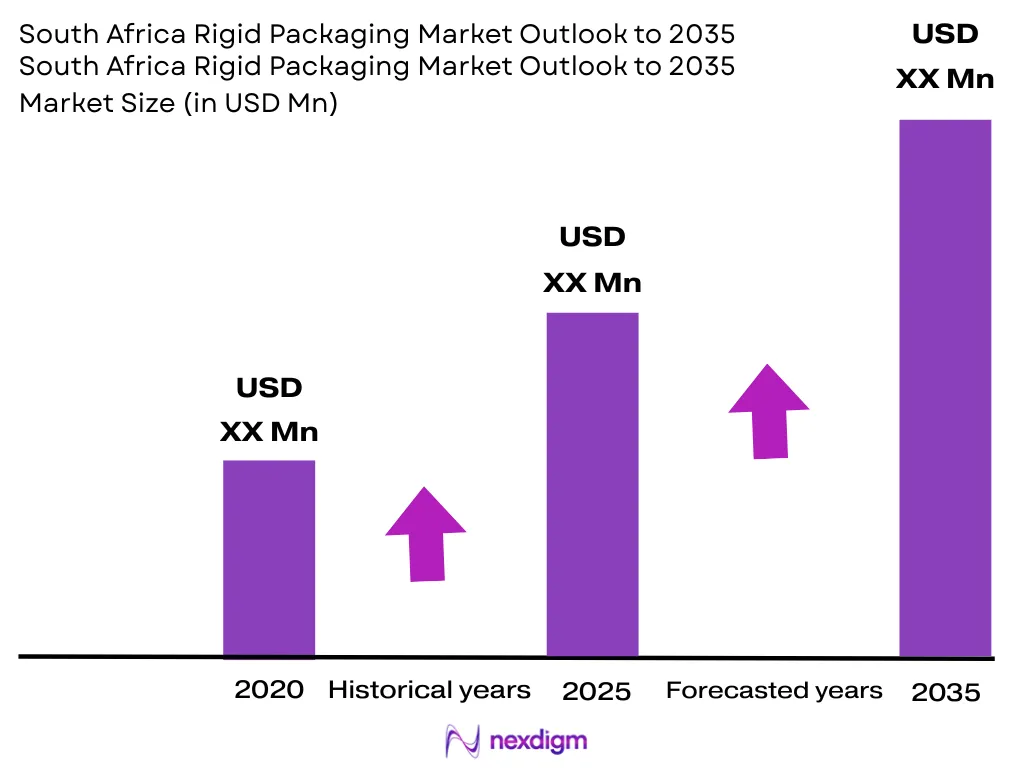
The South Africa Rigid Packaging Market was valued at USD ~ Million in 2024 and is anticipated to expand at a CAGR of ~% during 2026–2035. The market is primarily driven by growth in modern retail and packaged goods consumption, recycled content mandates supported by PETCO’s bottle recovery infrastructure, and expansion of industrial bulk packaging serving the country’s chemicals, lubricants, and agricultural sectors. The South Africa Rigid Plastic Packaging Market alone is expected to reach 1.17 million metric tons in 2025 and grow at a CAGR of 4.29% to reach 1.44 million metric tons by 2030, according to Mordor Intelligence, with Mpact Group, ALPLA Group, Amcor, Berry Global, and Polyoak Packaging Group recognized as major companies operating in the market. Bottles and jars accounted for 41.98% of the broader South Africa plastic packaging market in 2025 revenue, driven by beverage and personal-care fills, while PETCO recorded a 71% bottle recovery rate in 2024, enabling a sizable recycled PET supply that supports closed-loop bottle production. Rigid plastics remained the most consumed packaging material in South Africa’s packaging industry in 2023, preferred by food and non-alcoholic beverage manufacturers for their portability, convenience, and structural protection across beverage, personal care, industrial, and pharmaceutical applications.
Market Segmentation
By Material
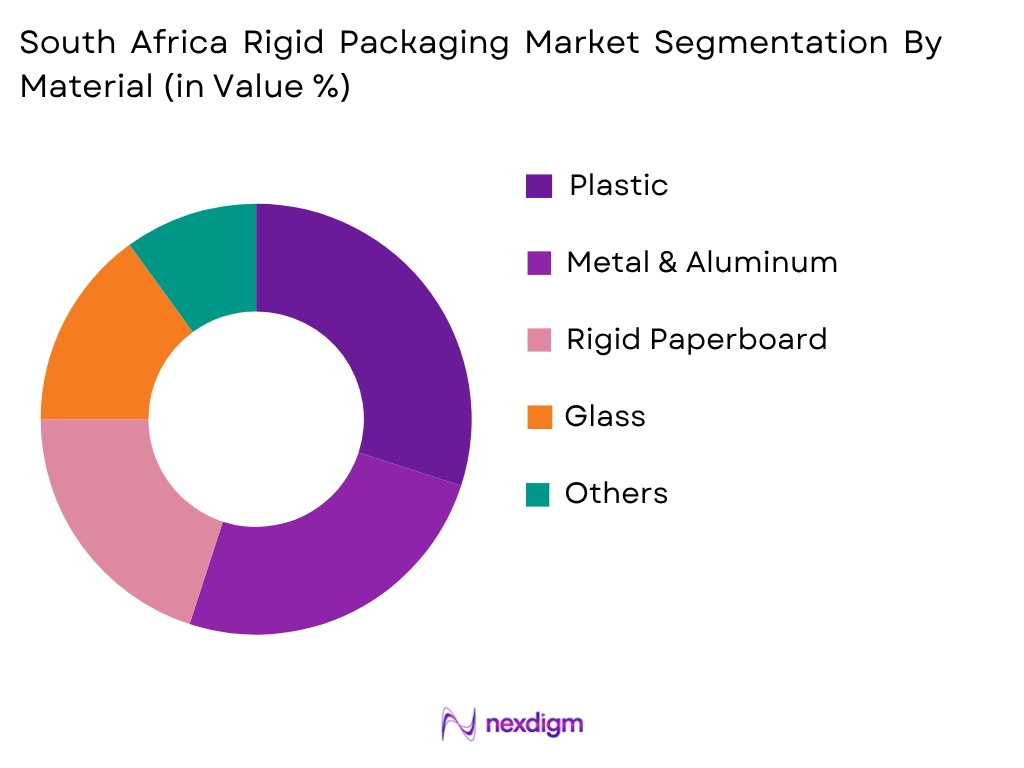
Among these, Plastic, encompassing PET, HDPE, and PP, dominates the South Africa Rigid Packaging Market, with polyethylene holding a major share given its use across food, non-alcoholic beverage, and industrial bulk applications. Bottles and jars accounted for 41.98% of the broader South Africa plastic packaging market in 2025 revenue, driven by beverage and personal-care fills, while superior carbonation retention and shatter resistance maintain PET’s advantage over glass, particularly for carbonated soft drinks and flavored waters. Recent line upgrades at a USD 68 million PET bottle plant added solar-powered capacity that supplies 3.5 billion units a year, underscoring investor confidence in rigid container demand despite resin benchmark prices climbing sharply in 2025, with PET averaging USD 1.13 per kilogram, a 27.8% rise year-on-year according to ICIS. Glass retains a meaningful niche for premium alcoholic beverages, though PET’s cost and weight advantages continue to erode glass’s traditional share in select beverage categories.
By Product Type
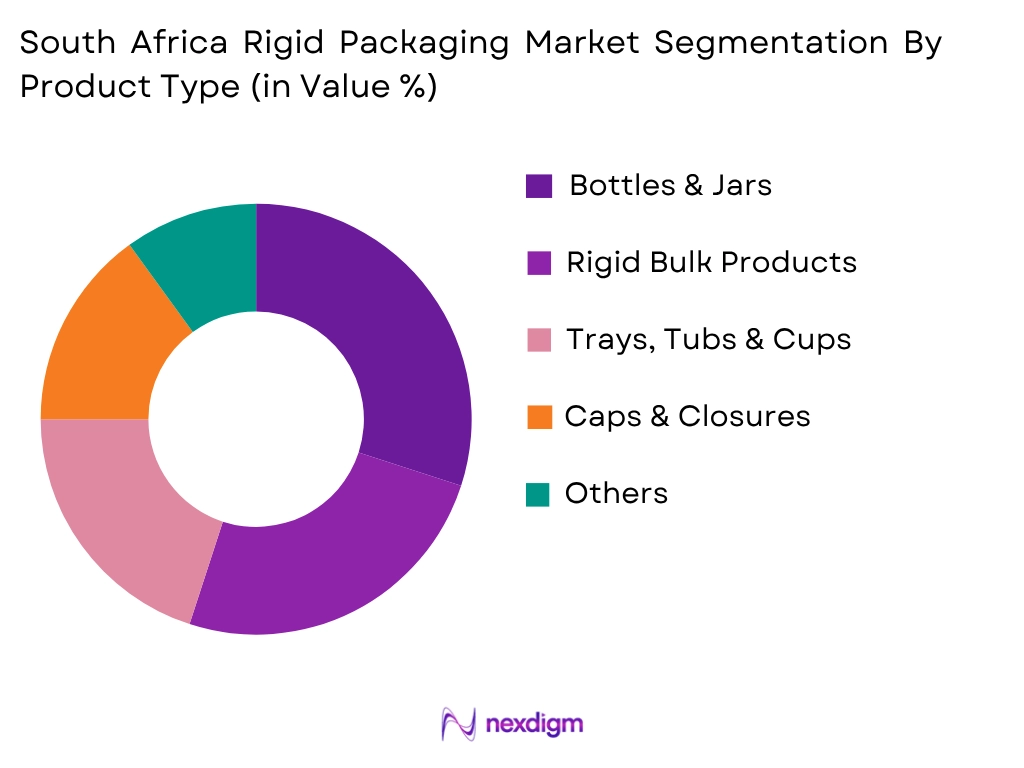
The Bottles & Jars segment holds the highest market share within the South Africa Rigid Packaging Market, driven by the growing food and beverage sector and increasing demand for rigid plastic packaging solutions across end-use industries. Mpact Group’s November 2023 gold medal win at the IPSA Gold Pack Awards, for a PET bottle innovatively crafted using Integrated Moulded Handle (IMH) technology, illustrates the continued innovation within this dominant product category. ALPLA’s May 2024 unveiling of a recyclable wine bottle crafted from PET, weighing just 50 grams and approximately eight times lighter than its glass counterpart, with a target of producing 1 million units by 2025, further demonstrates the segment’s innovation trajectory. Rigid Bulk Products, including drums and pails, represent a significant secondary category, exemplified by Mauser Packaging Solutions’ August 2024 acquisition of a South African business specializing in the manufacture and supply of plastic drums, including large rigid variants, reinforcing the segment’s connection to South Africa’s industrial and chemical sectors.
Competitive Landscape
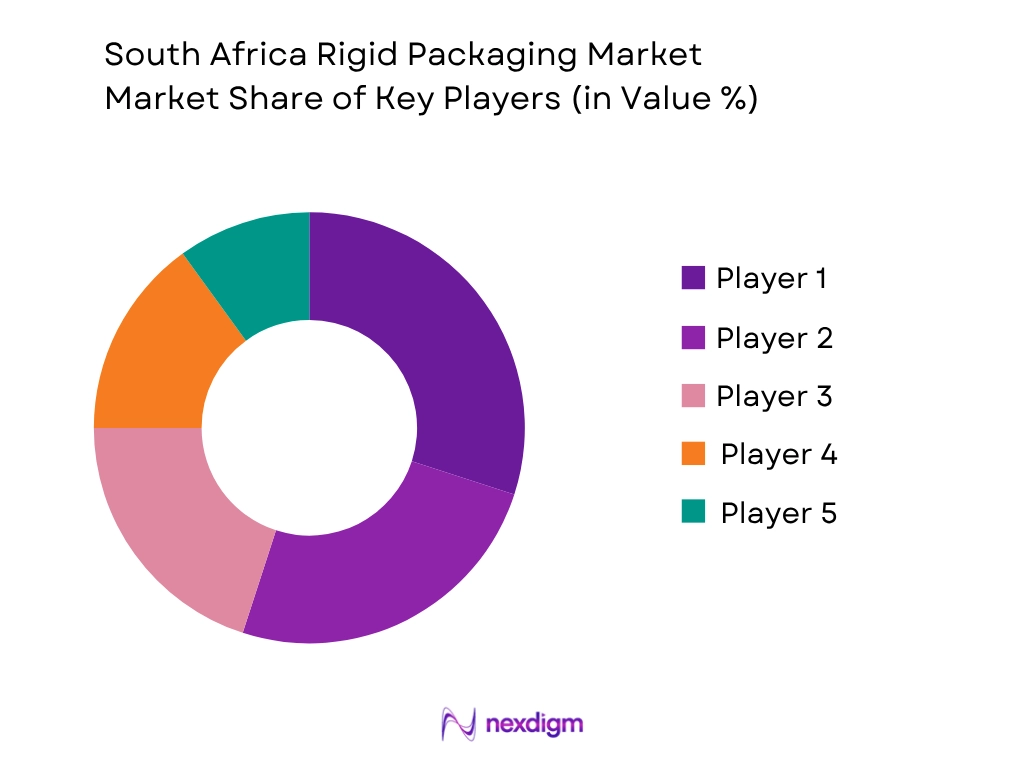
The South Africa Rigid Packaging Market is moderately consolidated, with established domestic rigid plastics and glass manufacturers competing alongside multinational packaging conglomerates that maintain substantial local manufacturing operations. Competition is primarily based on manufacturing capacity, PET and blow-moulding technology, recycled content integration, regulatory compliance with NRCS and PETCO standards, and the ability to serve South Africa’s food, beverage, and industrial sectors. Polyoak Packaging Group, a long-established South African rigid plastics manufacturer, competes alongside Nampak Limited, Africa’s largest diversified packaging company founded in 1968, and Mpact Limited, South Africa’s largest paper and plastics packaging business, which won the IPSA Gold Pack Award in November 2023 for its Integrated Moulded Handle PET bottle technology. Berry Astrapak, which sold a significant minority interest to private equity firm Agile Capital in July 2024, concentrates on rigid molded and thermoformed plastic packaging production across manufacturing sites in Gauteng, Western Cape, and KwaZulu-Natal. International players including ALPLA, which manages 13 plants and four joint ventures with local firms in South Africa, and Amcor continue to compete on the strength of their global PET lightweighting and recycled content innovation.
| Company | Established | Headquarters | Primary Product Portfolio | Rigid Packaging Portfolio | Manufacturing Presence | Major End-Use Industries | Key Strategic Focus | Certifications & Compliance |
| Polyoak Packaging Group | 1976 | ~ | ~ | ~ | ~ | ~ | ~ | ~ |
| Nampak Limited | 1968 | ~ | ~ | ~ | ~ | ~ | ~ | ~ |
| Mpact Limited | 2011 | ~ | ~ | ~ | ~ | ~ | ~ | ~ |
| ALPLA Werke Alwin Lehner | 1955 | ~ | ~ | ~ | ~ | ~ | ~ | ~ |
| Amcor plc | 1860 | ~ | ~ | ~ | ~ | ~ | ~ | ~ |
South Africa Rigid Packaging Market Analysis
Growth Drivers
Growth of Modern Retail and Packaged Goods Consumption
The South Africa Rigid Packaging Market is experiencing sustained growth due to the expanding retail sector, marked by the rise of supermarkets and hypermarkets, which amplifies demand for durable and aesthetically pleasing rigid packaging solutions. These retail outlets require packaging that not only attracts consumers but also maintains product integrity, reinforcing sustained demand for rigid plastic bottles, jars, and containers across food, beverage, and personal care categories. Increasing disposable incomes across South Africa and rapid urbanization continue to drive evolving consumer preferences favoring packaged goods, while technological advancements in plastic processing facilitate the production of lighter, more cost-effective rigid packaging formats that support the retail sector’s continued expansion across the country’s major metropolitan centers.
Recycled Content Mandates and PETCO-Driven Circularity
South Africa’s well-developed recycling infrastructure, anchored by PETCO’s 71% bottle recovery rate recorded in 2024, continues to enable a sizable recycled PET supply that supports closed-loop rigid bottle production and drives sustained investment in recycling-compatible packaging design. This recovery infrastructure has positioned South Africa as a regional leader in PET circularity, encouraging major rigid packaging manufacturers to develop recyclable and recycled-content product lines, exemplified by Amcor’s April 2024 unveiling of a one-litre PET bottle crafted entirely from 100% post-consumer recycled content for carbonated soft drinks. The growing regulatory and consumer expectation for recycled content, combined with South Africa’s relatively mature bottle collection infrastructure compared with other African markets, continues to reinforce sustained investment in circular rigid packaging technology across the country’s beverage and personal care sectors.
Market Challenges
Resin Price Volatility
The South Africa Rigid Packaging Market faces significant challenges from resin price volatility that continues to pressure manufacturer margins. Resin benchmark prices climbed sharply in 2025, with polyethylene terephthalate averaging USD 1.13 per kilogram, a 27.8% rise year-on-year according to ICIS, and local converters struggled to absorb these surcharges, with at least one major player closing a rigid-packaging mill after prolonged margin pressure. This volatility particularly affects converters reliant on imported polymer feedstocks, requiring manufacturers to hedge input costs through multi-supplier contracts and increasingly explore recycled PET alternatives to manage exposure to resin price swings that continue to complicate long-term capacity planning across South Africa’s rigid packaging value chain.
Import Dependency for Specialty Resins
The South Africa Rigid Packaging Market faces ongoing challenges related to import dependency for specialty resins and packaging components not produced at sufficient scale domestically. Local manufacturers remain significantly affected by currency volatility and rising production costs associated with imported polymer feedstocks, forcing packaging companies to either absorb losses or pass on price increases to food, beverage, and industrial customers. This dependency creates persistent margin pressure and supply chain risk for rigid packaging manufacturers, particularly given South Africa’s exposure to global resin price fluctuations and the logistical complexity of importing specialty materials required for high-performance rigid packaging applications.
Market Opportunities
Recyclable PET Innovation and Lightweighting
Growing investment in recyclable PET innovation and lightweighting technology presents substantial opportunities for rigid packaging manufacturers operating in South Africa. ALPLA’s May 2024 unveiling of a recyclable wine bottle crafted from PET, weighing just 50 grams and approximately eight times lighter than its glass counterpart, with a target of producing 1 million units by 2025, exemplifies the scale of opportunity in lightweight, recyclable rigid packaging innovation. Combined with PETCO’s 71% bottle recovery rate providing a robust recycled PET supply base, manufacturers capable of developing cost-competitive, lightweight recyclable rigid packaging formats are well positioned to capture growing demand from sustainability-conscious beverage and personal care brands across South Africa and the broader regional market.
Solar-Powered Manufacturing Capacity Expansion
The growing adoption of solar-powered manufacturing capacity presents meaningful opportunities for rigid packaging manufacturers seeking to reduce energy costs and carbon footprint amid South Africa’s ongoing electricity supply challenges. Recent line upgrades at a USD 68 million PET bottle plant added solar-powered capacity that supplies 3.5 billion units a year, demonstrating investor confidence in combining renewable energy infrastructure with large-scale rigid packaging production. This trend toward energy-independent manufacturing facilities creates opportunities for rigid packaging companies to reduce operational cost volatility associated with South Africa’s electricity grid constraints while simultaneously strengthening sustainability credentials increasingly demanded by multinational beverage and consumer goods customers.
Future Outlook
The South Africa Rigid Packaging Market is expected to witness sustained expansion over the forecast period, supported by continued growth in modern retail and packaged goods consumption, ongoing PETCO-driven recycled content circularity, and expansion of industrial bulk packaging for the country’s chemical and lubricant sectors. Continued investment in lightweight, recyclable PET innovation and solar-powered manufacturing capacity is expected to strengthen the market’s sustainability credentials and cost competitiveness. The market is also likely to benefit from continued consolidation activity and growing regional export orientation, supporting long-term growth across food and beverage, pharmaceutical, personal care, and industrial rigid packaging applications.
Major Players
- Polyoak Packaging Group
- Nampak Limited
- Mpact Limited
- ALPLA Werke Alwin Lehner
- Amcor plc
- Bowler Metcalf (Bowler Packaging)
- Berry Astrapak (Berry Global)
- Silafrica
- PXD Plastics
- Teqal
- Mauser Packaging Solutions
- Consol Glass
- Sonoco Products Company
- Berry Global Inc.
- Silgan Holdings Inc.
Key Target Audience
- Rigid Packaging Manufacturers and Converters
- Food & Beverage Companies
- Pharmaceutical and Healthcare Companies
- Personal Care and Cosmetics Companies
- Industrial Chemical and Lubricant Companies
- Recycling and Waste Management Companies
- Investment and Venture Capitalist Firms
- Government and Regulatory Bodies (National Regulator for Compulsory Specifications (NRCS), Department of Trade, Industry and Competition (DTIC), Department of Forestry, Fisheries and the Environment (DFFE))
- Raw Material Suppliers and Resin Distributors
Research Methodology
Step 1: Identification of Key Variables
The research process begins with identifying the complete ecosystem of the South Africa Rigid Packaging Market, including raw material suppliers, packaging manufacturers, converters, food and beverage companies, retailers, and regulatory authorities. Extensive secondary research is conducted using company annual reports, government publications, trade associations, customs statistics, industry journals, and proprietary databases to determine the variables influencing market demand, pricing, production, consumption, and technological developments.
Step 2: Market Analysis and Construction
Historical market information is collected and analyzed to estimate market size, production volumes, import-export activity, application-wise demand, and pricing trends. A combination of top-down and bottom-up approaches is used to estimate market revenues and validate segment-level performance. Consumption patterns across food, beverages, pharmaceuticals, and industrial applications are evaluated to establish an accurate representation of the industry.
Step 3: Hypothesis Validation and Expert Consultation
The preliminary findings are validated through Computer-Assisted Telephone Interviews (CATIs) and structured discussions with rigid packaging manufacturers, procurement managers, converters, food and beverage executives, regulatory experts, and senior executives operating within the South African packaging industry. These interviews help verify market assumptions, competitive developments, technology adoption trends, pricing dynamics, and future investment opportunities while refining the overall market estimates.
Step 4: Research Synthesis and Final Output
The final stage integrates insights obtained from primary interviews with quantitative information collected through secondary sources. Data triangulation techniques are applied to reconcile differences between supply-side and demand-side estimates, ensuring robust market forecasting. The report is then reviewed through multiple quality assurance checkpoints to deliver a comprehensive analysis covering market size, segmentation, competitive landscape, future outlook, and strategic recommendations for industry stakeholders.

- Executive Summary
- Research Methodology (Market Definitions and Assumptions, Abbreviations, Market Sizing Approach, Top-Down Analysis, Bottom-Up Analysis, Demand-Side Assessment, Supply-Side Assessment, Primary Industry Interviews, Secondary Research Validation, Data Triangulation, Forecasting Framework, Limitations and Future Conclusions)

- Definition and Scope
- Market Evolution and Industry Genesis
- Timeline of Major Industry Developments
- Rigid Packaging Industry Value Chain Analysis
- Supply Chain Analysis

- Growth Drivers (Growth of Modern Retail and Packaged Goods Consumption, Recycled Content Mandates and PETCO-Driven Circularity, Expansion of Industrial Bulk Packaging for Chemicals and Lubricants, Rising Urbanization and Disposable Income, Premiumization of Beverage Packaging, E-Commerce Growth)
- Market Challenges (Resin Price Volatility, Import Dependency for Specialty Resins, Currency Volatility and Rising Input Costs, High Implementation Costs, Regulatory Compliance Complexity)
- Market Opportunities (Recyclable PET Innovation and Lightweighting, Tethered Closure and EU-Aligned Design Innovation, Solar-Powered Manufacturing Capacity Expansion, Regional SADC Export-Oriented Manufacturing, Industrial Bulk Container Recycling)
- Market Trends (Shift Toward Lightweight Recyclable PET, Growth of Tethered Cap Designs, Solar-Powered Production Facility Investment, Integrated Moulded Handle Technology Adoption, Consolidation Through Mergers and Acquisitions)
- Government Regulations (Section 18 Extended Producer Responsibility Plan, National Regulator for Compulsory Specifications (NRCS), Plastics SA Industry Standards, National Environmental Management Waste Act, PETCO Recycling Framework)
- Import and Export Analysis (Trade Volume, Major Import Sources, Export Destinations, HS Code Analysis, Trade Balance)
- Raw Material Availability Analysis (Polyethylene Terephthalate (PET), Polyethylene, Polypropylene, Recycled PET (rPET), Glass Cullet)
- Technology Landscape (Injection-Stretch-Blow Moulding, Extrusion Blow Moulding, Integrated Moulded Handle Technology, Solar-Powered Manufacturing, Lightweighting Technology)
- Sustainability Assessment (Recycled Content Adoption, PETCO Bottle Recovery Programs, Tethered Closure Design, Carbon Footprint Reduction, Circular Economy Partnerships)
- PESTLE Analysis
- SWOT Analysis
- Porter’s Five Forces Analysis
- Stakeholder Ecosystem
- Competition Ecosystem

- By Market Value (2020-2025)
- By Volume Consumption (2020-2025)
- By Average Selling Price (2020-2025)

- By Material (In Value %)
Plastic (PET, HDPE & PP)
Glass
Metal & Aluminum
Rigid Paperboard - By Product Type (In Value %)
Bottles & Jars
Rigid Bulk Products (Drums & Pails)
Trays, Tubs & Cups
Caps & Closures - By Application (In Value %)
Food & Non-Alcoholic Beverages
Alcoholic Beverages
Pharmaceuticals & Healthcare
Personal Care & Cosmetics
Industrial & Household Chemicals - By Region (In Value %)
Gauteng
Western Cape
KwaZulu-Natal
Eastern Cape & Other Provinces

- Market Share of Major Players (By Value, Volume, Material, Application Industry, Product Category)
- Cross Comparison Parameters (Product Portfolio Breadth, PET and Blow-Moulding Capability, Application Technical Support Capability, Manufacturing Capacity, Regulatory Compliance & Certifications, Beverage Customer Base, Innovation & New Product Launch Frequency)
- SWOT Analysis of Major Players
- Pricing Analysis by Product Category and SKU
- Production Capacity Analysis
- Manufacturing Footprint Analysis
- Distribution Network Analysis
- Innovation Benchmarking
- Detailed Profiles of Major Companies
Polyoak Packaging Group
Nampak Limited
Mpact Limited
ALPLA Werke Alwin Lehner
Amcor plc
Bowler Metcalf (Bowler Packaging)
Berry Astrapak (Berry Global)
Silafrica
PXD Plastics
Teqal
Mauser Packaging Solutions
Consol Glass
Sonoco Products Company
Berry Global Inc.
Silgan Holdings Inc.

- Consumption Pattern Analysis (Industrial Usage, Batch Size, Product Category Penetration, Seasonal Demand, Reformulation Activity)
- Purchasing Criteria (Structural Strength, Regulatory Compliance, Cost Efficiency, Recyclability, Barrier Performance, Supply Reliability)
- Procurement and Supplier Selection Analysis
- Sustainable Packaging Adoption Assessment
- Premium vs Conventional Packaging Demand
- Product Attribute Preference Analysis (Top-Load Strength, Print Quality, Seal Integrity, Recyclability, Weight Reduction, Tamper Evidence)
- Consumer Sustainability Preference Influence on Product Development
- Pain Point Analysis
- Decision-Making Process

- By Market Value (2026-2035)
- By Volume Consumption (2026-2035)
- By Average Selling Price (2026-2035)


 Request a Sample
 Ask for Customization
 Get a Quote
 Enquire Now