

 Download PDF
Market Overview
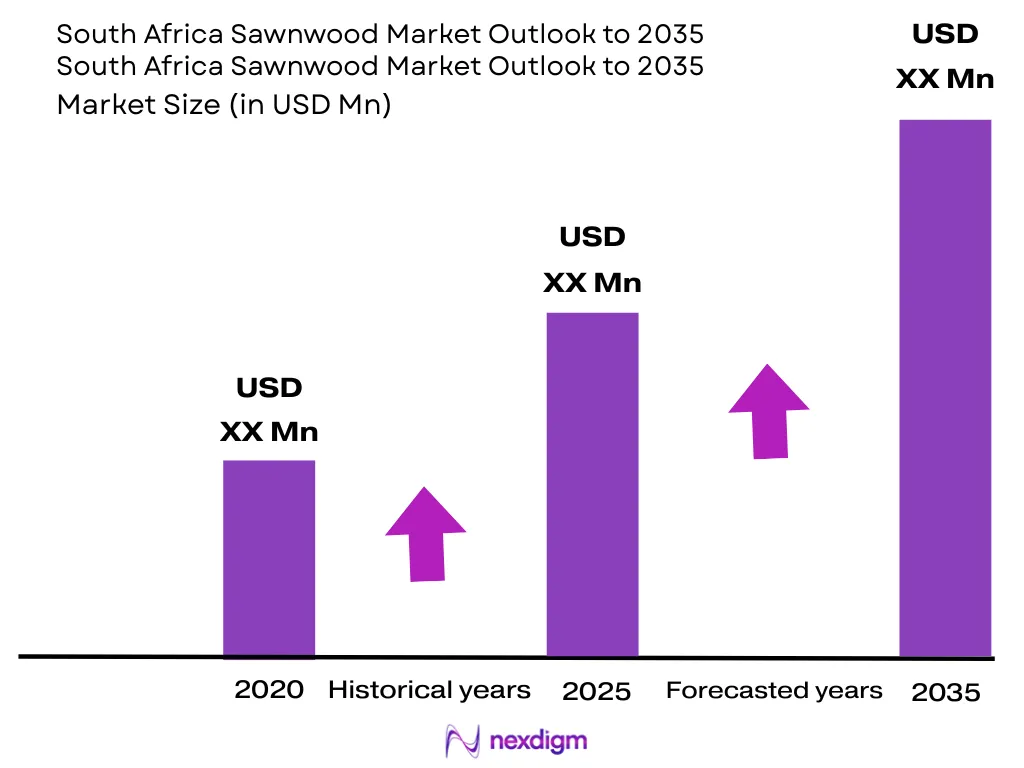
The South Africa Sawnwood Market was valued at approximately USD ~ Million in 2024, underpinned by the country’s position as Africa’s most industrialised forestry economy and the continent’s largest producer of plantation-grown softwood lumber. According to data published by the Food and Agriculture Organization, the Department of Agriculture, Land Reform and Rural Development (DALRRD), and the South African Forestry Company Limited (SAFCOL), South Africa’s commercial forestry sector manages approximately 1.27 million hectares of plantation forest, predominantly comprising pine and eucalyptus species established across the high-rainfall coastal and escarpment regions of Mpumalanga, KwaZulu-Natal, the Western Cape, and Limpopo. The country possesses a well-developed sawmilling and wood processing industry supplying sawnwood to domestic construction, mining, furniture manufacturing, packaging, and agricultural sectors, while also exporting processed timber to regional Sub-Saharan African markets. Demand is primarily driven by residential construction activity, government-funded affordable housing delivery programmes, the country’s significant mining sector timber requirements, furniture manufacturing output, and the sustained consumption of treated pine products across construction, agricultural, and infrastructure applications throughout the nine provinces.
Market Segmentation
By Wood Species Type
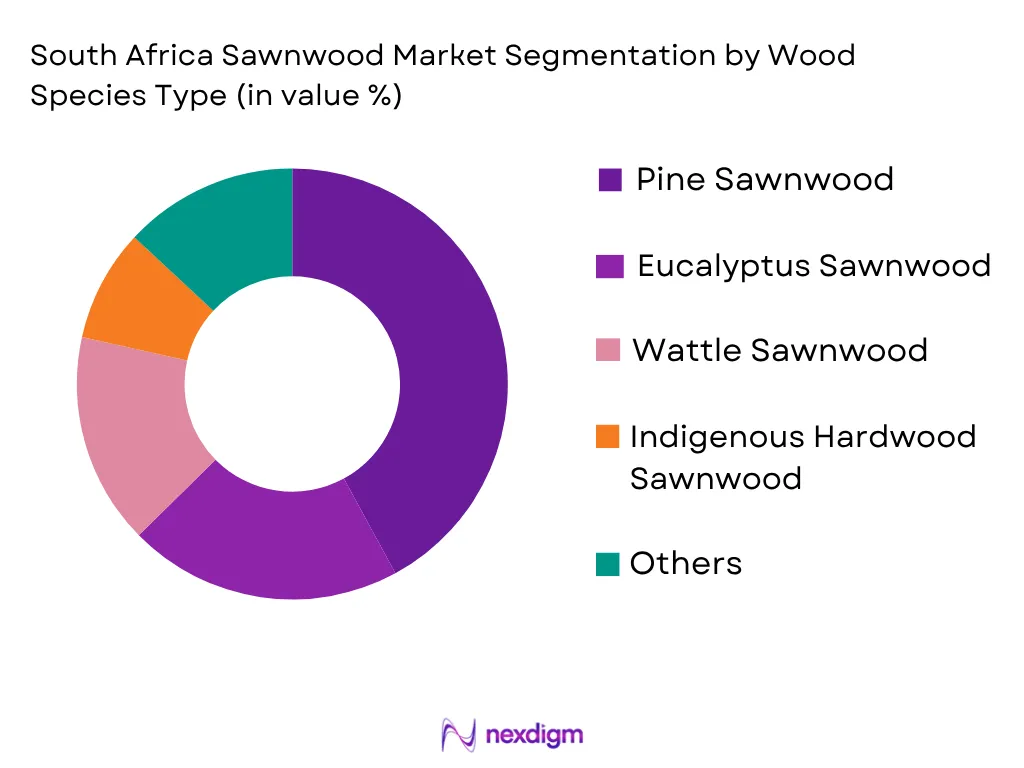
South Africa Sawnwood Market is segmented by wood species type into Pine Sawnwood, Eucalyptus Sawnwood, Wattle Sawnwood, Indigenous Hardwood Sawnwood, Imported Tropical Hardwood Sawnwood, and Other Commercial Species. Pine Sawnwood holds the dominant market share by a substantial margin, reflecting the extensive softwood plantation base established across the Mpumalanga escarpment, KwaZulu-Natal Midlands, the Western Cape George region, and Limpopo, which has been developed over more than a century of commercial plantation forestry. Pinus patula, Pinus elliottii, and Pinus taeda are the primary plantation species, collectively yielding large volumes of structural, utility, and appearance-grade sawnwood for domestic and export markets. Pine sawnwood’s dominance is reinforced by its broad suitability across construction framing, roof trusses, flooring, formwork, furniture substrate, and mining timber applications, combined with the well-established pressure treatment sector that converts significant proportions of green pine into CCA-treated and LOSP-treated products for outdoor, agricultural, and mining end uses. The South African pine sawmilling sector benefits from a mature industrial structure anchored by large integrated operators including York Timbers, Merensky Timber, PG Bison, and Komatiland Forests, which manage significant plantation areas and operate high-capacity sawmill facilities with established domestic distribution networks and export marketing capabilities. Eucalyptus Sawnwood is the second-largest segment, processed from Eucalyptus grandis, Eucalyptus nitens, and hybrid plantations primarily in KwaZulu-Natal and Mpumalanga, serving mining timber, pallet, packaging, and industrial flooring markets.
By End-Use Industry
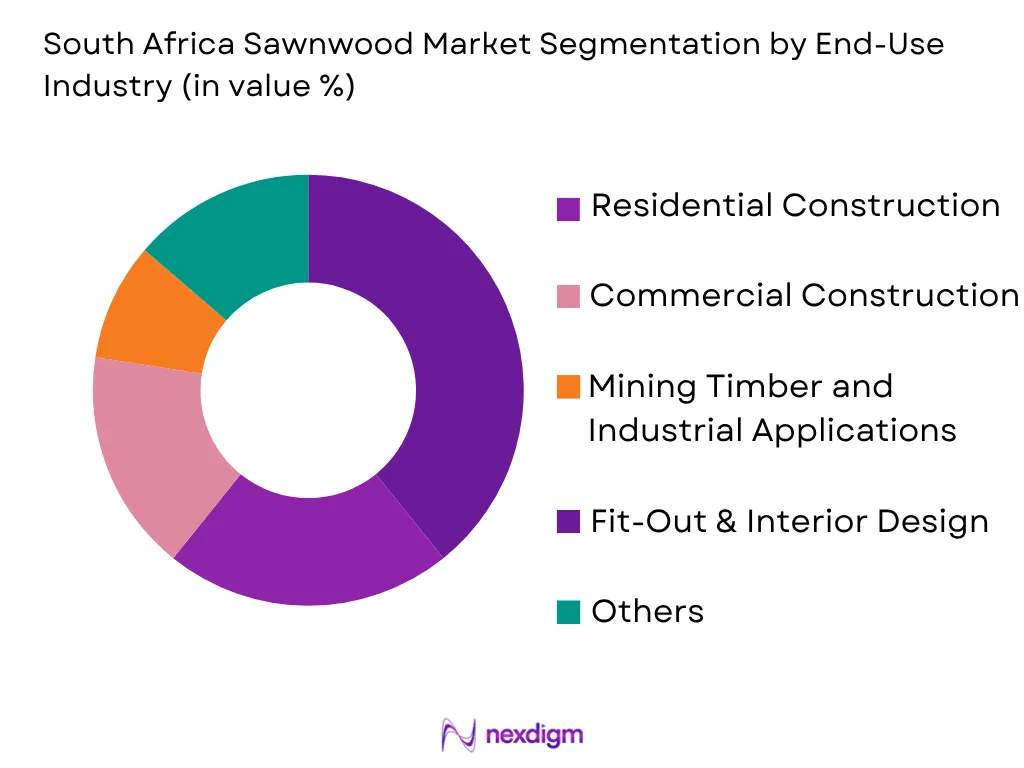
South Africa Sawnwood Market is segmented by end-use industry into Residential Construction, Commercial Construction, Mining Timber and Industrial Applications, Furniture Manufacturing, Packaging & Pallets, Joinery & Interior Applications, and Agricultural & Infrastructure Applications. Residential Construction represents the largest market segment, driven by the structural housing backlog that persists across South African urban and peri-urban areas, ongoing government Reconstruction and Development Programme (RDP) and Breaking New Ground (BNG) housing delivery, private residential development in major metropolitan areas, and substantial informal sector self-build construction activity that consumes structural pine and treated timber products. South Africa’s housing backlog, estimated at over two million units according to the Department of Human Settlements, generates long-term and persistent demand for affordable structural sawnwood across all construction-active provinces. Mining Timber and Industrial Applications constitute a uniquely significant segment within the South African sawnwood market, reflecting the country’s large and historically important deep-level gold, platinum, chrome, and coal mining sectors, which have traditionally consumed substantial volumes of round and sawn timber for underground shaft lining, stope support, and mine infrastructure applications. Although mechanised mining methods have partially substituted timber supports in some operations, the sector remains a meaningful consumer of mine prop timber and structural sawnwood. Furniture Manufacturing generates demand for appearance-grade pine, eucalyptus, and imported hardwood sawnwood across the established domestic furniture and cabinet-making industry, with production concentrated in the Western Cape, Gauteng, and KwaZulu-Natal.
Competitive Landscape
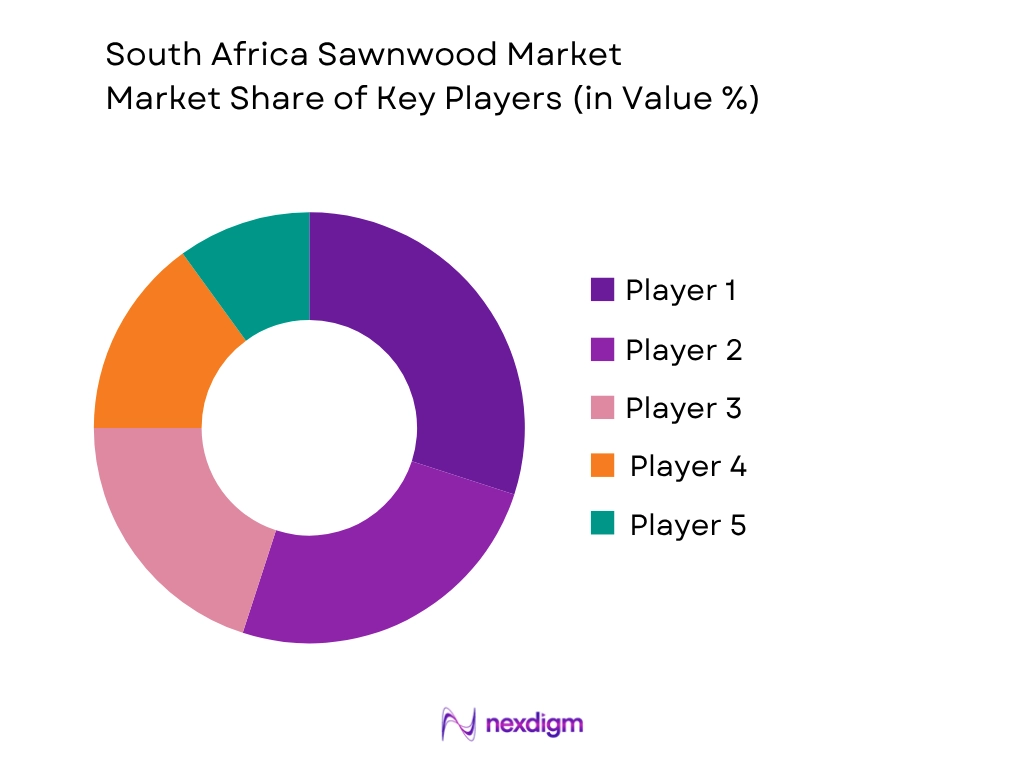
The South Africa Sawnwood Market is moderately consolidated, with a small number of large integrated plantation forestry and sawmilling groups accounting for the majority of domestic sawnwood production, alongside a larger number of independent medium and small sawmill operators, timber traders, and specialist treated timber producers. The market’s structure reflects South Africa’s established commercial plantation forestry sector, in which major players including PG Bison, Sappi, Mondi, York Timbers, and Merensky manage their own plantation resources and operate vertically integrated processing facilities. State-owned entities including SAFCOL and its subsidiary Komatiland Forests manage government plantation assets and sawmill operations. B-BBEE transformation requirements under the Forestry Sector Charter have influenced ownership structures and created opportunities for community forestry and emerging timber entrepreneur participation in the value chain. Companies with FSC and PEFC certification are well-positioned to access premium export markets in Europe, the United Kingdom, and the Middle East, as well as compliant domestic procurement channels serving major construction, retail, and institutional buyers.
| Company | Establishment Year | Headquarters | Plantation Assets | Sawmill Capacity | FSC/PEFC Certification | Export Presence | Product Portfolio | End-Use Focus |
| PG Bison (Pty) Ltd | 1966 | ~ | ~ | ~ | ~ | ~ | ~ | ~ |
| Sappi Southern Africa (Timber Division) | 1936 | ~ | ~ | ~ | ~ | ~ | ~ | ~ |
| Mondi South Africa (Timber Division) | 1967 | ~ | ~ | ~ | ~ | ~ | ~ | ~ |
| York Timbers (Pty) Ltd. | 1919 | ~ | ~ | ~ | ~ | ~ | ~ | ~ |
| Merensky Timber (Pty) Ltd. | 1953 | ~ | ~ | ~ | ~ | ~ | ~ | ~ |
South Africa Sawnwood Market Analysis
Growth Drivers
Established Commercial Plantation Forestry and Integrated Sawmill Sector
South Africa’s sawnwood industry is anchored by one of the African continent’s most productive and well-established commercial plantation forestry sectors, developed over more than a century of organised timber growing across suitable high-rainfall regions. According to the Department of Agriculture, Land Reform and Rural Development (DALRRD) and the Forestry South Africa industry association, South Africa manages approximately 1.27 million hectares of commercial plantation forest, with softwood species accounting for approximately 51% and hardwood species the remainder. Mpumalanga, KwaZulu-Natal, and the Western Cape represent the three primary plantation provinces, each supporting integrated networks of sawmills, pulp mills, board plants, and downstream processing facilities. The South African Forestry Company Limited (SAFCOL), PG Bison, Merensky Timber, York Timbers, and NCT Forestry Co-operative collectively manage large plantation estates supplying vertically integrated processing operations with a stable and consistent log input base. South Africa’s plantation timber yields are among the highest globally for comparable species, with Pinus patula achieving rotation cycles of approximately 25 to 30 years in high-productivity sites, generating log volumes suitable for sawmilling, pulp, and panel production. This mature plantation resource, combined with a skilled forestry workforce, established silvicultural knowledge base, and well-capitalised processing infrastructure, provides the South African sawnwood sector with a durable competitive foundation relative to other Sub-Saharan African timber markets. Ongoing private sector investment in plantation management, clonal improvement programmes, and sawmill capital upgrades further strengthens the long-term productivity and competitiveness of the domestic sawnwood supply base.
Residential Construction Demand and Government Housing Programmes
South Africa’s sawnwood market benefits from persistent structural demand driven by the country’s significant housing backlog and ongoing government affordable housing delivery programmes, which generate consistent consumption of structural pine, treated timber, and construction-grade sawnwood across all nine provinces. The Department of Human Settlements’ Breaking New Ground (BNG) programme and associated provincial housing delivery mechanisms have maintained a sustained pipeline of subsidised housing construction activity, generating recurring demand for roof truss systems, wall framing, door and window frames, and floor structures manufactured from domestic plantation pine. South Africa’s housing backlog, reflecting decades of urbanisation, population growth, and historical inequalities in housing provision, ensures that government housing delivery remains a long-term and structurally embedded driver of construction-grade sawnwood consumption. Private residential development in Gauteng, the Western Cape, and KwaZulu-Natal generates additional demand for higher-grade appearance and structural sawnwood, with growing consumer preference for engineered timber roof systems, timber-frame modular construction, and wood-finished interior applications supporting broader market development. The rapid expansion of South Africa’s townships and peri-urban areas generates substantial informal sector timber consumption, with structural pine and treated timber widely used in informal and incremental housing construction. Government urban renewal, social infrastructure, and public facility construction programmes further contribute to stable public sector timber procurement volumes, providing a baseline demand foundation for sawmill operators and building material distributors across the country’s major consumption centres in Johannesburg, Cape Town, Durban, Tshwane, and Ekurhuleni.
Market Challenges
Load Shedding, Energy Supply Constraints, and Operational Cost Pressures
The South African sawnwood industry faces severe operational challenges arising from the country’s prolonged electricity supply crisis, commonly referred to as load shedding, which has imposed substantial cost burdens, productivity losses, and capital investment requirements on sawmill operators and downstream wood processing enterprises throughout the sector. Eskom’s inability to meet national electricity demand has resulted in structured rotational power outages that at their peak reached Stage 6 load shedding, equivalent to more than ten hours of daily power interruption, severely disrupting sawmill production schedules, kiln-drying operations, planer mill throughput, and treatment plant processes that depend on continuous and reliable electricity supply. Sawmills are highly energy-intensive operations requiring consistent power for log debarking, bandsaw and frame saw processing, edging, trimming, drying kiln operation, and materials handling systems, all of which are adversely affected by intermittent electricity supply. The cost of diesel-powered generator backup systems to maintain production continuity during load shedding has added substantially to sawmill operating costs, eroding margins and reducing the industry’s competitiveness relative to imported lumber. Additional cost pressures arise from fuel price inflation, rising road freight costs driven by diesel price increases, deteriorating municipal road infrastructure in plantation regions, and escalating security costs related to timber theft from plantation estates and sawmill premises. These systemic infrastructure and cost pressures constrain sawmill capital investment, operational efficiency improvements, and workforce development programmes, presenting significant challenges for the competitiveness and growth of the South African sawnwood sector.
Rail and Logistics Infrastructure Deterioration and Market Access Constraints
The deterioration of South Africa’s rail freight network under Transnet Freight Rail has imposed significant additional logistics costs and market access constraints on the sawnwood industry, which historically relied on rail transport for cost-efficient movement of sawnwood from plantation regions in Mpumalanga, KwaZulu-Natal, and the Western Cape to major consumption centres and export ports. Transnet Freight Rail’s operational performance has declined substantially in recent years due to locomotive shortages, infrastructure maintenance backlogs, cable and equipment theft, and managerial challenges, reducing reliable rail capacity available to timber shippers. The consequent shift of sawnwood transport from rail to road has increased logistics costs per cubic metre, added to carbon footprint, and increased road wear on routes connecting plantation regions to processing facilities and markets. Port operational inefficiencies at Durban, Richards Bay, and Cape Town, including equipment failures, labour disruptions, and vessel queuing delays, have periodically constrained South African sawnwood export competitiveness and increased the cost and lead time of export shipments to regional and international markets. The dilapidation of provincial roads in key forestry regions, including Mpumalanga’s plantation access routes, increases vehicle operating costs and limits the weight and volume of loads that can be economically transported. Sustained underinvestment in freight rail and port infrastructure presents a structural competitiveness constraint for the South African sawnwood sector that requires coordinated government and private sector remediation to address effectively over the forecast period.
Market Opportunities
FSC-Certified Timber Export Growth and Sub-Saharan Africa Regional Markets
South Africa’s well-established FSC and PEFC plantation certification programmes and mature sawmill export capabilities position the country to capture growing export market opportunities in the United Kingdom, European Union, Middle East, and Sub-Saharan African regional markets, where demand for certified, legally sourced, and sustainably produced timber products is increasing consistently. According to Forestry South Africa and the South African Wood and Panel Federation (SAWPF), South Africa exports sawnwood and wood products to multiple international destinations, with certified pine and eucalyptus lumber products attracting premium pricing in sustainability-conscious European and British markets. The UK’s Timber Procurement Policy, EU Deforestation Regulation compliance requirements, and Middle Eastern green building specification frameworks all create demand pull for certified South African sawnwood from verified plantation supply chains with documented chain-of-custody systems. Sub-Saharan African regional markets, including Zambia, Zimbabwe, Mozambique, Botswana, Namibia, Angola, and Tanzania, represent growing and geographically proximate export opportunities for South African sawnwood producers, leveraging established road and rail freight connections and long-standing regional trade relationships. The rapid urbanisation and construction sector growth across southern and eastern African economies creates substantial incremental timber demand that South African producers are well-positioned to serve, given their production scale, species range, and logistics connectivity advantages. Deepening integration within the African Continental Free Trade Area (AfCFTA) framework is expected to progressively reduce intra-African trade barriers, improving South African sawnwood export competitiveness in regional markets through the forecast period.
Value-Added Processing Expansion and Engineered Timber Product Development
South Africa’s established plantation resource and integrated processing industry provide a strong foundation for expanding value-added sawnwood processing capabilities, developing engineered timber products, and capturing higher margins from the country’s well-managed plantation timber resource. The domestic market for roof truss systems, pre-fabricated timber frame wall panels, finger-jointed structural lumber, and laminated timber products has grown consistently as residential and commercial construction contractors seek faster build programmes and improved structural performance from wood-based building systems. Investment in continuous kiln-drying capacity, structural grading automation, finger-jointing lines, and engineered laminated timber manufacturing would enable South African sawmills to supply higher-value processed products to domestic construction markets and reduce raw material waste through improved log conversion efficiency. The growing global interest in mass timber construction, including cross-laminated timber and glulam structural systems, represents an emerging export opportunity for South African processors with access to high-quality, certified plantation pine and eucalyptus logs suitable for lamstock production. Development of domestic CLT manufacturing capability, drawing on New Zealand, Australian, and European industry models, could open significant new market segments in commercial, institutional, and multi-storey residential construction that are currently dominated by concrete and steel structural systems. Government support for forestry sector beneficiation, value-added manufacturing incentives under the Department of Trade, Industry and Competition (dtic) industrial policy frameworks, and B-BBEE transformation requirements that encourage downstream processing investment represent enabling conditions for value-added sawnwood sector development through 2035.
Future Outlook
The South Africa Sawnwood Market is expected to witness moderate growth over the forecast period, supported by persistent structural housing demand, ongoing government affordable housing delivery programmes, gradual recovery in construction sector activity, and growing export market opportunities in Sub-Saharan Africa and certified timber-demanding international markets. Resolution of the electricity supply crisis through accelerated private power generation investment and Eskom restructuring is expected to progressively reduce load shedding impacts on sawmill productivity and operational costs, improving industry competitiveness and capital investment confidence. Rehabilitation of Transnet Freight Rail operations and targeted road infrastructure maintenance in key forestry regions would further reduce logistics costs and improve market access for plantation region sawmill operators. Progressive expansion of FSC and PEFC certified plantation area, combined with growing international demand for verified sustainable timber, is expected to support premium pricing and export market development for certified South African sawnwood producers. Investment in value-added processing, engineered timber product manufacturing, and sawmill modernisation will be critical for improving the sector’s competitiveness, capturing higher margins from the plantation timber resource, and developing new market segments both domestically and across the Sub-Saharan African region through 2035.
Major Players
- PG Bison (Pty) Ltd.
- Sappi Southern Africa (Timber Division)
- Mondi South Africa (Timber Division)
- York Timbers (Pty) Ltd.
- Merensky Timber (Pty) Ltd.
- Hans Merensky Holdings
- NCT Forestry Co-operative Ltd.
- Komatiland Forests (Pty) Ltd.
- Singisi Forest Products (Pty) Ltd.
- Siyaqhubeka Forests (Pty) Ltd.
- George Timber Group
- Umgeni Timber (Pty) Ltd.
- SA Pine (Pty) Ltd.
- Weston Sawmills (Pty) Ltd.
- Zululand Timber (Pty) Ltd.
Key Target Audience
- Forestry and Timber Plantation Companies
- Sawmill Operators and Wood Processing Enterprises
- Furniture Manufacturing Companies
- Residential and Commercial Construction Companies
- Building Material Distributors and Timber Traders
- Investments and Venture Capitalist Firms
- Government and Regulatory Bodies (Department of Agriculture, Land Reform and Rural Development (DALRRD), South African Forestry Company Limited (SAFCOL), Department of Human Settlements, Department of Trade, Industry and Competition (dtic), Department of Environmental Affairs)
- Timber Exporters, Importers and Sub-Saharan African Regional Trading Organisations
Research Methodology
Step 1: Identification of Key Variables
The initial phase involves constructing an ecosystem map covering plantation forestry companies, state forest enterprises, sawmill operators, timber traders, building material distributors, construction companies, furniture manufacturers, and mining sector timber buyers operating within the South Africa Sawnwood Market. Extensive secondary research is conducted using industry associations, trade databases, forestry reports, and government publications including data from the Department of Agriculture, Land Reform and Rural Development (DALRRD), Forestry South Africa, the South African Wood and Panel Federation (SAWPF), Statistics South Africa, and the Food and Agriculture Organization to identify the variables influencing market demand, domestic supply, and export trade flows.
Step 2: Market Analysis and Construction
This phase focuses on gathering historical information relating to plantation timber harvesting volumes, sawnwood production by species and grade, domestic consumption by industry sector, export performance, pricing trends, and treatment sector output. Market revenues are estimated using a combination of production volumes, average selling prices, treatment conversion rates, and trade flow assessments while validating relationships between plantation harvest cycles, sawmill capacity utilisation, construction sector activity, and mining timber demand indicators.
Step 3: Hypothesis Validation and Expert Consultation
Market assumptions are validated through structured interviews with plantation forestry managers, sawmill operators, timber treatment plant operators, construction material distributors, mining procurement managers, and industry association representatives from Forestry South Africa and SAWPF. These consultations provide operational insights regarding sawmill capacity utilisation, log procurement costs, energy and logistics challenges, export market development, certification programme progress, and B-BBEE transformation impacts, ensuring greater accuracy of market estimates across the South African sawnwood value chain.
Step 4: Research Synthesis and Final Output
The final stage integrates findings from primary and secondary research to develop market forecasts, segmentation analysis, competitive benchmarking, and strategic recommendations. Data triangulation techniques are applied to validate market estimates and generate a comprehensive assessment of the South Africa Sawnwood Market while ensuring consistency across all species segments, end-use industries, provincial regions, and stakeholder perspectives within this well-established but operationally challenged African timber economy.

- Executive Summary
- Research Methodology (Market Definitions and Assumptions, Abbreviations, Market Sizing Approach, Top-Down Analysis, Bottom-Up Analysis, Demand-Side Assessment, Supply-Side Assessment, Primary Industry Interviews, Forestry Sector Validation Framework, Trade Flow Assessment, Data Triangulation, Forecasting Framework, Limitations and Future Conclusions)

- Definition and Scope
- Market Evolution and Industry Genesis
- Timeline of Major Industry Developments
- Forestry and Wood Processing Industry Ecosystem
- Sawnwood Value Chain Analysis

- Growth Drivers (Commercial Plantation Forestry Strength, Residential Construction and RDP Housing Demand, Mining Timber Requirements, Export Market Expansion, Government Infrastructure Investment)
- Market Challenges (Load Shedding and Energy Supply Constraints, Rail and Logistics Infrastructure Deterioration, Land Reform Policy Uncertainty, Sawmill Consolidation Pressures, Competition from Imported Lumber)
- Market Opportunities (FSC/PEFC Certified Timber Export Growth, Value-Added Wood Processing Expansion, Sub-Saharan Africa Regional Export Market, Government Forestry Sector Investment, Sawmill Modernisation and Energy Efficiency)
- Market Trends (Treated Pine Dominance in Construction, Eucalyptus Sawnwood Utilisation Growth, Sawmill Mechanisation, Certified Timber Export Demand, Sustainable Construction Material Adoption)
- Government Regulations (National Forests Act, National Veld and Forest Fire Act, DAFF Forestry Sector Charter, B-BBEE Forestry Compliance Requirements, Environmental Authorisation and Water Use Licensing)
- SWOT Analysis
- Porter’s Five Forces Analysis
- PESTLE Analysis
- Stakeholder Ecosystem
- Competition Ecosystem

- By Market Value (2020-2025)
- By Volume (2020-2025)
- By Average Realized Price (2020-2025)

- By Wood Species Type (In Value %)
Pine Sawnwood
Eucalyptus Sawnwood
Wattle Sawnwood
Indigenous Hardwood Sawnwood
Imported Tropical Hardwood Sawnwood
Other Commercial Wood Species - By Product Form (In Value %)
Rough Sawn Lumber
Planed Sawnwood
Kiln-Dried Sawnwood
Treated Sawnwood (CCA and LOSP)
Structural Sawn Timber
Appearance Grade Lumber - By End-Use Industry (In Value %)
Residential Construction
Commercial Construction
Mining Timber and Industrial Applications
Furniture Manufacturing
Packaging and Pallets
Joinery and Interior Applications
Agricultural and Infrastructure Applications - By Distribution Channel (In Value %)
Direct Sales to Industrial and Mining Buyers
Timber Traders and Wholesalers
Building Material Distributors and Merchant Chains
Retail Timber Yards and Hardware Stores
Export Trading Companies - By Region (In Value %)
Mpumalanga
KwaZulu-Natal
Western Cape
Limpopo
Gauteng and Remaining Provinces

- Market Share of Major Players (By Value, Production Volume, Export Volume, Sawmill Capacity)
- Cross Comparison Parameters (Annual Sawnwood Production Capacity, Plantation Area Under Management, Sawmill Recovery Rate, Kiln Drying and Treatment Capacity, FSC/PEFC Certified Timber Share, Export Revenue Share, Number of Sawmill Facilities, Product Grade Portfolio)
- SWOT Analysis of Major Players
- Benchmarking Analysis of Major Players
- Pricing Analysis (By Species, Grade, Treatment Type, Moisture Content, Export vs Domestic Sales)
- Detailed Profiles of Major Companies
PG Bison (Pty) Ltd.
Sappi Southern Africa (Timber Division)
Mondi South Africa (Timber Division)
York Timbers (Pty) Ltd.
Merensky Timber (Pty) Ltd.
Hans Merensky Holdings
NCT Forestry Co-operative Ltd.
Komatiland Forests (Pty) Ltd.
Singisi Forest Products (Pty) Ltd.
Siyaqhubeka Forests (Pty) Ltd.
George Timber Group
Umgeni Timber (Pty) Ltd.
SA Pine (Pty) Ltd.
Weston Sawmills (Pty) Ltd.
Zululand Timber (Pty) Ltd.

- Consumption Pattern Assessment (Consumption Frequency, Product Mix, Industry Demand Share, Volume Utilisation, Seasonal Demand)
- Sawnwood Utilisation by Industry (Construction Usage, Mining Timber Share, Furniture Manufacturing Consumption, Packaging Demand, Agricultural Applications)
- Procurement and Sourcing Analysis (Contract Duration, Supplier Preference, Import Dependence, Procurement Volume, Lead Time Requirements)
- Buyer Preference Analysis (Species Preference, Grade Preference, Treatment Requirements, Certification Requirements, Delivery Expectations)
- Price Sensitivity Analysis (Price Elasticity, Grade-Based Pricing, Regional Price Variations, Volume Discounts, Contract Pricing Trends)

- By Market Value (2026-2035)
- By Volume (2026-2035)
- By Average Realized Price (2026-2035)


 Request a Sample
 Ask for Customization
 Get a Quote
 Enquire Now