
 Download PDF
 Download PDF
Market Overview
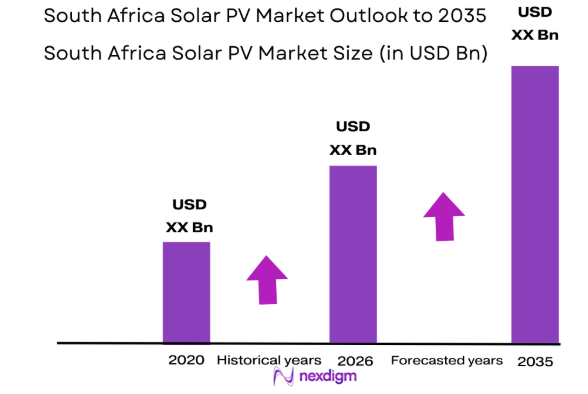
The South Africa Solar PV market is driven by a growing demand for clean energy solutions, with an estimated market size of USD ~ billion. The market’s expansion is fueled by various factors, including government incentives, increased awareness about environmental sustainability, and a decline in the cost of solar panel installations. The adoption of solar energy has been further promoted by local power shortages, encouraging individuals and businesses to switch to renewable energy sources.
Cities such as Cape Town and Johannesburg are leading the adoption of solar PV systems in South Africa due to their high population density, greater infrastructure availability, and improved grid integration. The government’s commitment to renewable energy policies, including the Renewable Energy Independent Power Producer Procurement Program (REIPPPP), and the increasing availability of financing options have also contributed to the dominance of these regions. These cities play a central role in solar energy generation and distribution across the country.
Market Segmentation
By Product Type
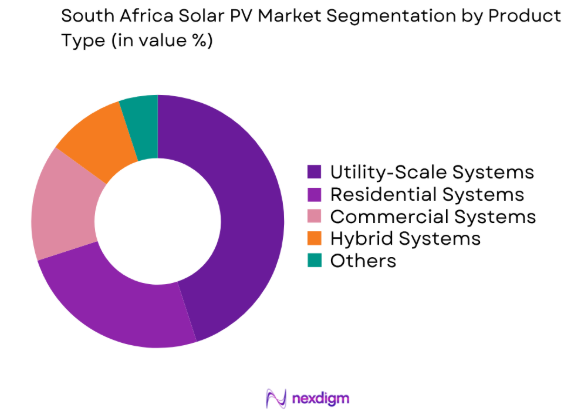
The South Africa Solar PV market is segmented by product type into utility-scale, residential, commercial, and hybrid systems. Recently, utility-scale systems have dominated the market share due to the increasing demand for large-scale renewable energy generation. These systems are attractive for both government and private sectors as they can generate a significant amount of energy, benefiting from economies of scale and favorable government incentives. Additionally, the push for energy security and reduced reliance on the national grid further propels the demand for large-scale solar power plants.
By Platform Type
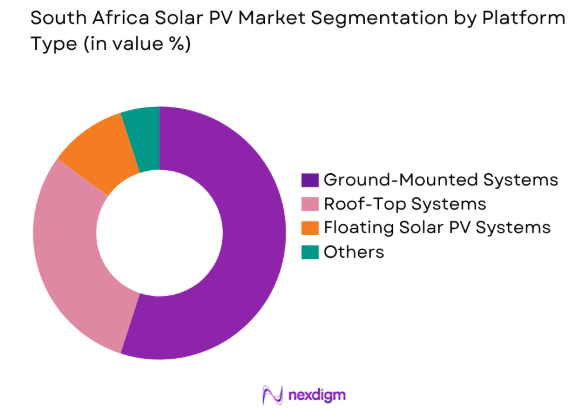
The South Africa Solar PV market is segmented by platform type into ground-mounted, roof-top, and floating solar systems. Among these, ground-mounted solar PV systems have the highest market share, primarily driven by their larger capacity and the availability of vast land areas, particularly in rural regions. These systems are ideal for utility-scale projects, which are increasingly adopted by power producers. The government’s push for green energy and long-term energy contracts has also contributed to the growth of ground-mounted installations, reinforcing their dominance in the market.
Competitive Landscape
The South Africa Solar PV market has witnessed significant growth in recent years due to favorable regulatory policies and increased adoption of solar energy. Major players such as JinkoSolar, First Solar, and Canadian Solar lead the market, benefiting from their advanced technology, strong distribution networks, and competitive pricing strategies. These companies continue to play a key role in expanding solar energy infrastructure, particularly through utility-scale projects that contribute to the country’s renewable energy goals.
| Company Name | Establishment Year | Headquarters | Technology Focus | Market Reach | Key Products | Revenue (USD) | Additional Market Parameter |
| JinkoSolar | 2006 | Shanghai, China | ~ | ~ | ~ | ~ | ~ |
| First Solar | 1999 | Tempe, Arizona, USA | ~ | ~ | ~ | ~ | ~ |
| Canadian Solar | 2001 | Guelph, Canada | ~ | ~ | ~ | ~ | ~ |
| Trina Solar | 1997 | Changzhou, China | ~ | ~ | ~ | ~ | ~ |
| Enel Green Power | 2008 | Rome, Italy | ~ | ~ | ~ | ~ | ~ |
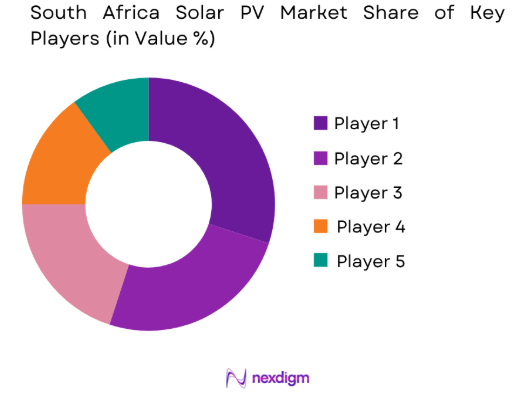
South Africa Solar PV Market Analysis
Growth Drivers
Government Support for Renewable Energy
Government incentives and policies are crucial drivers for the growth of the South African Solar PV market. Initiatives such as subsidies, feed-in tariffs, and renewable energy procurement programs like REIPPPP encourage investments in solar energy. The government’s commitment to diversifying energy sources and achieving renewable energy targets fosters a supportive environment for solar projects. This push for cleaner energy solutions aligns both private and public sector goals with sustainability efforts. As a result, more businesses and government bodies are adopting solar power to reduce reliance on conventional energy sources. These incentives and policies not only promote growth but also make solar energy more accessible, driving further adoption across residential, commercial, and industrial sectors.
Declining Costs of Solar Technology
The dramatic reduction in the cost of solar panel technology, especially photovoltaic (PV) cells, has significantly boosted solar energy adoption in South Africa. Advances in manufacturing, economies of scale, and improvements in panel efficiency have made solar PV more affordable. This cost decline is making solar energy solutions more attractive to both residential and commercial users. Additionally, the decreasing prices of solar storage systems, like batteries, have enhanced the overall feasibility of solar installations. As these costs continue to fall, more consumers and businesses are turning to solar energy, making it a more viable and sustainable option. The affordability and efficiency improvements are expected to accelerate the transition toward cleaner, renewable energy across the country.
Market Challenges
High Initial Investment Costs
Although the costs of solar panels and batteries have decreased, the high initial investment for solar PV systems, especially in utility-scale projects, remains a major obstacle. The cost of purchasing and installing solar panels, inverters, and necessary infrastructure can be too expensive for smaller businesses and residential customers. This financial burden, along with limited access to affordable financing options, prevents many from adopting solar energy. This challenge is particularly evident in rural areas or regions outside of major cities, where the upfront costs are more difficult to manage. Without improved financial solutions or subsidies, the widespread adoption of solar energy is hindered, despite its long-term economic and environmental benefits.
Intermittent Solar Power Generation
Solar energy generation is highly dependent on weather conditions, making it an intermittent source of power. Factors such as cloud cover, seasonal changes, and time of day significantly affect the efficiency of solar power production. While energy storage solutions, like batteries, can help address this issue by storing excess energy, the high cost and limited scalability of these storage systems present ongoing challenges. As a result, solar power may not always provide a consistent energy supply on its own. To ensure reliability, solar energy must be integrated with energy storage technologies or complementary power generation methods, such as wind or grid power, to smooth out fluctuations in energy production and demand.
Opportunities
Off-Grid Solar Solutions
Around 20% of South Africa’s population resides in rural areas with limited access to the national grid, creating a significant opportunity for off-grid solar solutions. Solar home systems, mini-grids, and solar-powered appliances are becoming essential in these underserved regions, providing affordable and reliable electricity. The government’s rural electrification programs, alongside financing schemes aimed at improving access to clean energy, are further supporting the growth of off-grid solar solutions. These initiatives are driving the adoption of solar PV in rural areas, creating a rapidly expanding market segment. As demand for decentralized energy solutions rises, solar PV providers have the potential to tap into this underserved market, improving energy access and contributing to sustainable development.
Energy Storage Systems Integration
Integrating energy storage systems with solar power offers a significant growth opportunity for the South African Solar PV market. Energy storage, such as batteries, allows excess solar energy generated during the day to be stored and utilized during periods of low sunlight. As battery technology continues to improve and prices decrease, the adoption of energy storage systems is expected to rise, enhancing the reliability and consistency of solar power. This integration enables solar PV systems to provide a continuous energy supply to both residential and commercial sectors, reducing reliance on the grid. The increasing demand for stable, renewable energy sources will further drive the growth of the solar PV market as more consumers and businesses embrace energy storage solutions.
Future Outlook
The future of the South African Solar PV market appears promising, with continued growth expected over the next five years. Technological advancements, such as more efficient solar panels and energy storage systems, will make solar energy more cost-effective and accessible. Additionally, the increasing focus on sustainability, along with strong government support for renewable energy, will further accelerate the adoption of solar power. The continued expansion of off-grid solutions and the integration of solar energy with energy storage systems will also play a pivotal role in ensuring the growth of the market.
Major Players
- JinkoSolar
- First Solar
- Canadian Solar
- Trina Solar
- Enel Green Power
- SMA Solar Technology
- LONGi Solar
- Hanwha Q CELLS
- Risen Energy
- JA Solar Technology
- Yingli Solar
- REC Group
- Vestas
- FirstRand Bank
- Acciona
Key Target Audience
- Investments and venture capitalist firms
- Government and regulatory bodies
- Solar energy developers
- Utility companies
- Renewable energy technology providers
- Large-scale industrial consumers
- International aid organizations
- Financial institutions
Research Methodology
Step 1: Identification of Key Variables
The first step involves identifying and defining the key variables influencing the South African Solar PV market, including product types, end-users, regulatory frameworks, and market dynamics.
Step 2: Market Analysis and Construction
In this step, data is collected from primary and secondary sources to build a comprehensive market model, highlighting key trends, challenges, and growth opportunities.
Step 3: Hypothesis Validation and Expert Consultation
Hypotheses regarding market behavior, technological trends, and competitive positioning are validated through consultations with industry experts, ensuring accuracy and reliability.
Step 4: Research Synthesis and Final Output
In the final step, all data and insights are synthesized into a cohesive report, highlighting key market drivers, challenges, and forecasts for the future of the South African Solar PV market.

- Executive Summary
- Research Methodology (Definitions, Scope, Industry Assumptions, Market Sizing Approach, Primary & Secondary Research Framework, Data Collection & Verification Protocol, Analytic Models & Forecast Methodology, Limitations & Research Validity Checks)

- Market Definition and Scope
- Value Chain & Stakeholder Ecosystem
- Regulatory / Certification Landscape
- Sector Dynamics Affecting Demand
- Strategic Initiatives & Infrastructure Growth

- Growth Drivers
Increased Government Initiatives in Renewable Energy
Technological Advancements in Solar PV Efficiency
Growing Power Demand in Rural and Urban Areas - Market Challenges
High Initial Investment Costs for Solar PV Systems
Limited Grid Infrastructure for Solar Power Integration
Lack of Skilled Workforce for Solar PV Installations - Market Opportunities
Rising Interest in Off-Grid Solar Solutions
Government Support for Renewable Energy Projects
Technological Innovation in Energy Storage Systems - Trends
Increased Adoption of Smart Grid Solutions
Growing Interest in Solar PV for Agriculture
Integration of Solar PV with Energy Storage Solutions - Government Regulations
- SWOT Analysis of Key Competitors
- Porter’s Five Forces

- By Market Value, 2020-2025
- By Installed Units, 2020-2025
- By Average System Price, 2020-2025
- By System Complexity Tier, 2020-2025

- By System Type (In Value%)
Utility-Scale Solar PV Systems
Residential Solar PV Systems
Commercial Solar PV Systems
Industrial Solar PV Systems
Hybrid Solar PV Systems - By Platform Type (In Value%)
Ground-Mounted Systems
Roof-Top Systems
Floating Solar PV Systems
BIPV Systems
Concentrated Solar Power Systems - By Fitment Type (In Value%)
On-grid Solutions
Off-grid Solutions
Hybrid Solutions
Integrated Solutions
Modular Solutions - By End User Segment (In Value%)
Residential
Commercial
Industrial
Government
Agriculture - By Procurement Channel (In Value%)
Direct Procurement
Third-party Distributors
Government Procurement
Private Sector Procurement
Online Bidding Platforms

- Market Share Analysis
- Cross Comparison Parameters (System Type, Platform Type, Procurement Channel, End User Segment, Fitment Type, Installation Location, Energy Storage Integration, System Efficiency, Market Demand, Regulatory Compliance)
- SWOT Analysis of Key Competitors
- Pricing & Procurement Analysis
- Key Players
Sungrow Power Supply
JinkoSolar
First Solar
SMA Solar Technology
Trina Solar
Canadian Solar
LONGi Solar
Enel Green Power
SoluSun
Acciona
FirstRand Bank
Worley
Enel
Scatec Solar
SolarWorld

- Growth in Residential Solar Installations
- Commercial Solar Adoption
- Government as a Key Player
- Increased Interest in Solar PV in Agricultural Sectors

- Forecast Market Value, 2026-2035
- Forecast Installed Units, 2026-2035
- Price Forecast by System Tier, 2026-2035
- Future Demand by Platform, 2026-2035


 Request a Sample
 Ask for Customization
 Get a Quote
 Enquire Now