

 Download PDF
Market Overview
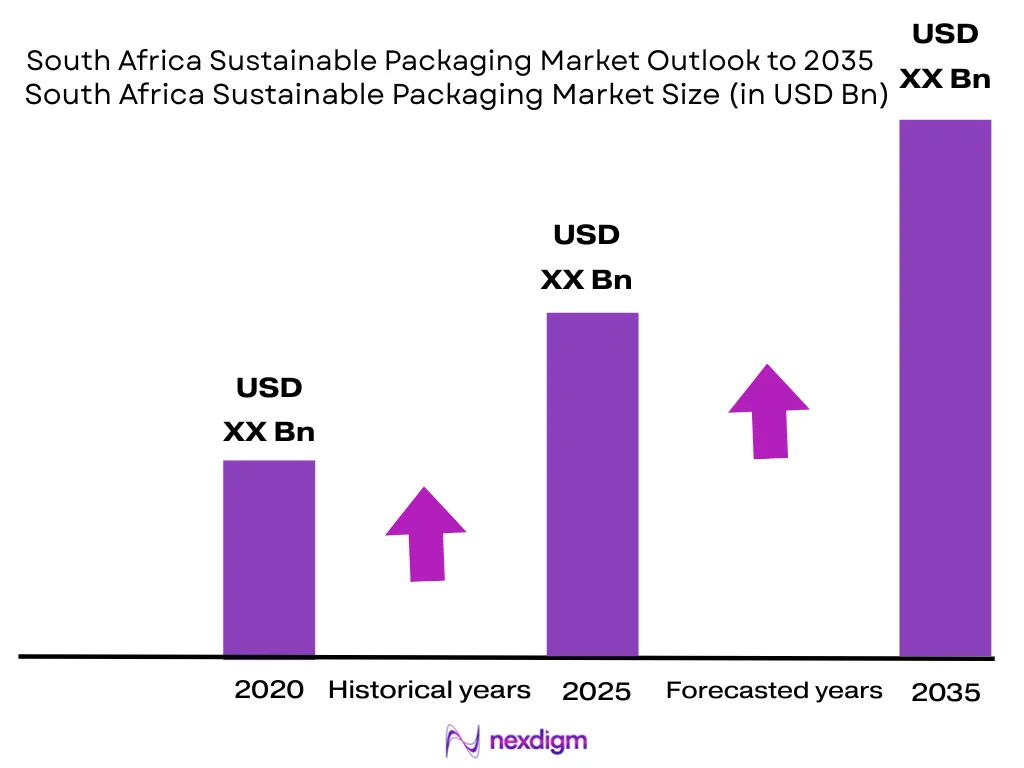
The South Africa Sustainable Packaging Market is valued at approximately USD ~ billion and is forecast to expand at a CAGR of % during 2026–2035. Nominal GDP increased from approximately ZAR 7.04 trillion to ZAR 7.35 trillion, while current-dollar output reached about USD 400.26 billion. Demand is supported by packaged food, beverages, agricultural exports, retail, e-commerce, healthcare, mandatory packaging EPR, recycled-content adoption, reusable containers, and improved collection systems. Gauteng, the Western Cape, and KwaZulu-Natal dominate the South Africa Sustainable Packaging Market. Johannesburg, East Rand, Pretoria, Cape Town, the Cape Winelands, Durban, and Pinetown concentrate brand owners, paper mills, beverage plants, packaging converters, recyclers, retailers, ports, and distribution centres. Gauteng leads through consumer and industrial density, the Western Cape through food, wine, fruit exports, and bottle-to-bottle recycling, and KwaZulu-Natal through paper, chemicals, port logistics, and food manufacturing.
Market Segmentation
By Material Type
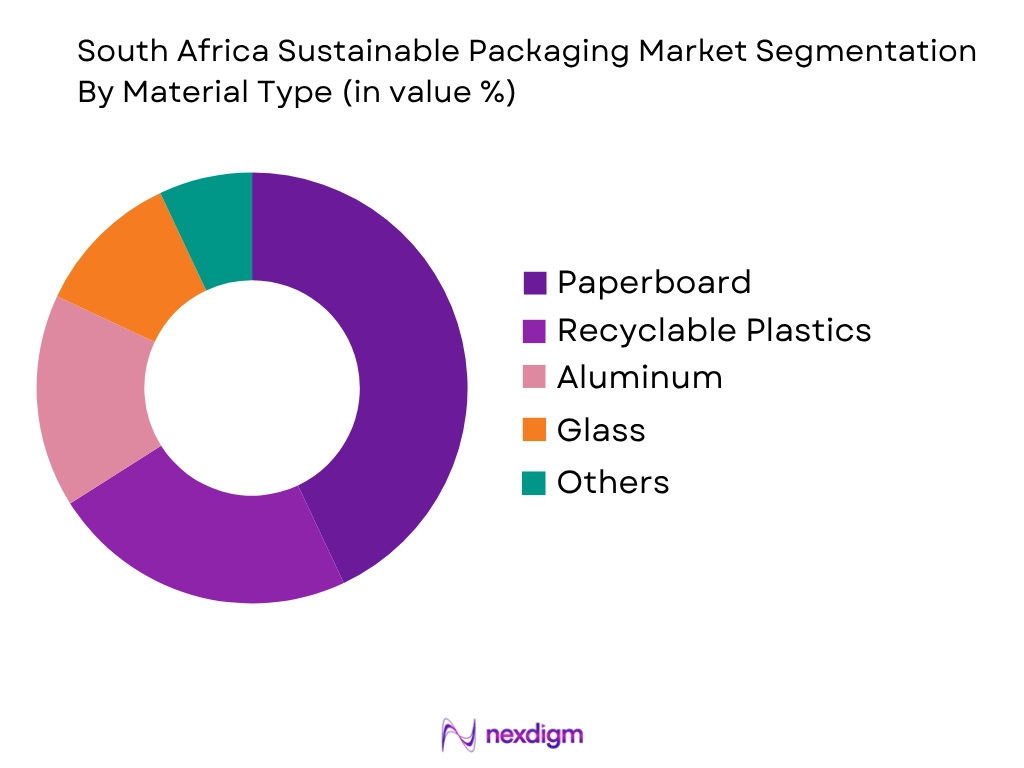
The South Africa Sustainable Packaging Market is segmented into paper and paperboard, recycled and recyclable plastics, glass, aluminum and steel, bio-based and compostable materials, wood, and sustainable multi-material structures. Paper and paperboard hold the dominant position because corrugated cases, folding cartons, paper sacks, molded-fiber trays, produce boxes, and e-commerce mailers serve food, beverages, agriculture, retail, mining, pharmaceuticals, and industrial distribution. South Africa has an established paper-recovery chain involving waste pickers, buy-back centres, commercial generators, recyclers, and mills. Approximately 1.3 million tonnes of paper and paper packaging were diverted from landfill during 2024, while the national paper-recycling rate was reported at approximately 60%. Fiber packaging also benefits from agricultural exports requiring strong, printable and ventilated transport cases. Recycled plastics remain important in PET bottles, trays, tubs, films, closures, personal-care packs, and industrial containers. Glass and metal retain strong recovery value because they serve beverages, food cans, aerosols, pharmaceuticals, and returnable systems.
By End-Use Industry
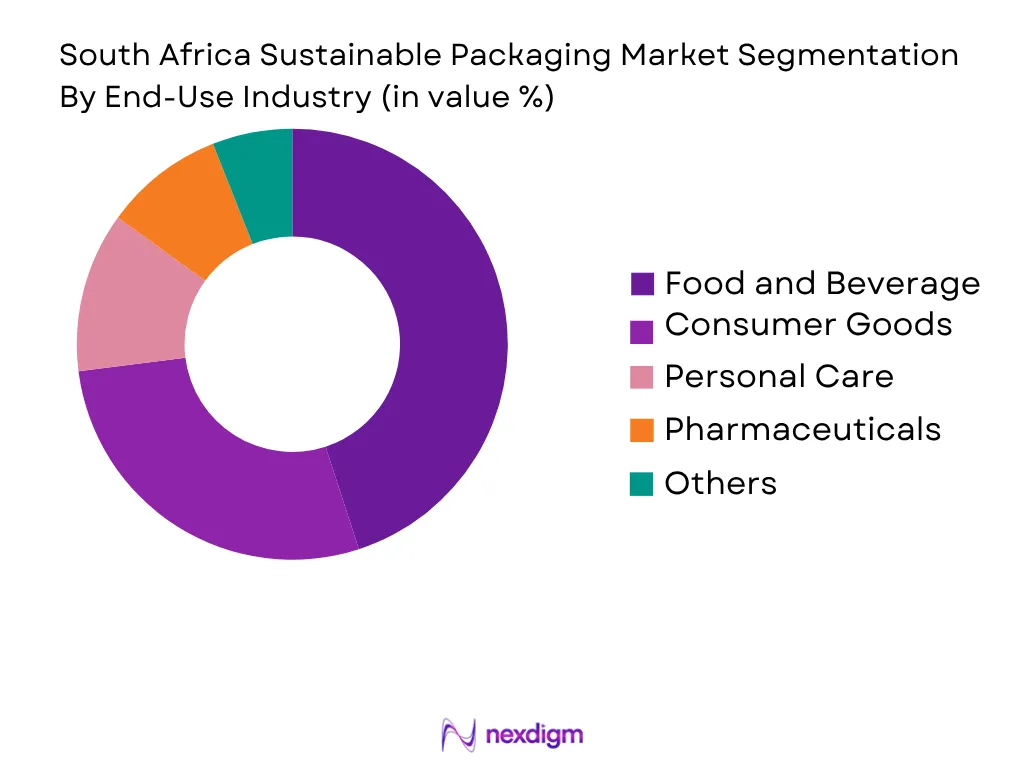
The South Africa Sustainable Packaging Market is segmented into food and beverage, retail and consumer goods, agriculture and fresh produce, personal and household care, healthcare and pharmaceuticals, e-commerce, foodservice, mining and industrial goods, and other applications. Food and beverage hold the dominant market position because the sector uses PET bottles, returnable glass, beverage cans, cartons, pouches, trays, films, paper sacks, corrugated cases, and liquid-board packaging. Beverage packaging benefits from established PET, glass, aluminum, and steel recovery organisations, while grocery companies increasingly require recyclable structures, recycled content, lightweighting, and EPR reporting. Agricultural and beverage exports also create substantial packaging demand. Citrus, grapes, deciduous fruit, wine, meat, and processed food require ventilated corrugated boxes, liners, bottles, closures, reusable crates, pallets, and cold-chain packaging capable of maintaining product quality through port handling and long-distance transport. Retail and e-commerce support recyclable mailers, right-sized cartons, paper void fill, and return-ready packaging. Healthcare conversion remains slower because sterility, migration control, tamper evidence, and product integrity remain essential.
Competitive Landscape
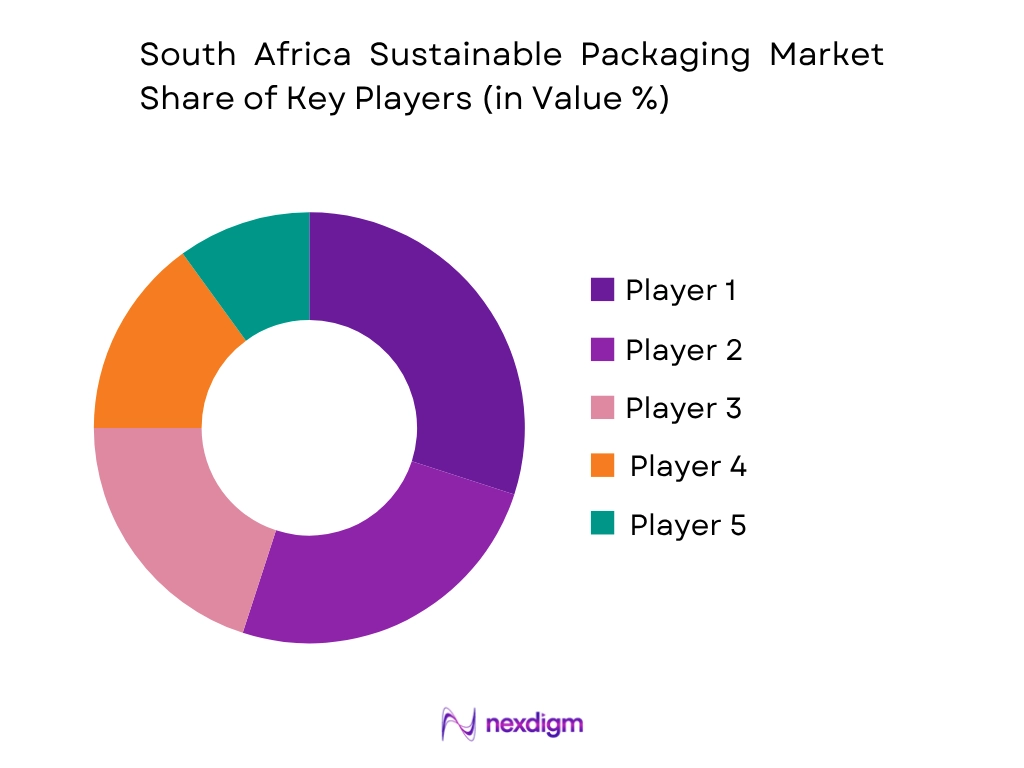
The South Africa Sustainable Packaging Market is led by integrated paper, plastics, metal, glass, carton, and flexible-packaging businesses. Mpact combines paper mills, corrugated conversion, plastics manufacturing, and one of the country’s largest recyclable-packaging collection networks. Nampak is prominent in beverage cans, food cans, aerosols, and other metal formats. Mondi operates paper and packaging activities, while Ardagh Glass Packaging–Africa supplies glass containers to beverage, food, and pharmaceutical customers. Polyoak is a major rigid-plastic converter. Competition centres on recycled-content capability, EPR support, manufacturing reach, design for recycling, food-contact compliance, collection partnerships, lightweighting, and the ability to manage energy and logistics constraints.
| Company | Establishment Year | Headquarters | Sustainable Portfolio | Principal End Uses | Material Capability | South African Footprint | Circularity Capability | Strategic Differentiation |
| Mpact | 2011 as listed company | Johannesburg, South Africa | ~ | ~ | ~ | ~ | ~ | ~ |
| Nampak | 1968 | Cape Town and Johannesburg, South Africa | ~ | ~ | ~ | ~ | ~ | ~ |
| Mondi South Africa | 1967 group incorporation heritage | Weybridge and Vienna; South African offices in Gauteng | ~ | ~ | ~ | ~ | ~ | ~ |
| Ardagh Glass Packaging–Africa | 1930s regional glass heritage | Luxembourg; African headquarters in Johannesburg | ~ | ~ | ~ | ~ | ~ | ~ |
| Polyoak Packaging | 1976 | Cape Town, South Africa | ~ | ~ | ~ | ~ | ~ | ~ |
South Africa Sustainable Packaging Market Analysis
Growth Drivers
Urban Consumer Demand and Organized Retail Distribution
South Africa’s concentrated urban consumer base is increasing demand for recyclable corrugated cases, folding cartons, paper delivery bags, lightweight bottles, mono-material pouches, returnable glass, aluminum cans, molded-fiber food containers, and reusable transport packaging. The country’s population reached approximately 63.02 million people in 2024, providing a substantial consumption base for packaged food, beverages, personal-care products, pharmaceuticals, household products, online orders, and takeaway meals. Economic activity is concentrated in Gauteng, the Western Cape, and KwaZulu-Natal, where Johannesburg, Pretoria, Cape Town, Durban, and surrounding industrial corridors contain major retailers, distribution centres, beverage plants, food processors, converters, recyclers, ports, and logistics providers. South Africa’s nominal GDP reached approximately ZAR 7.3 trillion in 2024, an increase of ZAR 312 billion from the previous year. Household expenditure on food and non-alcoholic beverages also increased in real terms, supporting greater movement of packaged consumer goods through supermarkets, wholesalers, informal retailers, quick-service restaurants, and e-commerce networks. Dense urban distribution routes make sustainable packaging systems more commercially practical because corrugated boxes, beverage containers, crates, pallets, and reusable totes can be collected from high-volume commercial locations. Grocery retailers can consolidate cardboard and plastic films at distribution centres, while restaurants and shopping centres can separate beverage containers and foodservice packaging. Packaging suppliers are responding through lighter bottle preforms, reduced carton board weight, paper-based void fill, recyclable mailers, return-ready e-commerce boxes, and packaging that uses fewer incompatible components. However, source reduction must preserve compression strength, shelf life, moisture resistance, tamper evidence, and product safety. A damaged food or household product may require replacement packaging and additional transport, eliminating the environmental benefit of material reduction. Sustainable packaging development therefore increasingly considers the entire distribution system, including pallet utilization, warehouse automation, truck loading, last-mile delivery, consumer opening, and recovery after use. South Africa’s large population, urban commercial concentration, and ZAR 7.3 trillion economy provide a broad demand foundation for packaging formats that combine product protection with recycling, reuse, reduced material weight, and improved logistics efficiency.
Extended Producer Responsibility and Brand-Owner Accountability
Mandatory extended producer responsibility is changing sustainable packaging from a voluntary corporate initiative into a measurable operating obligation for producers, importers, retailers, and brand owners. South Africa’s EPR framework for paper, packaging, and selected single-use products requires obligated businesses to register, participate through individual schemes or producer-responsibility organisations, report packaging placed on the market, and support collection, recycling, reuse, recovery, and design improvements. During 2024, the Department of Forestry, Fisheries and the Environment continued reviewing annual reports submitted by EPR schemes for paper and packaging, demonstrating that compliance is increasingly tied to documented material flows rather than general sustainability commitments. The government also published an EPR fee-determination guideline in November 2024, strengthening the basis for fees linked to material type, collection difficulty, recycling requirements, administration, and environmental performance. This creates a direct commercial incentive to reduce packaging weight, simplify multilayer structures, use components accepted by domestic recyclers, and incorporate recycled material where technically feasible. PETCO reported that its activities during 2024 included training more than 4,700 beneficiaries, supporting 47 small and medium enterprises, and working with 59 municipalities on waste-management and recycling initiatives. These figures illustrate how producer funding can extend beyond purchasing recycling evidence to strengthening collectors, buy-back centres, municipal systems, and local businesses. Packaging companies are increasingly expected to identify polymer type, paper grade, package weight, closure composition, label material, recycled content, and likely end-of-life route. Beverage companies require bottle and closure designs compatible with PET recycling; paper converters need coatings and adhesives that do not prevent repulping; and flexible-packaging suppliers must reduce incompatible layers while maintaining product barriers. EPR also strengthens demand for data platforms, packaging audits, recyclability assessments, collection contracts, annual reporting, and verification of recycling outputs. South Africa’s ZAR 7.3 trillion economy contains thousands of producers and importers using packaging across food, beverages, agriculture, personal care, healthcare, mining, retail, and industrial goods. As enforcement becomes more structured, suppliers capable of combining packaging design, recycled-content integration, recovery partnerships, technical documentation, and EPR reporting support will gain an advantage over converters offering packaging without a credible post-consumer pathway.
Market Challenges
Fragmented Collection and Uneven Recycled Feedstock Quality
South Africa’s sustainable packaging market is constrained by uneven municipal collection, dependence on informal recovery networks, regional infrastructure differences, and inconsistent recycled-feedstock quality. The country had approximately 63.02 million residents in 2024, but access to reliable source-separated collection differs significantly between metropolitan municipalities, secondary cities, towns, informal settlements, farms, and rural districts. High-value materials such as clear PET bottles, aluminum cans, steel packaging, corrugated cardboard, and returnable glass are more likely to be recovered because they have established buyers. Flexible films, multilayer sachets, small closures, contaminated food containers, black plastics, laminated paper, and composite packaging are harder to collect and process economically. Waste pickers and buy-back centres perform an essential role by recovering material that municipal systems may otherwise send to landfill, but many operate without covered storage, balers, collection vehicles, digital scales, quality-testing equipment, or stable working capital. PETCO’s 2024 activities included assistance to 47 small and medium enterprises and collaboration with 59 municipalities, indicating both the importance of local recovery organisations and the continuing need for infrastructure support. Feedstock quality presents a separate challenge. Recycled PET can contain labels, adhesives, coloured resin, moisture, food residue, and incompatible polymers. Recycled polyethylene and polypropylene can vary in odour, colour, melt flow, impact strength, and contamination. Recovered paper may contain grease, wax, wet-strength chemicals, plastic coatings, or excessive moisture, reducing fiber strength and mill acceptance. Glass requires colour separation and removal of ceramics, stones, and metals before cullet can return to furnaces. The country’s nominal GDP of ZAR 7.3 trillion in 2024 supports significant packaging consumption, yet economic scale does not guarantee reliable secondary-material supply. Material may be generated far from suitable processors, requiring aggregation and long-distance transport. Collection also responds to commodity demand: when a material has weak end-market value, recovery can decline even when packaging remains technically recyclable. Packaging manufacturers consequently face uncertainty over the availability, cleanliness, colour, and processing consistency of recycled inputs. Resolving this challenge requires better household separation, direct commercial collection, stronger buy-back centres, municipal partnerships, producer-funded transport, digital traceability, and long-term contracts connecting collectors with paper mills, plastic recyclers, glass manufacturers, metal processors, and packaging converters.
Technical Conversion, Energy Reliability, and Compliance Capacity
Converting conventional packaging into recyclable, reusable, or recycled-content formats requires complex technical validation and specialized operational capability. A multilayer food pouch may combine PET, polyethylene, polyamide, aluminum, coatings, inks, and adhesives to deliver oxygen protection, moisture resistance, aroma retention, puncture strength, and heat sealing. Replacing it with a mono-material structure can improve recycling compatibility but may reduce shelf life or production speed. Paper-based packaging can replace selected plastic products, but grease, moisture, and oxygen barriers may require coatings that interfere with repulping. Recycled resin may affect colour, odour, clarity, bottle strength, closure performance, and processing stability. Lightweighting can lower material use but cause bottle deformation, carton compression, seal failure, or product damage during long-distance distribution. South African converters must manage these technical risks while operating in an economy that produced approximately ZAR 7.3 trillion in nominal GDP during 2024 and serves highly varied industries, including beverages, food, pharmaceuticals, agriculture, mining, personal care, and automotive components. Electricity reliability and infrastructure constraints can further affect extrusion, molding, glass furnaces, paper production, printing, washing, pelletizing, and temperature-controlled manufacturing. Although the economy recorded consecutive quarterly gains through 2025 and expanded again in the first quarter of 2026, packaging and recycling businesses still require backup power, process controls, maintenance capability, and reliable logistics. Compliance adds another layer of complexity. Producers must register under EPR, report packaging quantities, classify materials, meet scheme requirements, maintain evidence, and support collection and recycling. Food-contact packaging requires migration control, hygiene, traceability, and verification that recycled materials are appropriate for the intended application. Environmental claims such as recyclable, compostable, biodegradable, reusable, or containing recycled content require substantiation. A package may be technically recyclable but lack collection or reprocessing access in much of the country. Smaller converters and brand owners may not employ dedicated polymer scientists, packaging engineers, regulatory specialists, sustainability teams, or laboratory personnel. They often depend on suppliers or producer-responsibility organisations for guidance. The challenge therefore combines material science, machinery compatibility, energy reliability, food safety, EPR reporting, recovery access, and technical workforce capability. Suppliers able to provide testing, line trials, shelf-life validation, recyclability assessment, and compliance documentation can reduce adoption risk, but companies lacking these capabilities may delay conversion or select packaging that performs poorly in existing South African recovery systems.
Market Opportunities
Food-Grade Recycled PET and Advanced Recovery Technologies
South Africa has a significant opportunity to expand bottle-to-bottle recycling, automated sorting, higher-quality recycled polymers, and packaging formats designed around existing recovery infrastructure. PET bottles provide a strong foundation because they are widely recognized by collectors, have established reprocessing markets, and can return to packaging applications when feedstock and decontamination requirements are controlled. Industry reporting indicates that approximately 2.1 billion PET bottles have been diverted from landfill through organized collection and recycling initiatives. A major Western Cape investment scheduled to become operational during 2025 added planned food-grade recycled PET capacity of 15,000 tonnes per year, creating the region’s first large-scale bottle-to-bottle capability of this type. The project involved approximately ZAR 300 million in investment and supports beverage producers seeking locally available food-grade resin. Advanced sorting can strengthen this opportunity. Near-infrared sensors, artificial intelligence, automated colour separation, digital watermarks, and machine-vision inspection can identify resin types and contaminants more accurately than manual processes alone. Improved washing, deodorization, melt filtration, and decontamination can produce recycled resin with more consistent colour, odour, strength, and food-contact suitability. Packaging design also matters. Clear PET bottles, removable sleeves, wash-off adhesives, compatible closures, reduced pigments, and standardized component materials improve collection and reprocessing outcomes. The opportunity extends beyond PET. Optical sorting can improve separation of HDPE, polypropylene, polyethylene films, cartons, metals, and glass. Digital records can document collection location, bale weight, recycler acceptance, processing output, and recycled-content use. South Africa’s approximately 63.02 million consumers and ZAR 7.3 trillion economy provide sufficient packaging throughput to support specialised sorting and reprocessing assets when long-term brand-owner offtake is secured. Producers can enter closed-loop agreements with retailers, municipalities, buy-back centres, waste pickers, and recyclers rather than relying exclusively on open commodity markets. Food-grade recycled PET offers a particularly visible demonstration of circular packaging because collected beverage containers can return to regulated beverage and food applications instead of being converted into lower-value products. Future growth will depend on connecting package design, consumer collection, waste-picker participation, automated sorting, verified decontamination, converter demand, and stable procurement contracts within a single domestic value chain.
Buy-Back Centre Modernization and Rural Recovery Networks
Modernizing buy-back centres and expanding recovery networks into smaller towns, rural districts, agricultural regions, and underserved municipalities can significantly strengthen South Africa’s sustainable packaging supply chain. Waste pickers, cooperatives, scrap dealers, municipal drop-off points, and buy-back centres already recover paper, PET, glass, aluminum, steel, HDPE, polypropylene, and selected films. However, many facilities lack balers, covered storage, sorting tables, digital weighing systems, forklifts, collection vehicles, safety equipment, and direct contracts with industrial recyclers. PETCO’s support to 47 small and medium enterprises, training of more than 4,700 beneficiaries, and engagement with 59 municipalities during 2024 show that producer-funded enterprise development can improve local recovery capacity. Hub-and-spoke networks can aggregate packaging from several communities before transporting compacted material to regional processors. Rural collection has particular relevance for beverage bottles, household-product containers, agricultural chemical packs, fertilizer sacks, seed bags, dairy packaging, corrugated boxes, wine and fruit packaging, and e-commerce deliveries. Agricultural cooperatives, schools, retailers, fuel stations, municipal depots, farms, tourism businesses, and community organisations can function as collection points. Digital tools can record weights, material grades, payments, collector identities, and movement to registered reprocessors. Direct electronic payments can improve transparency for informal collectors, while equipment financing can help centres increase throughput and material quality. International and domestic partnerships can support training, safer operations, sorting technology, and working capital. South Africa’s circular-economy policy recognizes EPR as a mechanism for funding recycling, job creation, and enterprise development in paper and packaging. The country’s population of 63.02 million people and broad geographic distribution mean that recovery cannot depend only on Johannesburg, Cape Town, and Durban. Regional networks are needed to prevent packaging from being landfilled, burned, or leaked into the environment in areas far from large processors. Packaging manufacturers benefit because improved aggregation creates larger and more predictable supplies of recovered fiber, PET, metals, glass, and polyolefins. Brand owners benefit through stronger EPR evidence and wider geographic collection. Communities benefit through income generation, safer working conditions, and local enterprise formation. The commercial opportunity therefore extends beyond selling sustainable packages; it includes baling equipment, transport, warehouse services, digital traceability, collector training, recycling partnerships, reusable agricultural crates, and decentralized material aggregation connected to national packaging production.
Future Outlook
The South Africa Sustainable Packaging Market is expected to expand during 2026–2035 as EPR implementation, recycled-content targets, retailer standards, agricultural exports, food and beverage demand, and formalisation of recycling networks reshape packaging design. Growth will come from integrating package development with collection, recycling, waste-picker inclusion, material traceability, reuse, and verified end markets. Mandatory EPR is the central regulatory mechanism. Producers and importers of paper, packaging, and selected single-use products must register, participate in an approved compliance structure, report material placed on the market, and contribute to collection, recycling, recovery, recycled-content, reuse, and design objectives. The national EPR portal enables registration and reporting by producers and producer-responsibility organisations. Packaging fees will become more differentiated according to material type, recyclability, collection difficulty, processing economics, and environmental performance. A government EPR fee guideline published in November 2024 presented recognised methods for determining producer fees. This creates an incentive to simplify packaging, reduce weight, increase compatibility with domestic recyclers, and avoid components that raise collection and treatment costs.
Major Players
- Mpact
- Nampak
- Mondi South Africa
- Ardagh Glass Packaging–Africa
- ALPLA South Africa
- Polyoak Packaging Group
- Transpaco
- Bowler Metcalf
- Corruseal Group
- Huhtamaki South Africa
- Amcor South Africa
- Constantia Flexibles South Africa
- Tetra Pak South Africa
- Detpak South Africa
- Novus Holdings–ITB Flexible Packaging Solutions
Key Target Audience
- Packaging material manufacturers and converters
- Food, beverage, personal-care, and pharmaceutical brand owners
- Grocery retailers, e-commerce platforms, and foodservice operators
- Agricultural exporters, wineries, and fresh-produce packers
- Recyclers, buy-back centres, and producer-responsibility organisations
- Investments and venture capitalist firms
- Private-equity and strategic packaging investors
- Government and regulatory bodies
Research Methodology
Step 1: Identification of Key Variables
The initial phase constructs an ecosystem map covering material producers, packaging converters, brand owners, importers, producer-responsibility organisations, waste pickers, buy-back centres, recyclers, municipalities, and end users. Core variables include material type, packaging weight, recycled content, recyclability, reuse, EPR exposure, converter capacity, collection access, and end-market demand.
Step 2: Market Analysis and Construction
Historical information is compiled by material, packaging format, end-use industry, province, sustainability strategy, and recovery channel. The bottom-up model evaluates converter shipments, packaging units, material tonnage, recycled-content use, and customer procurement. The top-down model reviews manufacturing output, trade, material consumption, company revenues, EPR reporting, and recycling activity.
Step 3: Hypothesis Validation and Expert Consultation
Market hypotheses are validated through computer-assisted telephone interviews with packaging engineers, brand owners, recyclers, producer-responsibility organisations, waste pickers, buy-back centres, procurement teams, retailers, and material suppliers. Interviews assess packaging qualification, collection economics, EPR fees, feedstock quality, operational constraints, and customer switching behaviour.
Step 4: Research Synthesis and Final Output
Supply-side and demand-side findings are triangulated to reconcile converter output, customer demand, recovered-material supply, and recycling performance. Segment shares and forecasts are tested against package weights, unit volumes, provincial capacity, EPR targets, production investments, collection infrastructure, and expert feedback.

- Executive Summary
- Research Methodology (Market Definitions and Assumptions, Sustainable Packaging Inclusion and Exclusion Criteria, Abbreviations, Market Sizing Approach, Top-Down Analysis, Bottom-Up Analysis, Packaging-Volume Conversion Model, Material Flow Analysis, Demand-Side Assessment, Supply-Side Assessment, Converter Capacity Assessment, Primary Industry Interviews, Data Triangulation, Regulatory Scenario Modelling, Forecasting Framework, Limitations and Future Conclusions)

- Definition and Scope
- Market Evolution and Industry Genesis
- Transition from Conventional Packaging to Circular Packaging Systems
- Evolution of Packaging Lightweighting and Source Reduction
- Development of Recycled-Content Packaging
- Expansion of Paper, Paperboard and Molded-Fiber Packaging

- Growth Drivers (Mandatory Packaging EPR, Retailer Sustainability Standards, Food and Beverage Manufacturing, E-Commerce Expansion, Export Agriculture, Recycled-Content Demand, Bottle-to-Bottle Recycling and Corporate Circularity Commitments)
- Market Challenges (Municipal Collection Gaps, Informal and Formal System Coordination, Electricity Supply Constraints, Recycled Feedstock Quality, Flexible Packaging Recovery Gaps, Multi-Layered Packaging Disposal, Recycling Infrastructure Inequality and Capital-Intensive Conversion)
- Market Opportunities (Food-Grade Recycled PET, Mono-Material Flexible Packaging, Molded Fiber, Reusable Transport Packaging, Buy-Back Centre Modernization, Rural Collection Networks, Smart Sorting and Closed-Loop Brand Partnerships)
- Market Trends (Paperization, Lightweighting, High-PCR Packaging, Refill Pouches, Returnable Glass, Recyclable Laminates, Fiber-Based Foodservice Packaging, Digital EPR Traceability, Wash-Off Labels and Packaging Carbon Disclosure)
- SWOT Analysis
- Porter’s Five Forces Analysis
- PESTLE Analysis

- By Market Value (2020-2025)
- By Packaging Volume (2020-2025)
- By Packaging Unit Shipments (2020-2025)

- By Material Type (In Value %)
Paper and Paperboard
Corrugated Board
Molded Fiber
Recycled Plastic
Bio-Based Plastic
Compostable Plastic - By End-Use Industry (In Value %)
Food and Beverage
Personal Care and Cosmetics
Household Care
Healthcare and Pharmaceuticals
E-Commerce - By Distribution Channel (In Value %)
Direct Sales to Brand Owners
Packaging Distributors
Contract Packaging Companies
Digital Packaging Platforms
Industrial Wholesalers
Retail Packaging Suppliers - By Province (In Value %)
Gauteng
Western Cape
KwaZulu-Natal
Eastern Cape
Free State

- Market Share of Major Players
- Cross Comparison Parameters (Sustainable Material Portfolio Breadth, Post-Consumer Recycled Content Capability, Design-for-Recycling and Lightweighting Expertise, South Africa Manufacturing and Conversion Footprint, EPR and Producer Responsibility Organisation Support Capability, Closed-Loop Recovery and Waste-Picker Partnership Capability, End-Use Industry Coverage, Packaging Innovation and Commercialization Speed)
- SWOT Analysis of Major Players
- Detailed Profiles of Major Companies
Mpact
Nampak
Mondi South Africa
Ardagh Glass Packaging–Africa
ALPLA South Africa
Polyoak Packaging Group
Transpaco
Bowler Metcalf
Corruseal Group
Huhtamaki South Africa
Amcor South Africa
Constantia Flexibles South Africa
Tetra Pak South Africa
Detpak South Africa
Novus Holdings–ITB Flexible Packaging Solutions

- Food and Beverage Brand Analysis
- Beverage Producer Analysis
- Grocery Retailer Analysis
- E-Commerce and Marketplace Analysis
- Foodservice Operator Analysis
- Agricultural Exporter Analysis

- By Market Value (2026-2035)
- By Packaging Volume (2026-2035)
- By Packaging Unit Shipments (2026-2035)


 Request a Sample
 Ask for Customization
 Get a Quote
 Enquire Now