
 Download PDF
Market Overview
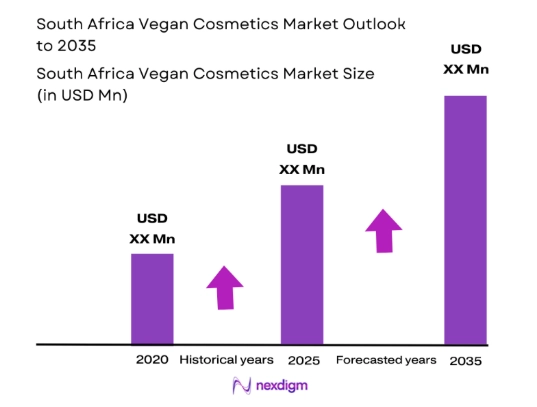
South Africa vegan cosmetics market was valued at USD ~ million in 2024, according to Nexdigm. The category is being pulled upward by a broader beauty environment that reached USD ~ billion in 2024, while the global cruelty-free cosmetics market stood at USD ~ billion in 2023. The demand engine is increasingly tied to natural-ingredient preference, ethical consumption, self-care routines, and premium/natural product adoption across South African beauty retail.
Within the region, South Africa is the clear anchor market because it combines the most developed organized retail base, strong pharmacy-led beauty distribution, and a gateway role into the rest of Africa; more than 60% of South Africa’s cosmetic exports in 2023 were destined for other African countries. Domestically, Johannesburg and Cape Town dominate because brand headquarters, premium retail rollout, omnichannel infrastructure, and specialty-clean beauty ecosystems are concentrated there, while the country’s beauty market expanded to USD ~ billion in 2024.
Market Segmentation
By Product Type
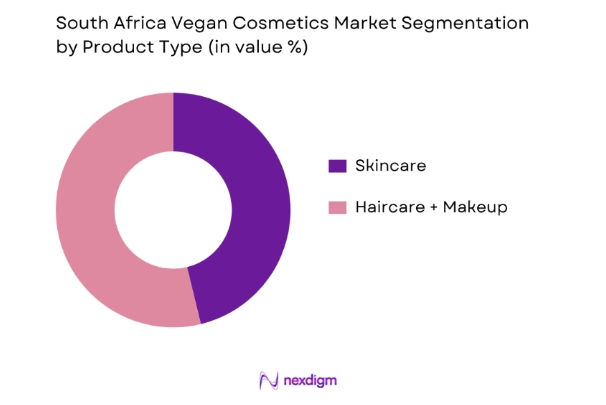
South Africa vegan cosmetics market is segmented by product type into skincare and haircare plus makeup (combined residual public split). Recently, skincare has held the dominant named share in South Africa under product segmentation. That lead is explained by the market’s current preference for barrier repair, hydration, pigmentation correction, sensitive-skin solutions, and botanical efficacy claims, all of which naturally favor skincare over color-driven purchases. Public South Africa data available through Deep Market Insights identifies skincare as the largest product line in 2024, while Grand View Research also identifies skincare as the leading segment in the country’s vegan cosmetics mix and haircare as the faster-growth area. In practical commercial terms, skincare converts better in pharmacy chains, clean-beauty specialty retail, and DTC channels because it aligns with ingredient transparency, trial-to-repeat behavior, and routine-based replenishment.
By Distribution Channel
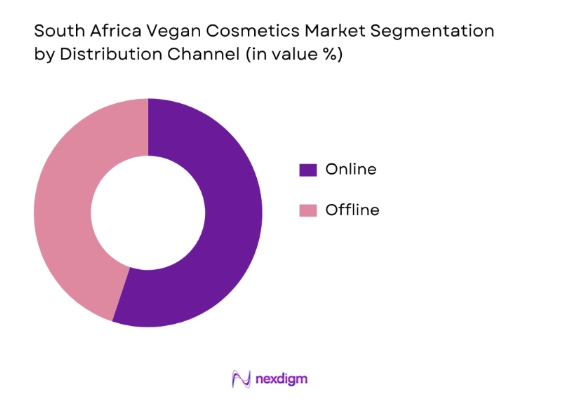
South Africa vegan cosmetics market is segmented by distribution channel into online and offline. Recently, online has held the dominant market share in South Africa under this segmentation. The online lead is consistent with how vegan and clean beauty shoppers search: they compare ingredient lists, verify cruelty-free and vegan badges, read reviews, and discover niche local brands through digital-first storefronts. The structure of the market also favors online because specialist platforms such as Faithful to Nature actively merchandise “plant-based beauty,” “cruelty-free beauty,” and other clean-value filters that make ethical discovery easier than in general retail. In addition, South Africa’s wider online retail economy expanded strongly, with 96 billion rand in turnover in 2024, reinforcing the digital route for premium, niche, and values-based beauty purchases.
Competitive Landscape
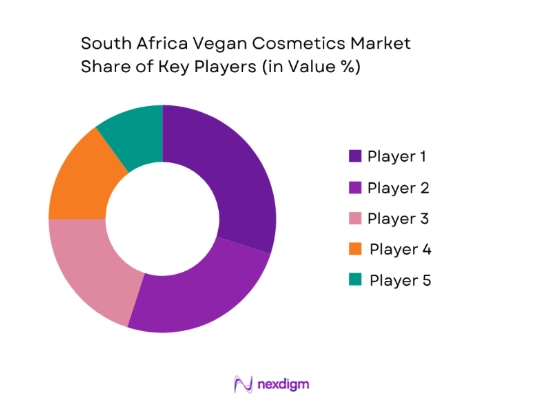
The South Africa vegan cosmetics market remains relatively fragmented but is being shaped by a visible set of local clean-beauty specialists and a smaller number of scaled international brands. Local players such as African Extracts, Esse, SKOON., and Lelive have built relevance through African botanicals, microbiome or science-backed positioning, and conscious-beauty storytelling, while The Body Shop adds international recognition, certification strength, and established retail familiarity. This mix creates a market where authenticity, ingredient credibility, and channel fit matter more than sheer portfolio breadth alone.
| Company | Establishment Year | Headquarters | Vegan / Cruelty-Free Positioning | Core Product Focus | Hero Ingredient / Science Platform | Primary Channel Strength | Market Positioning | Local Manufacturing / African Sourcing |
| African Extracts | 2002 | Cape Town, South Africa | ~ | ~ | ~ | ~ | ~ | ~ |
| Esse Skincare | 2002 | Richmond, KZN, South Africa | ~ | ~ | ~ | ~ | ~ | ~ |
| Lelive | 2020 | Johannesburg / Cape Town, South Africa | ~ | ~ | ~ | ~ | ~ | ~ |
| SKOON. | 2015 | Stellenbosch, South Africa | ~ | ~ | ~ | ~ | ~ | ~ |
| The Body Shop South Africa | 1976 | Littlehampton, United Kingdom | ~ | ~ | ~ | ~ | ~ | ~ |
South Africa Vegan Cosmetics Market Dynamics
Growth Drivers
Ethical Consumption
Ethical consumption is becoming a stronger demand engine for vegan cosmetics in South Africa because the country’s beauty demand sits on top of a large formal consumer economy and a sizable organized retail base. The IMF places South Africa’s nominal GDP at USD 401 billion in 2024, rising to USD 431 billion in 2025 and USD 474 billion in 2026, while population stands at 63 million in 2024 and 63.97 million in 2026. That matters for vegan cosmetics because ethically positioned products usually scale first where modern trade, pharmacy retail, and online discovery are already deep. Statistics South Africa shows that retailers in pharmaceuticals and medical goods, cosmetics and toiletries recorded R21.215 billion in real sales for September–November 2024, rising to R22.366 billion for September–November 2025. The World Bank also shows 78 people out of every 100 in South Africa were using the internet in 2024, which materially improves discovery of vegan, cruelty-free, refillable, and ingredient-led brands. In practical terms, this means ethical consumption in South Africa is not just values-driven; it is supported by purchasing infrastructure, category access, and digital comparison behaviour. For vegan cosmetics, that combination is important because consumers can more easily verify brand claims, compare formulations, and shift to products that align with animal-free and sustainability-led preferences once organized shelf space and digital access are present.
Ingredient Transparency
Ingredient transparency is a direct growth driver for vegan cosmetics in South Africa because the country’s beauty spending is increasingly flowing through channels where labels, claims, and ingredient lists are visible and comparable. Statistics South Africa reports that the personal care CPI index rose from 123.5 in February 2024 to 126.0 in March 2024, while the broader miscellaneous goods and services index reached 120.2 in March 2024. When consumers are paying more attention to personal-care baskets, they become more selective about what is inside those products, especially in categories such as serums, moisturisers, cleansers, and sunscreens where ingredient claims affect repeat purchase. The same demand is amplified by digital access: the World Bank records 78 internet users per 100 people in South Africa in 2024, which allows shoppers to check INCI lists, compare “vegan” versus “cruelty-free” claims, and read retailer and brand disclosures before purchase. On the supply side, the local compliance environment is also becoming more structured. CTFA South Africa states that it advises on ingredients, labelling, packaging and product claims, and the Advertising Regulatory Board’s 2025 Cosmetic Advertising Code requires substantiation for “natural”, “organic”, and ingredient-based claims with reference to SANS 16128-2 or an equivalent standard. For vegan cosmetics brands, that combination of higher label scrutiny, higher online comparability, and more explicit claim-substantiation rules makes transparency a commercial advantage rather than only a compliance obligation.
Market Restraints
Price Sensitivity
Price sensitivity remains a major restraint in South Africa’s vegan cosmetics market because ethical and ingredient-led beauty products often compete in a consumer economy that still carries weak labour-market depth and fragile disposable income. The IMF shows South Africa’s GDP per capita at USD 6,253 in 2024, with the unemployment rate averaging 32.6 in 2024, 32.6 in 2025, and 32.5 in 2026. Statistics South Africa adds more pressure to that picture: in Q1 2025, the country had 16.8 million employed people, 8.2 million unemployed people, and 16.7 million economically inactive people. At the same time, personal-care inflation was elevated: Stats SA recorded the personal care CPI at 126.0 in March 2024, up from 123.5 a month earlier, with annual change at 10.6. Even though IMF consumer-price inflation eases from 4.4 in 2024 to 3.2 in 2025 and 3.6 in 2026, vegan cosmetics still face a structural affordability challenge because they often sit in premium or mass-premium tiers, while many households remain focused on value preservation. That forces brands to prove efficacy and ethics simultaneously. In South Africa, shoppers may like vegan positioning, but high unemployment and ongoing pressure on household budgets mean they often down-trade, postpone trial, or wait for promotions unless the product delivers strong functional value, such as sensitive-skin relief, pigmentation support, or hair-texture benefits.
Certification Confusion
Certification confusion restrains the South Africa vegan cosmetics market because shoppers are navigating multiple claim systems, legal references, and quasi-regulatory signals at the same time. For a single beauty product, the consumer may encounter “vegan”, “cruelty-free”, “natural”, “organic”, “clean”, and “sensitive-skin” claims, but those terms do not all operate under one harmonized rulebook. The Advertising Regulatory Board’s 2025 Cosmetic Advertising Code states that “natural”, “natural ingredients”, and “organic” claims require substantiation against SANS 16128-2 or an internationally accredited equivalent. CTFA South Africa separately notes that it advises members on ingredients, labelling, packaging and product claims, while South African compliance references also include SANS 98 for ingredient labelling and SANS 289 for prepackaged-product labelling. That multi-layered framework is commercially relevant because South Africa is already a high-access beauty market: the World Bank records 78 internet users per 100 people in 2024, and Statistics South Africa reports R22.366 billion in real sales for pharmaceuticals and medical goods, cosmetics and toiletries in September–November 2025. In other words, a large number of shoppers can see and compare claims, but they do not always have a simple way to distinguish self-declared vegan positioning from third-party verification or advertising-substantiated language. For brands, that confusion can slow conversion, increase education costs, and reduce trust when consumers see similar products carrying very different badges, codes, or terminology on shelf and online.
Market Opportunities
Localized Botanicals
Localized botanicals represent one of the clearest future growth opportunities for South Africa vegan cosmetics because the country already has commercial, exportable indigenous ingredients with established processing and employment linkages. The dtic states that South Africa produces approximately 20,000 tons of rooibos each year, generating employment for more than 5,000 people, with exports already reaching 45 countries. That matters for vegan cosmetics because rooibos is not just a local story ingredient; it is already a scaled South African plant input with global recognition, which lowers the storytelling burden for brands trying to build authenticity. The South African Rooibos Council’s 2024 information sheet also places rooibos-supported employment at about 8,000 workers across primary production and upstream activities, and notes that the product is exported to more than 50 countries. South Africa’s broader macro setting supports that opportunity: the IMF projects nominal GDP to rise from USD 401 billion in 2024 to USD 474 billion in 2026, creating a larger domestic platform for premium, origin-led beauty narratives. For vegan cosmetics, localized botanicals such as rooibos and marula can do more than differentiate packaging copy. They can support higher-value local manufacturing, stronger African sourcing stories, and cleaner ingredient decks that are easier to communicate in online and pharmacy channels. This is especially relevant in a market where buyers increasingly want efficacy, locality, and ethical sourcing to appear in the same product rather than as separate brand promises.
Refill Systems
Refill systems are a strong forward opportunity for South Africa vegan cosmetics because packaging regulation, circular-economy reporting, and recycling infrastructure are now moving in a direction that directly favors reusable and returnable formats. The 2024 amendments to South Africa’s Extended Producer Responsibility regulations require producers and producer-responsibility organisations to report, by 31 July and 31 March, the tonnages placed on the market, collected, diverted from landfill, exported, and landfilled; the rules also explicitly reference a returnable packaging system. That is important for vegan cosmetics because refill models become more attractive when packaging is no longer treated as a one-way cost but as a measured compliance and recovery item. The commercial base for reuse is also becoming more visible. The SA Plastics Pact’s 2024 impact reporting, published in 2026, states that members placed more than 200,000 tonnes of plastics on the market, with 72 of plastic packaging now recyclable, reusable or compostable, 50 effectively recycled, and average recycled content at 19. For vegan beauty brands, that creates a clearer route to refill pouches, returnable containers, and concentrated formats in skincare, haircare, and body care. Because refill systems can lower virgin packaging dependence, strengthen sustainability claims, and improve repeat-purchase economics in DTC and specialty retail, they are especially relevant in a market where consumers increasingly evaluate both product ethics and packaging outcomes together.
Future Outlook
The market outlook remains favorable. This report forecasts a CAGR of 8.5% for 2026-2035, based on a synthesis of current South Africa-specific outlooks that place the market at 7.71% growth through 2033 in one public forecast and above 9.13% through 2031 in another. The next growth phase should be driven by online-first discovery, stronger vegan and cruelty-free claim verification, premium local botanical stories, and further shelf expansion across pharmacy, specialty clean-beauty, and private-label retail. Haircare, dermatology-adjacent skincare, refill-oriented packaging, and men’s grooming should remain the most scalable whitespace pools.
Major Players
- African Extracts
- Esse Skincare
- SKOON. Skincare
- Lelive
- Standard Beauty
- Pure Beginnings
- Lulu & Marula
- Suki Suki Naturals
- Pradiance
- The Body Shop South Africa
- WBeauty
- Chick Cosmetics
- Yolz Beauty
- Kudu Cosmetica
- Swaza Naturals
Key Target Audience
- Vegan and clean-beauty brand owners
- Cosmetic contract manufacturers and private-label formulators
- Pharmacy and organized beauty retail chains
- E-commerce marketplaces and specialty clean-beauty platforms
- Ingredient, actives, and sustainable packaging suppliers
- Investments and venture capitalist firms
- Government and regulatory bodies (Department of Trade, Industry and Competition; National Consumer Commission; South African Bureau of Standards; Advertising Regulatory Board)
- Beauty distributors, importers, and regional expansion companies
Research Methodology
Step 1: Identification of Key Variables
The first step maps the South Africa vegan cosmetics ecosystem across brands, retailers, e-commerce channels, certifiers, and ingredient-positioning trends. Secondary research is used to identify the variables that actually move this market: vegan and cruelty-free endorsement, product-category mix, digital discovery, premiumization, and local botanical storytelling. This stage also defines the market boundary between vegan cosmetics and the wider beauty and personal care sector.
Step 2: Market Analysis and Construction
The second step builds the market through top-down and bottom-up triangulation. The top-down layer uses the broader South African beauty market and regional vegan-beauty positioning, while the bottom-up layer uses disclosed country-level vegan cosmetics revenue, product splits, and distribution splits. Retailer filters, channel observations, and company positioning are then applied to construct a usable commercial picture of the market.
Step 3: Hypothesis Validation and Expert Consultation
The third step validates working assumptions against company disclosures, retailer merchandising logic, and certifier frameworks. Particular attention is given to claim integrity, category leadership, and digital-channel relevance because those are central to this market’s conversion mechanics. This stage is where segment dominance and competitive positioning are stress-tested against observable evidence from public company and retail sources.
Step 4: Research Synthesis and Final Output
The final step combines all validated inputs into a single market narrative, including market size, forecast direction, segment structure, competitor benchmarking, and buyer relevance. The result is a commercially actionable report format aimed at strategic users rather than a generic category summary. Forecasts are presented as research synthesis where public country-level long-range data are incomplete, and direct source-backed figures are preserved where disclosed.

- Executive Summary
- Research Methodology (Market Definitions and Assumptions, Vegan-Cosmetics Inclusion Criteria, Cruelty-Free vs Vegan Claim Boundaries, Primary Interviews Across Brands/Retailers/Distributors/Ingredient Suppliers, Demand-Side and Supply-Side Triangulation, Bottom-Up Revenue Mapping, Top-Down Category Benchmarking, Channel Validation, Pricing Benchmarking by Hero SKUs, Limitations and Data Normalization Framework)

- Definition and Scope
- Market Genesis and Evolution
- Industry Timeline of Key Brand and Retail Developments
- Business Cycle and Category Maturity
- Supply Chain and Value Chain Analysis
- Demand-Side Ecosystem Mapping
- Supply-Side Ecosystem Mapping
- Trade Flow Orientation and Market Structure

- Growth Drivers (Ethical Consumption, Ingredient Transparency, Clean Beauty Adoption, Melanin-Rich Skin Solutions, Wellness Convergence, Social Commerce)
- Market Restraints (Price Sensitivity, Certification Confusion, Shelf Competition, Import Costs, Consumer Trust Deficit, Counterfeit/Parallel Trade Risk)
- Market Opportunities (Localized Botanicals, Refill Systems, Men’s Grooming, Sensitive-Skin Vegan Lines, Vegan Suncare, Premium DTC Expansion)
- Key Trends (African Botanicals, Dermatological Positioning, Fragrance-Free Formulation, Microbiome/Barrier Care, Aluminium and Glass Packaging, Creator-Led Brand Building)
- Regulatory and Claims Environment (CTFA/ARB Cosmetic Code, Labelling and Advertising Discipline, Ingredient Disclosure, Claim Substantiation, Humane/Third-Party Endorsement Signalling)
- Import-Export and Sourcing Lens (Imported Premium Brands, Local Manufacturing, Private Label Opportunity, Raw Material Sourcing, Packaging Inputs)
- Porter’s Five Forces
- SWOT Analysis
- Stakeholder Ecosystem (Brands, Contract Manufacturers, Ingredient Suppliers, Retailers, Marketplaces, Certification Bodies, Influencers, Dermatology and Aesthetic Clinics)

- By Value (2020-2025)
- By Volume (2020-2025)
- By Average Selling Price (2020-2025)
- By Pack Units Sold (2020-2025)
- By Online vs Offline Contribution (2020-2025)

- By Product Category (In Value%)
Skin Care
Hair Care
Colour Cosmetics
Body Care
Deodorants and Fragrance
Sun Care - By Skin/Hair Concern Focus (In Value%)
Acne and Blemish Care
Hydration and Barrier Repair
Brightening and Pigmentation
Sensitive Skin and Fragrance-Free
Curl and Texture Care
Anti-Ageing and Firming - By Price Tier (In Value%)
Mass
Mass Premium
Premium
Prestige - By Distribution Channel (In Value%)
Clicks and Pharmacy Chains
Dis-Chem and Pharmacy Chains
Supermarkets and Department Stores
Organic and Specialty Retail
Brand-Owned DTC Websites
Online Marketplaces
Beauty Salons and Spas - By Consumer Group (In Value%)
Women
Men
Gender-Neutral Buyers
Teen and Young Adult
Millennial Professionals
Family and Baby-Care Buyers - By Certification and Claim Architecture (In Value%)
Beauty Without Cruelty Endorsed
Vegan Society/Third-Party Vegan Certified
Cruelty-Free Self-Claimed
Organic/Natural Certified
Reef-Safe/Planet-Friendly
Sensitive-Skin/Dermatologically Oriented - By Geography (In Value%)
Gauteng
Western Cape
KwaZulu-Natal
Eastern Cape
Rest of South Africa - By Packaging Format (In Value%)
Glass
Aluminium
Plastic
Refill Packs
Plastic-Free/Low-Waste

- Market Share of Major Players (By Value, By Volume, By Product Category, By Distribution Channel)
- Competitive Positioning Map (Mass vs Premium, Efficacy vs Naturalness, Local vs Imported, DTC vs Retail-Led)
- Cross Comparison Parameters (Vegan and Cruelty-Free Claim Integrity/Third-Party Endorsement Status, Hero Botanical and Active Ingredient Portfolio, Core Skin/Hair Concern Coverage, Price Ladder by Hero SKUs and Pack Sizes
Channel Mix Across Pharmacy, Specialty Retail, DTC and Marketplaces - Packaging Sustainability Profile (Aluminium, Glass, Refill, Plastic-Lightness)
- Local Manufacturing and African Sourcing Intensity
- Digital Community Strength and Creator-Commerce Traction
- Competitive Benchmarking (Launch Frequency, Assortment Width, Bestseller Concentration, Review Depth, Promotion Intensity, Brand Storytelling)
- Pricing Analysis (Cleanser, Serum, Moisturiser, Sunscreen, Shampoo, Lip Care, Makeup Essentials)
- SWOT Analysis of Major Players (Brand Trust, Innovation, Pricing, Reach, Retention, Differentiation)
- Detailed Profiles of Major Companies
African Extracts
Esse Skincare
SKOON. Skincare
Lelive
Standard Beauty
Pure Beginnings
Lulu & Marula
Suki Suki Naturals
Pradiance
The Body Shop South Africa
WBeauty
Chick Cosmetics
Yolz Beauty
Kudu Cosmetica
Swaza Naturals

- Consumer Awareness, Perceptions & Willingness to Pay
- Purchasing Behavior Across Channels (Influencer Seeding, Livestream Conversion, Store Trial, Clinic Recommendation, Peer Review Reliance)
- Pain Points & Unmet Needs (Ingredient Transparency, Product Efficacy)
- Decision Journey & Conversion Funnels
- Unmet Needs and Pain Points (Sensitive-Skin Safety, Humid-Climate Suitability, Authenticity Assurance, Shade/Texture Localization, Affordable Certified Vegan Options)
- Brand Loyalty and Repurchase Behavior (Repeat Rate, Hero SKU Pull, Community Building, CRM Effectiveness, Membership / Loyalty Leverage)
- Decision‑Making Triggers (Ingredients, Price, Brand Trust)

- By Value (2026-2035)
- By Volume (2026-2035)
- By Average Selling Price (2026-2035)
- By Pack Units Sold (2026-2035)
- By Online vs Offline Contribution (2026-2035)


 Request a Sample
 Ask for Customization
 Get a Quote
 Enquire Now