
 Download PDF
Market Overview
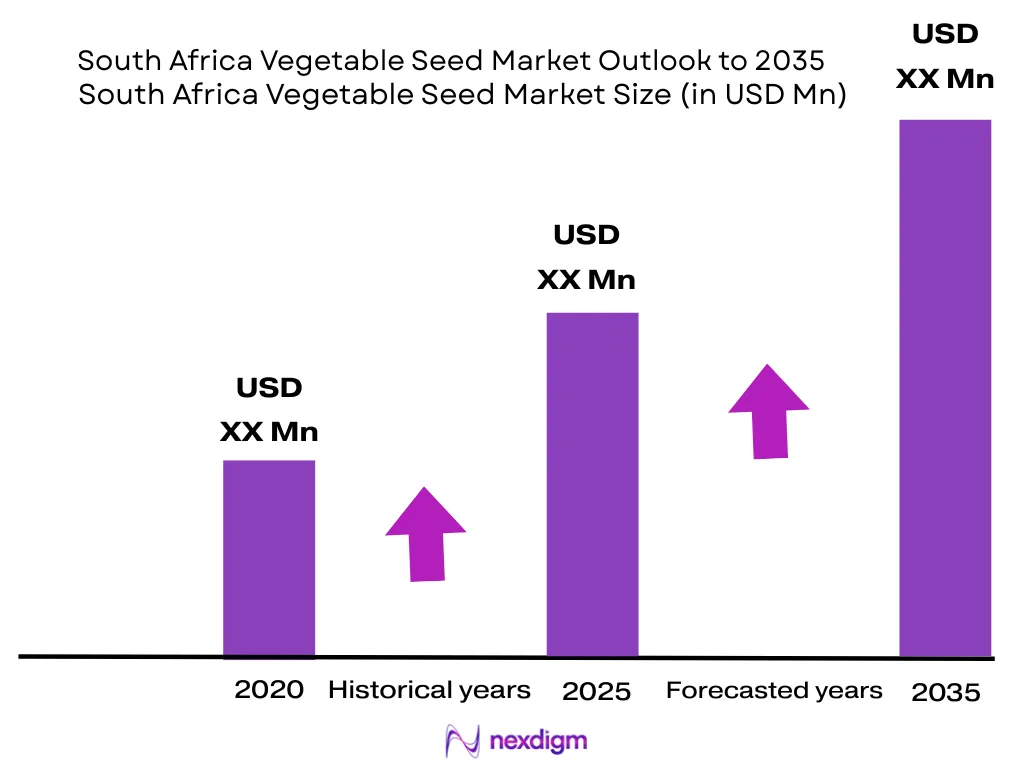
The South Africa Vegetable Seed Market is valued at USD ~ million, based on a five-year historical analysis and triangulation of Africa vegetable seed demand, South Africa’s regional contribution and national seed-market benchmarks. Demand is driven by commercial vegetable farming, hybrid adoption, fresh-produce markets and seed replacement. The Africa vegetable seed market reached USD ~ million, while South Africa’s total seed market reached USD ~ million, supporting vegetable-seed demand through potatoes, onions, tomatoes, cabbage and carrots. Limpopo, Western Cape, Gauteng, KwaZulu-Natal, Mpumalanga, Free State, Northern Cape and Eastern Cape dominate the South Africa Vegetable Seed Market because they combine irrigated production, commercial farms, smallholder vegetables, fresh-produce markets and protected cultivation. Limpopo leads tomato and potato demand; Western Cape supports onions, brassicas and lettuce; Gauteng is important due to Johannesburg and Tshwane fresh-produce markets; Northern Cape supports irrigated onion, watermelon and potato farming along river systems.
Market Segmentation
By Breeding Technology
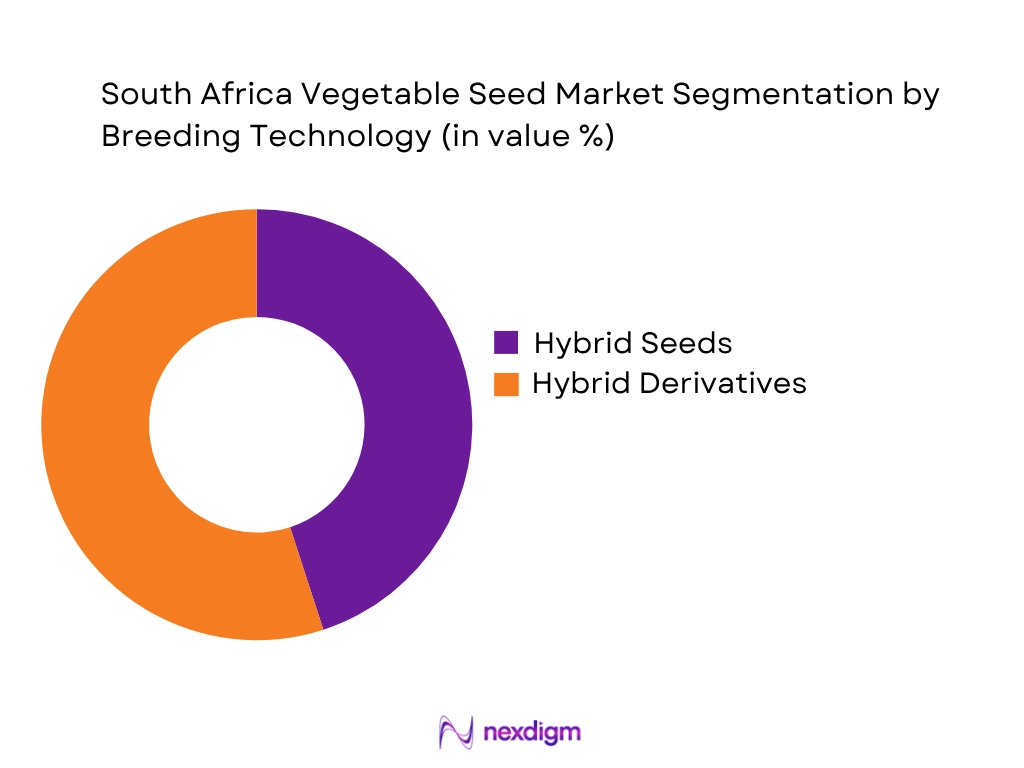
South Africa Vegetable Seed Market is segmented by breeding technology into open-pollinated varieties and hybrid derivatives, and hybrid seeds. Recently, open-pollinated varieties and hybrid derivatives have a dominant market share in South Africa under the breeding technology segmentation because they remain widely used by smallholders, informal vegetable producers, home gardeners and cost-sensitive farmers. These varieties are common in cabbage, spinach, pumpkin, butternut, beans, leafy greens and traditional vegetable crops because they are affordable, available in smaller packs and suited to local seed-saving practices. However, hybrid seeds are strategically important in commercial farming, especially for tomato, onion, cabbage, carrot, pepper, watermelon, cucumber and lettuce. Large growers supplying national fresh-produce markets, retailers and processors increasingly prefer hybrids because they offer higher uniformity, stronger disease resistance, predictable maturity and better marketable grade. The market therefore has a dual structure: OP seeds dominate volume access, while hybrids dominate premium commercial value.
By Cultivation Mechanism
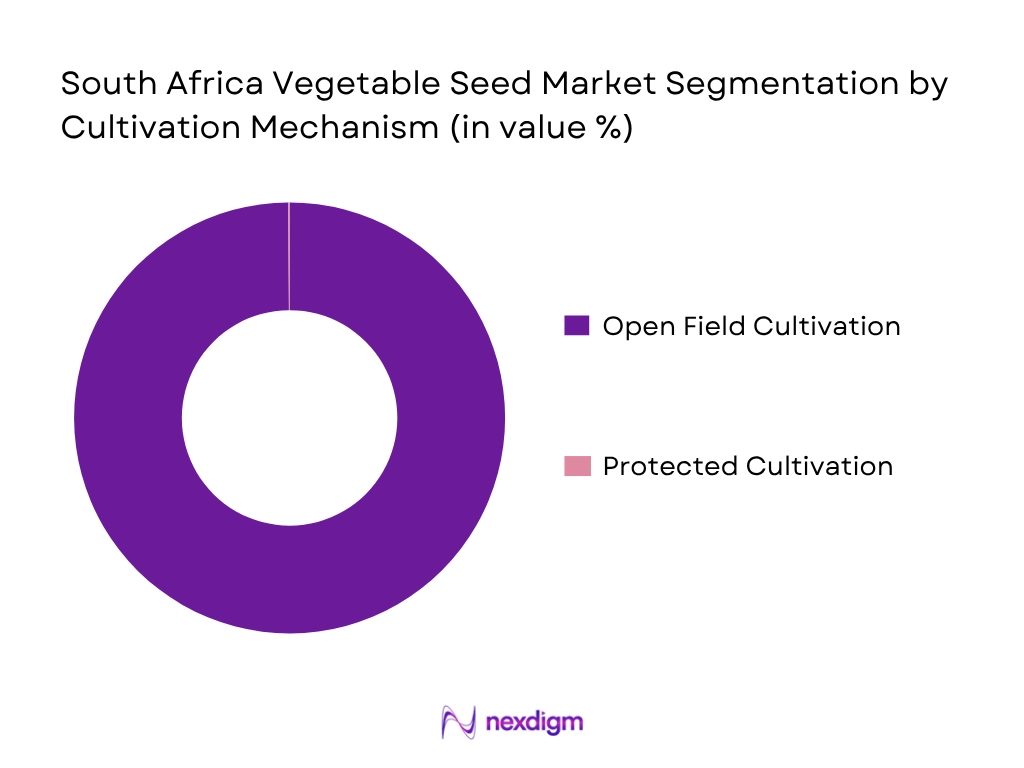
South Africa Vegetable Seed Market is segmented by cultivation mechanism into open field cultivation and protected cultivation. Recently, open field cultivation has a dominant market share in South Africa under the cultivation mechanism segmentation because most vegetables are grown in irrigated and rainfed field systems across Limpopo, Western Cape, Free State, Mpumalanga, KwaZulu-Natal and Northern Cape. Crops such as potatoes, onions, tomatoes, cabbage, carrots, butternut, pumpkin, watermelon and beans are produced on larger field areas and require recurring seed or seed-tuber purchases. Open-field dominance is supported by national fresh-produce markets, informal markets, processor contracts and rural retail input channels. Protected cultivation remains small but strategically relevant, particularly around Johannesburg, Pretoria, Cape Town and Durban, where hydroponic lettuce, herbs, tomato, cucumber and pepper production is expanding. Protected farms use higher-value seeds, but the cultivated base remains far smaller than open-field vegetable farming.
Competitive Landscape
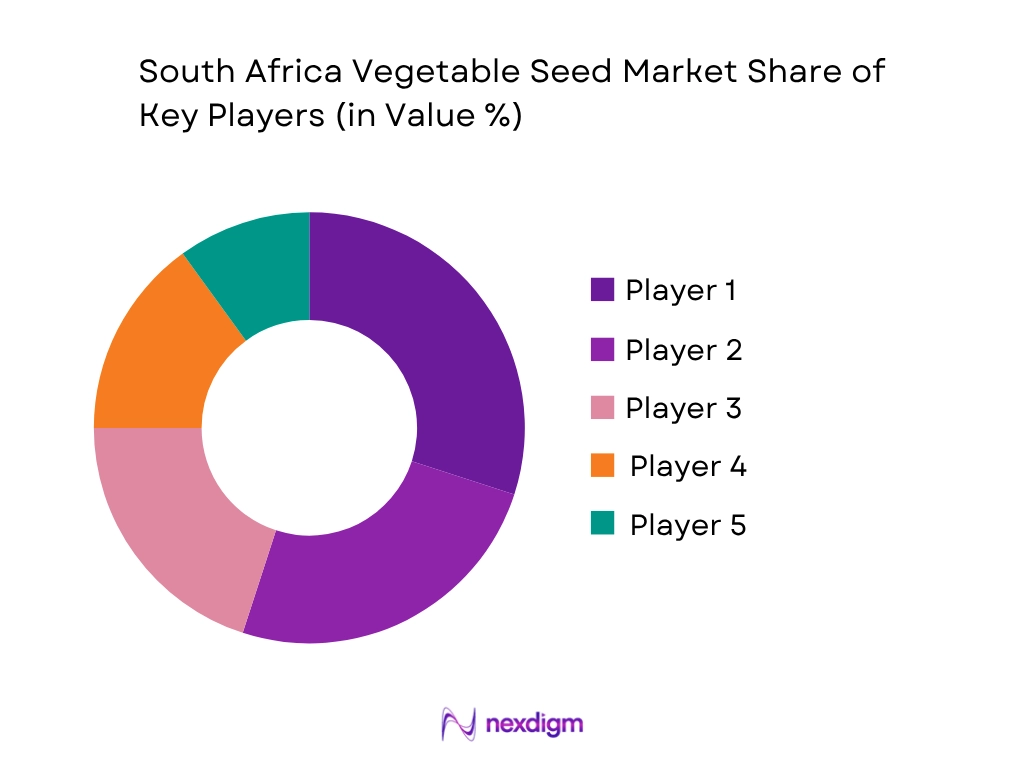
The South Africa Vegetable Seed Market is served by a mix of local seed houses, multinational vegetable seed companies, regional distributors and specialist nursery-linked suppliers. Starke Ayres, Sakata Seed Southern Africa, Hygrotech, MayFord Seeds and Syngenta are among the prominent players. Competition is shaped by hybrid portfolio strength, local disease-resistance packages, open-pollinated seed availability, seed treatment capability, trial farms, distributor reach, smallholder pack sizes and technical agronomy support. Local companies are strong in retail, smallholder and commercial field channels, while multinationals compete in premium hybrid and protected-crop categories.
| Company | Establishment Year | Headquarters | Key Vegetable Seed Focus | Main Crop Families | Distribution Strength | Protected Crop Portfolio | Seed Technology Focus | Market Positioning |
| Starke Ayres | 1877 | Bredell, South Africa | ~ | ~ | ~ | ~ | ~ | ~ |
| Sakata Seed Southern Africa | 1913 | Yokohama, Japan / South Africa operations | ~ | ~ | ~ | ~ | ~ | ~ |
| Hygrotech | 1984 | Pretoria, South Africa | ~ | ~ | ~ | ~ | ~ | ~ |
| MayFord Seeds | 1931 | South Africa | ~ | ~ | ~ | ~ | ~ | ~ |
| Syngenta South Africa | 2000 | Basel, Switzerland / South Africa operations | ~ | ~ | ~ | ~ | ~ | ~ |
South Africa Vegetable Seed Market Analysis
Growth Drivers
Commercial Vegetable Production Supports Recurring Seed Replacement
South Africa Vegetable Seed Market is supported by recurring seed replacement across commercial potato, onion, tomato, cabbage and carrot production. DALRRD’s Abstract of Agricultural Statistics 2025 reports vegetable production on major fresh produce markets at 995.8 thousand tonnes for potatoes, 375.4 thousand tonnes for onions, 222.1 thousand tonnes for tomatoes, 153.9 thousand tonnes for cabbages and 127.6 thousand tonnes for carrots. These crops require reliable seed, seed tubers, hybrids, OP varieties and treated lots for consistent establishment. World Bank data shows South Africa’s GDP per capita at USD 6,267.2 and GDP per capita PPP at 15,456.2 international dollars, supporting commercial horticulture input demand.
Fresh Produce Market System Strengthens Demand for Marketable Vegetable Varieties
South Africa Vegetable Seed Market benefits from a formal fresh-produce channel that rewards vegetables with uniform size, quality, shelf life and consistent supply. The Competition Commission’s Fresh Produce Market Inquiry final report states that South Africa’s fresh produce market is valued at over R53 billion annually, excluding informal sales channels and exports, and identifies potatoes, onions, carrots, cabbage, tomatoes and spinach as focus vegetables. This creates demand for hybrids and improved OP seeds with market-grade output. World Bank data shows South Africa’s GDP per capita at USD 6,267.2, indicating a sizeable formal consumption base that supports grower investment in commercial seeds.
Market Challenges
Drought and Heat Stress Disrupt Seed Planning and Crop Establishment
South Africa Vegetable Seed Market faces weather-linked volatility because vegetable production depends on rainfall, irrigation availability and stable planting windows. DALRRD reported that the El Niño-induced drought affected agriculture, while summer grains and oilseed production could fall to 15.2 million tonnes; although vegetable supplies were described as sufficient, the same drought conditions affected grower risk perception and planting decisions. DALRRD’s climate advisory also warned that temperatures were expected to be mostly above normal countrywide. For vegetable seed suppliers, this increases demand uncertainty for tomatoes, onions, cabbage, carrots and cucurbits. World Bank data shows GDP per capita of USD 6,267.2, making climate-resilient input use commercially relevant.
Import Permit and Phytosanitary Rules Add Operational Complexity
South Africa Vegetable Seed Market faces compliance pressure because imported seed, parent lines and plant material must meet phytosanitary requirements. The South African Government states that importers must apply for a plant import permit from NPPOZA when importing plants, plant products and regulated articles; NPPOZA inspectors inspect the products and phytosanitary certificate at the port of entry before release. This affects hybrid tomato, cabbage, onion, carrot, pepper, lettuce and cucumber seed suppliers relying on imported genetics. The market serves a vegetable base including 995.8 thousand tonnes of potatoes and 375.4 thousand tonnes of onions. World Bank data shows GDP per capita PPP of 15,456.2 international dollars, supporting formal but compliance-heavy trade.
Market Opportunities
Smallholder Inclusion Creates Opportunity for Affordable OP and Hybrid Pack Formats
South Africa Vegetable Seed Market has an opportunity in smallholder and emerging-farmer channels because fresh-produce access remains structurally uneven. The Competition Commission reported 31 remedial recommendations and highlighted limited access of small and emerging farmers to formal retail channels and national fresh produce markets. This creates scope for affordable seed sachets, improved OP varieties, smaller hybrid packs and dealer-led advisory for cabbage, spinach, beans, tomatoes, onions and pumpkins. DALRRD’s production data shows 153.9 thousand tonnes of cabbages and 58.3 thousand tonnes of pumpkins on major markets. World Bank data shows GDP per capita at USD 6,267.2, supporting demand for productivity-improving inputs among commercializing growers.
Climate-Resilient and Seedling-Nursery Varieties Offer Future Growth Potential
South Africa Vegetable Seed Market has an opportunity in drought-tolerant, heat-tolerant and nursery-suited varieties because growers are adapting to climate stress and establishment risk. DALRRD’s 2025/26 climate advisory notes that the Southern Cape faced drought stress, while summer crop farmers were preparing for the planting season; its 2024/25 advisory warned of mostly above-normal temperatures countrywide. These conditions support seed demand for heat-resilient tomato, onion, cabbage, carrot, pepper and cucurbit varieties, along with primed and treated seed for nurseries. DALRRD reported 222.1 thousand tonnes of tomatoes, 375.4 thousand tonnes of onions and 127.6 thousand tonnes of carrots. World Bank GDP per capita PPP stood at 15,456.2 international dollars.
Future Outlook
The South Africa Vegetable Seed Market is expected to grow at around 5.6% CAGR during the long-range forecast period, aligned with the Africa vegetable seed growth benchmark and South Africa’s role as a premium horticulture seed geography. Growth will be supported by hybrid adoption, drought-tolerant varieties, protected cultivation, seed treatment, fresh-produce market demand and commercial vegetable farming. Over the next phase, the market will increasingly shift toward climate-resilient vegetable seeds. Water stress, heat events and disease pressure will increase grower preference for hybrids and improved OP varieties that perform under variable field conditions. Tomato, onion, cabbage, carrot, potato seed tubers, pepper, watermelon and lettuce will remain priority categories because they are central to fresh-produce markets, retail supply chains and processor demand. Protected cultivation will create smaller but higher-value opportunities in hydroponic lettuce, herbs, cucumber, tomato and pepper seeds. Urban demand in Johannesburg, Pretoria, Cape Town and Durban will support clean-produce supply chains. Seedling nurseries will also gain importance because growers increasingly use transplants and plug seedlings to improve establishment and reduce field losses. Suppliers that combine local trials, disease packages, pack-size flexibility and advisory services will be best positioned.
Major Players
- Starke Ayres
- Sakata Seed Southern Africa
- Hygrotech
- MayFord Seeds
- Syngenta South Africa
- Bayer CropScience / Seminis / De Ruiter
- BASF Vegetable Seeds / Nunhems
- Rijk Zwaan South Africa
- Enza Zaden South Africa
- HM.CLAUSE South Africa
- Hazera Seeds South Africa
- Bejo Seeds South Africa
- East-West Seed
- McDonald Seeds
- Klein Karoo Seed Marketing
Key Target Audience
- Vegetable Seed Manufacturers
- Hybrid Vegetable Seed Breeding Companies
- Commercial Vegetable Farmers
- Smallholder and Emerging Vegetable Farmers
- Seedling Nurseries and Propagators
- Agri-Input Distributors and Seed Retailers
- Investments and Venture Capitalist Firms
- Government and Regulatory Bodies
Research Methodology
Step 1: Identification of Key Variables
The initial phase involves constructing an ecosystem map encompassing all major stakeholders within the South Africa Vegetable Seed Market. This includes seed breeders, importers, distributors, retailers, nurseries, commercial farmers, smallholders, fresh-produce markets and regulators. The objective is to identify critical variables such as crop family, hybrid adoption, cultivation mechanism, seed treatment, import dependency and regional crop concentration.
Step 2: Market Analysis and Construction
In this phase, historical data is compiled and analyzed for vegetable seed demand, fresh-produce market activity, crop clusters, open-field cultivation, protected cultivation and seed-channel structure. The market is constructed using top-down validation from regional seed benchmarks and bottom-up modelling based on crop use, planting cycles, seed type, grower category and distribution channel.
Step 3: Hypothesis Validation and Expert Consultation
Market hypotheses are validated through computer-assisted interviews with seed suppliers, distributors, nursery operators, commercial growers, smallholder aggregators and fresh-produce market stakeholders. These consultations provide insights into seed replacement, hybrid adoption, pack-size preference, dealer influence, protected cultivation demand and climate-resilient seed requirements.
Step 4: Research Synthesis and Final Output
The final phase integrates secondary research, company portfolio mapping, primary inputs and bottom-up crop-demand modelling into a validated report. The output is cross-checked across market size, segmentation, competitive landscape, regulatory framework and future outlook. This ensures a business-focused and investor-relevant view of the South Africa Vegetable Seed Market.

- Executive Summary
- Research Methodology (Market Definitions and Assumptions, Vegetable Seed Taxonomy, Hybrid/Open-Pollinated/Heirloom/Organic/Untreated Seed Classification, Market Sizing Approach, Top-Down Seed Revenue Validation, Bottom-Up Crop Area-to-Seed Requirement Model, Primary Interviews with Breeders/Distributors/Farmers/Fresh Produce Market Agents/Nursery Operators, Plant Improvement Act Compliance Review, Seed Import Permit Validation, Limitations and Future Conclusions)

- Definition and Scope
- Overview Genesis
- Evolution of Vegetable Seed Industry in South Africa
- Timeline of Major Players
- Business Cycle

- Growth Drivers (Hybrid Adoption, Fresh Produce Market Demand, Irrigated Vegetable Production, Seed Replacement, Retail Quality Standards, Smallholder Commercialisation)
- Market Challenges (Water Scarcity, Seed Import Dependency, Regulatory Compliance, Price Sensitivity, Load-Shedding, Informal Seed Use)
- Opportunities (Drought-Tolerant Hybrids, Protected Cultivation Genetics, Certified Seed Tubers, Organic Seeds, Seed Enhancement, Digital Advisory)
- Trends (Hybridization, Climate-Resilient Breeding, Seed Enhancement, Nursery-Based Production, Hydroponics, Retail Packet Premiumization)
- SWOT Analysis
- Porter’s Five Forces
- PESTLE Analysis

- By Value (2020-2025)
- By Volume (2020-2025)
- By Average Realization per Kilogram/Thousand Seeds (2020-2025)
- By Commercial Vegetable Seed Revenue (2020-2025)

- By Crop Family (In Value %)
Potato Seed Tubers
Onion Seeds
Tomato Seeds
Cabbage and Brassica Seeds
Carrot Seeds - By Distribution Channel (In Value %)
Direct-to-Grower Sales
Seed Distributors and Regional Agents
Agri-Input Retailer
Cooperatives and Producer Organisations
Fresh Produce Market-Linked Buyers
- By End User (In Value %)
Commercial Vegetable Farmers
Smallholder Farmers
Processing Growers
Protected-Crop Operators
Hydroponic Producers - By Region (In Value %)
Limpopo
Western Cape
Gauteng
KwaZulu-Natal
Mpumalanga

- Market Share of Major Players (Commercial Vegetable Seed Revenue, Crop-Family Share, Hybrid Share, Regional Presence)
- Cross Comparison Parameters (Hybrid Vegetable Portfolio Breadth, South Africa-Specific Disease-Resistance Trait Depth, Drought and Heat-Tolerance Trait Strength, Plant Improvement Act Compliance Capability, Seed Import and Phytosanitary Management Strength, Dealer and Provincial Distributor Network Coverage, Seed Treatment/Pelleting Capability, Local Trial and Agronomy Support)
- SWOT Analysis of Major Players
- Detailed Profiles of Major Companies
Starke Ayres
Sakata Seed Southern Africa
Hygrotech
MayFord Seeds
Syngenta South Africa
Bayer CropScience / Seminis / De Ruiter
BASF Vegetable Seeds / Nunhems
Rijk Zwaan South Africa
Enza Zaden South Africa
HM.CLAUSE South Africa
Hazera Seeds South Africa
Bejo Seeds South Africa
East-West Seed
McDonald Seeds
Klein Karoo Seed Marketing

- Commercial Vegetable Grower Analysis
- Smallholder Farmer Analysis
- Processing Grower Analysis
- Protected-Crop Operator Analysis
- Hydroponic Producer Analysis

- By Value (2026-2035)
- By Volume (2026-2035)
- By Average Realization per Kilogram/Thousand Seeds (2026-2035)


 Request a Sample
 Ask for Customization
 Get a Quote
 Enquire Now