
 Download PDF
 Download PDF
Market Overview
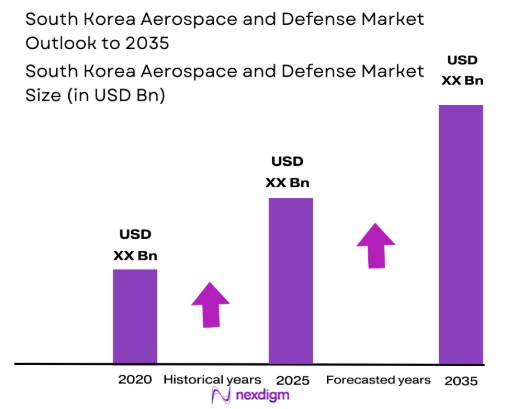
The South Korea Aerospace and Defense market is valued at approximately USD ~ billion, with an expected growth trajectory driven by the country’s robust defense budget and increasing demand for advanced aerospace technologies. The market is heavily influenced by government spending on military modernization, including the development of autonomous defense systems, space technologies, and cyber defense. This growing investment in innovation fuels growth in both aerospace and defense sectors, with private and public sector collaboration driving market developments.
South Korea is a dominant player in the aerospace and defense sector, leveraging its technological advancements and robust defense infrastructure. The country’s position as a leading aerospace hub in the Asia-Pacific region is supported by strategic initiatives and government funding. Leading cities like Seoul and Daegu contribute significantly to defense manufacturing, research, and development, as well as air and naval platforms. South Korea’s defense exports to neighboring countries further enhance its dominance in the region’s aerospace industry.
Market Segmentation
By Product Type
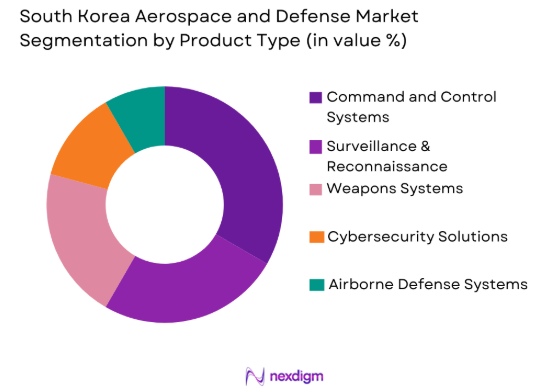
The South Korea Aerospace and Defense market is segmented by product type into systems such as command & control systems, weapon systems, surveillance & reconnaissance systems, airborne defense systems, and cybersecurity solutions. Recently, command & control systems have dominated the market share due to increasing demand for real-time, integrated military operations across various platforms. These systems are essential for enhanced communication, coordination, and situational awareness during operations, boosting their adoption among military and defense sectors.
By Platform Type
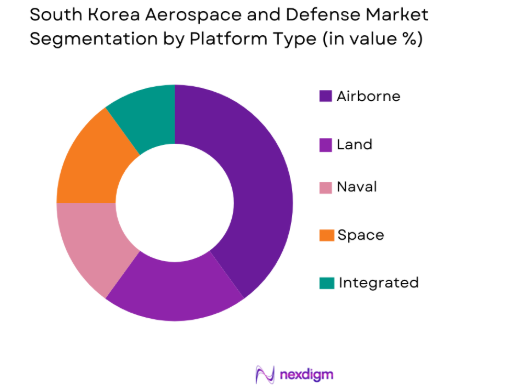
The market is segmented by platform type into land platforms, air platforms, naval platforms, space platforms, and integrated platforms. Air platforms currently dominate the market due to the country’s focus on strengthening its air defense systems, modernizing fighter jets, and enhancing unmanned aerial vehicle (UAV) capabilities. The rising geopolitical tensions in the region, combined with South Korea’s growing defense alliances, make air platforms critical for maintaining superiority in defense strategies.
Competitive Landscape
The competitive landscape of the South Korea Aerospace and Defense market is shaped by the presence of both local and international players. Key players such as Korea Aerospace Industries and Hyundai Heavy Industries dominate the market, while international players like Lockheed Martin and Boeing continue to influence the competition through joint ventures and partnerships. The market is highly consolidated, with several players focusing on technological innovation, defense system integration, and expanding product portfolios to capture market share.
| Company Name | Establishment Year | Headquarters | Technology Focus | Market Reach | Key Products | Revenue | Military Platform Integration |
| Korea Aerospace Industries | 1999 | Seoul, South Korea | ~ | ~ | ~ | ~ | ~ |
| Hanwha Defense | 1977 | Seoul, South Korea | ~ | ~ | ~ | ~ | ~ |
| Lockheed Martin | 1912 | Bethesda, USA | ~ | ~ | ~ | ~ | ~ |
| Boeing | 1916 | Chicago, USA | ~ | ~ | ~ | ~ | ~ |
| LIG Nex1 | 1976 | Seoul, South Korea | ~ | ~ | ~ | ~ | ~ |
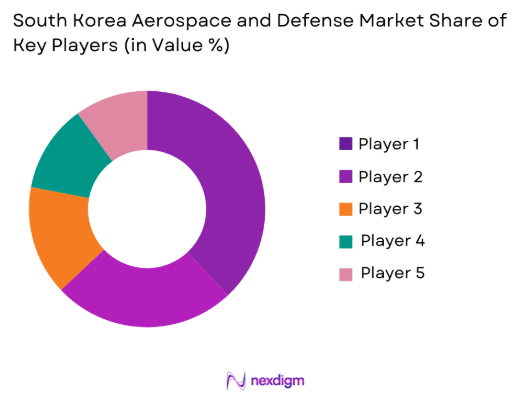
South Korea Aerospace and Defense Market Analysis
Growth Drivers
Government Focus on National Security:
South Korea’s robust defense budget supports the country’s vision of achieving advanced defense capabilities, driving innovation in defense technology, including advanced missile systems and UAVs. The government has made significant investments in autonomous systems, strengthening both its cybersecurity infrastructure and defense platforms. Additionally, increasing geopolitical tensions, particularly with North Korea and surrounding regions, create a continuous need for enhanced defense technologies. These initiatives, including military modernization programs, contribute significantly to the market’s growth trajectory.
Technological Advancements in Aerospace and Cybersecurity:
The continuous advancements in aerospace technologies, including unmanned systems and autonomous vehicles, are driving market expansion in South Korea. The country’s emphasis on research and development, coupled with the growth of defense partnerships, fosters innovation in sectors like satellite systems, airborne platforms, and missile technologies. Furthermore, the increasing importance of cybersecurity solutions to protect sensitive military data from cyber-attacks propels the market, especially as new technologies like AI and machine learning enhance defense capabilities.
Market Challenges
High Capital Expenditure
One significant challenge for the South Korean aerospace and defense market is the high capital expenditure required for the development and integration of advanced defense systems. Defense contractors must invest heavily in research and development (R&D) to stay ahead in an increasingly competitive market. This puts pressure on companies to secure funding and manage high-risk investments, which can impact profit margins and project timelines. The financial burden of maintaining cutting-edge military systems and keeping pace with technological advancements can strain resources and delay market growth.
Regulatory and Compliance Issues
South Korea’s aerospace and defense industry faces numerous regulatory hurdles, particularly regarding export control regulations, technology transfer laws, and compliance with international agreements. Companies must navigate complex government regulations and obtain approval from regulatory bodies to export military technologies, which slows down market entry and international expansion. Furthermore, compliance with various standards and certifications for defense systems increases costs and requires significant investments in legal and regulatory affairs, limiting the ability of smaller players to compete.
Opportunities
Growth in Space Defense Capabilities
As space exploration becomes more integrated into national security strategies, South Korea sees opportunities in enhancing its space defense capabilities. The increasing importance of satellite-based defense systems and the growing threat of space-based attacks present opportunities for companies to innovate and expand their product offerings. Investments in space defense technologies, coupled with strategic partnerships with global defense firms, are driving this market segment’s growth. South Korea’s rising space ambitions position it as a potential leader in space defense solutions in the Asia-Pacific region.
Expansion in Unmanned Systems
The demand for unmanned systems, including drones and UAVs, is rapidly increasing in the South Korean aerospace and defense market. These systems offer flexibility, reduced operational costs, and enhanced surveillance capabilities. South Korea is investing heavily in the development of unmanned aerial and ground vehicles for defense purposes, presenting an opportunity for growth in autonomous technologies. The military’s shift toward unmanned platforms, particularly in reconnaissance and combat scenarios, is poised to create significant growth in this segment.
Future Outlook
Over the next five years, the South Korea Aerospace and Defense market is expected to experience significant growth driven by technological innovations and increasing defense spending. The country’s defense strategy will continue to focus on modernizing its military platforms, especially in air, land, and space domains. The development of cutting-edge autonomous systems, along with enhanced cybersecurity solutions, will reshape the market, while regulatory frameworks will evolve to support new defense technologies. Increasing defense budgets and geopolitical uncertainties will drive sustained demand across aerospace and defense sectors.
Major Players
- Korea Aerospace Industries
- Hanwha Defense
- Lockheed Martin
- Boeing
- LIG Nex1
- Northrop Grumman
- Raytheon Technologies
- Airbus
- Hyundai Heavy Industries
- Samsung Techwin
- Daewoo Shipbuilding & Marine Engineering
- SK hynix
- General Dynamics
- BAE Systems
- Rolls-Royce
Key Target Audience
- Investments and venture capitalist firms
- Government and regulatory bodies
- Aerospace contractors and manufacturers
- Military defense departments
- Security services firms
- Space exploration firms
- Defense technology firms
- Unmanned vehicle developers
Research Methodology
Step 1: Identification of Key Variables
The first step involves identifying the key variables that impact the South Korea Aerospace and Defense market, including technological advancements, government spending, and geopolitical factors.
Step 2: Market Analysis and Construction
Market trends, opportunities, and challenges are analyzed using primary and secondary research. Data is synthesized to create an accurate picture of the current and future market.
Step 3: Hypothesis Validation and Expert Consultation
The hypotheses developed through initial research are validated by consulting industry experts, including defense contractors and regulatory bodies.
Step 4: Research Synthesis and Final Output
The final output is prepared after synthesizing all research data, providing a comprehensive market report backed by credible data and expert insights.

- Executive Summary
- Research Methodology (Definitions, Scope, Industry Assumptions, Market Sizing Approach, Primary & Secondary Research Framework, Data Collection & Verification Protocol, Analytic Models & Forecast Methodology, Limitations & Research Validity Checks)

- Market Definition and Scope
- Value Chain & Stakeholder Ecosystem
- Regulatory / Certification Landscape
- Sector Dynamics Affecting Demand
- Strategic Initiatives & Infrastructure Growth

- Growth Drivers
Government focus on defense modernization
Technological advancements in UAVs
Strategic partnerships with global defense contractors
Rising geopolitical tensions in the region
Increased defense budgets and investment - Market Challenges
High capital expenditure for defense projects
Complexity in system integration
Regulatory barriers and compliance issues
Technological obsolescence and cybersecurity threats
Lack of skilled workforce in advanced technologies - Market Opportunities
Growth in unmanned systems (UAV, UGV)
Rising demand for cybersecurity solutions
Expanding partnerships with global defense firms - Trends
Increasing use of autonomous systems in defense
Integration of AI and machine learning in defense operations
Surge in defense electronics and sensors market
Enhanced focus on cybersecurity for defense applications
Growth in space defense capabilities - Government Regulations & Defense Policy
Government funding for national defense projects
Stricter export control and compliance policies
Defense technology advancement and certification standards

- By Market Value, 2020-2025
- By Installed Units, 2020-2025
- By Average System Price, 2020-2025
- By System Complexity Tier, 2020-2025

- By System Type (In Value%)
Command & Control Systems
Surveillance & Reconnaissance Systems
Airborne Defense Systems
Weapon Systems
Cybersecurity Solutions - By Platform Type (In Value%)
Air Platforms
Naval Platforms
Land Platforms
Space Platforms
Integrated Platforms - By Fitment Type (In Value%)
On-premise Solutions
Cloud-based Solutions
Modular Solutions
Hybrid Solutions
Integrated Solutions - By End User Segment (In Value%)
Military Forces
Defense Contractors
Government Agencies
Security Services
Private Sector / Technology Firms - By Procurement Channel (In Value%)
Direct Procurement
Government Tenders
Private Sector Procurement
Online Bidding Platforms
Third-party Distributors - By Material / Technology (in Value%)
Electronics & Sensors
Composite Materials
Cybersecurity Technologies
Aerospace Technologies
Weapon Systems Technologies

- Market structure and competitive positioning
- Market share snapshot of major players
- Cross Comparison Parameters (System Type, Platform Type, Procurement Channel, End User Segment, Fitment Type, Technology, Geography, Pricing, Innovation, Service Offerings)
- SWOT Analysis of Key Players
- Pricing & Procurement Analysis
- Porter’s Five Forces
- Key Players
Korea Aerospace Industries
Hanwha Defense
LIG Nex1
Hyundai Heavy Industries
Samsung Techwin
Daewoo Shipbuilding & Marine Engineering
SK hynix
Hyundai Motor Group
Korean Air
Pusan National University (R&D)
Eldorado Systems
Korea Electronics Technology Institute (KETI)
Rolls-Royce Korea
Lockheed Martin Korea
General Dynamics

- Military forces’ growing demand for advanced defense systems
- Defense contractors’ focus on system innovation
- Government agencies’ role in regulating and procuring defense technology
- Private sector’s increasing interest in cybersecurity solutions for defense

- Forecast Market Value, 2026-2035
- Forecast Installed Units, 2026-2035
- Price Forecast by System Tier, 2026-2035
- Future Demand by Platform, 2026-2035


 Request a Sample
 Ask for Customization
 Get a Quote
 Enquire Now