

 Download PDF
 Download PDF
Market Overview
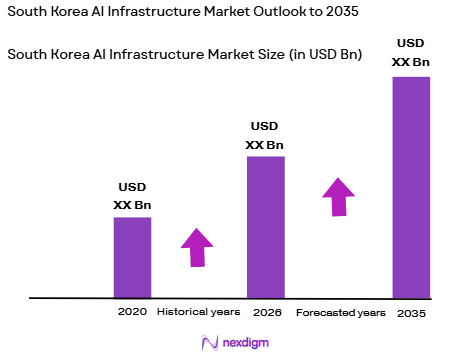
The South Korea AI infrastructure market is embedded within the country’s advanced digital and semiconductor ecosystem, valued at approximately USD ~ billion based on a recent historical assessment of AI data centers, GPU clusters, and high-performance computing platforms. Growth is driven by national AI strategy implementation, hyperscale cloud expansion, and enterprise adoption of generative AI across manufacturing, telecom, finance, and digital services. Investments in AI-ready data centers, supercomputing systems, and accelerated computing hardware are expanding domestic AI processing capacity.
Seoul metropolitan region dominates AI infrastructure concentration due to hyperscale data center density, enterprise headquarters presence, and advanced fiber connectivity enabling large-scale AI computing operations. Gyeonggi Province hosts major AI and semiconductor facilities supported by industrial technology parks and power availability. South Korea benefits from proximity to leading semiconductor manufacturing hubs and global electronics supply chains, positioning the country as a central AI compute and semiconductor integration hub within Northeast Asia digital infrastructure networks.
Market Segmentation
By Infrastructure Type
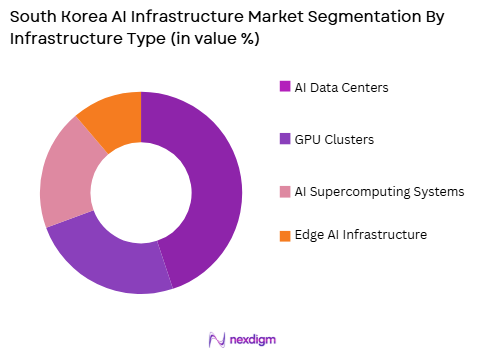
South Korea AI Infrastructure market is segmented by infrastructure type into AI data centers, GPU clusters, AI supercomputing systems, and edge AI infrastructure. Recently, AI data centers has a dominant market share due to factors such as hyperscale cloud expansion, enterprise AI workload migration, and government-supported AI computing facilities. Hyperscale and colocation providers deploy high-density AI data centers equipped with GPU racks and advanced cooling to support large-scale training and inference workloads. Enterprises across manufacturing, finance, and telecom sectors utilize centralized AI data centers for analytics, automation, and digital platform services. GPU clusters and supercomputing systems operate within these facilities, reinforcing data center dominance as the core infrastructure layer of South Korea’s AI ecosystem.
By End-Use Industry
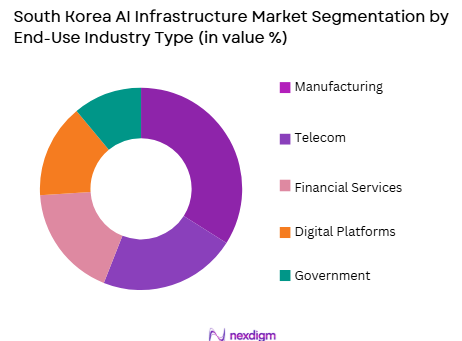
South Korea AI Infrastructure market is segmented by end-use industry into manufacturing, telecom, financial services, government, and digital platforms. Recently, manufacturing has a dominant market share due to factors such as industrial automation, smart factory deployment, and AI-driven robotics integration across South Korea’s advanced manufacturing sector. Automotive, electronics, and semiconductor manufacturers deploy AI infrastructure for predictive maintenance, quality inspection, and production optimization requiring large-scale computing resources. Telecom and digital platform firms also utilize AI computing, but manufacturing’s extensive automation and robotics ecosystems position it as the largest investor in AI infrastructure within South Korea’s industrial economy.
Competitive Landscape
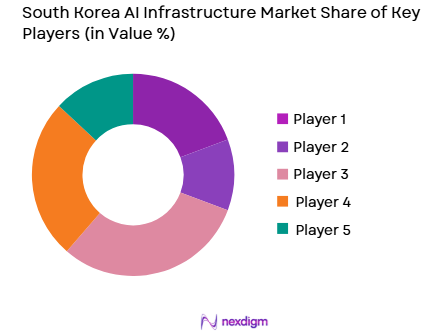
The South Korea AI infrastructure market is dominated by domestic technology conglomerates, telecom operators, and global cloud providers deploying large-scale AI computing facilities and platforms. Market concentration is high among firms integrating semiconductor manufacturing, cloud platforms, and AI hardware capabilities. Government-supported AI supercomputing initiatives further strengthen national players. Competition centers on GPU capacity scale, AI platform integration, and data center efficiency.
| Company Name | Establishment Year | Headquarters | Technology Focus | Market Reach | Key Products | Revenue | AI Infrastructure Focus |
| Samsung Electronics | 1969 | South Korea | ~ | ~ | ~ | ~ | ~ |
| SK Telecom | 1984 | South Korea | ~ | ~ | ~ | ~ | ~ |
| Naver | 1999 | South Korea | ~ | ~ | ~ | ~ | ~ |
| KT Corp | 1981 | South Korea | ~ | ~ | ~ | ~ | ~ |
| LG CNS | 1987 | South Korea | ~ | ~ | ~ | ~ | ~ |
South Korea AI Infrastructure Market Analysis
Growth Drivers
National AI Strategy and Government-Backed Compute Infrastructure Investment
South Korea has implemented a comprehensive national artificial intelligence strategy prioritizing domestic AI computing capacity through government-funded supercomputers, AI data centers, and public-private cloud infrastructure programs supporting nationwide AI adoption. Public investment initiatives finance large-scale AI compute clusters accessible to enterprises, startups, and research institutions, accelerating ecosystem development. National AI policy mandates expansion of sovereign AI infrastructure to maintain technological competitiveness in semiconductor and digital industries. Government agencies deploy AI computing for public services, defense, healthcare analytics, and smart city platforms. Funding incentives encourage private sector investment in AI-ready data centers and accelerated computing hardware. National supercomputing facilities support advanced AI research and industrial innovation. Regulatory frameworks promote domestic data processing and AI platform development. Public-private partnerships enable hyperscale data center expansion across regions. AI infrastructure deployment aligns with semiconductor industry leadership and digital economy strategy. Continuous government support ensures sustained growth in South Korea AI infrastructure capacity and adoption across sectors.
Industrial Automation and Smart Manufacturing AI Adoption
South Korea’s globally advanced manufacturing sector is rapidly integrating artificial intelligence into robotics, automation, quality control, and predictive maintenance systems, generating large-scale demand for AI infrastructure capable of processing industrial data and training machine learning models. Automotive, semiconductor, and electronics factories deploy computer vision, robotics AI, and digital twin platforms requiring high-performance computing environments. Industrial AI applications rely on GPU clusters and centralized AI data centers for model training and analytics. Smart factory initiatives across industrial zones incorporate AI-driven optimization and automation systems connected to enterprise computing platforms. Real-time production monitoring and predictive maintenance analytics generate continuous data streams processed by AI infrastructure. Manufacturing enterprises invest in private AI clouds and high-performance computing clusters for operational intelligence. Integration of AI with industrial IoT sensors increases computational requirements across production networks. Korea’s leadership in robotics and automation accelerates industrial AI deployment scale. Industrial competitiveness strategies emphasize AI-enabled manufacturing efficiency and innovation. As smart manufacturing expands nationwide, AI infrastructure demand grows across South Korea’s industrial ecosystem.
Market Challenges
High Energy Consumption and Cooling Requirements of AI Data Centers
AI infrastructure deployment in South Korea faces operational and environmental challenges due to extremely high energy consumption and cooling requirements of GPU-dense data centers and supercomputing facilities supporting large-scale AI workloads. Accelerated computing hardware generates substantial heat requiring advanced cooling technologies including liquid cooling and high-efficiency HVAC systems. Power demand of AI data centers strains national energy infrastructure and increases operational costs. Data center expansion competes with urban land and power availability constraints in metropolitan regions. Sustainability and carbon emission regulations require energy-efficient infrastructure design. Electricity price volatility affects long-term operating economics of AI facilities. Cooling water availability and environmental impact considerations affect site selection. High energy intensity increases lifecycle cost of AI computing infrastructure. Enterprises must balance AI performance with sustainability targets. Infrastructure operators invest heavily in energy optimization technologies. These energy and environmental constraints challenge large-scale AI infrastructure expansion despite strong demand.
Dependence on Imported AI Compute Hardware and Semiconductor Supply Risks
Although South Korea leads in semiconductor memory production, AI infrastructure deployment still relies on imported GPUs and specialized accelerators from global suppliers, creating supply chain vulnerabilities affecting domestic AI compute capacity expansion. Advanced AI GPUs and accelerators are produced by limited global vendors subject to export controls and allocation priorities. Demand surges for AI chips create procurement constraints and deployment delays. Integration of imported accelerators into domestic infrastructure increases cost and complexity. Semiconductor technology competition and geopolitical tensions influence supply availability. Domestic alternatives remain limited in high-end AI compute processors. Infrastructure investment planning depends on global hardware roadmaps. Supply chain disruptions affect hyperscale data center expansion schedules. Currency fluctuations influence hardware procurement costs. National AI competitiveness is partially constrained by external hardware dependence. These structural supply risks challenge self-sufficient AI infrastructure development.
Opportunities
Development of Domestic AI Accelerators and Semiconductor Integration
South Korea’s advanced semiconductor ecosystem provides significant opportunity to develop domestic AI accelerators, memory-compute integration technologies, and specialized processors integrated into national AI infrastructure, reducing dependence on foreign hardware and strengthening technological sovereignty. Semiconductor firms are investing in AI chip design and high-bandwidth memory optimized for AI workloads. Integration of domestic AI processors into data centers enhances supply security and performance optimization. National semiconductor strategies prioritize AI chip development aligned with infrastructure deployment. Collaboration between semiconductor manufacturers and cloud providers accelerates hardware-software integration. Domestic AI accelerator adoption supports local industry competitiveness. Export opportunities emerge for Korean AI hardware solutions. Vertical integration across semiconductor and AI infrastructure ecosystems strengthens value chain control. Research institutions advance AI processor innovation. Manufacturing scale enables competitive production of AI chips. Development of domestic AI hardware creates long-term growth opportunities for South Korea AI infrastructure.
Expansion of AI Cloud Platforms and Generative AI Services Ecosystem
South Korea’s digital platforms, telecom operators, and technology firms are rapidly expanding AI cloud services and generative AI platforms requiring large-scale infrastructure investment in GPU clusters, AI data centers, and distributed computing environments across the country. Domestic AI models and language platforms require high-performance training infrastructure. Enterprises adopt AI cloud services for automation, analytics, and digital products. Telecom providers deploy AI-enabled services across networks and applications. Generative AI startups drive demand for scalable compute resources. Government and enterprise clients require localized AI cloud platforms for compliance and performance. AI-as-a-service offerings expand infrastructure utilization. Platform ecosystems integrate AI tools across industries. Demand for AI inference infrastructure grows with application deployment. Regional AI cloud expansion positions Korea as a Northeast Asia AI hub. As AI services proliferate, infrastructure demand accelerates nationwide.
Future Outlook
The South Korea AI infrastructure market is expected to expand rapidly as national AI strategy implementation and industrial AI adoption accelerate across sectors. Domestic AI chip development and semiconductor integration will strengthen infrastructure capabilities. Hyperscale AI data centers and cloud platforms will expand nationwide capacity. Manufacturing and digital platform sectors will remain major infrastructure investors. South Korea will reinforce its position as a leading AI and semiconductor infrastructure hub in Asia.
Major Players
- Samsung Electronics
- SK Telecom
- KT Corp
- Naver
- LG CNS
- Kakao
- SK Hynix
- NHN Cloud
- Amazon Web Services
- Microsoft
- Google Cloud
- NVIDIA
- Intel
- HPE
- Dell Technologies
Key Target Audience
- Semiconductor manufacturers
- Telecom operators
- Cloud service providers
- Manufacturing conglomerates
- Financial institutions
- Digital platform companies
- Investments and venture capitalist firms
- Government and regulatory bodies
Research Methodology
Step 1: Identification of Key Variables
AI compute capacity, data center scale, semiconductor integration, industrial AI adoption, and government infrastructure investment were identified as primary variables. Supply chain dependencies and energy factors were mapped. Industry workload demand was assessed.
Step 2: Market Analysis and Construction
Market structure was constructed by analyzing infrastructure types, sector adoption, and regional deployment across South Korea. AI data center and compute segmentation were modeled. Industry demand drivers were evaluated.
Step 3: Hypothesis Validation and Expert Consultation
Assumptions regarding AI adoption, semiconductor integration, and infrastructure constraints were validated through ecosystem benchmarking and technology analysis. National policy impacts were incorporated. Competitive positioning factors were verified.
Step 4: Research Synthesis and Final Output
All insights were synthesized into a comprehensive market model describing segmentation, competition, growth drivers, and opportunities. Infrastructure investment and demand dynamics were integrated. Final outputs reflected technology and industrial trends shaping South Korea AI infrastructure outlook.

- Executive Summary
- Research Methodology (Definitions, Scope, Industry Assumptions, Market Sizing Approach, Primary & Secondary Research Framework, Data Collection & Verification Protocol, Analytic Models & Forecast Methodology, Limitations & Research Validity Checks)

- Market Definition and Scope
- Value Chain & Stakeholder Ecosystem
- Regulatory / Certification Landscape
- Sector Dynamics Affecting Demand
- Strategic Initiatives & Infrastructure Growth

- Growth Drivers
Strong national investment in AI and semiconductor infrastructure
Expansion of hyperscale cloud and AI data center capacity
Rapid AI adoption across automotive, robotics, and electronics sectors - Market Challenges
High energy consumption and cooling requirements of AI clusters
Dependence on imported advanced AI accelerators
Space and power constraints in urban data center hubs - Market Opportunities
Domestic AI supercomputing and sovereign AI infrastructure
AI integration in manufacturing automation and robotics
Autonomous mobility and smart city AI deployment - Trends
Adoption of liquid-cooled high-density AI clusters
Integration of AI accelerators in telecom and edge networks
Convergence of AI and semiconductor infrastructure ecosystems - Government regulations
National AI and digital infrastructure investment programs
Semiconductor and AI technology localization policies
Data governance and AI ethics compliance frameworks - SWOT analysis
- Porters five forces

- By Market Value, 2020-2025
- By Installed Units, 2020-2025
- By Average System Price, 2020-2025
- By System Complexity Tier, 2020-2025

- By System Type (In Value%)
AI Training Supercomputing Clusters
GPU and Accelerator Servers
AI Storage and Data Infrastructure
AI Networking and Interconnect Systems
Edge AI Infrastructure Platforms - By Platform Type (In Value%)
Hyperscale AI Data Centers
Enterprise AI Platforms
Telecom AI Cloud Infrastructure
Research and Academic HPC
Autonomous Systems Compute Platforms - By Fitment Type (In Value%)
New AI Data Center Deployment
AI Cluster Expansion
Accelerator Retrofit Integration
Modular AI Infrastructure Blocks
Edge AI Deployment Units - By EndUser Segment (In Value%)
Cloud and Internet Platforms
Telecommunications Operators
Automotive and Robotics Firms
Electronics and Semiconductor Companies
Government and Research Institutes - By Procurement Channel (In Value%)
Direct OEM and Accelerator Vendors
Cloud Provider Procurement
System Integrator Deployment
Telecom Infrastructure Contracts
Government AI Programs

- Market Share Analysis
- Cross Comparison Parameters (AI Compute Density, Accelerator Performance per Watt, Interconnect Bandwidth and Topology, Memory Bandwidth and Capacity, Cluster Scalability Architecture, Cooling and Thermal Management, AI Software Stack Compatibility, Deployment Flexibility, Power Consumption per Rack, Sovereign AI Compliance Readiness)
- SWOT Analysis of Key Competitors
- Pricing & Procurement Analysis
- Key Players
Samsung Electronics
SK hynix
LG CNS
Naver Cloud
Kakao Enterprise
KT Corporation
SK Telecom
LG Uplus
NHN Cloud
FuriosaAI
Rebellions
HyperAccel
Dell Technologies Korea
Hewlett Packard Enterprise Korea
NVIDIA Korea

- Cloud platforms expanding large-scale AI training clusters
- Telecom operators deploying AI for network automation
- Automotive and robotics firms building AI compute capacity
- Government and academia investing in national AI HPC

- Forecast Market Value, 2026-2035
- Forecast Installed Units, 2026-2035
- Price Forecast by System Tier, 2026-2035
- Future Demand by Platform, 2026-2035


 Request a Sample
 Ask for Customization
 Get a Quote
 Enquire Now