

 Download PDF
 Download PDF
Market Overview
The South Korean car finance market is projected to reach USD ~ billion based on a recent historical assessment. This growth is driven by increasing vehicle sales, greater financing options, and government incentives aimed at supporting electric vehicle adoption. With a growing middle class and rising consumer demand for mobility, car financing is becoming an accessible solution for a larger segment of the population, especially in urban areas with high vehicle ownership.
Seoul, Incheon, and Busan dominate the car finance market due to their higher income levels, large population, and developed infrastructure. These cities see a consistent demand for both traditional and electric vehicles, with government incentives further fueling the adoption of electric car financing. Additionally, urban areas benefit from well-established financial institutions, making car financing easily accessible for a broader range of consumers, contributing to the rapid growth of the market.
Market Segmentation
By Product Type:
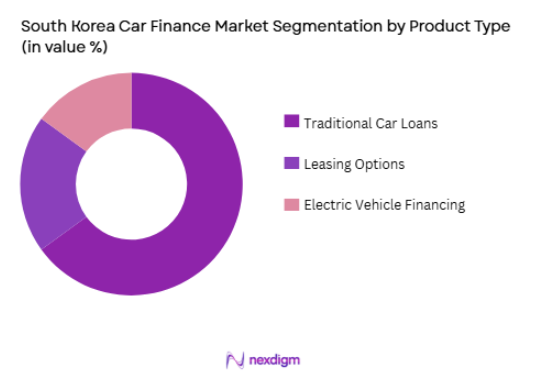
The South Korea car finance market is segmented by product type into traditional car loans, leasing options, and electric vehicle financing. Recently, traditional car loans have dominated the market share due to the widespread preference for owning vehicles and the availability of low-interest loans. The growth of financing options for electric vehicles has started to gain traction, especially with the government’s push for green mobility. However, traditional car loans continue to be the most popular choice for the majority of the population, owing to their established nature and familiarity among consumers.
By Application:
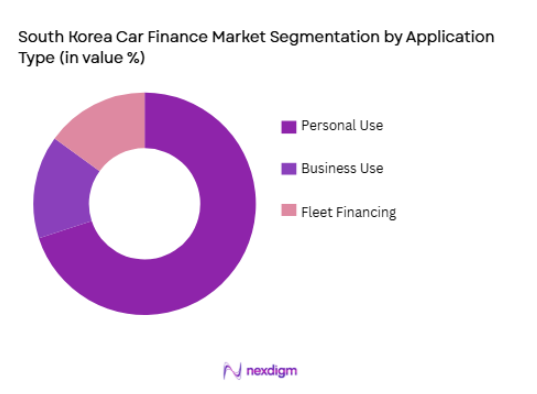
The South Korea car finance market is also segmented by application into personal use, business use, and fleet financing. Personal use has the dominant market share, driven by the increasing number of households owning personal vehicles. Business and fleet financing segments are growing but still have a smaller share, as businesses and companies typically prefer bulk purchase models with long-term leasing or financing options, particularly for electric fleets used in commercial operations.
Competitive Landscape
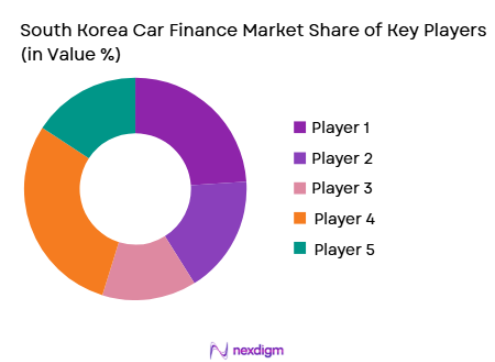
The South Korea car finance market is highly competitive, with several key players dominating the market. Major banks and financial institutions, such as Samsung Life Insurance and Hyundai Capital, have significant shares, offering comprehensive car loan products with attractive terms. Additionally, car manufacturers like Hyundai and Kia have strong partnerships with financial service providers to offer in-house financing options. These collaborations have helped to drive growth and streamline the process for consumers. As the market matures, there is a trend towards more specialized financing solutions, including those for electric vehicles and fleet management.
| Company Name | Establishment Year | Headquarters | Technology Focus | Market Reach | Key Products | Revenue | Additional Parameter |
| Hyundai Capital | 1989 | Seoul, South Korea | ~ | ~ | ~ | ~ | ~ |
| Samsung Life | 1957 | Seoul, South Korea | ~ | ~ | ~ | ~ | ~ |
| KB Kookmin Bank | 1963 | Seoul, South Korea | ~ | ~ | ~ | ~ | ~ |
| Shinhan Bank | 1897 | Seoul, South Korea | ~ | ~ | ~ | ~ | ~ |
| Hyundai Motor Group | 1967 | Seoul, South Korea | ~ | ~ | ~ | ~ | ~ |
South Korea Car Finance Market Analysis
Growth Drivers
Government Support:
The South Korean government plays a crucial role in supporting the car finance market through policies that stimulate consumer demand. Initiatives such as subsidies for electric vehicle purchases, tax rebates, and favorable financing schemes for electric cars have all contributed to the growth of the car finance market. The government’s long-term strategy focuses on increasing the adoption of electric vehicles and reducing carbon emissions, which has led to the introduction of attractive financing options, including low-interest loans for eco-friendly cars. These policies have not only supported consumer adoption of electric vehicles but also bolstered the overall car finance sector by encouraging purchases across all vehicle types.
Technological Advancements in Financing:
The advancement of digital technologies in the car finance market is another significant growth driver. The rise of online platforms and digital banking has made car financing more accessible to a broader audience. Consumers now have the ability to apply for loans, check credit scores, and secure financing entirely online, which reduces the time and effort involved in the purchasing process. This convenience has increased the attractiveness of financing, particularly for tech-savvy younger buyers. Furthermore, the integration of AI and machine learning in underwriting has enhanced the accuracy and efficiency of loan approval processes, making it easier for consumers to access car financing.
Market Challenges
High Initial Costs of Electric Vehicles:
The high upfront costs of electric vehicles (EVs) remain one of the most significant barriers to the adoption of EV financing in South Korea. Despite government subsidies and rebates, the price of EVs is still substantially higher than traditional gasoline-powered vehicles, which has created a significant gap in affordability for many consumers. While the operating costs of EVs are lower, the higher initial price point prevents many potential buyers from considering them, thus limiting the overall growth of EV financing options in the car finance market. This challenge is particularly prominent in the personal use segment, where budget constraints are a more significant factor.
Rising Interest Rates:
Another challenge that has affected the South Korean car finance market is the rising interest rates. As global and domestic economic conditions fluctuate, interest rates on car loans have seen an increase, which has made car financing more expensive for consumers. Higher financing costs have reduced the affordability of car loans, especially for middle-income groups. The rise in interest rates impacts consumer confidence and purchasing behavior, especially in times of economic uncertainty, where consumers are more likely to postpone large purchases like cars. The tightening of credit access also affects the broader market, as it limits the ability of some consumers to secure loans.
Opportunities
Expansion of Electric Vehicle Financing:
As South Korea’s government continues to push for greater electric vehicle adoption, the car finance market is presented with a significant opportunity in the electric vehicle financing segment. With more favorable terms and the expansion of incentives for EV buyers, there is a clear opportunity for financial institutions to cater to this growing market. Additionally, as the battery technology improves and the cost of EVs decreases, more consumers are expected to opt for electric vehicles. This shift in consumer preferences creates a fertile ground for financial products tailored to EV purchases, including specialized car loans and long-term leasing options. The increase in electric vehicle sales provides a new and expanding market for car finance companies, especially in urban areas where EV adoption is expected to rise faster.
Shift Toward Digital and Hybrid Financing Models:
The growth of digital financing solutions and hybrid models combining traditional car loans with new-age products like leasing and car-sharing services presents a significant opportunity for market players. Financial institutions and car manufacturers are exploring innovative financing structures that cater to new customer needs. These models can offer more flexibility for consumers, including shorter contract terms and customized payment options. Digital platforms and mobile apps are also making car finance more accessible to a broader demographic, including younger buyers who are more likely to engage with digital solutions. The ability to seamlessly integrate car loans with mobile payment systems and digital wallets presents new revenue streams for financial institutions, further accelerating the growth of the market.
Future Outlook
The South Korea car finance market is expected to continue its upward trajectory, supported by the increasing demand for both traditional and electric vehicles. Over the next five years, technological advancements in financing solutions and growing consumer adoption of electric vehicles will drive further market expansion. The government’s continued commitment to promoting green mobility, along with the expansion of digital financial services, will create opportunities for financial institutions to cater to a broader range of consumers. However, challenges such as rising interest rates and high EV prices will need to be addressed to ensure continued growth in the sector.
Major Players
- Hyundai Capital
- Samsung Life Insurance
- KB Kookmin Bank
- Shinhan Bank
- Hyundai Motor Group
- Woori Bank
- Kia Motors
- Daewoo Securities
- LG Electronics
- Citibank
- SC First Bank
- Hana Bank
- LG Chem
- Mercedes-Benz Financial Services
- BMW Financial Services
Key Target Audience
- Investments and venture capitalist firms
- Government and regulatory bodies
- Car manufacturers and dealers
- Banks and financial institutions
- EV manufacturers
- Car leasing companies
- Technology providers in finance
- Insurance companies
Research Methodology
Step 1: Identification of Key Variables
Identify key variables affecting the car finance market, including economic factors, technological advancements, government policies, and consumer behavior trends.
Step 2: Market Analysis and Construction
Analyze market trends, growth patterns, and the current structure of the car finance market using primary and secondary research data.
Step 3: Hypothesis Validation and Expert Consultation
Consult industry experts, financial institutions, and car manufacturers to validate research hypotheses and refine market forecasts.
Step 4: Research Synthesis and Final Output
Consolidate the findings into a comprehensive report, providing actionable insights and strategic recommendations for stakeholders in the South Korea car finance market.

- Executive Summary
- Research Methodology (Definitions, Scope, Industry Assumptions, Market Sizing Approach, Primary & Secondary Research Framework, Data Collection & Verification Protocol, Analytic Models & Forecast Methodology, Limitations & Research Validity Checks)

- Market Definition and Scope
- Value Chain & Stakeholder Ecosystem
- Regulatory / Certification Landscape
- Sector Dynamics Affecting Demand
- Strategic Initiatives & Infrastructure Growth

- Growth Drivers
Increasing Middle-Class Population
Growing Demand for Personal Vehicles
Expansion of Online Financing Platforms - Market Challenges
High Interest Rates
Limited Credit Accessibility
Regulatory and Compliance Hurdles - Market Opportunities
Digital Transformation in Car Financing
Government Policies Supporting Electric Vehicle Financing
Partnerships Between Automakers and Financial Institutions - Trends
Adoption of Digital Payment Solutions in Car Financing
Growth of Subscription-based Car Financing Models - Government Regulations
Financing Terms and Interest Rate Guidelines
Consumer Protection Laws in Vehicle Financing
Regulations on Electric Vehicle Financing - SWOT Analysis
- Porter’s Five Forces

- By Market Value, 2020-2025
- By Installed Units, 2020-2025
- By Average System Price, 2020-2025
- By System Complexity Tier, 2020-2025

- By System Type (In Value%)
Leasing Options
Installment Financing
Personal Loans
Fleet Financing
Balloon Financing - By Platform Type (In Value%)
Online Platforms
Banks & Financial Institutions
Automaker Partnerships
Independent Finance Companies
Peer-to-Peer Platforms - By Fitment Type (In Value%)
New Car Financing
Used Car Financing
Refinancing
Flexible Financing Options - By End User Segment (In Value%)
Individual Consumers
Car Dealerships
Fleet Operators
Corporate Buyers

- Market Share Analysis
- Cross Comparison Parameters (System Type, Platform Type, End User Segment, Interest Rates, Loan Tenure, Credit Score Requirements, Loan-to-Value Ratio, Geographic Coverage, Repayment Flexibility, Digital Integration)
- SWOT Analysis of Key Competitors
- Pricing & Procurement Analysis
- Key Players
Hyundai Capital
Samsung Card
KB Kookmin Card
Shinhan Bank
Lotte Capital
Citibank Korea
SK Networks
Hana Financial Group
SBI Savings Bank
Korea Investment & Securities
Woori Bank
Kookmin Bank
Daewoo Securities
Kia Motors Finance
Hyundai Motor Finance

- Increasing Adoption of Car Financing Among Millennials
- Fleet Operators Expanding Their Financing Options
- Government Support for Corporate Car Financing
- Rising Interest in Flexible Payment Schemes


 Request a Sample
 Ask for Customization
 Get a Quote
 Enquire Now