

 Download PDF
 Download PDF
Market Overview
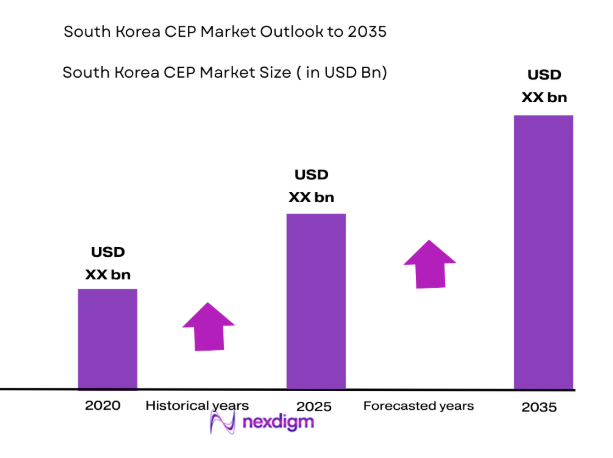
The South Korea CEP market demonstrates strong operational scale supported by the country’s advanced logistics infrastructure and highly digitized retail ecosystem. Based on recent historical assessments, the market size is valued at approximately USD ~ billion, supported by high parcel volumes generated from online retail platforms, manufacturing supply chains, and cross-border e-commerce activities. Government data from Korea Communications Commission and Statistics Korea indicate continuous parcel shipment growth driven by mobile commerce adoption, integrated logistics networks, and widespread digital payment usage.
Seoul, Busan, Incheon, and Gyeonggi Province dominate CEP logistics activity due to dense urban populations, high internet penetration, and concentration of major distribution infrastructure. Seoul functions as the primary logistics command hub supported by large parcel sorting facilities and headquarters of national courier companies. Busan contributes significantly through port-driven international parcel flows and export logistics connectivity, while Incheon strengthens air cargo and international parcel distribution due to the presence of Incheon International Airport and extensive free trade logistics zones.
Market Segmentation
By Product Type
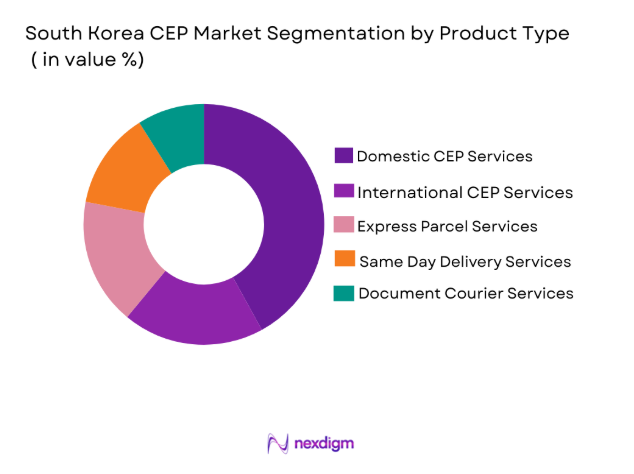
South Korea CEP market is segmented by product type into domestic courier services, international courier services, express parcel services, same day delivery services, and document courier services. Recently, domestic courier services have a dominant market share due to factors such as strong e-commerce shipment volumes, dense urban delivery networks, and high frequency of consumer parcel shipments. Online retail platforms generate millions of domestic parcel orders daily requiring reliable nationwide courier networks connecting fulfillment centers with residential delivery zones. Logistics providers maintain extensive parcel sorting hubs, motorcycle fleets, and automated distribution systems supporting rapid domestic delivery operations across metropolitan regions.
By Platform Type
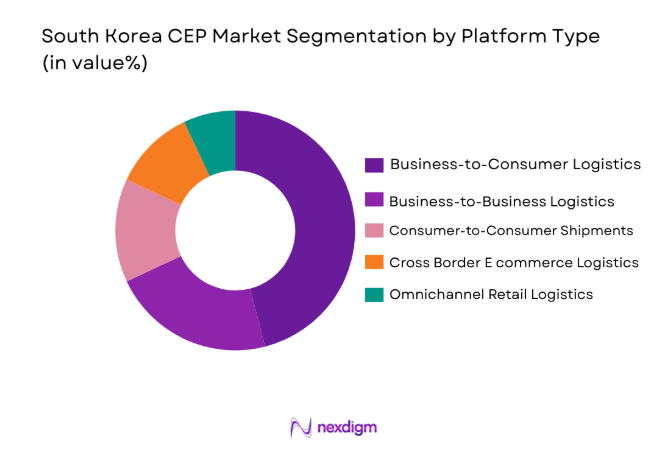
South Korea CEP market is segmented by platform type into business to consumer logistics, business to business logistics, consumer to consumer shipments, cross border e-commerce logistics, and omnichannel retail logistics. Recently, business to consumer logistics has a dominant market share due to factors such as rapid online retail adoption, widespread mobile commerce platforms, and growing consumer preference for home delivery services. Major digital marketplaces process extremely high order volumes requiring parcel carriers capable of managing urban distribution routes and automated fulfillment integration with online retail systems.
Competitive Landscape
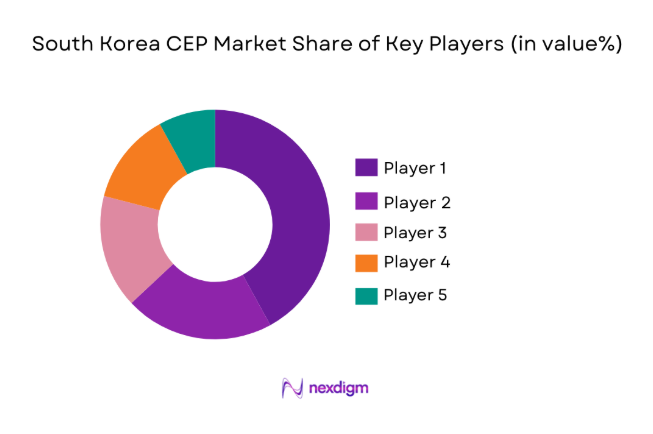
The South Korea CEP market is moderately consolidated with several dominant national courier companies controlling large parcel volumes through extensive distribution infrastructure and integrated logistics networks. Major players continuously invest in automated parcel sorting facilities, artificial intelligence driven route optimization systems, and urban micro fulfillment hubs to improve operational efficiency and delivery speed. Strong competition exists between domestic logistics providers and global courier companies operating within international parcel delivery and cross border logistics segments.
| Company Name | Establishment Year | Headquarters | Technology Focus | Market Reach | Key Products | Revenue | Logistics Network Capacity |
| CJ Logistics | 1930 | Seoul, South Korea | ~ | ~ | ~ | ~ | ~ |
| Hanjin Transportation | 1945 | Seoul, South Korea | ~ | ~ | ~ | ~ | ~ |
| Lotte Global Logistics | 1988 | Seoul, South Korea | ~ | ~ | ~ | ~ | ~ |
| DHL Korea | 1969 | Seoul, South Korea | ~ | ~ | ~ | ~ | ~ |
| Korea Post | 1884 | Sejong, South Korea | ~ | ~ | ~ | ~ | ~ |
South Korea CEP Market Analysis
Growth Drivers
Expansion of E Commerce Platforms and Mobile Retail Logistics Networks
Rapid expansion of digital retail platforms significantly strengthens demand for courier express parcel services across South Korea’s logistics ecosystem. Online marketplaces including Coupang, Naver Shopping, and Gmarket generate extremely high parcel shipment volumes that require reliable nationwide delivery infrastructure connecting fulfillment warehouses with urban residential areas. Consumers increasingly rely on mobile commerce applications for purchasing electronics, fashion products, groceries, and household items that require rapid delivery services. Logistics companies therefore invest heavily in automated parcel sorting hubs, advanced warehouse robotics, and urban distribution facilities designed to process large shipment volumes efficiently. Integrated logistics management software allows courier providers to track shipments in real time while optimizing delivery routes to reduce operational delays and improve customer satisfaction. Retail companies increasingly partner with third party logistics providers capable of managing complex last mile delivery operations and reverse logistics handling for product returns. Expanding smartphone usage and digital payment adoption enable a larger share of the population to participate in online retail transactions that generate consistent parcel demand. Logistics providers also implement predictive analytics systems that forecast parcel volumes and allocate fleet capacity accordingly across metropolitan delivery routes. As online retail continues expanding across South Korea’s digital economy, courier express parcel services remain essential logistics infrastructure supporting the country’s fast growing e commerce supply chains.
High Urban Population Density Supporting Efficient Last Mile Delivery Operations
South Korea’s highly urbanized population structure significantly strengthens operational efficiency within the courier express parcel logistics sector. Large metropolitan areas including Seoul, Busan, and Incheon contain dense residential neighborhoods where courier fleets can deliver a high volume of parcels within relatively short geographic distances. This concentration of delivery destinations allows logistics companies to maximize vehicle productivity while reducing transportation costs associated with long distance deliveries. Courier companies operate sophisticated parcel sorting facilities located near urban centers that allow shipments to be quickly distributed across city districts. High density housing complexes and apartment communities enable delivery personnel to complete multiple deliveries within a single location, improving daily parcel delivery capacity. Urban infrastructure including advanced road networks, digital navigation systems, and real time traffic monitoring platforms supports efficient courier routing across metropolitan logistics corridors. Logistics providers increasingly deploy electric delivery vehicles and automated locker systems located within residential complexes to improve operational sustainability and parcel collection convenience. Retail fulfillment centers positioned close to urban markets allow parcels to reach consumers within short delivery timeframes including same day and next day services. As urban population density continues supporting high delivery concentration, logistics providers can maintain highly efficient last mile distribution networks capable of handling increasing parcel shipment volumes across South Korea’s major cities.
Market Challenges
Rising Operational Costs and Urban Delivery Infrastructure Constraints
Rising operational costs present a major challenge for courier express parcel providers operating within South Korea’s competitive logistics environment. Courier companies must continuously invest in fleet expansion, automated parcel sorting technology, and digital logistics platforms in order to maintain service speed and reliability demanded by e commerce retailers and consumers. Labor costs associated with delivery personnel and warehouse operators also increase operating expenses across logistics networks handling millions of parcels daily. Urban congestion within major metropolitan regions can slow delivery routes and reduce overall fleet efficiency despite advanced routing systems designed to optimize transportation schedules. Logistics providers therefore need to invest in additional distribution centers and micro fulfillment hubs positioned closer to consumers in order to maintain rapid delivery timelines. Fuel costs and vehicle maintenance expenses further contribute to operational challenges for courier companies managing large transportation fleets. Environmental regulations also require logistics providers to transition toward electric delivery vehicles and energy efficient warehouse infrastructure, creating additional capital investment requirements. Maintaining profitability becomes difficult as intense competition among courier providers pushes companies to offer faster delivery services while controlling pricing structures. Technology integration across multiple logistics platforms can also create operational complexity requiring skilled workforce training and system maintenance. As parcel volumes continue expanding across South Korea’s digital commerce ecosystem, courier companies must balance infrastructure investment with operational efficiency to maintain sustainable logistics operations.
Increasing Parcel Delivery Expectations and Service Speed Competition
Increasing consumer expectations regarding delivery speed and service reliability create continuous operational pressure for courier express parcel providers across South Korea. Online shoppers increasingly expect same day or next day delivery services supported by real time parcel tracking and flexible delivery scheduling options. Retail platforms promote rapid shipping as a competitive advantage which requires logistics providers to maintain highly responsive delivery networks capable of handling sudden spikes in parcel demand. Courier companies must therefore expand distribution infrastructure including automated parcel hubs and urban fulfillment facilities designed for high throughput operations. Managing delivery workforce capacity becomes challenging during seasonal sales events when parcel volumes increase dramatically within short time periods. Logistics providers also face pressure to maintain low shipping costs despite increasing operational expenses associated with faster delivery commitments. Reverse logistics handling for product returns adds additional complexity to parcel management operations particularly within fashion and electronics retail sectors where return rates remain high. Delivery accuracy and customer service responsiveness also influence brand reputation within highly competitive courier markets where consumers frequently compare service experiences. Maintaining reliable delivery timelines across dense urban areas requires sophisticated logistics management software capable of analyzing traffic patterns and route conditions. As delivery speed expectations continue rising across digital retail ecosystems, courier companies must continuously upgrade infrastructure and operational strategies to remain competitive within South Korea’s rapidly evolving parcel logistics industry.
Opportunities
Expansion of Cross Border E Commerce and International Parcel Logistics Networks
Rapid growth of cross border e commerce presents significant opportunities for courier express parcel providers operating within South Korea’s logistics sector. Consumers increasingly purchase international products through digital retail platforms that connect domestic buyers with overseas merchants located in China, the United States, Japan, and Southeast Asia. These international transactions require reliable courier services capable of managing customs documentation, international freight coordination, and last mile delivery operations within South Korea. Logistics companies therefore expand partnerships with global courier networks and air cargo carriers to strengthen international parcel transportation capabilities. Investment in digital customs processing systems allows courier providers to streamline cross border parcel clearance procedures while reducing shipment delays. Free trade agreements and trade facilitation policies implemented by the South Korean government also support growth in international parcel logistics activity. Courier companies develop specialized international shipping solutions that integrate overseas warehousing, freight consolidation, and domestic parcel distribution services. Cross border logistics platforms supported by real time tracking technology improve shipment visibility for consumers purchasing international products through online marketplaces. Logistics providers also establish overseas distribution centers that allow international merchants to store inventory closer to Korean consumer markets. As global digital commerce continues expanding, cross border parcel shipments represent a major opportunity for logistics companies seeking to expand service offerings and strengthen international supply chain connectivity.
Adoption of Automation Artificial Intelligence and Smart Logistics Infrastructure
Technological innovation across automation and artificial intelligence platforms creates strong opportunities for courier express parcel providers seeking operational efficiency improvements within South Korea’s logistics networks. Logistics companies increasingly deploy automated parcel sorting systems capable of processing thousands of shipments per hour while reducing manual labor requirements within distribution centers. Artificial intelligence driven logistics platforms analyze shipment patterns, delivery routes, and traffic conditions to optimize transportation schedules and fleet deployment strategies. Smart warehouse infrastructure including robotics assisted picking systems improves inventory handling efficiency and reduces processing times for e commerce order fulfillment operations. Courier providers also integrate Internet of Things sensors within logistics networks to monitor parcel movement and warehouse conditions in real time. Autonomous delivery technologies including delivery robots and automated parcel lockers further expand opportunities for improving last mile logistics efficiency in dense urban environments. Digital logistics platforms connecting retailers, logistics providers, and consumers allow seamless shipment coordination across multiple supply chain stages. Government initiatives supporting smart logistics infrastructure and digital transformation within the transportation sector encourage private investment in advanced logistics technology platforms. As automation and artificial intelligence technologies continue evolving, courier express parcel companies can significantly improve productivity, reduce operational costs, and enhance service reliability within South Korea’s highly competitive parcel delivery ecosystem.
Future Outlook
The South Korea CEP market is expected to experience sustained growth driven by continued expansion of e commerce, digital retail platforms, and cross border parcel shipments. Logistics providers are likely to accelerate investments in automation technologies, smart warehouses, and artificial intelligence driven delivery management systems. Government infrastructure modernization and smart logistics initiatives are expected to further strengthen national parcel distribution capabilities. Increasing consumer expectations for rapid delivery services and international product access will continue shaping courier network expansion strategies.
Major Players
- CJ Logistics
- Hanjin Transportation
- Lotte Global Logistics
- Korea Post
- DHL Korea
- FedEx Korea
- UPS Korea
- CJ Korea Express
- Pantos Logistics
- Hyundai Glovis
- Kuehne + Nagel Korea
- DB Schenker Korea
- SF Express Korea
- Kerry Logistics Korea
Key Target Audience
- E-commerce retailers
- Manufacturing companies
- Retail distribution companies
- Logistics infrastructure developers
- Cross border trade companies
- Investments and venture capitalist firms
- Government and regulatory bodies
Research Methodology
Step 1: Identification of Key Variables
Initial research identifies the primary operational variables influencing the South Korea CEP market including parcel shipment volume, logistics infrastructure capacity, courier network coverage, and digital retail transaction activity across domestic and cross border delivery ecosystems.
Step 2: Market Analysis and Construction
Secondary research sources including government logistics statistics, national postal service reports, trade databases, and corporate financial disclosures are analyzed to construct a comprehensive understanding of the courier express parcel logistics landscape.
Step 3: Hypothesis Validation and Expert Consultation
Industry analysts validate preliminary findings through expert consultations with logistics professionals, supply chain managers, and transportation sector specialists to ensure data accuracy and relevance within the market environment.
Step 4: Research Synthesis and Final Output
Collected information is synthesized through analytical frameworks and comparative market evaluation methods to produce structured insights on market dynamics, competitive positioning, and future growth opportunities within the South Korea CEP sector.

- Executive Summary
- Research Methodology (Definitions, Scope, Industry Assumptions, Market Sizing Approach, Primary & Secondary Research Framework, Data Collection & Verification Protocol, Analytic Models & Forecast Methodology, Limitations & Research Validity Checks)

- Market Definition and Scope
- Value Chain & Stakeholder Ecosystem
- Regulatory / Certification Landscape
- Sector Dynamics Affecting Demand
- Strategic Initiatives & Infrastructure Growth

- Growth Drivers
Rapid Expansion of E-commerce and Digital Retail Platforms
Advanced Urban Logistics Infrastructure and Technology Adoption
Rising Demand for Same Day and Next Day Delivery Services - Market Challenges
High Last Mile Delivery Costs in Dense Urban Areas
Labor Shortages and Workforce Management Challenges
Increasing Environmental Regulations on Delivery Fleets - Market Opportunities
Expansion of Automated Parcel Sorting and Smart Warehousing
Growth of Cross Border E-commerce Logistics Services
Adoption of Electric Vehicles and Sustainable Delivery Solutions - Trends
Integration of AI Driven Route Optimization and Delivery Tracking
Growth of Automated Parcel Lockers and Smart Pickup Stations - Government Regulations
- SWOT Analysis
- Porter’s Five Forces

- By Market Value, 2020-2025
- By Installed Units, 2020-2025
- By Average System Price, 2020-2025
- By System Complexity Tier, 2020-2025

- By System Type (In Value%)
Domestic Courier Services
International Express Delivery
E-commerce Parcel Delivery
Same Day Delivery Services
Cross Border Parcel Logistics - By Platform Type (In Value%)
Ground Transportation Networks
Air Cargo Express Networks
Integrated Logistics Platforms
Digital Courier Management Platforms
Urban Micro Fulfillment Networks - By Fitment Type (In Value%)
Business to Business Delivery
Business to Consumer Delivery
Consumer to Consumer Delivery
Omnichannel Retail Fulfillment - By End User Segment (In Value%)
E-commerce Retailers
Manufacturing and Industrial Companies
Healthcare and Pharmaceutical Distributors

- Market Share Analysis
- Cross Comparison Parameters (Service Coverage Network, Delivery Speed Capability, Pricing Structure, Technology Integration, Fleet Capacity, Cross Border Logistics Capability, E-commerce Integration)
- SWOT Analysis of Key Competitors
- Pricing & Procurement Analysis
- Key Players
CJ Logistics
Hanjin Transportation
Lotte Global Logistics
Korea Post EMS
DHL Express Korea
FedEx Korea
UPS Korea
SF Express Korea
Kerry Logistics Korea
Hyundai Glovis
Pantos Logistics
DB Schenker Korea
Kuehne + Nagel Korea
Yamato Korea
Korea Integrated Logistics

- E-commerce retailers rely heavily on CEP networks to manage high daily parcel volumes and nationwide distribution coverage
- Manufacturing companies depend on courier and express logistics for rapid shipment of industrial components and spare parts
- Healthcare distributors utilize CEP networks for time sensitive pharmaceutical and medical supply deliveries
- SMEs increasingly adopt courier platforms to support nationwide online retail and direct to consumer shipments

- Forecast Market Value, 2026-2035
- Forecast Installed Units, 2026-2035
- Price Forecast by System Tier, 2026-2035
- Future Demand by Platform, 2026-2035


 Request a Sample
 Ask for Customization
 Get a Quote
 Enquire Now