
 Download PDF
 Download PDF
Market Overview
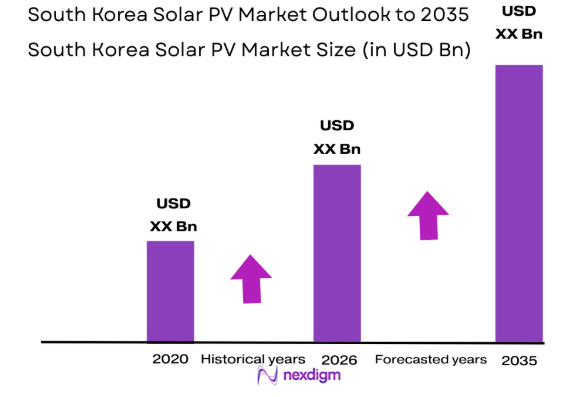
The South Korea Solar Photovoltaic (PV) market is valued at approximately USD ~ billion, with a significant annual growth trajectory driven by increasing investments in renewable energy infrastructure and a national focus on clean energy adoption. The market’s expansion is propelled by government policies, subsidies for renewable projects, and advancements in solar technology. Furthermore, the nation’s substantial commitment to reducing carbon emissions has been a key factor in the market’s continued growth, facilitating the uptake of solar energy solutions across residential, commercial, and industrial sectors.
Key cities such as Seoul and Incheon, along with regions near South Korea’s vast coastline, lead the solar PV market due to their high solar energy potential and government support. The country’s favorable solar radiation levels, coupled with robust technological infrastructure and the government’s long-term energy strategies, provide a solid foundation for solar energy deployment. Urban areas benefit from large-scale rooftop installations and utility-scale solar farms, contributing significantly to the market’s dominance in the Asia-Pacific region.
Market Segmentation
By Product Type
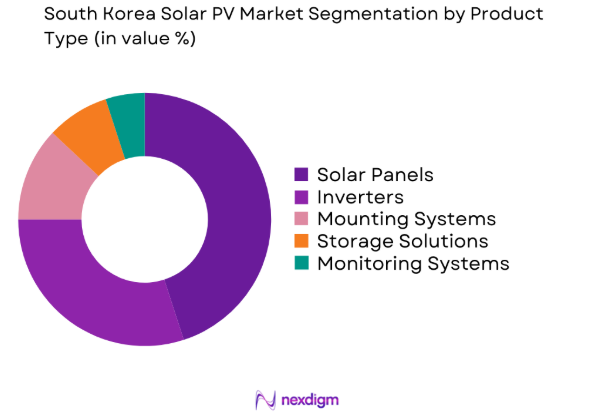
The South Korea Solar PV market is segmented by product type into solar panels, inverters, mounting systems, storage solutions, and monitoring systems. Recently, solar panels have taken the dominant market share, owing to the rising demand for high-efficiency photovoltaic cells, driven by advancements in materials like monocrystalline silicon. The strong performance, coupled with ongoing R&D efforts and economies of scale, has made solar panels the preferred choice for both large-scale and residential installations.
By Platform Type
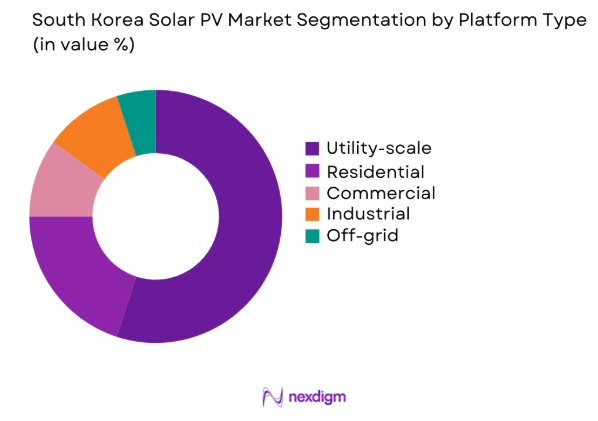
The South Korea Solar PV market is segmented by platform type into residential, commercial, industrial, utility-scale, and off-grid platforms. Utility-scale solar power plants currently hold the dominant share due to the substantial government support and the growing energy demand across the nation. These large-scale plants benefit from significant economies of scale and feed-in tariffs, making them attractive to developers and investors.
Competitive Landscape
The competitive landscape of the South Korea solar PV market is characterized by consolidation, with several large domestic and international players holding significant shares of the market. These players dominate with strong technological innovations, extensive manufacturing capabilities, and strategic partnerships. Leading firms are increasingly focusing on vertical integration, where they control the entire supply chain, from manufacturing solar panels to providing complete solar solutions.
| Company Name | Establishment Year | Headquarters | Technology Focus | Market Reach | Key Products | Revenue (USD) | Additional Parameter |
| Hanwha Q Cells | 2012 | Seoul, South Korea | ~ | ~ | ~ | ~ | ~ |
| LG Electronics | 1958 | Seoul, South Korea | ~ | ~ | ~ | ~ | ~ |
| Hyundai Heavy Industries | 1977 | Seoul, South Korea | ~ | ~ | ~ | ~ | ~ |
| Samsung SDI | 1970 | Seoul, South Korea | ~ | ~ | ~ | ~ | ~ |
| OCI Company | 1959 | Seoul, South Korea | ~ | ~ | ~ | ~ | ~ |
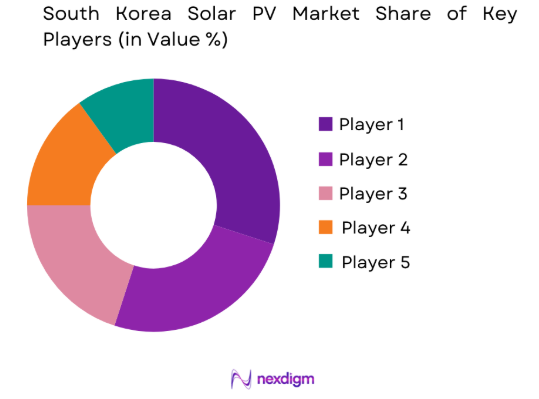
South Korea Solar PV Market Analysis
Growth Drivers
Government incentives for renewable energy
The South Korean government has introduced several policies, such as subsidies and tax incentives, to foster the growth of the solar PV market. These initiatives aim to decrease dependence on fossil fuels while promoting clean energy alternatives. By offering financial support for both residential and commercial solar systems, the government has significantly increased the adoption of solar energy. These incentives have also made solar solutions more affordable and accessible to a broader range of consumers. Continued government backing remains a key growth driver, playing a crucial role in the rapid expansion of the solar market and facilitating the transition to a more sustainable energy system in the country.
Technological advancements in solar technology
The rapid advancements in high-efficiency solar panels and storage solutions have been crucial to the growth of the solar PV market. Innovations like bifacial solar panels, which capture sunlight on both sides, and the development of large-scale battery storage systems, have greatly enhanced the performance and efficiency of solar energy systems. These technological improvements are expected to further drive market growth by increasing energy production, boosting storage capabilities, and improving grid stability. The integration of these technologies is making solar energy more feasible for various applications, including residential, commercial, and industrial sectors, thereby expanding the potential for widespread adoption and sustainable energy solutions.
Market Challenges
High initial capital investment
A major challenge for the South Korean solar PV market is the high initial cost of solar installations. Despite government incentives, the upfront capital required for purchasing and installing solar panels and related equipment remains considerable. This financial burden can discourage potential investors, particularly in the residential sector, where affordability is a primary concern. While the long-term benefits of solar energy, such as reduced electricity bills and energy independence, are well-established, the high initial investment can act as a barrier. This is especially true for small businesses and low-income households, who may struggle to afford the upfront costs, even with financial incentives in place.
Regulatory and policy barriers
Despite strong government support for renewable energy, regulatory and bureaucratic inefficiencies in the permitting and licensing process continue to hinder the deployment of solar projects in South Korea. Lengthy approval procedures for new installations and delays in securing necessary permits can cause significant project delays, leading to increased costs and reduced profitability. These inefficiencies are especially challenging for smaller developers, who may lack the resources to navigate the complex regulatory landscape or cope with extended approval timelines. As a result, these hurdles can slow down project execution and discourage investment, despite the government’s efforts to promote solar energy adoption. Addressing these regulatory challenges is crucial for the continued growth and success of the solar PV market.
Opportunities
Emerging demand for solar-plus-storage solutions
The integration of solar power with energy storage systems presents a major opportunity for market players in South Korea. With the increasing demand for reliable, renewable energy, the need for energy storage solutions that can store excess solar power generated during the day for use at night or during peak demand has grown. By offering solar-plus-storage systems, companies can target a market segment focused on energy independence and enhanced grid stability. This integration allows consumers to maximize the benefits of their solar systems, reducing reliance on the grid and increasing flexibility. As more individuals and businesses seek sustainable energy solutions, this combination provides a competitive edge and supports the transition to cleaner, more reliable energy sources.
Expansion of floating solar PV systems
Floating solar PV systems have attracted attention in South Korea due to the country’s limited land availability for large-scale solar projects. These systems, which are installed on water bodies such as reservoirs and lakes, can generate significant amounts of electricity while minimizing land usage. This solution is especially relevant in South Korea, where land scarcity is a major concern for solar development. As floating solar technology advances, more projects are expected to be implemented, especially in urban areas with limited space for traditional rooftop or ground-mounted solar installations. This growing opportunity not only helps overcome land constraints but also offers an efficient and sustainable way to meet the country’s renewable energy goals.
Future Outlook
The South Korea solar PV market is poised for continued growth, driven by advancements in solar technologies, government policies supporting renewable energy, and growing consumer demand for clean energy solutions. Over the next five years, the market is expected to see significant increases in both residential and commercial solar installations, particularly with the rise of integrated solar and storage systems. Continued investment in large-scale utility projects, along with regulatory support, will help accelerate the transition to a low-carbon economy, ensuring that solar power plays a pivotal role in South Korea’s future energy landscape.
Major Players
- Hanwha Q Cells
- LG Electronics
- Hyundai Heavy Industries
- Samsung SDI
- OCI Company
- Solis
- JA Solar Technology
- Trina Solar
- First Solar
- Risen Energy
- LONGiGreen Energy
- SunPower
- Canadian Solar
- Yingli Solar
- Sunrun
Key Target Audience
- Investments and venture capitalist firms
- Government and regulatory bodies
- Solar power installers
- Utility companies
- Renewable energy project developers
- Real estate developers
- Environmental NGOs
- Large-scale commercial and industrial energy consumers
Research Methodology
Step 1: Identification of Key Variables
The first step involves identifying the key variables influencing the solar PV market in South Korea, such as government policies, technological developments, and energy demand patterns. These variables are critical in understanding the market dynamics.
Step 2: Market Analysis and Construction
This step involves analyzing existing data on solar energy installations, product trends, and key players. This helps construct a comprehensive understanding of market size, growth patterns, and the competitive landscape.
Step 3: Hypothesis Validation and Expert Consultation
In this step, hypotheses related to the market trends and growth drivers are validated through expert consultations with industry leaders, government representatives, and technological innovators.
Step 4: Research Synthesis and Final Output
Finally, all research findings are synthesized into a comprehensive report, ensuring that the output is accurate, actionable, and supported by up-to-date data from credible sources.

- Executive Summary
- Research Methodology (Definitions, Scope, Industry Assumptions, Market Sizing Approach, Primary & Secondary Research Framework, Data Collection & Verification Protocol, Analytic Models & Forecast Methodology, Limitations & Research Validity Checks)

- Market Definition and Scope
- Value Chain & Stakeholder Ecosystem
- Regulatory / Certification Landscape
- Sector Dynamics Affecting Demand
- Strategic Initiatives & Infrastructure Growth

- Growth Drivers
Increasing government incentives for renewable energy
Growing demand for clean energy
Technological advancements in solar PV systems - Market Challenges
High initial capital investment
Regulatory hurdles
Intermittency and grid integration issues - Market Opportunities
Expansion in energy storage systems
Emerging demand for solar-plus-storage solutions
Investment in floating solar PV systems - Trends
Adoption of bifacial solar panels
Increase in decentralized energy systems
Integration of AI and IoT in solar energy management - Government Regulations
- SWOT Analysis of Key Competitors
- Porter’s Five Forces

- By Market Value, 2020-2025
- By Installed Units, 2020-2025
- By Average System Price, 2020-2025
- By System Complexity Tier, 2020-2025

- By System Type (In Value%)
Solar Panels
Inverters
Mounting Systems
Storage Solutions
Monitoring Systems - By Platform Type (In Value%)
Residential
Commercial
Industrial
Utility-scale
Off-grid - By Fitment Type (In Value%)
Rooftop
Ground-mounted
Building-integrated
Floating
Community Solar - By End User Segment (In Value%)
Residential Consumers
Commercial Businesses
Government Agencies
Energy Utilities
Non-profit Organizations - By Procurement Channel (In Value%)
Direct Procurement
Third-party Procurement
Government Tenders
Online Platforms
Distributors

- Market Share Analysis
- Cross Comparison Parameters (System Type, Platform Type, Procurement Channel, End User Segment, Fitment Type, Technology Integration, Installation Method, Geographic Region, Financing Models, Market Share by Vendor)
- SWOT Analysis of Key Competitors
- Pricing & Procurement Analysis
- Key Players
Hanwha Q Cells
LG Electronics
Korea Electric Power Corporation (KEPCO)
Samsung SDI
Hyundai Heavy Industries
OCI Company
SK Innovation
LG Chem
Sungrow Power Supply
SolarEdge Technologies
Trina Solar
First Solar
JA Solar Technology
LONGi Green Energy
Risen Energy
Canadian Solar

- Growth in residential rooftop solar installations
- Government push for solar integration in commercial buildings
- Industrial adoption of solar energy for cost savings
- Increase in utility-scale solar power projects

- Forecast Market Value, 2026-2035
- Forecast Installed Units, 2026-2035
- Price Forecast by System Tier, 2026-2035
- Future Demand by Platform, 2026-2035


 Request a Sample
 Ask for Customization
 Get a Quote
 Enquire Now