

 Download PDF
 Download PDF
Market Overview
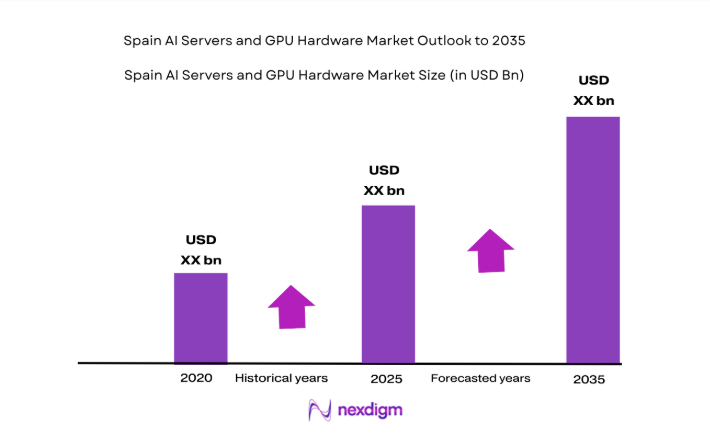
Spain AI servers and GPU hardware market reached approximately USD ~ billion based on recent European data center infrastructure assessments and accelerator hardware shipment disclosures from industry vendors. Market expansion is primarily driven by hyperscale data center investments, public supercomputing programs, and enterprise generative AI adoption requiring high performance GPU clusters. Increasing demand for liquid cooled high density AI servers and sovereign cloud initiatives has accelerated infrastructure procurement across Spain’s AI compute ecosystem.
Madrid and Barcelona dominate Spain AI servers and GPU hardware market due to concentration of hyperscale and colocation data centers, national research supercomputing facilities, and telecom network hubs enabling AI edge deployment. Madrid hosts major cloud regions and national digital infrastructure programs, while Barcelona benefits from the Barcelona Supercomputing Center and technology innovation clusters. Strong fiber connectivity, renewable energy access, and government supported digitalization initiatives further reinforce these cities as AI infrastructure deployment centers.
Market Segmentation
By Product Type
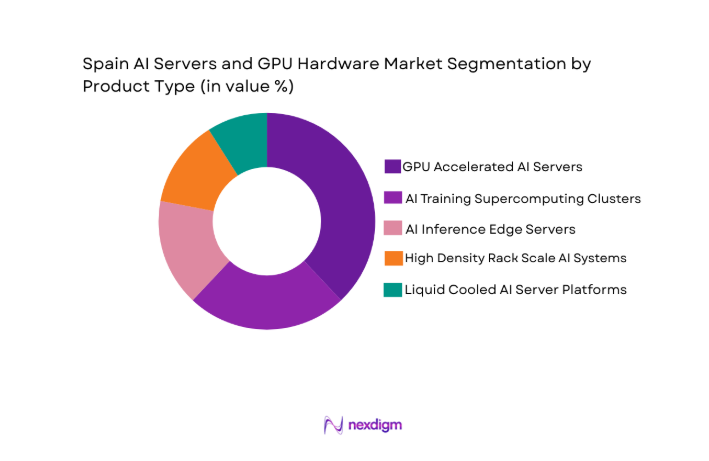
Spain AI servers and GPU hardware market is segmented by product type into GPU accelerated AI servers, AI training supercomputing clusters, AI inference edge servers, high density rack scale AI systems, and liquid cooled AI server platforms. Recently, GPU accelerated AI servers has a dominant market share due to factors such as demand patterns, brand presence, infrastructure availability, or consumer preference.
By Platform Type
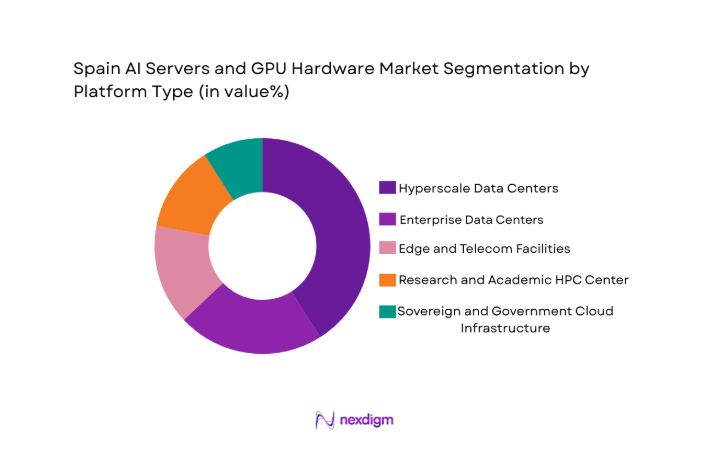
Spain AI servers and GPU hardware market is segmented by platform type into hyperscale data centers, enterprise data centers, edge and telecom facilities, research and academic HPC centers, and sovereign and government cloud infrastructure. Recently, hyperscale data centers has a dominant market share due to factors such as demand patterns, brand presence, infrastructure availability, or consumer preference.
Competitive Landscape
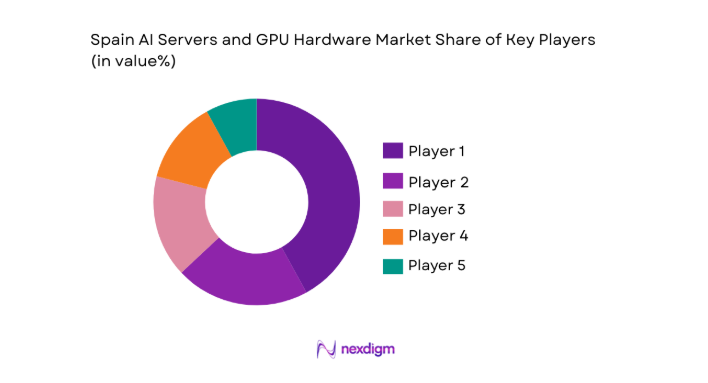
Spain AI servers and GPU hardware market exhibits moderate consolidation with global server OEMs and accelerator technology providers dominating supply while regional system integrators and HPC specialists support deployment and customization. Major players leverage GPU partnerships, liquid cooling innovation, and AI software stack integration to secure large hyperscale and government contracts. Presence of European HPC integrators and cloud infrastructure providers strengthens competition in public supercomputing and sovereign AI initiatives.
| Company Name | Establishment Year | Headquarters | Technology Focus | Market Reach | Key Products | Revenue | AI Infrastructure Integration |
| Hewlett Packard Enterprise | 2015 | United States | ~ | ~ | ~ | ~ | ~ |
| Dell Technologies | 1984 | United States | ~ | ~ | ~ | ~ | ~ |
| Lenovo Group | 1984 | China | ~ | ~ | ~ | ~ | ~ |
| NVIDIA Corporation | 1993 | United States | ~ | ~ | ~ | ~ | ~ |
| Atos Eviden | 1997 | France | ~ | ~ | ~ | ~ | ~ |
Spain AI servers and GPU hardware Market Analysis
Growth Drivers
Expansion of sovereign and hyperscale AI compute infrastructure in Spain
Spain AI servers and GPU hardware market growth is strongly driven by national and European initiatives to establish sovereign artificial intelligence compute capacity that reduces reliance on foreign cloud providers while enabling secure data processing environments for public sector and regulated industries. Government backed programs supporting supercomputing expansion and digital sovereignty are encouraging large scale procurement of GPU accelerated clusters and high density AI servers deployed in national data centers and research facilities. Hyperscale cloud operators are simultaneously expanding regional cloud regions and AI infrastructure footprints to meet enterprise demand for generative AI workloads, machine learning model training, and advanced analytics services hosted within Spanish jurisdiction. Spain’s strategic geographic position linking Europe, Africa, and Latin America further supports hyperscale deployment as providers establish data processing hubs serving multilingual and cross regional AI services. Strong renewable energy integration in Spanish power grids enables hyperscale operators to deploy energy intensive GPU clusters with sustainability compliance, which is increasingly required by European regulations and enterprise ESG commitments. Increasing enterprise adoption of private AI infrastructure for data sensitive workloads such as financial modeling, healthcare imaging, and industrial automation is accelerating demand for on premise GPU servers and AI optimized systems. Telecommunications operators are also investing in edge AI infrastructure integrated with 5G networks to support low latency applications including smart cities, autonomous mobility, and real time analytics across urban infrastructure. Growth in generative AI applications across Spanish enterprises is significantly increasing compute density requirements, pushing organizations toward GPU accelerated architectures rather than traditional CPU based servers. Spain’s integration into European HPC and AI research networks further drives procurement of advanced AI servers to support collaborative research, scientific computing, and national innovation programs. Combined sovereign policy support, hyperscale investment, enterprise AI adoption, and energy infrastructure readiness collectively sustain strong demand for AI servers and GPU hardware across Spain.
Acceleration of enterprise and research adoption of high performance GPU computing
Spain AI servers and GPU hardware market expansion is further driven by rapid adoption of GPU accelerated computing across enterprises, universities, and research institutions seeking to deploy advanced artificial intelligence and high performance computing workloads locally. Spanish enterprises across banking, manufacturing, healthcare, and energy sectors are deploying GPU clusters to enable generative AI development, predictive analytics, and digital twin simulations requiring massive parallel processing capability beyond conventional infrastructure. Research institutions and national laboratories are expanding supercomputing installations integrating next generation GPUs to support climate modeling, genomics research, and materials science innovation aligned with European research funding programs. Growth in AI driven automation across Spanish industry is creating demand for inference optimized GPU servers deployed both in centralized data centers and distributed industrial environments. Universities and innovation centers are investing in GPU infrastructure to support AI education, research commercialization, and startup incubation ecosystems fostering domestic AI development capability. Expansion of AI as a service offerings by cloud providers operating in Spain is also increasing procurement of GPU servers within local data centers to ensure compliance with data residency regulations. Spanish startups developing AI software and platforms require access to high performance GPU compute environments, further stimulating demand for scalable GPU clusters and cloud integrated AI hardware infrastructure. Increasing complexity of generative models and large language models requires exponentially higher compute performance, encouraging organizations to invest in advanced GPU architectures and high bandwidth memory systems. Collaboration between Spanish research institutions and European HPC networks necessitates compatible GPU based supercomputing infrastructure, reinforcing procurement cycles across academic and government sectors. Widespread adoption of GPU accelerated computing across enterprise, research, and cloud environments is therefore a central structural driver of Spain AI servers and GPU hardware market growth.
Market Challenges
Power and cooling constraints in high density AI data center deployments
Spain AI servers and GPU hardware market faces significant constraints from the escalating power consumption and thermal management requirements associated with high density GPU clusters deployed in modern AI data centers. GPU accelerated AI servers consume substantially higher electrical power compared with traditional compute infrastructure, creating pressure on existing data center power provisioning capacity and grid connection limits in urban deployment locations. Many Spanish metropolitan areas already experience limitations in new high capacity grid connections for data center expansion, delaying hyperscale and colocation projects required to host AI infrastructure. Thermal loads generated by densely packed GPUs necessitate advanced liquid cooling or immersion cooling technologies that increase capital expenditure, engineering complexity, and facility retrofitting requirements for existing data centers. Spanish operators must also comply with strict European energy efficiency and sustainability regulations governing data center power usage effectiveness and environmental impact, further complicating deployment of energy intensive AI clusters. Integration of renewable energy sources, while beneficial for sustainability compliance, introduces variability in power availability that complicates stable operation of large scale GPU clusters requiring consistent high power supply. Edge AI deployments in telecom facilities encounter additional cooling and power constraints due to limited space and infrastructure compared with hyperscale environments. Upgrading legacy enterprise data centers to support GPU accelerated infrastructure often requires substantial redesign of electrical distribution, cooling systems, and rack density configurations, increasing project cost and deployment timelines. Rising electricity prices in Europe also increase operational cost of running GPU intensive AI workloads, affecting economic feasibility for some organizations. These combined power availability, cooling technology, regulatory, and cost challenges represent a structural barrier to rapid scaling of AI servers and GPU hardware across Spain.
Dependence on global semiconductor supply chains for advanced GPUs
Spain AI servers and GPU hardware market development is constrained by heavy dependence on global semiconductor manufacturing ecosystems for advanced GPU accelerators, high bandwidth memory, and AI specific silicon components predominantly produced outside Europe. Leading edge GPUs are designed by a limited number of multinational vendors and fabricated in specialized semiconductor foundries concentrated in Asia, creating supply bottlenecks and geopolitical exposure risks for European markets including Spain. Periodic global shortages of advanced semiconductor nodes and packaging capacity directly affect availability and delivery timelines of AI servers and GPU hardware, delaying infrastructure deployment projects in Spanish data centers and research institutions. Export control policies and technology restrictions between major semiconductor producing regions can also impact access to certain high performance GPU models required for advanced AI workloads. European initiatives to develop domestic semiconductor manufacturing capability are still emerging and do not yet provide sufficient capacity for advanced GPU production required by AI infrastructure markets. Spanish enterprises and cloud operators therefore face long procurement cycles, price volatility, and limited supplier diversification for AI accelerators. Integration of GPUs into AI servers also depends on specialized interconnect technologies, memory modules, and cooling components sourced globally, amplifying supply chain complexity and risk exposure. Fluctuating global demand for GPUs driven by generative AI expansion can rapidly redirect supply toward larger hyperscale markets, reducing availability for smaller national markets. Strategic stockpiling or long term procurement contracts increase capital requirements for Spanish organizations investing in AI infrastructure. Continued reliance on concentrated global semiconductor supply chains thus represents a persistent structural challenge affecting scalability and predictability of Spain AI servers and GPU hardware market growth.
Opportunities
Development of sovereign AI cloud and supercomputing infrastructure in Spain
Spain AI servers and GPU hardware market presents substantial opportunity through expansion of nationally controlled AI cloud platforms and supercomputing facilities designed to provide secure, high performance compute resources within Spanish jurisdiction. European digital sovereignty initiatives encourage member states to develop domestic AI infrastructure supporting sensitive public sector, defense, and regulated industry workloads that cannot rely on external cloud providers. Spain’s investment in national supercomputing centers and participation in European HPC networks creates sustained demand for advanced GPU clusters, AI servers, and specialized high performance infrastructure. Establishment of sovereign AI clouds enables Spanish enterprises and government agencies to deploy generative AI applications while maintaining data residency compliance and cybersecurity assurance. Public funding and European recovery programs provide financial support for large scale AI compute installations, accelerating procurement of GPU hardware and associated server infrastructure. Development of domestic AI cloud ecosystems also fosters local AI software development, startups, and digital innovation requiring scalable GPU compute access. National AI infrastructure platforms can serve multiple sectors including healthcare research, smart cities, energy optimization, and industrial automation, broadening market demand for AI servers. Integration of sovereign AI infrastructure with Spanish telecom and edge networks creates distributed compute architectures supporting real time AI applications across the country. Spain’s geographic connectivity across continents positions sovereign AI clouds as regional AI service hubs for Spanish speaking markets. Expansion of sovereign AI cloud and supercomputing initiatives therefore represents a major long term growth opportunity for AI servers and GPU hardware deployment in Spain.
Expansion of edge AI infrastructure across telecom and smart city ecosystems
Spain AI servers and GPU hardware market has strong opportunity in deployment of distributed AI compute infrastructure integrated with telecom networks and urban digital systems supporting next generation smart city and industrial applications. Spanish telecom operators are advancing 5G and fiber networks capable of hosting edge data centers equipped with GPU accelerated inference servers enabling low latency AI processing near data sources. Edge AI infrastructure supports applications such as intelligent traffic management, public safety analytics, autonomous mobility coordination, and industrial automation across Spanish cities and transportation networks. Smart city initiatives funded by national and European programs require localized AI compute resources for video analytics, environmental monitoring, and real time infrastructure optimization, driving demand for compact GPU servers and edge AI platforms. Industrial sectors including manufacturing, logistics, and energy are adopting edge AI systems for predictive maintenance, robotics control, and operational optimization requiring on site GPU compute capability. Distributed AI architectures reduce bandwidth consumption and latency compared with centralized cloud processing, encouraging deployment of GPU hardware at telecom and enterprise edge locations. Integration of edge AI with renewable energy management and grid optimization systems also creates new infrastructure demand across Spain’s energy sector. Development of edge AI ecosystems supports domestic technology providers, system integrators, and telecom infrastructure vendors participating in deployment projects. Spain’s urban digitalization and industrial automation strategies therefore create sustained opportunity for growth of AI servers and GPU hardware beyond centralized data centers into distributed edge environments.
Future Outlook
Spain AI servers and GPU hardware market is expected to expand steadily as hyperscale data center investments, sovereign AI initiatives, and enterprise generative AI adoption accelerate infrastructure demand. Advances in GPU architectures, liquid cooling, and energy efficient AI servers will enable higher density deployments aligned with European sustainability requirements. Continued government support for supercomputing and digital sovereignty programs will strengthen domestic AI compute capacity. Growth in telecom edge AI and smart city deployments will broaden market adoption across sectors.
Major Players
- Hewlett Packard Enterprise
- Dell Technologies
- Lenovo Group
- NVIDIA Corporation
- Super Micro Computer
- Fujitsu
- AtosEviden
- Cisco Systems
- IBM
- Inspur Systems
- Gigabyte Technology
- Quanta Computer
- Advantech
- Penguin Solutions
- Eviden
Key Target Audience
- Hyperscale cloud service providers
- Telecom network operators
- Enterprise data center operators
- Government and regulatory bodies
- Defense and national security agencies
- Industrial manufacturing corporations
- Investments and venture capitalist firms
- Smart city infrastructure authorities
Research Methodology
Step 1: Identification of Key Variables
Key variables including GPU server shipments, hyperscale data center capacity, AI workload demand, and public supercomputing investments were identified across Spain AI servers and GPU hardware ecosystem. Supply chain, technology, and deployment indicators were mapped to define market boundaries and segmentation structure.
Step 2: Market Analysis and Construction
Market size was constructed using vendor shipment disclosures, data center capacity expansion data, and European AI infrastructure investment programs. Segment distribution was derived from deployment patterns across hyperscale, enterprise, telecom, and research environments within Spain.
Step 3: Hypothesis Validation and Expert Consultation
Assumptions on adoption rates, infrastructure scaling, and GPU deployment intensity were validated through expert inputs from AI infrastructure specialists, data center operators, and HPC ecosystem stakeholders active in Spain and Europe.
Step 4: Research Synthesis and Final Output
Validated quantitative and qualitative insights were synthesized into market structure, segmentation, and growth analysis reflecting Spain AI servers and GPU hardware market dynamics. Final outputs align with European AI infrastructure trends and national deployment patterns.

- Executive Summary
- Research Methodology (Definitions, Scope, Industry Assumptions, Market Sizing Approach, Primary & Secondary Research Framework, Data Collection & Verification Protocol, Analytic Models & Forecast Methodology, Limitations & Research Validity Checks)

- Market Definition and Scope
- Value Chain & Stakeholder Ecosystem
- Regulatory / Certification Landscape
- Sector Dynamics Affecting Demand
- Strategic Initiatives & Infrastructure Growth

- Growth Drivers
Expansion of sovereign AI infrastructure initiatives across Spain
Rapid enterprise adoption of generative AI workloads
Growth in hyperscale and colocation data center capacity
Public investment in supercomputing and research AI systems
Acceleration of telecom edge AI deployment - Market Challenges
High capital intensity of GPU accelerated infrastructure
Power availability and data center energy constraints
Supply chain dependence on advanced semiconductors
Thermal management complexity in dense AI clusters
Skills shortage in AI infrastructure engineering - Market Opportunities
Development of Spain based AI cloud platforms
Integration of AI compute in telecom edge networks
Public sector and smart city AI deployments - Trends
Shift toward liquid cooled AI server architectures
Growth of GPU as a service offerings
Adoption of AI optimized high speed interconnects
Localization of European AI compute capacity
Convergence of HPC and enterprise AI infrastructure - Government Regulations & Defense Policy
European data sovereignty and AI infrastructure funding programs
National digital and supercomputing strategies
Energy efficiency and sustainable data center regulations - SWOT Analysis
- Stakeholder and Ecosystem Analysis
- Porter’s Five Forces Analysis
- Competition Intensity and Ecosystem Mapping

- By Market Value, 2020-2025
- By Installed Units, 2020-2025
- By Average System Price, 2020-2025
- By System Complexity Tier, 2020-2025

- By System Type (In Value%)
GPU Accelerated AI Servers
AI Training Supercomputing Clusters
AI Inference Edge Servers
High Density Rack Scale AI Systems
Liquid Cooled AI Server Platforms - By Platform Type (In Value%)
Hyperscale Data Centers
Enterprise Data Centers
Edge and Telecom Facilities
Research and Academic HPC Centers
Sovereign and Government Cloud Infrastructure - By Fitment Type (In Value%)
Rack Integrated Systems
Blade AI Server Modules
Standalone GPU Expansion Systems
Modular AI Infrastructure Pods
Preconfigured AI Appliances - By EndUser Segment (In Value%)
Cloud Service Providers
Telecom Operators
Financial and Enterprise Corporates
Public Sector and Defense Agencies
Research and Education Institutions - By Procurement Channel (In Value%)
Direct OEM Procurement
System Integrator Contracts
Cloud Infrastructure Partnerships
Government Tenders
Distributor and Reseller Networks

- Market structure and competitive positioning
Market share snapshot of major players - Cross Comparison Parameters (GPU Performance Density, System Scalability, Cooling Technology, Interconnect Architecture, Energy Efficiency)
- SWOT Analysis of Key Competitors
- Pricing & Procurement Analysis
- Key Players
Hewlett Packard Enterprise
Dell Technologies
Lenovo Group
NVIDIA Corporation
Super Micro Computer
Fujitsu
Atos
Cisco Systems
IBM
Inspur Systems
Gigabyte Technology
Quanta Computer
Advantech
Penguin Solutions
Eviden

- Cloud providers scaling GPU clusters for AI service portfolios
- Telecom operators deploying edge AI compute nodes
- Enterprises investing in on premise AI training systems
- Research institutions expanding national supercomputing capacity

- Forecast Market Value, 2026-2035
- Forecast Installed Units, 2026-2035
- Price Forecast by System Tier, 2026-2035
- Future Demand by Platform, 2026-2035


 Request a Sample
 Ask for Customization
 Get a Quote
 Enquire Now