

 Download PDF
 Download PDF
Market Overview
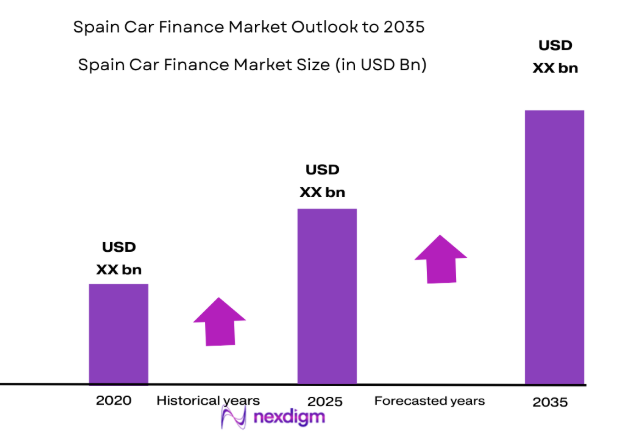
The Spain car finance market has witnessed substantial growth, driven by a combination of factors including the increasing demand for cars, consumer inclination toward financing options, and the growing acceptance of car leasing and digital financing solutions. In recent assessments, the market size has been valued in the billions ~ USD, with significant contributions from both new and used car financing. The market is primarily driven by banks, financial institutions, and car dealerships offering varied financial solutions to consumers seeking flexibility in their car purchasing decisions.
Spain’s dominance in the car finance market can be attributed to its robust automotive industry, coupled with high demand for personal and corporate car financing. Key cities such as Madrid and Barcelona are major hubs where financial institutions, dealerships, and consumers are active, with an ever-expanding range of financing options. Spain’s regulatory framework has also contributed to the market’s growth, making car finance more accessible through low-interest rates and consumer-friendly lending policies.
Market Segmentation
By Product Type:
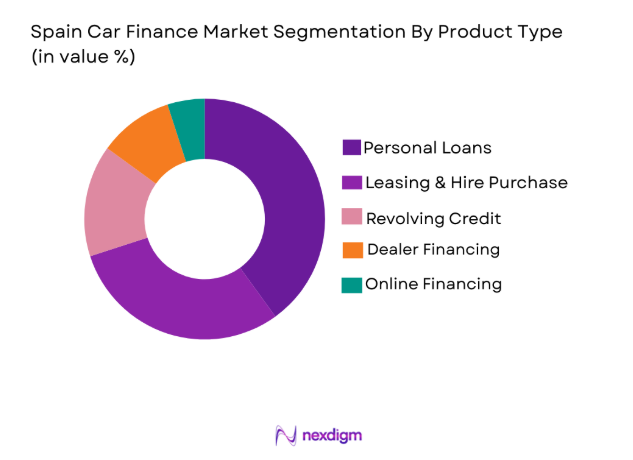
Spain car finance market is segmented by product type into personal loans, leasing & hire purchase, revolving credit, dealer financing, and online financing. Recently, personal loans have dominated the market share due to factors such as consumer preference for flexible payment terms and lower interest rates, making them highly attractive to individuals. As financial institutions continue to provide competitive loan options with streamlined processes and minimal documentation, consumers are increasingly opting for personal loans over other financing methods.
By Platform Type:
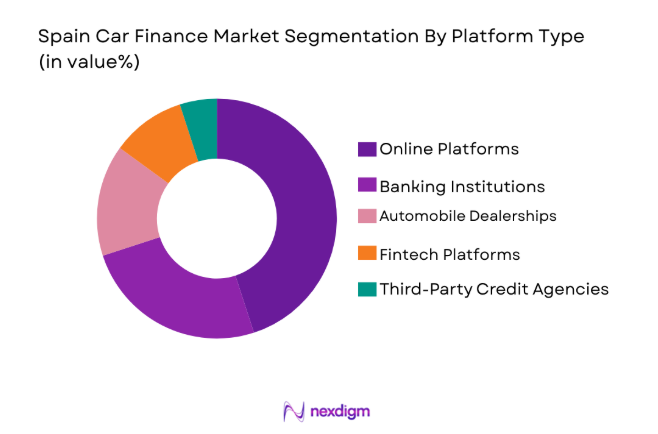
Spain car finance market is segmented by platform type into online platforms, banking institutions, automobile dealerships, fintech platforms, and third-party credit agencies. Recently, online platforms have dominated the market share due to the growing trend of digitalization and the convenience they offer. Consumers are increasingly choosing online platforms for their car financing needs due to their ease of access, faster approval processes, and the ability to compare multiple offers in one place. With enhanced digital infrastructure and growing trust in online transactions, these platforms have become the go-to choice for a significant portion of the population.
Competitive Landscape
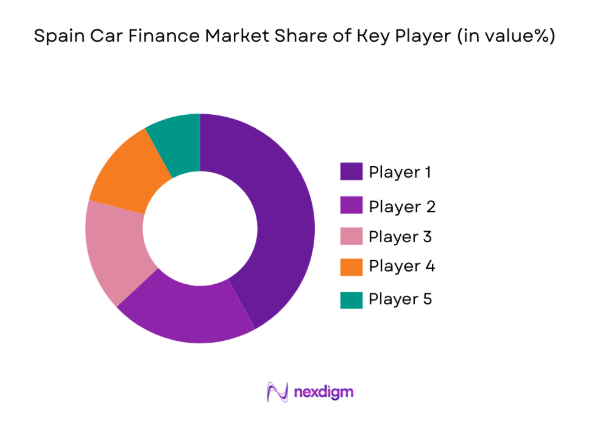
The competitive landscape of the Spain car finance market is marked by intense competition among financial institutions, car manufacturers, and dealerships. Major players have significantly consolidated the market through various strategic partnerships and the enhancement of digital platforms. The rise of online financing solutions and increasing demand for electric vehicle financing are driving innovation among key players, with some focusing on creating tailored products for corporate fleets.
| Company Name | Establishment Year | Headquarters | Technology Focus | Market Reach | Key Products | Revenue (USD) | Additional Market-Specific Parameter |
| Santander Consumer Finance | 1957 | Madrid, Spain | ~ | ~ | ~ | ~ | ~ |
| CaixaBank | 1904 | Barcelona, Spain | ~ | ~ | ~ | ~ | ~ |
| BBVA | 1857 | Bilbao, Spain | ~ | ~ | ~ | ~ | ~ |
| Volkswagen Financial Services | 2001 | Barcelona, Spain | ~ | ~ | ~ | ~ | ~ |
| Bankinter | 1965 | Madrid, Spain | ~ | ~ | ~ | ~ | ~ |
Spain Car Finance Market Analysis
Growth Drivers
Government Incentives:
Government incentives are playing a crucial role in driving the Spain car finance market. Spain has adopted various policies aimed at encouraging the adoption of electric vehicles and making car financing more affordable. These incentives often include tax exemptions, subsidies for green vehicles, and low-interest loans for electric car buyers, significantly lowering the financial burden on consumers. With the government’s push for sustainability and reducing carbon emissions, consumers are encouraged to take advantage of government-backed car finance options. This initiative directly contributes to the growth of electric vehicle sales, while simultaneously boosting the overall car finance market. Additionally, these incentives help make financing options more accessible to a wider range of consumers, including those with lower credit scores. Furthermore, these incentives align with Spain’s broader goals of reducing transportation emissions, which strengthens the policy-driven push for environmentally friendly vehicles. Government funding for the development of electric vehicle infrastructure also indirectly supports the car finance market by increasing the desirability of electric cars, thereby pushing consumers toward financing options. Moreover, as the market for electric cars continues to grow, government-backed car financing schemes will likely remain a major growth driver. These programs have been instrumental in promoting widespread adoption and will continue to help alleviate financial barriers for consumers.
Technological Advancements in Financing Platforms:
The rise of digitalization in the financial sector has dramatically transformed the Spain car finance market. As technology continues to advance, more consumers are turning to online platforms for their car financing needs. The development of AI-based credit scoring models has allowed lenders to offer more competitive rates to a wider demographic by assessing risk more accurately. Online car financing platforms, in particular, have seen significant growth as they allow consumers to quickly compare loan offers from different institutions, facilitating more informed purchasing decisions. The availability of instant loan approvals and digital loan agreements has made the process of securing financing faster and more efficient. Furthermore, mobile technology enables customers to apply for and manage their car loans directly from their smartphones, enhancing the consumer experience. Financial institutions have increasingly integrated blockchain technology to offer more secure, transparent, and efficient car financing solutions. As the demand for seamless, user-friendly digital financing solutions continues to rise, the car finance market is expected to see further growth. The use of technology to streamline loan processing and reduce operational costs is also improving the profitability of lenders, making it a win-win for both consumers and financial institutions. This technological evolution has made car financing more accessible, especially to younger, tech-savvy consumers who prefer managing their finances digitally.
Market Challenges
Regulatory Compliance and Complex Documentation:
One of the key challenges faced by the Spain car finance market is the complex regulatory framework and documentation requirements. Despite the growing number of digital financing platforms, many consumers still face difficulties navigating the legal and documentation processes involved in securing a car loan. The presence of multiple regulatory bodies and the evolving nature of finance-related laws in Spain create an environment where both lenders and borrowers must stay up-to-date with compliance requirements. This has created friction in the market as financial institutions must invest in legal counsel and compliance teams to ensure they meet all necessary regulations. Additionally, the complexity of car loan contracts, which often contain numerous clauses and terms, can lead to confusion for consumers, resulting in a lack of trust in the financing process. This challenge is particularly acute for first-time buyers or individuals with limited financial literacy, who may struggle to understand the terms of their car loan agreements. As a result, many consumers hesitate to explore financing options due to concerns about the complexity and transparency of the process. Financial institutions will need to address these challenges by simplifying documentation, offering clearer terms, and providing more accessible customer support in order to make car finance more accessible to a broader segment of the population.
High Consumer Debt and Economic Uncertainty:
High levels of consumer debt and economic uncertainty pose significant challenges to the Spain car finance market. In recent assessments, the rising levels of household debt, coupled with concerns about inflation and unemployment, have caused many consumers to be more cautious about taking on additional financial commitments. This economic environment has made potential car buyers more hesitant to enter into long-term financing agreements, fearing that an economic downturn or job loss could strain their finances. Additionally, while car financing options have become more accessible, the cost of borrowing has risen due to increased interest rates in the broader economy. This makes car loans more expensive for consumers, further dampening demand. Furthermore, economic uncertainty also affects the willingness of financial institutions to lend, as lenders become more cautious about extending credit to individuals who may struggle with repayment. As a result, the combination of high consumer debt, inflationary pressures, and economic instability is hindering the growth of the car finance market. Financial institutions must therefore adapt to this economic environment by offering flexible financing terms, lower interest rates, and financial education programs that can help consumers make informed decisions without overburdening themselves with debt.
Opportunities
Expansion of Electric Vehicle Financing Solutions:
One of the most significant opportunities in the Spain car finance market lies in the growing demand for electric vehicle (EV) financing. As Spain pushes for carbon neutrality and promotes the use of sustainable transportation, consumers are increasingly opting for electric vehicles. This growing shift presents a unique opportunity for financial institutions to create tailored car financing solutions for electric vehicle buyers. The availability of government-backed incentives for electric vehicles and their financing makes EVs more affordable for consumers, driving demand for specific financing products. Furthermore, as the infrastructure for electric vehicles continues to develop, including more charging stations and battery technologies, the desire to own electric vehicles is expected to grow. Financial institutions have the opportunity to capitalize on this demand by offering favorable loan terms, low-interest rates, and customized financing products for electric vehicle buyers. In addition, as automakers introduce more affordable electric vehicle options, the market for EV financing will expand, particularly in urban areas where electric vehicles are a viable alternative to traditional gas-powered cars. Financial institutions that focus on creating specialized products for the electric vehicle market will be well-positioned to benefit from this growing demand in Spain.
Peer-to-Peer Lending Platforms for Car Financing:
Another promising opportunity lies in the rise of peer-to-peer (P2P) lending platforms for car financing. These platforms offer an alternative to traditional banks and financial institutions by connecting borrowers directly with investors, allowing for more competitive rates and flexible terms. The growing interest in alternative financing solutions, particularly among younger consumers, has fueled the demand for P2P car financing. These platforms typically offer lower interest rates compared to traditional lenders, as they eliminate many of the administrative costs associated with conventional financing. Additionally, the growing acceptance of fintech solutions in Spain has made P2P lending platforms a popular choice for car buyers looking for more personalized and accessible financing options. Investors, on the other hand, are attracted to the potential for higher returns compared to traditional investments. This growing segment is expected to continue expanding as more consumers become familiar with P2P lending platforms and as regulations evolve to support the growth of this alternative financing model. Financial institutions and fintech companies that capitalize on this trend by partnering with P2P lending platforms or offering their own car financing products will have a distinct advantage in the market.
Future Outlook
The future of Spain’s car finance market looks promising, driven by factors such as evolving customer preferences, technological advancements, and increased government support for sustainable vehicle financing. The rise of digital financing platforms, coupled with the shift towards electric vehicles, will continue to influence the market in the coming years. Regulatory support for eco-friendly vehicles and favorable economic policies are expected to boost the growth of both traditional and alternative car financing solutions. The market is also likely to see further innovations in AI-based credit scoring and loan processing, making financing more accessible and efficient for consumers.
Major Players
- Santander Consumer Finance
- CaixaBank
- BBVA
- Volkswagen Financial Services
- Bankinter
- Banco Sabadell
- Cetelem España
- Renault Finance
- Bankia
- Hyundai Capital
- Opel Financial Services
- PSA Finance Spain
- ING
- Citroën Finance
- Unicaja Banco
Key Target Audience
- Investments and venture capitalist firms
- Government and regulatory bodies
- Car manufacturers
- Car dealerships
- Financial institutions
- Digital lending platforms
- EV infrastructure developers
- Corporate fleet buyers
Research Methodology
Step 1: Identification of Key Variables
This step involves identifying the primary factors and trends that influence the Spain car finance market, including economic factors, consumer behavior, and regulatory frameworks.
Step 2: Market Analysis and Construction
Market analysis involves examining historical data, consumer trends, and industry dynamics to build a comprehensive understanding of the market’s current state and future prospects.
Step 3: Hypothesis Validation and Expert Consultation
Expert consultation is used to validate hypotheses about market trends and forecasts by consulting with industry specialists, financial analysts, and key stakeholders.
Step 4: Research Synthesis and Final Output
The final step involves synthesizing all collected data, insights, and expert feedback into a cohesive market report, providing actionable insights and recommendations.

- Executive Summary
- Research Methodology
(Definitions, Scope, Industry Assumptions, Market Sizing Approach, Primary & Secondary Research Framework, Data Collection & Verification Protocol, Analytic Models & Forecast Methodology, Limitations & Research Validity Checks)

- Market Definition and Scope
- Value Chain & Stakeholder Ecosystem
- Regulatory / Certification Landscape
- Sector Dynamics Affecting Demand
- Strategic Initiatives & Infrastructure Growth

- Growth Drivers
Strong demand for vehicles in urban areas
Rise in automotive financing penetration
Increasing acceptance of electric and hybrid vehicles
Expansion of online car financing platforms
Government support for sustainable mobility solutions - Market Challenges
High competition among lenders
Regulatory hurdles and compliance issues
Economic uncertainty and its impact on credit risk
Lack of financial literacy among consumers
Limited consumer trust in new digital financing models - Market Opportunities
Emergence of electric vehicle financing solutions
Growth of peer-to-peer lending platforms
Expansion of AI-based credit assessment models - Trends
Shift towards digital-first financing solutions
Rise of subscription-based car financing models
Integration of financial products with telematics and IoT
Increasing role of government subsidies for green vehicle financing
Growth of cross-border financing options - Government Regulations & Defense Policy
Government incentives for sustainable vehicles
Policies promoting digital transformation in the finance sector
Tax exemptions and subsidies for eco-friendly vehicles - SWOT Analysis
Stakeholder and Ecosystem Analysis
Porter’s Five Forces Analysis
Competition Intensity and Ecosystem Mapping

- By Market Value, 2020-2025
- By Installed Units, 2020-2025
- By Average System Price, 2020-2025
- By System Complexity Tier, 2020-2025

- By System Type (In Value%)
Personal Loans
Leasing & Hire Purchase
Revolving Credit
Dealer Financing
Online Financing - By Platform Type (In Value%)
Online Platforms
Banking Institutions
Automobile Dealerships
Fintech Platforms
Third-Party Credit Agencies - By Fitment Type (In Value%)
New Car Financing
Used Car Financing
Hybrid Car Financing
Electric Car Financing
Lease Option Financing - By EndUser Segment (In Value%)
Private Consumers
Corporate Fleet
Automobile Dealerships
Online Retailers
Financial Institutions - By Procurement Channel (In Value%)
Direct Financing
Indirect Financing
Online Financing Platforms
Government-Sponsored Programs
Third-Party Financing Services - By Material / Technology (In Value%)
Digital Lending Technology
Telematics for Financing
Blockchain in Financing
AI in Credit Scoring
Online Payment Solutions

- Market structure and competitive positioning
Market share snapshot of major players
CrossComparison Parameters (System Type, Platform Type, Procurement Channel, EndUser Segment, Fitment Type)
SWOT Analysis of Key Competitors
Pricing & Procurement Analysis - Key Players
Santander Consumer Finance
CaixaBank
BBVA
Banco Sabadell
Volkswagen Financial Services
Renault Finance
PSA Finance Spain
Bankinter
Financiación Ibercaja
Banco Popular
Eurasian Financial Services
Cetelem España
Sygma Bank
Santander Auto
Lloyds Banking Group

- Increasing interest from private consumers in flexible financing
- Corporate fleets seeking tailored financing solutions
- Automobile dealerships offering financing to boost sales
- Financial institutions focusing on high-risk consumer segments

- Forecast Market Value, 2026-2035
- Forecast Installed Units, 2026-2035
- Price Forecast by System Tier, 2026-2035
- Future Demand by Platform, 2026-2035


 Request a Sample
 Ask for Customization
 Get a Quote
 Enquire Now