

 Download PDF
 Download PDF
Market Overview
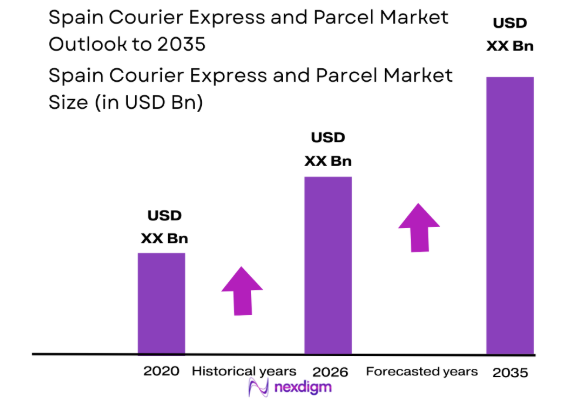
The Spain Courier Express and Parcel market is valued at approximately USD ~ billion based on a recent historical assessment, supported by strong expansion of digital commerce logistics and rapid parcel shipment growth across national distribution networks. Increasing online retail activity, growth in business-to-consumer shipping, and rising consumer demand for rapid delivery services continue driving parcel volumes across Spain. Investments in automated sorting hubs, nationwide delivery fleets, and advanced tracking technologies further strengthen operational efficiency and support the expansion of courier and express logistics infrastructure.
Parcel logistics operations are heavily concentrated in major metropolitan hubs including Madrid, Barcelona, Valencia, and Zaragoza due to dense population clusters, advanced transportation infrastructure, and proximity to major fulfillment centers. Madrid operates as the primary logistics hub with large automated parcel facilities and strong highway connectivity linking regional distribution corridors. Barcelona supports high international parcel flows through its major seaport and air cargo gateway, while Valencia and Zaragoza host large logistics parks enabling efficient national parcel distribution networks.
Market Segmentation
By Product Type
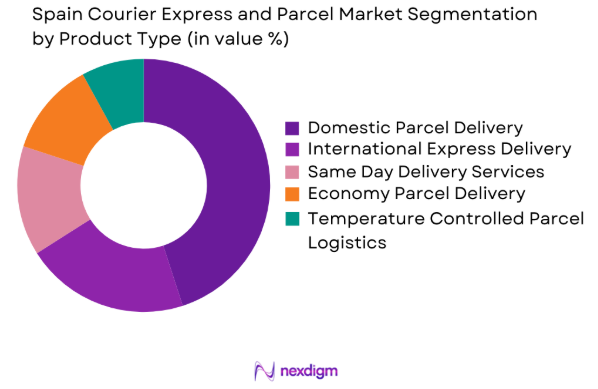
Spain CEP market is segmented by product type into domestic parcel delivery, international express delivery, same day delivery services, economy parcel delivery, and temperature controlled parcel logistics. Recently, domestic parcel delivery has a dominant market share due to the extremely high shipment volumes generated by national e commerce retailers distributing consumer goods across Spain. Most online purchases occur within national supply chains where fulfillment centers ship products directly to Spanish consumers, creating substantial domestic parcel demand. Large courier providers operate extensive road delivery networks capable of reaching urban and rural delivery destinations across Spain, enabling faster transit times and cost efficiency compared with international shipments. Retail companies also prioritize domestic courier networks because of simplified customs procedures and shorter delivery distances. Expansion of omnichannel retail distribution, where physical stores dispatch online orders directly to nearby consumers, further increases domestic parcel flows. Continuous growth of grocery delivery platforms, fashion e commerce, and consumer electronics distribution also strengthens the dominance of domestic parcel delivery within Spain’s CEP logistics ecosystem.
By End User
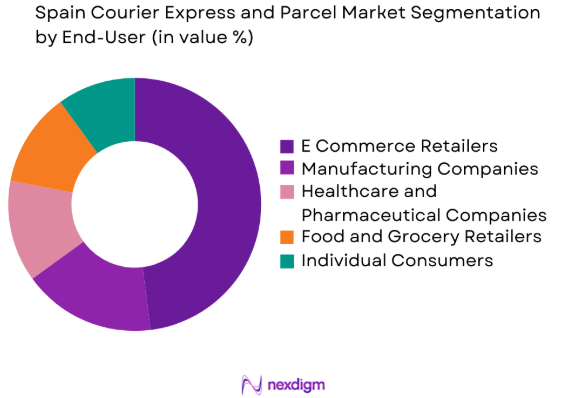
Spain CEP market is segmented by end user into e commerce retailers, manufacturing companies, healthcare and pharmaceutical companies, food and grocery retailers, and individual consumers. Recently, e commerce retailers dominate market share because online retail platforms generate extremely high parcel shipment volumes requiring continuous courier logistics operations across national distribution networks. Digital marketplaces distribute consumer electronics, apparel, home goods, and personal care products which require efficient last mile parcel delivery infrastructure connecting fulfillment warehouses with residential delivery destinations. Large online retailers also establish regional fulfillment hubs positioned close to metropolitan markets to accelerate parcel processing and reduce delivery times. Courier providers partner closely with e commerce platforms to integrate digital order management systems, automated sorting hubs, and real time parcel tracking technologies that support large shipment volumes. The expansion of mobile commerce platforms and digital payment systems further increases consumer participation in online shopping activities, which directly increases parcel shipments handled by courier providers. These factors reinforce the dominance of e commerce retailers within Spain’s CEP logistics ecosystem.
Competitive Landscape
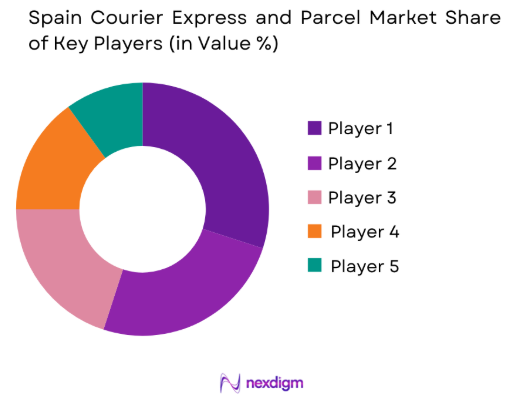
The Spain courier express parcel market is moderately consolidated with a combination of global logistics providers and domestic courier companies operating integrated parcel distribution networks. International operators provide advanced automation technologies, international shipping infrastructure, and large scale delivery fleets, while domestic courier companies maintain strong regional coverage and established relationships with e commerce retailers. Market competition focuses heavily on delivery speed, network coverage, technology integration, and customer experience.
| Company Name | Establishment Year | Headquarters | Technology Focus | Market Reach | Key Products | Revenue | Parcel Network Coverage |
| Correos Express | 2011 | Madrid, Spain | ~ | ~ | ~ | ~ | ~ |
| SEUR | 1942 | Madrid, Spain | ~ | ~ | ~ | ~ | ~ |
| DHL Express | 1969 | Bonn, Germany | ~ | ~ | ~ | ~ | ~ |
| UPS | 1907 | Atlanta, USA | ~ | ~ | ~ | ~ | ~ |
| FedEx | 1971 | Memphis, USA | ~ | ~ | ~ | ~ | ~ |
Spain Courier Express and Parcel Market Analysis
Growth Drivers
Rapid Expansion of Digital Commerce Logistics Across Spain
Spain’s courier express parcel market grows rapidly due to expansion of digital commerce platforms generating high parcel shipment volumes across national logistics networks. Online retail marketplaces distribute consumer goods including electronics, clothing, groceries, pharmaceuticals, and household products that require reliable parcel transportation systems. Retail companies increasingly rely on courier providers operating automated sorting hubs, nationwide delivery fleets, and advanced warehouse management technologies to process shipments efficiently. Logistics firms also deploy artificial intelligence route optimization to improve delivery performance in urban areas. Regional fulfillment centers located near major population hubs shorten delivery distances. Growth of mobile commerce and omnichannel retail models further increases parcel volumes handled by courier networks.
Increasing Consumer Demand for Time Definite Delivery Services
Consumer purchasing behavior increasingly prioritizes rapid delivery, strengthening demand for courier express parcel services across Spain’s e commerce supply chains. Online shoppers expect same day, next day, and scheduled delivery options when buying products through digital retail platforms. Retail companies respond by partnering with courier providers that operate advanced parcel distribution networks supported by automated logistics infrastructure and real time tracking technologies. Logistics firms invest in urban micro fulfillment centers near residential areas to accelerate dispatch and shorten delivery distances. Automated sorting systems and digital shipment management platforms improve operational efficiency while predictive analytics help forecast parcel demand and optimize workforce and vehicle deployment.
Market Challenges
Urban Delivery Congestion and Last Mile Logistics Complexity
Spain’s courier express parcel market faces operational challenges due to heavy traffic congestion and complex delivery conditions in major cities such as Madrid, Barcelona, and Valencia. Courier companies manage extremely high parcel volumes across densely populated urban areas where narrow streets, parking limitations, and restricted delivery zones complicate logistics operations. Last mile delivery remains costly because parcels must be delivered individually to numerous residential locations. Growing e commerce activity also requires expansion of delivery fleets and workforce capacity. Municipal traffic rules and environmental restrictions limit vehicle access during peak hours. Logistics providers therefore invest in route optimization software, automated sorting hubs, and parcel lockers to improve delivery efficiency.
Rising Transportation and Fuel Costs Affecting Logistics Profitability
Spain’s courier express parcel industry faces growing financial pressure due to rising fuel prices and transportation costs required to operate nationwide parcel delivery networks. Courier companies manage large fleets of delivery vans and trucks that transport shipments between sorting hubs, fulfillment centers, and final delivery points across urban and regional areas. Fuel expenses represent a major share of logistics operating costs, particularly as parcel volumes increase with expanding digital commerce activity. Logistics firms also invest heavily in automated warehouses, parcel tracking technologies, and workforce training, raising capital expenditures. Energy price volatility, vehicle maintenance, insurance, and labor costs further increase operational expenses for courier providers across Spain.
Opportunities
Expansion of Automated Parcel Sorting and Smart Logistics Infrastructure
Spain’s courier express parcel market offers strong opportunities through expansion of automated parcel sorting infrastructure and smart logistics systems designed to manage rising shipment volumes generated by digital commerce platforms. Automated sorting hubs equipped with robotics, conveyor systems, and artificial intelligence logistics software significantly improve operational efficiency by accelerating parcel processing and reducing manual labor dependency. Logistics companies invest in large automated distribution centers near major logistics corridors such as Madrid, Barcelona, and Zaragoza where high shipment volumes support advanced automation deployment. These facilities improve delivery speed and parcel tracking accuracy through integration with real time monitoring systems, enabling courier providers to manage expanding parcel flows efficiently across Spain.
Growth of Cross Border E Commerce Parcel Distribution Networks
Spain’s courier express parcel market benefits significantly from the expansion of cross border e commerce shipments linking international online marketplaces with Spanish consumers. Global digital retail platforms distribute products such as electronics, apparel, cosmetics, and household goods through complex international supply chains requiring efficient logistics coordination. Courier companies operate integrated networks connecting Spain with major European markets including Germany, France, Italy, and the Netherlands, enabling smooth parcel movement across regional trade corridors. Increasing consumer purchases from overseas merchants offering wider product selections and competitive pricing further raise parcel volumes entering Spain. Logistics providers strengthen customs clearance systems, automated international sorting hubs, and digital documentation platforms to manage cross border shipments efficiently.
Future Outlook
The Spain CEP market is expected to experience sustained expansion as digital commerce continues increasing across consumer retail channels. Logistics providers will accelerate investments in automated sorting hubs artificial intelligence route optimization systems and electric delivery vehicle fleets. Cross border e commerce trade within the European Union will further expand parcel shipment volumes across international logistics corridors. Government sustainability regulations and smart logistics infrastructure development will also influence technological modernization across Spain’s courier delivery ecosystem.
Major Players
- CorreosExpress
- SEUR
- MRW
- NACEX
- CTT Express
- DHL Express
- UPS
- FedEx
- GLS Spain
- Amazon Logistics
- InPost
- DB Schenker
- Dachser
- Geopost
- XPO Logistics
Key Target Audience
- E commerce retailers
- Logistics service providers
- Parcel delivery companies
- Manufacturing companies
- Healthcare and pharmaceutical distributors
- Investments and venture capitalist firms
- Government and regulatory bodies
- Supply chain technology providers
Research Methodology
Step 1: Identification of Key Variables
Key logistics variables including parcel shipment volumes courier network coverage warehouse infrastructure e commerce transactions and transportation capacity were identified. These variables form the foundation for evaluating Spain’s courier express parcel logistics ecosystem and market expansion drivers.
Step 2: Market Analysis and Construction
Primary data from logistics providers government transport statistics and trade associations were analyzed alongside secondary industry databases. This analysis enabled construction of a detailed framework representing parcel flows distribution networks and logistics infrastructure across Spain.
Step 3: Hypothesis Validation and Expert Consultation
Industry experts including logistics managers supply chain specialists and transportation analysts were consulted to validate research assumptions. Expert insights refined understanding of operational trends competitive strategies and technology adoption patterns influencing courier providers.
Step 4: Research Synthesis and Final Output
All research findings were consolidated through data triangulation techniques to ensure analytical consistency and accuracy. The final market assessment integrates operational insights logistics infrastructure analysis and competitive landscape evaluation to present a comprehensive Spain CEP market outlook.

- Executive Summary
- Research Methodology (Definitions, Scope, Industry Assumptions, Market Sizing Approach, Primary & Secondary Research Framework, Data Collection & Verification Protocol, Analytic Models & Forecast Methodology, Limitations & Research Validity Checks)

- Market Definition and Scope
- Value Chain & Stakeholder Ecosystem
- Regulatory / Certification Landscape
- Sector Dynamics Affecting Demand
- Strategic Initiatives & Infrastructure Growt

- Growth Drivers
Expansion of E Commerce Parcel Volumes Across Spain
Rising Demand for Time Definite Delivery Services
Growth in Cross Border Trade and International Parcel Flows - Market Challenges
High Last Mile Delivery Costs in Urban Areas
Rising Fuel and Fleet Operating Expenses
Delivery Delays from Congestion and Capacity Constraints - Market Opportunities
Expansion of Automated Parcel Sorting Infrastructure
Deployment of Electric Vehicles in Urban Delivery Fleets
Growth of Value Added Services for E Commerce Logistics - Trends
Increasing Adoption of AI Based Route Optimization
Expansion of Parcel Locker and Pickup Point Networks
Integration of Real Time Shipment Tracking Platforms - Government Regulations
- SWOT Analysis of Key Competitors
- Porter’s Five Forces

- By Market Value, 2020-2025
- By Installed Units, 2020-2025
- By Average System Price, 2020-2025
- By System Complexity Tier, 2020-2025

- By System Type (In Value%)
Domestic Parcel Delivery
International Express Delivery
Same Day Delivery Services
Economy Parcel Delivery
Temperature Controlled Parcel Services - By Platform Type (In Value%)
Road Based Parcel Networks
Air Express Logistics Networks
Rail Integrated Distribution Networks
Urban Micro Fulfillment Platforms
Automated Sorting Hub Networks - By Fitment Type (In Value%)
Business to Consumer Delivery
Business to Business Delivery
Consumer to Consumer Delivery
Same Day Urban Fulfillment
Cross Border Parcel Handling - By End User Segment (In Value%)
E Commerce Retailers
Manufacturing Companies
Healthcare and Pharmaceutical Companies
Food and Grocery Retailers
Individual Consumers - By Procurement Channel (In Value%)
Direct Corporate Contracts
E Commerce Platform Partnerships
Third Party Logistics Agreements
Government Tender Procurement
Digital Booking Platforms

- Market Share Analysis
- Cross Comparison Parameters (Delivery Speed, Network Coverage, Technology Integration, Pricing Model, End User Focus, Parcel Tracking Capability, Last Mile Delivery Infrastructure, International Shipping Capability, Automation in Sorting Facilities, E Commerce Integration Capability)
- SWOT Analysis of Key Competitors
- Pricing & Procurement Analysis
- Key Players
Correos Express
SEUR
MRW
NACEX
CTT Express
DHL Express
UPS
FedEx
GLS Spain
Amazon Logistics
InPost
DB Schenker
Dachser
Geopost
XPO Logistics

- E commerce retailers drive the highest parcel shipment volumes
- Manufacturers rely on CEP networks for urgent spare parts movement
- Healthcare companies require reliable express distribution for sensitive products
- Consumers increasingly prefer flexible delivery and pickup options

- Forecast Market Value, 2026-2035
- Forecast Installed Units, 2026-2035
- Price Forecast by System Tier, 2026-2035
- Future Demand by Platform, 2026-2035


 Request a Sample
 Ask for Customization
 Get a Quote
 Enquire Now