

 Download PDF
Market Overview
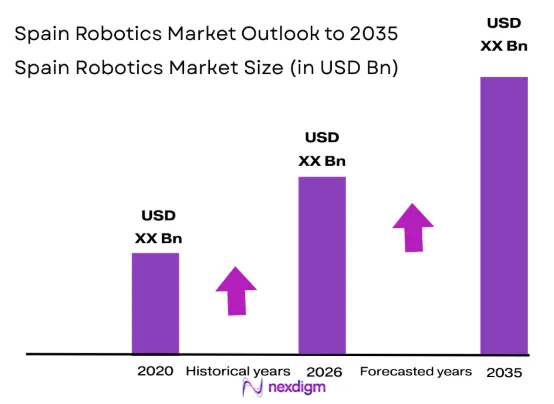
The Spain Robotics Market has witnessed substantial growth, driven by factors such as the increasing demand for automation and the integration of artificial intelligence in robotic systems. As of the most recent historical assessments, the market size for robotics is valued at USD ~ billion, primarily fueled by the industrial, healthcare, and logistics sectors. The growing focus on precision, efficiency, and safety across industries has led to a marked increase in demand for both industrial and service robots. The market is propelled by technological advancements and the need for automation solutions that improve productivity and reduce operational costs.
The robotics market is primarily dominated by key regions such as Europe, North America, and Asia-Pacific. In particular, countries like the United States, Japan, Germany, and China play a significant role due to their advanced manufacturing capabilities, extensive research and development, and the adoption of robotic technologies in various sectors. These regions lead the market, with Japan and South Korea being prominent for industrial robotics, while the United States excels in robotics for healthcare and defense. The widespread application of robotics in these regions has helped maintain their leadership in the global robotics market.
Market Segmentation
By System Type
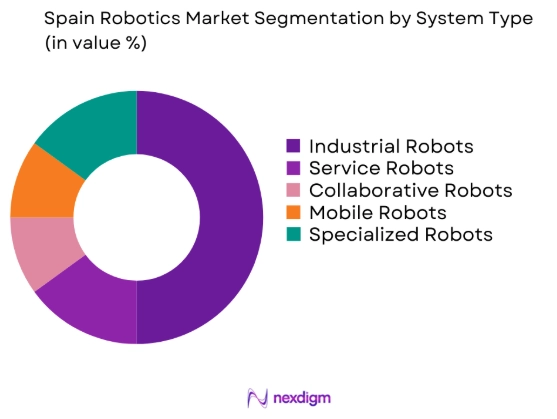
The Spain Robotics market is segmented by system type into industrial robots, service robots, collaborative robots, mobile robots, and specialized robots. Recently, industrial robots have dominated the market share due to their essential role in industries like automotive manufacturing, where precision and efficiency are crucial. The increasing adoption of robotic automation in factories, particularly in the automotive and electronics sectors, has significantly boosted the demand for industrial robots, enabling them to maintain their market dominance.
By Platform Type
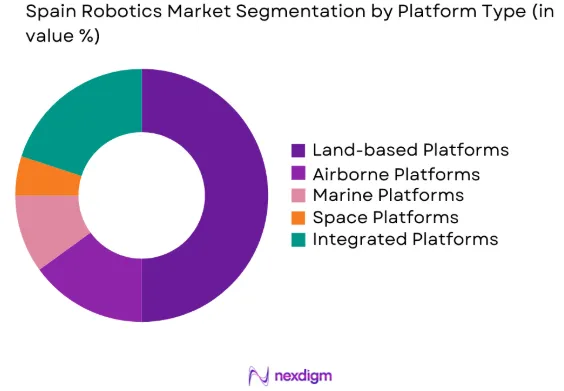
The Spain Robotics market is also segmented by platform type into land-based platforms, airborne platforms, marine platforms, space platforms, and integrated platforms. Land-based platforms currently dominate the market, largely due to their wide range of applications in sectors such as manufacturing, logistics, and agriculture. With the rise in demand for autonomous vehicles and mobile robots, land-based platforms have become crucial in sectors that require movement and precise handling of goods or operations across large areas.
Competitive Landscape
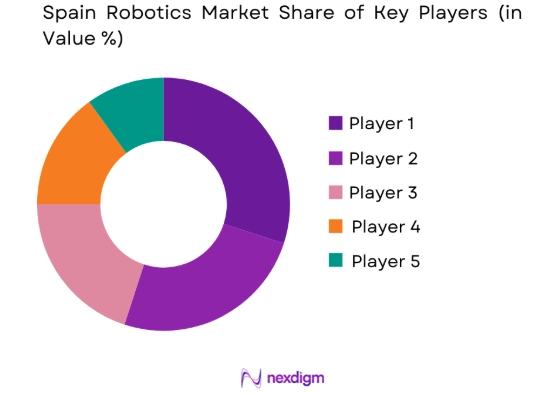
The competitive landscape of the robotics market is characterized by consolidation, with major players contributing to technological innovations and the expanding reach of robotic systems across industries. Leading companies such as ABB, KUKA, FANUC, and Yaskawa Electric dominate the market through their strong product portfolios and established global networks. These players are heavily involved in both the development and commercialization of robotics, with particular emphasis on industrial robots for manufacturing, as well as service robots for healthcare and other service sectors. As the market continues to grow, mergers, acquisitions, and partnerships are likely to intensify competition and expand capabilities.
| Company Name | Establishment Year | Headquarters | Technology Focus | Market Reach | Key Products | Revenue | Additional Parameter |
| ABB | 1988 | Zurich, Switzerland | ~ | ~ | ~ | ~ | ~ |
| KUKA | 1898 | Augsburg, Germany | ~ | ~ | ~ | ~ | ~ |
| FANUC | 1956 | Oshino, Japan | ~ | ~ | ~ | ~ | ~ |
| Yaskawa Electric | 1915 | Kitakyushu, Japan | ~ | ~ | ~ | ~ | ~ |
| Universal Robots | 2005 | Odense, Denmark | ~ | ~ | ~ | ~ | ~ |
Spain Robotics Market Analysis
Growth Drivers
Technological Advancements in Robotics
Technological advancements, especially in artificial intelligence (AI) and machine learning (ML), are the main drivers of the robotics market’s growth. These innovations have enabled robots to perform complex tasks with improved precision and efficiency. AI integration allows robots to process vast amounts of data, make real-time decisions, and operate autonomously, making them highly adaptable to industries like manufacturing, logistics, and healthcare. As robots continue to evolve, they are moving beyond traditional industrial roles and expanding into sectors like autonomous driving and personalized medical care. The ongoing development of AI is expected to increase their capabilities, allowing robots to perform increasingly sophisticated operations, thereby fueling the overall growth of the robotics market.
Government Support for Robotics Development
Another critical growth driver for the robotics market is the increasing government support for robotic technologies, particularly in countries with a focus on technological advancements. Government initiatives, subsidies, and funding programs aimed at promoting automation and industrial robotics are accelerating market growth. These initiatives support the development of robotics systems for diverse applications, including manufacturing, healthcare, and agriculture. In many regions, governments are encouraging the adoption of robotic systems through grants and tax incentives, particularly in industries facing labor shortages or requiring high efficiency. With increased investments in robotics infrastructure and technology, the market is expected to expand rapidly, particularly in developing nations, where automation could boost productivity in industries such as agriculture and manufacturing.
Market Challenges
High Initial Capital Investment
One of the significant challenges facing the robotics market is the high initial capital investment required for the deployment of robotic systems. The cost of purchasing and implementing industrial robots, as well as the costs associated with integration into existing processes, can be prohibitively expensive for many companies, especially small and medium-sized enterprises (SMEs). Although the long-term cost benefits, such as increased productivity and reduced labor costs, often justify the initial investment, the upfront capital requirements may deter some potential adopters from investing in robotic technologies. This challenge is particularly relevant in emerging markets, where financial constraints limit the adoption of robotics despite its potential benefits.
Complexity of Integration with Existing Systems
Integrating robotic systems into existing operations is a significant challenge for the robotics market. Many industries still rely on legacy systems, making the adaptation to new robotics technologies both complex and costly. For large-scale operations, seamless integration is critical to maximizing productivity. However, integrating robotics with current infrastructure, software, and supply chains requires specialized knowledge and expertise, adding to the technical complexity. This challenge often results in delays in implementation, higher costs, and potential operational disruptions. These factors hinder the widespread adoption of robotics, especially in industries where existing systems are deeply entrenched, making it difficult to realize the full potential of robotic technologies in these environments.
Opportunities
Advancements in Healthcare Robotics
The healthcare industry offers significant growth opportunities for the robotics market, particularly with the increasing demand for surgical robots and robotic-assisted therapies. Robotics is becoming an essential tool in performing minimally invasive surgeries, improving patient outcomes, and reducing recovery times. Robotic systems are increasingly being used in operating rooms for tasks such as assisting surgeons with precision and providing real-time data for diagnostic procedures. As healthcare costs rise and the demand for more efficient medical procedures increases, the robotics market is poised for substantial growth in this sector. The introduction of AI-powered surgical robots, capable of performing autonomous or semi-autonomous surgeries, presents new opportunities for healthcare providers to deliver high-quality care at reduced costs.
Expansion in Service Robotics
A significant opportunity in the robotics market is the expansion of service robots, particularly in hospitality, logistics, and retail sectors. As industries face labor shortages and strive for greater efficiency, robots are increasingly being used for tasks like cleaning, delivery, customer service, and inventory management. Service robots, such as autonomous mobile robots (AMRs) and humanoid robots, are becoming common in public spaces, retail stores, and warehouses. Their ability to perform repetitive tasks safely and efficiently is driving their adoption in areas with high labor demand. With continuous advancements in autonomous navigation, artificial intelligence, and sensor technology, service robots are poised to play a larger role in enhancing industries requiring high-touch customer interactions and operational efficiency.
Future Outlook
The future of the robotics market looks promising, with strong growth expected over the next five years. As robotics technology continues to advance, the scope of its applications will expand, particularly in the fields of healthcare, manufacturing, and logistics. Technological innovations, such as AI and machine learning, will make robots more intelligent and capable of performing more complex tasks. Additionally, the increasing adoption of robots in emerging markets will further drive growth, as governments and businesses seek to improve productivity and address labor shortages. With regulatory support and technological advancements, the robotics market is expected to witness continued growth, creating new opportunities for businesses and consumers alike.
Major Players
- ABB
- KUKA
- FANUC
- Yaskawa Electric
- Universal Robots
- Teradyne
- Kawasaki Robotics
- StäubliRobotics
- Denso Robotics
- Epson Robots
- Omron Corporation
- Comau
- Mitsubishi Electric
- Applied Robotics
- Rethink Robotics
Key Target Audience
- Investments and venture capitalist firms
- Government and regulatory bodies
- Manufacturing companies seeking automation solutions
- Healthcare institutions adopting robotic technologies
- Logistics and warehousing companies
- Research and development organizations
- Enterprises exploring robotic process automation
- Automation technology providers
Research Methodology
Step 1: Identification of Key Variables
The first step involves identifying critical variables, such as technological trends, market dynamics, and regional factors, that influence the robotics market.
Step 2: Market Analysis and Construction
This step includes gathering and analyzing data from both primary and secondary sources to construct a comprehensive market model.
Step 3: Hypothesis Validation and Expert Consultation
Hypotheses are validated through consultations with industry experts and by reviewing the latest trends and forecasts in the robotics sector.
Step 4: Research Synthesis and Final Output
Data is synthesized into a cohesive report, providing actionable insights and forecasts for the robotics market.

- Executive Summary
- Research Methodology (Definitions, Scope, Industry Assumptions, Market Sizing Approach, Primary & Secondary Research Framework, Data Collection & Verification Protocol, Analytic Models & Forecast Methodology, Limitations & Research Validity Checks)

- Market Definition and Scope
- Value Chain & Stakeholder Ecosystem
- Regulatory / Certification Landscape
- Sector Dynamics Affecting Demand
- Strategic Initiatives & Infrastructure Growth

- Growth Drivers
Increased Adoption of Automation in Manufacturing
Government Investment in Robotic Technologies
Technological Advancements in Robotics and AI - Market Challenges
High Initial Capital Investment
Lack of Skilled Workforce
Integration with Existing Systems - Market Opportunities
Development of Collaborative Robots for Small Enterprises
Expansion of Robotics in Healthcare Applications
Growth of Robotics in Logistics and Warehousing - Trends
Rise of AI-powered Robots
Increased Demand for Collaborative Robots
Growth in Robotic Process Automation - Government Regulations
- SWOT Analysis of Key Competitors
- Porter’s Five Forces

- By Market Value, 2020-2025
- By Installed Units, 2020-2025
- By Average System Price, 2020-2025
- By System Complexity Tier, 2020-2025

- By System Type (In Value%)
Industrial Robots
Service Robots
Collaborative Robots
Mobile Robots
Specialized Robots - By Platform Type (In Value%)
Land-based Platforms
Airborne Platforms
Marine Platforms
Space Platforms
Integrated Platforms - By Fitment Type (In Value%)
On-premise Solutions
Cloud-based Solutions
Hybrid Solutions
Modular Solutions
Integrated Solutions - By End User Segment (In Value%)
Manufacturing
Healthcare
Logistics
Defense
Agriculture - By Procurement Channel (In Value%)
Direct Procurement
Government Tenders
Private Sector Procurement
Online Bidding Platforms
Third-party Distributors

- Market Share Analysis
- Cross Comparison Parameters (System Type, Platform Type, End User Segment, Procurement Channel, Fitment Type, Robot Type, Technology Integration, Application Sector, Automation Level, Geography)
- SWOT Analysis of Key Competitors
- Pricing & Procurement Analysis
- Key Players
ABB
KUKA
FANUC
Universal Robots
Yaskawa Electric
Comau
Teradyne
Stäubli Robotics
Denso Robotics
Epson Robots
Omron Corporation
Kawasaki Robotics
Applied Robotics
Rethink Robotics
Adept Technology

- Manufacturing Sector’s Increased Demand for Automation
- Healthcare’s Adoption of Surgical and Assistance Robots
- Logistics Industry’s Reliance on Autonomous Vehicles
- Agriculture’s Shift to Autonomous Farming Equipment

- Forecast Market Value, 2026-2035
- Forecast Installed Units, 2026-2035
- Price Forecast by System Tier, 2026-2035
- Future Demand by Platform, 2026-2035


 Request a Sample
 Ask for Customization
 Get a Quote
 Enquire Now