
 Download PDF
 Download PDF
Market Overview
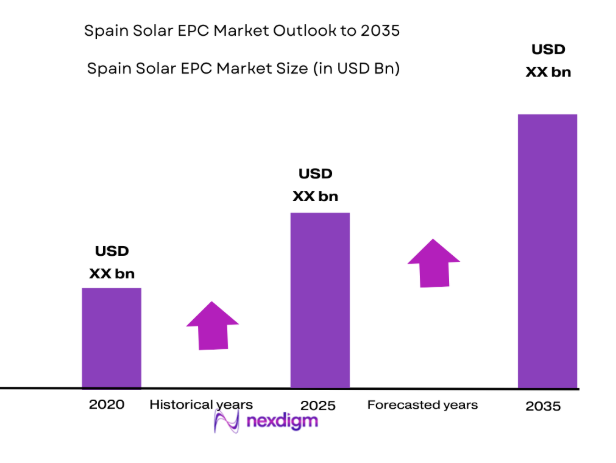
The Spanish Solar EPC market is experiencing robust growth, with the industry driven by strong government support, technological advancements, and increasing demand for renewable energy solutions. In recent historical assessments, the market size reached approximately USD ~ billion, supported by Spain’s commitment to achieving ambitious renewable energy targets. This growth is fueled by the adoption of solar technologies, including large-scale solar projects, commercial installations, and residential systems. Government policies incentivizing renewable energy adoption further propel the expansion of the market.
Dominant countries in the solar EPC market include Spain, where favorable climate conditions, government backing, and a strong energy infrastructure play pivotal roles in its dominance. Spain’s strategic location with abundant sunlight makes it an attractive destination for solar energy investments, especially in regions such as Andalusia and Castilla-La Mancha, which are known for their high solar potential. The country’s investment in solar power has positioned it as a key player in Europe’s energy transition, attracting both domestic and international investments in the solar EPC sector.
Market Segmentation
By Product Type
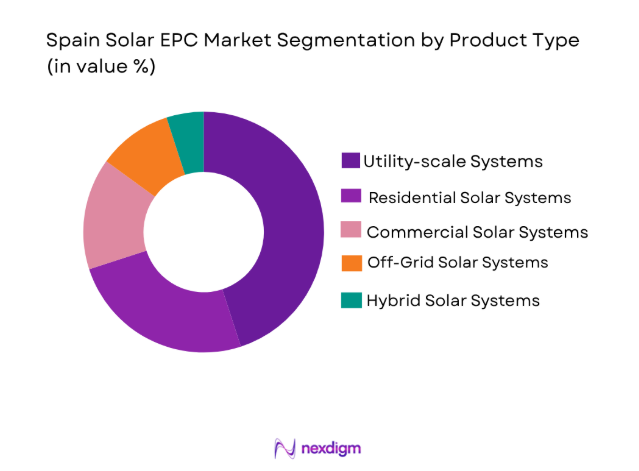
Spain’s solar EPC market is segmented by product type into utility-scale, residential, commercial, and hybrid solar systems. Recently, utility-scale solar systems have dominated the market due to factors like lower production costs, government incentives for large-scale solar plants, and an increasing push toward decarbonizing the energy sector. Utility-scale systems are the most cost-effective for mass production and are supported by the government’s renewable energy initiatives. Furthermore, the push for energy independence and sustainability has made these large-scale installations increasingly popular for industrial and governmental energy needs.
By Platform Type
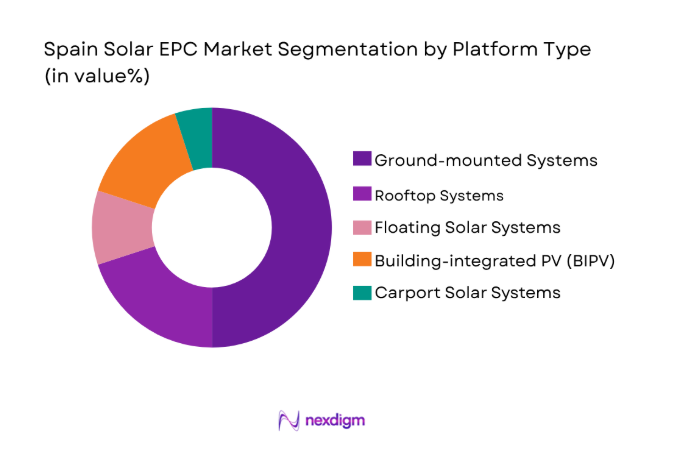
The market is also segmented by platform type into ground-mounted, rooftop, floating solar, BIPV, and carport solar systems. Ground-mounted systems hold the largest share, driven by their suitability for utility-scale installations and the availability of vast, open land in Spain. Ground-mounted systems offer high energy yields and are suitable for large-scale installations, making them an attractive option for developers and energy companies looking to implement renewable solutions on a commercial scale. These systems also benefit from economies of scale, which reduce the overall cost of energy production.
Competitive Landscape
The competitive landscape of Spain’s solar EPC market is highly fragmented, with key players ranging from local contractors to global energy firms. The market sees constant consolidation through mergers and acquisitions, with larger companies expanding their influence by acquiring smaller, regional players. The leading companies in Spain’s solar EPC sector are focusing on technological advancements, customer service, and expanding their footprints in new geographic areas. This dynamic environment encourages firms to innovate and adopt new business models such as integrated energy solutions, energy storage, and smart grid technologies.
| Company Name | Establishment Year | Headquarters | Technology Focus | Market Reach | Key Products | Revenue | Market-specific Parameter |
| Iberdrola | 1992 | Bilbao, Spain | ~ | ~ | ~ | ~ | ~ |
| Acciona | 2001 | Madrid, Spain | ~ | ~ | ~ | ~ | ~ |
| First Solar | 1999 | Tempe, USA | ~ | ~ | ~ | ~ | ~ |
| Enel Green Power | 2008 | Rome, Italy | ~ | ~ | ~ | ~ | ~ |
| JinkoSolar | 2006 | Shanghai, China | ~ | ~ | ~ | ~ | ~ |
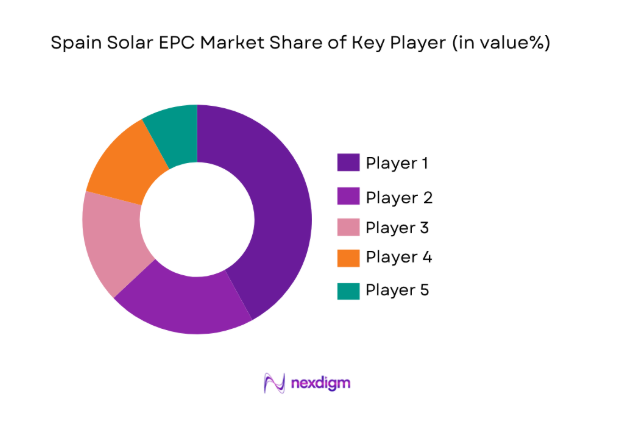
Spain Solar EPC Market Analysis
Growth Drivers
Government Policy Support
Spain’s commitment to renewable energy has been a significant driver of growth in the solar EPC market. The government’s favorable policies, including financial incentives such as tax breaks and feed-in tariffs, have spurred investments in renewable energy. Additionally, the ambitious renewable energy targets set under the EU Green Deal have created a conducive environment for large-scale solar projects. Spain’s focus on achieving carbon neutrality by 2050 is another factor that has contributed to the growth of the solar EPC market. The strong policy framework has ensured continuous growth, attracting both domestic and international investors. Furthermore, the government has streamlined the permitting process for renewable energy projects, making it easier for solar EPC contractors to operate in the country. This supportive environment is likely to continue driving the growth of the solar EPC market in Spain.
Technological Advancements:
Another key growth driver is the continuous advancement in solar technology, including improvements in panel efficiency, energy storage solutions, and system integration. The development of high-efficiency photovoltaic cells, bifacial solar panels, and innovations in solar storage technology has made solar energy increasingly cost-competitive with conventional energy sources. Technological advancements have also led to reduced installation costs, further boosting the adoption of solar energy in Spain. The integration of energy storage systems with solar power plants has enhanced the reliability of solar energy, enabling it to meet demand even during periods of low sunlight. These advancements, coupled with the decreasing cost of solar panels and improved system performance, are expected to fuel the growth of Spain’s solar EPC market in the coming years. Additionally, digitalization and the adoption of smart grids are expected to further streamline the operation and management of solar power systems, driving market growth.
Market Challenges
High Capital Investment
One of the primary challenges faced by the Spain Solar EPC market is the high upfront capital required for large-scale solar projects. Despite the long-term cost savings associated with solar energy, the initial investment for solar panels, inverters, and other infrastructure remains a significant barrier. The high cost of installation and maintenance for solar systems can be particularly challenging for smaller businesses and residential customers, despite government incentives and subsidies. While the price of solar panels has decreased in recent years, the total cost of ownership, including the cost of land, installation, and integration into the grid, can still be prohibitive. This financial burden is a major consideration for developers, EPC contractors, and customers alike, hindering the widespread adoption of solar energy in Spain. Overcoming this challenge will require further policy support and financing solutions to make solar energy more accessible to a wider range of consumers and businesses.
Regulatory Hurdles
Despite the favorable policy framework, Spain’s solar EPC market faces regulatory challenges that can delay the development of solar projects. Issues related to permitting, land acquisition, and environmental impact assessments often result in delays, particularly for larger-scale utility projects. The permitting process for solar installations can be complex and time-consuming, with different regulations at the local, regional, and national levels. In some cases, the regulatory uncertainty surrounding the approval process can create hurdles for solar developers and contractors, making it difficult to accurately forecast project timelines and budgets. Additionally, changes in government policies or regulations can lead to sudden shifts in the market, creating uncertainty for investors and stakeholders. Addressing these regulatory hurdles is essential for unlocking the full potential of Spain’s solar EPC market.
Opportunities
Expansion of Energy Storage Solutions
The growing demand for energy storage solutions presents a significant opportunity for Spain’s solar EPC market. As the cost of energy storage systems continues to decline, integrating storage with solar energy systems has become a viable option for both residential and commercial customers. Solar energy combined with storage solutions provides a reliable and consistent power source, especially in areas where grid stability is a concern. The adoption of energy storage technologies has the potential to revolutionize the solar EPC market by increasing the capacity and reliability of solar power systems. Additionally, advancements in battery technology and the integration of smart grid systems will enable better management of electricity generation, storage, and consumption. EPC contractors that offer integrated solar and storage solutions are well-positioned to take advantage of this growing trend. This opportunity is expected to drive the growth of solar EPC projects in Spain, especially as consumers and businesses seek more sustainable and cost-effective energy solutions.
Growth in Commercial Solar Projects
The commercial sector represents another significant opportunity for growth in Spain’s solar EPC market. Businesses are increasingly looking to reduce energy costs and meet sustainability goals through the adoption of solar power. The availability of government incentives, combined with the decreasing cost of solar technology, has made solar energy an attractive option for commercial enterprises. As companies become more aware of the financial and environmental benefits of solar power, the demand for commercial solar installations has increased. This trend is particularly evident in Spain, where large-scale commercial projects, such as solar farms, retail installations, and corporate buildings, are gaining traction. Solar EPC contractors focusing on the commercial sector can tap into this growing demand for sustainable energy solutions. The commercial market is expected to be a key driver of the solar EPC market in Spain, with significant growth opportunities in the coming years.
Future Outlook
The future outlook for Spain’s solar EPC market is positive, with continued growth expected driven by technological advancements, supportive government policies, and increasing demand for clean energy. Over the next five years, the market is expected to expand further as more commercial and residential customers adopt solar power. Energy storage integration, along with innovations in solar technology, will continue to play a pivotal role in enhancing the efficiency and reliability of solar systems. With Spain’s ambitious renewable energy goals and the ongoing push for decarbonization, the solar EPC market is poised for significant growth, attracting more investments and technological innovations. Additionally, as the cost of solar energy continues to decrease, more consumers and businesses will shift towards solar solutions, creating a favorable environment for the industry.
Major Players
- Iberdrola
- Acciona
- First Solar
- Enel Green Power
- JinkoSolar
- Trina Solar
- Canadian Solar
- LONGi Solar
- Hanwha Q CELLS
- REC Group
- JA Solar
- Risen Energy
- Solarcentury
- BP Solar
- SunPower
Key Target Audience
- Investments and venture capitalist firms
- Government and regulatory bodies
- Energy companies and utility providers
- Commercial enterprises and industries
- Solar developers and EPC contractors
- Real estate developers
- Residential consumers
Research Methodology
Step 1: Identification of Key Variables
Key variables related to market trends, growth drivers, and challenges are identified and analyzed to develop a comprehensive understanding of the market.
Step 2: Market Analysis and Construction
Detailed analysis of market size, trends, and competitive landscape is conducted through secondary research and primary data collection.
Step 3: Hypothesis Validation and Expert Consultation
Market hypotheses are validated through consultations with industry experts and stakeholders in the solar EPC market to ensure accuracy.
Step 4: Research Synthesis and Final Output
Research findings are synthesized, and final insights are provided to deliver a comprehensive report on the Spain Solar EPC market.

- Executive Summary
- Research Methodology (Definitions, Scope, Industry Assumptions, Market Sizing Approach, Primary & Secondary Research Framework, Data Collection & Verification Protocol, Analytic Models & Forecast Methodology, Limitations & Research Validity Checks)

- Market Definition and Scope
- Value Chain & Stakeholder Ecosystem
- Regulatory / Certification Landscape
- Sector Dynamics Affecting Demand
- Strategic Initiatives & Infrastructure Growth

- Growth Drivers
Government Policy Support for Renewable Energy
Technological Advancements in Solar Power Systems
Increasing Demand for Sustainable Energy Solutions - Market Challenges
High Capital Investment for Solar Projects
Regulatory Hurdles and Permitting Delays
Lack of Skilled Labor in the Solar EPC Industry - Market Opportunities
Incentives for Green Energy Solutions
Expanding Solar Infrastructure in Rural Areas
Collaborations with International Renewable Energy Players - Trends
Shift Towards Energy Storage Integration
Growing Adoption of Digitalization in Solar EPC - Government Regulations
- SWOT Analysis
- Porter’s Five Forces

- By Market Value, 2020-2025
- By Installed Units, 2020-2025
- By Average System Price, 2020-2025
- By System Complexity Tier, 2020-2025

- By System Type (In Value%)
Utility-scale Solar Systems
Commercial & Industrial Solar Systems
Residential Solar Systems
Off-grid Solar Systems
Hybrid Solar Systems - By Platform Type (In Value%)
Ground-mounted Systems
Rooftop Systems
Floating Solar Systems
Building Integrated Photovoltaics (BIPV)
Carport Solar Systems - By Fitment Type (In Value%)
On-site Installation
Remote Installation
Turnkey Installation
EPC Services Integration - By End User Segment (In Value%)
Utility Companies
Commercial Enterprises
Residential Consumers

- Market Share Analysis
- Cross Comparison Parameters (System Type, Platform Type, End User Segment, Fitment Type, Market Value, Installed Units, Average System Price)
- SWOT Analysis of Key Competitors
- Pricing & Procurement Analysis
- Key Players
Iberdrola
Acciona
Ferrovial
Sacyr
Enel Green Power
First Solar
Suntech Power
JinkoSolar
Trina Solar
Canadian Solar
LONGi Solar
Hanwha Q CELLS
REC Group
JA Solar
Risen Energy

- Increasing Adoption Among Residential Consumers
- Government-driven Solar Initiatives for Commercial Players
- Utility Companies Focusing on Renewable Energy Sources
- Collaborations Between EPC Contractors and Renewable Energy Providers

- Forecast Market Value, 2026-2035
- Forecast Installed Units, 2026-2035
- Price Forecast by System Tier, 2026-2035
- Future Demand by Platform, 2026-2035


 Request a Sample
 Ask for Customization
 Get a Quote
 Enquire Now