

 Download PDF
 Download PDF
Market Overview
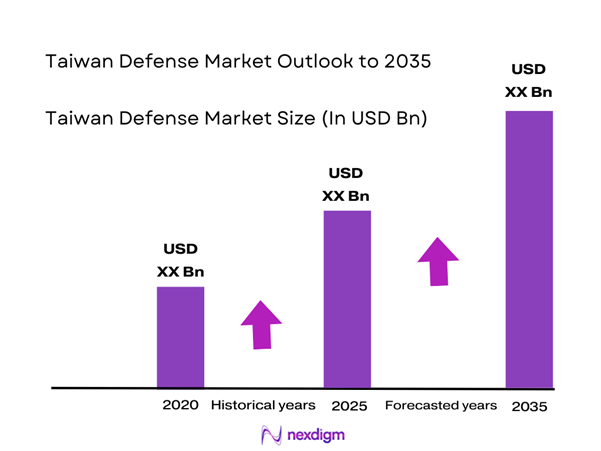
The Taiwan Defense Market market current size stands at around USD ~ million, reflecting sustained procurement momentum across air, naval, land, cyber, and ISR domains driven by security imperatives and modernization programs. Spending concentration remains anchored in platform upgrades, networked command systems, and sustainment of active fleets, supported by multi-year acquisition planning and domestic industrial participation. The market structure integrates foreign procurement pathways with localized manufacturing, MRO, and subsystem integration, reinforcing resilience across program lifecycles and operational readiness outcomes.
Northern Taiwan anchors procurement coordination and systems integration due to proximity to command headquarters, logistics hubs, and major shipyards, while central regions concentrate aerospace manufacturing and avionics integration. Southern coastal zones host naval construction, fleet sustainment, and port-based testing ecosystems. Demand clusters around air bases, naval ports, and joint command facilities supported by testing ranges and hardened infrastructure. Ecosystem maturity is reinforced by policy alignment, industrial offsets, and supplier qualification regimes that streamline qualification, compliance, and lifecycle support.
Market Segmentation
By Domain
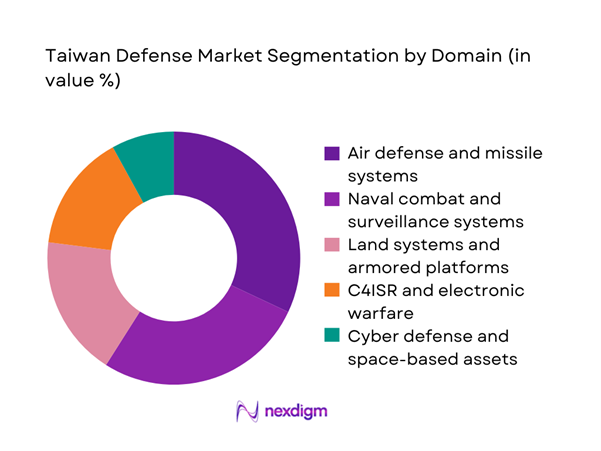
Air and missile defense, naval combat systems, and C4ISR dominate demand due to integrated deterrence doctrines, continuous fleet modernization, and network-centric operations. ISR fusion across sensors, command networks, and cyber defense elevates multi-domain interoperability, while land systems modernization focuses on survivability and mobility. Unmanned aerial and maritime platforms gain traction for persistent surveillance and distributed operations. The ecosystem favors modular architectures, rapid integration, and sustainment-centric procurement, supporting lifecycle upgrades and interoperability across joint commands. Policy emphasis on asymmetric capabilities sustains steady procurement across missiles, sensors, EW, and resilient communications.
By End User Branch
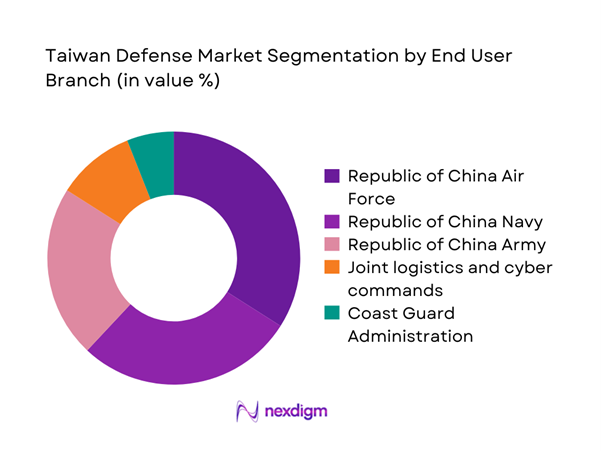
The Air Force drives platform upgrades and sensor-network integration to strengthen early warning and strike coordination. The Navy prioritizes surface combatants, undersea platforms, and coastal surveillance to enhance sea denial and maritime domain awareness. The Army advances mobility, counter-landing capabilities, and protected firepower for distributed defense. Joint commands accelerate cyber defense, data fusion, and resilient communications to enable cross-domain coordination. The Coast Guard strengthens surveillance and patrol assets to support maritime security and civil-military coordination, reinforcing layered deterrence and operational continuity across contested environments.
Competitive Landscape
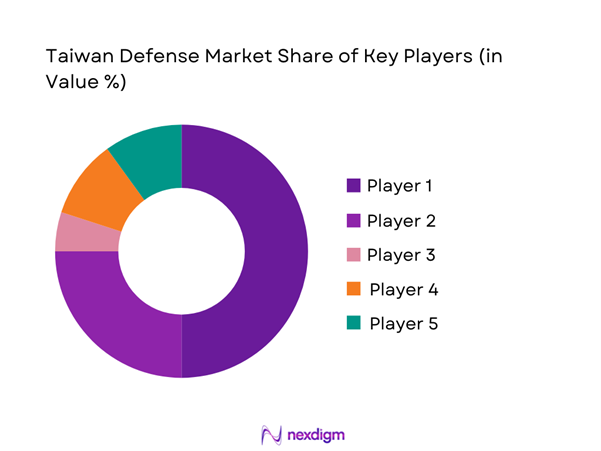
The market features a concentrated group of international primes alongside domestic integrators, with competition centered on platform breadth, integration depth, lifecycle support, and compliance readiness. Partnerships and co-development models shape access to advanced subsystems and sustainment capabilities, while local industrial participation strengthens qualification pipelines and long-term support.
| Company Name | Establishment Year | Headquarters | Formulation Depth | Distribution Reach | Regulatory Readiness | Service Capability | Channel Strength | Pricing Flexibility |
| Lockheed Martin | 1995 | Bethesda, Maryland | ~ | ~ | ~ | ~ | ~ | ~ |
| Raytheon Technologies | 2020 | Arlington, Virginia | ~ | ~ | ~ | ~ | ~ | ~ |
| Northrop Grumman | 1939 | Falls Church, Virginia | ~ | ~ | ~ | ~ | ~ | ~ |
| BAE Systems | 1999 | London, United Kingdom | ~ | ~ | ~ | ~ | ~ | ~ |
| Thales Group | 1893 | Paris, France | ~ | ~ | ~ | ~ | ~ | ~ |
Taiwan Defense Market Analysis
Growth Drivers
Rising defense budget driven by cross-strait security risks
Rising defense budget driven by cross-strait security risks intensifies multi-domain modernization, prioritizing readiness and resilience. In 2024, joint exercises increased to 16 annual iterations, expanding live-fire drills across air, sea, and littoral zones. The armed forces fielded 48 new ISR nodes integrated with 12 command centers, improving detection-to-decision timelines. Airbase hardening programs expanded shelter capacity by 320 units, while runway rapid repair teams increased to 24 detachments. Cyber defense units added 900 trained personnel during 2025, strengthening network monitoring across 6 regional hubs. Maritime patrol days rose to 2,140, reinforcing persistent surveillance coverage nationwide.
Acceleration of indigenous defense industrialization policy
Acceleration of indigenous defense industrialization policy expands local integration capacity and lifecycle autonomy. During 2024, certified domestic suppliers increased to 186 entities across avionics, propulsion subsystems, and secure communications. Co-development programs supported 42 active technology transfer workstreams aligned to naval shipbuilding and missile integration. The workforce added 3,400 skilled engineers across composite materials, software-defined radios, and systems integration in 2025. Local MRO throughput rose by 28 facilities achieving qualification for depot-level maintenance. Test ranges expanded instrumentation coverage across 5 coastal corridors, reducing integration cycles for sensors and EW payloads while strengthening quality assurance and sustainment readiness nationwide.
Challenges
Technology transfer restrictions and export controls
Technology transfer restrictions and export controls constrain access to advanced subsystems, extending qualification timelines and integration risk. In 2024, 17 critical components required multi-agency licensing, adding 9 months to average program schedules. Secure cryptographic modules faced 14 approval checkpoints across allied compliance regimes, complicating interoperability certification. Export review backlogs affected 23 subsystem variants awaiting clearance for integration testing. Engineering change requests increased to 61 instances due to specification substitutions, elevating validation workloads across 8 accredited labs. These constraints amplify dependency on alternate architectures and local redesign, slowing fielding velocity for time-sensitive capabilities and raising sustainment complexity across deployed platforms.
Supply chain vulnerabilities for critical components
Supply chain vulnerabilities for critical components disrupt program tempo and readiness sustainment. In 2024, lead times for high-grade microelectronics stretched to 46 weeks, impacting 19 integration milestones across radar and EW systems. Single-source dependencies affected 27 propulsion and guidance items, creating exposure to production pauses. Quality escapes rose to 11 incidents requiring rework across depot maintenance lines. Inventory buffers increased to 120 days for 34 components, tying up logistics capacity. Transportation bottlenecks across 6 ports delayed acceptance testing cycles, compressing training windows and increasing re-certification workloads across 4 operational commands during readiness surges.
Opportunities
Indigenous submarine and naval shipbuilding programs
Indigenous submarine and naval shipbuilding programs create sustained integration, testing, and sustainment demand across domestic yards. In 2024, keel-laying milestones advanced across 3 hulls with 21 major subsystems entering harbor integration trials. Acoustic testing hours expanded to 4,800 across coastal ranges, accelerating signature management validation. Workforce certification added 1,200 technicians in hull fabrication and combat system integration by 2025. Supplier qualification onboarded 64 local vendors for power management, sensors, and secure networks. Dry dock utilization increased to 310 operational days annually, strengthening lifecycle support capacity and continuous improvement loops for maritime combat readiness nationwide.
Expansion of unmanned aerial and maritime systems
Expansion of unmanned aerial and maritime systems enables persistent ISR and distributed operations at lower risk profiles. In 2024, 72 UAV units entered service across 9 squadrons, extending endurance coverage across 18 maritime corridors. Autonomous surface craft completed 1,260 patrol hours, integrating 14 sensor payloads with shore command nodes. Training pipelines certified 380 operators in 2025, while maintenance crews added 220 specialists for composite airframes and propulsion modules. Secure data links expanded to 26 relay sites, improving mesh resilience across contested littorals and enabling rapid tasking for reconnaissance, targeting support, and maritime domain awareness operations.
Future Outlook
The outlook reflects sustained modernization across air, naval, land, cyber, and ISR capabilities through the mid-2030s. Program sequencing will prioritize resilience, interoperability, and lifecycle sustainment, with deeper localization and co-development. Multi-domain integration and unmanned systems adoption will accelerate. Regulatory coordination and supply chain resilience will shape delivery cadence, while training pipelines and depot capacity expansion support readiness and continuous upgrades.
Major Players
- Lockheed Martin
- Raytheon Technologies
- Northrop Grumman
- Boeing Defense, Space & Security
- General Dynamics
- BAE Systems
- L3Harris Technologies
- Thales Group
- Saab AB
- Leonardo
- Hanwha Aerospace
- Mitsubishi Heavy Industries
- Naval Group
- Taiwan Aerospace & Defense Technology Co.
- China Shipbuilding Corporation
Key Target Audience
- Ministry of National Defense procurement departments
- Armed forces program management offices
- Systems integrators and prime contractors
- Tier-1 and Tier-2 defense suppliers
- Maintenance, repair, and overhaul providers
- Cybersecurity and C4ISR solution providers
- Investments and venture capital firms
- Government and regulatory bodies with agency names
Research Methodology
Step 1: Identification of Key Variables
Capability roadmaps, platform inventories, and sustainment dependencies were mapped across air, naval, land, cyber, and ISR domains. Program milestones, integration bottlenecks, and regulatory checkpoints were identified to frame demand drivers. Supplier qualification criteria and lifecycle support needs were defined to scope integration depth and readiness constraints.
Step 2: Market Analysis and Construction
Program pipelines, subsystem integration flows, and depot capacities were structured into a multi-domain framework. Interoperability requirements and open-architecture adoption were incorporated to reflect upgrade cycles. Localization pathways and co-development models were embedded to assess delivery cadence and sustainment resilience.
Step 3: Hypothesis Validation and Expert Consultation
Operational planners, systems engineers, and logistics managers validated assumptions on readiness, integration risk, and sustainment throughput. Scenario stress tests assessed supply chain shocks, regulatory delays, and training capacity constraints. Feedback refined interoperability priorities and lifecycle planning assumptions across domains.
Step 4: Research Synthesis and Final Output
Findings were synthesized into capability-driven narratives aligned to procurement cycles and sustainment needs. Cross-domain dependencies were consolidated to highlight bottlenecks and opportunity areas. Final outputs aligned modernization priorities with integration readiness, training pipelines, and lifecycle support requirements.

- Executive Summary
- Research Methodology (Market Definitions and platform scope mapping, Taiwan MoD procurement data triangulation, defense budget line-item tracking and offsets analysis, primary interviews with defense contractors and retired ROC Armed Forces officers, SIPRI and IISS defense datasets integration, supply chain and domestic industrial base validation, scenario modeling of cross-strait contingencies)

- Definition and Scope
- Market evolution
- Defense capability development pathways
- Ecosystem structure
- Supply chain and channel structure
- Regulatory and export control environment

- Growth Drivers
Rising defense budget driven by cross-strait security risks
Acceleration of indigenous defense industrialization policy
Expansion of asymmetric warfare capabilities
Modernization of legacy platforms and systems
Increased reliance on ISR, cyber, and EW capabilities
Deepening security cooperation with partner nations - Challenges
Technology transfer restrictions and export controls
Supply chain vulnerabilities for critical components
Limited domestic production scale for advanced platforms
Geopolitical risks affecting procurement timelines
Budget execution constraints and project delays
Talent shortages in advanced defense engineering - Opportunities
Indigenous submarine and naval shipbuilding programs
Expansion of unmanned aerial and maritime systems
Upgrades to integrated air and missile defense networks
Cybersecurity and space situational awareness investments
Localization of MRO and sustainment services
Dual-use technology spillovers into defense programs - Trends
Shift toward asymmetric and distributed defense concepts
Rising adoption of AI-enabled ISR and command systems
Increased procurement of loitering munitions and UAVs
Modular platform upgrades and open-architecture systems
Greater focus on resilience and hardened infrastructure
Expansion of joint operations and network-centric warfare - Government Regulations
- SWOT Analysis
- Stakeholder and Ecosystem Analysis
- Porter’s Five Forces Analysis
- Competition Intensity and Ecosystem Mapping

- By Value, 2020–2025
- By Volume, 2020–2025
- By Active Systems, 2020–2025
- By Average Selling Price, 2020–2025

- By Domain (in Value %)
Air defense and missile systems
Naval combat and surveillance systems
Land systems and armored platforms
C4ISR and electronic warfare
Cyber defense and space-based assets - By Capability Area (in Value %)
Integrated air and missile defense
Anti-ship and sea denial
ISR and early warning
Cybersecurity and information operations
Unmanned and autonomous systems - By Platform Type (in Value %)
Fixed-wing aircraft and UAVs
Surface combatants and submarines
Ground vehicles and artillery
Radar, sensors, and EW platforms
Missile and precision-guided munitions - By Procurement Channel (in Value %)
Foreign Military Sales
Direct commercial sales
Domestic prime contractors
Public-private co-development programs
Maintenance, repair, and overhaul contracts - By End User Branch (in Value %)
Republic of China Air Force
Republic of China Navy
Republic of China Army
Joint logistics and cyber commands
Coast Guard Administration

- Market structure and competitive positioning
Market share snapshot of major players - Cross Comparison Parameters (platform breadth, localization capability, technology transfer depth, lifecycle support capacity, cybersecurity integration, delivery timelines, compliance with export controls, cost competitiveness)
- SWOT Analysis of Key Players
- Pricing and Commercial Model Benchmarketing
- Detailed Profiles of Major Companies
Lockheed Martin
Raytheon Technologies
Northrop Grumman
Boeing Defense, Space & Security
General Dynamics
BAE Systems
L3Harris Technologies
Thales Group
Saab AB
Leonardo
Hanwha Aerospace
Mitsubishi Heavy Industries
Naval Group
Taiwan Aerospace & Defense Technology Co. (AIDC)
China Shipbuilding Corporation (CSBC)

- Demand and utilization drivers
- Procurement and tender dynamics
- Buying criteria and vendor selection
- Budget allocation and financing preferences
- Implementation barriers and risk factors
- Post-purchase service expectations

- By Value, 2026–2035
- By Volume, 2026–2035
- By Active Systems, 2026–2035
- By Average Selling Price, 2026–2035


 Request a Sample
 Ask for Customization
 Get a Quote
 Enquire Now