

 Download PDF
Market Overview
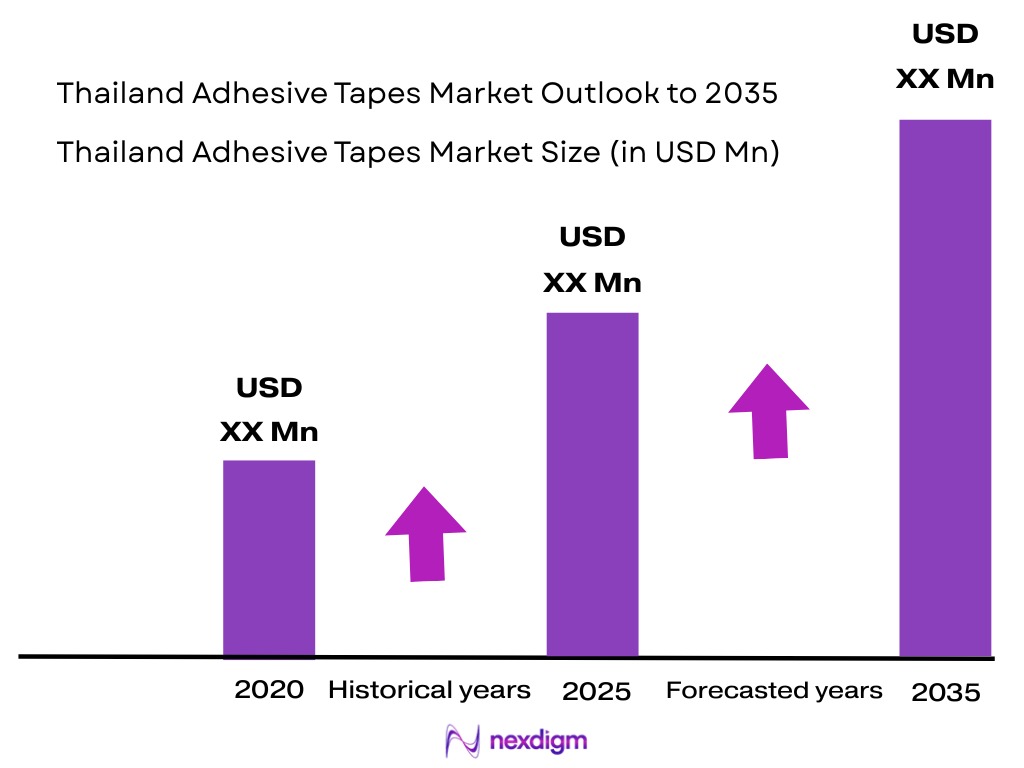
The Thailand Adhesive Tapes Market is valued at USD XX million, supported by demand from packaging, automotive, electronics, construction, industrial manufacturing and logistics applications. Thailand imported 16.91 million kg of self-adhesive tape in rolls under HS 391910, valued at USD 83.11 million, while exports reached 8.79 million kg, valued at USD 59.70 million. The broader industrial base also strengthened, with investment-promotion applications reaching 3,137 projects valued at THB 1.14 trillion, creating additional demand for industrial and specialty bonding solutions.
Thailand’s adhesive-tape demand is concentrated around Bangkok and the Eastern Economic Corridor, particularly Chonburi, Rayong and Chachoengsao, because these areas connect automotive, electronics, packaging, petrochemical and industrial manufacturing clusters. Thailand’s industrial estates covered approximately 190,212 rai across 16 provinces, with around 5,098 factories and 907,172 workers, demonstrating the scale of the manufacturing ecosystem supporting tape consumption. The EEC is particularly important because investment is increasingly directed toward electronics, automotive, chemicals and advanced manufacturing applications.
Market Segmentation
By Adhesive Technology
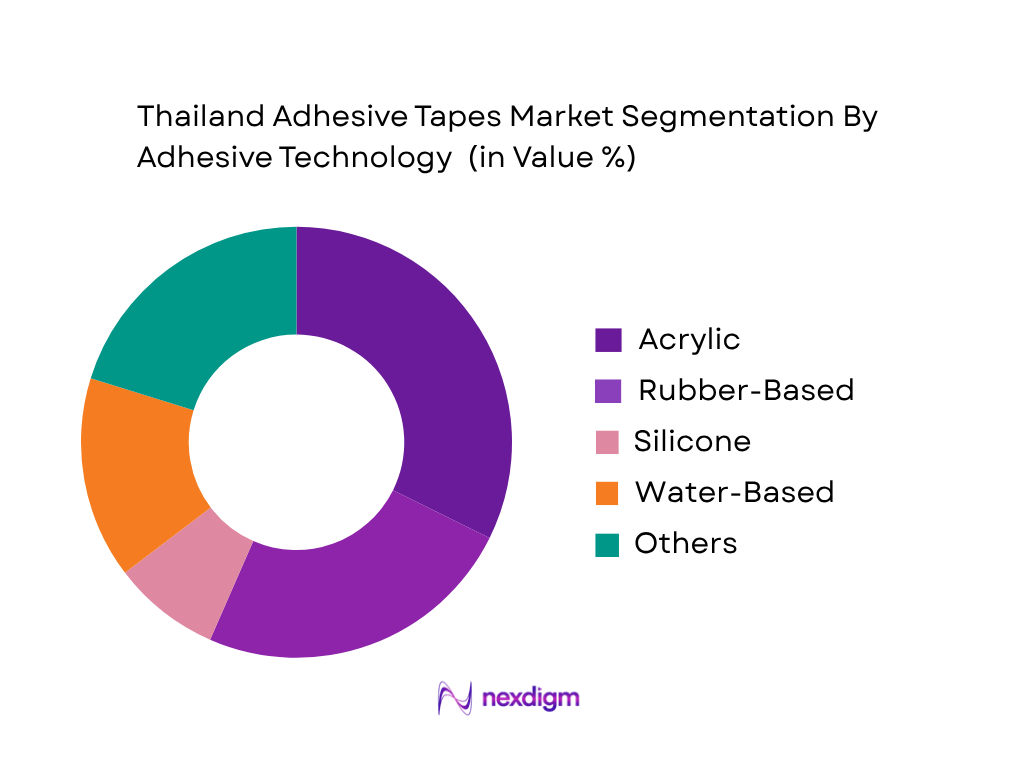
The Thailand Adhesive Tapes Market is segmented by adhesive technology into acrylic, rubber-based, silicone, water-based, solvent-based and hot-melt systems. Acrylic adhesive tapes are expected to represent the dominant technology because they provide the combination of adhesion, durability, UV resistance, temperature performance and versatility required across packaging, automotive, electronics and industrial applications. Thailand’s industrial investment profile reinforces this position: electronics and electrical appliances attracted 407 investment-promotion projects valued at THB 231.7 billion, while automotive and parts attracted 309 projects valued at THB 102.4 billion. These manufacturing environments require tapes with consistent bonding, clean application and long-term performance. Water-based technologies remain important for packaging applications because of their lower-VOC profile, while silicone systems serve demanding high-temperature and specialty applications. Hot-melt systems are particularly relevant to high-speed packaging and assembly. Solvent-based products retain applications where aggressive adhesion and substrate compatibility are critical. The resulting technology mix therefore reflects a two-tier market: high-volume acrylic, rubber and water-based tapes serving mainstream applications, alongside silicone, hot-melt and specialty chemistries serving higher-performance requirements.
By End-Use Industry
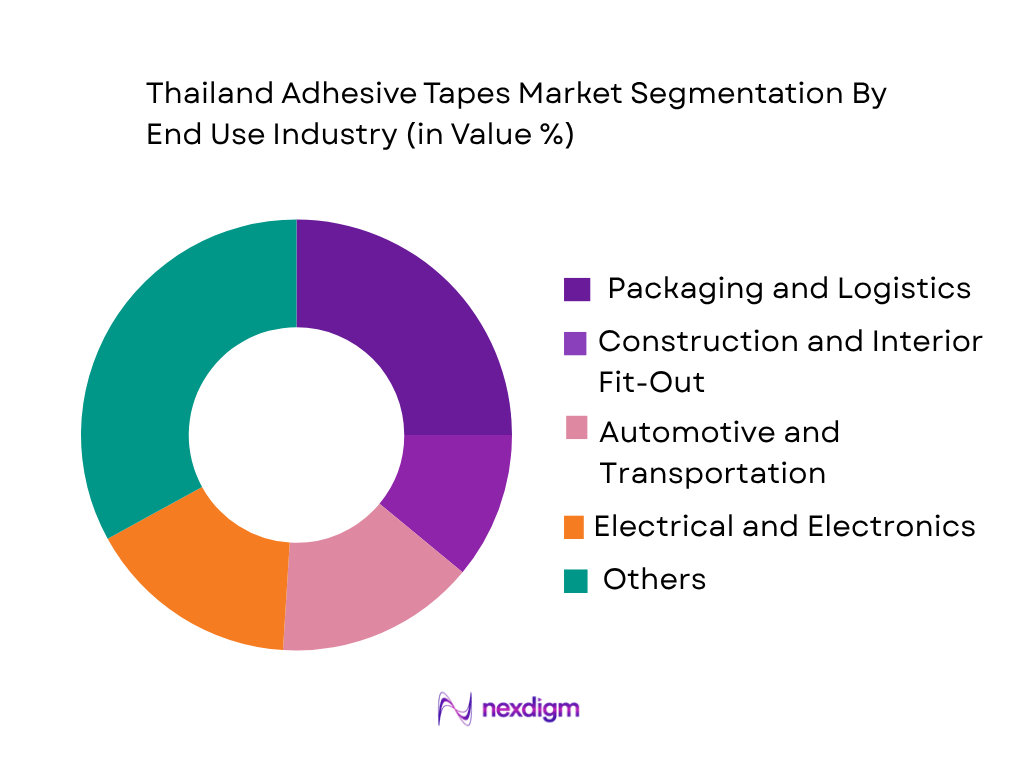
The Thailand Adhesive Tapes Market is segmented by end-use industry into packaging and logistics, construction and interior fit-out, automotive and transportation, electrical and electronics, HVAC and MEP, healthcare and pharmaceuticals, industrial manufacturing, aerospace and defense, furniture and interiors, food and beverage, and marine and specialty applications. Packaging and logistics is expected to remain the largest end-use segment because carton sealing, bundling, palletization, labeling and parcel fulfilment generate recurring tape consumption across Thailand’s extensive distribution ecosystem. Thailand’s e-commerce economy was estimated by the Electronic Transactions Development Agency at THB 5.96 trillion for 2023, providing a substantial structural base for packaging-related tape consumption. Industrial demand is simultaneously reinforced by manufacturing investment: E&E attracted 407 projects worth THB 231.7 billion, while automotive and parts attracted 309 projects worth THB 102.4 billion in 2024. Electronics manufacturing increasingly requires double-sided, transfer, masking, insulation and precision die-cut tapes, while automotive production uses tapes for trim attachment, wire management and component assembly. Construction, HVAC, healthcare and industrial manufacturing provide additional diversified demand, reducing dependence on any single application.
Competitive Landscape
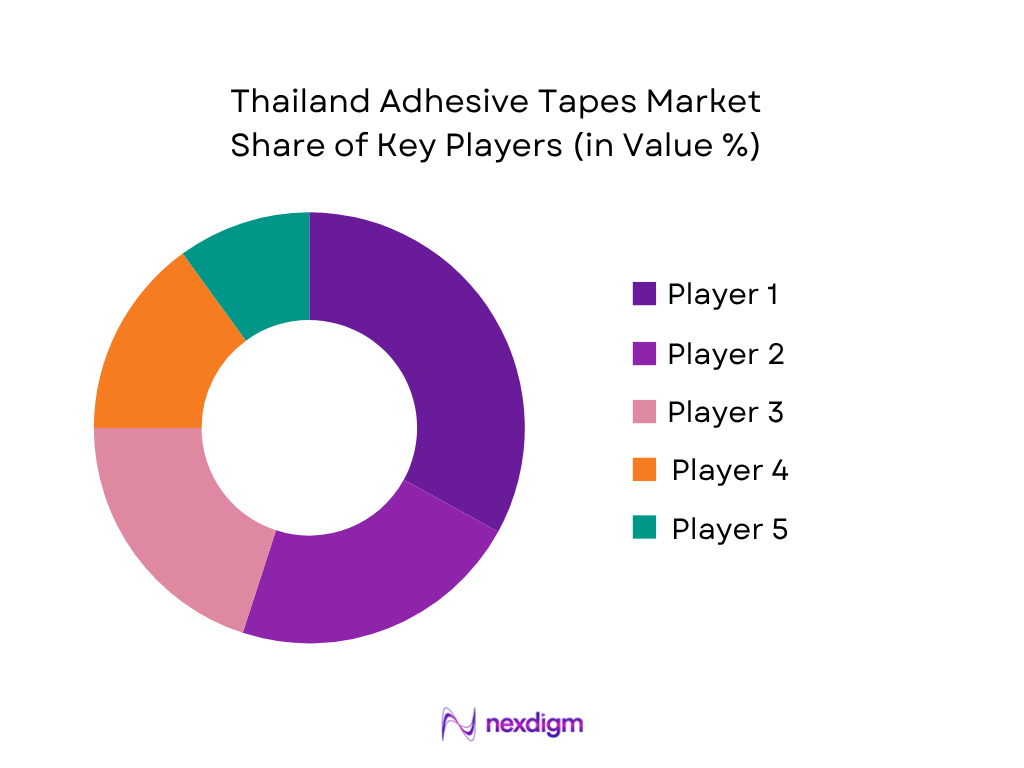
The Thailand Adhesive Tapes Market has a mixed competitive structure, combining multinational technology suppliers, regional manufacturers, domestic tape producers, distributors and specialized converters. International companies are particularly influential in high-performance automotive and electronics applications, while domestic manufacturers compete strongly in packaging, masking and general-purpose products. Thailand also functions as a regional manufacturing and export base: in 2024, exports of HS 391910 self-adhesive tape reached 8.79 million kg, demonstrating the presence of local converting and manufacturing capabilities.
| Company | Establishment | Headquarters | Thailand Presence | Key Tape Portfolio | Major Applications | Manufacturing / Converting Capability |
| 3M | 1902 | St. Paul, Minnesota, USA | ~ | ~ | ~ | ~ |
| Nitto Denko | 1918 | Osaka, Japan | ~ | ~ | ~ | ~ |
| tesa SE | 2001 | Norderstedt, Germany | ~ | ~ | ~ | ~ |
| Avery Dennison | 1935 | Mentor, Ohio, USA | ~ | ~ | ~ | ~ |
| LINTEC | 1934 | Tokyo, Japan | ~ | ~ | ~ | ~ |
Thailand Adhesive Tapes Market Analysis
Growth Drivers
Automotive Production and EV Manufacturing
Thailand’s automotive manufacturing base remains a direct demand generator for adhesive tapes used in wire harnessing, interior assembly, trim attachment, masking, insulation, component mounting and battery-pack applications. The Office of Industrial Economics recorded 1.50 million automobiles produced in Thailand during 2024, alongside 1.05 million vehicle exports, demonstrating the continued importance of Thailand as an export-oriented vehicle manufacturing platform. The Ministry of Commerce recorded THB 1.093 trillion in 2024 exports of motor cars, parts and accessories, reinforcing the scale of the automotive supply chain. The transition toward EVs is creating additional tape-intensive applications because battery modules, thermal-management components, insulation materials, sensors, displays and lightweight interior components require thin, conformable and electrically functional bonding solutions. Thailand’s Board of Investment reported cumulative approved EV-related investment of THB 137.7 billion, covering vehicles, batteries, critical components and charging infrastructure, including 386,000 units per year of approved BEV production capacity. The policy framework also establishes minimum local-content requirements of 40% for BEVs, 45% for PHEVs, and 40% for electric buses and trucks, encouraging deeper domestic sourcing. This combination of established automotive production, export manufacturing, EV localization and component integration supports sustained demand for acrylic, rubber-based, double-sided, foam, electrical-insulation and high-temperature adhesive tapes across OEM and tier-supplier operations.
Electronics Assembly and Export Manufacturing
Thailand’s electronics manufacturing ecosystem provides a high-value demand base for adhesive tapes used in component fixation, insulation, shielding, display assembly, PCB processing, semiconductor packaging, wire management and precision mounting. The Thailand Board of Investment reports that electronics and electrical products represented around one-quarter of Thailand’s total exports, while electronics exports reached THB 1.86 trillion (USD 58.9 billion) in 2024 and semiconductor exports reached THB 436 billion (USD 13.8 billion). The Ministry of Commerce additionally recorded THB 862.933 billion of exports for computers, equipment and components and THB 304.518 billion for integrated electronic circuits during 2024. These export values demonstrate that adhesive-tape demand is not limited to conventional packaging or construction applications; it is increasingly connected to precision manufacturing environments where dimensional stability, clean removal, dielectric performance, temperature resistance and low outgassing are important. Investment momentum reinforces this opportunity: BOI data shows 1,748 electrical and electronics investment-promotion projects representing THB 1.17 trillion in applications between 2018 and November 2025, with investment concentrated in PCBs, semiconductor assembly and testing, hard-disk drives and components. Such manufacturing activities create opportunities for specialty double-sided tapes, process tapes, masking tapes, thermal-interface bonding solutions and electronics-grade adhesive systems. Thailand’s export-oriented electronics structure therefore supports adhesive-tape consumption both through domestic production and through internationally integrated supply chains.
Market Challenges
Imported Master-Roll Dependency and Adhesive Raw Material Volatility
Thailand’s adhesive-tape industry faces structural exposure to imported master rolls, polymer films, resins and specialty adhesive chemistries because high-performance tape production requires specialized coating, formulation and converting capabilities that are not uniformly available domestically. This vulnerability is particularly relevant for acrylic, silicone, hot-melt and solvent-based systems used in automotive, electronics and industrial applications. Thailand’s Ministry of Commerce recorded THB 308.789 billion of polymer exports and THB 295.631 billion of chemical-product exports in 2024, illustrating the scale of the broader chemical and polymer ecosystem, while the Office of Industrial Economics reported that manufacturing capacity utilization averaged 58.44% during 2024. At the same time, OIE identified higher production costs associated with energy prices and intense competition from inexpensive imported goods as pressures on Thai manufacturers. For adhesive-tape converters, fluctuations in polymer availability, specialty resin specifications, release liners and adhesive additives can complicate production planning and qualification consistency. Imported master-roll dependency can also lengthen replenishment cycles and increase exposure to international logistics disruptions. The challenge is especially pronounced for industrial customers requiring validated adhesive formulations, consistent coat weight, controlled adhesion and stable performance across tropical operating conditions. As a result, domestic converters must balance inventory resilience, supplier diversification, formulation capability and technical qualification requirements while competing against imported commodity tapes.
Tropical Humidity, High-Temperature Requirements and Technical Qualification Barriers
Thailand’s tropical operating environment creates demanding conditions for adhesive tapes, particularly where products are exposed to heat, humidity, condensation, outdoor environments and prolonged service periods. These conditions increase the technical requirements for adhesion retention, shear resistance, liner stability, dimensional consistency and resistance to adhesive migration. The challenge becomes more significant in automotive, electronics, HVAC, construction and industrial applications where tape failure can affect assembly quality or product reliability. Thailand’s manufacturing sector recorded a 58.44% capacity-utilization rate across 2024, while the Manufacturing Production Index contracted 1.79% during the year, demonstrating that industrial customers are operating within a competitive environment where process efficiency and defect avoidance remain important. Automotive manufacturing alone produced approximately 1.50 million vehicles in 2024, creating large volumes of applications where adhesive tapes must meet OEM and tier-supplier specifications rather than simply compete on basic tack. In electronics, the technical threshold is even higher because semiconductor and precision-component applications can require controlled residue, low contamination, electrical insulation and stable performance under thermal cycling. Qualification requirements therefore lengthen customer conversion cycles and can make entry difficult for smaller tape manufacturers or converters without laboratory testing and application-engineering capabilities. The combination of tropical exposure and stringent industrial qualification increases the importance of formulation stability, substrate compatibility, controlled coating processes and application-specific technical support. Sources: Thailand Office of Industrial Economics and Thailand Office of Industrial Economics automotive-industry data.
Market Opportunities
Electronics-Grade, Semiconductor Process and EV Battery Assembly Tapes
Thailand’s ongoing expansion of electronics, semiconductor and EV manufacturing creates an opportunity to move adhesive tapes toward higher-value engineered applications rather than relying predominantly on commodity packaging tapes. BOI data shows that Thailand’s electronics exports reached THB 1.86 trillion in 2024, while semiconductor exports reached THB 436 billion. The country also recorded THB 1.093 trillion in exports of motor cars, parts and accessories, establishing substantial manufacturing ecosystems where specialized tapes can be integrated directly into production processes. EV localization further strengthens the opportunity: approved EV-related investments have reached THB 137.7 billion, with approved BEV production capacity of 386,000 units annually, while battery-related projects represent THB 80.1 billion of investment under the cited BOI program. These applications require adhesive technologies capable of thermal resistance, electrical insulation, thin-profile bonding, vibration resistance, clean processing and compatibility with metals, plastics, foams and battery components. Semiconductor and electronics manufacturers can similarly require process-specific masking, die-cutting, protective and temporary-bonding tapes with stringent cleanliness characteristics. The opportunity therefore lies in developing or locally converting acrylic foam tapes, PET electrical tapes, polyimide tapes, thermal-management tapes, precision die-cut components and other engineered products tailored to Thai automotive-electronics production. Greater domestic localization of these solutions could also reduce dependence on imported finished tapes and create opportunities for specialized local converting operations.
Sustainable Packaging Tapes, Low-VOC Adhesives and Specialty Converting
Thailand’s large manufacturing and export base creates an expanding opportunity for adhesive-tape suppliers that can combine performance with lower environmental impact and localized converting. The Ministry of Commerce recorded THB 1.093 trillion in automotive exports, THB 862.933 billion in computer and component exports, THB 498.585 billion in rubber-product exports and THB 308.789 billion in polymer exports during 2024, indicating substantial volumes of products moving through manufacturing, packaging and logistics chains. ETDA’s official e-commerce survey also reported Thailand’s e-commerce value at THB 5.96 trillion for 2023, with manufacturing alone accounting for THB 699 billion, demonstrating the scale of digitally enabled commercial activity requiring packaging and fulfilment infrastructure. These conditions support opportunities for sustainable BOPP carton-sealing tapes, paper-based tapes, recyclable packaging systems, low-VOC adhesive formulations and specialty tapes designed for automated packaging lines. Local specialty converting can add further value through slitting, rewinding, die-cutting and application-specific formats that reduce the need for customers to import finished products. The opportunity is particularly relevant where manufacturers need tapes adapted to automated equipment, specific substrate combinations or narrow-width applications. Combining domestic converting with imported or locally sourced adhesive technologies can allow suppliers to respond faster to Thai electronics, automotive, packaging and industrial customers while progressively expanding into higher-specification applications.
Future Outlook
Over the coming decade, the Thailand Adhesive Tapes Market is expected to benefit from the country’s position as a manufacturing and export hub for automotive, electronics, packaging and industrial products. The investment pipeline is increasingly concentrated in higher-value manufacturing: Thailand recorded THB 1.14 trillion in investment-promotion applications, with electronics and electrical appliances alone accounting for THB 231.7 billion. Automotive and parts applications added another THB 102.4 billion. These industrial shifts should increase requirements for precision bonding, lightweight assembly, thermal management, masking and electrical insulation tapes.
Major Players
- 3M
- Nitto Denko Corporation
- tesa SE
- Avery Dennison Corporation
- LINTEC Corporation
- Lohmann GmbH & Co. KG
- Henkel AG & Co. KGaA
- Sika AG
- Saint-Gobain
- Intertape Polymer Group
- Berry Global
- Shurtape Technologies
- H.B. Fuller Company
- Louis Adhesive Tapes Co., Ltd.
- Thailand Adhesive Tapes Industry Co., Ltd.
Key Target Audience
- Adhesive Tape Manufacturers and Converters
- Automotive OEMs and Tier-1/Tier-2 Component Manufacturers
- Electronics and Semiconductor Manufacturers
- Packaging, Logistics and E-Commerce Fulfilment Companies
- Construction, HVAC and MEP Contractors
- Industrial Manufacturing and Machinery Companies
- Investments and Venture Capitalist Firms
- Government and Regulatory Bodies (Thailand Board of Investment, Ministry of Industry, Industrial Estate Authority of Thailand, Eastern Economic Corridor Office)
Research Methodology
Step 1: Identification of Key Variables
The research begins with mapping Thailand’s adhesive-tape ecosystem across adhesive producers, film and paper suppliers, coating companies, converters, distributors, OEMs and end users. Variables include tape construction, adhesive chemistry, backing material, application, industrial consumption, import dependency and local production.
Step 2: Market Analysis and Construction
Historical market information is reconstructed using trade statistics, industrial production indicators, company disclosures, investment data and end-use demand indicators. Import and export data are reconciled with domestic manufacturing and consumption estimates to identify the addressable adhesive-tape market.
Step 3: Hypothesis Validation and Expert Consultation
Market hypotheses are tested through discussions with tape manufacturers, converters, distributors, automotive suppliers, electronics manufacturers and packaging users. Technical inputs concerning adhesion, substrate compatibility, temperature resistance, moisture performance and qualification requirements are incorporated into the assessment.
Step 4: Research Synthesis and Final Output
The final analysis triangulates bottom-up company and application assessments with top-down industrial indicators. Thailand-specific demand drivers, competitive positioning, technology adoption, import dependency and emerging application opportunities are synthesized into market forecasts and strategic conclusions.

- Executive Summary
- Research Methodology (Market Definition and Scope, Adhesive Tape Classification, HS-Code Mapping, Historical Data Collection, Top-Down Market Sizing, Bottom-Up Consumption Assessment, Demand-Side Analysis, Supply-Side Analysis, Import–Export Reconciliation, Primary Industry Interviews, OEM Validation, Distributor Mapping, End-User Verification, Data Triangulation, Forecasting Framework, Sensitivity Analysis, Research Limitations)

- Definition and Scope
- Market Evolution and Industrial Development
- Thailand Adhesive Tapes Industry Ecosystem
- Adhesive Tape Value Chain Analysis
- Raw Material-to-Tape Conversion Structure
- Adhesive Formulation and Coating Ecosystem

- Growth Drivers (Automotive Production, EV Manufacturing, Electronics Assembly, Packaging Consumption, E-Commerce Fulfilment, Industrial Automation, Construction Activity, Export Manufacturing)
- Market Challenges (Imported Master-Roll Dependency, Polymer Feedstock Exposure, Adhesive Raw Material Volatility, Tropical Humidity, High-Temperature Requirements, Commodity Tape Competition, Technical Qualification Barriers)
- Market Opportunities (Electronics-Grade Tapes, EV Battery Assembly, Acrylic Foam Tapes, Sustainable Packaging Tapes, Low-VOC Adhesives, HVAC Tapes, Semiconductor Process Tapes, Specialty Converting)
- Thailand Adhesive Tapes Market Trends
Chemical and Product Regulatory Framework (Industrial Chemical Controls, Product Safety, Environmental Compliance, Workplace Safety, Chemical Labelling, Hazard Communication) - SWOT Analysis
- Porter’s Five Forces Analysis
- PESTLE Analysis

- By Market Value (2020-2025)
- By Tape Consumption Volume (2020-2025)
- By Average Selling Price (2020-2025)
- By Domestic Production Volume (2020-2025)
- By Import Volume (2020-2025)
- By Export Volume (2020-2025)

- By Adhesive Technology (in value %)
Acrylic Adhesive Tapes
Rubber-Based Adhesive Tapes
Silicone Adhesive Tapes
Water-Based Adhesive Tapes
Solvent-Based Adhesive Tapes
Hot-Melt Adhesive Tapes
Reactive and Specialty Adhesive Systems - By Backing Material
BOPP Tapes
PVC Tapes
PET Tapes
Paper-Based Tapes
PE Tapes
Nonwoven Tapes
Foam Tapes
Polyimide Tapes
Aluminum Foil Tapes
Fabric and Specialty Film Tapes - By Tape Construction
Single-Sided Tapes
Double-Sided Tapes
Transfer Tapes
Foam Tapes
Filament-Reinforced Tapes
Masking Tapes
Protective Surface Tapes
Electrical Insulation Tapes
Thermal Management Tapes
Specialty Functional Tapes - By Product Format
Jumbo Rolls
Slit Rolls
Narrow-Width Industrial Rolls
Die-Cut Adhesive Components
Adhesive Sheets
Laminated Tape Structures
Custom-Converted Tape Components - By End-Use Industry
Packaging and Logistics
Construction and Interior Fit-Out
Automotive and Transportation
Electrical and Electronics
HVAC and MEP
Healthcare and Pharmaceuticals
Industrial Manufacturing
Aerospace and Defense
Furniture and Interiors
Food and Beverage
Marine and Specialty Applications - By Application
Carton Sealing and Case Closing
Permanent Mounting and Bonding
Splicing and Web Joining
Masking and Surface Protection
Electrical Insulation and Wire Management
Component Assembly
Lamination and Composite Bonding
Labelling and Graphic Applications
Packaging Reinforcement
HVAC Insulation and Sealing

- Market Share of Major Players (By Value, Volume, Adhesive Technology, Tape Construction, End-Use Industry, Application, Distribution Channel)
- Cross Comparison Parameters (Adhesive Technology Breadth, Tape Construction Portfolio, Electronics-Grade Capability, Automotive OEM Qualification, Local Manufacturing Footprint, Converting and Die-Cutting Capability, Distribution Network Reach, R&D and Product Innovation Capability)
- SWOT Analysis Of Major Players
- Detailed Profiles of Major Companies
3M Company
Nitto Denko Corporation
tesa SE
Avery Dennison Corporation
LINTEC Corporation
Lohmann GmbH & Co. KG
Scapa Group
Intertape Polymer Group
H.B. Fuller Company
Saint-Gobain
Henkel AG & Co. KGaA
Sika AG
Berry Global
Shurtape Technologies

- Packaging and Logistics End-User Assessment
- Automotive and EV End-User Assessment
- Electronics and Semiconductor End-User Assessment
- Construction and Interior Fit-Out End-User Assessment
- Industrial Manufacturing End-User Assessment
- Healthcare and Pharmaceutical End-User Assessment
- Food and Beverage End-User Assessment

- By Market Value (2026-2035)
- By Tape Consumption Volume (2026-2035)
- By Average Selling Price (2026-2035)
- By Domestic Production Volume (2026-2035)
- By Import Volume (2026-2035)
- By Export Volume (2026-2035)


 Request a Sample
 Ask for Customization
 Get a Quote
 Enquire Now