
 Download PDF
Market Overview
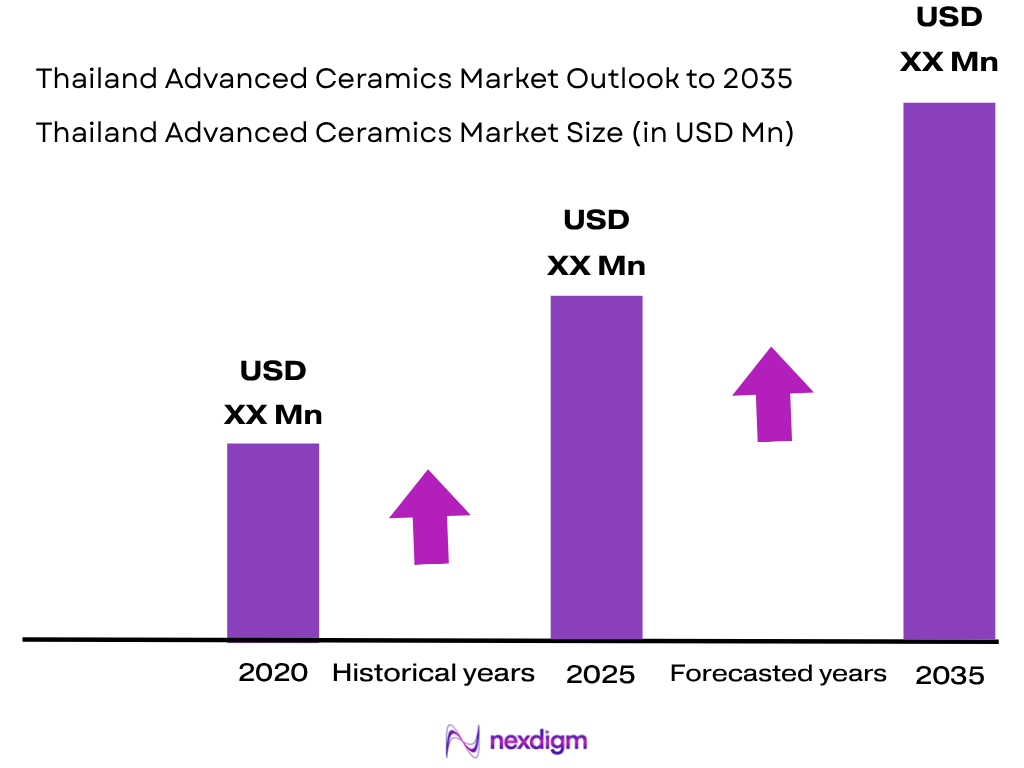
The Thailand Advanced Ceramics Market is estimated at USD ~ million in 2024, compared with USD ~ million in 2023, with demand concentrated in electronics, semiconductor components, automotive electronics, industrial machinery and medical applications. Thailand’s manufacturing value added reached 2,802,807 million in constant local currency units in the latest World Bank observation, highlighting the scale of the industrial base supporting technical-material consumption. Investment applications also reached 1.14 trillion baht, while semiconductor and advanced-electronics projects were among the leading investment categories, strengthening the downstream requirement for high-purity substrates, ceramic packages, insulation components and precision ceramic parts.
Thailand’s advanced-ceramics demand is concentrated around Bangkok and the major industrial corridors serving electronics, automotive and precision manufacturing. The Eastern Economic Corridor is particularly relevant because Thailand combines automotive production with expanding electronics, semiconductor and EV investment. The country recorded 309 automotive and parts investment-promotion projects worth 102.4 billion baht, while electronics manufacturing continues to attract substantial investment. Separately, PCB companies filed 95 investment-promotion applications representing 162 billion baht from the beginning of 2023 through September 2024, creating an important downstream base for ceramic substrates, electronic packages and thermal-management materials.
Market Segmentation
By Material Type
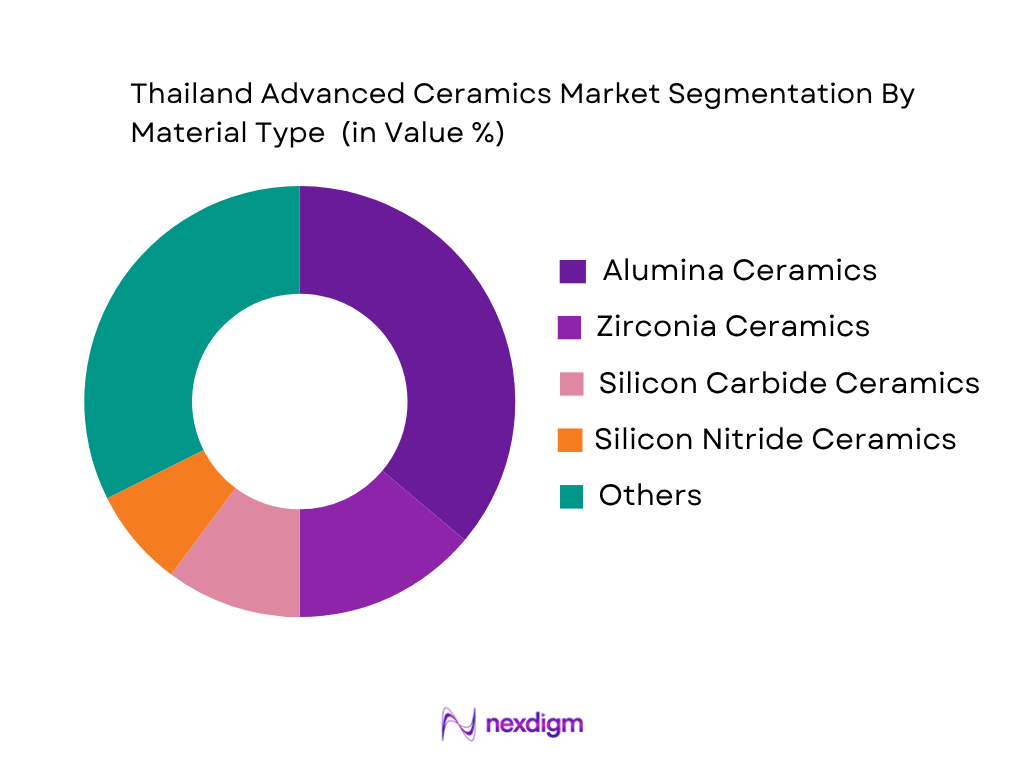
The Thailand Advanced Ceramics Market is segmented by material type into alumina, zirconia, silicon carbide, silicon nitride, aluminum nitride, titanate ceramics, boron carbide and ceramic composites. Alumina is expected to represent the dominant material category because of its broad applicability across electrical insulation, electronic substrates, semiconductor equipment, wear components, industrial machinery and automotive electronics. Its combination of electrical insulation, hardness, chemical stability and thermal performance enables deployment across both mature and high-technology applications. Thailand’s expanding electronics ecosystem creates multiple demand channels rather than dependence on a single application. BOI has identified advanced electronics and semiconductor manufacturing as major investment areas, while PCB investment has expanded significantly, supporting requirements for reliable insulating and substrate materials. Kyocera’s Thailand operations specifically identify fine ceramics for electronics and semiconductor processing, while its global portfolio includes alumina, zirconia, silicon carbide, silicon nitride and aluminum nitride.
By Application
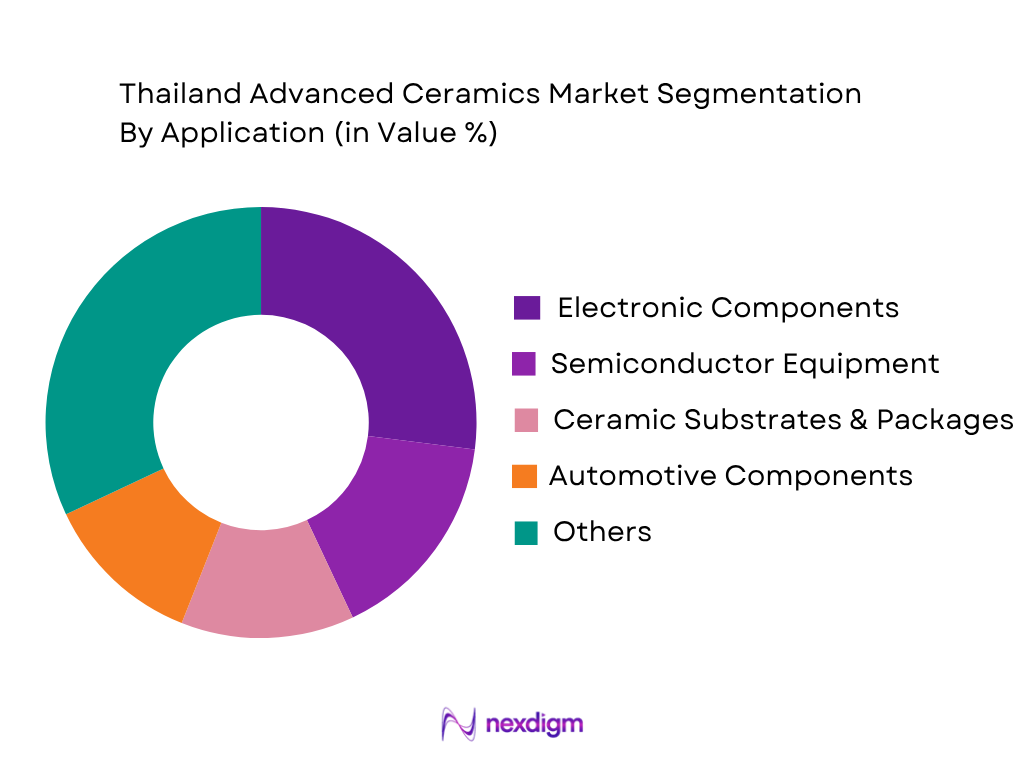
The Thailand Advanced Ceramics Market is segmented by application into electronic components, semiconductor equipment components, ceramic substrates and packages, automotive components, medical components, industrial machinery components, electrical insulation, thermal-management components and energy applications. Electronic components are positioned as the leading application segment because Thailand possesses an established electronics manufacturing ecosystem spanning PCBs, electronic assemblies, hard-disk-drive production, electrical equipment and semiconductor assembly and testing. Advanced ceramics are used where electrical insulation, dimensional stability, thermal management, wear resistance and high-frequency performance are required. Thailand’s BOI reported that the country is among the world’s leading HDD manufacturing locations and that its PCB manufacturing base ranks among the global leaders; more than 10 major semiconductor companies were identified as participating in assembly and testing activities. The investment pipeline therefore creates demand for ceramic substrates, packages, precision semiconductor components and thermal-management materials.
Competitive Landscape
The Thailand Advanced Ceramics Market is characterized by a combination of global advanced-material manufacturers, specialist technical-ceramic companies and electronics-component manufacturers. Competitive intensity is strongest where advanced ceramics intersect with semiconductor equipment, electronic substrates, automotive electronics and high-precision industrial components. Kyocera already operates a Thailand organization serving fine-ceramics, semiconductor and electronic-component requirements, while KYOCERA AVX has established a major advanced manufacturing facility in Nakhon Ratchasima. Global suppliers such as CoorsTek and CeramTec compete through broad material portfolios and application-specific engineering capabilities.
| Company | Established | Headquarters | Material Portfolio | Semiconductor Focus | Electronics Focus | Automotive Focus | Medical Focus |
| Kyocera Corporation | 1959 | Kyoto, Japan | ~ | ~ | ~ | ~ | ~ |
| CoorsTek | 1910 | Golden, Colorado, USA | ~ | ~ | ~ | ~ | ~ |
| CeramTec | 1903 | Plochingen, Germany | ~ | ~ | ~ | ~ | ~ |
| Morgan Advanced Materials | 1856 | Windsor, UK | ~ | ~ | ~ | ~ | ~ |
| 3M | 1902 | St. Paul, Minnesota, USA | ~ | ~ | ~ | ~ | ~ |
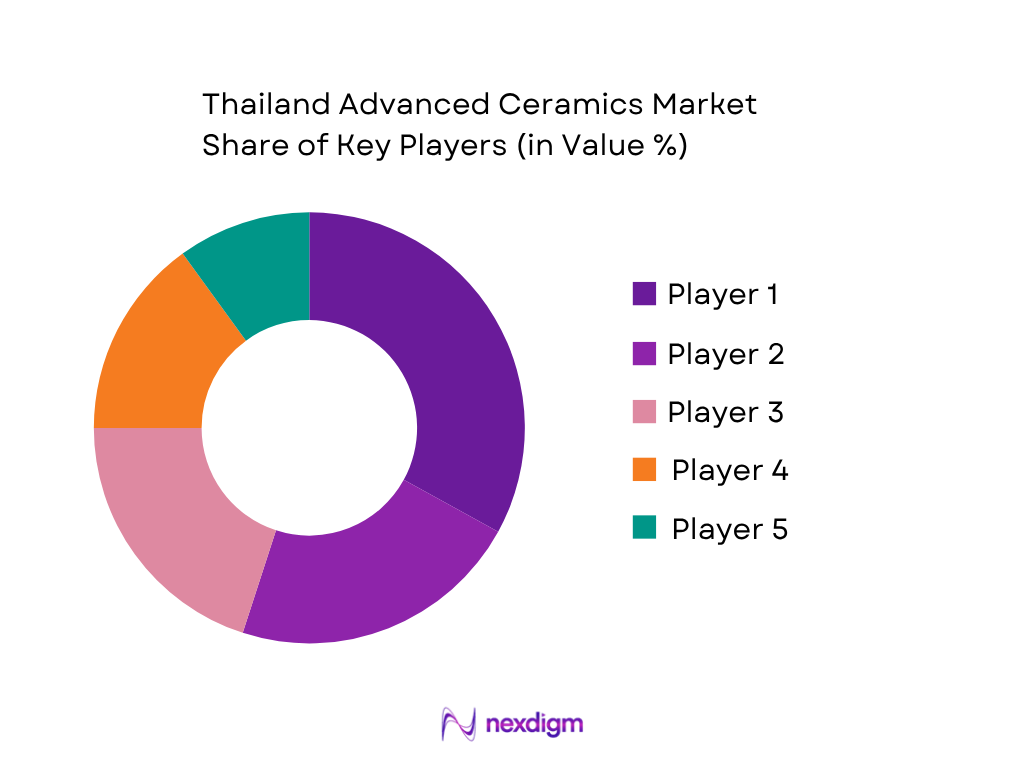
Thailand Advanced Ceramics Market Analysis
Growth Drivers
Electronics Manufacturing Expansion
Thailand’s expanding electronics manufacturing base is creating a direct downstream requirement for advanced ceramics used in electronic insulation, substrates, packages, capacitors, thermal-management components and precision equipment parts. Thailand Board of Investment data shows that electrical appliances and electronics attracted 291 investment-promotion projects worth THB 183.4 billion during the first nine months of 2024, while total investment-promotion applications reached THB 722.5 billion. The country’s PCB ecosystem is particularly relevant: 95 PCB investment applications representing THB 162 billion were filed from January 2023 through September 2024. This expansion increases demand for ceramic materials capable of maintaining dimensional stability, dielectric performance and thermal resistance in increasingly compact electronic systems. World Bank trade data also records Thailand importing USD 43.1 million of ceramic dielectric capacitors under HS 853223 and USD 251.9 million under HS 853224 in 2024, demonstrating substantial industrial activity around ceramic-based electronic components. The combination of electronics investment, PCB manufacturing and imported ceramic electronic components strengthens the addressable demand base for alumina, aluminum nitride, titanate ceramics and other engineered ceramic materials.
Semiconductor Assembly Growth
Thailand’s semiconductor ecosystem is becoming an increasingly important demand center for high-purity alumina, aluminum nitride, silicon carbide, silicon nitride and other advanced ceramics used in wafer-processing equipment, semiconductor packaging, thermal management and electrical isolation. The Thailand Board of Investment reported 291 E&E investment projects worth THB 183.4 billion in the first nine months of 2024, with semiconductor and advanced-electronics projects among the major investment flows. The government’s semiconductor workforce strategy covers more than 86,000 people, including 1,400 master’s and PhD-level researchers, demonstrating the scale of industrial capability being developed around the sector. Thailand’s PCB investment pipeline adds 95 applications worth THB 162 billion, reinforcing the electronics supply chain supporting semiconductor-related applications. BOI also identified semiconductor equipment manufacturing investments involving high-vacuum and high-purity components for etching, thin-film and CMP processes. These processes require materials capable of resisting plasma, chemicals, high temperatures and particle generation. Consequently, the expansion of semiconductor manufacturing, equipment localization and advanced electronics creates a stronger requirement for technically engineered ceramic components rather than conventional ceramic products.
Market Challenges
Import Dependence for High-Purity Materials
Thailand’s advanced ceramics ecosystem remains exposed to imported technical materials and components, particularly where applications require high-purity grades, specialized formulations or precision-engineered ceramic parts. World Bank WITS/UN Comtrade records USD 13.5 million of Thai imports of ceramic electrical insulators in 2024, corresponding to approximately 5.06 million kg. China alone supplied approximately USD 8.23 million and 4.66 million kg, while Japan supplied approximately USD 3.10 million and 80,007 kg. Ceramic dielectric components show an even larger import requirement: Thailand imported approximately USD 251.9 million of fixed ceramic dielectric capacitors under HS 853224 and USD 43.1 million under HS 853223. These trade flows indicate substantial dependence on established Asian manufacturing hubs for ceramic-based electronic components and related technologies. At the same time, Thailand’s electronics investment pipeline is expanding rapidly, with 291 E&E investment projects worth THB 183.4 billion during the first nine months of 2024. This creates a structural challenge: domestic advanced-ceramic processing, powder purification, precision machining and component qualification must develop quickly enough to support higher-value semiconductor and electronics manufacturing without creating excessive dependence on overseas suppliers.
Specialized Workforce and Precision Manufacturing Requirements
Advanced ceramics require substantially more specialized processing capabilities than conventional ceramic manufacturing because component performance depends on powder purity, particle size, forming accuracy, sintering conditions, surface finishing and tight dimensional tolerances. Thailand’s semiconductor strategy itself identifies workforce development as a major requirement, with the government planning training, upskilling and reskilling for more than 86,000 people, including 1,400 master’s and PhD-level researchers. The requirement is particularly relevant for advanced ceramics because semiconductor equipment components must meet demanding requirements for purity, plasma resistance, thermal stability and particle control. Thailand’s PCB investment pipeline further demonstrates the sophistication of the emerging electronics ecosystem: 95 investment applications worth THB 162 billion were filed between January 2023 and September 2024. A Welltek PCB facility in Ayutthaya also began operations with an initial investment exceeding THB 2.5 billion and more than 500 employees, including engineers and technicians. The expanding industrial base therefore increases the need for specialized ceramic-processing personnel, precision machining expertise and application-engineering capabilities, while qualification requirements can lengthen the transition from conventional ceramics toward high-value semiconductor-grade components.
Market Opportunities
Semiconductor Ceramic Components
Thailand’s semiconductor and advanced-electronics investment pipeline creates a strong opportunity for domestic production and regional supply of ceramic components used in wafer fabrication, semiconductor equipment and electronic packaging. BOI reported 291 E&E projects worth THB 183.4 billion during the first nine months of 2024, while the government’s semiconductor strategy targets the development of a workforce exceeding 86,000 people, including 1,400 master’s and PhD-level researchers. BOI has also highlighted investment in high-purity semiconductor equipment components for etching, thin-film and CMP processes, demonstrating that Thailand is moving beyond basic electronics assembly toward higher-value semiconductor supply-chain activities. These applications require alumina, aluminum nitride, silicon carbide, silicon nitride and other materials offering high purity, thermal stability, chemical resistance and controlled electrical properties. The opportunity extends from ceramic chambers and fixtures to wafer-handling components, insulating parts, thermal-management substrates and precision semiconductor packages. Thailand’s 95 PCB investment applications representing THB 162 billion further strengthen the adjacent electronics ecosystem. As semiconductor and advanced-electronics manufacturing becomes more sophisticated, local suppliers capable of producing qualified ceramic components can capture additional value from Thailand’s industrial localization strategy.
Ceramic Substrate and Thermal-Management Manufacturing
Thailand’s growing electronics, semiconductor, EV and automotive-electronics ecosystems create opportunities for ceramic substrates and thermal-management components based on aluminum nitride, alumina and silicon carbide. The country attracted THB 1.14 trillion in investment-promotion applications across sectors in 2024, while automotive and parts accounted for 309 projects worth THB 102.4 billion. BOI also reported more than THB 80 billion of cumulative investment in Thailand’s EV ecosystem covering BEVs, batteries, key parts and charging infrastructure. These manufacturing activities increase the importance of materials capable of dissipating heat while maintaining electrical insulation and mechanical reliability. Aluminum nitride is particularly relevant for power-electronics substrates because it combines high thermal conductivity with electrical insulation, while silicon carbide components can support high-temperature and high-power environments. The opportunity is reinforced by Thailand’s electronics investment pipeline, which generated 291 E&E projects worth THB 183.4 billion during the first nine months of 2024. Developing domestic capabilities in ceramic substrate processing, metallization, precision cutting and thermal-interface component manufacturing would allow suppliers to participate across semiconductor packaging, EV power electronics, industrial electronics and high-performance electrical systems.
Future Outlook
The Thailand Advanced Ceramics Market is expected to develop around the intersection of electronics manufacturing, semiconductor investment, automotive electrification and high-value industrial production. Increasing requirements for thermal management, electrical insulation, chemical resistance and dimensional stability should support advanced ceramic adoption in technically demanding applications.
Thailand’s investment pipeline is particularly important: total investment-promotion applications reached 1.14 trillion baht, while digital-sector projects alone accounted for 243.3 billion baht. Semiconductor and advanced-electronics investments are therefore creating downstream opportunities for ceramic substrates, semiconductor-processing components, electronic packages and high-purity materials.
Major Players
- Kyocera Corporation
- CoorsTek
- CeramTec
- Morgan Advanced Materials
- Saint-Gobain Performance Ceramics & Refractories
- 3M
- Tosoh Corporation
- Murata Manufacturing
- NGK Insulators
- Niterra
- CUMI International
- Shinagawa Refractories
- Rauschert Group
- KYOCERA AVX
- Electro Ceramics (Thailand)
Key Target Audience
- Advanced Ceramics and Technical Materials Manufacturers
- Semiconductor Equipment and Component Manufacturers
- Electronics and PCB Manufacturers
- Automotive and EV Component Manufacturers
- Medical Device and Bioceramic Manufacturers
- Industrial Machinery and Precision Engineering Companies
- Investments and Venture Capitalist Firms
- Government and Regulatory Bodies (Thailand Board of Investment, Ministry of Industry, Ministry of Commerce, Electronic Transactions Development Agency)
Research Methodology
Step 1: Identification of Key Variables
The initial stage establishes the Thailand advanced-ceramics ecosystem across raw-material suppliers, ceramic powder producers, component manufacturers, electronics companies, semiconductor businesses, automotive suppliers, medical-device manufacturers and industrial users. Material grades, component types, manufacturing processes, application intensity and end-use requirements are mapped to define the addressable market.
Step 2: Market Analysis and Construction
Historical market information is constructed using production indicators, trade flows, industrial investment, downstream manufacturing activity and company-level application data. The analysis separates material consumption from finished ceramic-component demand and distinguishes domestic production, imports, exports and application-level consumption.
Step 3: Hypothesis Validation and Expert Consultation
Market hypotheses are validated through structured discussions with ceramic manufacturers, electronics producers, semiconductor-equipment suppliers, automotive component companies and industrial users. Interviews focus on material qualification, supplier selection, imported-versus-local sourcing, processing capability, application specifications and purchasing requirements.
Step 4: Research Synthesis and Final Output
Bottom-up company and application estimates are reconciled against top-down industrial indicators and trade data. Market values are triangulated across material type, application, product form and end-use industry before developing the forecast model. Competitive benchmarking is then used to assess technology capability, Thailand footprint and application positioning.

- Executive Summary
- Research Methodology (Market Definition and Scope, Advanced Ceramics Classification, Material–Application Mapping, Market Sizing Framework, Top-Down Assessment, Bottom-Up Assessment, Demand-Side Analysis, Supply-Side Analysis, Import–Export Validation, Primary Industry Interviews, Manufacturer-Level Validation, Data Triangulation, Forecasting Framework, Scenario Analysis, Research Limitations)

- Definition and Scope
- Thailand Advanced Ceramics Industry Evolution
- Advanced Ceramics Ecosystem Mapping
- Thailand Advanced Ceramics Value Chain Analysis
- Thailand Advanced Ceramics Supply Chain Analysis
- Domestic Manufacturing Versus Import Dependency

- Growth Drivers (Electronics Manufacturing Expansion, Semiconductor Assembly Growth, Automotive Production, EV Component Localization, Medical Device Manufacturing, Industrial Automation, Electronics Miniaturization)
- Market Challenges (Import Dependence for High-Purity Materials, Limited Domestic Advanced Ceramic Processing Capacity, Precision Manufacturing Requirements, High Qualification Barriers, Specialized Workforce Requirements, Supply Chain Exposure, Technology Localization Constraints)
- Market Opportunities (Semiconductor Ceramic Components, Ceramic Substrate Manufacturing, Thermal Management Ceramics, EV Ceramic Components, Medical Ceramics, High-Purity Alumina Applications, Silicon Carbide Components, Advanced Ceramic Packaging)
- Market Trends (Electronics Miniaturization, High-Thermal-Conductivity Ceramics, Semiconductor Equipment Localization, EV Electrification, Ceramic Substrate Development, High-Purity Materials, Precision Ceramic Manufacturing, Advanced Sintering)
- SWOT Analysis
- Porter’s Five Forces Analysis
- PESTLE Analysis

- By Market Value (2020-2025)
- By Volume Consumption (2020-2025)
- By Domestic Production (2020-2025)
- By Import Volume (2020-2025)
- By Export Volume (2020-2025)
- By Material Consumption (2020-2025)

- By Material Type (In Value %)
Alumina Ceramics
Zirconia Ceramics
Silicon Carbide Ceramics
Silicon Nitride Ceramics
Aluminum Nitride Ceramics
Titanate Ceramics
Boron Carbide Ceramics
Ceramic Composites
Other Advanced Ceramics - By Product Form (In Value %)
Monolithic Ceramic Components
Ceramic Substrates
Ceramic Packages
Ceramic Coatings
Ceramic Powders
Ceramic Fibers
Ceramic Tubes and Rods
Ceramic Plates and Discs
Ceramic Seals and Bearings - By Application (In Value %)
Ceramic Substrates
Electronic Components
Semiconductor Equipment Components
Ceramic Packages
Wear-Resistant Components
Thermal Management Components
Electrical Insulation Components
Medical Components
Automotive Components - By Manufacturing Process (In Value %)
Dry Pressing
Injection Molding
Tape Casting
Extrusion
Slip Casting
Hot Pressing
Cold Isostatic Pressing
Hot Isostatic Pressing
Reaction Bonding
Pressureless Sintering - By End-Use Industry (In Value %)
Electrical and Electronics
Semiconductors and Semiconductor Equipment
Automotive and Mobility
Medical and Healthcare
Industrial Machinery
Energy and Power
Telecommunications
Aerospace and Defense
Chemical Processing
Environmental and Water Treatment
Thailand Advanced Ceramics Electrical and Electronics Analysis

- Market Share of Major Players (By Value, Volume, Material Type, Product Form, Application, End-Use Industry)
- Cross Comparison Parameters (Advanced Ceramic Material Portfolio, Product and Component Portfolio Breadth, Manufacturing Process Capability, Precision Machining Capability, Material Purity Grades, Thermal and Electrical Performance Portfolio, Application-Specific Customization Capability, Thailand Manufacturing and Technical Support Footprint)
- SWOT Analysis of Major Players
- Detailed Profiles of Major Companies
Kyocera Corporation
CoorsTek Inc.
CeramTec GmbH
Morgan Advanced Materials plc
Saint-Gobain Performance Ceramics & Refractories
3M
Tosoh Corporation
Murata Manufacturing Co., Ltd.
NGK Insulators, Ltd.
Niterra Co., Ltd.
CUMI International Limited
Shinagawa Refractories Co., Ltd.
Rauschert Group
Coorstek Thailand
Electro Ceramics (Thailand) Co., Ltd.

- Electronics Manufacturer Requirements
- Semiconductor Equipment Requirements
- Automotive and EV Manufacturer Requirements
- Medical Device Manufacturer Requirements
- Industrial Equipment Requirements
- Purchasing Criteria Assessment
- Domestic Versus Imported Component Preference
- OEM Qualification and Supplier Switching Assessment

- By Market Value (2026-2035)
- By Volume Consumption (2026-2035)
- By Domestic Production (2026-2035)
- By Import Volume (2026-2035)
- By Export Volume (2026-2035)
- By Material Consumption (2026-2035)


 Request a Sample
 Ask for Customization
 Get a Quote
 Enquire Now