
 Download PDF
Market Overview
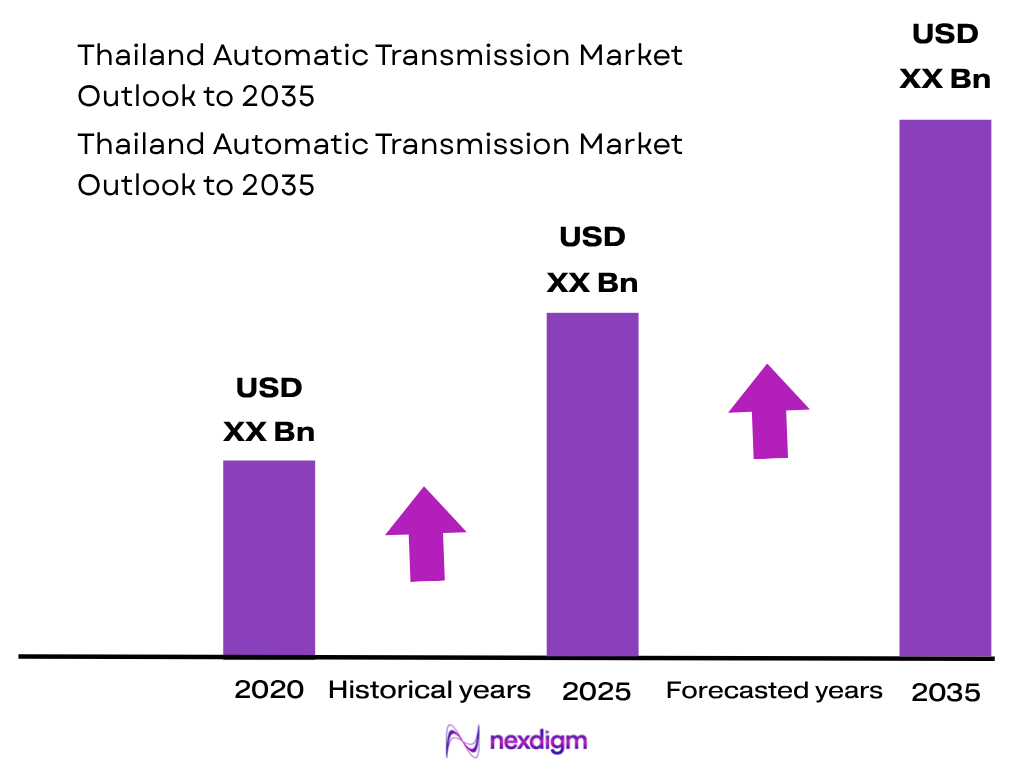
The Thailand Automatic Transmission Market is valued at approximately ~USD XX billion, supported by one of Southeast Asia’s largest automotive manufacturing ecosystems. Passenger-car production reached 519,691 units during January–November, while the corresponding earlier-period output was approximately 598,700 units. Thailand also produced 8,490 battery-electric passenger cars during the latest eleven-month period. Automatic-transmission demand is sustained by locally assembled passenger cars, one-ton pickups, PPVs, hybrids and export-oriented vehicles requiring CVTs, torque-converter automatics and electrified transaxles.
Chonburi, Rayong and Chachoengsao dominate Thailand’s automatic-transmission ecosystem because they form the core Eastern Economic Corridor automotive cluster. Chonburi hosts AISIN’s dedicated automatic-transmission production operation, originally designed for approximately 120,000 transmissions annually, while Rayong contains multiple automotive and commercial-vehicle technology facilities. Thailand exported 688,633 vehicles during January–August in the latest period, illustrating why proximity to Eastern Seaboard manufacturing plants and Laem Chabang logistics infrastructure strengthens these provinces as transmission production, component sourcing and export centres.
Market Segmentation
By Transmission Technology
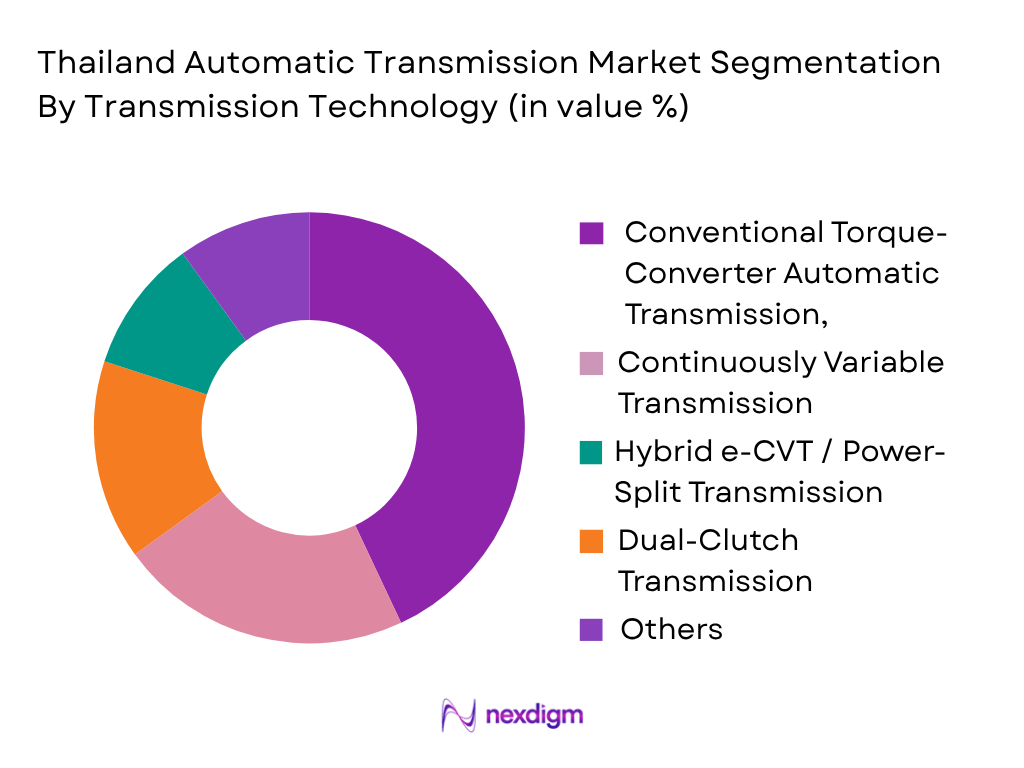
The Thailand Automatic Transmission Market is segmented into conventional torque-converter automatic transmissions, continuously variable transmissions, dual-clutch transmissions, hybrid e-CVT/power-split systems, automated manual transmissions and other electrified architectures. Conventional torque-converter automatic transmissions hold the leading position because Thailand’s automotive industry has historically been centred on one-ton pickups, PPVs, SUVs and conventional passenger vehicles requiring durable multi-speed gearboxes capable of handling higher torque. Domestic production by established Japanese powertrain suppliers further reinforces this architecture. CVTs are prominent across compact Japanese passenger cars, while hybrid e-CVT systems are gaining importance as locally manufactured HEVs increase. During January–November, passenger-car production included substantial monthly HEV volumes, with 18,801 HEVs produced in January, 19,547 in February and 18,583 in March alone. This expanding electrified manufacturing base is gradually changing Thailand’s transmission mix, but the country’s large pickup and conventional vehicle production infrastructure continues to support torque-converter automatics as the principal transmission category.
By Vehicle Type
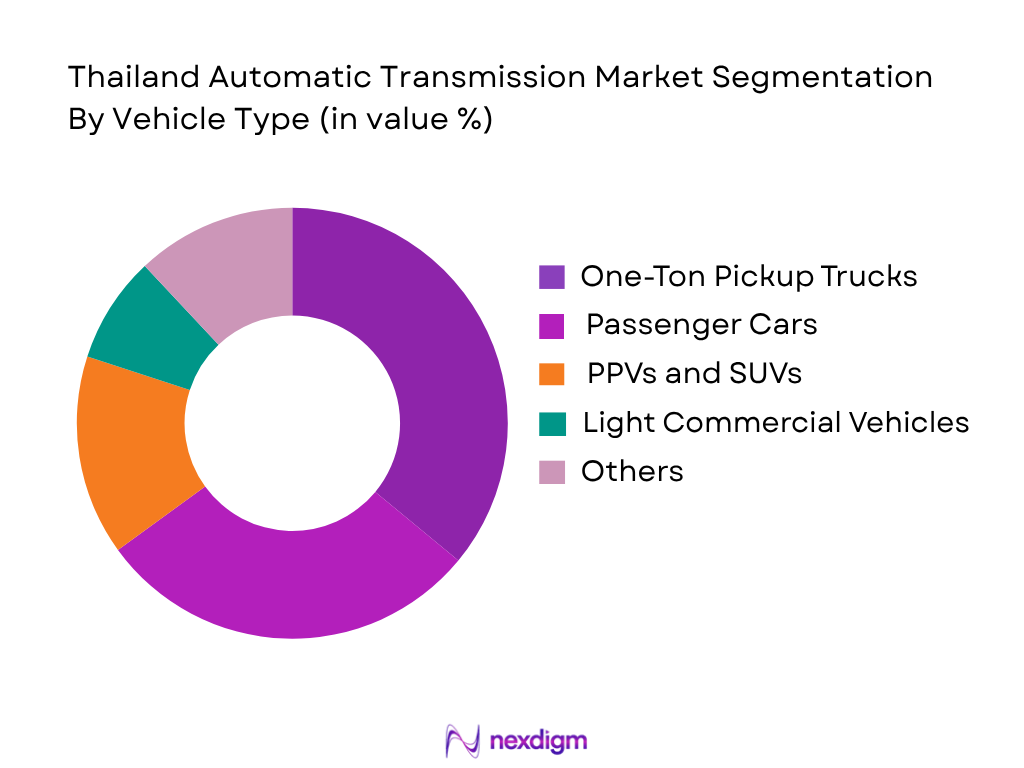
The Thailand Automatic Transmission Market is segmented into one-ton pickups, passenger cars, PPVs and SUVs, light commercial vehicles, medium and heavy commercial vehicles, and other applications. One-ton pickups represent the dominant segment because Thailand has developed a specialized global manufacturing ecosystem around pickup platforms, diesel engines, high-torque drivetrains and export-oriented vehicle assembly. Automatic transmissions used in these vehicles require higher torque capacity, robust cooling systems and calibrated shift strategies suitable for payload, towing and mixed road conditions. Passenger cars form the second major demand pool and provide greater exposure to CVTs, hybrid e-CVTs and increasingly sophisticated multi-speed automatics. Thailand’s vehicle exports reached 853,221 units during January–October, including 248,680 units shipped to Oceania, 234,808 to Asia and 161,856 to the Middle East. These export markets reinforce domestic production of pickup and passenger-vehicle drivetrain configurations and create transmission demand that extends well beyond Thailand’s domestic new-vehicle sales base.
Competitive Landscape
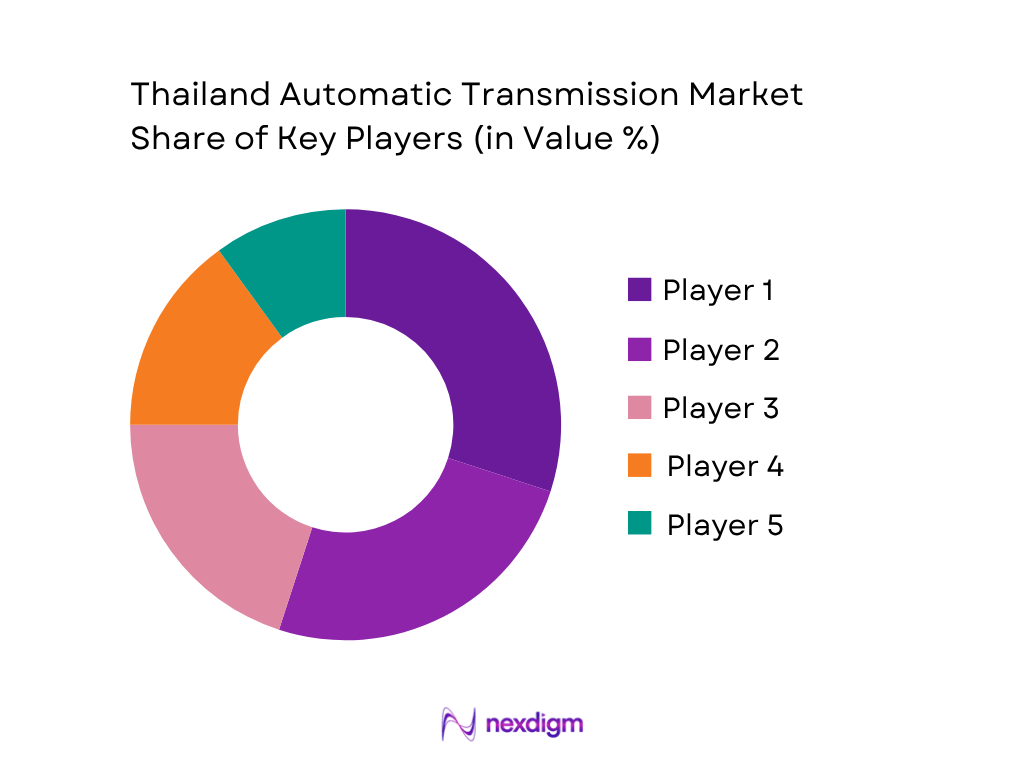
The Thailand Automatic Transmission Market combines specialized global transmission manufacturers with automotive OEMs possessing substantial local vehicle and powertrain operations. AISIN benefits from dedicated automatic-transmission production in Chonburi, while ZF maintains several operations in Bangkok, Rayong and Chonburi. JATCO is closely linked to Japanese CVT technology, BorgWarner participates in advanced drivetrain and electrification technologies, and Toyota’s extensive local manufacturing ecosystem generates substantial demand for conventional and hybrid transmissions. Competitive differentiation increasingly depends on localization, pickup torque capability, hybrid readiness, OEM integration and ASEAN export support.
| Major Player | Establishment Year | Headquarters | Core Transmission Capability | Thailand Manufacturing / Supply Position | Pickup & High-Torque Capability | CVT / DCT Capability | Hybrid & Electrified Readiness | ASEAN / Aftermarket Support |
| AISIN Corporation | 1965 | Kariya, Japan | ~ | ~ | ~ | ~ | ~ | ~ |
| JATCO Ltd. | 1999 | Fuji, Japan | ~ | ~ | ~ | ~ | ~ | ~ |
| ZF Friedrichshafen AG | 1915 | Friedrichshafen, Germany | ~ | ~ | ~ | ~ | ~ | ~ |
| BorgWarner Inc. | 1928 | Auburn Hills, USA | ~ | ~ | ~ | ~ | ~ | ~ |
| Toyota Motor Corporation | 1937 | Toyota City, Japan | ~ | ~ | ~ | ~ | ~ |
Thailand Automatic Transmission Market Analysis
Growth Drivers
Large Vehicle Manufacturing and Export Base Supporting Transmission Demand
Thailand’s large vehicle manufacturing and export base is a direct growth driver for automatic transmissions because local assembly creates demand for torque-converter automatics, CVTs, hybrid transaxles, control units, valve bodies and related components. The Thailand Automotive Institute reported 1,469,000 motor vehicles produced in 2024, including 558,000 passenger cars, 894,000 pickups and 17,000 other commercial vehicles. Export-oriented production reached 1,019,000 vehicles, showing that transmission demand is supported by both domestic assembly and overseas vehicle programs. This structure is especially important for high-torque pickup transmissions, where Thailand remains deeply specialized in one-ton pickup manufacturing and associated diesel drivetrains. The Federation of Thai Industries also reported 117,383 vehicles produced in July 2026 and 59,196 domestic vehicle sales in the same month, confirming continuing production activity. The macroeconomic base supports this industrial scale: the IMF recorded Thailand’s 2024 nominal GDP at THB 18,603.0 billion, equivalent to USD 527.1 billion. Together, these manufacturing, export and macroeconomic indicators support sustained OEM demand for automatic-transmission assemblies, components, calibration systems and local technical services. This manufacturing depth also supports demand for transmission testing, software calibration, thermal management, remanufacturing and replacement parts across Thailand’s Eastern automotive corridor nationwide efficiently.
Hybrid Powertrain Localization Expanding e-CVT and Electrified Transmission Requirements
Thailand’s shift toward hybrid powertrains is strengthening automatic-transmission demand because HEVs preserve substantial transmission content while adding electric motors, power-split gearsets, reduction stages, electric oil pumps and sophisticated control electronics. The Thailand Automotive Institute, using Department of Land Transport data, recorded 2024 passenger-car and pickup registrations in which hybrid-electric vehicles represented a large absolute vehicle base within the national registration mix, while 2026 data showed electrified registrations continuing to expand. More importantly for local supply, the Thailand Board of Investment reported in 2026 that seven promoted HEV manufacturing projects carried THB 29.9 billion of investment and seven PHEV projects carried THB 9.429 billion. The same BOI update identified 49 critical EV-component projects with THB 12.5 billion of investment, covering traction motors, battery-management systems and power-control systems that increasingly integrate with hybrid drivetrains. Thailand’s 2024 nominal GDP reached THB 18,603.0 billion, or USD 527.1 billion, according to the IMF. This combination of localized hybrid assembly, component investment and established powertrain manufacturing expands opportunities for e-CVTs, dedicated hybrid transmissions and motor-integrated transaxles. For suppliers, the transition favors localized mechatronics, hybrid control modules, precision gears, bearings and software calibration over mechanical gearbox content.
Market Challenges
Battery-Electric Vehicle Localization Reducing Conventional Multi-Speed Transmission Content
Rapid battery-electric vehicle localization is a structural challenge for Thailand’s conventional automatic-transmission market because BEVs normally replace multi-speed torque-converter, CVT and DCT architectures with simpler reduction gears and integrated electric drive units. The Thailand Board of Investment reported in 2026 that 18 promoted BEV manufacturing projects represented THB 39.5 billion of investment, while 49 critical EV-component projects represented THB 12.5 billion. BOI also stated that promoted BEV manufacturers operating in Thailand employed more than 16,000 Thai workers, confirming that electrified production is becoming an established industrial activity rather than only an import channel. The Thailand Automotive Institute reported that BEV passenger-car and pickup registrations reached a cumulative 355,920 units as of April 2026, based on Department of Land Transport data. This shift can reduce future demand for planetary gearsets, hydraulic valve bodies, torque converters and clutch packs used in conventional automatic transmissions. Thailand nevertheless had a 2024 nominal GDP of THB 18,603.0 billion, equivalent to USD 527.1 billion, according to the IMF, supporting continued vehicle technology investment. Transmission suppliers therefore face pressure to convert machining, gear, bearing and control capabilities toward e-drive systems. The challenge is substitution across Thailand’s base.
Pickup Production Volatility Creating Capacity-Utilization Pressure
Thailand’s automatic-transmission market also faces a utilization challenge from weakness in conventional vehicle production, particularly pickups, which are central to the country’s drivetrain supply chain. The Thailand Automotive Institute reported that total motor-vehicle production fell to 1,469,000 units in 2024, including 894,000 pickups, 558,000 passenger cars and 17,000 other commercial vehicles. Domestic-market assembly accounted for 573,000 vehicles while export-market production accounted for 1,019,000 units, highlighting the industry’s dependence on external demand as well as domestic purchasing conditions. Because pickup transmissions require specialized high-torque gearsets, torque converters, valve bodies and cooling systems, lower pickup output can reduce capacity utilization across transmission plants and component suppliers even when other vehicle categories remain active. The Federation of Thai Industries reported 117,383 vehicles produced in July 2026, showing that production continues but remains sensitive to monthly demand and export conditions. Thailand’s 2024 nominal GDP was THB 18,603.0 billion, or USD 527.1 billion, according to the IMF. This environment makes production planning, supplier utilization and investment recovery more difficult for manufacturers concentrated in conventional pickup and internal-combustion automatic-transmission programs. Export concentration exposes suppliers to demand shifts and OEM sourcing decisions that can alter production schedules.
Market Opportunities
Hybrid Transmission Localization Creating Scope for e-CVT and Integrated Transaxles
Hybrid-transmission localization is a major future opportunity for Thailand because the country already combines vehicle assembly, precision machining, electronics production and a deep Tier-1 supplier network. The Thailand Board of Investment reported in 2026 that seven promoted HEV projects represented THB 29.9 billion of investment and seven PHEV projects represented THB 9.429 billion. It also recorded 49 critical EV-component projects worth THB 12.5 billion, creating an expanding local base for traction motors, power-control systems and related electrified drivetrain components. A separate BOI-supported mild-hybrid project disclosed annual production capacity of 100,000 B-SUVs, demonstrating that automakers are adding intermediate electrification architectures alongside BEVs. These investments create scope for local production of e-CVT transaxles, hybrid gearsets, electric oil pumps, integrated motor-transmission assemblies, sensors and transmission control electronics. Thailand’s established automotive scale reinforces this opportunity: 1,469,000 vehicles were produced in 2024, according to the Thailand Automotive Institute. The IMF recorded 2024 nominal GDP of THB 18,603.0 billion, equivalent to USD 527.1 billion. Current industrial investment therefore provides a credible platform for future hybrid-transmission localization and ASEAN-oriented exports. Local suppliers can also leverage Thailand’s export infrastructure to serve regional hybrid programs more efficiently and competitively.
Electrified Reduction Gears and e-Drive Components Opening a Diversification Path
Thailand has a forward opportunity to reposition conventional transmission manufacturing capabilities toward reduction gears, e-axles and electrified drivetrain components as BEV production expands. The Thailand Board of Investment reported in 2026 that the country had secured 198 promoted EV-related projects with investment exceeding THB 137 billion. This included 18 BEV manufacturing projects worth THB 39.5 billion, 57 battery and energy-storage projects worth THB 33.5 billion, and 49 critical EV-component projects worth THB 12.5 billion. BOI also identified 42 charging and battery-swapping projects with THB 9.788 billion of investment, showing that the broader electrified-mobility ecosystem is developing alongside vehicle production. For transmission suppliers, this creates an adjacent growth pathway because gear cutting, shaft machining, bearings, housings, lubrication systems and electronic control expertise can be adapted to single-speed reducers and integrated electric drive units. The Thailand Automotive Institute reported 1,469,000 vehicles produced in 2024, confirming the scale of the existing automotive manufacturing platform. The IMF recorded Thailand’s 2024 nominal GDP at THB 18,603.0 billion, or USD 527.1 billion. These current investments support future diversification without relying on forecast statistics. Existing plants can preserve relevance by redirecting competencies toward electrified architectures and exports.
Future Outlook
The Thailand Automatic Transmission Market is expected to expand at approximately ~X.X% CAGR during 2026–2035, although its technology composition will change substantially. Conventional torque-converter automatics will remain important in pickup trucks, PPVs and higher-torque applications, while hybrid e-CVTs, integrated hybrid transmissions and electrified drivetrain systems should capture increasing strategic attention. Thailand’s established automotive manufacturing infrastructure gives transmission suppliers an advantage during this transition. Unlike markets dependent almost entirely on vehicle imports, Thailand possesses vehicle assembly, engine manufacturing, transmission manufacturing, precision component production, export logistics and a mature Tier-1 supplier ecosystem. This creates opportunities to localize hybrid transaxles, electric oil pumps, control electronics, gearsets and other powertrain components alongside conventional automatic transmissions.
Hybrid vehicles are particularly relevant to the medium-term outlook because they preserve substantial transmission content while reducing dependence on traditional ICE-only architectures. Passenger-car manufacturing statistics already show significant HEV production. This creates a pathway for transmission suppliers to transition from conventional automatics into power-split systems, motor-integrated transaxles and dedicated hybrid transmissions without abandoning Thailand’s existing machining and drivetrain expertise.
Major Players
- AISIN Corporation / AISIN Powertrain (Thailand) Co., Ltd.
- JATCO Ltd.
- ZF Friedrichshafen AG / ZF Thailand
- BorgWarner Inc.
- Schaeffler Manufacturing (Thailand)
- Magna International Inc. / Magna Powertrain
- Valeo Thailand
- Allison Transmission Holdings, Inc.
- Toyota Motor Corporation / Toyota Motor Thailand
- Honda Motor Co., Ltd. / Honda Automobile Thailand
- Isuzu Motors Limited / Isuzu Motors Company Thailand
- Mitsubishi Motors Corporation / Mitsubishi Motors Thailand
- Nissan Motor Co., Ltd. / Nissan Motor Thailand
- Ford Motor Company / Ford Thailand Manufacturing
- SAIC Motor / SAIC Motor-CP Co., Ltd.
Key Target Audience
- Automotive OEMs and Vehicle Manufacturers
- Automatic Transmission and Powertrain System Manufacturers
- Automotive Tier-1 and Transmission Component Suppliers
- Automotive Parts Distributors and Aftermarket Networks
- Pickup, Commercial Vehicle and Fleet Operators
- Automotive Industrial Estate and Manufacturing Investors
- Investments and Venture Capitalist Firms
- Government and Regulatory Bodies (Thailand Board of Investment, Ministry of Industry, Department of Land Transport, Excise Department, Eastern Economic Corridor Office of Thailand, Thai Industrial Standards Institute)
Research Methodology
Step 1: Identification of Key Variables
The initial phase involves creating an ecosystem map for the Thailand Automatic Transmission Market, covering vehicle OEMs, transmission manufacturers, Tier-1 suppliers, component producers, distributors, exporters and aftermarket operators. Key variables include transmission architecture, domestic production, vehicle fitment, pickup exposure, hybrid penetration, localization, export demand, torque requirements and propulsion technology.
Step 2: Market Analysis and Construction
Historical automotive production, domestic sales, exports, passenger-car manufacturing, pickup output and electrified-vehicle production are analyzed to establish the addressable transmission base. A top-down assessment of Thailand’s automotive industry is combined with bottom-up mapping of automatic-transmission fitment by vehicle type, OEM platform, propulsion technology and locally produced vehicle programs.
Step 3: Hypothesis Validation and Expert Consultation
Market hypotheses are validated through structured interactions with transmission suppliers, automotive manufacturers, parts distributors, powertrain specialists, workshops and relevant fleet participants. Validation focuses on automatic-transmission technology mix, OEM sourcing, local-content levels, pickup applications, hybrid adoption, replacement requirements, supplier relationships and the growing role of electronics and software in transmission systems.
Step 4: Research Synthesis and Final Output
The final phase triangulates production statistics, company operating information, government industrial-policy data and automotive supply-chain evidence. Bottom-up estimates are reconciled with Thailand’s total vehicle production and export environment to determine market segmentation, competitive positioning and long-term direction. The analysis incorporates conventional AT, CVT, DCT, hybrid transmission and electrified drivetrain substitution to create a consistent market framework.

- Executive Summary
- Research Methodology (Market Definition and Scope, Thailand Automatic Transmission Taxonomy, Torque-Converter Automatic Transmission Classification, Continuously Variable Transmission Mapping, Dual-Clutch Transmission Mapping, Automated Manual Transmission Assessment, Hybrid e-CVT and Electrified Transmission Classification, Vehicle Fitment Mapping, Pickup and PPV Transmission Assessment, Passenger Vehicle Transmission Mapping, Local Production Assessment, Import and Export Mapping, Localization Assessment, OEM Sourcing Analysis, Aftermarket Replacement Assessment, Market Sizing Framework)

- Definition and Scope
- Thailand Automatic Transmission Industry Evolution and Technology Development
- Automatic Transmission Manufacturing and Assembly Process
- Thailand Automatic Transmission Value Chain Analysis
- Thailand Automatic Transmission Supply Chain Analysis
- Transmission Component, Gearset, Clutch and Mechatronics Ecosystem Analysis
- Thailand Automatic Transmission Localization and Import Dependency Assessment
- OEM Transmission Sourcing and Local Vehicle Assembly Framework

- Growth Drivers (Large Domestic Automotive Manufacturing Base, Strong One-Ton Pickup Production, Established Japanese OEM Manufacturing Ecosystem, Local Automatic Transmission Production, Rising Hybrid Vehicle Production, Increasing CVT and Multi-Speed AT Fitment, Expanding Automotive Parts Localization, Strong ASEAN Vehicle and Component Export Network)
- Market Challenges (Domestic Vehicle Sales Cyclicality, High Exposure to Pickup Production, Increasing Battery-Electric Vehicle Substitution, Imported High-Precision Mechatronic Component Dependency, Complex Transmission Electronics, Pressure on ICE Powertrain Supplier Utilization, OEM Platform Consolidation, Transmission Technician Skill Requirements)
- Market Opportunities (Localized Hybrid Transmissions, High-Torque Pickup Automatic Transmissions, Hybrid e-CVT Production, ASEAN Transmission Exports, DCT and Hybrid Mechatronics, Transmission Control Electronics, Remanufactured Automatic Transmissions, EV Reduction Gear and e-Axle Diversification)
- Market Trends (Hybrid Powertrain Localization, Higher-Speed Torque-Converter Transmission Adoption, CVT Penetration in Passenger Cars, Hybrid e-CVT Expansion, Pickup Automatic Transmission Upgrading, Shift-by-Wire Technology, Transmission Software Integration, Localized Electrified Drivetrain Components)
- Regulatory and Policy Landscape (Thailand Board of Investment Automotive Incentives, EV 3.5 Measures, National EV Policy Framework, Thailand Industrial Standards Requirements, Automotive and Tire Testing Research and Innovation Center Requirements, Excise Tax Framework, Local Production Requirements, Automotive Parts Localization Requirements)
- SWOT Analysis
- Porter’s Five Forces Analysis
- PESTLE Analysis
- Stakeholder Ecosystem
- Competition Ecosystem

- By Market Value (2020-2025)
- By Automatic Transmission Unit Demand (2020-2025)
- By Domestic Automatic Transmission Production Volume (2020-2025)
- By OEM-Fitted Automatic Transmission Volume (2020-2025)
- By Imported Automatic Transmission Volume (2020-2025)
- By Exported Automatic Transmission Volume (2020-2025)
- By Replacement Automatic Transmission Volume (2020-2025)
- By Pickup and PPV Automatic Transmission Demand (2020-2025)
- By Hybrid Transmission and e-CVT Demand (2020-2025)

- By Transmission Technology (In Value %)
Conventional Torque-Converter Automatic Transmission
Continuously Variable Transmission
Dual-Clutch Transmission
Automated Manual Transmission
Hybrid e-CVT / Power-Split Transmission
Dedicated Hybrid Transmission
Integrated Hybrid Automatic Transmission
Pickup and High-Torque Automatic Transmission
Commercial Vehicle Fully Automatic Transmission
Commercial Vehicle Automated Transmission
Single-Speed Electrified Reduction Transmission
Other Advanced Transmission Architectures - By Number of Forward Speeds (In Value %)
4-Speed and Below Automatic Transmission
5-Speed Automatic Transmission
6-Speed Automatic Transmission
7-Speed Dual-Clutch Transmission
8-Speed Automatic Transmission
9-Speed Automatic Transmission
10-Speed Automatic Transmission
Above 10-Speed and Multi-Ratio Systems
Continuously Variable Ratio Systems
Hybrid Power-Split Systems - By Vehicle Type (In Value %)
Subcompact Passenger Cars
Compact Passenger Cars
Mid-Size Sedans
Crossovers
Compact SUVs
Mid-Size SUVs
Pickup Passenger Vehicles / PPVs
One-Ton Pickup Trucks
Double-Cab Pickup Trucks
Premium and Luxury Vehicles
MPVs
Light Commercial Vehicles
Medium-Duty Trucks
Heavy-Duty Trucks
Buses and Coaches - By Propulsion Type (In Value %)
Gasoline Internal Combustion Vehicles
Diesel Internal Combustion Vehicles
Hybrid Electric Vehicles
Plug-In Hybrid Electric Vehicles
Mild-Hybrid Vehicles
Battery Electric Vehicles with Reduction Drives
Alternative-Fuel Commercial Vehicles
Other Electrified Powertrains - By Sales Channel (In Value %)
OEM Vehicle Fitment
Tier-1 Direct OEM Supply
Authorized Transmission Distributor Channel
Authorized Vehicle Dealer Service Centres
Independent Automotive Parts Distributors
Transmission Specialist Workshops
Independent Automotive Workshops
Transmission Rebuilders and Remanufacturers
Commercial Fleet Maintenance Operators
Automotive Parts Wholesale Networks
Online Automotive Parts Platforms
Export and ASEAN Distribution Channels - By Region (In Value %)
Bangkok Metropolitan Region
Chonburi
Rayong
Chachoengsao
Ayutthaya
Prachinburi
Samut Prakan
Pathum Thani
Eastern Economic Corridor
Central Thailand
Northern Thailand
Northeastern Thailand
Southern Thailand

- Market Share of Major Players (By Revenue, Transmission Unit Volume, Transmission Technology, Vehicle Segment, Domestic Production, OEM Fitment, Export Supply, Aftermarket Presence)
- Cross Comparison Parameters (Automatic Transmission Architecture and Gear-Speed Portfolio, Thailand Manufacturing and Localization Footprint, Pickup-PPV and High-Torque Transmission Capability, Passenger Vehicle CVT and Multi-Speed AT Coverage, Hybrid e-CVT and Electrified Transmission Readiness, Eastern Economic Corridor Supply and Engineering Footprint, OEM Fitment and ASEAN Export Coverage, Mechatronics-Aftermarket and Technical Support Capability)
- SWOT Analysis of Major Players
- Competitive Positioning Matrix
- Transmission Architecture and Product Portfolio Benchmarking
- Local Manufacturing and Distribution Network Benchmarking
- Market Entry Strategy Assessment
- Detailed Profiles of Major Companies
AISIN Corporation / AISIN Powertrain (Thailand) Co., Ltd.
JATCO Ltd.
ZF Friedrichshafen AG / ZF Thailand
BorgWarner Inc.
Schaeffler Manufacturing (Thailand)
Magna International Inc. / Magna Powertrain
Valeo Thailand
Allison Transmission Holdings, Inc.
Toyota Motor Corporation / Toyota Motor Thailand
Honda Motor Co., Ltd. / Honda Automobile Thailand
Isuzu Motors Limited / Isuzu Motors Company Thailand
Mitsubishi Motors Corporation / Mitsubishi Motors Thailand
Nissan Motor Co., Ltd. / Nissan Motor Thailand
Ford Motor Company / Ford Thailand Manufacturing
SAIC Motor / SAIC Motor-CP Co., Ltd.

- Buyer Segmentation
- OEM and Tier-1 Procurement Behaviour
- Transmission Supplier Selection Criteria
- Buyer Pain Points
- Hybrid Transmission Adoption Assessment
- Aftermarket Replacement Behaviour

- By Market Value (2026-2035)
- By Automatic Transmission Unit Demand (2026-2035)
- By Domestic Automatic Transmission Production Volume (2026-2035)
- By OEM-Fitted Automatic Transmission Volume (2026-2035)
- By Imported Automatic Transmission Volume (2026-2035)
- By Exported Automatic Transmission Volume (2026-2035)
- By Replacement Automatic Transmission Volume (2026-2035)
- By Pickup and PPV Automatic Transmission Demand (2026-2035)
- By Hybrid Transmission and e-CVT Demand (2026-2035)


 Request a Sample
 Ask for Customization
 Get a Quote
 Enquire Now