

 Download PDF
Market Overview
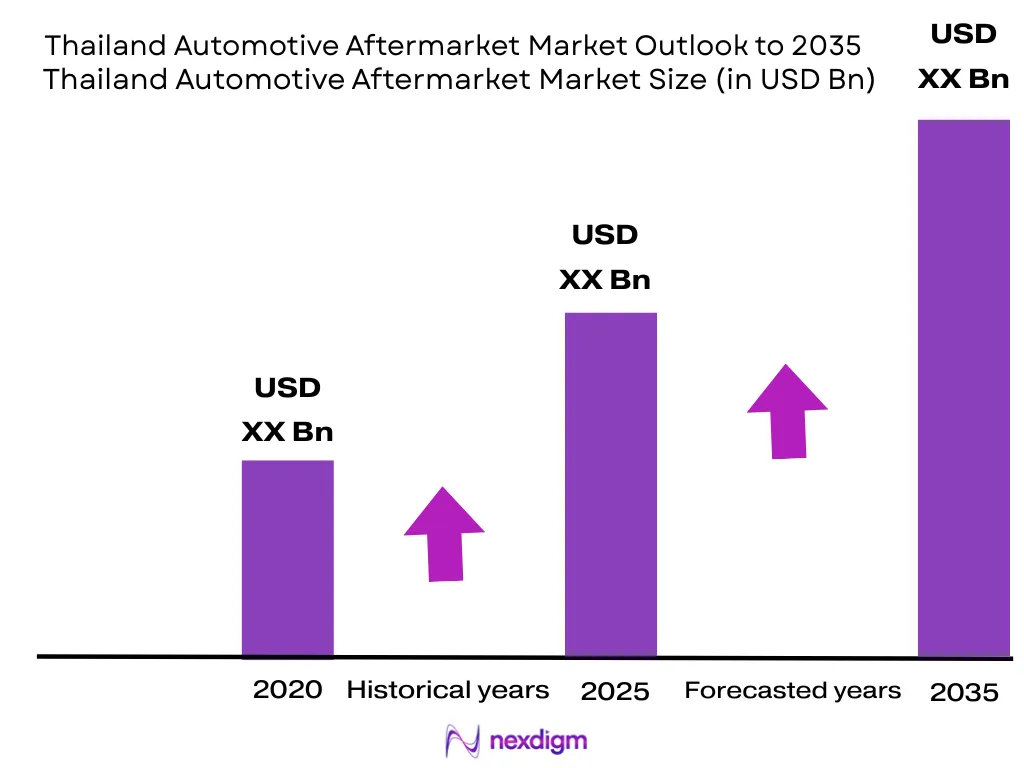
The Thailand Automotive Aftermarket Market is valued at approximately ~ billion, compared with ~ billion in the preceding reporting period. Demand is supported by a registered vehicle parc exceeding 44 million vehicles, including more than 22 million motorcycles, alongside domestic vehicle production of approximately 1.47 million units, compared with about 1.84 million units previously. The large installed base sustains replacement demand despite weaker new-vehicle production and sales.
Bangkok, the surrounding metropolitan provinces and Thailand’s Eastern Economic Corridor dominate aftermarket activity because they concentrate vehicle registrations, workshop chains, parts warehouses, automotive factories and logistics operations. Chonburi, Rayong and Chachoengsao benefit from major vehicle and component manufacturing clusters, while Bangkok provides the country’s largest concentration of private cars, taxis, delivery vehicles and service centers. Provincial markets remain important because motorcycles and pickup trucks are extensively used for commuting, agriculture, trade and goods transportation.
The Thailand Automotive Aftermarket Market includes replacement parts, scheduled maintenance, mechanical repairs, tires, batteries, lubricants, electrical services, collision repair, accessories, pickup-truck modifications and motorcycle servicing. Its participants include authorized dealerships, independent garages, fast-fit chains, parts manufacturers, wholesale distributors, tire networks, digital marketplaces, fleet operators and roadside-service providers.
Market Segmentation
By Aftermarket Offering
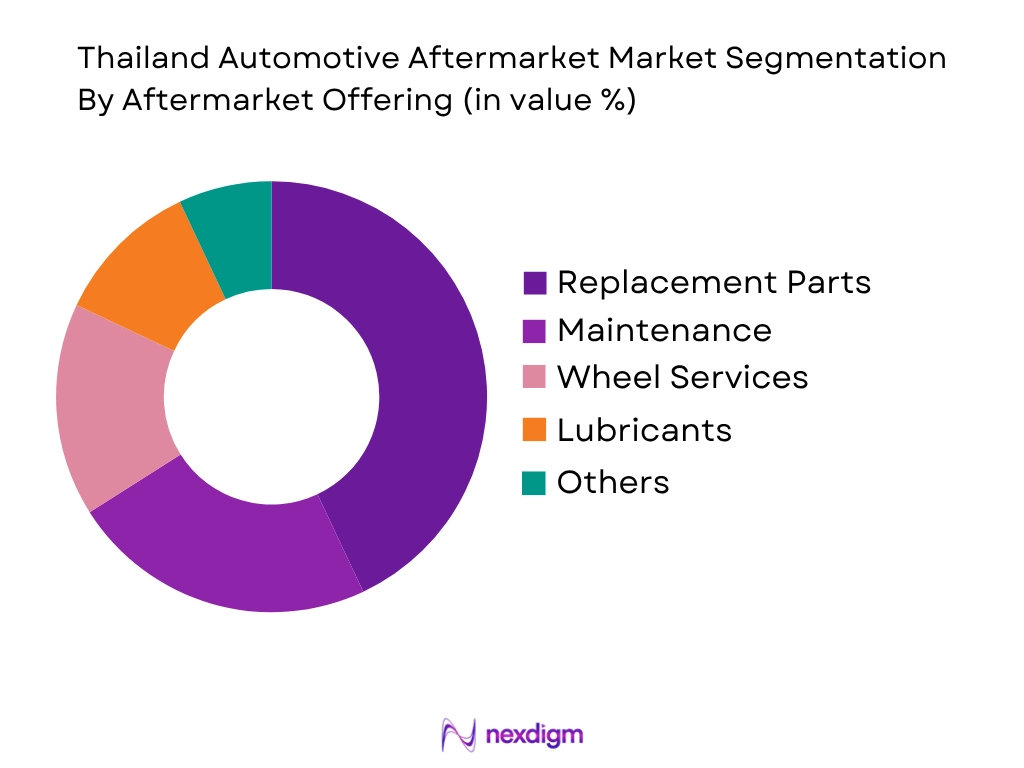
The Thailand Automotive Aftermarket Market is segmented into replacement parts, maintenance and mechanical repair, tires and wheel services, lubricants and fluids, batteries and electrical services, collision repair, accessories and modifications, and car-care services. Replacement parts hold the dominant market share because nearly every workshop transaction requires a component, consumable or wear item.
Thailand’s extensive vehicle parc generates repeat demand for filters, brake pads, brake shoes, spark plugs, suspension parts, belts, hoses, batteries and cooling components. The country’s large population of aging passenger cars, diesel pickup trucks and motorcycles further increases component-replacement frequency. Replacement-parts demand is also supported by several price and quality tiers, including genuine, original-equipment-supplier, premium aftermarket, economy, private-label, remanufactured and used products. This range allows workshops and motorists to select parts according to vehicle age, usage pattern and available budget. Domestic parts manufacturing improves product availability, while Bangkok-based distributors support provincial workshops through wholesale and courier-based fulfilment.
By Vehicle Type
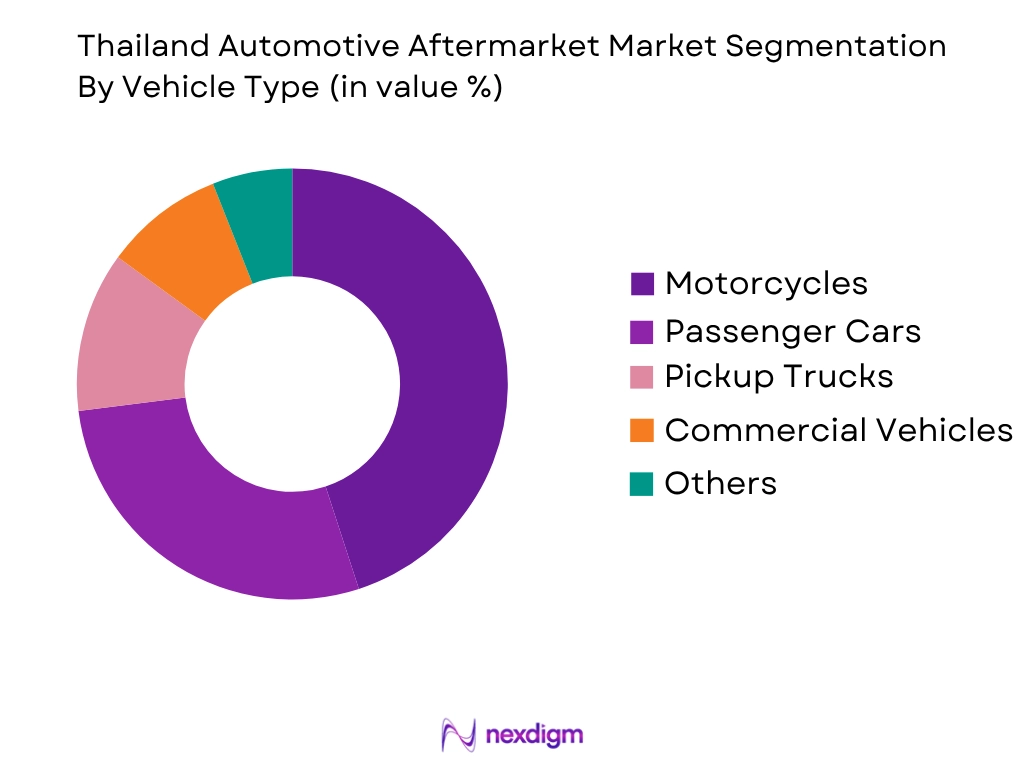
The Thailand Automotive Aftermarket Market is segmented into passenger cars, pickup trucks, motorcycles and scooters, light commercial vehicles, heavy commercial vehicles, buses and other specialized vehicles. Motorcycles and scooters hold the dominant market share by service volume, supported by Thailand’s installed base of more than 22 million registered units and their extensive use for daily commuting, commercial delivery and small-business transportation.
Motorcycles require frequent oil changes, tire and tube replacement, brake servicing, batteries, chains, sprockets, spark plugs and engine components. Their high utilization and relatively short service intervals create large transaction volumes, although individual repair orders are generally smaller than those for passenger cars or pickup trucks. Pickup trucks form another strategically important sub-segment because they are used for personal transportation, agriculture, construction, distribution and provincial commerce. Their diesel engines, load-carrying applications and exposure to poor road surfaces generate demand for suspension, tires, brakes, clutches, fuel-system components and cooling systems.
Competitive Landscape
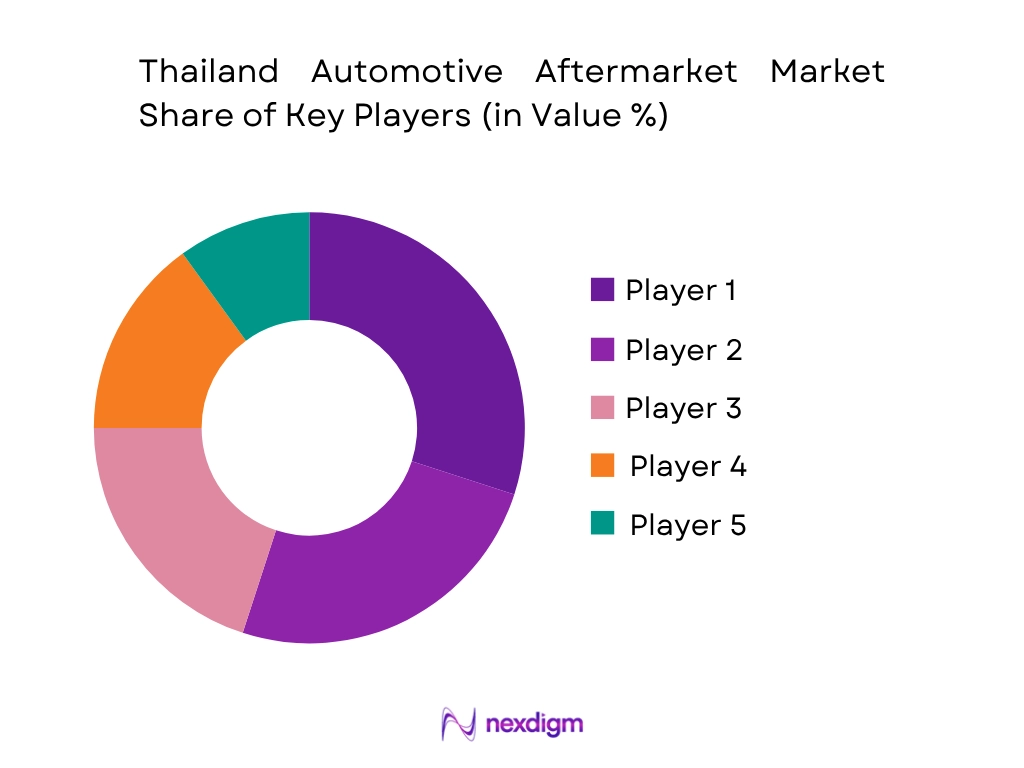
The Thailand Automotive Aftermarket Market is fragmented between national fast-fit chains, tire-led service networks, petroleum-company workshop formats, authorized dealerships and independent garages. B-Quik, Cockpit and FIT Auto are among the most visible organized service brands, while Autobacs and A.C.T Auto Care compete through multi-category maintenance and retail offerings. Their organized networks differentiate through standardized inspections, branded products, national promotions, technician training, branch accessibility and customer-service warranties.
| Company | Establishment Year | Headquarters | Business Model | Core Service Portfolio | Network Position | Vehicle Coverage | Digital Capability | Market-Specific Strength |
| B-Quik | 1996 | Bangkok, Thailand | ~ | ~ | ~ | ~ | ~ | ~ |
| Cockpit | 1990s | Bangkok, Thailand | ~ | ~ | ~ | ~ | ~ | ~ |
| FIT Auto | 2014 | Bangkok, Thailand | ~ | ~ | ~ | ~ | ~ | ~ |
| Autobacs Thailand | 2000s | Bangkok, Thailand | ~ | ~ | ~ | ~ | ~ | ~ |
| A.C.T Auto Care | 1990s | Bangkok, Thailand | ~ | ~ | ~ | ~ | ~ | ~ |
Thailand Automotive Aftermarket Market Analysis
Growth Drivers
Large Aging Vehicle Parc and Intensive Road-Based Mobility
Thailand’s large operating vehicle population is a structural driver of replacement-parts and repair demand. Department of Land Transport records show more than 44 million registered vehicles at the end of 2024, including over 22 million motorcycles and a substantial installed base of passenger cars, one-ton pickup trucks, commercial vehicles and buses. This creates recurring requirements for tires, batteries, lubricants, filters, brake components, suspension parts, cooling systems and electrical repairs. The demand base is resilient because it depends on vehicles already operating rather than solely on new-vehicle sales. Thailand produced approximately 1.47 million vehicles in 2024, exported 999,307 vehicles and recorded domestic sales of 572,675 vehicles. Lower domestic replacement activity can extend vehicle-holding periods, causing owners to repair aging cars and pickup trucks instead of purchasing new vehicles. Pickup trucks and pickup passenger vehicles represented 60.8% of domestic vehicle production, reflecting their central role in agriculture, construction, logistics and provincial commerce. Motorcycles generate an additional high-frequency aftermarket because they are widely used for commuting, food delivery, parcel distribution and household mobility. Their shorter service intervals support repeated demand for engine oil, tires, brake shoes, chains, sprockets, spark plugs and batteries. Thailand’s economy expanded by 2.5% in 2024, while transportation and storage activity grew by 9.0% during the first nine months, supporting greater utilization of delivery vans, motorcycles, trucks and commercial fleets. The IMF reported national economic growth of 2.1% in 2025 and projected 1.6% in 2026, indicating slower but continuing economic activity. Even under moderate growth, the scale of Thailand’s existing vehicle parc sustains workshop traffic because preventive servicing, safety repairs and wear-component replacement cannot be deferred indefinitely. The opportunity extends from organized fast-fit chains in Bangkok to independent motorcycle and pickup-truck garages in provincial and rural markets.
Domestic Automotive Manufacturing and Component-Supply Ecosystem
Thailand’s established automotive manufacturing base supports aftermarket development through domestic component availability, technical capability and nationwide distribution relationships. The country maintained annual vehicle-production capacity of approximately 3 million units and manufactured about 1.47 million vehicles in 2024. Production included passenger cars, pickup trucks, pickup passenger vehicles, vans, buses and trucks, creating a broad local supplier ecosystem for tires, braking products, electrical components, suspension systems, rubber products, plastics, filters, batteries and engine-related parts. Thailand exported 999,307 completed vehicles, demonstrating the scale and international integration of its automotive industrial base. Although export production serves original-equipment customers, many suppliers possess tooling, quality systems and manufacturing knowledge that can also support replacement products, private-label parts and remanufactured components. The domestic production mix is particularly relevant to aftermarket demand because pickup trucks and pickup passenger vehicles accounted for 60.8% of output, while passenger cars represented 35.6%. Local suppliers and distributors therefore have extensive experience supporting diesel powertrains, load-bearing suspension systems, commercial tires, brake components and cooling systems required by Thailand’s high-utilization pickup parc. Broader logistics activity reinforces the distribution opportunity. Thailand’s logistics costs totaled approximately THB 2,509.4 billion in 2024, reflecting the scale of freight transportation, inventory management and warehousing across the economy. A mature logistics network enables automotive parts to move from manufacturing clusters and Bangkok warehouses to provincial wholesalers and workshops. Macroeconomic conditions also support continued industrial activity: Thailand’s fourth-quarter economy expanded by 3.2% in 2024, while the manufacturing sector returned to growth of 0.4% in 2025 after contracting in the preceding period. For aftermarket businesses, this industrial ecosystem reduces reliance on fully imported finished components, enables shorter procurement cycles and supports product adaptation for locally assembled Japanese and increasingly Chinese vehicle platforms. It also creates opportunities for manufacturers to diversify beyond OEM contracts into branded replacement parts, workshop-direct distribution and regional exports.
Market Challenges
Increasing Vehicle Technology Complexity and Uneven EV-Service Readiness
Thailand’s accelerating transition toward electric, hybrid and electronically complex vehicles creates a capability challenge for conventional workshops. At the end of 2024, accumulated electrified-vehicle registrations exceeded 760,000 units, comprising 469,543 hybrid electric vehicles, 63,184 plug-in hybrid vehicles and 227,490 battery electric vehicles. New battery-electric registrations reached 96,891 units during the same period. This rapidly expanding installed base requires different diagnostic tools, safety procedures and replacement-part inventories from those used for conventional gasoline and diesel vehicles. Workshops must develop capability in high-voltage isolation, battery-health assessment, thermal-management systems, electric compressors, power electronics, onboard chargers, low-voltage systems and regenerative braking. Collision repairers must also identify battery locations and isolate high-voltage circuits before welding, structural repair or paint-curing work. The technical challenge extends beyond electric vehicles because new internal-combustion and hybrid models increasingly incorporate cameras, radar, electronic steering, networked control modules and advanced driver-assistance systems. Windshield replacement, bumper repair, wheel alignment and suspension work may require sensor calibration and software procedures after the mechanical task is completed. Thailand’s investment pipeline will increase the diversity of vehicles requiring support. Approved projects include 21 battery-electric vehicle production projects with combined capacity of 386,000 units annually, 16 electric-motorcycle projects with capacity of 810,000 units, and 42 projects producing traction motors, battery-management systems, drive-control units and onboard chargers. The charging ecosystem includes 29 approved projects intended to install 20,080 charging stations, including 7,360 direct-current chargers. These investments strengthen the industry but place pressure on independent garages that lack manufacturer-level diagnostic access and trained technicians. Thailand’s economy grew by 2.5% in 2024, but credit constraints and slower growth of 2.1% in 2025 may limit smaller workshops’ ability to acquire advanced equipment. Without coordinated training and shared diagnostic infrastructure, sophisticated repair work may remain concentrated among authorized dealerships and a limited number of organized specialists.
Fragmented Workshop Base and Shortage of Advanced Automotive Skills
Thailand’s fragmented repair ecosystem creates inconsistent service quality and makes nationwide technical upgrading difficult. The market includes authorized dealership workshops, organized fast-fit chains, independent passenger-car garages, pickup specialists, motorcycle repair shops, tire outlets, electrical workshops and informal provincial operators. This breadth supports customer access, but many smaller businesses depend on general mechanical experience rather than standardized diagnostic procedures, documented inspections or formal high-voltage certification. The skills requirement is becoming more complex as Thailand simultaneously supports a legacy parc of gasoline motorcycles and diesel pickup trucks while adding hybrid and battery-electric vehicles. More than 44 million registered vehicles must be maintained, including over 22 million motorcycles, creating substantial labor demand across routine servicing, engine repair, transmission work, electrical diagnosis and collision restoration. The emerging electrified fleet adds at least 760,000 registered xEVs, requiring knowledge of battery systems, cooling circuits, software diagnostics and electrical safety. Government-approved manufacturing capacity includes 810,000 electric motorcycles annually, 386,000 battery-electric passenger vehicles and 4,800 electric buses and trucks, indicating that technical diversity will continue to increase. Thailand also produced 1.47 million vehicles in 2024, meaning workshop technicians must support a wide range of domestically assembled and imported models. The country’s macroeconomic conditions make workforce investment more difficult for small operators. The IMF estimated growth of 2.1% in 2025 and 1.6% in 2026, while constrained credit growth and tight financial conditions affected domestic activity. Under these conditions, independent workshops may postpone investment in scan tools, calibration frames, insulated equipment and technician training. Rural and secondary-city garages face additional constraints because specialist trainers, diagnostic subscriptions and replacement electronic modules are concentrated around Bangkok and major industrial provinces. The result may be longer repair times, outsourcing of complex jobs and uneven customer confidence. Organized workshop networks can partially address the problem through centralized technical support, shared training centers, standard operating procedures and remote diagnostics, but the broader market requires scalable certification programs covering ADAS, EV safety, automotive electronics and digital fault analysis.
Market Opportunities
EV Diagnostics, Battery Services and Specialized Electronic Repair
Thailand’s current EV manufacturing and registration base creates a substantial future opportunity for aftermarket providers that establish high-voltage and electronic-repair capability before large numbers of vehicles leave manufacturer warranty. More than 760,000 electrified vehicles were registered at the end of 2024, including 227,490 battery-electric vehicles, 469,543 hybrids and 63,184 plug-in hybrids. The country also registered 96,891 new battery-electric vehicles during the year. These current operating vehicles will progressively require independent support for tires, suspension, low-voltage batteries, air-conditioning, thermal-management systems, electronic modules, charging components and collision repairs. Thailand’s Board of Investment reported cumulative approved EV ecosystem investment of THB 137.7 billion. This included THB 41.08 billion across battery-electric vehicle projects, THB 80.1 billion across 53 battery projects, THB 6.52 billion across 42 key-component projects, and THB 5.56 billion across charging-station projects. This localized supply base can improve future access to battery modules, drive electronics, motors and charging equipment, reducing dependence on complete imported assemblies. The opportunity is not limited to passenger cars. Approved capacity includes 810,000 electric motorcycles, creating demand for battery testing, controller repair, hub-motor service, battery swapping and fleet maintenance for delivery riders. It also includes 4,800 electric buses and trucks, which can support specialist commercial-vehicle workshops. Organized aftermarket businesses can establish dedicated EV bays, mobile battery-health testing, thermal diagnostics, ADAS calibration and electronic service records. Parts distributors can build catalogs for low-voltage components, cooling pumps, sensors, charging ports and collision parts. Current economic indicators justify capability development without relying on future-market projections: Thailand’s economy expanded by 2.5% in 2024, transportation and storage activity grew by 9.0% during the first nine months, and existing vehicle production reached 1.47 million units. Providers that invest early can serve fleet operators, insurers and consumers seeking alternatives to dealership servicing once warranties expire.
Provincial Parts Distribution, Motorcycle Service and Commercial-Fleet Maintenance
Thailand’s provincial vehicle population creates an opportunity to expand organized parts distribution, mobile servicing and standardized workshop formats beyond Bangkok. The country’s more than 44 million registered vehicles are distributed across metropolitan, industrial, agricultural, border and rural provinces. Over 22 million motorcycles provide a particularly broad service base because motorcycles are essential for household mobility, commuting, food delivery, parcel transport and small-business operations. Their frequent requirements for tires, lubricants, chains, sprockets, brake components, spark plugs and batteries allow aftermarket businesses to generate repeat transactions through compact service formats. Pickup trucks provide another provincial growth platform. They accounted for the majority of Thailand’s automotive production mix, with pickup trucks and pickup passenger vehicles representing **60.8% of the 1.47 million vehicles produced in 2024. These vehicles are widely used for farming, construction, retail distribution and interprovincial transport, creating requirements for diesel-engine repair, suspension reinforcement, commercial tires, brakes, clutches and cargo accessories. Thailand’s logistics system supports the need for broader aftermarket coverage. National logistics costs reached approximately THB 2,509.4 billion in 2024, while transportation and storage activity grew by 9.0% during the first nine months. This reflects intensive movement of goods through trucks, vans and motorcycles, where downtime directly affects operator income. Aftermarket businesses can address this demand through provincial warehouse hubs, overnight parts fulfilment, mobile tire and battery vehicles, franchise workshops and fleet-maintenance contracts. Digital B2B catalogs can connect small garages with Bangkok and Eastern Economic Corridor inventories, reducing model-identification errors and improving access to long-tail parts. Existing EV infrastructure investment adds a further opportunity: approved projects cover 555 motorcycle battery-swapping stations, alongside stations for passenger and commercial vehicles. This enables service providers to combine conventional motorcycle maintenance with electric two-wheeler diagnostics and battery support. Thailand’s GDP expansion of 2.5% in 2024 and continued economic activity in 2025 support present commercial demand, while the opportunity arises from organizing and standardizing services already required by the country’s active provincial fleets.
Future Outlook
The Thailand Automotive Aftermarket Market is forecast to expand at approximately % CAGR during the forecast period. Growth will be supported by a large installed vehicle base, continued vehicle aging, high motorcycle dependence and the extensive use of pickup trucks in commercial and provincial applications.
The market will gradually shift from conventional mechanical repair toward a mixed servicing environment covering gasoline, diesel, hybrid and battery-electric vehicles. Fast-fit chains and independent garages will need diagnostic equipment, high-voltage safety processes and access to model-specific repair information.
The decline in domestic new-vehicle production does not eliminate aftermarket demand. Thailand produced approximately 1.47 million vehicles, compared with about 1.84 million units in the preceding reporting period. Lower replacement activity can increase average vehicle holding periods, keeping older cars and pickup trucks on the road and supporting repairs that may otherwise have been avoided through vehicle replacement.
Electric mobility will alter the composition of demand. The government’s EV 3.5 package applies during a four-year period and supports continued domestic EV manufacturing and market development. Thailand has secured investment commitments exceeding THB 137 billion across the electric-vehicle supply chain, including vehicle manufacturing, batteries and supporting components.
This investment will create a larger installed base of Chinese and locally manufactured electric vehicles. Aftermarket opportunities will emerge in tires, suspension, cooling systems, low-voltage batteries, air-conditioning, electronic modules, charging systems and collision repair. However, workshops will require insulated tools, battery isolation areas, trained technicians and reliable access to replacement components.
Major Players
- B-Quik
- Cockpit
- FIT Auto
- Autobacs Thailand
- A.C.T Auto Care
- Bridgestone Sales Thailand
- Siam Motors Parts
- Somboon Advance Technology
- Thai Stanley Electric
- AAPICO Hitech
- DENSO Thailand
- Robert Bosch Automotive Technologies Thailand
- Continental Tyres Thailand
- Goodyear Thailand
- Yokohama Tire Sales Thailand
Key Target Audience
- Automotive parts and component manufacturers
- Automotive parts importers, wholesalers and provincial distributors
- Fast-fit chains, independent workshop networks and franchise operators
- Tire, battery, lubricant and automotive specialty retailers
- Passenger transport, logistics, delivery and commercial-fleet operators
- Automotive e-commerce and workshop-technology providers
- Investments and venture capitalist firms
- Government and regulatory bodies (Department of Land Transport, Thailand Board of Investment, Thai Industrial Standards Institute, Office of Industrial Economics, Excise Department and Pollution Control Department)
Research Methodology
Step 1: Identification of Key Variables
The initial phase develops an ecosystem map covering component manufacturers, vehicle assemblers, parts distributors, workshops, fast-fit chains, motorcycle repairers, fleet operators and digital platforms. Key variables include vehicle parc, vehicle age, propulsion type, annual usage, replacement intervals, repair frequency, workshop throughput and distribution margins.
Step 2: Market Analysis and Construction
Historical vehicle registrations, domestic production, vehicle sales, component output and parts trade are compiled. Top-down analysis assesses total automotive maintenance and parts expenditure, while bottom-up analysis calculates demand using vehicle-category populations, replacement rates, service visits and average repair-order structures.
Step 3: Supply-Side Assessment
Parts manufacturers, importers, distributors, fast-fit chains and independent workshops are evaluated according to revenue, branch network, service bays, SKU breadth, geographic coverage and customer composition. Company-level evidence is used to reconstruct the organized sector and benchmark it against Thailand’s fragmented garage ecosystem.
Step 4: Demand-Side Assessment
Vehicle owners and fleet operators are analyzed by vehicle type, age, location, annual usage, warranty status and service preference. The assessment compares authorized and independent workshop behavior, parts-quality preferences, price sensitivity, motorcycle maintenance patterns and pickup-truck service requirements.

- Executive Summary
- Research Methodology (Market Definitions and Assumptions, Abbreviations, Automotive Aftermarket Boundary, Vehicle Parc–Based Market Modeling, Top-Down Analysis, Bottom-Up Analysis, Demand-Side Assessment, Supply-Side Assessment, Replacement-Rate Modeling, Workshop Throughput Assessment, Parts Production and Trade Analysis, Primary Industry Interviews, Data Triangulation, Forecasting Framework, Limitations and Future Conclusions)a

- Definition and Scope
- Market Evolution and Industry Genesis
- Timeline of Major Industry Developments
- Automotive Aftermarket Business Cycle
- Vehicle Parc and Replacement Demand Ecosystem
- Passenger Car, Pickup Truck and Motorcycle Aftermarket Structure

- Growth Drivers (Aging Vehicle Parc, High Motorcycle Ownership, Pickup Truck Penetration, Domestic Parts Manufacturing, Commercial Fleet Utilization, Used-Vehicle Retention)
- Market Challenges (Household Debt, Technician Shortage, Counterfeit Parts, Model Proliferation, Technology Complexity, Workshop Fragmentation)
- Market Opportunities (EV Servicing, Chinese Vehicle Parts, Motorcycle Services, Fleet Contracts, Digital Procurement, Provincial Expansion)
- Market Trends (Digitalization, Electrification, Workshop Consolidation, Omnichannel Retailing, Private Labels, Parts Traceability)
- Government Regulations (Thai Industrial Standards, Vehicle Inspection, Consumer Protection, Emission Compliance, Workshop Licensing, Environmental Management)
- SWOT Analysis
Porter’s Five Forces Analysis
PESTLE Analysis

- By Market Value (2020-2025)
- By Replacement Parts Revenue (2020-2025)
- By Maintenance and Repair Service Revenue (2020-2025)

- By Aftermarket Offering (In Value %)
Replacement Parts
Scheduled Maintenance Services
Mechanical Repair Services
Tires and Wheel Services
Batteries and Automotive Electrical Services
Lubricants and Fluid Replacement
Collision Repair and Bodywork - By Vehicle Type (In Value %)
Passenger Cars
Subcompact and Eco Cars
Sports Utility Vehicles
One-Ton Pickup Trucks
Pickup Passenger Vehicles
Light Commercial Vehicles
Heavy Commercial Vehicles
Buses and Coaches - By Service Provider Type (In Value %)
Authorized Dealer Workshops
Independent Multi-Brand Workshop Chains
Independent Standalone Garages
Vehicle Brand–Specialist Workshops
Fast-Fit and Quick-Service Centers
Tire and Battery Service Centers
Collision Repair and Body Shops - By Geographic Region (In Value %)
Bangkok Metropolitan Region
Central Thailand
Eastern Thailand
Northern Thailand
Northeastern Thailand
Southern Thailand
Western Thailand

- Market Share of Major Players (By Aftermarket Revenue, Parts Revenue, Service Revenue, Tire Revenue, Distribution Reach)
- Cross Comparison Parameters (Service Center and Workshop Network Coverage, Passenger Car–Pickup–Motorcycle Vehicle Coverage, Tire–Battery–Lubricant–Mechanical Service Portfolio, Automotive SKU Availability and Inventory Fill Rate, Bangkok–Provincial Distribution and Same-Day Fulfilment Capability, OEM–OES–Aftermarket–Private-Label Parts Mix, EV–Hybrid–ADAS Diagnostic and Repair Readiness, Fleet Contract Portfolio and Workshop Throughput)
- SWOT Analysis of Major Players
- Pricing Analysis by SKU and Service Category
- Detailed Profiles of Major Companies
B-Quik
Cockpit
FIT Auto
Autobacs Thailand
A.C.T Auto Care
Bridgestone Sales Thailand
Siam Motors Parts
Somboon Advance Technology
Thai Stanley Electric
AAPICO Hitech
DENSO Thailand
Robert Bosch Automotive Technologies Thailand
Continental Tyres Thailand
Goodyear Thailand
Yokohama Tire Sales Thailand

- Individual Vehicle Owner Demand Analysis
- Passenger Car Owner Maintenance Behaviour
- Eco-Car Owner Demand Analysis
- SUV Owner Demand Analysis
- Pickup Truck Owner Analysis

- By Market Value (2026-2035)
- By Replacement Parts Revenue (2026-2035)
- By Maintenance and Repair Service Revenue (2026-2035)


 Request a Sample
 Ask for Customization
 Get a Quote
 Enquire Now